+971-8000321216



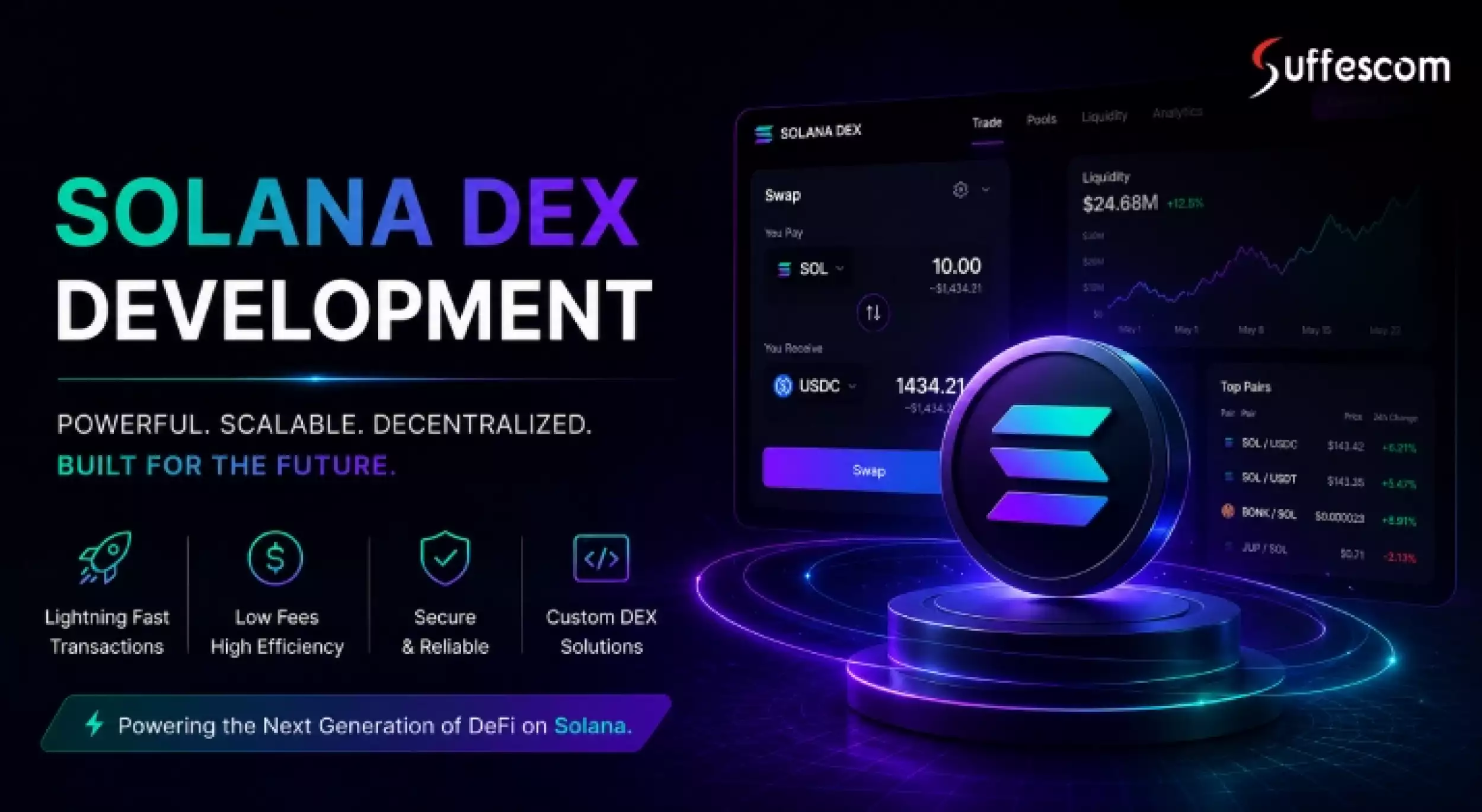
A Solana DEX is a decentralized exchange (DEX) built on the Solana blockchain, letting users trade crypto assets peer to peer without a central authority holding funds or matching orders. Solana DEXs run on Solana's Sealevel parallel processing engine, which lets the network confirm trades in roughly 400 milliseconds and handle upward of 65,000 transactions per second (TPS), with transaction fees typically around $0.00025. That combination of speed and cost is why Solana has become one of the primary chains for new DEX builds, alongside Ethereum and BNB Smart Chain (BSC).
Quick answer, if you are scoping a build:
Architecture choice: An Automated Market Maker (AMM) for token swaps and simple liquidity, or an order book model for professional trading and perpetuals. Most new builds start AMM and add order book depth later.
Core stack: Rust for smart contracts, the Anchor framework for secure contract development, Solana Web3.js for frontend integration.
Infrastructure requirement: A low-latency, dedicated RPC (Remote Procedure Call) endpoint, since public RPC nodes throttle under trading volume.
Liquidity requirement: Aggregator compatibility with routers like Jupiter, so your pools are discoverable to the volume that already exists on Solana.
Timeline: 3 to 6 months for an AMM-based DEX, 6 to 12 months for order book or cross-chain builds.
Which Solana DEX Are You Actually Building?
Build an AMM if: Your users want simple token swaps, your initial liquidity is thin, and you want to launch fast. AMMs price assets using a mathematical formula against pooled liquidity (an approach popularized by platforms like Raydium), so you don't need deep order books to function on day one.
Build an order book (or perpetuals) model if: You're targeting active traders or institutional flow that expects limit orders, tighter spreads, and visible market depth. This is a heavier build, closer to 6 to 12 months, and it depends on either integrating an existing on-chain order book program or building matching logic from scratch.
Our position: Unless you already have a committed market-making partner or institutional user base lined up before launch, start with an AMM. Order book liquidity is hard to bootstrap without volume, and volume doesn't show up without liquidity. Most Solana DEXs that survive their first year launched AMM-first and added order book or perpetuals functionality once they had trading volume to support it.
Looking For A Solana DEX Development Company?
Enjoy seamless trading, gain the massive attention of investors, and remain competitive in this ever-evolving landscape. Join the revolution and expand the market reach with our customer base.
How a Solana DEX Works
Wallet connection: users connect a Solana-compatible wallet (Phantom, Solflare, or Backpack) directly to the interface. No account creation, no custodian holding funds.
Smart contract execution: Trades run through on-chain programs (Solana's term for smart contracts) written in Rust, typically using the Anchor framework. These programs enforce the trade logic automatically, so a swap either executes exactly as coded or fails outright.
Liquidity model: AMMs pull from liquidity pools, where users deposit paired assets and earn a share of trading fees. Order book models match buy and sell orders directly, either through an on-chain program like OpenBook or through a hybrid off-chain matching engine that settles on-chain.
Settlement: Solana's Proof of History (PoH) timestamps transactions before they're submitted for consensus, which is what lets the network confirm trades in around 400 milliseconds instead of waiting for full block finality like most other chains.
Why Businesses Choose Solana for DEX Development
High Throughput
Solana processes over 65,000 TPS through parallel transaction processing (Sealevel), letting many trades execute simultaneously instead of one at a time.
Low Transaction Costs
Fees average $0.00025 per transaction, which matters most for high-frequency traders and liquidity providers rebalancing positions often.
Fast Finality
Trades settle in about 400 milliseconds, reducing the window where a price can move against a user between order submission and execution.
Rust-based Smart Contracts
Rust is a memory-safe systems language, which reduces a category of bugs (memory leaks, buffer overflows) that have caused exploits on other chains' contract languages.
Mature Ecosystem Tooling
Libraries and frameworks for order matching, liquidity pooling, and cross-chain bridging already exist on Solana, so a build doesn't start from zero the way it might on a newer chain.
Solana vs. other chains, by the numbers:
| Feature | Solana | Ethereum | BSC | Avalanche |
| TPS | 65,000+ | 15–30 | ~300 | ~4,500 |
| Transaction cost | ~$0.00025 | $2–$50+ | ~$0.30 | ~$0.75 |
| Time to finality | ~400ms | ~6 min | ~3 sec | ~2 sec |
| Smart contract language | Rust | Solidity | Solidity | Solidity |
If you're weighing a full Decentralized Exchange Development Company partner across multiple chains rather than committing to Solana specifically, that comparison is worth having before locking in an architecture, since the chain choice determines your entire tech stack.
What a Production-Ready Solana DEX Actually Needs
Low-latency Rpc Infrastructure
Public Solana RPC endpoints throttle and lag under load. Production DEXs run dedicated, low-latency RPC connections (services like Yellowstone gRPC are a common choice) to keep state synced and avoid downtime during high-traffic periods.
Transaction Bundling and Atomicity
Popular pools face state contention when many trades hit the same liquidity pool in the same block. Handling this requires transaction bundling and atomic execution logic, so a batch of trades either all succeed together or fail together, rather than partially executing and leaving the pool in an inconsistent state.
Aggregator Compatibility
A new Solana DEX with no aggregator visibility struggles to attract volume, no matter how good its execution is. Formatting your program instructions cleanly so routers like Jupiter can index and route volume to your pools is one of the highest-leverage things a new DEX can get right at launch, since aggregators already carry the bulk of Solana's retail trading volume.
Step-by-Step: How to Build a Solana DEX
Building a Solana DEX requires careful planning, technical expertise, and a focus on security. Here’s a step-by-step guide:
Step 1. Define Project Scope
Decide on AMM vs. order book (see above), cross-chain support, and target user (retail swappers vs. active traders). This decision drives your entire timeline and budget.
Step 2. Assemble a Development Team
You need Rust developers comfortable with the Anchor framework, plus security-focused engineers, not just general blockchain developers. Solana's programming model (accounts, program derived addresses) differs enough from Ethereum's that Solidity experience doesn't transfer directly.
Step 3. Choose the Tech Stack
Rust and TypeScript for development, Solana Web3.js and JSON-RPC API for integration, Anchor and the Solana Program Library (SPL) for contract tooling, Pyth Network or Chainlink for price oracles.
Step 4. Develop Smart Contracts
Write contracts for swaps, liquidity pools, and governance using Anchor. Test on Solana's Devnet using the Solana CLI (command-line interface) before any Mainnet deployment.
Step 5. Integrate Liquidity Models
Build an AMM (similar in approach to Raydium) or integrate an order book program like OpenBook, depending on your Step 1 decision.
Step 6. Build the Frontend
React or Next.js for the interface, with wallet adapters for Phantom and Solflare, real-time price charts, and transaction history.
Step 7. Set Up RPC and Infrastructure
Configure dedicated low-latency RPC endpoints and transaction bundling logic before launch, not after volume arrives.
Step 8. Perform Security Audits
Multiple audit rounds, from firms with Solana-specific experience such as Certik, OtterSec, or Quantstamp. A single audit round is not sufficient for a platform holding user funds.
Step 9. Test and Deploy
Simulate high-volume trading scenarios on Devnet before going live, and resolve performance issues before Mainnet exposes them to real capital.
Step 10. Provide Post-Launch Support
Bug fixes, feature upgrades, and monitoring for the failure modes covered in the next section.
Key Features of a Production Solana DEX
Token Swapping
Direct exchange between assets within the Solana ecosystem, executed through the AMM or order book layer.
Cross-chain Compatibility
Bridge protocols (Wormhole, Allbridge) let assets from Ethereum, BSC, and other chains trade on your Solana DEX, widening the asset pool beyond native Solana tokens.
Real-time Price Discovery
Aggregating data across multiple pools and DEXs to show accurate pricing and liquidity depth to users making a trade decision.
Smart Order Routing
Automatically finding the best execution path across available liquidity sources, factoring in price and speed.
Two-factor Authentication and Wallet Security
Verification layers beyond wallet connection alone, particularly relevant for platforms adding custodial or semi-custodial features.
On-chain Analytics
Trading volume, token performance, and user behavior data, useful both for platform operators and for traders making informed decisions.
Popular Solana DEX Platforms
| Platform | Model | Best suited for |
| Jupiter | Aggregator | Best for routing and liquidity discovery across all Solana DEXs |
| Raydium | AMM | Best for straightforward token swaps with deep existing liquidity |
| Orca | AMM (concentrated liquidity) | Best for yield farming and capital-efficient liquidity provision |
| Saber | AMM (stablecoin-focused) | Best for stablecoin and pegged-asset swaps with minimal slippage |
| Lifinity | AMM (proactive market maker) | Best for reducing impermanent loss on volatile pairs |
If your build is closer to a custom token launch than a full exchange, create your own Solana token covers that path separately and links back to this build guide where the two overlap.
When Building a Solana DEX Doesn't Make Sense
Being direct here, since most vendor content skips this: a Solana DEX is not the right build for every project.
If you don't have a liquidity or market-making plan before launch, an AMM with no volume is just an empty pool. Aggregator compatibility helps, but it doesn't substitute for an actual liquidity strategy.
If your target users need regulated, custodial trading, a DEX's non-custodial model works against you. That's a centralized exchange (CEX) build instead.
If you don't have budget for ongoing security audits, don't launch. A single audit at launch is not sufficient for a platform holding user funds long-term; smart contract exploits remain the single largest cause of DEX fund loss industry-wide.
Regulatory position is not settled. DEXs operate in a genuinely unresolved regulatory space in most jurisdictions. If you plan to serve institutional users or specific regulated markets, build KYC/AML (Know Your Customer / Anti-Money Laundering) considerations into your roadmap from the start, and involve legal counsel with crypto-specific experience before launch, not after.
Common Failure Modes and How Production Teams Handle Them
| Risk | What causes it | How it's typically handled |
| Network congestion during peaks | High trading volume overwhelms a single RPC connection | Multiple RPC endpoints, load balancing |
| RPC timeouts | Public or under-provisioned RPC nodes | Dedicated low-latency RPC (Yellowstone gRPC or similar) |
| Smart contract exploits | Insufficient audit coverage or unaudited upgrades | Multiple audit rounds, real-time monitoring, staged rollouts |
| Impermanent loss for liquidity providers | AMM pricing formula reacting to volatile pairs | Concentrated liquidity models, proactive market maker designs |
| Bridge vulnerabilities | Cross-chain bridge contracts as an attack surface | Limiting bridge exposure, using audited bridge protocols only |
Tech Stack for Solana DEX Development
Our Solana-powered decentralized exchange platform uses cutting-edge tools and technologies to deliver highly scalable, performance-driven solutions tailored to business needs.
| Aspects | Tech Stacks |
| Programming languages | Rust, C++, TypeScript |
| Database Management | Solana Ledger Database, PostgreSQL, MongoDB, |
| API Integration | Solana JSON-RPC API, Solana Web3.js |
| Smart Contract tools | Solana Program Library (SPL), Sealevel, Anchor Framework |
| DevOps | Kubernetes, Jenkins, Docker |
| Cloud Hosting | AWS, Microsoft Azure |
| Oracles & Data Feeds | Chainlink, Solana Oracle, Pyth Network, Band Protocol |
Solana DEX Development Cost
Basic AMM-based DEX: $30,000 - $50,000, covering a single liquidity model, standard wallet integration, and one security audit round.
Mid-tier DEx With Order Book or Advanced Trading Features: $50,000 - $80,000, covering order book integration or perpetuals, aggregator compatibility work, and multiple audit rounds.
Enterprise-grade, Cross-chain DEX: $80,000 - $120,000, covering bridge integration, institutional-grade infrastructure, and ongoing compliance work.
Cost Drivers, Regardless of Tier: Tech stack complexity, number of security audit rounds, post-launch maintenance scope, and UI/UX complexity.
Why Choose Suffescom for Solana DEX Development
If you're weighing whether to build a decentralized exchange in-house or with a development partner, the deciding factors are usually Solana-specific engineering depth (Rust and Anchor experience, not just general blockchain experience) and audit rigor, not general web development capability.
- Tech expertise in Rust, Anchor, and Solana-specific architecture
- Round-the-clock delivery and support
- Rigorous Testing & Quality Assurance
- Multiple security audit rounds as standard, not optional
- Agile delivery with milestone-based tracking
FAQs
1. How long does it take to build a Solana DEX?
An AMM-based DEX typically takes 3 to 6 months. An order book or cross-chain platform with advanced features typically takes 6 to 12 months.
2. What is the cost of developing a Solana DEX?
Cost depends on architecture and scope. A basic AMM-based DEX runs $30,000 to $50,000. A mid-tier DEX with order book or advanced trading features runs $50,000 to $80,000. An enterprise-grade, cross-chain DEX runs $80,000 to $120,000.
3. What are the risks of building a Solana DEX?
The main risks are smart contract vulnerabilities, impermanent loss for liquidity providers, RPC infrastructure bottlenecks under trading volume, and an unresolved regulatory position in most jurisdictions. See the failure modes table above.
4. Why is Solana used for DEX development instead of Ethereum?
Solana offers higher throughput (65,000+ TPS vs. 15 to 30 TPS on Ethereum), lower transaction fees (around $0.00025 vs. $2 to $50 or more on Ethereum), and faster finality (about 400 milliseconds vs. several minutes).
5. Can a Solana DEX support cross-chain trading?
Yes, through bridge protocols such as Wormhole or Allbridge, which let assets from Ethereum, BSC, and other chains trade on a Solana-based DEX.
6. How do I get liquidity and trading volume to a new Solana DEX?
Aggregator compatibility (with routers like Jupiter) is the primary channel, since most Solana trading volume already flows through aggregators rather than individual DEX interfaces directly.
7. What tools are essential for Solana DEX development?
Rust, the Anchor framework, Solana Web3.js, Solana CLI for testing, and Pyth Network or Chainlink for price data.