+971-8000321216



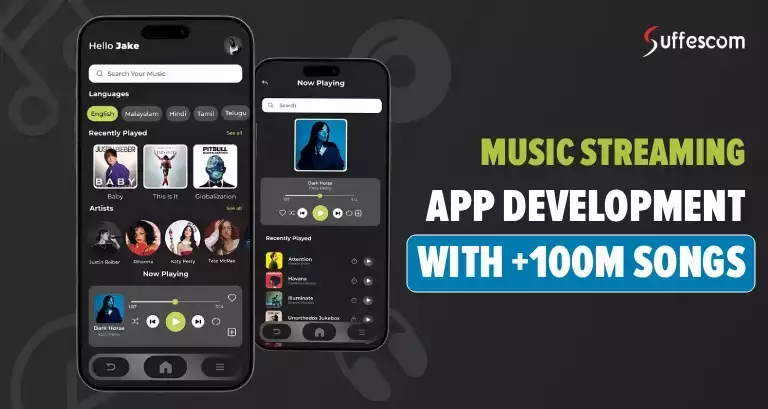
More than 85% of music lovers prefer using music streaming apps, and Deezer, a well-established French music streaming service, is ranked among the top 5 global platforms. Businesses exploring Deezer clone development have better growth opportunities, as its success is driven by a scalable architecture, content delivery mechanisms, and strong B2B partnerships.
47% of Deezer subscribers receive a subscription as part of the package, making it a strong business reference point for developing an app similar to Deezer that aligns with evolving digital music consumption and partnership-led growth, resulting in 2x revenue.
A Deezer clone with modern implementations leveraging generative AI, agentic recommendation systems, and collaborative filtering models drives app scalability and enables the business to enter the market faster in a booming market.
*Deezer names mentioned in the blog are used solely for identification purposes.
Understanding the Deezer App Process
The process of music streaming platforms like Deezer enables users to access and play music from around the world. It uses a server-based model that stores large volumes of music files and makes them accessible to users across different operating systems.
Below is a breakdown of the app's client-server architecture.
User Interface
A user-friendly interface lets users interact with the Deezer app across all devices.
Authentication
As the user logs in, the credentials are authenticated to ensure they have access to the service.
Search and Discovery
Users' access to vast songs, albums, or artists and discover new songs through personalized playlists based on listening history and preferences.
Content Delivery
Users select a song to play, and the app server fetches the audio data for the specific song.
Music Encoding
The audio data for the user-selected song is encoded and compressed into a format optimised for streaming.
Data Transmission
Encoded audio data, called packets, is transmitted from the app server to the user's device over an internet connection.
Playback
The user's device receives packets or audio data, decodes them for the app, and plays the audio stream through the device's speaker or headphones.
Caching
Users mark songs to listen offline, and the device saves the songs they've recently played, allowing them easy access to their playlist even without an internet connection.
Monetize & Launch a Scalable Music Streaming Platform
Accelerate market entry by building a music streaming Deezer app clone with offline listening powered by advanced capabilities with Suffescom.
Build an App Like Deezer with Advanced Features to Improve Music Experience
Admin Panel
These are the features and functionalities managed by the admin for overall platform control, moderation, and content management.
Account Management:
Users create profiles and register to access app features, and Admins manage those profiles, the payment system, and user access control.
Music Library Management:
Admins browse and manage soundtracks and upload and manage music content for the users. Also, it allows them to have an overview of artist profile management.
Payment Management:
Manages in-app purchases and payment gateway configuration for setting pricing and packages within the app.
Analytics & Reporting:
Admins view real-time app performance, user activity, and trends to monitor and analyze music preferences.
Push Notifications Management:
Manage push notification content, and have admins send notifications to users to update them on new content, such as promotions or updates.
Content Moderation:
Admins manage user-generated content like comments and playlists, and also oversee real-time lyrics display management.
Promotions and Discounts:
Admins set up promotions or special offers for the upcoming events or collaborations to increase user retention.
User Panel
These are the user-facing features that provide the primary functionality, allowing for music discovery, streaming, and interaction.
Account Creation and User Registration:
Users create profiles to access a vast song library, secure payment methods, discover new artists, and enjoy personalized suggestions.
Search and Browse Music Library:
Users can use the search function with filters for songs, albums, and artists to discover new music and get personalized recommendations. They can also browse music based on mood and genre.
Audio Streaming & Playback Controls:
Users enjoy unlimited skips, on-demand listening, volume control, and real-time lyrics display with translation and Hi-Quality audio streaming.
Playlists:
Users access offline playlists, create playlists with their favorite songs, and manage them.
Offline Mode:
Users listen to music without an internet connection, caching it for offline listening.
Push Notifications:
Receives notifications for new releases, events, or updates, and they have the option to turn them off.
Social Sharing:
Users share songs, albums, or playlists with others and invite their friends to join the platform to make collaborative playlists using the shaker feature.
Wearables & Multi-Device Synchronization:
App get sync across devices to continue music from one device to another without interruption.
- Smart Speakers: Google Nest, Alexa, Sonos.
- Wearables: Galaxy Watch, Fitbit, and other Wear OS devices.
- In Car: Deezer Premium with Automotive OS (ad-free, unlimited skips, and HiFi audio).
- On Android TV: Premium users can enjoy Deezer on their TV with Flow, track mixes, favorite playlists, and HiFi quality.
Payment and Subscriptions:
Manages subscriptions and accesses exclusive content with premium accounts. They also manage in-app purchases for exclusive tracks or live events.
Artist Profile:
View artist information, upcoming releases, and concerts, and access the artist’s music catalog.
Personalized Recommendations:
An AI-powered flow of free music streaming app like Deezer lets users receive AI-generated playlists based on taste and listening history.
Real-Time Lyrics Display:
Users view song lyrics in real time and access high-quality audio streaming with lyrics translation support.
Search Functionality:
This feature lets them perform an in-depth search for songs, albums, artists, genres, or even specific tracks.
Quality Streaming:
Users stream audio with HiFi-quality audio, improving their listening experience.
Shaker:
Allows users to mix playlists with friends and compare music tastes. This promotes social interaction and shared experiences, making music listening more fun and interactive.
Music Quiz:
Users can test their music knowledge solo or with friends. This adds a gamification element to the app, boosting engagement and providing an interactive way for users to discover new music.
Song Catcher:
Helps users find songs playing around them (even from humming). This feature provides instant music recognition, making it a standout tool for users wanting to identify songs they encounter in their environment.
Deezer Club:
Offers exclusive live event tickets and rewards. This gives users real-world rewards and creates a loyalty program that boosts user retention.
Functionality of AI Features in Deezer Clone
AI Chatbots:
Assist users with music recommendations or technical support inquiries related to the music streaming Deezer app clone with offline listening and other features.
Predictive Analytics:
AI feature predictive analytics predicts which songs or artists users might like based on their listening behavior. AI-powered Flow automatically plays music based on mood or previous listening.
Collaborative AI:
Enable user collaboration for music creation or playlist building with AI-driven tools.
Technology Stack Needed to Develop an app similar to Deezer
A scalable backend system, a high-performance frontend, and an advanced technology combination are required to build a Deezer music streaming app clone that supports AI-powered recommendations, personalized playlists, and agentic music discovery.
Use of an advanced tech stack ensures low-latency streaming, a secure payment process, and multi-device compatibility, with an offline listening feature, meeting business requirements.
Layer | Technology/Tool | Purpose |
Frontend | React Native / Flutter / Swift / Kotlin | Cross-platform or native app development for responsive UI and smooth playback controls |
Backend | Node.js / Python / Java (Spring Boot) | Handles API endpoints, user management, and business logic |
Database | PostgreSQL / MongoDB / Firebase | Structured and unstructured data storage for playlists, user preferences, and streaming metadata |
Cloud & Hosting | AWS / Google Cloud / Azure | Scalable infrastructure for content delivery, media storage, and real-time analytics |
Streaming Protocols | HLS / RTMP / DASH | Adaptive bitrate streaming for uninterrupted playback across networks |
AI/ML | Generative AI, Collaborative Filtering, NLP | Predictive recommendations, playlist generation, lyrics translation, and personalized Flow |
Payment & Monetization | Stripe / PayPal / Braintree | Secure subscription management, in-app purchases, and hybrid monetization |
Analytics & Monitoring | Google Analytics / Firebase Analytics | Tracks user engagement, subscription conversion, and playback metrics |
Caching & CDN | Redis / CloudFront / Akamai | Ensures low-latency delivery and supports offline mode with pre-cached content |
Cost breakdown of Deezer Clone Development
The cost to build a Deezer music streaming app clone varies and depends on factors such as feature complexity, platform requirements, security, and post-maintenance costs. The development cost of a free music streaming app like Deezer ranges between $5,000 - $25,000.
Development Stage | Cost Breakdown |
Analysis/Consultation | Free |
Prototyping | $500 - $2,500 |
Frontend/Backend Development | $2,500 - $7,500 |
Features Integration | $15,000 - $25,000 |
Testing & Deployment | $1,000 - $5,000 |
Maintenance & Support | Depends on the expert's decision |
Cost Optimization Strategies of Deezer Music Streaming App Clone
Businesses can use cost-optimization strategies to reduce development costs and achieve better results. These strategies let businesses decide the suitable cost-effective approach while leveraging a modern tech stack and entering the growing music streaming market.
MVP and Scale Gradually
Business with limited budget avail building a MVP with essential features and lower development costs. This approach lets businesses minimize financial risks and gather user feedback, and validate a music app idea before investing in advanced features of lyrics translation app development like Deezer.
Use Cross-Platform Frameworks
Another cost monetization strategy practised by businesses is the use of cross-platform frameworks such as React Native and Flutter. It enables businesses to build apps for both iOS and Android with the use of a single codebase.
APIs for Streaming, Payments, and Notification
API integrations for critical functionalities such as audio streaming, payment processing, and push notifications can affect development costs. It allows the development team to focus on unique features that help differentiate your app. It is a cost-effective way for businesses to build a Deezer music streaming app clone.
Cost-Effective Outsource
Outsourcing Deezer Clone Development company like Suffescom can save labor costs with expertise and reduce overall budget. The outsourced team's expertise in effective communication and project management tools helps businesses balance affordability with professional development, making it an ideal cost optimisation strategy for developing an app similar to Deezer.
Development Stages to Follow to Create an app like the Deezer app
To create an app like the Deezer app takes different lengths of time and requires a different approach. The development process defines the full project scope, including feature integration, and the technologies used that affect the development timeline.
Below is the process to follow for the development of a Music streaming Deezer app clone with offline listening and other advanced features.
Step 1: Analysis/Consultation
The development of a free music streaming app like Deezer starts with consulting or analysing the business requirements to understand the objective, target audience, and aligning the budget accordingly.
Step 2: Prototyping
This phase starts with app visuals creation with user friendly interface, encompassing wireframes and prototypes with final UI/UX elements to ensure a cohesive, intuitive and clean user experience.
Step 3: Frontend/Backend Development
This step involves laying the foundation of the app, including server infrastructure, authentication and authorization systems, with customisation for personalized playlists and suggestions to improve app efficiency and user retention. Developers focus on compatibility across all devices and provide a smooth experience for all users.
Step 4: Features Integration
Once the development stages are completed, the features are integrated to foster community and user engagement. The addition of these features boosts the app's social appeal.
Step 5: Testing & Deployment
App is tested to ensure its functionality, performance and security of the application. A thorough, rigorous testing of the app let the development team fix any errors if occurred. Once testing is successful, the app is deployed to the Google Play Store and the Apple App Store.
Step 6: Maintenance & Support
Continuous support is offered to address user feedback, fix bugs, feature enhancements or provide app updates, ensuring the app remains up-to-date and responsive to user needs.
Exploring Competing Alternative development of Deezer Music streaming app
- Spotify/Apple Music: With extensive catalogs, advanced collaborative filtering and Agentic recommendation engines, Spotify and Apple Music ecosystems rely on data-driven personalization, offline listening, and subscription models, making large-scale distribution and higher user retention.
- YouTube Music: The decentralized live-streaming platform that combines licensed tracks with user-generated content, enabling audio-video convergence. YouTube Music works with generative AI models trained on cross-consumption patterns, offering insights for platforms to build a free music streaming app like Deezer with a hybrid model and playback support.
- Qobuz: A French-origin platform, Qobuz focuses on Hi-Res audio streaming with high-bandwidth delivery, premium subscriptions and audio fidelity, providing a reference for building a music streaming Deezer app clone with offline listening and audiophile-grade performance.
- SoundCloud: Supported by collaborative tools and creator-centric monetization, SoundCloud emphasize on independent creators and niche content. The open distribution model and engagement features provide businesses with a blueprint to follow to create an app like Deezer app, with community-driven discovery and personalized content strategies.
Monetization Strategies to Adapt in Business for Deezer Music Streaming App Clone
Businesses investing in a French music streaming app like Deezer adopt monetization models that generate strong revenue. The models listed below create a constant, recurring revenue source.
Freemium Model
The Freemium model allows users to explore the app without any initial cost. Users can stream music with occasional advertisements and limited functionalities. This approach attracts a user base and encourages them to avail premium features at a cost fee.
Subscriptions
Users pay recurring monthly or yearly fees to access premium content with enhanced features. This model generates a steady, predictable revenue stream for the platform.
In-App Purchases
Users purchase virtual goods or tokens to support their favorite artist. It complements subscriptions by offering flexible, one-time purchases without any recurring payments. It improves user engagement and generates revenue.
Advertisements & Partnerships
Audio ads, banners, and advertisements with artists, music streaming platforms, or partnerships with music publishers or artists boost income with each ad and collaboration.
Hybrid Model
This model combines several strategies, such as freemium models with ads, premium subscriptions for ad-free listening, and in-app purchases. This diversifies revenue streams, reduces dependency on a single source, and generates 2X revenue.
Promotions
Paid advertising campaigns and promotions with referral and incentive programs encourage user retention and increase their spending frequency in the app.
Pay-Per-Download Model
This model allows users to purchase individual tracks or albums from the app, giving flexibility to those who prefer ownership over streaming.
Affiliate Marketing
Apps like Deezer let businesses earn commissions on sales made via partnered links within the app, creating a recurring, additional revenue stream and boosting user retention.
High-performing and Affordable Suffescom Solutions for Music Streaming Platforms like Deezer
Building a music streaming clone platform like Deezer, Smule, and other apps leverage modular architecture, cloud-based content delivery, and AI-powered systems. Suffescom solutions accelerate time-to-market while supporting advanced capabilities such as Generative AI, collaborative filtering, and agentic workflows, creating scalable, affordable solutions for businesses.
MVP (Minimum Viable Product)
MVP development solution focuses on streamlining core functionalities such as authentication, on-demand playback, offline listening, and AI-driven recommendations. This model supports businesses seeking rapid validation of a free music streaming app like Deezer while enabling future expansion with Generative AI and agentic recommendation layers.
White Label Development
White label solutions are ready-to-deploy solutions built on a scalable backend, CDN integration, and a modular feature architecture. It supports customization of UI, monetization models, and AI-powered discovery engines to build an app like Deezer with faster market entry.
No-Code App Development
No-code app development is suitable for early-stage deployments and for businesses seeking advanced capabilities, such as agentic AI, predictive analytics, and high-fidelity streaming, which can be integrated to develop an app similar to Deezer.
Validate the Market with an AI-Ready MVP Development Solution
Start with an MVP designed to create an app like Deezer, focusing on faster validation in the market.
Flexible subscription models of Deezer Clone for Its Users
This section discusses Deezer's subscription model and its plans, highlighting how the app can adopt a similar model to cater to different user needs.
- Deezer Premium – One Premium account with all features (ad-free, offline mode, HiFi audio).
- Deezer Duo – Two Premium accounts for one subscription.
- Deezer Family – Up to 6 Premium accounts, with kid-friendly profiles.
- Deezer Student – All the benefits of Deezer Premium at half the price for students.
- Deezer Free – Full access to Deezer’s music catalog, with occasional ads and limited features.
AI-Driven Innovations in the free music streaming app, like the Deezer Clone App
AI-driven innovations in a French music streaming app like Deezer focus on improving user engagement through intelligent content discovery, hyper-personalization, and enhanced audio experiences. AI PoC development helps test predictive analytics, collaborative AI, and agentic recommendation engines before full deployment. The AI-powered tools have also improved the app's efficiency in real time.
AI-Powered Flow
This model uses collaborative filtering, contextual signs, and agentic recommendation to deliver a continuous stream of music aligned with the user's mood, time, and listening behavior. The system adapts dynamically by using real-time feedback to maintain relevance and listening continuity.
Personalized Playlists
AI tools create unique, real-time playlists that are beyond simple curation and adapt to user preferences over time, increasing user retention. It is curated based on skips, replays, and the user's session duration.
Generative AI "Ask for Music"
Users can “ask for music” with Generative AI enabled by natural-language music discovery, which translates conversational prompts into intent-based recommendations. This model interprets mood, activity, and genre to curate personalized playlists, suggest albums, tracks, and create mixes instantly.
Voice Recognition with NLP
Users search, navigate, and control playback using voice commands with Natural language processing and speech-to-text models. It supports hands-free interaction across all devices, smart speakers, automotive, and wearable devices.
AI Chatbots
AI-powered voice assistants let users search for a specific song, create their favorite playlists, and control playback hands-free with simple voice or chat commands.
AI Predictive Analytics
AI predictive analytics let users retain the engagement with the app when they are most likely to stop using it, with automated, personalized offers.
Future Trends Defining Music streaming, Deezer app clone with Offline listening
User-driven and clone-app AI innovations provide a high-end, personalized experience that keeps users engaged. The future trends of music streaming platforms are briding gap between free and premium services for users.
AR/VR Virtual Concerts
Businesses are moving beyond basic music streaming or listening experiences and adopting Augmented Reality (AR) and Virtual Reality (VR). The new trend for French music streaming service app like Deezer has created new doors to offer virtual concerts and a 3D listening environment for users.
Collaborative AI
Enhanced music experience by enabling multi-user playlist creation and real-time taste alignment with collaborative AI systems. These models are adapted to group and social behavior to create an app like the Deezer app that supports collective listening and is community-driven.
Blockchain Integration
Blockchain with AI integration ensures transparent and fair royalty distribution for the artists. It also creates revenue opportunities for businesses with customer retention.
Biometric-Based Music
An AI-powered tool that defines a music playlist for the user based on their biofeedback, i.e., heart rate, mood, and activity levels, associated with specific songs, artists, or mixes. It ensures better deliverables and lets AI adjust music based on the user's listening history.
Conclusion
Businesses with a Deezer app clone enable faster market entry while supporting long-term scalability and evolving user expectations. These solutions require scalable architecture, low-latency content delivery, and AI-driven personalization to improve discovery, retention, and monetization. With the right development approach of companies like Suffesom, businesses can scale and generate revenue with a profit margin.
FAQs
What is a Deezer clone app?
A Deezer clone app is a music streaming platform that replicates core functionalities such as on-demand playback, offline listening, personalized recommendations, and multi-device synchronization using a scalable client–server architecture.
How much does it cost to develop a Deezer clone?
The development cost of a free music streaming app like Deezer varies based on feature scope, AI integration, and platform support. Solutions at Suffescom, with core streaming and offline capabilities, typically start at $5,000–$25,000, while advanced platforms with generative AI and agentic workflows require a higher investment.
How long does it take to create an app like the Deezer app?
The timeline to build an app like Deezer depends on complexity and development approach. An MVP can be developed within weeks, while a fully featured platform with AI-powered discovery and multi-device support may take 3–4 months.
What are the business advantages of a Deezer clone?
An app like Deezer enables faster market entry by leveraging proven streaming models, subscription monetization, and AI-driven personalization. Features such as collaborative playlists, offline listening, and predictive analytics improve engagement, retention, and recurring revenue potential.
Which technologies are required to develop an app similar to Deezer?
To develop an app similar to Deezer, platforms typically use cloud-native infrastructure, adaptive streaming protocols (HLS/DASH), CDN caching, secure payment gateways, and AI/ML models, including collaborative filtering, NLP, and generative AI for music discovery.
Can an app like Deezer support offline listening and HiFi audio?
Yes, a music streaming Deezer app clone with offline listening uses encrypted caching, adaptive bitrate streaming, and device-level storage management to support uninterrupted playback and high-fidelity audio across networks.