+971-8000321216










Global crypto market cap
Starting cost for white label platform
Fastest white label launch timeline
Client retention rate
Crypto banking software is an online banking application that incorporates all the features of a conventional bank account, including deposits, withdrawals, payments, loans, and debit card services, alongside those associated with cryptocurrencies and blockchain technology.
In contrast to traditional banking institutions, crypto banks offer round-the-clock global service, no brick-and-mortar offices, substantially lower costs, rapid international transactions, and complete control over users' cryptocurrency storage. This is a fusion of DeFi and conventional banking, known as "CeFi-DeFi hybrids."
Understanding the structural differences helps businesses determine which model to build toward and which users they are serving.
| Asset Types | Fiat + Cryptocurrency | Fiat currency only |
|---|---|---|
| Custody Model | User-controlled or custodial options | Bank holds all funds (custodial) |
| Operating Hours | 24/7 globally | Business hours, regional restrictions |
| Cross-Border Speed | Minutes via blockchain | 1–5 business days (SWIFT) |
| Transaction Fees | Lower — no intermediaries | Higher, correspondent bank fees |
| Transparency | Immutable blockchain audit trail | Internal bank records only |
| Security Model | Cryptographic + MFA + biometric | Password + 2FA (traditional) |
| Interest on Savings | DeFi yield: 3–15%+ APY possible | 0.01–5% APY (traditional) |
| Legal Recognition | Varies by jurisdiction (growing) | Universally recognized |
| Decentralization | Full or partial, no single authority | Fully centralized |
What We Build
End-to-end crypto banking platform development from architecture and compliance framework to UI/UX, blockchain integration, and post-launch support.
Pre-built, fully branded crypto banking platform deployable in 3-6 weeks. Complete feature set with your brand identity, zero backend rebuild required.
Bespoke crypto banking infrastructure built to your exact specifications, proprietary features, custom tokenomics, and unique UX differentiation.
Decentralized banking with on-chain lending, borrowing, yield farming, and liquidity provision, bringing DeFi yields to mainstream banking users.
Digital-native banking platform with crypto as a first-class asset, combining expertise in neobank app development to deliver accounts, cards, savings, and payments in one seamless mobile-first experience.
Visa/Mastercard-compatible crypto debit and credit cards with real-time crypto-to-fiat conversion, cashback rewards, and Apple/Google Pay support.
Custodial and non-custodial wallet infrastructure supporting 50+ cryptocurrencies, fiat currencies, and DeFi token management in one interface.
Crypto-backed loan platforms where users collateralize crypto holdings to access fiat or stablecoin liquidity without selling their assets.
Cross-border payment infrastructure with instant crypto rails, scan-and-pay QR codes, payment links, and merchant acceptance globally.
Full regulatory compliance infrastructure, KYC onboarding, AML transaction monitoring, KYT risk scoring, and multi-jurisdiction reporting.
Our blockchain and fintech specialists will map the right architecture, compliance framework, and deployment model for your specific business goals.
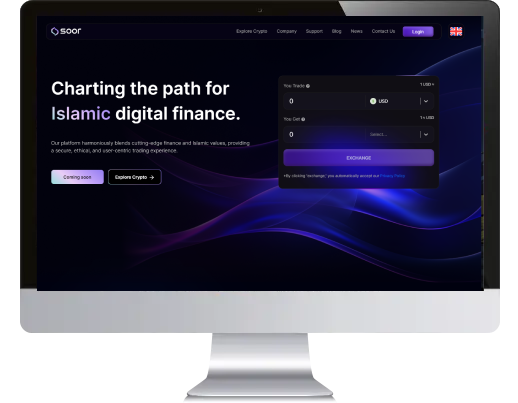
Enjoy a seamless trading experience within the boundaries of Islamic values. Witness the impressive fusion of tradition and technology with a comprehensive set of financial tools, making trading simple, easy, and secure.
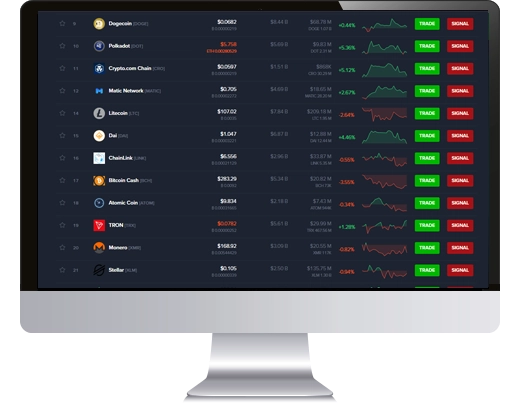
View Case StudyBuilt a seamless crypto trading platform for traders and enthusiasts to track cryptocurrencies, manage portfolios, and stay updated with live market movements—all without switching between tools.
✅ Multi-coin tracking
✅ Live price updates
✅ Portfolio dashboard
✅ News integrated
View Case StudyPlatform Capabilities
A production-grade crypto banking platform must cover the full financial lifecycle from onboarding and asset management to payments, lending, and compliance.
Core Features Every Crypto Banking Platform Needs
Digital KYC in under 3 minutes, document upload, liveness check, AML screening, and account activation in a single mobile flow, removing all friction from the first user interaction.
Instantly issued virtual cards and physical Visa/Mastercard debit cards with real-time crypto-to-fiat conversion, spending controls, freeze/unfreeze, and Apple/Google Pay integration.
Hold multiple fiat currencies (USD, EUR, GBP) and 50+ cryptocurrencies in unified accounts with IBAN support for SEPA/SWIFT payments alongside crypto rails.
Integrated staking for PoS cryptocurrencies and DeFi yield products, letting users earn 3–15%+ APY on idle crypto holdings directly within the banking interface.
Collateralize BTC, ETH, or stablecoins to access instant fiat or stablecoin loans — with configurable LTV ratios, automatic margin calls, and liquidation protection.
Send money internationally in seconds with Crypto Rails, featuring fiat delivery at destination, multi-currency conversion, and fees 80–95% lower than traditional wire transfers.
Multi-signature wallet management, HSM key management, biometric login, 3D Secure payments, AI fraud detection, and transaction monitoring safeguard all user actions.
Portfolio tracking, spending analysis, income classification, tax filing tools, and an investment performance tracking dashboard provide users with total financial transparency.
AI fraud detection, smart spending insights, automated savings goals, personalized product recommendations, and a virtual financial assistant for 24/7 customer support.
Crypto banking platform development serves a wide range of businesses from fintechs and neobanks to crypto exchanges and enterprise treasury teams.
Launch a full-featured crypto banking product without 18 months of infrastructure building. White-label platforms get you to market in weeks, with real users and real revenue.
Add cryptocurrency as a native asset class to your existing neobank, leveraging Neo app development to enable crypto accounts, staking, and DeFi yield products for your existing user base.
Crypto exchanges can evolve into full banking ecosystems through cryptocurrency exchange development, adding savings, lending, and payment card features to boost user lifetime value.
Upgrade your remittance product into a full crypto banking platform that enables recipients to manage, save, and spend received crypto without converting it to cash.
Build treasury management platforms that hold and deploy crypto assets with multi-sig controls, expense management cards, and crypto payroll capabilities.
Add banking-as-a-service capabilities to your consumer super app, embedding crypto wallets, payments, and financial products alongside your existing services.
Technology Selection
The right blockchain determines your platform's transaction costs, speed, DeFi composability, and compliance capabilities.
| Blockchain | Best For Crypto Banking | Transaction Cost | Speed | DeFi Access |
|---|---|---|---|---|
| Ethereum | DeFi-heavy platforms, institutional | $2–$20 | 15 TPS | Maximum |
| Polygon (Recommended) | Retail crypto banking, neobanks | $0.01–$0.10 | 7,000 TPS | High |
| BNB Chain | Cost-sensitive, Asia-Pacific focus | $0.10–$0.50 | 2,200 TPS | Medium |
| Arbitrum / Optimism | Ethereum L2, DeFi + low fees | $0.003–$0.01 | 40,000 TPS | High |
| Solana | High-volume payments, remittance | $0.00025 | 65,000 TPS | Growing |
| Hyperledger | Private enterprise banking | Near-zero | 3,500 TPS | Limited |
From architecture design and compliance framework to card program setup and DeFi integration, Suffescom handles the full development cycle. Get your platform scoped and priced in 48 hours.
Development Process
Compliance-driven development process for delivering fully fledged cryptocurrency banking solutions within the stipulated timeframe and budget constraints.
Clarify the intended market segment, end-user personas, the financial assets to be supported, and compliance requirements before initiating any development work. Compliance framework creation should come before architectural planning, never the other way around.
Architecture planning, selection of the best-suited blockchain technology, defining the smart contract strategy, choosing between custodial, non-custodial, or hybrid wallets, and determining third-party integrations.
Develop mobile-first UI designs with banking-specific UX patterns, onboarding processes, transaction interfaces, investment portfolio dashboards, and administrative tools prototypes tested by users beforehand.
Create the core banking module with account management features, wallet infrastructure, transaction engine, payment channels, and multi-currency converter, which forms the foundation of a crypto bank platform.
Integration of identity verification systems (Jumio, Sumsub), AML screening systems (Chainalysis, Elliptic), know-your-transaction analysis, and jurisdictional compliance report modules.
Incorporate lending, staking, yield generation, cryptocurrency cards (BIN sponsorship), international payments rails, and any other DeFi components.
Smart contract security auditing, penetration testing, load testing at scale, regulatory compliance validation, and full functional QA are mandatory before any user funds are deposited into the platform.
Production deployment with monitoring infrastructure, go-live support, regulatory submission assistance, and ongoing maintenance covering upgrades, new chain support, and compliance updates.
Regulatory Framework
Crypto banking platforms operate at the intersection of digital asset regulation and payment law. Our compliance-by-design approach covers all major global frameworks.
Business Value
A well-built crypto banking platform creates value for both your business and your users, opening new revenue streams while delivering financial services that traditional banks simply cannot match.
Sub-minute cross-country transactions compared to the 1 to 5 business days that SWIFT needs. This makes the difference for remittances and payments from abroad.
Omitting correspondent banks and payment intermediaries can save up to 80-95% in operational costs. It enables cost-competitive fees for price-sensitive users worldwide.
Serve users across 150+ countries without setting up local branches. There are no geographical limitations with crypto rails, meaning that you can provide your services internationally from day one.
Interchange fees when users perform card transactions, fees from cryptocurrency exchanges, interest from lending products, fees from staking tokens, and fees from premium service tiers.
Since users have cryptographic control over their assets, only their private keys can authorize transactions, eliminating a single point of failure.
Every transaction is recorded in an immutable ledger, in the form of blocks, on a blockchain.
Connect users to DeFi protocols, earning 3–15%+ APY on stablecoins and crypto, offering yield rates dramatically higher than traditional savings accounts on the same familiar banking interface.
Every feature, token support, fee structure, compliance rule, UI theme, and user journey is configurable to meet specific market requirements, regulatory jurisdictions, and brand standards.
White-label platforms launch in 8–16 weeks, compared with 18+ months for traditional banking infrastructure, enabling first-mover advantage in emerging crypto banking markets before competition intensifies.
Why Suffescom
We've built crypto wallets, exchanges, DeFi protocols, and banking platforms since 2011, giving us domain expertise spanning the full fintech and blockchain technology stack that few firms can match.
KYC/AML, PCI DSS, GDPR, MiCA, VARA, and FinCEN compliance are built into the platform architecture from day one, not retrofitted after development when it's exponentially more expensive.
Fast white-label deployment for rapid market entry or fully custom platforms for maximum differentiation — both paths deliver production-quality, compliant platforms, not prototypes.
End-to-end card program development, including BIN sponsorship setup, Visa/Mastercard integration, Apple Pay/Google Pay tokenization, and dispute resolution from virtual cards to physical issuance.
Deep expertise in integrating Aave, Compound, Uniswap, and other DeFi protocols into consumer-facing banking interfaces, making DeFi yields accessible to mainstream banking users.
We develop across leading blockchain networks, including Ethereum, Polygon, BNB Chain, Solana, Avalanche, and Hyperledger, selecting the most suitable technology for your specific business requirements.
Weekly sprint reviews, daily build access, full development transparency, and milestone-driven delivery with complete visibility at every stage from architecture to mainnet launch.
95% client retention rate because we invest in long-term partnerships. Post-launch compliance updates, new feature development, regulatory changes, and scaling support are part of every engagement.
API-first, microservices-based systems built for seamless integrations, faster deployments, and reliable scaling as user demand and transaction volumes grow.
Client Stories

Suffescom built our crypto banking platform in 14 weeks, fully KYC/AML compliant, integrated with our existing neobank infrastructure, and supporting 25 cryptocurrencies from launch. The compliance knowledge their team brought was genuinely impressive. We've grown to 50,000 users in the first quarter post-launch.

We needed a crypto lending platform integrated into our existing exchange, Suffescom delivered a crypto-backed loan product in 10 weeks that our users immediately adopted. The smart contract security and compliance setup were exactly what we needed for our regulated market. Post-launch support has been excellent.

The white label crypto banking platform Suffescom built reduced our time to market from 18 months to 12 weeks. It came fully branded, with crypto cards, multi-currency wallets, and KYC built in. We launched in 3 countries simultaneously, something that would have been impossible to build from scratch.
Timelines depend on the platform type. A white-label crypto banking app can be launched within 3–6 weeks, a mid-level custom platform typically takes 4–8 weeks, while enterprise-grade platforms with advanced compliance and infrastructure require around 8–12 weeks.
The cost of developing a crypto banking app varies with complexity. White-label solutions range from $15,000–$30,000; mid-level custom platforms cost $30,000–$50,000; and enterprise platforms with multi-jurisdictional compliance and institutional features can exceed $100,000.
A complete platform includes wallet integration, multi-currency accounts, crypto-fiat payments, lending modules, card systems, compliance infrastructure (KYC/AML), and analytics dashboards for financial insights.
White-label platforms are pre-built and faster to deploy with essential features, while custom platforms are developed from scratch, offering advanced capabilities like DeFi integration, crypto cards, and tailored user experiences.
Yes, modern platforms are designed to support hybrid financial systems, enabling users to manage fiat currencies and cryptocurrencies in a single interface with integrated payment rails.
Compliance is handled through integrated KYC onboarding, AML monitoring, transaction tracking, and automated reporting systems aligned with global regulatory standards.
Yes, they implement advanced security measures, including multi-signature wallets, encryption, biometric authentication, fraud-detection systems, and secure key-management infrastructure.
Yes, platforms can integrate DeFi functionalities such as staking, lending, borrowing, and yield generation, making decentralized finance accessible within a traditional banking interface.
Yes, they can include debit and credit card systems with real-time crypto-to-fiat conversion, along with integrations for global payment networks and mobile wallets.
• SUFFESCOM SOLUTIONS
Build Smarter. Scale Faster. Grow More.
Have a Vision? Let’s Turn It Into a Digital Reality.
Get a quick response from our best experts in under 10 minutes.
Suffescom easily understood our main goal and delivered the best digital solution. Their team was very cooperative, and it was a very good experience working with them. I would highly recommend them.

Working with Suffescom was a really great experience. Their developers demonstrated technical knowledge and delivered our mobile app solution with all required functionalities on time.

Suffescom helped us build a logistics software solution that completely improved our fleet operations. Their professionalism and transparency are what make them a reliable technology partner.

Share Your Requirements. Our Experts Will Shape the Solution.
• SUFFESCOM SOLUTIONS
Build Smarter. Scale Faster. Grow More.
Have a Vision? Let’s Turn It Into a Digital Reality.
Get a quick response from our best experts in under 10 minutes.
Suffescom easily understood our main goal and delivered the best digital solution. Their team was very cooperative, and it was a very good experience working with them. I would highly recommend them.
Working with Suffescom was a really great experience. Their developers demonstrated technical knowledge and delivered our mobile app solution with all required functionalities on time.
Suffescom helped us build a logistics software solution that completely improved our fleet operations. Their professionalism and transparency are what make them a reliable technology partner.
Share Your Requirements. Our Experts Will Shape the Solution.
• SUFFESCOM SOLUTIONS
Build Smarter. Scale Faster. Grow More.
Have a Vision? Let’s Turn It Into a Digital Reality.
Get a quick response from our best experts in under 10 minutes.
Suffescom easily understood our main goal and delivered the best digital solution. Their team was very cooperative, and it was a very good experience working with them. I would highly recommend them.
Working with Suffescom was a really great experience. Their developers demonstrated technical knowledge and delivered our mobile app solution with all required functionalities on time.
Suffescom helped us build a logistics software solution that completely improved our fleet operations. Their professionalism and transparency are what make them a reliable technology partner.
Share Your Requirements. Our Experts Will Shape the Solution.
Fret Not! We have Something to Offer.