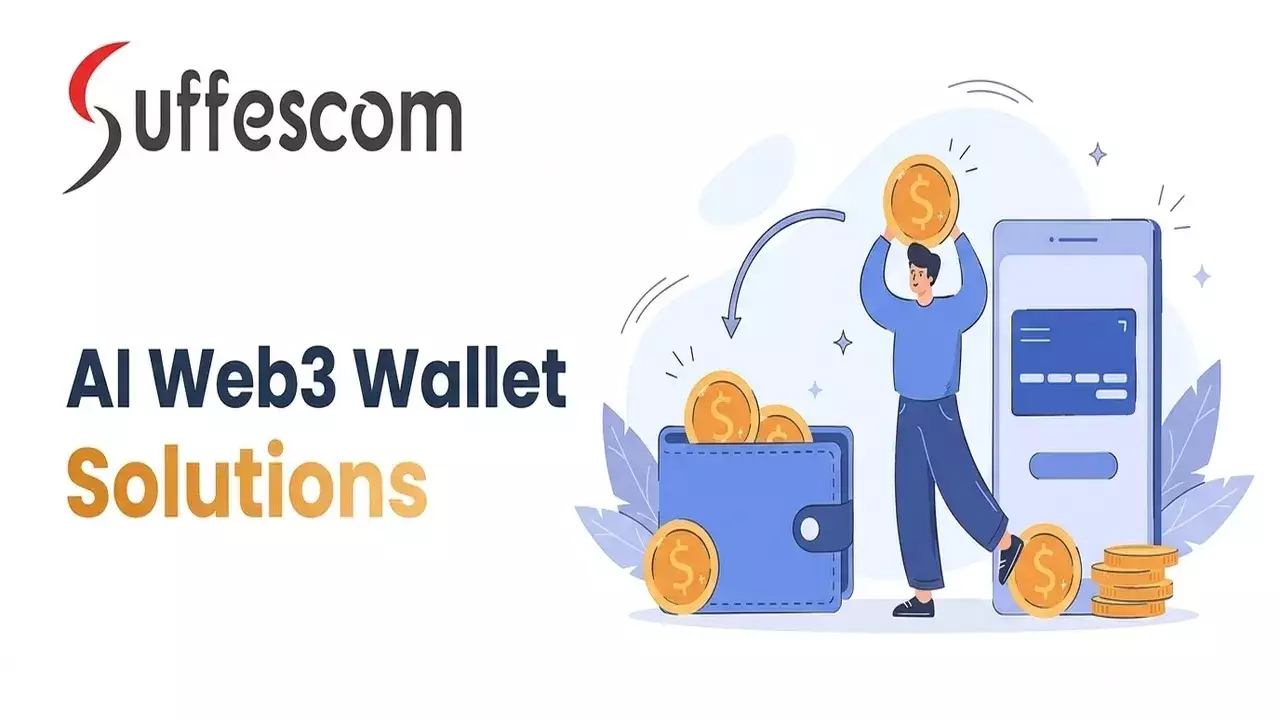
Develop an AI-powered Web3 wallet that uses ML algorithms to amplify user experience, working, and security. Our AI experts are well-versed in understanding market trends/patterns. We will help you design a highly secure and robust AI-driven Web3 Wallet for storing and managing cryptocurrencies. For more valuable details, contact our team at Suffescom.
The advanced AI-integrated Web3 wallet uses both Web3 and artificial intelligence to flawlessly manage digital assets. With machine learning, valuable insights are analyzed that lead to optimized asset allocation. The main objective behind creating AI-powered Web3 wallets is not just to elevate user experience but also to make it more accessible to users, resulting in elevated adoption by the audience.
Suffescom is the top-rated cryptocurrency wallet development company that helps businesses launch a platform with world-class crypto wallet solutions. Collaborate with us in case you want to develop a Web3 wallet or AI-driven Web3 wallet; we will offer you top resources to deliver results.
Choosing The Correct AI Web3 Development Services
Select the right AI Web3 wallet development services for unparalleled innovation and efficiency. Harness expertise in crafting intelligent solutions, ensuring optimal integration with the decentralized Web3 environment.
AI Plays Crucial Role For Revolutionizing Web3 Wallet Functionality
Web3 and AI, both are cutting-edge technologies that have revolutionized how the tech industry works. With more technological advancements, the realm of crypto wallets is also going to get revamped. AI-led Web3 wallets come with the extraordinary capabilities of understanding user preferences, adapting to ever-evolving market trends, and automating daily operations.
Smart Security Measures
AI algorithms play a crucial role in reinforcing the security of Web3 wallets. These analyze patterns, detect abnormalities, and offer adaptive authentication mechanisms, thereby, reducing the risk of unauthorized access.
Intuitive Interface
With AI Web3 wallets, the complications are reduced, and interaction is improved with the decentralized applications through a user-friendly interface along with tailored suggestions, and real-time market insights.
Predictive Insights
By analyzing pre-historical data, AI Web3 wallets offer users insights that help them make precise decisions and navigate the volatile cryptocurrency market with greater confidence.
Hi-Tech Monitoring
AI-driven crypto wallets are able to smartly monitor transactions and therefore increase crypto investments by anticipating potential market movements.
Automated Portfolio Management
AI Web3 wallets allow automated portfolio management by analyzing market data and user preferences. This guarantees optimal asset allocation, risk management, and the execution of strategic trades.
AI Features To Include in a Web3 Wallet
AI Web3 Wallets have the power to remodel the interaction between cryptocurrencies and decentralized applications by reducing complexities. Our AI powered Web3 wallets are integrated with top-tier features that blend well in this new world of smart financial management.
Fraud Detection
With AI, the transaction patterns are examined that help detect suspicious activities in real-time and communicate through alerts thereby avoiding fraudulent activities.
Voice Commands
Utilizes NLP to help users while interacting with the wallet via voice commands, ultimately leading to enhanced user experience and ensuring hands-free operation.
Ultra-Security
With features like biometric authentication and multi-factor authentication, security is provided based on the user's behavior and risk profile.
Personalized Financial Insights
Leverages AI to offer personalized financial advice (budgeting, saving, and investing) by inspecting user's spending habits.
Cross-Platform Compatibility
Facilitates compatibility across diverse platforms/devices, providing a consistent user experience by enabling access to their wallets through desktops, mobile devices, etc.
Seamless Interface
With the user-friendly interface, the navigation to different parts of the wallet is made smooth and convenient
Want To Develop AI-Driven Web3 Wallet Today?
Elevate your users experience with our AI-driven Web3 wallet development that make it more secure, manageable and streamline transactions. AI powered web3 wallet provides more user friendly and secure functionalities in the wallets.
How to Build an AI-Powered Web3 Wallet
Step 1: Define the Wallet's Business Model and Target Audience
Start by identifying the wallet's purpose and intended users. A retail crypto wallet, institutional wallet, DeFi-focused wallet, and exchange-integrated wallet have different technical and operational requirements.
Define:
- Target customer segments.
- Supported blockchain networks.
- Custodial or non-custodial architecture.
- Core AI capabilities.
- Supported tokens and digital assets.
- Revenue model and business objectives.
Step 2: Choose the Wallet Architecture
Select the wallet architecture based on asset ownership, signing requirements, and recovery mechanisms.
Common options include:
- Traditional externally owned accounts.
- Smart contract wallets.
- MPC-based wallet infrastructure.
- Custodial wallet architecture.
- Hybrid wallet models.
The architecture should clearly separate AI processing, blockchain connectivity, private-key storage, and transaction signing.
Step 3: Select Blockchain Networks
Choose blockchain networks according to transaction fees, scalability, ecosystem activity, developer support, and the needs of your target users.
Possible networks include:
- Ethereum
- Solana
- Polygon
- BNB Chain
- Arbitrum
- Optimism
- Base
- TRON
Avoid integrating every network at launch. Start with the networks that best support your product's use cases and expand as adoption grows.
Step 4: Design the Wallet UI/UX
Create an intuitive interface that simplifies complex blockchain activities.
Important screens include:
- Wallet onboarding and authentication.
- Portfolio dashboard.
- Token and NFT management.
- Send and receive assets.
- Transaction history.
- AI assistant interface.
- Security alerts.
- Network selection.
- Settings and recovery options.
Display transaction fees, network details, token approvals, and recipient information clearly before users authorize an action.
Step 5: Develop the Core Wallet Infrastructure
Build the wallet functionality required to generate or connect wallet accounts, manage supported assets, retrieve balances, and prepare blockchain transactions.
Integrate appropriate wallet SDKs, node providers, RPC endpoints, and blockchain indexing services. Implement secure key storage and signing mechanisms based on the selected custody model.
Step 6: Integrate AI and Machine Learning Models
Choose AI models according to the features you want to deliver.
For example:
- Anomaly detection models for unusual transaction monitoring.
- NLP models for conversational wallet assistance.
- Classification models for transaction categorization.
- Predictive models for analytical market insights.
- Recommendation systems for personalized wallet experiences.
Use reliable data sources and evaluate model performance before exposing insights to users.
Step 7: Integrate Smart Contracts and DeFi Protocols
If the wallet supports token swaps, staking, lending, or other DeFi activities, integrate the required smart contracts and protocol APIs.
Before deployment, verify contract interactions, permissions, transaction parameters, and failure-handling mechanisms.
Step 8: Implement Security and Risk Controls
Introduce security controls across the wallet architecture, including:
- Encrypted key storage.
- Secure transaction signing.
- Multi-factor or passkey authentication.
- MPC or hardware-backed key protection where appropriate.
- Transaction simulation and validation.
- Smart contract audits.
- Rate limiting and suspicious activity monitoring.
- Secure recovery mechanisms.
AI-generated recommendations must never bypass transaction authorization policies.
Step 9: Test the Wallet
Conduct functional, integration, performance, and security testing before launch.
Test transaction flows on supported testnets, validate smart contract behavior, examine AI output quality, and simulate suspicious activity scenarios.
Also test network failures, incorrect transaction parameters, recovery workflows, and unexpected API responses.
Step 10: Deploy, Monitor, and Improve
Deploy the wallet infrastructure and monitor application performance, transaction success rates, security alerts, AI response quality, and user feedback.
Regularly update blockchain integrations, AI models, security controls, and supported network configurations
Technology Stack for AI Web3 Wallet Development
The technology stack depends on the wallet's supported networks, custody model, AI features, and target platforms. The following options can help businesses plan their development architecture
| Development layer | Technology Options |
| Frontend | React.js, Next.js, React Native, Flutter |
| Backend | Ethereum, Solana, Polygon, BNB Chain, Base |
| Smart contracts | Solidity, Rust |
| Blockchain libraries | ethers.js, viem, web3.js, Solana Web3.js |
| Wallet infrastructure | WalletConnect, MPC providers, embedded wallet SDKs |
| AI and machine learning | Python, PyTorch, TensorFlow, scikit-learn |
| AI assistant | LLM APIs, retrieval-augmented generation (RAG), NLP frameworks |
| Blockchain data | RPC providers, blockchain indexers, analytics APIs |
| Database | PostgreSQL, MongoDB, Redis |
| Cloud infrastructure | AWS, Google Cloud, Microsoft Azure |
| Security | HSM, secure enclaves, encryption, smart contract auditing tools |
AI Models and Integrations for a Smart Web3 Wallet
AI-powered wallets may require different models and external services to support their functionality.
Large Language Models for Wallet Assistance
LLMs can power conversational interfaces that explain wallet features, summarize transaction activity, and help users understand blockchain terminology.
Connect the assistant to verified wallet data and controlled tools. It should not be allowed to invent balances, transaction statuses, or blockchain confirmations.
Machine Learning for Fraud and Anomaly Detection
Supervised and unsupervised machine learning models can help identify unusual transaction patterns and suspicious wallet activity.
These models should be evaluated against relevant historical data and combined with rule-based security checks.
Blockchain Analytics Integrations
Blockchain analytics services and indexing tools can provide structured information about wallet balances, transactions, token transfers, and contract interactions.
This information can help AI models generate more contextually relevant insights.
Price and Market Data APIs
Market data providers can supply token prices, trading volumes, historical information, and other market indicators.
The wallet should display the data source and timestamp so users understand how current the information is.
Wallet and DeFi Integrations
Wallet connectivity protocols, embedded wallet providers, decentralized exchange aggregators, and DeFi APIs can extend the wallet's functionality.
Each integration should be assessed for security, reliability, supported networks, fees, and dependency risks.
Security Considerations for AI-Powered Web3 Wallets
Security should be a core part of the wallet architecture rather than a feature added just before launch. A vulnerability in key management, smart contracts, or transaction authorization can expose user assets to serious risks.
Private-Key and Seed Phrase Protection
Private keys and seed phrases should never be exposed to AI models, third-party analytics tools, or unsecured backend services.
Use secure key-generation, storage, backup, and signing mechanisms appropriate to the wallet's custody model.
Multi-Party Computation and Hardware Security
MPC can distribute signing authority across multiple key shares, while hardware security modules and secure enclaves can protect sensitive cryptographic operations.
The right implementation depends on the threat model, operational requirements, and supported platforms.
Transaction Simulation and Approval Controls
Show users the recipient address, token, amount, network, fees, and contract permissions before signing.
Where supported, simulate transactions and flag unexpected asset movements or potentially dangerous approvals.
AI Prompt Injection and Tool Security
An AI assistant may process untrusted content from token descriptions, websites, transaction metadata, or external sources. Malicious content could attempt to manipulate its behavior.
Use strict tool permissions, input validation, transaction policies, and independent authorization checks to prevent AI instructions from triggering unauthorized actions.
Smart Contract Auditing
Smart contracts should undergo code reviews, automated security testing, and independent audits where appropriate.
Wallet integrations should also be monitored for changes in contract behavior, dependencies, and protocol risks.
Privacy and Regulatory Compliance
Collect only the user information required for the wallet's intended functionality. Apply encryption, access controls, retention policies, and privacy safeguards.
Depending on the business model and jurisdictions served, evaluate applicable KYC/AML, sanctions screening, consumer protection, data protection, and financial regulations with qualified legal professionals.
Benefits Offered By Our AI Driven Web3 Wallet
The mesmerizing combination of two futuristic technologies i.e. AI & Web3 has rightfully overcome the challenges and brought a significant paradigm shift in offering a matchless user experience without compromising on transparency and security.
Decentralized Identity
Integration of AI contributes to the development of decentralized identity solutions, maintaining privacy and security in digital transactions.
Optimized Security
AI helps implement advanced security measures, through biometric authentication and error-detection, making the wallet extremely resilient to unwarranted access.
Automatic Transaction
Uses machine learning algorithms that automatically label transactions and help users to easily track their spending patterns.
User-Friendly Interface
NLP and intuitive design enhances user experience and simplifies complex actions like transaction instructions and key management.
Adaptive Learning
Our AI Web3 wallet adapts to user behavior and choices and offers personalized recommendations dependent on transaction history.
Risk Management
With ML algorithms, users are able to make informed decisions about cryptocurrency investments and detect earlier potential risks.
Community Insights
AI perfectly analyzes community sentiments and therefore provides users with insights pertaining to upcoming risks, market trends, and possible opportunities.
Multi-Blockchain Support
AI provides seamless interaction through different blockchain networks, supporting an extensive range of dApps and cryptocurrencies.
Online/Offline Integration
AI-powered Web3 wallets facilitate online/offline functionality with superb security features, ensuring users have access to their funds even in offline conditions.
How to Develop a AI Web3 Wallet Integrated With Blockchain Technology?
To develop an AI Web3 Wallet integrated with blockchain technology, employ expert developers proficient in AI and blockchain. Outline requirements, design a secure architecture, implement AI features, and rigorously test for a robust solution.
How Much Does AI-Powered Web3 Wallet Development Cost?
The cost of developing an AI-powered Web3 wallet depends on the complexity of its features, blockchain integrations, security architecture, and AI capabilities.
The existing Suffescom page mentions an indicative development range of 30,000–150,000. This can remain as an initial reference, provided it is clearly described as a project-specific estimate rather than a fixed market price.
A more accurate project estimate should consider the following factors:
1. Wallet Architecture
A basic non-custodial wallet may require a different level of engineering than an institutional wallet with MPC, multi-signature approvals, and advanced recovery workflows.
2. AI Feature Complexity
A wallet with basic AI-powered transaction categorization will generally require less work than one with fraud detection, an AI assistant, predictive analytics, and automated transaction workflows.
3. Blockchain Integrations
Supporting multiple networks, tokens, smart contracts, and cross-chain transactions increases integration and testing requirements.
4. Security Requirements
Security audits, secure key management, penetration testing, and compliance-related controls can add to the overall budget.
5. Platform Compatibility
Developing for web, Android, and iOS requires additional interface engineering, device testing, and platform-specific security implementation.
6. Third-Party Services
AI APIs, wallet SDKs, blockchain nodes, market data providers, cloud infrastructure, and transaction monitoring services may involve ongoing subscription or usage charges.
7. Maintenance and Updates
After launch, businesses need to budget for security patches, blockchain upgrades, AI model monitoring, infrastructure management, and feature improvements.
Cost recommendation: Instead of publishing a single universal price, add a project-based cost breakdown or calculator. Make clear whether the estimate includes design, development, third-party services, audits, deployment, and post-launch maintenance.
Book a consultation with our team and get a precise price quote depending on your business requirements!
Choose Suffescom As Your AI-powered Web3 Wallet Development Partner!
Suffescom is a prominent name in the IT industry with 13+ years of experience across industry verticals. Our AI development solutions are quite popular among businesses worldwide. Additionally, we have a team of professionals with a knack for contemporary tools and technologies to build fabulous apps/platforms.
You can count on us for your next development project.
- Matchless Technical Expertise
- Assured Services
- 24/7 Support
- Cost-effective Prices
- Agile Methodologies
- Transparent Pricing Policies
Contact our team and develop an outstanding AI Web3 wallet with phenomenal features and functionalities.
Conclusion
AI-powered Web3 wallets are evolving beyond basic cryptocurrency storage by bringing intelligent assistance, transaction monitoring, portfolio analytics, and simplified blockchain interactions into one platform. For businesses, this creates an opportunity to develop wallet products that address real user challenges while supporting broader crypto and DeFi adoption.
However, building a successful wallet requires more than integrating an AI model. It involves selecting the right blockchain networks, designing a secure wallet architecture, protecting private keys, validating smart contract interactions, and ensuring that AI recommendations remain transparent and controlled. Features such as account abstraction, multi-chain support, intelligent risk monitoring, and conversational assistance can further differentiate the product when implemented around genuine user needs.
Frequently Asked Questions
1. How can AI-powered Web3 wallets identify potentially malicious crypto transactions?
AI models analyze transaction history, wallet behavior, address activity, and unusual transfer patterns to identify potential threats.
The wallet can flag suspicious activity and request additional verification before allowing users to proceed.
2. Can an AI-powered Web3 wallet execute crypto transactions automatically?
Yes, it can support automated transactions through smart accounts, predefined permissions, and controlled AI agents.
However, spending limits, approved destinations, transaction validation, and authorization policies must restrict execution.
3. How can AI improve cross-chain asset management in Web3 wallets?
AI can consolidate wallet activity across supported blockchains and provide insights into balances, fees, and transaction history.
It can also help users compare cross-chain options, while actual transfers require secure bridge integrations.
4. What is the role of MPC in AI-powered crypto wallet development?
MPC distributes cryptographic signing authority across multiple key shares instead of relying on one complete private key.
It can strengthen key-management architecture while allowing AI features to operate separately from transaction signing.
5. How can businesses integrate AI agents into Web3 wallet applications?
Businesses can connect AI agents with blockchain data APIs, wallet services, and approved transaction tools through controlled interfaces.
Permission boundaries and independent signing controls should prevent agents from accessing private keys or exceeding user-defined limits.
6. Can an AI-powered Web3 wallet support DeFi protocols and decentralized exchanges?
Yes, developers can integrate DEX aggregators, lending platforms, staking protocols, and other compatible DeFi services.