+971-8000321216



In This Guide, You'll Learn:
- How to decide whether to develop your mobile applications in-house or outsource depending on your budget, time frame, objectives, and resources.
- Various outsourcing options, their pros and cons, and situations where each is applicable.
- The true cost of both options and additional costs that tend to be overlooked.
- Security, regulatory compliance, and intellectual property issues that Saudi companies need to consider prior to development.
- A useful decision-making framework to choose a development model.
Deciding whether to use an in-house team or outsource is the first and perhaps the most important step for developing a mobile application. It will affect all aspects of the work. It affects budget, project duration, and the final product quality and future development.
The situation is especially critical for businesses in Saudi Arabia. This is because they face the growing need to implement digital transformation according to Vision 2030 while developing a mobile app. In 2024, Saudi Arabia's digital economy contributed to 16% of the nation's GDP, showing how quickly technology has become an essential part of doing business. In light of this, selecting an appropriate model for mobile app development has now become a critical business decision.
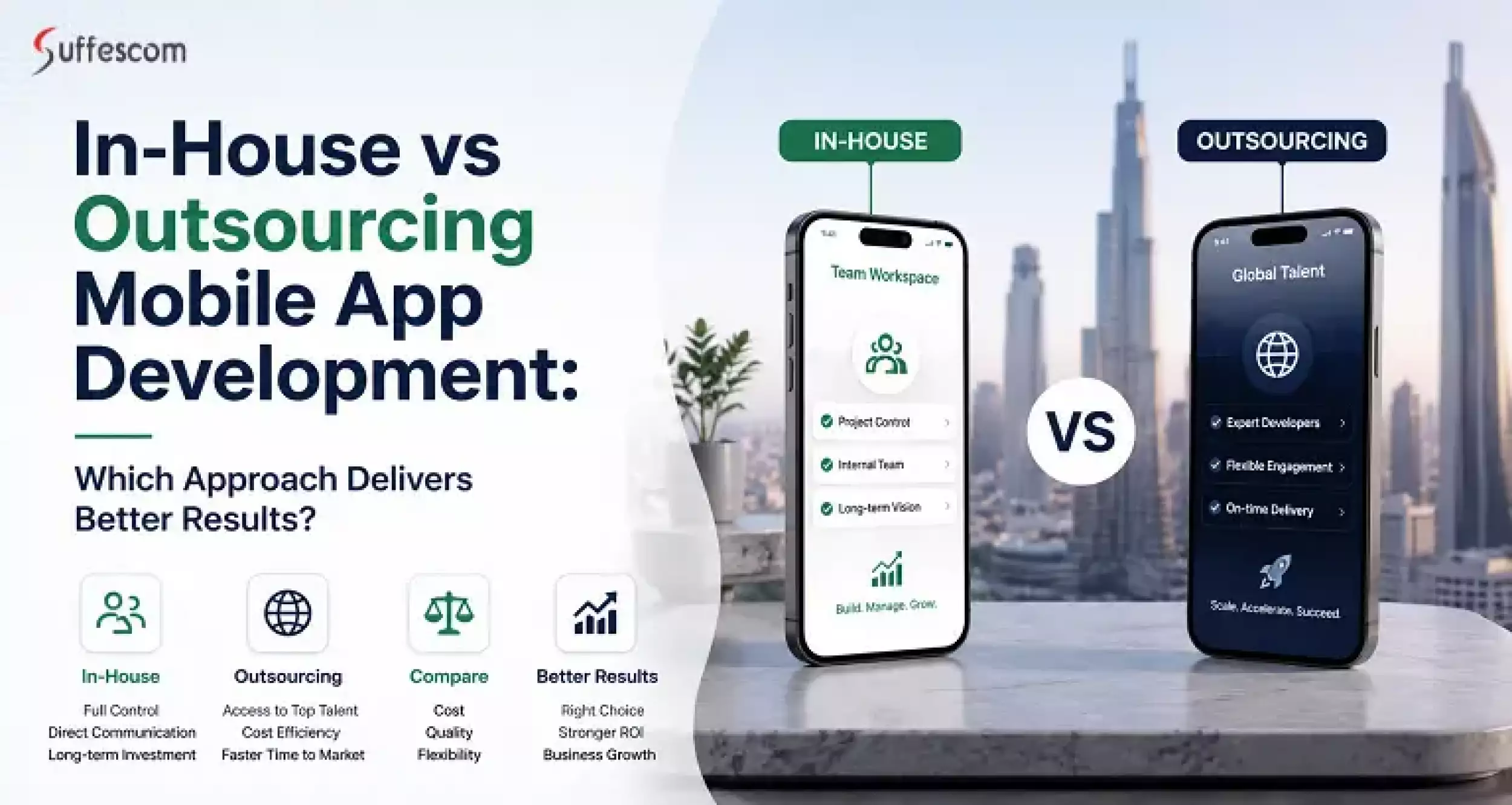
In this article, we will compare in-house vs outsourcing mobile app development, discuss its advantages and disadvantages, and give tips on picking the right development strategy.
Understanding In-House Mobile App Development
In-house mobile app development refers to the creation of your application with a group of developers who work for your firm. It means that there is no need for you to rely on an external contractor, but to employ the experts who will create the software for you. This way, you have better control over the process of development; however, it requires considerable financial investments from you.
What Is an In-House Development Team?
The in-house development team consists of software experts who will be developing software exclusively for you. The team collaborates with your stakeholders, knows what you want, and helps create your product during its entire lifecycle. Because your team is fully engaged in the business, all the decisions regarding product, technology priorities, and development processes are in your hands.
How In-House Mobile App Development Works
To begin with, it will mean selecting the proper specialists to work on your app according to the particular needs of your application. Next, the team will cooperate while coming up with a feature list, UX design, development, testing, and updating the app. Everything will be done internally, thus giving you complete control over the process of development.
Typical Team Structure
A well-rounded in-house team brings together specialists from different areas of product development.
| Role | Primary Responsibility |
| Product Manager | Defines the product vision, prioritizes features, and aligns development with business goals. |
| UI/UX Designer | Designs user journeys, wireframes, and interfaces that deliver a seamless user experience. |
| Android Developer | Builds and maintains native Android applications using platform-specific technologies. |
| iOS Developer | Develops native iPhone and iPad applications optimized for Apple's ecosystem. |
| Flutter/React Native Developer | Creates cross-platform applications from a shared codebase to reduce development time. |
| Backend Developer | Builds APIs, manages databases, and develops the server-side logic that powers the application. |
| QA Engineer | Tests the application, identifies defects, and ensures every release meets quality standards. |
| DevOps Engineer | Automates deployments, manages cloud infrastructure, and monitors application performance after launch. |
When Businesses Prefer an Internal Team
In-house developers are the right choice for those firms where applications play a major role in business operations and have to be constantly improved. In addition, this solution works well for companies requiring cooperation between the technical staff and management. Enterprises and technology companies, which have allocated budgets for engineering projects, tend to use this approach due to its stability, though at the cost of greater efforts and money investments.
Get expert guidance before investing in your mobile app project.
What Does Outsourcing Mobile App Development Mean?
Mobile application development outsourcing involves engaging a third-party company or team in the process of developing some parts or even the whole mobile application. Rather than engaging an internal team of developers, you collaborate with experts who have what it takes in terms of skills, tools, and experience to deliver the project. Depending on your specific requirements, you may choose to outsource one function or even outsource the whole process of development.
Types of Outsourcing Models
Businesses can choose from several outsourcing models depending on the level of involvement and flexibility they need.
Offshore Development
Offshore development requires collaboration with a team from another country. Offshore development is normally preferred in order to cut down the cost of developing software and to have a bigger pool of talent to choose from. Most of the Saudi Arabian firms tend to outsource projects to nations like India that have developed software industries. Because mobile app development outsourcing companies in India are highly reputed for great development expertise and engineering talent.
Nearshore Development
Nearshore development implies working with a company located in a neighboring country or region having common time zones. This type of development is beneficial in terms of cooperation and common working hours but still gives access to outside skills.
Onshore Development
Onshore outsourcing involves using a development partner that resides in the same country. It makes face-to-face interaction easier and ensures better understanding of the regulatory framework, even though the cost of development is usually high compared to offshore outsourcing.
Dedicated Development Team
A special team of developers works solely on your project during the entire time of the engagement period. Though the team is controlled by the outsourcing company, it acts like an integral part of your business and scales up depending on your needs.
Staff Augmentation
Augmentation staffing will enable you to employ developers that complement your team members without employing permanent staff members. While your internal managers supervise the process, the external developers plug skill gaps in your team.
Project-Based Outsourcing
The outsourcing party assumes accountability in executing the project as per the terms of the scope of work, budget, and time frame specified. It is suitable for organizations that would like to have a complete solution without worrying about development.
How Mobile App Outsourcing Works
It usually begins with specifying project requirements, business objectives, and technical expectations. After the selection of a development partner, both parties mutually decide upon the scope of work, the schedule, communication, and deliverables. Thereafter, the external team is responsible for designing, developing, testing, deploying, and delivering frequent updates. Even after the launch, many firms provide maintenance and additional technical support.
Popular Outsourcing Destinations for Saudi Companies
Saudi companies prefer to partner with outsourced software developers according to their knowledge base, communication skills, and experience rather than their pricing only. India is still one of the favored destinations due to its huge number of engineers and vast experience in developing enterprise and bespoke mobile applications. Developers from Eastern Europe, the Middle East, and North Africa (MENA) regions are also used in case more coordination is needed.
Not sure which development model fits your business?
Let's help you decide.
In-House vs Outsourcing Mobile App Development: Side-by-Side Comparison
Both the development approaches can help you create a successful mobile application, but there is a different focus on the business requirements for both of them. The in-house approach will give you greater control and ownership of the application, while the outsourced approach will allow you to use experienced personnel and be more flexible.
| Factor | In-House Team | Outsourcing |
| Initial Cost | High | Low to Moderate |
| Hiring Time | Weeks to Months | Days to Weeks |
| Development Speed | Moderate | Fast |
| Technical Expertise | Limited to Internal Team | Broad & Specialized |
| Team Scalability | Slow | Highly Flexible |
| Communication | Direct | Structured |
| Quality Assurance | Internal Standards | Provider Standards |
| Security | Full Internal Control | Shared Responsibility |
| Maintenance | Internal Team | Provider or Shared |
| Long-Term Cost | Higher | More Flexible |
| Innovation | Internal Experience | Cross-Industry Expertise |
| Risk Level | Hiring & Retention | Vendor Selection |
Cost Comparison of In-House vs Outsourcing Mobile App Development
Cost is usually what determines the selection of a model of development, but the actual cost is far more than just paying salaries to developers. Creating a team of developers involves continual costs of hiring, creating infrastructure, software development, and retaining people. Outsourcing combines a lot of these costs into one engagement.
Recruitment Costs
Hiring capable mobile application developers takes up too much time and money. Apart from recruiting fees, companies incur other expenses like sourcing, technical interviews, and training even before development can commence. The outsourcing model saves firms all those initial costs of hiring since the outsourced company already has a ready team for the job.
Employee Salaries
The in-house team demands fixed salaries for each month irrespective of the workload on the project. The total cost would include bonus, insurance, holiday leaves, and many other employment benefits. In outsourcing, you are paying for the agreed scope of the work or team engagement.
Infrastructure Costs
The internal team requires office space, development machines, testing equipment, cloud computing power, and networking environments. The costs associated with these will occur throughout the course of the project. Outsourcing companies handle all of this infrastructure.
Software Licensing
Developers need paid software to design, manage projects, test software, collaborate on coding, and ensure security. The firms with an in-house development team need to acquire and renew the licenses for such software. Such outsourcing firms have already acquired these tools for development.
Outsourcing Pricing Models
The options usually offered by the outsourcing vendors include various methods depending upon the nature of the project. The fixed-price contract works well for well-defined projects, while a dedicated team is ideal for development projects. Time and material pricing works well for dynamic businesses.
Hidden Costs Businesses Often Miss
Most firms only consider the cost of mobile app development and ignore the cost of other factors that may arise in the future. Late hiring, labor churn, inefficiencies in onboarding, and continuous training are some of the factors that may raise the overall cost of employing an in-house team. Outsourcing is also associated with hidden costs, but they are related to bad outsourcing decision-making.
Overall Cost Comparison
| Expense | In-House | Outsourcing |
| Hiring | High | None |
| HR & Administration | High | None |
| Office & Infrastructure | High | Included |
| Equipment | High | Included |
| Software Tools | High | Usually Included |
| Training | Ongoing | Included |
| Employee Benefits | Required | Not Applicable |
| Maintenance | Internal Team | Provider or Shared |
Speed to Market: Which Development Model Delivers Faster?
In most instances, the timely release can prove equally important to the appropriate product. It ensures that the idea is validated, tested, user feedback collected, and opportunities exploited before the competition. The kind of development methodology used has a lot of impact on the speed of the release.
Time Required to Build an Internal Team
The process of forming an in-house team is time-consuming, as it entails recruiting the right specialists, onboarding them, setting up a development environment, and setting up the process flow. The lack of experienced professionals may lead to an increase in the duration of the process.
Project Kickoff Timeline with an Outsourcing Partner
The outsourcing firm will have an advantage since they are now prepared to work early on account of the team being in place already. Once the scope of the project is finalized, the developers, designers, and quality assurance engineers will be in position to begin immediately. This will save a lot of time before development starts.
Reducing Development Delays
Whatever the kind of development model used, delays usually result from changes in requirements rather than programming. The project objectives should be clear, realistic deadlines should be set, and there should always be regular review and feedback from stakeholders. Organizations that know their needs right from the start and can make decisions fast will surely launch their projects on time.
Speed Comparison
| Factor | In-House | Outsourcing |
| Team Setup | Weeks to Months | Days to Weeks |
| Project Kickoff | After Hiring | Almost Immediate |
| Resource Availability | Depends on Recruitment | Project-Ready Team |
| Time to Market | Moderate | Faster |
Quality, Innovation, and Technical Expertise Compared
The quality of mobile applications is not dependent only on technical expertise but also on the experience of the team and the engineering and problem-solving abilities of the team members. While internal and external development teams are equally capable of producing quality products, their strengths differ.
Access to Emerging Technologies
The internal team gains experience through time, but constantly adapting to new technologies requires constant training and recruitment. Outsourcing companies normally operate in areas like artificial intelligence, cloud computing, cross-platform technologies, Internet of Things (IoT) app development, and enterprise software, allowing companies to benefit from specialists instantly without increasing the size of the internal team.
Experience Across Multiple Industries
In-house teams have an understanding of just one company and its procedures. In contrast, outsourced teams have the experience of dealing with projects in different sectors such as:
- Retail software development
- Developing logistics platforms
- Building government projects
All of this makes it possible for them to suggest successful solutions to the development process.
Code Quality Standards
The quality of code is determined by sound engineering practice and not necessarily the development methodology being followed. Good software development teams adhere to coding guidelines, conduct code reviews, have automated tests, and write comprehensive documentation in the course of the entire development process.
Agile Development Practices
Modern-day software developers usually make use of the Agile approach for the development of their software. This is due to the reason that using this process makes it easier for organizations to validate their concepts and make changes accordingly.
Quality & Expertise Comparison
| Factor | In-House | Outsourcing |
| Technology Exposure | Limited to Internal Experience | Broad, Multi-Industry |
| Domain Expertise | Business-Specific | Cross-Industry |
| Code Quality | Internal Standards | Established Engineering Practices |
| Innovation | Team Dependent | Experience from Diverse Projects |
| Agile Maturity | Varies by Organization | Typically Well Established |
Security, Compliance, and Intellectual Property Considerations
Security needs to be considered prior to development rather than at the end, when the app has already been developed. It doesn't matter whether your business chooses to develop the app within their own company or outsource; security must always be considered, as well as adhering to all local laws in Saudi Arabia, especially for certain industries like finance and health.
Data Privacy in Saudi Arabia
Organizations that collect or process personal information will be required to conform to the laws of Saudi Arabia for the protection of personal data. Appropriate security measures will need to be put in place by development teams.
NDA and Intellectual Property Ownership
Always ensure that before disclosing any business ideas or technical documents, a Non-Disclosure Agreement (NDA) is signed. It is important to note that the development agreement needs to define who will own the source code, designs, documents, and all other forms of intellectual property.
Secure Development Lifecycle (SDLC)
Security must be considered at each step of development and not just in testing. The Secure Development Lifecycle (SDLC) encompasses secure coding techniques, code review, vulnerability assessment, pen testing, and continuous monitoring of security threats prior to deployment.
ISO Certifications to Look For
When using third parties for your software development, take into consideration not only their technical skills but also their security qualifications. ISO 27001 is a standard of information security management, while ISO 9001 is one of quality management.
Security & Compliance Comparison
| Factor | In-House | Outsourcing |
| Data Control | Complete Internal Control | Shared with Provider |
| PDPL Compliance | Business Responsibility | Shared Responsibility |
| Intellectual Property | Fully Internal | Defined by Contract |
| Security Practices | Internal Standards | Depends on Provider |
| Certifications | Organization-Dependent | Often ISO Certified |
Get a development strategy tailored to your business goals.
Communication, Collaboration, and Project Management
Effective mobile app development involves more than technical skills alone. Effective communication, delineation of roles and responsibilities, and effective project management ensure that development is progressing efficiently without unnecessary costs. In-house development teams work seamlessly as they belong to the company, but outsourced development teams can work equally effectively.
Managing Remote Development Teams
Remote development will be effective if everyone has the same expectations right from the beginning. Sprint meetings, documentation, and monitoring will ensure that everything is on track. Companies should have a well-defined process for decision-making to avoid delays in development.
Time Zone Advantages for Saudi Businesses
There are instances when time zone differences will affect collaborations, but these should not hinder the progress of a project. In many cases, outsourcing firms have their schedule set to coincide with those of Saudi Arabia, which allows for easy communication, feedback, and problem-solving on a daily basis. Effective communication becomes more crucial than sharing a time zone.
Best Collaboration Tools
Collaboration tools used nowadays ensure ease of working simultaneously within a distributed team. Jira for tracking projects, Slack or Microsoft Teams for communication purposes, Figma for designing collaborations, as well as GitHub or GitLab for coding, ensure transparency of all processes in projects and make it possible for businesses to be aware of everything that happens.
Collaboration Comparison
| Factor | In-House | Outsourcing |
| Daily Communication | Direct | Structured |
| Project Visibility | High | High with Reporting |
| Time Zone Coordination | Not Required | Depends on Partner |
| Collaboration Tools | Internal | Shared Platforms |
| Project Management | Internal Team | Shared or Provider-Led |
How Vision 2030 Is Changing Mobile App Development Strategies in Saudi Arabia
In Saudi Arabia, the ongoing digital revolution is transforming the way businesses handle software development. With businesses working on upgrading themselves and their offerings, mobile applications are no longer seen as an afterthought but are becoming an essential part of their investment. This change is leading businesses to opt for development approaches that can achieve all three qualities at once.
Government Digital Transformation Initiatives
Vision 2030 in Saudi Arabia makes sure that there is continuous investment in digital infrastructure, smart cities, e-government applications, and AI technology. This trend makes the requirement for secure, scalable, and mobile applications for the private and public sectors even more evident. Organizations that go digital from the very beginning face an easier task of meeting customer demands.
Rising Demand for Custom Mobile Applications
Companies are shifting from generic software towards those designed based on their process and customer needs. No matter whether it's a banking app, health care app, logistics app, or retail app, custom apps will be more flexible, secure, and easily integrated with the system.
Why Businesses Are Choosing Strategic Technology Partners
The more complex the project, the more companies tend to go for long-term technology partners rather than vendors on an ad hoc basis. Apart from providing the necessary technical expertise and experience in project delivery, the technical partner provides continued support after project launch, enabling companies to innovate quickly without focusing on other activities.
Development Strategy by Business Goal
| Business Goal | Recommended Approach |
| Faster Product Launch | Outsourcing |
| Long-Term Product Ownership | In-House |
| Rapid Team Scaling | Outsourcing |
| Continuous Innovation | Hybrid |
| Enterprise Modernization | Hybrid |
Decision Framework: Which Development Model Fits Your Business?
The ideal approach will depend on the objective that your company aims to attain. The startup company that introduces its first minimum viable product (MVP) will not have the same objectives as the established firm that is trying to update its aging technology.
Best Choice for Startups
The startup will always find outsourcing advantageous. The process will help cut the time required for creating an MVP, will be cost-effective at the recruitment stage, and will provide the possibility to collaborate with professionals without having a full-fledged engineering staff on board.
Best Choice for SMEs
For smaller and mid-sized organizations, there is always a need to find the right balance between costs and growth. Having an in-house development team or outsourced developers can help you start without having to incur expenses on an engineering department.
Best Choice for Enterprises
It is normal for bigger companies to need continuous growth, better governance, and more integration with internal processes. A number of companies have their own engineering group, but they will work together with outside experts to get something done quickly.
Best Choice for Government Organizations
Government-related projects require stringent security, compliance, and operational support needs. Organizations can either create their own teams based on procurement policy or the complexity of the project, or adopt a hybrid approach.
Decision Matrix
| Business Type | Recommended Model | Why |
| Startup | Outsourcing | Lower investment and faster launch |
| SME | Outsourcing / Dedicated Team | Cost-effective with room to scale |
| Enterprise | Hybrid | Balances control with specialized expertise |
| Healthcare | Hybrid | Meets compliance while accessing niche skills |
| Banking | In-House / Hybrid | Greater security and governance |
| Retail | Outsourcing | Faster delivery and seasonal scalability |
| Logistics | Hybrid | Supports continuous improvement and scaling |
| Government | In-House / Hybrid | Stronger control and regulatory compliance |
Get expert guidance before choosing your development model.
Pros and Cons of In-House Mobile App Development
An in-house team provides your business full ownership of the product and flexibility in molding the development according to internal business interests. On the other hand, it involves a commitment in the long run to recruiting, retaining, and managing the team. Both aspects provide insight into determining if this is right for you.
| Advantages | Disadvantages |
| Complete control over development | High upfront investment |
| Strong alignment with business goals | Longer hiring process |
| Faster internal decision-making | Ongoing salary and benefit costs |
| Better knowledge retention | Limited access to niche expertise |
| Easier collaboration with internal teams | Slower team scaling |
| Greater visibility into project progress | Higher operational overhead |
| Stronger control over sensitive data | Employee turnover can disrupt projects |
| Long-term product ownership | Continuous training and upskilling required |
Common Mistakes Businesses Make When Choosing a Development Model
It is not only a question of budgeting when deciding whether to go for an in-house team or outsourcing. The reason behind most projects facing delays and exceeding budgets is the fact that the development approach does not fit the requirements of the company in the long run.
Focusing Only on Cost
Affordability is not always synonymous with efficiency. Firms that focus on short-term costs neglect aspects such as code quality, scalability, maintenance, and further development. While a lower initial cost will eventually incur greater costs due to subsequent rework.
Ignoring Long-Term Maintenance
The development of the app is just the beginning. Ongoing maintenance of the application involves updating, patching, and fixing bugs. Choosing a model that overlooks the post-launch development process will bring about some problems.
Choosing Vendors Without Technical Evaluation
Choosing a developer only for low prices or marketing statements is a very bad practice. It is necessary to look into the portfolio, skills, experience of the company, and customer reviews before choosing a developer. Proper evaluation will decrease the risks of the project.
Poor Requirement Documentation
Unclear specifications may result in fluctuating expectations, delays, and cost overruns. Specification of project objectives, key features, user workflows, and metrics of success prior to development can provide a solid basis for completion.
Underestimating Project Management
Every development team requires proper guidance even if it is a competent one. In the absence of good communication, feedback, and project management, minor problems may easily become huge obstacles. Clarifying ownership and making decisions helps in keeping the project on track.
Validate your development strategy with our specialists.
How to Choose the Right Mobile App Development Partner in Saudi Arabia
Selecting a good development partner is just as important as choosing an appropriate development methodology. An appropriate development partner brings expertise in terms of technology, communication, and a methodology for delivering a project with the least risk possible from the very beginning.
Technical Expertise Checklist
Begin by assessing the technological expertise of the company. This includes checking the experience of the company in native and cross-platform development, backend development, cloud-based architecture, APIs, DevOps, and application security. In case your project involves any regulation in your industry, then make sure that the company is familiar with all the regulatory aspects involved in such a situation.
Questions to Ask Before Hiring
The discovery process will uncover how the company develops software. Question them on how they manage timelines, scope changes, code quality, intellectual property protection, and post-deployment support. Their responses should be specific and realistic and should include concrete examples.
Portfolio Evaluation
The effectiveness of your portfolio goes beyond just having nice-looking applications. Look at similar projects that you are planning to build and examine how functional, scalable, and successful they are. Your experience within the industry is important because it decreases the learning curve.
Client Testimonials
The clients' responses give information about the way the company works during the process of the project. You should search for those testimonials that speak about communication, delivery reliability, technology, and after-sales support rather than about the end product itself.
Post-Launch Support
The process of developing a mobile app does not end when it is launched into the market. You should ensure that your development company gives you post-development services, which include upgrading your application for its security, performance, and enhancements. Mobile app maintenance services make sure that your app remains secure and updated.
Future Trends in Mobile App Development Outsourcing
Outsourcing is becoming more than just about cost savings. Companies are looking to develop partnerships based on their expertise, innovation ability, and availability of new technologies, which would otherwise be hard to create in-house. Such developments are defining future approaches to mobile application development.
AI-Assisted Development
AI is improving the process of software development through automation of code writing, testing, debugging, and documentation. While the developer is still responsible for all decisions related to the design and strategy, the introduction of AI technology may assist in performing some tasks more efficiently.
Cross-Platform Frameworks
Flutter and React Native have become increasingly popular due to their ability to allow businesses to develop both Android and iOS applications from a single codebase. This has proved to be beneficial by saving both money and time.
Cloud-Native Applications
Modern mobile apps being developed use cloud-native technologies, which are scalable, highly available, and also very easy to incorporate into other applications. It is due to this reason that businesses can grow without changing the back-end architecture.
Low-Code Development
Although low-code app development is considered ideal for internal use and simple processes, custom application development is still considered better for customer-facing applications and enterprise environments.
Cybersecurity-First Development
Security is evolving to become a central part of the development process instead of a final step. Organizations now demand security throughout development, including secure code, security testing, and compliance with standards.
Discuss your mobile app requirements with our experts.
Conclusion
Both in-house and outsourcing development approaches can produce great mobile apps, yet they are meant for different purposes. In many cases in Saudi Arabia, this is simply a question of prioritization when it comes to speed, cost, and available resources. Prior to making the final decision, make sure to take into consideration all budgetary, timing, technical, compliance, and roadmap aspects of your project. The right choice of development approach is not always about picking a better one; it is more about finding what fits your business today and allows growth tomorrow.
Are you torn between hiring an in-house team and outsourcing? Let our mobile app development expert assist you in choosing the right development model according to your project requirements, budget, and business objectives. Book your free consultation today.
FAQs
Is outsourcing mobile app development cheaper than hiring an in-house team?
Yes, generally, since there is no cost for hiring people, benefits for employees, opening the office, or buying software licenses because the whole thing has been outsourced. The business only pays for their skill sets.
What are the risks of outsourcing app development?
The most common risks associated with outsourcing an app development team are:
- Using a new vendor
- Undefined project requirements
- Poor communication
- Insecure procedures
All these risks can be addressed by reviewing the vendor's portfolio and negotiating the contract.
Which is better for startups: in-house or outsourcing?
Usually, for startups, outsourcing is considered an ideal option. This is because it requires low capital investment. It enables fast product development. And once the product becomes successful, startups can start to build their engineering teams while outsourcing the necessary skills.
How much does mobile app development cost in Saudi Arabia?
There are a lot of factors that make up the cost of mobile app development in Saudi Arabia. Usually, this includes the following:
- App's complexity level
- Technology used
- Type of development
Can outsourced developers maintain my app after launch?
Yes. Generally, mobile application development companies offer post-launch services that cover bug fixes, security improvements, performance enhancements, OS compatibility, and functionality. Make sure you have discussed maintenance terms before entering into any development contracts.
Is outsourcing secure for enterprise mobile applications?
Yes, but you must select developers who are trustworthy and will develop your application using safe coding practices. These companies must have non-disclosure agreements and stringent access control procedures.
How do I protect my app idea before outsourcing?
Before providing any confidential information, you should do the following:
- Sign a Non-Disclosure Agreement (NDA)
- Get the intellectual property ownership
- Gain rights to source code
- Ensure confidentiality obligations are covered by the development agreement
What is the difference between staff augmentation and outsourcing?
Staff augmentation means employing external programmers alongside internal staff, while outsourcing means handing over part of the work to an external agency. Your organization handles the management on a day-to-day basis.
Should Saudi businesses choose local or offshore app developers?
It all depends on personal preferences. Regional partners may be more knowledgeable about the region and collaborate directly. On the other hand, offshoring provides access to a larger talent pool and helps reduce development costs. Most Saudi firms choose to cooperate with experienced offshoring companies that handle the project and work within working hours.
How long does it take to build a mobile application?
Development timelines are determined by the complexity of the projects. The easiest MVP can be developed within three to five months. But more sophisticated enterprise applications require nine months or even more.
Can I outsource only UI/UX design or QA testing?
Yes, there are quite a number of development firms that offer such specialized services, allowing firms to outsource only certain components such as:
- QA
- UI/UX
- DevOps
- Backend
- Security testing
What technologies should a mobile app development company offer?
A good development partner must be able to develop native applications on the Android and iOS platforms. They must be well-versed in cross-platform application development. They must excel at in the following areas:
- Robust back-end development
- Cloud platforms
- API integrations
- DevOps
- Security
How do Agile and Scrum improve outsourced app development?
Agile and Scrum divide the development process into small iterations. This way, it becomes easier to track the progress of the project. It also becomes easier to provide feedback and make changes as business requirements change.
What industries benefit most from outsourced mobile app development?
Usually, the following industries benefit from outsourcing rather than building an in-house team:
- Healthcare
- Banks
- Retail
- Logistics
- Education
- Manufacturing
- Real estate
- Government
Is a hybrid development model better than fully in-house or outsourced?
Absolutely, for many new businesses. The hybrid system allows the internal team to retain their strategic advantage while external experts deliver fast results and bring unique expertise without increasing permanent staffing levels.
How do I evaluate a mobile app development company's portfolio?
While evaluating a mobile development company's portfolio, these are the key things you should look at:
- Projects and how they compare to other companies offering the same services
- Technical challenges they have dealt with and delivered the results for
- Tangible success they achieved through measurable business results