+971-8000321216



What happens when legal work keeps growing, but time and accuracy cannot be maintained any further? Law firms and enterprises in UAE face this issue every day as regulations expand, cases increase and clients want clear answers without delay. This is where LegalTech software development helps to support teams behind the work by decreasing manual effort and bringing clarity to complex legal tasks.
Across the UAE more legal teams are choosing technology to stay in control. Recent industry data indicates that the global LegalTech market is projected to reach a valuation of $38.1 billion by 2026, with expectations for it to double to $78.1 billion by 2036. This adoption shows the actual pressure on legal professionals who need reliable systems to keep work moving without errors.
In this blog, we explain how LegalTech software development in UAE helps law firms and enterprises. We also cover key areas such as development process costs, core features and how the right LegalTech solution can improve everyday legal operations.
What is LegalTech Software Development?
LegalTech software development means developing digital solutions designed particularly for legal professionals and legal operations. These solutions help law firms and enterprises handle legal work better while staying compliant with regulations in UAE.
Key aspects of Legal software development include:
- Digitizing legal processes such as case handling, contract review and compliance tracking
- Creating custom software solution based on law firm workflows
- Automating repetitive legal tasks to decrease manual effort and human error
- Ensuring compliance with UAE legal frameworks and data protection laws like PDPL
- Securing sensitive legal data with enterprise grade security controls
- Enabling better collaboration between lawyers, clients and internal teams
Build a Secure Legal Platform Aligned with UAE Laws
Why Law Firms and Enterprises in UAE Need LegalTech Software Solutions
Legal teams in the UAE work within a strict and well defined legal framework. New obligations and frequent updates make it difficult to manage everything through emails and spreadsheets. LegalTech gives law firms and enterprises a practical way to stay compliant, organized and responsive.
Increasing Legal Complexity and Regulatory Requirements in UAE
Law firms and legal teams should comply with regulations like Federal Decree Law No. 45 on Personal Data Protection (UAE PDPL) and sector specific rules issued by DIFC Data Protection Law No. 5, where tracking consent records, contract clauses and audit trails manually is risky. LegalTech solutions for law firms help centralize regulatory requirements and reduce compliance gaps.
Demand for Automation and Efficiency
Daily legal work includes contract reviews, approvals, filings and internal reporting. Doing this manually increases delays and possibilities of errors. LegalTech software development UAE enables automation of document workflows, case tracking and approvals, which helps teams work faster without compromising on accuracy.
Client Expectations for Faster and Transparent Legal Services
Clients, when getting legal services, want clear timelines, instant updates and easy access to information. If it is a corporate contract or a litigation matter, LegalTech allows law firms and enterprises to share real time status updates and maintain transparent communication.
Types of LegalTech Software Development Solutions
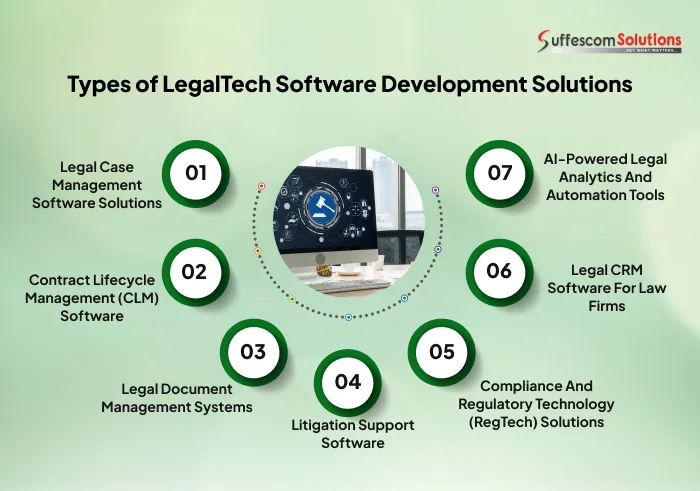
LegalTech software development solutions are designed to support different areas of legal work, from daily case handling to compliance management. Each type of solution focuses on solving practical problems that legal teams face while improving accuracy, control, and visibility across legal operations.
Legal Case Management Software Solutions
Legal case management software helps legal teams manage each aspect of a legal matter in one system. It provides a precise view of case status and its timelines, which is important for managing numerous matters simultaneously.
- Centralized case and matter records
- Automated reminders for court dates and deadlines
- Task allocation and responsibility tracking
- Secure storage of case documents and evidence
Contract Lifecycle Management (CLM) Software
CLM software controls every stage of a contract’s lifecycle, starting from drafting to execution and renewal. It helps legal teams decrease risk by guaranteeing contracts that follow approved templates with regulatory and business requirements.
- Contract drafting with clause libraries
- Multi level approval and review workflows
- Tracking of obligations and renewal dates
- Compliance monitoring and audit readiness
Legal Document Management Systems
Document management systems organize legal documents in a secure environment. These systems decrease document loss, prevent version conflicts and support secure collaboration among legal teams.
- Structured storage with metadata tagging
- Version control and change history
- Advanced search and document retrieval
- Role based access and confidentiality controls
Litigation Support Software
Litigation support software assists legal teams during dispute investigations and litigation. They help manage large volumes of data and make case preparation more efficient and accurate.
- Data collection from email, files and databases
- Review tools for filtering and relevance analysis
- Evidence tagging and case mapping
- Support for litigation and arbitration workflows
Compliance and Regulatory Technology (RegTech) Solutions
RegTech solutions are another type of LegalTech software which help legal teams stay compliant with changing laws and regulations in the UAE. They provide visibility into compliance status and reduce the risk of regulatory issues.
- Monitoring of regulatory obligations and updates
- Compliance documentation and reporting tools
- Risk assessment and control tracking
- Audit support and regulatory readiness
Legal CRM Software for Law Firms
Legal CRM software helps law firms manage client relationships beyond case handling. It supports better communication and long term client engagement.
- Client and matter history management
- Communication and follow up tracking
- Lead and referral management
- Centralized client information access
AI-Powered Legal Analytics and Automation Tools
AI-powered LegalTech tools support decision making and reduce repetitive work. They assist legal professionals by analyzing large datasets and automating routine legal tasks.
- Automated contract and document analysis
- Legal research support and insight generation
- Risk detection and pattern analysis
- Workflow automation for routine legal processes
LegalTech Software Development Process
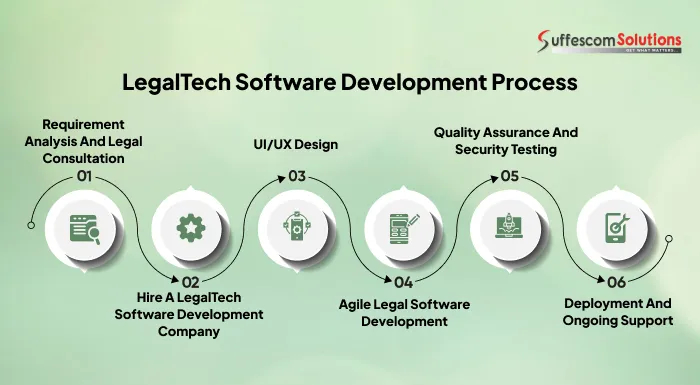
Legal software works best when it is built according to the legal business’s needs and not assumptions. That’s why a well defined Legal software development process focuses on clarity and long term usability rather than rushing to deliver features.
Requirement Analysis and Legal Consultation
This stage is about knowing the legal environment before writing any code or designing the software. Legal firms should know how cases are handled and where delays or risks are likely to occur. Also, regulatory obligations specific to the UAE are reviewed at this stage to avoid future compliance issues.
- Mapping current legal workflows and daily tasks
- Identifying gaps, inefficiencies and risk points
- Reviewing applicable UAE laws and compliance needs
- Defining clear software goals and priorities
Hire a LegalTech Software Development Company
Next, selecting the right software development company in UAE shapes the entire result. Legal software requires experience with confidentiality, data retention and strict access control. A capable partner with a reliable software development team understands that mistakes in legal systems can have serious consequences for the future.
- Proven experience in LegalTech or enterprise legal systems
- Strong understanding of data security and confidentiality
- Familiarity with UAE legal and business environments
- Commitment to long term maintenance and support
UI/UX Design
Legal professionals use software for long periods every day. Poor design slows them down and increases errors. UI/UX design in LegalTech focuses on reducing effort and making complex information easier to understand and use.
- Clean layouts that reduce cognitive load
- Logical navigation for cases, contracts and documents
- Dashboards designed for different legal roles
- Consistent user experience across devices
Agile Legal Software Development
Next, core agile development begins with software developed using the latest technologies, like AI and blockchain, in a controlled and flexible way. Instead of waiting months to see results with agile methodology, legal teams can review progress regularly and guide improvements based on real needs.
- Development in short manageable cycles
- Continuous feedback from legal users
- Early detection of usability or logic issues
- Ability to adapt to regulatory or business changes
Quality Assurance and Security Testing
Legal systems must be accurate and secure, which is why next thorough testing and QA is done to check that it goes beyond basic functionality and ensures data protection and system reliability under real world conditions.
- Functional testing across all legal workflows
- Security testing for access and data protection
- Performance testing under heavy usage
- Validation against UAE compliance requirements
Deployment and Ongoing Support
After the development of the LegalTech software in UAE, the focus shifts to stability and long term performance. Deployment must be handled carefully and support should continue as legal needs and regulations evolve.
- Secure deployment on cloud or on-premises environments
- System monitoring to ensure consistent performance
- Bug fixes and performance optimization
- Regular updates to meet regulatory and operational changes
Tech Stack Used to Develop a Legal Software
| Layer | Technologies Used | Purpose |
| Frontend | React.js, Angular, Vue.js | Builds responsive interfaces for lawyers, legal teams, and clients |
| Backend | Node.js, Java, Spring Boot, .NET Core | Handles legal workflows, business logic, and system integrations |
| Database | PostgreSQL, MySQL, MongoDB | Stores case data, contracts, documents, and audit records |
| Cloud Infrastructure | AWS, Microsoft Azure, Google Cloud | Enables secure hosting, scalability, and high availability |
| AI and Machine Learning | Python, TensorFlow, spaCy, OpenAI APIs | Supports document analysis, legal research, and automation |
| Search and Indexing | Elasticsearch, Apache Solr | Allows fast search across legal documents and case records |
| Security | OAuth 2.0, JWT, AES 256, SSL, TLS | Manages authentication, encryption, and access control |
| Compliance and Auditing | Custom audit modules, log management tools | Maintains audit trails and compliance reporting |
| Integration | REST APIs, GraphQL, Webhooks | Connects legal systems with ERP, HR, and finance tools |
| DevOps | Docker, Kubernetes, CI/CD pipelines | Supports automated deployment, monitoring, and system stability |
Key Features of a LegalTech Software Solution
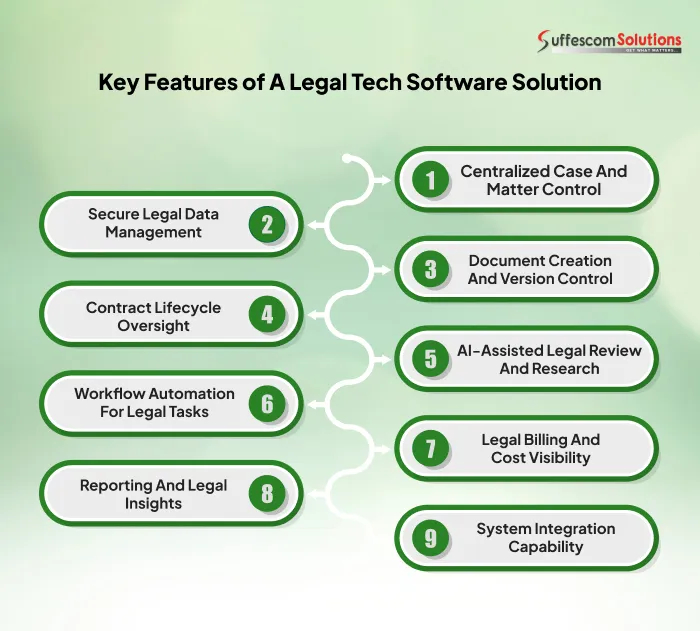
Let’s discuss the main features a LegalTech software solution should have:
Centralized Case and Matter Control
This feature keeps every case detail in one place. Legal firms can view case status, related documents, deadlines and internal notes without switching systems again and again. It helps avoid any missed actions and gives full clarity on active and closed matters.
Secure Legal Data Management
Legal data is protected through strict access controls, encryption and activity logs. Every document action and user change is recorded, which helps in keeping confidentiality and internal accountability.
Document Creation and Version Control
Another feature that should be present in the software is that legal documents can be drafted, stored and updated within the same software. Built in version control eliminates confusion and ensures businesses always work on the right document and have a clear edit history.
Contract Lifecycle Oversight
Contracts are tracked from creation to execution and renewal. The system should highlight obligations, key hearing dates and approval stages, which helps reduce contractual risk and delays.
AI-Assisted Legal Review and Research
AI tools within the software assist with document review and legal research by identifying key terms and relevant references. This reduces manual review time while keeping final decisions with legal professionals.
Workflow Automation for Legal Tasks
Routine legal tasks such as approvals, reminders and status updates should be automated. This helps reduce follow-ups and manual tracking while keeping work moving smoothly.
Legal Billing and Cost Visibility
Billing activity and legal spend can be tracked in one system with a billing and visibility feature. This helps law firms manage billable work and allows enterprises to monitor legal costs more clearly.
Reporting and Legal Insights
With features like reporting and legal insights, you can gain knowledge into workload turnaround time and risk areas. This helps legal leaders make informed decisions and improve operational planning.
System Integration Capability
The platform should connect with finance, HR, ERP and document systems. This ensures legal data stays consistent across departments and reduces duplicate work.
Compliance and Data Security Standards in UAE for LegalTech Software Development
- Compliance with Federal Decree Law No. 45 of 2021 (UAE Personal Data Protection Law) for handling personal and sensitive legal data
- Alignment with DIFC Data Protection Law No. 5 of 2020 for organizations operating within DIFC
- Role-based access control to restrict legal data by user responsibility
- Multi factor authentication integration for secure user access
- End to end encryption for data at rest and data in transit
- Secure cloud hosting with approved regional data centers
- Regular vulnerability assessments and security updates
- Defined incident response and data breach management procedures
Cost of LegalTech Software Development in UAE
The cost of LegalTech software development in UAE depends on the features, security requirements and level of customization. Usually, the cost range is between AED 30,000 to AED 130,000.
Legal Software Cost Based on Complexity
| Project Complexity | Estimated Cost (AED) | Estimated Timeline |
| Basic LegalTech Solution | AED 30,000 to AED 45,000 | 6 to 8 weeks |
| Mid-Level LegalTech Solution | AED 55,000 to AED 85,000 | 10 to 14 weeks |
| Complex LegalTech Solution | AED 95,000 to AED 130,000 | 16 to 24 weeks |
These estimates provide a practical reference point. Final cost depends on legal requirements, deployment model and integration needs.
Key Factors That Influence LegalTech Development Cost
Number of features such as case management, contracts compliance and analytics
- Level of customization required for firm or enterprise workflows
- Type of legal software you want to build
- Security requirements, including encryption and audit trails
- Compliance needs related to UAE, PDPL, DIFC or ADGM regulations
- Integration with existing ERP, HR, finance or document systems
- Deployment model: cloud or on-premises
- Use of AI features such as document analysis or legal research tools
Benefits of Legal Software Development for Law Firms and Enterprises
Legal work is demanding and even small delays or mistakes can create issues. LegalTech software helps make everyday legal work predictable and easier to handle for both law firms and enterprise legal teams.
Improved Productivity and Cost Efficiency
Legal teams spend a lot of time on tasks that do not require very much time like searching files, updating records or following up on approvals. LegalTech software decreases this workload so lawyers can focus on actual legal work.
Faster Legal Operations and Case Resolution
When information is scattered, work slows down. Through legal software, everything is in one place, so teams do not waste time looking for documents or updates. Deadlines are clearer and cases move without unnecessary delays.
Enhanced Collaboration and Knowledge Management
Legal work involves people working on the same matter. LegalTech software makes it simple for teams to share updates. Everyone stays on the same page even when working from different locations.
Reduced Human Error Through Automation
Manual work increases the chance of missed dates or incomplete records. Automation helps prevent these issues by following set processes and keeping track of every change. This gives legal teams more confidence in their work and fewer last minute problems.
Top 5 LegalTech Software Development Companies in UAE
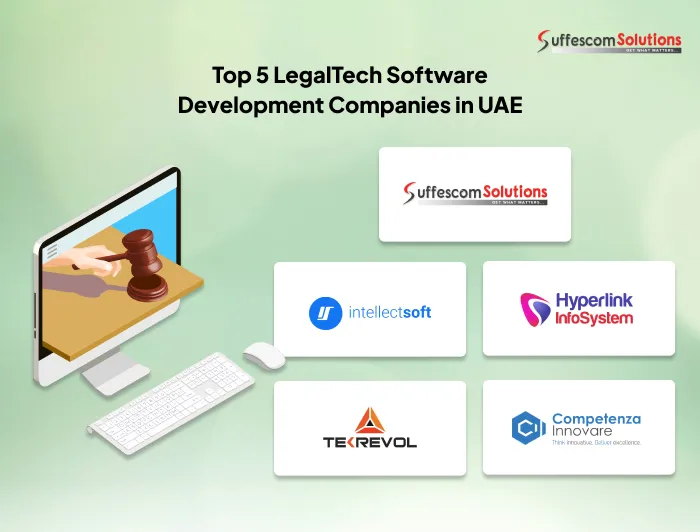
Now, let’s discuss the top 5 legal software development companies in UAE, which you can work with to develop a custom legal software solution based on your business needs.
1. Suffescom
Suffescom is a top mobile app development company in UAE that delivers fully custom LegalTech platforms like a lawyer consultation app, an AI legal case management system, and more. The company focuses on scalable architecture and long-term product stability and has developed 1000+ apps and software solutions for various industries.
2. IntellectSoft
IntellectSoft specializes in enterprise grade digital solutions for large organizations. Their Legal software development services emphasize system integration, data security, and analytics-driven insights. They are well-suited for enterprises managing complex legal operations across multiple departments.
3. Hyperlink Infosystem
Hyperlink Infosystem provides custom software development services with a focus on flexibility and cost control. Their LegalTech solutions include legal document management systems, workflow automation, and client portals designed for law firms and growing legal teams.
4. Tekrevol
Tekrevol is one of the best 5 legal software development companies in UAE known for building product focused applications with strong UI and UX. In LegalTech projects, the company emphasizes usability and modern application design that improves daily legal operations.
5. Competenza Innovare
Competenza Innovare develops enterprise software solutions centered on process automation and compliance. Their LegalTech platforms focus on structured workflows, system integration and data governance for regulated environments.
How Emerging Technologies Are Transforming Legal Services in the UAE
Artificial Intelligence for Legal Decision Support
AI will move from just document review and help with legal reasoning by examining past case outcomes and patterns.
Example: An AI system suggests likely outcomes of a commercial dispute based on past UAE court rulings.
Natural Language Processing for Legal Understanding
NLP will help systems know legal language more accurately. This will improve contract analysis, legal research and regulatory interpretation in Arabic legal texts.
Example: A tool in legal software that compares Arabic contracts with English versions and flags clauses that are mismatched.
Predictive Analytics for Risk Forecasting
Predictive analytics will help legal teams get an estimate of timelines before taking any action. This helps with decreasing the chances of unexpected results.
Example: A legal software that anticipates how long a dispute may take based on past cases.
Blockchain for Legal Records and Evidence
Blockchain integration can be used to store legal records in a tamper proof way. This increases trust in document authenticity and legal evidence.
Example: Property agreements recorded on blockchain to avoid any ownership disputes.
Virtual Legal Assistants and Chatbots
AI-powered assistants will handle basic legal queries and document requests. This frees up time for legal professionals.
Example: A chatbot that answers basic contract or compliance questions for the legal teams.
Data Driven Compliance Monitoring
Future LegalTech systems will track regulatory changes in real time and alert legal teams automatically.
Example: Alerts when UAE data protection rules change, affecting client data handling.
Cloud Native Legal Platforms
Cloud native systems will offer better scalability and improved collaboration across locations.
Example: A law firm accessing case files securely from multiple offices in the UAE.
Conclusion
Legal work in the UAE is becoming more complex with stricter regulations, higher client expectations and growing volumes of cases and contracts. Relying on outdated methods like emails or disconnected tools is now not enough to manage this pressure. LegalTech software development gives law firms and enterprises a practical way to bring structure and control into their legal operations.
From case management and contract lifecycle tracking to compliance automation, LegalTech software solutions help legal teams save time, decrease errors and work with better clarity.
As technologies like AI and cloud platforms continue to shape legal services, those who invest in the right LegalTech solutions today will be prepared for the future. Also, with the right technology selection and a trusted legal software development company, law firms and enterprises in UAE can modernize their legal processes and stay prepared for future regulatory and business challenges.
Get a Custom Legal Software Consultation
FAQs
Q1. What is LegalTech software development?
Ans. LegalTech software development involves building solutions designed specifically for legal work such as case management, contract handling, compliance tracking and legal research for law firms and enterprises.
Q2. Who should use LegalTech software in the UAE?
Ans. LegalTech software is useful for law firms, corporate legal departments, regulated enterprises and businesses that manage contract compliance or legal documentation regularly.
Q3. Is LegalTech software compliant with UAE laws?
Ans. Yes, when built correctly, LegalTech software is designed to comply with UAE regulations such as the UAE Personal Data Protection Law PDPL and data protection laws applicable in DIFC and ADGM.
Q4. Can LegalTech software be customized for UAE law firms?
Ans. LegalTech solutions can be fully customized based on local legal workflows, practice areas, language needs and regulatory requirements specific to the UAE.
Q5. How secure is LegalTech software?
Ans. LegalTech software uses encryption, role-based access, audit logs and secure hosting to protect sensitive legal data and maintain confidentiality.
Q6. How long does it take to develop LegalTech software in UAE?
Ans. LegalTech software development timelines usually range from 6 weeks for basic solutions to 24 weeks for complex platforms with AI integrations and compliance automation.
Q7. How much does LegalTech software development cost in UAE?
Ans. The cost typically ranges between AED 30,000 and AED 130,000, depending on features, security complexity, integrations and level of customization.
Q8. Can LegalTech software integrate with existing systems?
Ans. Yes, LegalTech platforms can integrate with ERP, HR, finance, document management and email systems to ensure smooth data flow across departments.
Q9. Does LegalTech software support both cloud and on-premises deployment?
Ans. Most LegalTech solutions support cloud-based and on-premises deployment, so organizations can choose based on internal IT and data residency policies.
Q10. Can LegalTech software support Arabic language and bilingual documents?
Ans. Yes, LegalTech software can be built to support Arabic, English, and bilingual legal documents, including search and document analysis features.
Q11. Is AI used in LegalTech software?
Ans. AI is commonly used for document review, legal research, risk analysis, contract insights and workflow automation while keeping human oversight in place.
Q12. Can small law firms benefit from LegalTech software?
Ans. Yes, LegalTech is valuable for small and mid sized firms as it helps manage workload, reduce manual effort and compete with larger firms more effectively.
Q13. What type of LegalTech software should I start with?
Ans. Most law firms start with case management, document management or contract lifecycle management, depending on their immediate pain points.
Q14. Why is choosing the right LegalTech development partner important?
Ans. A reliable software development partner understands legal workflows, data sensitivity and UAE compliance requirements, which ensures the software is secure, scalable and future-ready.