+971-8000321216



Why are so many businesses in the UAE and Saudi Arabia moving away from manual tracking systems? The simple answer is that RFID tracking systems are becoming a practical part of how businesses in the UAE and Saudi Arabia manage movement assets and data. Businesses in different sectors are looking for ways to decrease manual tracking errors and get better operational visibility. RFID technology enables this by automatic identification without physical contact.
In the Gulf region, this shift is highly connected to national digital transformation programs like Vision 2030 and smart infrastructure investments. Ports and industrial zones are using RFID tracking systems to monitor inventory and items instantly. The RFID market is projected to grow at over 11.70 percent CAGR, and UAE and Saudi Arabia continue investing in such solutions for smart cities, supply chain modernization and automated compliance systems.
In this guide, we will discuss how RFID tracking systems work, how they are developed for regional requirements, cost and how technologies are extending RFID capabilities for future ready tracking systems.
What is RFID Technology?
RFID stands for Radio Frequency Identification. It is a wireless technology used to identify, track and manage physical objects through radio waves. Each object is attached with an RFID tag that carries a unique ID or data. When the tag enters the range of an RFID reader, the information is captured automatically without scanning or physical contact, which makes RFID best for high volume and fast moving environments.
Types of RFID Tags
- Passive RFID
Passive RFID tags do not contain a battery and work by the signal from the reader. Their read range varies from a few centimeters up to 10–15 meters based on frequency and environment. These tags are low-cost, small in size and used for inventory tracking, retail products and warehouse management.
- Active RFID
Active RFID tags have an internal battery that allows to broadcast signals continuously. They are used for long ranges of 50 to 100 meters or more, which makes them helpful for tracking vehicles and heavy equipment in large facilities, ports and industrial sites. These tags are more expensive but provide continuous visibility.
- Semi Passive RFID
Semi passive tags use a battery to power the chip but rely on the reader signal to transmit data. Their read range is usually 15 to 30 meters. These tags are used for tracking sensitive assets or monitoring conditions such as temperature in healthcare and industrial environments.
RFID Frequency Bands
- Low Frequency LF
Operates at short ranges of up to 10 cm and works well around metal and liquids. Commonly used for access control and animal identification.
- High Frequency HF
Offers a read range of up to 1 meter with better data security. Used in smart cards, public transport systems and NFC applications.
- Ultra High Frequency UHF
Supports long range reading of up to 15 meters for passive tags and even more for active tags. UHF RFID enables fast bulk scanning and is widely used in logistics, inventory and supply chain tracking in the UAE and Saudi Arabia.
How RFID Works
RFID systems work through wireless communication between tags and readers.
- The reader emits radio waves and creates a read zone
- RFID tags within range become active
- Tags transmit stored data to the reader
- Data is sent to backend software for processing
This data is then sent to the backend and displayed in the RFID tracking app, where users can see real-time status, location, history and alerts without manual input and all this happens in milliseconds.
Start with an MVP RFID tracking solution before full-scale deployment!
Importance of RFID System in UAE and Saudi Arabia
RFID tracking systems play a main role in helping businesses and governments in UAE and Saudi Arabia to manage asset data and operations.
The Rise of Smart Cities in UAE and Saudi Arabia
Smart city projects in UAE and Saudi Arabia depend on digital systems that can collect and process data automatically. RFID tracking systems in Saudi Arabia & UAE do this by providing instant data that can be managed through centralized software and mobile applications.
- Enables real time asset and vehicle tracking through web and mobile apps
- Supports digital access control and identity management systems
- Feeds live data into dashboards and monitoring platforms
- Integrates with cloud systems for analytics and automation
Enhancing Logistics and Supply Chain in the Gulf
Logistics and supply chain operations in the Gulf need precise tracking and that is what RFID tracking system development focuses on: building software that converts RFID data into informative insights for businesses.
- Better inventory management through RFID tracking applications
- Automated stock updates without manual data entry
- Shipment and asset movement tracking via mobile and admin dashboards
- Integration with ERP and warehouse management systems for process automation
Key Industries Adopting RFID Tracking Systems in the UAE & Saudi Arabia
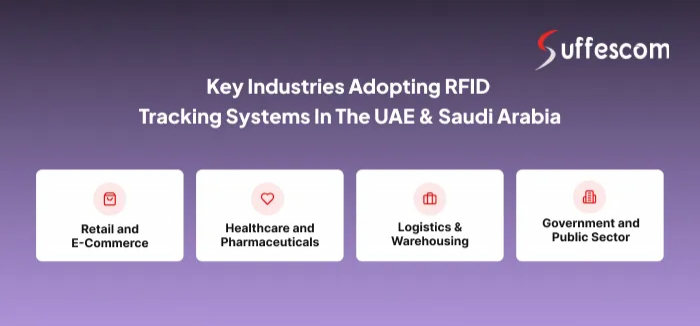
Retail and E-Commerce
RFID tracking systems can help businesses in the retail and ecommerce sectors maintain inventory in stores and warehouses. An RFID enabled application can update stock levels and support quicker order picking while reducing losses caused by misplacement.
Example: It can immediately detect missing items during store audits and show the changes in the inventory management software.
Healthcare and Pharmaceuticals
RFID in healthcare can increase control over equipment and medications. Integrated software shows if the ordered medicine reaches the right patient and generates compliance reports for audits.
Example: An RFID system can notify hospital staff through a dashboard if a medical device is moved outside its zone.
Logistics & Warehousing
RFID in logistics sector can help warehouse and supply chain operations by automating item movement tracking. The system can provide status of shipments.
Example: Offer updates on shipment status when goods pass entry and exit points.
Government and Public Sector
RFID tracking systems can support security and asset management across government infrastructure. Integrated platforms can monitor access control and maintain digital records for accountability.
Example: An RFID system can log the movement of official vehicles and display usage history within a centralized government monitoring system.
Steps to Develop an RFID Tracking System in UAE & Saudi Arabia
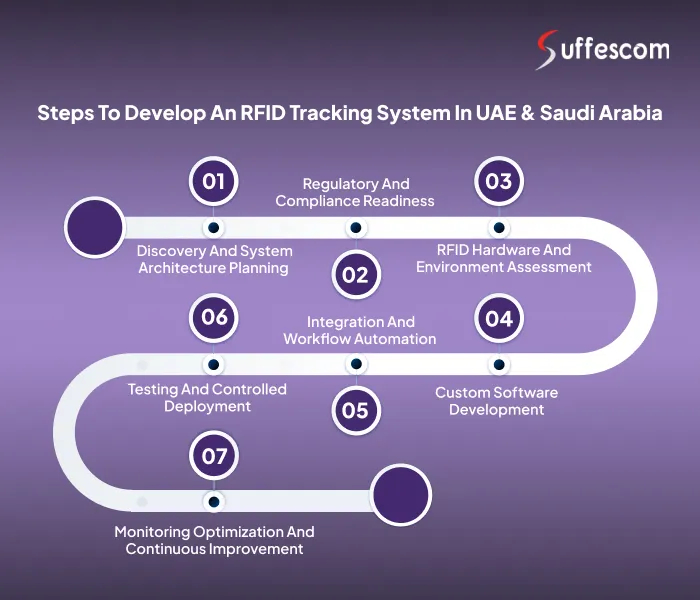
Now, let’s discuss the steps to develop an RFID tracking system in UAE and Saudi Arabia
1. Discovery and System Architecture Planning
This phase focuses on understanding business goals and defining how the RFID tracking system will function at a software level. Clear planning at this stage prevents rework and ensures the system supports scalability.
- Define tracking objectives such as asset visibility, inventory accuracy or compliance
- Identify data points including asset ID, location, timestamps and movement events
- Map data flow between RFID readers and enterprise applications
- Define metrics and performance benchmarks for the system
2. Regulatory and Compliance Readiness
Before moving forward, compliance requirements should be addressed to avoid deployment risks. This is very important for UHF RFID systems in the UAE and Saudi Arabia.
- Validate RFID frequency usage and regional standards
- Ensure data privacy and security requirements are addressed in system design
- Plan audit logs and compliance reporting inside the application
- Align system architecture with local hosting and data residency policies
3. RFID Hardware and Environment Assessment
Although the project is software-driven, environmental conditions affect data quality. This phase ensures the software receives reliable input.
- Analyze site conditions like liquid exposure and movement flow
- Define reader placement zones to ensure accurate data capture
- Select tag types suitable for asset type and operating conditions
- Reduce duplicate and false reads at the source
4. Custom Software Development
This is the core software development phase where RFID data is transformed into usable business intelligence through applications and backend systems. You can collaborate with a top software development company in UAE to help you build the system.
- Build middleware to filter raw reads and apply business logic
- Develop scalable backend services for real-time data processing
- Create web and mobile apps for dashboards, alerts and reporting
- Design APIs for integration with ERP, WMS and asset management systems
5. Integration and Workflow Automation
RFID tracking systems deliver value when connected with business processes. This phase focuses on automation and system interoperability.
- Integrate RFID data with existing enterprise platforms
- Configure automated workflows like check-in/check-out and alerts
- Enable notifications and exception handling
- Ensure role based access and secure data exchange
6. Testing and Controlled Deployment
The system is validated in real environments before full scale rollout to ensure accuracy and security.
- Conduct pilot testing under live operating conditions
- Validate read accuracy, application performance and data consistency
- Perform security and access control testing
- Roll out the system in phases to minimize operational disruption
7. Monitoring Optimization and Continuous Improvement
After deployment, monitoring is required to guarantee that the system works as intended and delivers its value and also adapts to changing business requirements.
- Monitor application performance and data flow
- Analyze system data to improve business rules and accuracy
- Optimize dashboards and automation logic
- Plan feature upgrades such as analytics, AI, and predictive insights
This seven phase RFID system development approach ensures platforms are ready for scale compliance and increasing ROI in UAE and Saudi Arabia.
Key Features of an RFID Tracking System in UAE and Saudi Arabia
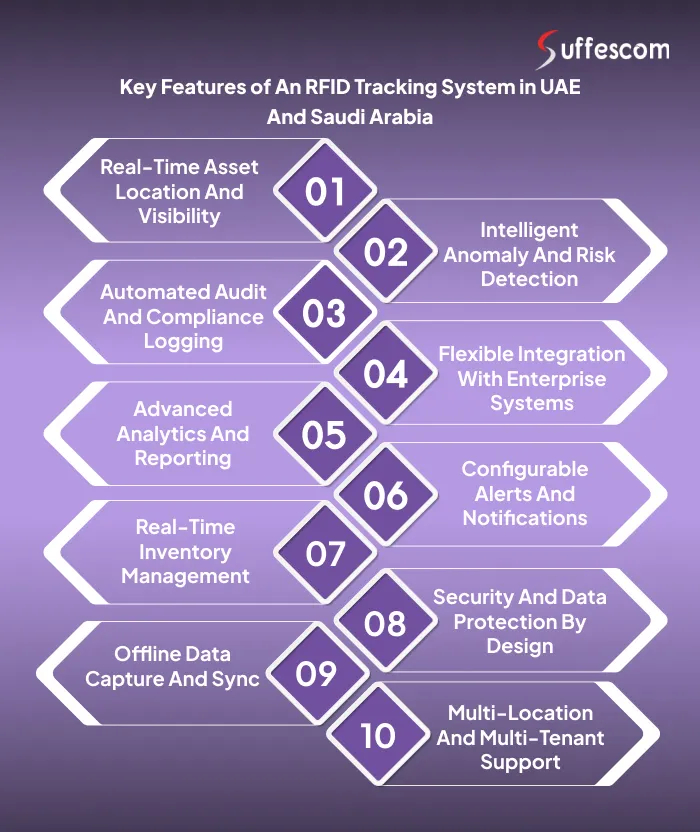
An RFID tracking system should convert RFID data into operational clarity and measurable business value. The features below focus on capabilities that the system should support in UAE and Saudi Arabia.
Real-Time Asset Location and Visibility
This is the feature in which the system shows the latest location and status of assets to decrease search time and improve response.
Intelligent Anomaly and Risk Detection
Movement patterns are analyzed to find if there is any unusual behavior like unauthorized access or unexpected asset movement, which helps in early intervention.
Automated Audit and Compliance Logging
All asset activities should be recorded with timestamps and location data that creates a digital trail that helps in clear audits and regulatory reporting.
Flexible Integration with Enterprise Systems
Open APIs allow smooth connection with ERP, CMMS and other platforms which helps to ensure that RFID data flows into business processes.
Advanced Analytics and Reporting
Dashboards and reports provide information on asset usage and performance metrics to support informed decision-making.
Configurable Alerts and Notifications
Custom rules trigger notifications for events such as asset movement violations, maintenance due dates or inventory thresholds.
Real-Time Inventory Management
Live stock visibility helps teams maintain precise inventory levels and neglect shortages or excess stock.
Security and Data Protection by Design
Encryption and audit logs ensure data is protected and matched with regional data privacy requirements in UAE and Saudi Arabia.
Offline Data Capture and Sync
The system should capture RFID events even during network issues and sync data automatically once connectivity is restored.
Multi-Location and Multi-Tenant Support
The platform should support multiple sites or business units from a single system making it best for large enterprises and government deployments.
Tech Stack Used to Develop an RFID Tracking System
The tech stack used in RFID tracking system development defines how easily the data will be captured, processed, secured and delivered to the business.
| Layer | Technologies | Why It Is Used |
| Cloud Platform | AWS, Azure | Enables scalable infrastructure, high availability, secure data storage, and regional compliance |
| IoT & Device Connectivity | AWS IoT Core, Azure IoT Hub, MQTT | Connects RFID readers and gateways securely and manages device communication |
| Data Streaming & Processing | Apache Kafka, AWS Kinesis | Processes high-volume RFID events in real time with low latency |
| Backend Services | Node.js, Java Spring Boot, Python | Handles business logic, RFID data processing, and API management |
| RFID Middleware | Custom middleware, rule engines | Filters duplicate reads and converts raw RFID data into accurate events |
| Databases | PostgreSQL, MySQL, MongoDB, DynamoDB | Stores structured asset data and large RFID event logs efficiently |
| Web Application | React, Angular, Vue.js | Builds dashboards for asset visibility, reporting, and system monitoring |
| Mobile Applications | Flutter, React Native, Swift, Kotlin | Supports mobile access for audits, alerts, and field operations |
| API Integration | REST APIs, GraphQL | Integrates RFID data with ERP, WMS, CMMS, and third-party systems |
| Security & Access Control | OAuth 2.0, JWT, role-based access | Manages authentication, authorization, and data protection |
| Analytics & Reporting | Power BI, Grafana, custom dashboards | Provides insights on asset usage, trends, and performance |
| DevOps & Monitoring | Docker, Kubernetes, CI/CD pipelines | Automates deployment, scaling, and system monitoring |
Cost to Develop an RFID Tracking System in UAE & Saudi Arabia
The RFID tracking software development cost depends on system complexity, integration depth and scalability requirements. Since RFID systems process real time data from hardware devices, most of the investment goes into backend architecture and integration logic.
Development Costs Based on Complexity
These are one time development costs required to design, build and launch the RFID tracking
| Complexity | Cost Range (AED) | Cost Range (SAR) | Estimated Timeline |
| Small-Scale | AED 30,000 – AED 55,000 | SAR 30,000 – SAR 55,000 | 1 – 3 months |
| Medium-Scale | AED 55,000 – AED 75,000 | SAR 55,000 – SAR 75,000 | 3 – 5 months |
| Large-Scale | AED 75,000 – AED 110,000 | SAR 75,000 – SAR 110,000 | 5 – 9+ months |
Ongoing Development and Maintenance Costs
After launch ongoing investment is required to keep the RFID tracking system aligned with business growth, and usually it costs 10-15% of total development expenditure, but it can vary based on needs.
App Updates
Regular updates are needed to include new features, enhance performance and support new devices or operating system versions.
Server and Cloud Hosting Fees
RFID systems generate continuous data streams which need cloud hosting, storage and monitoring services.
Bug Fixes and Technical Support
Post launch support ensures system uptime, issue resolution and smooth integration with evolving enterprise systems.
Licensing Compliance and Regulatory Costs
In the UAE and Saudi Arabia, RFID systems should follow local regulations, especially for data security like PDPL and frequency usage. These costs are usually neglected but are important for deployment.
Licensing Software and Technology
This includes licenses for RFID middleware analytics tools or third-party platforms used in the solution.
Compliance with Local Regulations
Costs related to data protection, security audits, compliance documentation and regional configuration.
App Store Fees and Distribution Costs
Standard fees for publishing and maintaining apps on Apple App Store and Google Play Store.
Overview of Estimated Regulatory and Licensing Costs
| Cost Component | Estimated Cost (USD) |
| Software Licensing | 3,000 – 10,000 |
| Compliance & Security Audits | 5,000 – 15,000 |
| App Store & Distribution Fees | 200 – 500 per year |
Connect with a software development company now to get a free estimated cost quote based on your system development needs.
Challenges and Solutions in RFID Tracking System Development
RFID tracking systems solve a lot of operational problems but they also create some technical challenges. Knowing these issues from the beginning helps businesses design systems that work best.
Challenge: Too Many RFID Reads for One Item
RFID readers sometimes scan the same tag multiple times in a span of a few seconds. This creates repeated entries of data and makes reports inaccurate.
Solution: Build a middleware layer that groups repeated reads into a single event using time and location logic before data reaches the app.
Challenge: Raw RFID Data Has No Business Meaning
RFID data only contains tag IDs and timestamps. On its own it does not explain what actually happened.
Solution: Apply business rules in the backend to convert reads into actions like asset checked in, asset moved or asset exited zone.
Challenge: Existing Systems Cannot Handle Real-Time Data
Many ERP and asset systems are built for manual or batch updates and struggle with continuous RFID data.
Solution: Integrate APIs and event based processing so RFID updates flow into existing systems without overloading them.
Challenge: Missed or Incorrect Reads in Real Environments
Metal shelves and fast movement can cause missing or partial RFID scans.
Solution: Design software logic that validates movement patterns and fills gaps instead of being based on a single read.
Challenge: System Performance Drops as Usage Grows
As asset locations and users increase, the system can slow down if not designed properly from the start.
Solution: Use cloud infrastructure services that adjust automatically based on data volume.
Challenge: Tracking Data Needs Protection and Audit Trails
RFID systems store sensitive movement and asset data that should be protected.
Solution: Implement encryption, role based access and time-stamped logs to meet UAE and Saudi data regulations.
Challenge: Users Do Not Trust or Use the System
If data looks confusing or unstructured, teams usually switch back to manual tracking.
Solution: Provide defined dashboards and explainable data so teams know, understand and trust the system.
Top 5 RFID Tracking System Development Companies
Selecting the right software development partner is important for building a reliable and scalable RFID tracking system. Let’s discuss the top RFID system development companies you can work with:
1. Suffescom Solutions
Suffescom is a top software development company that specializes in RFID tracking system development with a focus on software architecture, system integration and scalable applications. The company builds custom RFID platforms that integrate with ERP and mobile applications, which makes them best for various sectors in the UAE and Saudi Arabia.
2. Appinventiv
Appinventiv is a mobile app development company in UAE that provides RFID tracking system development as part of its digital and enterprise software services. The company focuses on building user-friendly mobile and web applications that connect RFID hardware with backend systems for tracking and reporting.
3. Abbacus Technologies
Abbacus Technologies provides custom RFID tracking and asset management software for businesses looking to improve visibility. Their solutions focus on backend development, integration and operational dashboards for tracking assets and inventory.
4. Asset Infinity
Asset Infinity is known for its asset tracking and maintenance platforms that use RFID technology. The company focuses on helping organizations manage asset lifecycle, audits and compliance through RFID-enabled software systems.
5. Hyperlink Infosystem
Hyperlink Infosystem develops RFID tracking solutions with an emphasis on mobile apps and cloud applications. Their software development services support businesses that need RFID systems with instant data access.
Overview of Top RFID Tracking System Development Companies
| Rank | Company Name | Location | Founded In | RFID Development Focus |
| 1 | Suffescom Solutions | Dubai, UAE | 2011 | Custom RFID tracking systems, ERP integration, scalable enterprise platforms |
| 2 | Appinventiv | Dubai, UAE | 2015 | RFID-based mobile and web applications, real-time dashboards |
| 3 | Abbacus Technologies | Riyadh, Saudi Arabia | 2008 | Backend-driven RFID tracking, asset and inventory management systems |
| 4 | Asset Infinity | Riyadh, Saudi Arabia | 2016 | RFID asset lifecycle tracking, audits, compliance-focused platforms |
| 5 | Hyperlink Infosystem | Dubai, UAE | 2011 | Cloud-based RFID apps, mobile tracking solutions, MVP app development |
Also Read: Top 15 IT Software Companies in Middle East
The Future of RFID: Integrating Modern Technologies for Secure Ecosystems
RFID tracking systems are changing from identification tools into digital platforms when integrated with latest technologies.
AI-Driven Predictive Analytics
AI integration in RFID system data to depict failures before they happen. By monitoring reader performance and data consistency, the system can find initial warning signs and trigger alerts.
This helps businesses reduce downtime and plan maintenance through dashboards and notifications.
Decision-Making Through AI and RFID Integration
When RFID data is combined with AI models, it becomes more than just tracking information. AI can identify patterns and anomalies in asset movement and inventory usage.
This allows management applications to support better decisions like demand planning, asset optimization and operational forecasting.
AI-Enabled Automation in RFID System
AI automation in RFID systems triggers actions without the need for manual input. Systems instantly reroute shipments or flag exceptions based on predefined rules and insights.
This reduces human intervention and improves accuracy in supply chain operations.
Secure Data Exchange Using Blockchain and RFID
Blockchain development adds an additional layer of security to RFID systems by creating tamper resistant records of RFID events. Each scan or movement can be logged as an immutable transaction.
This ensures that RFID data shared between multiple systems or organizations remains traceable and trustworthy.
RFID and IoT Integration for Real-Time Connected Systems
RFID when combined with IoT creates a connected tracking environment where data flows continuously from tags and sensors into centralized platforms. IoT gateways collect RFID data and transmit it to cloud platforms.
This integration allows software systems to track not only location but also conditions like temperature and system health.
Conclusion
RFID tracking system development is no longer just technical upgrades for businesses in the UAE and Saudi Arabia. They are becoming a practical way to manage assets and movement without relying on manual effort. When RFID data is connected to the right software, it gives teams clear visibility and control over daily operations.
What matters most is not the tags or readers but how the system is designed. A well-built RFID tracking system focuses on clean data, smooth integration, and ease of use. When developed and integrated right it supports real business workflows and continues to improve as operations grow.
For businesses planning to adopt RFID, the right software development company makes the difference between a system that just collects data and one that actually delivers value.
Schedule a consultation to plan your RFID tracking software architecture!
FAQs
Q1. What is an RFID tracking system used for?
Ans. An RFID tracking system is used to track assets, inventory, vehicles or equipment automatically using RFID tags and software applications that show real time status and movement.
Q2. Is RFID tracking legal in the UAE and Saudi Arabia?
Ans. Yes, RFID tracking is legal, but systems must follow local regulations related to frequency usage, data security and privacy in both the UAE and Saudi Arabia.
Q3. How much does it cost to develop an RFID tracking system?
Ans. The RFID tracking system development cost depends on system size, features and integrations. Small systems may start around AED 30,000 while large enterprise systems can exceed AED 110,000.
Q4. How long does it take to develop an RFID tracking system?
Ans. RFID tracking system development time usually ranges from 1 to 9 months based on complexity, integrations and testing requirements.
Q5. Which industries benefit the most from RFID tracking systems?
Ans. The industries that benefit the most from RFID tracking systems are:
- Retail
- Logistics
- Healthcare
- Manufacturing
- Government
Q6. Do RFID tracking systems require mobile apps?
Ans. Mobile apps are not mandatory but they are highly useful for audit alerts and field operations, especially in warehouses and large facilities.
Q7. Can RFID systems integrate with ERP or WMS software?
Ans. Yes, RFID tracking systems are commonly integrated with ERP, WMS and asset management platforms through APIs.
Q8. What is the difference between active and passive RFID for tracking?
Ans. Passive RFID is low cost and suitable for short range scanning, while active RFID supports long-range tracking with continuous updates.
Q9. Is RFID better than barcode systems?
Ans. RFID allows automatic scanning without line of sight and can read multiple items at once which makes it more efficient than barcodes in large-scale operations.
Q10. How accurate are RFID tracking systems?
Ans. Accuracy depends on the system design environment and software logic. With proper setup, RFID systems can achieve very high tracking accuracy.
Q11. Can RFID tracking work without internet connectivity?
Ans. Yes, systems can store data locally during network issues and sync automatically once connectivity is restored.
Q12. Is RFID tracking secure for sensitive data?
Ans. Yes, when built correctly, RFID systems use encryption, access control and audit logs to protect sensitive data.
Q13. Can RFID systems scale as business operations grow?
Ans. RFID systems designed with cloud architecture can scale easily to support more assets, users and locations.
Q14. How do I get started with RFID tracking system development?
Ans. The best way to start is by defining your tracking needs and consulting a software development company experienced in RFID system design and integration.