Healthcare Technology / HealthTech
AI Clinical Documentation Automation Development
React.js, Node.js, MongoDB, Python, AWS
HIPAA, GDPR, PHIPA, SOC 2
Comprehensive AI-powered clinical documentation platform with real-time transcription (1.4s), context-aware NLP, automated SOAP note generation (2.1s), medical code extraction (680ms), FHIR-compliant claim generation (1.2s), and HIPAA/GDPR-compliant zero-retention architecture.
Business Model:
B2B enterprise SaaS with per-clinician subscription. Client investment: $120M over 10 years delivering transformative ROI. Platform designed for multi-specialty workflows with sub-5s end-to-end documentation.

Capturing clinical conversations with high accuracy while handling medical terminology, varied accents, and ambient noise — without errors cascading through diagnosis, coding, and billing. Required sub-2s latency.
Converting raw transcripts into structured notes required understanding medical context, patient history, and clinician intent — not just word-for-word transcription. Without context, AI hallucinates fabricated content.
Generating structured Subjective, Objective, Assessment, and Plan notes accurately reflecting clinician assessment while maintaining professional "voice" and appropriate formatting.
Automatically extracting ICD-10 and CPT codes from clinical narratives with high accuracy — critical for billing and reimbursement. Required confidence scoring (0-1).
PHI subject to HIPAA/GDPR/PHIPA. Processing sensitive data on cloud required process-and-purge architecture with no persistent storage.
LLMs produce convincingly wrong content — a single incorrect diagnosis cascades through coding, billing, and audit trails. Required grounding in transcript data.
Documentation must align with existing EHRs, specialty-specific templates, and clinician preferences — while maintaining natural "voice" and professional identity.
Psychiatry, primary care, and cardiology have vastly different documentation requirements. Required specialty-specific validation and customization across 10+ specialties.
Web Speech API with sub-2s latency. Real-time transcript editing allows clinicians to correct errors immediately. Achieved 1.4s transcription (target <2s).
Session-persistent vector knowledge store encoding patient-physician interactions — enabling longitudinal context retention. Dynamic template engine permits real-time, schema-level customization without model retraining across 10+ specialties.
OpenAI GPT-4 with structured system prompts for clinical summarization, SOAP generation, and red flag identification. End-to-end documentation 3.8s (target <5s). SOAP generation 2.1s (target <3s).
PhenoML for ICD-10/CPT extraction with confidence scoring (0-1). Enhanced accuracy through CMS/payer validation. Achieved 680ms extraction (target <1s).
PHI processed in volatile memory — automated purge after documentation generation. No persistent storage. Anonymized metadata only (transcript length, processing time, specialties). Compliant with HIPAA/GDPR/PHIPA.
Modular multi-agent orchestration enforcing sequential validation, retrieval, reasoning, generation — content grounded in transcript data. Clinician review required before EHR entry. Zero critical safety incidents.
Automated FHIR R4 claim generation with UHC validation — header hygiene, ICD validity, specificity, exclusion rules, sequencing. Achieved 1.2s generation (target <2s).
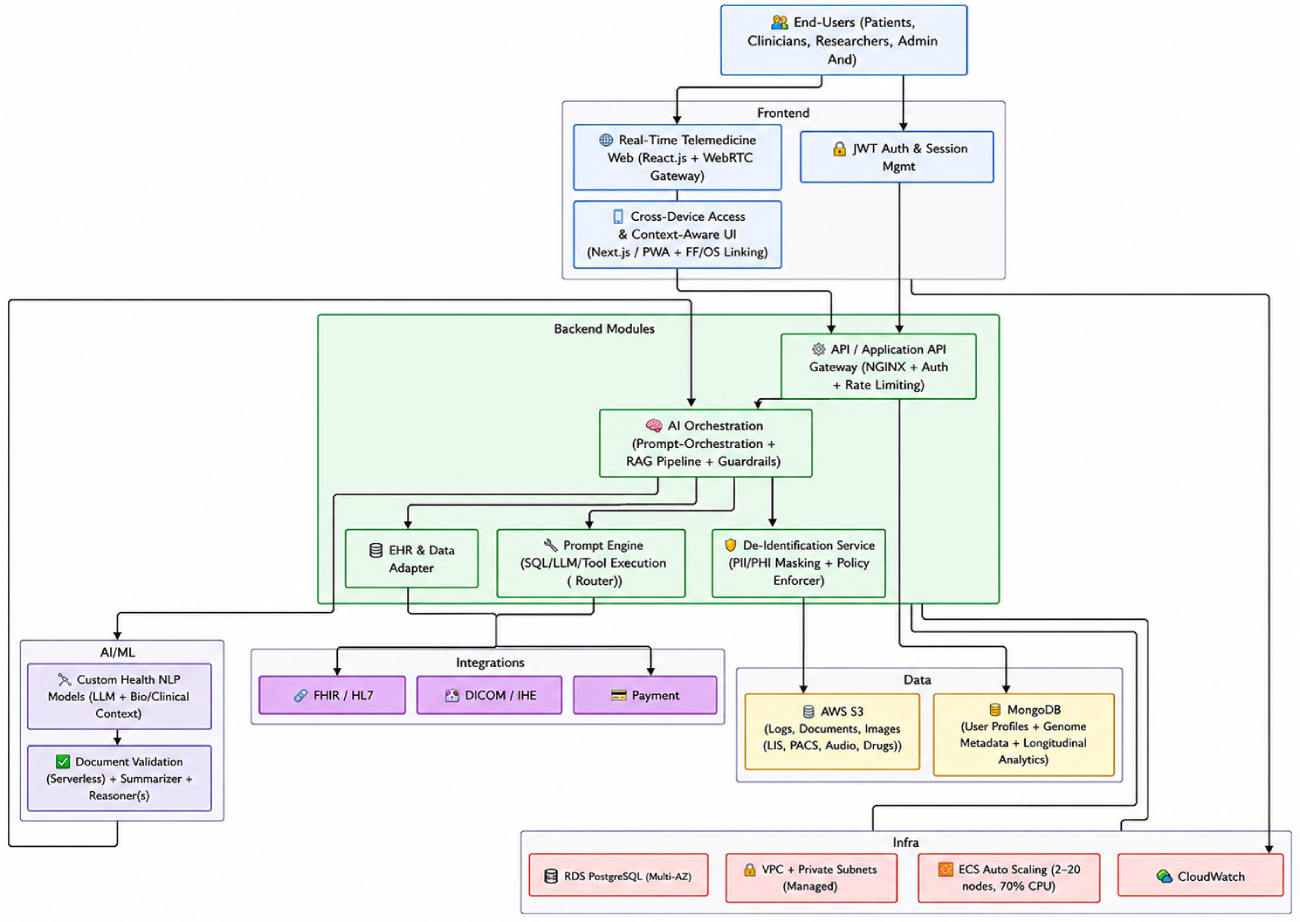
React 19 responsive design for desktop/mobile. Node.js backend. Python pipeline for claims. Session management for save/restore.
Web-based clinician application. Features — real-time transcription (Web Speech API, 1.4s), transcript editor, AI summarization trigger (2.1s), SOAP note display with structured sections, medical code suggestions with confidence scores (0-1), FHIR claim generation (1.2s), session management (save/restore), responsive design.
REST API. Services — transcription management, AI summarization orchestration (OpenAI GPT-4), clinical notes generation (SOAP), Python pipeline trigger, session management, JWT authentication, audit logging. API throughput: 680 req/min (target 500 req/min).
AI agent logic — medical scribe (summarization, SOAP extraction, risk detection, code suggestions), UHC compliance validation (header hygiene, ICD validity, specificity, exclusion rules, sequencing), PhenoML integration (680ms), FHIR claim builder (1.2s), compliance feedback.
MongoDB for user profiles, session metadata, anonymized analytics. S3 (AES-256) for temporary transcript storage (purged post-processing). Notes directory for generated artifacts.
OpenAI GPT-4, PhenoML, FHIR R4, Web Speech API, AWS, EHR integration layer (configurable). WebSocket for real-time transcription (10,000 concurrent sessions).
EC2 Auto Scaling (min 2, max 10, 70% CPU). RDS PostgreSQL Multi-AZ. S3 AES-256. CloudFront CDN. AWS WAF. 15-min RTO via Terraform. <5-min RPO via RDS Multi-AZ. Monthly DR testing
Challenge: PHI on cloud raises privacy concerns. Generative models require transparent data-handling, encryption, audit logging. Nurses accountable for AI-generated content — requiring rigorous review.
Solution: Custom pipeline processing sensitive data in volatile memory — automated purge after documentation generation. No PHI persists — only anonymized metadata (transcript length, processing time, specialties). TLS 1.3 in transit, AES-256 for temporary storage. Compliant with HIPAA, GDPR, PHIPA. Audit logs for every AI-generated output.
Results: Zero image/transcript retention. Full compliance. Zero PHI leakage validated.
Challenge: LLMs generate outputs based on probabilities — convincingly wrong. Single incorrect detail cascades through coding, billing, audit trails. AI scribes produce omissions and clinically significant hallucinations.
Solution: Modular multi-agent orchestration enforcing sequential validation, retrieval grounding (content grounded in transcript data), confidence scoring (0-1 for code suggestions). All AI-generated content undergoes human review before EHR entry. Clinicians verify accuracy, completeness, appropriateness.
Results: Clinician-rated accuracy, quality, efficiency significantly higher. Zero critical safety incidents. 63% documentation time reduction validated.
Challenge: Existing solutions limited by inadequate contextual comprehension and rigid templates — causing clinically significant errors. Clinicians reported overlong/underspecified sections, unfamiliar formatting, lost professional "voice."
Solution: Context-aware, retrieval-augmented framework with:
• Session-persistent vector knowledge store: Encodes patient-physician interactions — enabling longitudinal context retention
• Dynamic template engine: Real-time, schema-level customization without model retraining — accommodating 10+ specialties
• Modular multi-agent orchestration: Sequential validation, retrieval, reasoning, generation — mitigating hallucination
• Clinicians customize AI-drafted text and provide feedback — teaching AI their style over 1-3 months.
Results: End-to-end documentation 3.8s (target <5s). SOAP generation 2.1s (target <3s). Zero critical safety incidents. Clinician-rated accuracy significantly higher than manual.
JWT (RS256, 24h expiry). Role-based access (clinicians, administrators, compliance). MFA for admins. Rate limiting (100 req/min/user)
PHI processed in volatile memory only — automated purge after documentation generation. No persistent storage of transcripts, patient data, or clinical notes. Anonymized metadata only. Audit logs for every AI-generated output. Compliant with HIPAA, GDPR, PHIPA.
At-rest — MongoDB (AES-256), S3 (SSE-S3). In-transit — TLS 1.3 for APIs, WSS for WebSocket. Automated encrypted snapshots. Keys via AWS KMS.
Monthly API key rotation via AWS Secrets Manager. CORS restriction to healthcare domains. JSON schema validation, parameterized queries, input sanitization. AWS WAF for DDoS protection. Snyk weekly scans.
Clinicians obtain verbal consent before using AI scribes. Sample: "I wanted to ask your permission for me to use a secure AI scribe tool to help generate documentation during our visit so I can focus more on you. Is that OK?" Respect for opt-outs. Consent documented in health record. 97% patient acceptance.
Regular AI output audits for accuracy, bias, unintended consequences. Models trained on diverse datasets. Transparent reporting of limitations.
Cross-functional AI governance committee — HIM/CDI leadership, compliance/legal, clinical champions, IT, privacy experts. Policies for model vetting, user training, audit monitoring. SOC 2 Type II in progress.

"Clinicians have seen 40-50% reduction in documentation time. Saves about five minutes per patient on documentation — nine and a half minutes in EHR overall. In my 25 years in healthcare, you don't often see providers say, 'Please never take this away' — but that's exactly the feedback we're getting."
• SUFFESCOM SOLUTIONS
Build Smarter. Scale Faster. Grow More.
Have a Vision? Let’s Turn It Into a Digital Reality.
Get a quick response from our best experts in under 10 minutes.
Suffescom easily understood our main goal and delivered the best digital solution. Their team was very cooperative, and it was a very good experience working with them. I would highly recommend them.

Working with Suffescom was a really great experience. Their developers demonstrated technical knowledge and delivered our mobile app solution with all required functionalities on time.

Suffescom helped us build a logistics software solution that completely improved our fleet operations. Their professionalism and transparency are what make them a reliable technology partner.

Share Your Requirements. Our Experts Will Shape the Solution.
• SUFFESCOM SOLUTIONS
Build Smarter. Scale Faster. Grow More.
Have a Vision? Let’s Turn It Into a Digital Reality.
Get a quick response from our best experts in under 10 minutes.
Suffescom easily understood our main goal and delivered the best digital solution. Their team was very cooperative, and it was a very good experience working with them. I would highly recommend them.
Working with Suffescom was a really great experience. Their developers demonstrated technical knowledge and delivered our mobile app solution with all required functionalities on time.
Suffescom helped us build a logistics software solution that completely improved our fleet operations. Their professionalism and transparency are what make them a reliable technology partner.
Share Your Requirements. Our Experts Will Shape the Solution.
• SUFFESCOM SOLUTIONS
Build Smarter. Scale Faster. Grow More.
Have a Vision? Let’s Turn It Into a Digital Reality.
Get a quick response from our best experts in under 10 minutes.
Suffescom easily understood our main goal and delivered the best digital solution. Their team was very cooperative, and it was a very good experience working with them. I would highly recommend them.
Working with Suffescom was a really great experience. Their developers demonstrated technical knowledge and delivered our mobile app solution with all required functionalities on time.
Suffescom helped us build a logistics software solution that completely improved our fleet operations. Their professionalism and transparency are what make them a reliable technology partner.
Share Your Requirements. Our Experts Will Shape the Solution.
Fret Not! We have Something to Offer.