+971-8000321216



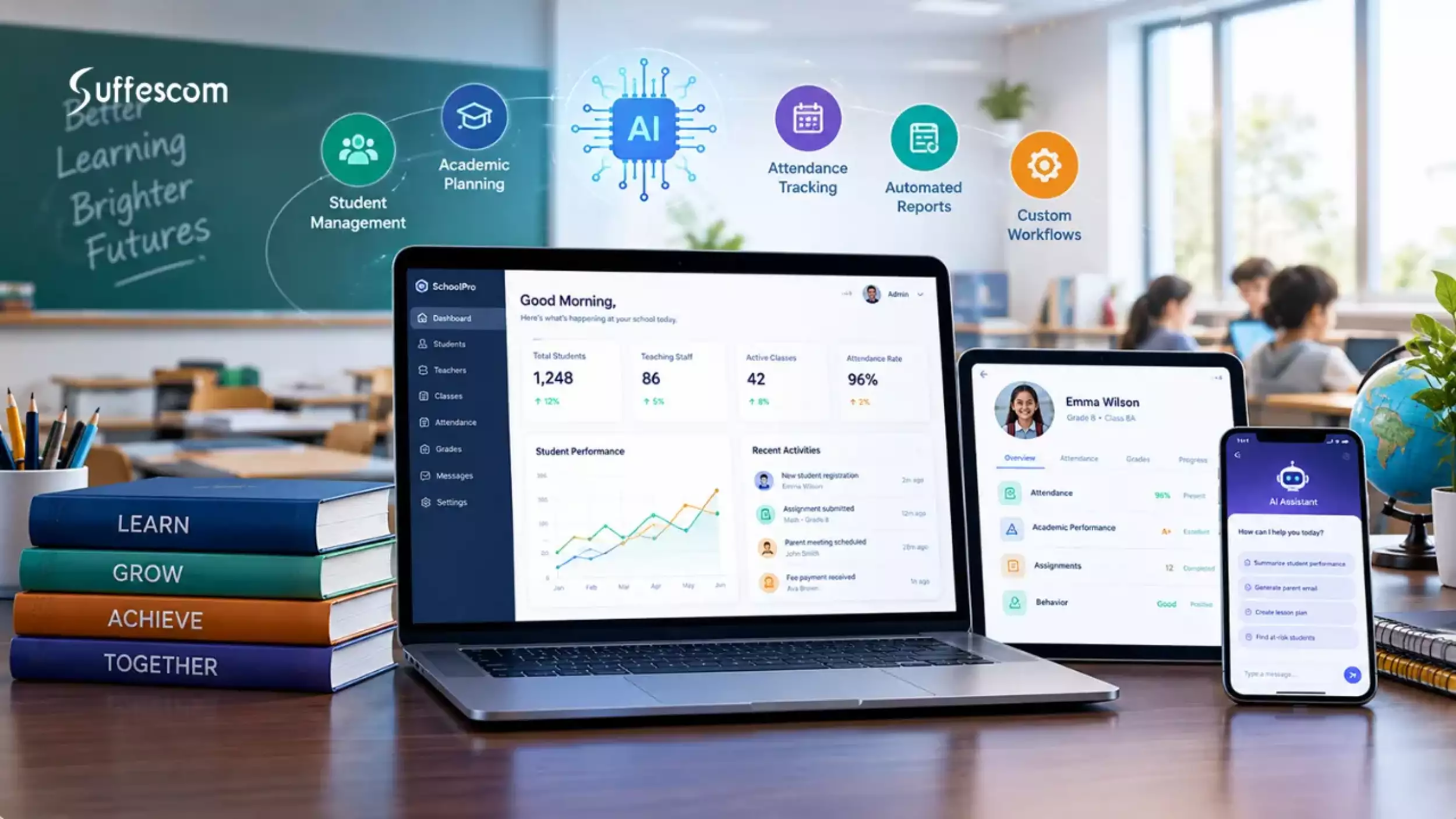
Key Takeaways:
- Artificial Intelligence School Management Software uses AI to automate processes, make them more student-friendly, and support decision-making.
- AI is being used by schools to automate tasks, offer a personalized experience, improve communication, and improve overall operations.
- Modules in this software include SIS, Admissions, Attendance, Fees, Academics, LMS, Parent Communication, HR, Transport, and Reporting.
- Development begins with business requirements, AI use cases, data maturity, and integration requirements.
- A legacy system can be transformed into a modern AI-based system without changing the whole software landscape.
- AI school management software development costs start at roughly $15,000, with a basic MVP taking 2–4 months to build.
- A mid-level platform with full ERP, mobile apps, and AI features can cost $25,000–$55,000 and take 4–6 months.
- Enterprise platforms can cost $55,000- $150,000+, with development timelines extending to 12 months or more.
- The right development company should have all the necessary qualifications, including EdTech experience and expertise in AI.
Picture a school administrator switching between five different spreadsheets just to answer one parent's question about their child's attendance and fee dues. Now think about doing this for hundreds of students, all teachers, and a long list of rules to follow. It is easy to see why doing things manually rarely stays manageable for long in schools.
This is the gap AI school management software is built to fill. Instead of just turning paperwork into digital files, these platforms bring together admissions, attendance, fees, academics, communication, HR, and transport into one system. It does not just store data. It makes sense of it, points out what needs attention, and handles tasks that do not need a human touch.
This change is already happening. The global school management software market is set to reach $42.58 billion by 2030. AI is the main reason for this growth. Schools that once used software just to keep records now want it to predict drops in enrollment, spot students who need help before they fall behind, and much more.
For schools and EdTech companies considering building one of these platforms, the question is no longer if AI integration in school management is required. The real questions are which features matter most, what this kind of project costs, how long it takes, and how to keep student data safe while AI does the hard work. That is what this guide will cover.
What Is AI School Management Software?
AI school management software is not just another digital filing cabinet for student records. These systems are capable of handling processes such as student information management, attendance, fee management, academic processes, communication, and administrative processes through AI technology.
AI School Management Software vs Traditional School Management Software
The fundamental distinction lies in how the system handles information from the school. Conventional software collects and manages information, while AI uses it to identify trends and provide automated guidance.
| Capability | Traditional Software | AI-Powered Software |
| Attendance | Marks who was present or absent | Spots absence patterns before they become a problem |
| Timetabling | Follows fixed rules to build a schedule | Builds and adjusts schedules based on real constraints |
| Parent communication | Sends the same message to everyone | Sends updates written for each parent |
| Reporting | Shows numbers as they are | Shows what those numbers are likely to lead to |
| Student support | Waits for a teacher to notice a problem | Flags struggling students early, so staff can step in sooner |
| Administration | Runs on people manually pushing every step forward | Runs with AI handling the repeat steps, so staff focus on decisions |
Why Schools Often Combine Multiple Systems
Schools do not always need one large platform. A small school may only require student information, attendance, fees, and communication tools, while a large school group may need an integrated ecosystem where they don't have to go for separate ERP software development, LMS, transport system, finance, HR, and more.
SIS vs School ERP vs AI School Management Platform
The terms are closely related, but their roles differ as follows:
- SIS (Student Information System): It basically handles all information related to students, like profiles, registration, attendance, marks, and academic information.
- School ERP: Deals with all operations of an institution beyond the scope of SIS, including finance, HR, payroll, procurement, transportation, and many others.
- AI-based School Management System: With AI development, one can integrate school management activities with advanced AI technologies and processes for prediction, generation, automation, and conversational AI.
Why Schools Are Investing in AI-Powered Education Management Systems in 2026
Schools are moving beyond basic digitization as the volume and complexity of educational data continue to grow. Here are the key reasons schools are investing in AI-powered education management systems in 2026:
From Digital Record-Keeping to Intelligent School Operations
The conventional school software simply serves the function of storing information in addition to retrieving it. AI, on the other hand, takes this process a step further as it is able to analyze the stored information in order to make decisions or give recommendations.
For instance, an attendance program can capture whether a student is present; with AI software, it can further analyze this information, and students with a pattern of absenteeism can be flagged for administrative attention. Similarly, enrollment information will not only help monitor enrollments but will also allow for forecasting of enrollments.
This means that the use of AI will transform the function of school management software from being a system of record to a system that can assist in making decisions.
Automating Repetitive Administrative Work
School personnel spend much time performing repetitive activities like data entry, report preparation, document processing, answering routine questions, summarizing attendance, and issuing reminders.
Many of these processes can be automated or assisted by AI technology. For instance, document-processing models will facilitate the extraction of data from forms, generative AI will aid in report preparation, while conversational assistants can answer routine questions based on school information approved by the school.
According to the OECD 2026 Digital Education Outlook, generative AI can simplify school management and backend processes, such as reporting, work associated with the curriculum, and classification of educational materials.
Such an approach can free up time for activities involving communication, judgement, supervision, and direct student interaction.
Rising Demand for Personalized Student Experiences
Not every student has similar academic requirements, learning patterns, and support needs. The information collected by a school management system using data related to attendance, assessments, assignments, engagement, and any other academic activities can be analyzed.
The use of this information by the AI can assist in identifying gaps in learning, recommending useful resources, generating personal summary notes, or even identifying students requiring more assistance.
This way, it will help teachers and support staff recognize patterns and offer more targeted interventions.
According to UNESCO, the benefits of AI in education include personalized learning and more efficient educational management, although risks such as privacy, equity, security, and governance must be taken into account.
Real-Time Parent Expectations
Parents are also getting used to schools ensuring that there is access to information on a timely basis instead of only depending on notices and communication.
An intelligent school management system can integrate the various modules to provide an easy-to-understand process. Parents could get personalized updates on their children's attendance, homework, payment dues, and other announcements through a portal, mobile app, or other such channel for communication.
Another advantage of AI would be to assist in drafting responses to common questions, so employees do not have to answer every question manually.
It is not only about faster communication but also relevant communication whereby parents are provided with the necessary information that pertains to their children.
Predictive Decision-Making for School Leaders
Administrators within the educational institution must make decisions regarding enrollment, staff, classrooms, budgeting, transportation, and student services based on information that is likely to be available from many sources.
Using AI and predictive analytics enables administrators to consolidate the above data in order to identify trends and possible risk factors.
School administrators can use AI-driven analytics to analyze the following aspects:
- Enrollment forecast per grades
- Class and facility usage
- Workload and staffing needs of teachers
- Patterns of attendance and disengagement
- Transportation needs
- Resource needs
Data-Backed Market Growth & AI Adoption
Another reason why educational establishments are considering AI management solutions is related to the increase in the application of AI technologies in education. Today, AI is not only implemented in experiments with educational technology but is also increasingly integrated into the learning process, administrative activities, tutoring, and operations.
According to the 2026 OECD Digital Education Outlook, 37% of lower-secondary teachers interviewed through TALIS 2024 used AI in their work, and 57% believe AI helps them develop or refine their lesson plans. At the same time, OECD stresses that the effective implementation of these solutions requires well-articulated educational principles, human intervention, privacy protections, and adequate governance.
From the schools' perspective, it is necessary to provide proper, controlled use of AI technologies within educational institutions.
Before vs After AI Digitization — Real Institution Example
Imagine an institution spread across multiple campuses that already utilizes an SIS, accounting software, an LMS, and other applications for transportation and communications.
Before the implementation of AI:
- Data is manually collated from various systems.
- Reports on attendance and performance are prepared by administrators.
- Teachers determine the needs of students in terms of assistance manually.
- Parents approach teachers for any queries.
- Enrollment is based mainly on previous figures and personal knowledge.
After AI integration:
- Connected systems can have their data analyzed by means of an intelligence layer.
- AI can compile data on attendance, academics, and operations.
- Early warning models can detect trends requiring human analysis.
- Administrators can pose natural language questions concerning authorized school data.
- Enrollment projections can help with resource forecasting.
- Generative AI can help with periodic reporting and communication.
- Parents can get access to pertinent data via an AI-enabled interface.
The significant thing about AI integration here is not that each process in the school should become autonomous. Instead, an intelligent, automated component will be added to an existing digital system. Staff will still need to review recommendations and handle issues that require professional assessment.
Core Modules Every AI School Management Software Must Include
The AI school management system requires an excellent operational structure. It should have features for managing students' data, attendance, finance, learning, communications, HR, transportation, and other aspects of the school. Below are some crucial modules that need to be incorporated into the school management system:
AI-Powered Student Information System (SIS) & Enrollment
The student information system acts as the central repository for student profiles, enrollment records, academic history, attendance, documents, and other student-related information.
AI can improve the quality and management of this data by helping schools:
- Detect duplicate student records
- Validate enrollment information
- Identify missing or inconsistent data
- Extract information from admission forms and documents
- Summarize student records for authorized staff
- Classify and route admission inquiries
Example: When the application process is open, the parent uploads a scanned copy of the transfer certificate. Rather than the user having to enter the details of the student again by rekeying the data, the AI gets all the details from the transfer certificate itself.
AI Attendance & Intelligent Timetabling
The attendance management system tracks the attendance of students and teachers and provides insights about absenteeism and attendance patterns.
AI can add features that detect patterns that would otherwise require time-consuming manual review:
- Detection of attendance anomalies
- Detection of absence patterns
- Tardiness pattern detection
- Automatic scheduling
- Optimization of teacher availability
- Classroom usage tracking
- Teacher and administrator attendance summaries
Example: A student who was previously consistent starts missing every Monday over three consecutive weeks. Instead of this pattern going unnoticed until report card season, the system flags it for the counselor to review, without assuming a cause or taking any action on its own.
For instance, an AI system can detect absence patterns. However, it should not assume the cause of the absence or take disciplinary action without human involvement.
Finance Management
AI can help finance teams move from basic transaction tracking toward forecasting and proactive management:
- Payment risk alerts
- Revenue forecasting
- Cash flow trend analysis
- Automated classification of financial inquiries
Example: A family that has paid fees on time for two years suddenly misses a due date. The system picks up on the deviation from their usual payment behavior and surfaces the account for the finance team's attention, well before it becomes a formal overdue case.
These predictions should support authorized finance staff rather than automatically making decisions about penalties, financial aid, or student access.
LMS & AI Learning Integration
When the learning management system is linked with the school management system, administrative and educational data merge into one ecosystem, including course content, assignments, assessment tools, learning resources, grades, and more.
The role of artificial intelligence here is to help analyze the learning process and give teachers more visibility into student performance:
- Personalized learning recommendations
- Assignment and assessment summaries
- Learning gap identification
- Student engagement analysis
- AI-assisted content generation
- Question generation for practice
- Teacher insights based on academic and engagement data
Example: Across a grade, quiz outcomes show students constantly underperforming on one specific topic within a unit. Rather than the teacher noticing this only after grading each paper individually, the software solution shows the pattern so the teacher can decide if to revisit that topic in class.
AI-generated learning recommendations should remain reviewable by teachers when they impact instructional decisions or student support.
AI Parent-Teacher Communication
A communication module integrates teachers, parents, students, and administrators through notifications, announcements, messaging, email, and mobile apps.
AI can enhance the relevance of communication and reduce repetitive work for staff:
- AI-assisted message drafting
- Personalized parent updates
- Automatic message summarization
- Multilingual communication
- Frequently asked question assistants
- Intelligent notification personalization
- Conversation and communication summaries for authorized staff
Example: A teacher needs to send end-of-term updates to thirty sets of parents. Rather than writing each message one by one, AI drafts a personalized version for each student, pulling in their specific attendance and grade data, and the teacher reviews and sends each one rather than typing from scratch.
AI-Assisted HR & Payroll
The HR module manages teacher and staff profiles, attendance, leave, payroll, recruitment records, performance information, and workforce administration.
AI can support HR teams with administrative and analytical tasks such as:
- Staff record summarization
- Resume and application data extraction
- Leave and attendance pattern analysis
- Teacher workload analysis
- Staffing requirement forecasting
- Payroll anomaly detection
- Substitute teacher recommendations
Example: A teacher calls in sick the morning of a scheduled exam. Instead of an administrator manually checking who is free during that period, the system cross references availability and subject expertise and suggests a shortlist of suitable substitutes for HR to confirm.
Because employment-related decisions can have significant consequences, AI outputs should be treated as recommendations that require review by authorized HR personnel.
AI Transport & Student Safety
The transportation component oversees school buses, drivers, routes, vehicles, student scheduling, and pick-up and drop-off data.
Combined with GPS, telematics, and mobile applications, AI can help schools enhance transportation scheduling:
- AI-assisted route optimization
- Travel time prediction
- Vehicle utilization analysis
- Driver behavior pattern detection
- Route delay alerts
- Bus occupancy forecasting
- Pickup and drop-off anomaly detection
- Student transportation notifications
Example: A bus that usually completes its route by 8:10 AM is still running twenty minutes behind due to traffic. Parents waiting at the final stops get an automatic delay notification rather than calling the school to ask where the bus is.
This system can analyze both historical and real-time transportation information to detect possible delays and problems. The safety warning system needs to be developed with the aim of aiding professionals rather than being an absolute safety assessment based on AI predictions.
AI Features in Modern School Management Software
AI features can turn a conventional school management platform into an intelligent operational system. So, here are the main features of such a platform:
AI School Administration Copilot
An AI school administration copilot gives authorized administrators a conversational way to interact with school data. An administrator can ask which classes had the highest absenteeism this month or how enrollment compares with the previous academic year and get an answer grounded in the school's own records.
Example: A vice principal preparing for a board meeting asks the copilot to compare this term's attendance. Instead of requesting numbers from three department heads and waiting a few days, the copilot pulls the figures directly from the attendance system in minutes, with the underlying records available for verification.
The copilot should retrieve relevant information from connected SIS, ERP, LMS, finance and attendance systems rather than answering from general knowledge. A retrieval-augmented generation (RAG) architecture helps ground responses in approved institutional data. Access controls matter here too since the copilot should only surface information the requesting user is permitted to view.
Generative AI for School Reports
Preparing recurring reports means gathering details from different systems and formatting them manually. Generative AI can turn structured school data into readable summaries and draft reports, covering attendance summaries, academic performance reports, board reports and management dashboards.
Example: An administrator who spends a full day each month compiling a principal's report from attendance, fee and academic data has generative AI draft the narrative summary first. What remains is a quick review and edit before it goes out.
Staff should review and make changes in AI-generated reports before they're shared externally. The system should find its underlying data sources too so users can verify any important figures.
AI Student Early-Warning System
An AI early warning system looks at different student signals together. It includes attendance and behavioral records to spot patterns that may call for support.
Example: A student's assignment completion drops from 90% to 60% in a month alongside two unexplained absences. Neither signal alone would raise a flag. Together, the system surfaces the combination for a counselor to look into before it shows up as a failing grade at term's end.
This should function as a warning and support tool rather than a decision maker. A risk signal doesn't establish why a student is struggling and shouldn't independently determine disciplinary, academic or support outcomes.
AI-Powered Timetable Optimization
Building a school timetable means juggling teacher availability, classroom capacity, subject requirements, student groups, workload limits and break periods all at once. That's what makes manual scheduling very slow. AI and optimization algorithms can weigh these constraints together and produce schedules that meet institutional requirements.
Example: A school with 40 teachers and 25 sections used to spend nearly two weeks building a clash-free timetable each year. With AI generating and comparing several valid schedules against the same constraints, it drops to a few days of review and adjustment.
Administrators define rules and priorities first. The system then generates and compares possible schedules, and staff reviews the proposed timetable before publication.
AI Enrollment Forecasting
Enrollment forecasting helps administrators estimate future student demand and plan resources accordingly by analyzing historical and current enrollment information.
Example: A school notices its Grade 6 applications have grown steadily for three years. Rather than discovering mid-year that classrooms are short, a forecasting model flags the likely demand early enough for the school to plan an additional section and hire ahead of the admission cycle.
Forecasts should come with the assumptions and confidence levels behind them so administrators understand the basis of the prediction instead of treating it as guaranteed.
AI Fee Collection Forecasting
AI can study historical payment behavior and payment schedules to forecast fee collection patterns and flag accounts likely to need follow-up.
Example: Ahead of a new term, a finance team wants to know how much of the expected fee amount will come in on time. Prior years' payment behavior gives them a collection range to plan cash flow around instead of finding out only after due dates pass.
These forecasts help finance teams plan collection activity and cash flow. The system shouldn't impose penalties or make financial aid decisions based solely on a prediction.
AI Teacher Workload Optimization
Teacher workload covers teaching hours and more. AI can weigh these factors together to catch imbalances that would otherwise go unnoticed.
Example: There is one teacher who teaches six classes per day and has three after-school activities, while his colleague who is from the same department takes four classes per day with no after-school activity. This discrepancy is identified by the algorithm for further action.
Recommendations should account for institutional policy and teacher specific constraints rather than optimizing for a single metric.
AI Curriculum Gap Detection
AI can compare curriculum plans and student performance data to highlight topics with thin assessment coverage or recurring learning difficulties.
Example: Test results across three sections of Grade 9 science show a consistent dip on questions tied to one chapter, regardless of who taught the section. That pattern points to a gap in the curriculum's coverage of the topic rather than a single teacher's delivery, giving curriculum leaders a clear place to start.
Teachers and curriculum leaders can then decide whether instructional materials, pacing or assessment need to change.
AI-Powered Document Processing
Schools handle large volumes of documents during admissions and academic administration. Pairing optical character recognition with AI extracts and classifies information from admission forms and registration forms without manual entry.
Example: During admission season, a front office team receives hundreds of scanned identity documents and certificates. Instead of keying in each field by hand, the system extracts names and certificate numbers automatically and flags any document with a missing or unreadable field for manual review.
AI can detect which fields are required, detect any missing information, and send the extracted information to the required module. The sensitive documents should also adhere to the privacy policies of the institute.
AI Knowledge Base for School Policies
An AI knowledge base lets administrators and other authorized staff find information from approved institutional documents by asking a question directly instead of searching a handbook or emailing a department.
Example: A newly joined teacher wants to know how many casual leave days they get this year. Rather than going through a lengthy staff handbook or waiting on an email from HR, they ask the knowledge base and get an answer along with a link to the relevant policy section for confirmation.
The system pulls from approved sources such as policies, handbooks, regulations and internal documentation. A RAG-based setup grounds responses in the institution's own knowledge base rather than the model's general training, and pointing to the source document lets staff verify the answer. Over time this turns scattered documentation into a resource staff can actually search, while the school keeps control over the underlying policies.
How AI Improves the Parent and Student Experience
There are various ways AI can contribute to making school administration easier for parents and students, especially when it comes to providing personalized information, faster responses, and communicating via channels parents and students prefer.
AI Parent Assistant
The AI can provide an automated response to some routine queries such as:
- Attendance
- Homework & assignments
- Fees
- Schedules
- Events
- Transportation
- Announcements
It should not invent any information but provide it based on available data from school information systems. For instance, A parent asks if their child's bus is running late and gets an answer pulled from the transport system rather than calling the school office.
Personalized Student & Parent Digest
AI can create personal digests that will include all important news related to students' activities at school and important announcements.
Multilingual AI Communication
AI can provide translation of school messages in multilingual communities where it is needed or even create school communications in the languages supported by AI technology.
AI Voice Assistant
AI Voice assistants can be helpful when parents and students want to ask something or get routine information without searching through various windows.
Personalized Notifications
AI can help identify the most relevant notifications to send to a certain parent or student according to his or her activities.
AI Agents & Autonomous School Administration
An AI agent goes a step beyond an assistant. It doesn't just answer a question, it observes a situation, applies the school's own rules, and carries out an approved action on its own, checking in with a person only when judgment is required.
AI Agent for Substitute Teacher Scheduling
When a teacher calls in absent, the agent checks who's available, matches them against subject and grade level, and builds the substitute schedule without an administrator working the phones.
Lubbock ISD and Edgewood ISD in Texas, which balanced class sizes and teacher workloads, resulting in savings of $2.2 million in 14 Lubbock schools and $1.05 million in Edgewood ISD altogether, with all changes made through regular teacher turnover.
AI Agent for Admission Follow-Ups
Incoming inquiries get sorted, applications with missing details get marked, and approved reminders go out automatically, with anything unusual routed to the admissions team.
Georgia Southern University's admissions agent processed over 300,000 messages in its first two months at under 1% opt-out, contributing to 2% enrollment growth and $2.4 million in projected additional revenue over two years.
AI Agent for Fee Reminder Workflows
Upcoming and any missed payments get tracked automatically, approved reminders go out on schedule, and unresolved accounts land in the finance team's queue.
A family that consistently pays on time but misses a single due date gets a reminder the same day instead of a phone call weeks later, and an account that stays unresolved after two automated follow-ups gets flagged for a staff member to handle directly, rather than every account requiring a manual check regardless of payment history.
AI Agent for Staff Leave & Replacement Management
Routine leave requests get processed based on policy and, in contrast, conflicts get flagged before they become a problem, and available replacements get identified without HR digging through a spreadsheet.
Indianapolis Public Schools built internal AI tools on Google's Gemini system for HR workflows, saving over $300,000 districtwide in the 2026-27 school year.
AI Agent for Parent Support
Routine questions on attendance, fees, homework, and transport get answered directly from the school's approved data, while anything sensitive gets passed to staff.
Mesquite ISD built its AYO system on generative AI to give teachers fast access to student information and draft parent messages that reference specific, individual student details rather than a generic template.
Multi-Agent School Operations Architecture
Larger institutions typically run several specialized agents together rather than one general-purpose tool:
- Admissions Agent for inquiries and follow-ups
- Finance Agent for fee reminders and payment tracking
- Attendance Agent for checks and alerts
- HR Agent for leave and staffing
- Parent Support Agent for parent and student queries
- Reporting Agent for administrative reports
A central orchestration layer controls what data each agent can access and what actions it's permitted to take.
Human Approval & AI Guardrails
Agents automate tasks, not decisions with actual consequences for a student or staff member. Some situations in which decisions must go to a person, just like any disciplinary issues or decisions about students with special needs. At such times, the agent will provide the data and the recommendation while the final decision remains with the authorized individual.
Some of the controls that help to ensure that this happens include permission levels by agent, required approvals of flagged actions, audit trails, restricted data access, escalation levels, and the capability to disable an agent that exhibits weird behavior.
Advanced AI Features for Enterprise School Management Platforms
Enterprise platforms extend past day-to-day administration into large-scale planning, operations, and long-term institutional decisions.
Predictive Classroom & Resource Allocation
AI weighs class scheduling and resource usage together to suggest how classrooms and shared facilities should be allocated on campus.
Three chemistry labs sit half empty every Tuesday afternoon while two others are double booked the same day. The system catches that pattern on its own; without it, the imbalance usually surfaces only after a teacher complains about not finding a free lab.
AI-Generated Board Reports
AI pulls data from academics, finance, attendance, staff, and operations databases into a single report built for board review. This feature replaces the manual compilation work that normally happens right before every meeting.
A board meeting on Monday morning used to mean an administrator spending Saturday pulling numbers from five separate systems. With the draft ready by Friday afternoon, that weekend goes to review instead.
Vendor & Contract Intelligence
AI tracks vendor contracts and spending history, giving procurement teams a lot more visibility into what's coming due well before it hits an invoice.
A textbook supplier's auto-renewal clause triggers 60 days out. Procurement gets time to renegotiate or shop alternatives, rather than discovering the renewal after it's already locked in for another year.
AI-Based Visitor Risk & Access Monitoring
AI reviews access logs for any kind of unusual patterns and alerts security when a risk indicator trips. It adds a layer of oversight beyond standard check-in procedures.
A visitor badge scanned into a restricted wing outside normal hours triggers an instant alert. That entry doesn't sit buried in a log until it gets pulled up during an investigation after something goes wrong.
Emergency Response Assistant
An AI assistant surfaces emergency procedures, contact numbers, and campus information for staff during an incident. It speeds up access to information; the people on the ground still make every decision.
Alumni Engagement Engine
AI organizes alumni records by interests, engagement history, graduation year, and other permissible factors, so outreach can target specific groups rather than going out as one mass email.
An alumni office planning a networking night for graduates in finance pulls a targeted list in minutes, not by filtering a spreadsheet of thousands of records line by line.
Scholarship Matching
AI matches eligible candidates to scholarship programs based on set criteria and stated interests. This feature narrows down a large applicant pool to a shortlist. Staff still make the final eligibility call.
A fund set aside for first-generation students pursuing STEM majors surfaces every eligible applicant from that term's pool automatically, sparing staff from manually cross-checking hundreds of applications against the criteria.
Peer Tutoring Recommendations
AI identifies students who can be tutored by peers based on their performance and interaction patterns and pairs them up with tutors by topic, need, and availability.
A student having difficulty in algebra gets matched with someone who received an A in that subject class and has the same free time slot.
AI Governance, Privacy & Responsible AI in EdTech
AI school management systems deal with private student, parental, and staff information. Thus, there should be certain safeguards for issues related to privacy, automation, model accuracy, and human intervention.
FERPA & AI Systems
Regarding U.S. educational institutions governed by FERPA, AI programs that will have access to education records need to be developed on the basis of student privacy laws. Institutions of learning should have control of the student information an AI program has access to, its purpose, and its use by third parties.
GDPR & Automated Decision-Making
Schools that operate within GDPR guidelines must analyze the use of AI to determine whether the technology employs any kind of profiling or automated decision-making. When it is relevant, provisions for transparency, human input, and challenging decisions must be made.
Student Consent & Parental Controls
A clear definition of what requires consent and what control mechanisms must be put in place for various AI technologies, such as data sharing and personalization, should be established by schools. Consent does not mean that any and all data may be used.
AI Explainability
Reasons need to be given for critical recommendations or alerts made by artificial intelligence systems. For instance, a risk alert system must provide the basis behind the student's risk alert rather than just the alert itself.
Bias & Fairness Testing
AI models must be evaluated to determine any performance or outcome differences between relevant student and staff populations. False positive results, false negative results, and other disparities must be tracked both pre- and post-implementation.
AI Hallucination Prevention
AI can be used to generate wrong information. This problem can be minimized by ensuring that the responses made by the AI are based on information contained in approved school materials.
Human-in-the-Loop Controls
The use of AI should complement rather than substitute the work of authorized personnel in making critical decisions. Human oversight is essential in issues that include discipline, grading, special education needs, hiring, and financial aid.
AI Model Monitoring & Audit Logs
Post-deployment monitoring of the AI system needs to be done for its accuracy, errors, peculiar outputs, and altered performance. Logs need to capture relevant AI decisions, actions, approvals, overrides, and model versions.
Data Retention & Model Training Policies
There needs to be clarity on the duration for which the data is stored and whether it is permissible to be used for AI model training or improvement. The agreement between the school and the AI service provider must cover all these aspects of data usage.
Cost to Develop AI School Management Software in 2026
Developing AI school management software typically ranges from $15,000 to $150,000+ and takes about 2 to 12 months.
AI School Management Software Cost by Complexity
This is not an estimate, but rather categories you can use to estimate costs based on required features, development location, team size, integrations, AI model usage, etc.
| Project Scope | Key Features Included | Estimated Cost (USD) | Timeline |
| Basic MVP | Core ERP (admissions, attendance, fee collection, basic reports) + basic AI (rule-based alerts, automated notifications) | $15,000 – $25,000 | 2 – 4 Months |
| Mid-Level System | Full ERP + Student/Parent mobile apps + Mid-tier AI (AI timetable generator, smart question paper generator, predictive attendance analytics) | $25,000 – $55,000 | 4 – 6 Months |
| Advanced | Multi-campus management + Custom LLM/AI Assistant + AI-driven exam grading, video engagement tracking, and personalized learning pathways | $55,000 – $150,000+ | 7 – 12+ Months |
Factors That Impact AI School Management Software Development Cost
Cost drivers of development include the following:
- AI models and APIs costs: Usage of language learning models, computer vision, speech, and other AI services entails ongoing cost.
- Data engineering: Cleaning and structuring school data in order to use it for AI purposes entails extra development effort.
- RAG Development: Retrieval, indexing, and data-access infrastructure is required for AI assistants that are supposed to access information from school policies and records.
- AI evaluation: Models need testing for quality, reliability, bias, and hallucinations.
- Model monitoring: Performance and output monitoring is needed for production AI.
- Security: Authentication, access controls, encryption, and monitoring of student and staff data are needed.
- Data migration: Historical data migration from legacy SIS, ERP, and other systems will cost extra.
- Integration of third-party systems: LMS, payment gateway, HR, transportation, communications, and identity solutions require additional integrations.
- Cloud consulting and infrastructure: AI workloads, database, storage, monitoring, and high availability costs.
- Compliance requirements: Privacy, security, audit, and data governance entail development and testing effort.
- Multi-campus architecture: Multiple campuses, locations, currencies, roles, and administration require a more complicated platform.
Ongoing Maintenance & AI Operating Costs After Launch
The figures above relate only to the development process. After launch, the platform incurs additional costs to maintain both itself and its artificial intelligence features. It is often overlooked in budgets because it is not a one-time item like development costs.
There are usually four categories that fall under recurring costs:
- Infrastructure & hosting: Cloud hosting, database, backups, uptime monitoring.
- AI model & API usage: Cost of every AI report, bot response, and every prediction made; it depends on the number of activated AI features and frequency of their use.
- Storage & data processing: Student records, documents, and indexation of data that powers RAG assistants.
- Support & model maintenance: Patching, monitoring accuracy and bias in AI-generated output, and regular reevaluation of the model against changed school data each year, charged either as a share of original build cost or monthly retainer.
Schools should request these estimates from vendors when acquiring platforms.
AI School Management Software Development Cost vs Traditional Software Cost
A traditional platform stores records and generates reports. An AI-based platform adds prediction, natural language interaction, and automation on top of that, which is where the additional development cost comes from.
| Development Area | Traditional | AI-Based |
| Core build | Forms, database, reports | Same, plus a model layer |
| Data work | Basic validation | Cleaning and structuring for models |
| Infrastructure | Standard servers | Vector databases, model hosting |
| Testing | Functional and UI | Accuracy and bias testing |
| Added cost | Baseline | $12,000 to $200,000+, feature dependent |
A school digitizing attendance and fees with no AI runs cost $15,000 to $20,000. Adding AI on top of that shifts the price based on what's actually being built:
- A retrieval bot over one document, such as a handbook, costs under $15,000
- The same feature built across multiple sources with role based access and source citation runs closer to $60,000
- A single AI agent handling fee reminders adds $8,000 to $20,000
- Three coordinated agents with a shared orchestration layer can add $60,000 to $100,000+
The return on that spend shows up when a problem gets caught, not just what the software can do:
- A traditional attendance system produces a report after the term ends. An early warning model flags a student's absence pattern while a counselor can still act on it.
- A traditional finance module lists overdue accounts after the due date passes. A forecasting model flags the same accounts before the date arrives.
- A traditional scheduling tool needs manual rework after a clash is discovered. A timetable optimizer catches the clash before publication.
Comparing the two systems fairly means scoping them the same way: same modules, same integrations, same number of users, with AI features priced separately rather than folded into one estimate. That shows whether the added cost is buying genuine prediction and automation, or a chatbot layered onto a traditional system and sold under an AI label.
Not certain what your AI platform will cost?
Process to Build an AI School Management Software
The development of an AI-based school management system involves all aspects of the software development life cycle along with extra efforts involved in preparing data, integrating AI models, evaluation, governance, and monitoring.
1. Business & AI Use-Case Discovery
The first step is to identify what school functions can be enhanced through the application of AI. Some applications include attendance analysis, enrollment prediction, parent assistance, report preparation, timetable creation, and administration.
- Map each AI use case to a specific school workflow.
- Define what data the AI capability needs as input.
- Set clear points where staff approval is required.
- Decide whether the use case needs ML, an LLM, RAG, or automation.
2. Data Readiness Assessment
The development team analyzes the existing data from SIS, ERP, LMS, attendance, finance, HR, and other systems. The quality, structure, accessibility, permissions to use, and migration aspects are analyzed prior to AI development.
- Build ETL/ELT pipelines for data ingestion.
- Validate and normalize student and academic records.
- Set permissions for accessing sensitive school data.
- Establish data lineage before using data for AI.
3. AI Feasibility Analysis
Each use case proposal is considered based on the availability of data, potential accuracy, business value, technical complexity, and cost of implementation. This will help identify whether a use case requires predictive machine learning, generative AI, RAG, an AI agent, or conventional automation.
- Check whether sufficient data exists for the proposed AI use case.
- Select the appropriate AI architecture for the required outcome.
- Define evaluation metrics before model development begins.
- Estimate inference costs and infrastructure requirements.
4. UX/UI Design
The design of the interface revolves around the needs of administrators, teachers, students, parents, and other end-users. The AI functionalities must clearly articulate recommendations and suggestions along with other information without making the interface overly complicated.
5. SIS/ERP/LMS Development & Integration
The main system of school management is designed or built for dealing with the student database, academic management, attendance, finances, human resources, communications, transportation, etc. These systems provide data and workflows used by the AI features.
6. AI Model & RAG Development
The integration or development of AI models takes place based on the use cases chosen. When the AI model has to fetch information from school documents or data sources, then the use of RAG is appropriate.
7. AI Agent Workflow Development
Whenever autonomous workflows are needed, AI agents are hooked up with approved systems and tools. In order for agents to take any action, permissions, workflow policies, approvals, and escalation procedures need to be specified.
8. AI Evaluation & Accuracy Testing
Outputs from AI algorithms are validated based on school data to ensure their accuracy, precision, recall, relevance, consistency, reliability, and hallucination rates. More human validation is needed for sensitive Examples.
9. Security & Compliance Testing
The platform is evaluated for authentication, access control, data encryption, API security, auditing/logging, and other relevant security/privacy requirements. Additionally, specific to AI, evaluations need to ensure that data exposure and model access do not occur without authorization.
- Test RBAC to restrict access based on user roles.
- Validate API authentication before connecting external systems.
- Check encryption for data at rest and in transit.
- Audit AI prompts and responses for unauthorized data exposure.
10. Pilot Deployment
First, the system can be piloted out to a smaller user base such as departments or campuses. Information gathered through feedback and data from the AI system will help in pinpointing any problems that may arise.
11. Continuous AI Monitoring & Improvement
Continuous monitoring is required for AI systems even after deployment. This would allow one to monitor the accuracy, user feedback, model, data changes, errors, and patterns of use before making any necessary modifications.
- Monitor model drift as school data changes over time.
- Track hallucinations and failed AI responses after deployment.
- Review user feedback to identify recurring AI errors.
- Re-evaluate RAG retrieval and prompts when performance drops.
Monetization Models to Integrate in AI-Powered School Management Software Solution
AI school management software by educational institutions and EdTech companies can be monetized through subscription models, pay-as-you-go pricing models, enterprise licenses, and AI-enabled add-ons. It all depends on what platform is targeting who and how.
AI Features as Premium SaaS Tier
Provide basic school management functionality in standard packages, and AI features in a premium package. The functionalities of AI assistance, prediction, automatic reporting, and AI agents may be restricted to premium pricing packages only.
Example: A K-12 school subscribes to the standard plan for attendance and fee management. It moves to the premium tier when it requires an AI assistant for staff queries and automated student performance reports.
Per-Student AI Pricing
The charge will be determined by the number of students using the AI features. This is because it makes it easy for institutions that would like predictable pricing.
Example: A school has 2,500 active student records. Its annual AI fee is calculated against those 2,500 records. A new academic year with 2,800 students increases the subscription accordingly.
AI Usage-Based Pricing
Charging customers for the usage of AI can be done based on how much the customer utilizes AI. For example, charging the customer depending on the number of questions put to the AI.
Example: An admissions department processes 6,000 student applications during an enrollment cycle. The platform charges for the documents analyzed by its AI rather than applying the same fee during periods of low activity.
Enterprise AI Licensing
Large school groups, universities, and education networks can license the AI platform under an enterprise agreement. Pricing can account for campuses, users, integrations, security requirements, and dedicated infrastructure.
Example: A private education group operates 18 campuses through a central administration team. Its enterprise contract covers campus-level access controls and SIS integrations with a dedicated AI environment.
White-Label AI School Platform
A development company can build a white-label platform that EdTech businesses or education providers rebrand and offer to their own customers. AI features can be included as part of the licensed platform.
Example: An EdTech provider plans to launch a branded school management product. It licenses a ready-made platform and replaces the vendor branding with its own interface and product identity.
AI Add-On Marketplace
Provide customized AI features as an option for users, which may include tutoring, document analysis, predictive analytics, voice assistants, and optimizing transport services. Users may pick whichever feature is useful for their organization.
Example: A school already has the core management system but wants automated timetable generation. It purchases the scheduling AI module as an add-on. A second school can purchase the AI document review module for admission records.
Hybrid Subscription + AI Usage Model
Combine a recurring platform subscription with usage-based AI charges. Customers pay a fixed amount for core school management features and an additional fee based on their AI consumption.
Example: A school pays a fixed monthly fee for its management modules with 1,000 AI requests included. Additional requests trigger usage charges when staff activity crosses that threshold.
Common Challenges in AI School Management Software Development
The advent of artificial intelligence poses some new problems for school management software systems. The problems of data integrity, robustness of models used, integration capabilities, privacy, and user adoption have to be dealt with.
Poor-Quality Student Data
AI technologies require accurate data. Repetitive, incomplete, old, and conflicting information about students will decrease the precision of recommendations. Data cleaning, verification, standardization, and governance should be carried out before the use of this data for AI.
AI Hallucinations
Information generated by generative AI could be inaccurate or unproven. This could be especially dangerous in the case where questions relating to school policy, students' personal records, tuition, or academic information are being asked.
Model Bias
AI systems may replicate any pattern or bias found in the training data used to train them. It is essential that schools test AI systems against the intended student and staff populations.
Lack of Explainability
The users might feel apprehensive about using the advice generated by the AI system if they do not know how the system generated those results. The key predictions and warnings need to be accompanied by appropriate reasons.
Integration With Legacy SIS/ERP
Many schools already use separate SIS, ERP, LMS, finance, HR, or transportation systems. Connecting these systems to an AI platform can require API integration, data mapping, migration, synchronization, and additional security controls.
Staff Resistance to AI
Teachers and administrators may be concerned about inaccurate outputs, increased workload, job changes, or loss of control. Training, clear usage policies, and human approval workflows can help staff adopt AI appropriately.
AI Infrastructure Costs
AI models can introduce ongoing costs for API usage, computing, storage, data processing, monitoring, and model evaluation. The architecture should account for expected usage and allow infrastructure to scale as adoption increases.
Privacy & Data Governance
School platforms handle sensitive information, making data access and AI usage important considerations. Organizations need clear policies for data collection, access, retention, sharing, third-party AI services, and model training.
Over-Automation of Human Decisions
Not every school decision should be automated. AI should support staff with analysis and recommendations while keeping authorized humans responsible for high-impact decisions involving students, staff, and financial assistance.
How Experienced Teams Mitigate These Risks
An experienced AI development team can address these challenges through:
- Data quality assessment and preparation
- Use-case-specific AI architecture
- RAG and controlled data sources
- AI evaluation and accuracy testing
- Bias and performance monitoring
- Secure API and legacy-system integration
- Role-based access controls
- Human approval workflows
- AI monitoring and audit logs
- Staff training and pilot deployment
The goal is not simply to add AI to existing school software, but to build an AI system that is reliable, secure, explainable, and practical for real school operations.
Your SIS, LMS, and ERP shouldn’t work in silos.
How to Choose an AI School Management Software Development Company
Selecting an AI school management software development firm involves looking at much more than just the firm’s experience with software development. The firm must have knowledge about school operations, enterprise integration, AI systems architecture, data security, and risks associated with using AI in education.
EdTech Experience
Search for experience with building software for educational institutions like schools and colleges or for educational technology companies. A software development company needs to be familiar with requirements like student data, attendance, academics, fees, communications with parents, staff, and educational privacy rules.
SIS + ERP + LMS Integrations
The developer organization should be capable of developing or integrating the critical systems that the AI system relies on, such as SIS, ERP, LMS, finance, HR, transportation, communication, and identity management systems. Inquire about past API integration and migration experiences.
AI Models and Architecture
Inquire about the process that the vendor follows when deciding to apply either classical machine learning, Generative AI, RAG, speech models, or AI agents. The structure should be in accordance with the school's data, accuracy standards, load, and budget, rather than the general AI model.
AI Accuracy Evaluation
Ask how AI outputs will be tested before and after launch. Evaluation should cover accuracy, hallucinations, bias, reliability, and performance against representative school data. Important use cases should also have clear human review criteria.
Human-in-the-Loop Controls
The platform should allow authorized staff to review, approve, reject, or override AI recommendations and actions. This is particularly important for high-impact student, staff, academic, and financial decisions.
Student Data Protection
Ask how the vendor handles authentication, authorization, encryption, data storage, retention, audit logs, third-party AI services, and access to student information. The contract should also clearly define how data is handled by external AI providers.
AI Data and Output Ownership
Clarify ownership and usage rights for school data, uploaded documents, generated content, AI outputs, prompts, and custom models or configurations. The agreement should specify whether the vendor or third-party AI provider can use customer data for model training.
Third-Party AI Provider Dependencies
AI platforms may depend on third-party model providers. Ask whether the architecture can support multiple models or providers and how the vendor will handle API changes, pricing increases, model retirement, or service interruptions.
Future of AI School Management Software
The AI-assisted school management system is expected to shift towards integration, prediction, and autonomy. Future systems might integrate aspects such as AI agents, multimodal interfaces, predictive planning, and privacy-aware architecture for managing school operations.
Agentic AI for School Operations
AI agents might take care of bigger chunks of school processes, such as admissions, scheduling, accounting, HR, parents, and reporting. Human confirmation could be a part of processes where decisions have some sensitive implications.
- Autonomous admission screening
- AI-driven fee reconciliation
- Agentic HR workflows
Multimodal AI in Education
Text, images, sound, videos, and even documents might be processed together in future systems. This can help in performing operations like document analysis, visual inspections, audio communications, and better support for students or administrators.
- Scanned document understanding
- Video lesson analysis
- Image-based record processing
Voice-First School Administration
Voice interfaces can enable teachers and other administrative personnel to access data, generate reports, update records, or start workflows using simple voice instructions rather than screen navigation.
- Voice attendance updates
- Spoken report generation
- Voice-triggered workflows
AI-Personalized Learning Ecosystems
AI could be used to link students' data, tests, activities, and content so that personalized advice on learning is provided. The teacher can then tailor teaching based on these results but still retain overall control over academic matters.
- Adaptive learning paths
- Learning gap detection
- AI study planning
Predictive School Resource Planning
AI can assist in taking the management of resource planning into the arena of forecasting. In schools, there may be predictions made as to how the school will use its various resources.
- Enrollment forecasting
- Teacher demand prediction
- Facility demand forecasting
AI-Powered Digital Twins for Campus Operations
The digital twin could utilize data about buildings, IoT sensors, transportation, energy systems, and even campus facilities in a virtual model of the way the school works. The AI could then find inefficiencies within the system.
- Campus energy modeling
- Smart transport simulation
- Predictive facility maintenance
Privacy-Preserving AI & On-Device Intelligence
With increased caution from educational institutions when it comes to the personal data of students, there might be a shift towards using AI architectures that employ strategies such as local processing, data minimization, and privacy-preserving machine learning.
- On-device AI inference
- Federated model training
- Permission-aware RAG
Autonomous Workflow Orchestration
Future school platforms could integrate various AI bots and software systems to perform end-to-end workflows. Rather than having isolated AI capabilities that work separately from one another, an orchestration layer could integrate admissions, attendance, finance, HR, transportation, and reporting activities using appropriate permission and approval policies.
- Cross-system agent orchestration
- Policy-based action controls
- Automated exception escalation
Ready to move beyond traditional school management?
Conclusion
AI school management tools may prove useful in automating administrative functions, providing personalized services for students, improving communication between people, and making decisions in real time based on data analysis.
A successful school management software development and deployment requires careful selection of the use cases, quality data sources, secure integration, accurate AI output, and proper human intervention. Schools and EdTech vendors should focus on the areas that are crucial to them and later develop the capabilities of the platform.
If you're planning to create your own AI-powered school management system, tell us about your needs in a free consultation. Our experts can guide you through the key features, technology options, implementation process, and answer all the questions you may have.
Book your no-obligation consultation session today and take the first step toward building a smarter school management system.
FAQs
1. How much does it cost to develop AI school management software?
The price to develop AI school management software ranges from $15,000 to $ 150,000. It will vary depending on various factors like the modules of the platform, artificial intelligence capabilities, integration capabilities, number of users, security, and deployment type.
2. How long does it take to develop AI school management software?
The time to build AI-powered school management software can take between 2 to 12 months, depending on various factors. A simple platform with basic school management modules will take less time to develop compared to a complicated platform that will involve integrations and other things.
3. What features should an AI school management platform include?
Key features may consist of student information management, admissions, attendance, fee management, academics, learning management systems (LMS), parent communication, HR and payroll management, transportation, analytics, and reporting. AI-related features may include virtual assistants, predictive analytics, automated reporting, optimized timetables, document processing, and workflow automation.
4. Can AI school management software integrate with an existing SIS, ERP, or LMS?
The AI School Management system can be integrated into current SIS, ERP, LMS, financial, HR, attendance, transportation, communications, payments, and identification systems using APIs or any other integration methods that the software supports. Data mapping and data synchronization needs need to be determined beforehand.
5. Can AI personalize learning for individual students?
AI can examine the acceptable data in academia and engagement to detect learning patterns and suggest appropriate content, interventions, or support. The teachers and other authorized personnel need to have full control over these decisions.
6. Can AI automate school administration?
Absolutely. AI can be used to automate selected processes such as admissions follow-ups, billing, reports, substitute teachers' schedules, general parental support, and administrative notifications. Processes requiring more sensitivity must be left in the hands of humans.
7. How is student data protected in AI school management software?
Protective measures could consist of role-based access controls, authentication, encryption, logging, data minimization, retention policies, APIs, and management of AI services from other companies. The specific needs vary based on the location of the university, its users, data involved, integrations, and applicable privacy laws.
8. Can schools control what data the AI can access?
Yes. Access could be controlled based on roles, permissions, departments, and workflow processes of the AI. School authorities can control what data AI systems can access and how they would store, share, and process it with third parties.
9. Can AI school management software support multiple campuses?
An enterprise platform can support multiple campuses with centralized administration while allowing campus-specific users, permissions, academic structures, fees, schedules, and reporting. The architecture should be designed for multi-campus requirements from the beginning.
10. Can we customize the software for our school or education business?
Absolutely. It can be customized in accordance with the company's workflow, academic structure, approval process, brand guidelines, integration, users' roles, reporting needs, and artificial intelligence applications. Customization is especially necessary when substituting a legacy system.
11. Should we build custom AI models or use existing AI APIs?
It depends on the application, data, accuracy, privacy, and budget. The existing API for artificial intelligence may be useful for chatbots and content creation, while customized machine learning models may fit some prediction or classification tasks. Hybrid system design may involve third-party models with school data and RAG.
12. How do I choose an AI school management software development company?
Consider looking for someone who has experience working on educational process flows, systems such as SIS, ERP, LMS integration, AI architecture, data security, AI testing, scalable system design, and post-deployment maintenance. Inquire about the ways in which they intend to secure school data, test the accuracy of AI, and manage third-party AI providers.