+971-8000321216




Key Takeaways:
- Payroll fraud can stay hidden for months, which makes continuous monitoring more valuable than relying only on periodic manual audits. ACFE's 2026 research found proactive data monitoring was associated with frauds that were 53% less costly and detected nearly twice as quickly.
- A payroll fraud detection system is more than an alert engine. It connects payroll, HRIS/HRMS, attendance, banking, accounting, rules, anomaly detection, risk scoring, investigation, and audit trails into one workflow.
- The strongest architecture combines rules with analytics and human review. Known risks such as duplicate payments and post-termination payments can use deterministic rules, while machine learning can help surface less obvious patterns. An anomaly should remain a signal until it is investigated.
- A practical custom development budget starts around $80,000 for an MVP. Production-ready platforms can reach $350,000, while AI-enhanced and enterprise implementations can move to 450,000–700,000+.
- You do not always need to replace your payroll platform. A fraud detection layer can sit above systems such as Workday, SAP, ADP, UKG, or Oracle and analyze payroll, HR, payment, and access data through integrations.
- The real value comes after detection. A mature platform can move suspicious activity from detection to risk scoring, triage, investigation, approval, controlled response, evidence preservation, and final disposition.
Payroll fraud is not simply a payroll processing problem. It is a data-monitoring and control problem that can span employee records, attendance, compensation, approvals, payment destinations, and privileged access. The ACFE's 2026 Report to the Nations, based on 2,402 occupational fraud cases across 143 countries and territories, found that organizations using proactive data monitoring and analysis experienced frauds that were 53% less costly and detected nearly twice as quickly.
This means that payroll fraud detection software development is not just an audit process. A modern payroll fraud detection system can integrate payroll, attendance, banking, and accounting information to match these with rules, detect anomalies, calculate risk, and route alerts for human investigation.
This guide will help you design, build, integrate, secure, test, and scale payroll fraud detection software without considering all sides of an anomaly as payroll fraud.
What Is Payroll Fraud Detection Software?
Payroll fraud detection software is a layer of monitoring and risk analysis on top of an organization's payroll. It captures employee data, compensation, attendance, approval, and payment information, then analyzes this data for unusual activity and points out possible risks for investigation.
The modern payroll fraud detection system integrates a rules engine, a payroll anomaly detector, risk scoring, workflow automation, and audit trails. It can integrate with HRIS, HRMS, payroll, time and attendance, accounting, and banking systems to identify signals that may not be visible in one system.
The main difference lies in the fact that an anomaly is a signal, not evidence of fraud. The software continues to focus on suspicious activity and offers proof for approved investigators to check.
Payroll Fraud Detection Software vs. Traditional Payroll Software
A typical payroll system is centered around calculating and paying employees. A fraud detection layer is dedicated to detecting abnormal activities throughout payroll information and linked systems.
| Capability | Traditional payroll system | Fraud detection layer |
| Payroll calculation | ✓ | — |
| Employee records | ✓ | ✓ |
| Payment processing | ✓ | ✓ |
| Anomaly detection | Limited | ✓ |
| Risk scoring | Limited | ✓ |
| Continuous monitoring | Limited | ✓ |
| Fraud rules | Basic controls | Advanced rules engine |
| Investigation workflow | Limited | ✓ |
| Cross-system analysis | Limited | ✓ |
| Fraud case management | Usually limited | ✓ |
| Audit trail | Varies | Core requirement |
A fraud detection layer adds another layer of functionality to existing payroll software. This enables organizations to track payroll risks through their current HR, banking, accounting, and workforce systems.
How an Automated Payroll Monitoring System Works
An automated payroll monitoring system should be based on a systematic detection pipeline:
Data sources → Data validation → Rules engine → Anomaly detection → Risk scoring → Alert generation → Investigation → Resolution → Audit trail
First, data from payroll, HRIS, attendance, banking, and accounting systems are collected, validated, and normalized. Known fraud patterns are then checked by the rules engine, and the anomaly detection algorithms detect abnormal behavior that may not be covered by the fixed rules.
A risk scoring engine synthesizes all these signals and implements the prioritization of alerts according to the priority and supporting evidence. Investigators are then able to review the case, accept a valid exception, escalate the issue, or take corrective action, while all activity is captured in the audit logs.
Why Payroll Fraud Detection Requires More Than Simple Rule Matching
It's important to recognize that fixed rules cannot be used to track all payroll variations. It might seem odd, but a raise following a promotion is perfectly legal.
Good payroll fraud analytics should take into account:
- Seasonal overtime and payroll variations
- New employees with limited history
- Promotions, bonuses, and approved salary changes
- Contractors with different payment patterns
- Multiple entities and jurisdictions
- Historical employee behavior
- Signals across HR, attendance, payroll, and banking data
Human investigation is still important. Payroll anomaly detection should focus on suspicious activity and not presume that all anomalies are fraud. This helps to minimize false positives and provide investigators with context for making the final decision.
Common Payroll Fraud Risks Your Software Should Detect
A payroll fraud detection system should be able to detect suspicious patterns in employee, payroll, attendance, payment, and access information. The objective is not to consider each and every discrepancy to be fraudulent, but to bring to the surface evidence that needs to be checked. The latest guidance on payroll analytics suggests comparing data, implementing internal controls, and exercising judgment to investigate anomalies.
Ghost Employee and Phantom Employee Detection
Ghost employee detection can be used to validate employees' records, payment destinations, and activity in the HR and payroll systems. Some helpful indicators are duplicate addresses or identifiers, the same bank accounts, unusual employee creation, payments following the termination of services, no workplace activity for a certain employee, or inconsistencies in the HR and payroll records. Several payments deposited into the same bank account may serve as a helpful clue to investigate.
Timesheet and Attendance Fraud Detection
Timesheet fraud detection makes a comparison between hours logged and schedules, attendance, approvals, and history. The system can identify buddy punching, overworked hours, duplicate manual corrections, overtime hours outside of a worker's shift, and suspicious overtime trends. Another part of the payroll analytics direction is to review time entries against employee schedules and alert when there are any deviations from set standards.
Unauthorized Pay Rate and Salary Changes
Changes in salary, rates of pay, allowances, and employee classification should be monitored by the system. Every change can be compared to the approved changes, effective dates, who made the change, and the employee's previous pay rates.
Overtime or Bonus Manipulation
Overtime fraud detection can detect unusually high overtime, multiple manual overtime adjustments, unusual overtime approvals, or inconsistencies that are significantly out of an employee's typical range of activity. Changes to bonuses and commission should also be checked against approved policies and approved records.
Duplicate Payroll Payments
Duplicate payroll detection will compare payroll runs, employee IDs, payment amounts, pay periods, and payment destination. This will assist in the prevention of duplicate disbursements, repeated adjustments, and/or discrepancies in payroll records before they become time-consuming exceptions.
Payroll Diversion and Bank Account Changes
Track updates to direct deposit information, banking, routing, and payment locations. An unusual account change combined with a payroll run may weigh in higher than a single account change, especially if it is followed by an additional payroll run.
Terminated Employee Payment Detection
The payment made after termination can be identified when the HR termination records are matched with HR payroll disbursements. A payment made after an employee's termination date should not automatically be considered fraud, as there may be legitimate payments made after an employee's termination.
Payroll Access and Privilege Abuse
Access monitoring of payroll should be able to monitor privileged actions like employee creation, pay-rate changes, bank detail updates, and payroll approvals. Using role-based access control, segregation of duties, and maintaining logs of activities makes it easy to pinpoint users who are attempting to take conflicting or unauthorized actions.
Employee Classification and Payroll Master-Data Manipulation
The system should monitor changes to employee type, department, status, compensation, tax information, and other payroll master data. Comparing current values with historical records and approved HR changes can expose unusual modifications without treating legitimate updates as fraud.
Payroll Fraud Detection Software Development Architecture
A scalable payroll fraud detection architecture connects payroll and workforce data to multiple detection methods before routing risk signals into investigation and case management. This approach allows organizations to add a fraud detection layer without replacing their existing payroll infrastructure.
High-Level System Architecture
The core flow is:
HRIS/HRMS + Payroll + Time & Attendance → Data Integration → Validation → Fraud Detection → Rules/ML/Risk Scoring → Alerts → Investigation → Case Management → Reporting → Audit
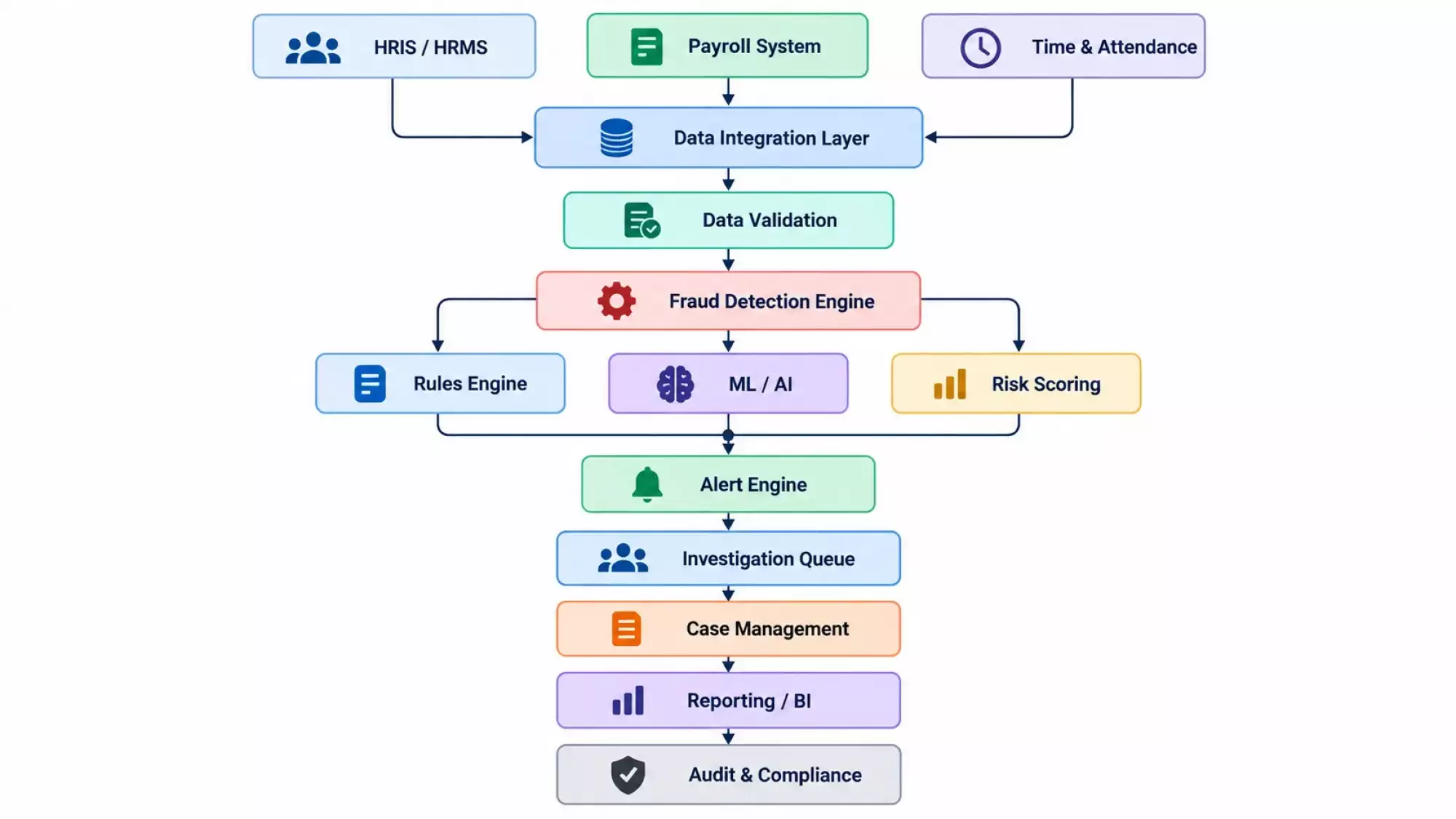
Each layer has a distinct responsibility. Data enters through integration channels, gets validated and normalized, passes through deterministic rules and analytical models, and is then prioritized through risk scoring. High-risk alerts move into investigation workflows where authorized users can review evidence and record the outcome.
Data Ingestion Layer
The data ingestion layer connects the detection platform with existing payroll and business systems. Depending on the source, it can support:
- REST APIs and webhooks
- Batch payroll files
- SFTP
- Database connectors
- Event streams
- Banking and payment data
The architecture should support both scheduled imports and near-real-time events where timely detection matters.
Payroll Data Normalization Layer
Data normalization creates a common structure across different payroll and HR systems. Employee IDs, department codes, pay periods, currencies, timestamps, payment details, and other fields may use different formats across systems.
A common data model makes cross-system analysis possible and prevents the detection engine from treating the same employee or transaction as separate records.
Fraud Detection Engine
The fraud detection engine combines deterministic controls with analytical detection. A rules engine can identify known conditions, while statistical models, behavioral baselines, and machine learning can surface less obvious deviations.
For example, the engine could combine an unusual salary change with a privileged-user action and a recent bank account update to create a stronger risk signal than any individual event alone.
Risk Scoring Engine
A risk scoring engine rates alerts by more than just fraud and non-fraud decisions.
A model would be:
Risk Score = Transaction Risk + Employee Risk + Behavioral Deviation + Rule Severity + Historical Risk
The weighting should be customizable based on the organization, the fraud scenario, and the risk appetite.
Alert and Case Management Layer
The alert layer transforms detection alerts into investigations. Severity, affected employee or transaction, rules triggered, supporting evidence, risk score, and suggested next steps are some of the items that can be included in an alert.
Investigators can then be assigned to cases, reviewed, escalated, dismissed, or resolved cases while keeping track of the decision history.
Audit and Evidence Layer
The audit layer provides a history of any user and system activity relevant to the audit. It should include the who (who did what), the when (when did it happen), the what (what happened), and the outcome (what happened as a result). According to NIST, audit trails are a chronological record that can be used for reconstruction and examination of security-related events.
In the case of payroll systems, this evidence can be used to assist investigations, accountability, compliance checks, and post-incident analysis while not creating an unwarranted risk of exposing sensitive data via the audit log.
Planning a payroll fraud detection architecture for your existing HR and payroll ecosystem?
Get a practical architecture plan based on your systems, fraud scenarios, and scalability requirements.
Core Features to Build Into Payroll Fraud Detection Software
A payroll fraud detection solution should have more than just a dashboard of suspicious transactions. It should regularly gather information on payroll signals, assess the risk, provide the rationale for the warning, and transfer the appropriate cases to the proper reviewers.
Real-Time Payroll Monitoring
Real-time payroll monitoring monitors payroll in real time, such as when a new employee is added, pay is changed, overtime is entered, it is approved, it is paid out, etc. If the underlying systems are capable of event-based integration, then alerts can be sent prior to suspicious transactions progressing further down the payroll process.
Configurable Fraud Rules Engine
A configurable rules engine lets payroll teams define conditions for known fraud patterns without changing application code. Rules can cover duplicate payments, post-termination payments, unusual salary changes, shared payment destinations, or excessive overtime.
AI-Powered Anomaly Detection
Anomaly detection using AI is a process of recognizing behavior that deviates from a known pattern. Machine learning fraud detection systems can compare the current payroll activity to historical baselines, employee groups, pay periods, and other contextual clues.
A best practice is to use ML along with deterministic controls. Guidance for payroll analytics also suggests that analytics should be used to detect anomalies and then employ professional judgment when determining if it is fraud.
Risk-Based Alerts and Employee Risk Profiles
Risk-based alerts get investigators the attention they need on top-value exceptions rather than having to look into each and every anomaly. Additional context can be provided by a combination of compensation changes, attendance, payment, access, and previous case outcomes from an employee risk profile.
Payroll Change and Payment Monitoring
Change monitoring for payroll should cover salary, bonus, allowance, classification, bank account, and where money is paid. The events can be assessed with regard to approvals, historical values, user permissions, and transactions related to it.
Investigation and Case Management
Case management translates detection into an investigation process. Each case will contain the triggered rule, the risk score, supporting records, the investigator assigned to the case, the actions taken, the disposition, and the resolution date.
This provides a clear flow of information from anomaly to alert and then to investigation and resolution, instead of assuming that any flag is an instance of fraud.
Approval, Escalation, Notifications
Approval and escalation workflows ensure that payroll is released to the right people before it gets sensitive treatment. Based on rules for severity, ownership, and escalation, the system can notify payroll managers, HR teams, finance users, or security teams.
Reporting, Analytics, and Audit Trails
Trend reports of alerts, fraud patterns, false positives, investigation results, and uninvestigated alerts must be included in payroll fraud analytics. Audit trails must be able to capture the who, what, when, and how of an action, as well as the outcome.
According to NIST, an audit trail is a log of activity that can be used to reconstruct and examine security-relevant activity chronologically.
Payroll Fraud Detection Dashboard
A payroll fraud detection dashboard gives different users a shared view of payroll risk without exposing unnecessary sensitive data. Key dashboard components include:
- Executive risk overview: Overall risk trends and high-priority cases
- Alert queue: Open alerts ranked by severity and risk
- Employee risk: Employees with unusual or repeated activity
- Payment destination: Suspicious bank account or payment patterns
- Investigation cases: Assigned, escalated, and resolved cases
- Audit Activity: Actions of key users and systems
- Detection performance: The volume of alerts, confirmed cases, false positives, and resolution time
Payroll Fraud Detection MVP Features
A practical MVP should focus on the fraud scenarios that create the highest financial and operational risk rather than attempting to automate every detection use case from day one.
| MVP capability | What to include |
| Payroll data ingestion | 1–3 core HR/payroll integrations |
| Fraud rules engine | Duplicate payments, terminated employees, pay-rate changes, shared bank accounts |
| Basic anomaly detection | Unusual payroll amounts, overtime, payment patterns |
| Risk scoring | Transaction and employee-level risk indicators |
| Alert management | Severity, assignment, status, and notifications |
| Investigation workflow | Evidence, notes, decisions, and case status |
| Audit trail | User actions, rule changes, approvals, and dispositions |
| Dashboard | Alerts, risk trends, cases, and detection performance |
Designing a Payroll Fraud Detection Rules Engine
The known fraud scenarios are transformed into repeatable and testable controls through a payroll fraud detection rules engine. It should also have a degree of flexibility to allow payroll teams to adjust thresholds and conditions while keeping a version history, approval process, and audit trail.
What Is a Payroll Fraud Rules Engine?
A payroll fraud rules engine compares payroll events to a set of rules and generates an action like an alert, a review request, a risk score change, or an escalation.
For instance, a rule could be set up to detect a payment after a verified termination date or two employees getting paid into the same account. It is preferable that these rules cause investigation signals and don't automatically trigger a verdict of fraud.
Hard Rules vs. Soft Rules
Different rule types serve different detection purposes:
| Rule type | Example | Typical response |
| Hard rule | Payment after confirmed termination | High-priority review |
| Threshold rule | Overtime exceeds configured limit | Alert |
| Duplicate rule | Same payment processed twice | Block/review |
| Pattern rule | Multiple employees linked to one account | Investigation |
| Behavioral rule | Unusual payroll administrator activity | Security alert |
| Statistical rule | Large deviation from historical pattern | Risk score |
Hard and duplicate rules are useful for clear conditions, while behavioural and statistical rules provide context for less obvious anomalies. Combining both creates a stronger payroll monitoring system.
Building Configurable Fraud Detection Rules
Rules should support configurable thresholds, conditions, severity, effective dates, exclusions, and actions. A rules engine should also allow teams to create controls for ghost employee detection, duplicate payroll detection, timesheet fraud, overtime manipulation, unauthorized salary changes, and payment diversion.
Rule Prioritization and Severity Levels
Not all alerts are created equal. Apply severity levels (low, medium, high, and critical) to prioritize investigations, notify, and escalate.
Then, risk scoring can be used to tie these employee, transaction, and behavioral risk indicators with the severity of the rules.
Rule Versioning
Each production rule should have a "Version History." Who came up with the change or modified the rule, what changed, when it was activated, its old setting, and the approval associated with the change.
This simplifies auditing of rule behavior and provides teams with insight into the reason for an alert when it occurs under a specific configuration.
Rule Testing Before Production
Payroll data should always be tested prior to deployment with historical data and synthetic data before any fraud rule is put in place. Test cases should contain real cases of fraud, valid exceptions, boundary conditions, missing data, and unusual but valid payroll events.
This helps to minimize false alarms and ensure that the volume of new rules is not excessive.
Avoiding Alert Fatigue
A too noisy alerting system can actually decrease the effectiveness of the fraud detection system. Apply thresholds, risk scoring, suppression rules, alert grouping, and investigator feedback to prioritize meaningful exceptions.
The objective is not maximum alert volume. It is a smaller queue of higher-quality signals that investigators can act on before payroll funds are released.
AI and Machine Learning for Payroll Fraud Detection
Machine learning and AI development can extend payroll fraud detection beyond fixed rules by identifying unusual patterns across large volumes of payroll data. The best architecture isn't one that takes the place of deterministic controls and introduces AI. It is a mix of rules, statistical analysis, anomaly detection algorithms, risk scoring, and human review.
Rule-Based Detection vs. Machine Learning
Rules can be more easily explained and work well in known fraud scenarios. While it is possible for ML models to capture less obvious patterns, high-quality data, continuous validation, and monitoring of the models are necessary.
| Factor | Rules-based detection | ML-based detection |
| Explainability | High | Varies |
| Setup | Faster | More involved |
| Known fraud patterns | Strong | Strong |
| Unknown patterns | Limited | Potentially stronger |
| Data requirements | Lower | Higher |
| Maintenance | Rule updates | Model monitoring/retraining |
| False positives | Depends on tuning | Depends on model/data |
A hybrid solution is typically best for payroll analytics: Rules for obvious controls, ML for complex or changing patterns.
Supervised Learning for Payroll Fraud
Supervised learning uses labeled historical data to learn the characteristics of known fraud cases. If an organization has reliable investigation outcomes, models can learn from features such as unusual pay changes, payment destinations, overtime patterns, access activity, and previous fraud cases.
The main constraint is data quality. Poor labels, limited fraud examples, or major changes in payroll processes can reduce model reliability.
Unsupervised Anomaly Detection
Unsupervised anomaly detection identifies activity that is outside of the payroll rules that may not be fraud-labeled. Algorithms for anomaly detection can spot unusual salary increases, new payment targets, unusual overtime, new payment locations, or administrator activity that's outside the norm.
These signals should feed the risk scoring engine rather than automatically become fraud findings.
Employee Behavioral Baselines
Employee behavioral baselines establish what normal payroll activity looks like for an employee or comparable group. The system can monitor changes in pay, overtime, attendance, payment details, and other attributes over time.
This contextual layer helps distinguish a genuine promotion or seasonal overtime increase from an unexplained deviation.
Transaction-Level Anomaly Detection
Transaction-level anomaly detection evaluates individual payroll events for unusual characteristics. A model can examine amount, timing, employee history, approval path, payment destination, and related transactions to identify combinations that deserve review.
For example, a bank account change followed by an unusual payment may receive a higher risk score than either event would receive independently.
Explainable AI for Fraud Alerts
Explainable AI can help investigators better understand and question an automated fraud alert. Businesses can also explore AI TRiSM to identify the signals that led up to the high-risk score, rather than just displaying the high-risk score as the total.
Human-in-the-Loop Fraud Investigation
Payroll investigators should use AI to assist them, but not to automatically label all odd transactions as fraud. PayrollOrg specifically notes that while analytics can detect anomalies and potential indicators of fraud, there is a need for professional judgment, as there are myriad legitimate reasons for anomalies.
A practical workflow is:
AI signal → Risk score → Evidence → Human review → Investigation outcome → Model/rule feedback
This approach creates a more trustworthy automated fraud detection system while giving investigators control over final decisions and creating feedback that can improve future payroll monitoring.
Payroll Fraud Detection Data Model
A strong payroll fraud detection data model allows the detection engine to correlate events across systems instead of evaluating each payroll transaction in isolation. The model should also preserve historical changes. That matters when investigators need to understand who changed what, when it changed, and which payroll transaction was affected.
Employee Entity
Contains the basic information for a worker profile that is used to relate payroll and behavior to an employee. Common types of fields include employee ID, employment status, department, manager, employee type, hire date, and termination date.
Payroll Transaction Entity
Records each payroll transaction and its financial components. It should support pay-period analysis, duplicate detection, unusual payment amounts, and reconciliation.
Time and Attendance Entity
Maintains clock-in/clock-out logs, schedules, overtime, absences, and manual adjustments. This information can be used for timesheet fraud detection and anomaly analysis based on attendance.
Compensation Entity
Tracks salary, hourly rate, bonuses, allowances, commissions, effective dates, and historical compensation changes. Versioned records make unauthorized salary changes easier to investigate.
Bank Account and Payment Destination Entity
Stores approved payment destinations and their relationship with employees. The system can use this entity to identify new accounts, changed destinations, shared accounts, and unusual payment patterns.
Approval Entity
Records approval workflows, including approver identity, action, timestamp, approval status, and related transaction. It helps enforce segregation of duties and identify unusual approval behavior.
Fraud Alert Entity
Stores detection results generated by the rules engine or ML models. Key information includes the triggered rule, severity, risk score, supporting signals, status, and creation time.
Investigation Case Entity
Connects one or more alerts to an investigation. It should capture the assigned investigator, evidence, notes, actions, escalation history, resolution, and closure date.
Audit Event Entity
Maintains an immutable record of important system and user actions. Before-and-after values are particularly useful for tracking changes to payroll records, compensation, payment details, and fraud rules.
Suggested Conceptual Schema
| Entity | Important fields |
| Employee | employee ID, status, department, manager |
| Payroll | pay period, gross pay, deductions, net pay |
| Attendance | date, clock-in, clock-out, hours |
| Compensation | salary, rate, bonus, effective date |
| Payment | destination, amount, payment date |
| Approval | approver, timestamp, action |
| Alert | rule, severity, score, status |
| Case | investigator, evidence, resolution |
| Audit Event | actor, action, timestamp, before/after state |
Integrating Payroll Fraud Detection With Existing Systems
Payroll fraud detection software should integrate with the systems that create, modify, approve, and process payroll data. With a connected architecture, the detection engine has more context to recognize relationships that a stand-alone payroll database might not be able to.
HRIS and HRMS Integration
Integration between HRIS and HRMS gives you employee details, employment status, department, manager, compensation changes, and termination details. These records can be used to validate payroll events and detect ghost employees, unauthorized payroll changes, or payments after termination.
Payroll Platform Integration
Payroll platform integration provides pay runs, earnings, deductions, adjustments, employee changes, and payment records. APIs, webhooks, or secure file exchange can feed these events into the payroll monitoring system.
Time and Attendance Integration
Time and attendance integration ties up scheduled hours, clock-in/out, overtime, absences, and manual adjustments. These data are used in timesheet fraud detection and to detect unusual patterns of working hours.
Accounting and ERP Integration
Accounting and ERP integration allows payroll transactions to be reconciled with the general ledger, cost centers, expenses, and financial records. This can expose discrepancies between payroll activity and recorded financial data.
Banking and Payment System Integration
Banking and payment integration enables monitoring of payment destinations, amounts, payment dates, and account changes. New or unusual payment destinations can be correlated with employee, approval, and access events before funds are released.
Identity and Access Management Integration
IAM integration connects payroll activity with user identity and privilege information. The system can verify whether an administrator had the required permissions and flag unusual privileged activity, failed authentication attempts, or conflicting access.
SIEM and Security Monitoring Integration
By integrating SIEM with payroll, organizations can enhance their overall security posture and gain a more comprehensive view of the company's operations. Fraud alerts can be correlated with authentication events, endpoint activity, privilege changes, or any other security signals in order to detect any account compromise or insider-risk indicators.
API-First Payroll Fraud Detection Architecture
An API-first architecture allows for payroll fraud detection to be easily integrated, scaled, and maintained. All of the above can help with both periodic data synchronization and near real-time monitoring.
The integration layer should contain authentication, schema validation, rate limiting, error handling, idempotency, monitoring, and data flow ownership.
Security Requirements for Payroll Fraud Detection Software
With employee, compensation, banking, and identity information held in sensitive hands, security is a fundamental design feature of payroll fraud detection software. The NIST guidance focuses on systems with sensitive data and fine-grained access control, least privilege, encryption, authentication, and logging.
Role-Based Access Control
The role-based access control system should be used to limit the access of users based on their roles. Only those who are responsible and need access to the functions and data should have access to it, such as payroll administrators, investigators, HR managers, and finance and security staff.
Least-Privilege Access
Least privilege restricts the access that users or services have to the minimum needed to carry out their assigned function. Do this with application roles, APIs, databases, service accounts, and administrative interfaces.
Multi-Factor Authentication
MFA adds another verification layer for sensitive payroll access. It should be required, particularly for administrators, investigators, privileged accounts, and actions involving payment details or security configuration.
Encryption in Transit and at Rest
Payroll information must be encrypted while it is being transmitted and while it is stored. Implement robust and trusted cryptographic standards and safeguard the cryptographic keys that are used with them using proper key-management procedures. NIST is particularly urging protection of sensitive data in storage and communications.
Secure API Authentication
Every payroll API should authenticate and authorize requests before allowing data access or state changes. Use appropriate mechanisms such as OAuth 2.0, signed requests, service credentials, or mutual TLS based on the integration requirement, along with rate limiting and request validation.
Audit Logging
Audit logging records security-relevant actions and changes across the platform. Capture the actor, timestamp, action, affected resource, outcome, and relevant before-and-after state without unnecessarily storing sensitive values. NIST guidance includes logging and audit capabilities alongside access controls and authentication.
Data Masking
Data masking limits exposure of sensitive payroll information. For example, dashboards can display only the last few digits of bank accounts while authorized investigators receive additional information when required for a legitimate case.
Secrets Management
API keys, database credentials, certificates, and encryption keys are examples of secrets that should never be hard-coded into application code. Keep them in a secure secrets-management application that has access control, rotation, expiration, and audit.
Database Security
The security of the database should cover the payroll data and detection metadata. Implement encryption and network isolation, use strong authentication and least privilege database accounts, validate input, back up, patch, and monitor for unusual activity in the database.
Administrative Activity Monitoring
There are additional cases where administrator actions should be visible. Tracing of activities like role changes, rule editing, configuration changes, data exports, account creation, and payment or integration changes.
Backup and Disaster Recovery
Payroll investigations and historical evidence are protected against disruption and loss via backup and disaster recovery. The platform is backed up using encryption, access control, specified retention policies, and recovery testing, and recovery objectives are documented so it can be restored without compromising sensitive data.
Have you defined what your payroll fraud detection MVP should include?
Suffescom Solutions can help turn your fraud scenarios into a development roadmap covering data ingestion, rules, anomaly detection, risk scoring, security, and investigation workflows.
Privacy and Compliance Considerations in Payroll Monitoring
Payroll fraud monitoring must be built-in, not bolted-on. Information that can be stored in payroll systems includes employee identities, payroll, tax details, attendance records, banking details, or evidence of investigations. NIST suggests that privacy be considered an enterprise risk management (ERM) issue and privacy risk be re-evaluated as systems and data change.
Payroll Data Classification
Classify payroll data according to its sensitivity and business use. Access, protection, and retention controls for employee identifiers, salary, bank information, authentication information, investigation information, and audit events can vary.
Data Minimization
Collect and process only the data required for legitimate detection and investigation purposes. Avoid sending unnecessary employee information to analytics or machine learning pipelines, particularly when a less sensitive field can provide the same detection signal.
Retention and Deletion Policies
Retention periods should be defined for each category of payroll and investigation data. Keep information only as long as required by business, legal, regulatory, audit, or investigation needs, then securely delete or anonymize it according to the organization's policy.
Employee Privacy
There needs to be a balance between the need to detect fraud and employee privacy when it comes to fraud monitoring. Establish clear boundaries for data monitored, the purpose of monitoring, who can monitor the data, and how it will be used. You should also examine the monitoring logic for unnecessary data collection, profiling, or the impact on outcomes.
Access and Disclosure Controls
Access to payroll monitoring data should follow role-based and least-privilege principles. Sensitive employee or investigation information should only be disclosed to authorized personnel with a legitimate business need, with access and disclosure events recorded for accountability.
Auditability and Evidence Retention
Investigation evidence must remain traceable without becoming an uncontrolled copy of sensitive payroll data. Maintain relevant alerts, rule versions, investigator actions, approvals, and case outcomes with appropriate integrity and retention controls.
Compliance Requirements by Operating Jurisdiction
Payroll privacy and compliance requirements vary by jurisdiction, industry, workforce structure, and organization. A multinational payroll fraud detection platform may need different data processing, employee rights, cross-border transfer, retention, and disclosure controls across the markets where it operates.
NIST's Privacy Framework is intentionally flexible and jurisdiction-agnostic, allowing organizations to identify and manage privacy risks according to their own data-processing environment and requirements.
Step-by-Step Payroll Fraud Detection Software Development Process
The payroll & AI fraud detection software development must be a step-by-step process that links business requirements with payroll data, detection logic, security, investigation, and learning. It's not just about creating an alert system. The goal is to develop a scalable process for detecting and translating payroll information into actionable and explainable risk signals.
Step 1. Define Fraud Detection Requirements
First, determine the system's detection criteria, who will be responsible for investigating the system, and what steps will follow an alert of some kind. Recognize fraud situations, including ghost employees, duplicate payments, unauthorized salary changes, overtime abuse, payment diversion, and privileged-user abuse.
Identify business goals, detect thresholds, user roles, reporting requirements, response time, and success metrics like false positive rate and investigation time.
A company might wish to set up the system to alert them to payments made after the termination but not automatically prevent the payments of legitimate final settlements from going through for manual review.
Step 2. Map Data Sources and Integrations
Define all the possible systems that could provide evidence of payroll fraud analytics. Typical sources include:
- HRIS and HRMS
- Payroll platforms
- Time and attendance systems
- Accounting and ERP software
- Banking and payment systems
- Identity and access management platforms
- Existing security tools
Record information provided by each source, the integration process, how often it is updated, who owns it, and its level of security. This becomes the foundation for the integration architecture.
Step 3. Design the Data Model and Architecture
Create a common data model for employees, payroll transactions, attendance, compensation, payments, approvals, alerts, cases, and audit events.
Then define the payroll fraud detection architecture, including the ingestion layer, validation layer, rules engine, anomaly detection, risk scoring, alert management, investigation workflow, reporting, and audit layer.
The architecture should support scalability without forcing organizations to replace their existing payroll infrastructure.
Step 4. Build Data Ingestion and Validation
Create secure pipelines to fetch payroll information via APIs, webhooks, SFTP, database connectors, batch files, or event streams.
Ensure schemas are validated, employee identifiers are unique, timestamps are correct, pay periods are valid, duplicate records are not included, and data relationships are enforced prior to detection. Even if the logic for detecting the problem is correct, poor input data can result in false alerts.
Step 5. Develop Rules and Anomaly Detection
Create a set of rules that can be configured for known cases and add in statistical or machine learning models for less common anomalies.
Rules can be used to identify duplicate payments or post-termination payments, etc., while anomaly detection algorithms can be used to detect abnormal administrator, payment, overtime, or compensation activities, etc.
Adopt a blended approach: apply deterministic rules to clear controls and AI using payroll anomaly detection for patterns needing more context.
Step 6. Implement Risk Scoring and Alert Management
Convert detection signals into prioritized alerts using a risk scoring engine. Score factors can include transaction value, rule severity, behavioral deviation, employee risk, historical activity, and the number of correlated signals.
Avoid a simple fraud/no-fraud outcome. A better workflow is
Detection → Risk score → Alert severity → Investigation priority
This helps investigators focus on the cases that require attention first.
Step 7. Build Investigation and Response Workflows
Develop a case management workflow to allow investigators to view alerts, supporting records, triggered rules, risk factors, past activity, and transactions.
The system should be able to add assignments, escalate, gather evidence, add comments, and resolve and close. Human review needs to be in place, as there may be genuine business reasons for an unusual payroll event.
Step 8. Implement Security and Auditability
Securely protect payroll data with RBAC, least-privilege access, MFA, encryption, secure API authentication, secrets management, database controls, and data masking.
Concurrently, maintain comprehensive audit logs of important events like salary adjustments, payment-destination changes, rule changes, permission changes, investigations, and admin activity.
Step 9. Test Detection Accuracy and System Performance
Testing should cover more than application functionality. Validate:
- Detection precision and false positives
- Known fraud scenarios
- Legitimate payroll exceptions
- Missing or inconsistent data
- Rule conflicts
- Model performance and drift
- API and integration failures
- Alert-processing latency
- Security and access controls
- High-volume payroll processing
Step 10. Deploy, Monitor, and Continuously Improve
Test and roll out the platform gradually, beginning by testing a small group or limited detection scenarios. Track alert level, detection success, false alarms, investigation time, integration health, model performance, and system availability.
It's not a one-time development project to detect payroll fraud. Update rules on the frequency of updates to track changing patterns of fraud, retrain models as needed, check with investigators on updates, adjust risk levels, and periodically re-evaluate integration and security controls.
The resulting lifecycle is
Requirements → Data & Integrations → Architecture → Ingestion → Detection → Risk Scoring → Investigation → Security → Testing → Deployment → Continuous Improvement
Testing and Quality Assurance for Payroll Fraud Detection Systems
Before you test a payroll fraud detection system, you need to determine if it works, but that isn't enough. The team has to ensure that payroll information is correct, fraud rules are working as they should, models are detecting valuable anomalies, and valid transactions are not being blocked unnecessarily.
Functional Testing
Confirm essential processes like employee onboarding, monitoring payroll, triggering alerts, case assignment and escalation, case resolution, reporting, and auditing.
API Testing
Test every payroll API and integration for authentication, authorization, valid and invalid payloads, error handling, rate limits, duplicate requests, and integration failures.
Data Validation Testing
Check missing fields, duplicate records, incorrect employee IDs, inconsistent pay periods, invalid timestamps, unexpected formats, and conflicting records before data reaches the detection engine.
Rules Engine Testing
Every fraud rule should be tested against positive, negative, boundary, and exception cases. For example, a post-termination payment rule should flag an unexpected payment but allow an approved final settlement to proceed for review.
Fraud Scenario Testing
Design realistic test scenarios involving ghost employees, double payments, shared accounts, overwork, unauthorized salary changes, salary diversion, and privileged-user access.
False Positive Testing
A false positive test confirms that a legitimate payroll transaction will not incorrectly be reported as high-risk. Enter legitimate promotions, approved bonuses, overtime (seasonal), legitimate bank changes, and approved payroll corrections.
False Negative Testing
Test whether the system can detect known fraud scenarios when indicators are incomplete, distributed across systems, or deliberately subtle. Missed high-risk cases should feed back into rule and model improvement.
Security Testing
Test RBAC, MFA, API authentication, encryption, privilege escalation, session management, data exposure, audit logging, and administrative controls. Sensitive payroll data should never become accessible through an unintended workflow.
Performance and Load Testing
The performance test will check if it can handle a high volume of payroll without delay. Run payroll concurrently, import bulk payrolls, and import high volumes of alerts, API bursts, and peak payroll periods.
Model Validation
Test precision, recall, false positive rate, drift, and stability of ML models on representative data sets. Model output should be explained in such a way that the investigators can see why an alert was triggered.
Regression Testing
Regression testing should be carried out for every new rule, application change, or model change. This helps to prevent the increase of false alarms or the disruption of current alarms when working on one detection scenario.
User Acceptance Testing
Before production deployment, the teams of payroll, HR, finance, security, and investigation should test real workflows. UAT should validate that alerts have sufficient context, cases can be solved, and reports can be provided to enable actual business decisions.
Payroll Fraud Detection Testing Matrix
| Test scenario | Expected result |
| Duplicate payment | Alert generated |
| Legitimate salary increase | No high-risk fraud alert |
| Terminated employee payment | Review alert |
| Shared bank destination | Risk signal |
| Excessive overtime | Configurable alert |
| Unauthorized pay-rate change | High-priority alert |
| Valid manager approval | Transaction proceeds |
| Unauthorized administrator action | Security event |
Measuring Payroll Fraud Detection Software Performance
Good payroll & AI fraud detection software should have a balanced approach to KPIs, which include detection, investigation, operational, and financial. Overall, there is no one-size-fits-all effectiveness measure. Businesses should choose appropriate red flags that are commensurate with their risk profile, their fraud detection plan, and their fraud investigation resources.
Detection Rate
Detection rate is the ability of the system to detect known or validated fraud scenarios. Monitor it by fraud type, business unit, rule, or detection method to know where the system works well and where it has less coverage.
False Positive Rate
False positive rate measures how often legitimate payroll activity is incorrectly flagged as suspicious. A high rate can increase investigation workload and reduce confidence in the payroll fraud monitoring system.
False Negative Rate
False negative rate measures relevant fraud cases that the system fails to identify. This is particularly important because undetected cases can reveal weaknesses in rules, data quality, model coverage, or integration.
Alert-to-Case Conversion
Alert-to-case conversion measures how many generated alerts progress into formal investigation cases. A very low conversion rate may indicate excessive alert noise, while a high rate may indicate that detection logic is effectively prioritizing relevant signals.
Average Investigation Time
Average investigation time (AIT) is the average time required to investigate and resolve detected cases. It can provide information on whether alerts have enough information and context for investigators to make efficient decisions.
Time to Detect
Time to detect refers to the elapsed time from the occurrence of a suspicious payroll event to its detection by the system. For payment changes, privileged access events, and other risks that require timely detection, shorter detection windows can be of significant value.
Time to Resolve
Time to resolve is how long it takes to close an investigation after an alert is created. Extended resolution time could signal evidence collection, escalation or approval delays, or communication between HR, payroll, finance, and security.
Prevented or Recovered Losses
Prevented or recovered losses is a financial forfeiture to successful intervention. There should be a clear separation between funds that are withheld and funds that are recovered in the event of an incident and estimated loss prevented through early detection.
Rule Effectiveness
Rule effectiveness evaluates which detection rules generate useful investigation signals. Review alert volume, confirmed cases, false positives, severity, and investigator feedback for individual rules.
Model Drift
Model drift indicates whether an ML-based detection model's data patterns or performance are changing over time. Model reliability can be impacted by changes to payroll processes, workforce behavior, fraud tactics, or source system data.
Investigator Productivity
Investigator productivity captures the effectiveness of teams in processing and solving valuable alerts. Some helpful metrics are cases to which we provide a response, the average time that it takes for us to review, backlog, rates of escalation, and resolution outcomes.
How to Reduce False Positives in Payroll Fraud Detection?
Making a system less sensitive isn't the key to minimizing false positives; it's just providing more context for each alert. Payroll anomaly detection should distinguish unusual activity from genuinely suspicious activity wherever the available data allows.
Use Employee and Organizational Context
Anomalies are easier to understand in the context. Verify that an employee is active when compared to their role, department, manager, employee type, location, compensation history, and approved changes before assigning high risk.
For instance, an overtime increase in a time of year known for seasonal changes might be less unusual than the same increase at another time of year when the employee should be working normally.
Combine Multiple Signals
Multiple related signals usually provide stronger evidence than one isolated event. A new bank account, unusual administrator login, and unexpected payroll change occurring together can receive more attention than any single event alone.
Establish Historical Baselines
Historical baselines help the system understand normal payroll behavior. Compare current salary, overtime, payment amounts, attendance, and administrative activity with relevant historical patterns rather than applying identical thresholds to every employee.
Use Risk-Based Thresholds
Risk-based thresholds allow detection sensitivity to vary by scenario and context. High-value transactions, privileged actions, or multiple correlated anomalies may warrant lower thresholds than routine low-risk payroll activity.
Introduce Alert Suppression Rules
Alert suppression reduces repetitive notifications without removing the underlying detection control. Group related alerts, suppress duplicate events within defined windows, and allow approved exceptions to prevent investigators from repeatedly reviewing the same legitimate activity.
Give Investigators Explainable Alerts
An alert should explain why it was generated. Show the triggered rule, relevant transaction, comparison baseline, risk factors, related events, and supporting evidence so investigators can make decisions without manually reconstructing the entire event.
Continuously Tune Detection Rules
Payroll fraud monitoring should evolve as payroll processes and fraud patterns change. Review thresholds, exclusions, rule combinations, and alert outcomes regularly instead of treating production rules as permanent configurations.
Track Investigator Feedback
Investigator feedback is important evidence that can be used to enhance rules and machine learning models. Capture if alerts were true, false, escalated, or confirmed and then find noisy rules, missing signals, and new fraud patterns based on the outcomes.
The practical objective is not the lowest possible false-positive rate. It is a detection workflow that produces sufficiently accurate, explainable alerts for the organization's risk tolerance and investigation capacity.
Already using Workday, SAP, ADP, UKG, or another payroll platform?
Suffescom can help design a fraud detection layer that works with your current systems and adds monitoring, analytics, risk scoring, and investigation workflows.
From Detection to Automated Fraud Response
Payroll fraud detection doesn't end with the alert. A sophisticated payroll fraud detection system should enable detection to follow a specific workflow to triage, investigate, approve, gather evidence of suspicious activity, and control the response.
Alert → Triage → Investigation → Decision → Action
The workflow for the response should follow logical steps and take each meaningful alert through the subsequent stages. The severity and ownership are assigned in the triage, the supporting evidence is reviewed in the investigation, and the authorized users decide to dismiss, escalate, hold, correct, or resolve the cases.
This provides a structured journey from automated fraud detection to human decision-making but doesn't assume that all anomalies are fraud.
Automatically Holding High-Risk Transactions
High-risk payroll transactions can be placed on a configurable hold when predefined conditions are met. For example, an organization may temporarily hold an unusual payment following a recent bank account change until an authorized reviewer verifies the request.
Requesting Additional Approval
When the transaction is above a given determined risk threshold, it can automatically ask for further approval. The process can be passed to a payroll manager, finance lead, or another authorized approver prior to the payment and then passed back for payment. This gives extra control for salary, payment, or master data changes.
Escalating Suspicious Changes
If changes to payroll are found to be suspicious, they can be escalated on an automatic basis depending on the value of the transactions, repeated use, level of access, or severity. For instance, a bank account change that originates in a high-risk account may send alerts to the payroll and security teams at the same time.
Creating Investigation Cases Automatically
The platform can automatically create an investigation case when an alert meets defined criteria. The case should carry the triggered rule, risk score, affected employee or transaction, related events, evidence, and relevant audit history. This prevents investigators from manually reconstructing information scattered across multiple payroll systems.
Preserving Evidence
Evidence preservation ensures that investigators can reconstruct what happened and why the system raised the alert. Store relevant transaction records, rule versions, timestamps, approval activity, user actions, and related system events with appropriate integrity and access controls.
Recording the Final Disposition
Every investigation should end with a recorded disposition. Common results might be a "legitimate" user, a false positive, a violation of policy, confirmed fraud, escalation to investigation, or unsolved.
Avoiding Fully Automated Fraud Decisions
Automated fraud response should assist decision-making rather than independently declare an employee or transaction fraudulent. High-impact actions such as permanently blocking payments, changing employee records, or initiating disciplinary processes should have configurable approval and review mechanisms.
A practical model is
Detect → Score → Triage → Investigate → Approve → Act → Record
Technology Stack for Payroll Fraud Detection Software Development
The right technology stack for payroll fraud detection software should be selected around the system’s workload, integrations, security requirements, and detection architecture, not popularity alone.
| Layer | Potential technologies |
| Frontend | React, Angular, Vue |
| Backend | Node.js, Java, .NET, Python |
| Database | PostgreSQL, MySQL, SQL Server |
| Analytics | Python, Pandas, Spark |
| ML | Scikit-learn, TensorFlow, PyTorch |
| APIs | REST, GraphQL |
| Messaging | Kafka, RabbitMQ |
| Cloud | AWS, Azure, Google Cloud |
| Monitoring | OpenTelemetry, cloud-native monitoring |
| Identity | OAuth 2.0, OpenID Connect |
| Deployment | Docker, Kubernetes, CI/CD |
Choosing the Right Stack
Frontend technologies like React, Angular, or Vue
These can be used for risk dashboards, risk alert queues, investigation screens, and administrative interfaces. Backend options such as Java, .NET, Node.js, or Python should be considered based on API complexity, team skills, transaction volume, and the existing enterprise systems.
PostgreSQL, MySQL, or SQL Server
These can process structured payroll and investigation data; Python, Pandas, or Spark can process larger amounts of payroll data for payroll analytics. The machine learning libraries for fraud detection can include Scikit-learn, TensorFlow, or PyTorch, depending on the complexity of the models and the requirements of the operations.
Kafka or RabbitMQ
If you are monitoring the detection in response to an event, then you might be able to use Kafka or RabbitMQ to get the detection event from one service to another. The integration APIs can be exposed using REST or GraphQL, and identity and authorized access can be provided with OAuth 2.0 and OpenID Connect.
Docker, Kubernetes, and CI/CD pipelines
Consistent deployment, consistent scaling, and visibility into API performance, detection pipelines, failures, and system health can be supported by these as well as by cloud-native monitoring and OpenTelemetry.
The end result should be a final stack that will be determined by data volume, detection latency, integration needs, security architecture, regulatory requirements, scalability, current infrastructure, and team expertise. There is no universal technology stack for payroll fraud detection software development.
Build vs. Buy Payroll Fraud Detection Software
The build-versus-buy decision depends on how closely the organization's existing payroll environment matches its fraud detection requirements.
| Factor | Custom development | Existing solution |
| Custom workflows | High flexibility | Depends on vendor |
| Integration control | High | Depends on APIs |
| Initial investment | Usually higher | Usually lower |
| Custom fraud rules | Extensive | Product-dependent |
| Ownership | Organization | Vendor |
| Time to deployment | Longer | Potentially faster |
| Differentiation | High | Limited by product |
| Maintenance | Internal responsibility | Shared/vendor responsibility |
When Custom Payroll Fraud Software Makes Sense
Enterprise software development is effective when an organization requires specific fraud rules, intricate workflows, many integrations, and full control over the payroll fraud detection system. It can also facilitate customized risk rating, analytics, and investigation processes.
When an Existing Platform May Be Sufficient
Standard fraud controls, reporting, alerts, and integrations can address an organization's needs, and an existing solution may suffice. Consider its flexibility of rules, capabilities of APIs, security, scalability, data ownership, and costs before choosing it.
Hybrid Payroll Fraud Detection Architecture
A hybrid model combines existing payroll infrastructure with custom detection capabilities. Businesses can retain their payroll platform while adding custom rules, anomaly detection, risk scoring, or case management where gaps exist.
When a Fraud Detection Layer Is Better Than Replacing Your Payroll System
It's not always necessary for businesses to change over their current payroll software. A separate fraud detection layer can be placed on top of platforms like Workday, SAP, ADP, UKG, or Oracle, and the data can be fed into it via APIs or other integrations to detect suspicious activity.
Cost of Developing Payroll Fraud Detection Software
Payroll fraud detection software development typically costs about $80,000–$350,000 for a production-ready custom platform, while complex enterprise implementations can reach $350,000–$700,000+.
Discovery and Requirements
Estimated cost: $5,000–$20,000
This phase is where fraud scenarios, data sources, user roles, detection objectives, workflows, integrations, and technical requirements are defined. The thorough discovery phase minimizes subsequent expensive changes in the architecture.
UX/UI Design
Estimated cost: $8,000–$20,000
Design includes fraud dashboards, employee risk views, investigation screens, fraud alert queues, reports, and administrative workflows. Things get even more complicated if multiple teams need to access and view different things.
Backend Development
Estimated cost: $35,000–$80,000
The back-end aspect of the development includes APIs, authentication, business logic, data processing, case management, reporting, and linking detection services with the current payroll system.
Fraud Detection Engine
Estimated cost: $20,000–$50,000
The core of the platform is the rules engine, thresholds, pattern detection, risk signals, alert generation, and detection workflow. The more fraud scenarios and complicated correlation logic are added, the more effort it takes for development.
AI/ML Development
Estimated cost: $15,000–$50,000+
Anomaly detection, behavioral baselines, predictive models, and managing the models all need further data engineering and ML skills. Expensive when models have to handle large amounts of data and/or continuous training.
Integrations
Estimated cost: $15,000–$50,000+
HRMS integration, payroll, time and attendance, accounting and banking, and IAM and security platforms can be one of the biggest cost drivers. API development, data mapping, authentication, error handling, testing, and ongoing maintenance are added to each of the integrations.
Security Engineering
Estimated cost: $10,000–$25,000
RBAC, MFA, encryption, secure APIs, secrets management, database security, data masking, privileged-access monitoring, and audit logging are examples of security engineering that might be included.
QA and Testing
Estimated cost: $10,000–$30,000
Fraud scenarios, false positives, false negatives, rules, APIs, data quality, security, performance, regression, and model validation for ML models should be included in testing. The need for deeper QA of fraud detection systems arises from the possible consequences to operations and finances when alerts are wrong.
Cloud Infrastructure
The potential cost of this project is anticipated based on the monthly fees that must be paid after deployment, which range from $3,000 to $15,000+ per month. Published fraud-detection benchmarks similarly identify cloud processing and hosting as recurring costs that increase with data and transaction volume.
Compliance and Audit Requirements
Estimated cost: $5,000–$25,000+
Costs can include compliance analysis, security assessments, audit preparation, evidence controls, privacy requirements, penetration testing, and jurisdiction-specific controls. The actual requirement depends on where the organization operates and what payroll data it processes.
Maintenance and Model Monitoring
Estimated cost: $15,000–$50,000+ per year, excluding variable cloud costs
Continuing efforts involve bug fixes, security, maintenance of integrations, tuning of fraud rules, monitoring, evaluation of models, retraining models, and optimizing the infrastructure. An AI/ML-based system typically needs more ongoing maintenance and upkeep than a rules-only system.
Payroll Fraud Detection Software Cost by Project Scope
| Project scope | Estimated cost | Typical scope |
| MVP | $80,000–$150,000 | Core payroll monitoring, rules engine, basic alerts, 1–3 integrations |
| Production-ready | $125,000–$350,000 | Advanced rules, risk scoring, investigation workflows, multiple integrations, security and analytics |
| AI-enhanced | $200,000–$450,000+ | ML anomaly detection, behavioural analytics, advanced risk scoring and model monitoring |
| Enterprise | $350,000–$700,000+ | Multi-tenant architecture, real-time processing, extensive integrations, advanced security, compliance and high-volume analytics |
Payroll Fraud Detection Software Development Timeline
A basic MVP can typically take around 3–5 months, while a production-ready enterprise platform may require 6–12+ months depending on integrations, detection complexity, security requirements, and AI/ML scope.
| Development stage | Typical timeframe |
| Discovery and requirements | 2–4 weeks |
| Architecture and UX/UI | 2–4 weeks |
| MVP development | 8–16 weeks |
| Integrations and security | 4–10 weeks |
| QA and deployment | 3–6 weeks |
| Enterprise expansion | 6–12+ months overall |
Key Cost Drivers
| Cost driver | Impact on development effort |
| Number of payroll integrations | High |
| Real-time monitoring | High |
| Number of fraud scenarios | Medium–High |
| Custom workflows | Medium–High |
| Multi-tenant architecture | High |
| Compliance requirements | Medium–High |
| Reporting complexity | Medium |
| Expected transaction volume | Medium–High |
| ML capabilities | High |
Want to know what your payroll fraud detection platform could cost?
Share your integrations, fraud scenarios, expected payroll volume, and preferred detection capabilities with our team.
Who Needs Payroll Fraud Detection Software?
The financial software is most useful for businesses with complex payroll systems, large payroll operations, or high financial risk due to payroll fraud. It is not about the size of the company but the number of employees, payroll systems, entities, payment destinations, and people who are involved in the payroll operations.
Mid-Size and Large Enterprises
If you have large workforces, manual review of payroll is not feasible. Automated payroll monitoring can monitor salary changes, overtime, payments, employee records, and administrator activity at all times and escalate higher-risk events for investigation.
Multi-Entity Organizations
Businesses with multiple entities, departments, or sites require uniformity of fraud controls used in various payroll sites. A central detection layer can help tie together employee, payment, approval, and compensation data for entities.
Payroll Service Providers
Payroll service providers process payroll transactions and data for multiple clients, so it is especially beneficial to have scalable detection and alert management. Multi-tenant architecture can provide separation of client data and support the application of configurable fraud rules across various customer environments.
Shared-Service Payroll Teams
Automated detection enables centralized payroll teams to monitor activity on a business unit-by-business unit basis without having to manually review each transaction. RBA alerts enable teams to prioritize their investigation efforts on higher-risk incidents due to limited capacity.
Financially Sensitive Organizations
Payroll fraud prevention software is a valuable tool for organizations that have high payroll values or tight financial controls. It can track payment updates, approval activity, privileged access, and unusual transaction patterns.
Organizations With Complex HR/Staff Integrations
Cross-system payroll fraud analytics can help businesses that are integrating HRIS, HRMS, payroll, attendance, accounting, banking, and identity systems. These sources can be correlated to uncover unseen relationships between the sources.
Challenges in Payroll Fraud Detection Software Development
Poor Data Quality
Payroll data can be incomplete, duplicated, or inconsistent, which can affect the accuracy of payroll detection. Data validation and normalization should take place before the rules or models are applied to the data to check it.
Disconnected HR and Payroll Systems
Fraud signs may be found in other systems and not just within payroll itself. The detection engine might not have sufficient context to detect meaningful anomalies if there are no reliable integrations.
False Positives
Legitimate payroll events can look suspicious. Promotions, bonuses, seasonal overtime, and approved account changes need contextual analysis to avoid unnecessary investigations.
False Negatives
The system might also fail to detect legitimate fraud if the signals are incomplete or the fraud detection logic is too limited. Review confirmed cases to determine if there are deficiencies in rules, data, or models.
Changing Fraud Patterns
As payroll processes and controls evolve, so do fraud patterns. Detection rules, baselines, and ML models should be reviewed and tuned periodically.
Legacy Payroll Systems
Older payroll software might not have the latest APIs and real-time events. Secure file transfer, database connectors, middleware, or scheduled integrations might be needed.
Privacy Constraints
Payroll information is important and holds sensitive employee and financial information. Data minimization, access controls, masking, retention policies, and proper governance need to be incorporated into the architecture.
Integration Complexity
Every external integration adds authentication, data mapping, error handling, testing, and maintenance requirements. This becomes more challenging as the number of HR, payroll, banking, and accounting software systems increases.
Model Explainability
Investigators must be able to comprehend why an AI model raised an alert. Risk factors and supporting evidence are easier to review and govern when explained.
Alert Fatigue
Investigation teams can be inundated with too many alerts that are either low severity or low value. This allows scores to be assigned to risk cases, alerts to be grouped, suppression rules to be set up, and contextual detection to focus on meaningful cases.
Maintaining Detection Rules
Fraud rules require continuous maintenance as payroll policies, workflows, and fraud patterns change. Version control, testing, performance tracking, and investigator feedback should therefore be part of the rules-engine lifecycle.
Best Practices for Building Automated Payroll Monitoring Software
Start With High-Value Fraud Scenarios
Focus on fraud situations that have a significant financial or operational impact. Before expanding detection coverage, focus on use cases like duplicate payments, ghost employees, unauthorized pay-rate changes, payment diversion, and privileged-user abuse.
Design for Explainability
Every significant alert should provide a clear reason for its risk score. Show the triggered rule, unusual behavior, supporting transaction data, and relevant historical comparison so investigators can understand the signal quickly.
Separate Detection From Investigation
Separate automated detection from final investigation and disposition. The system should detect and flag suspicious behavior, and authorized investigators review evidence and make the appropriate decision.
Implement Segregation of Duties
Separate sensitive payroll actions between different roles wherever practical. For example, the person modifying time-and-attendance records should not automatically have authority to approve the resulting payroll changes. This reduces the risk of one account controlling an entire fraud path.
Log Every Sensitive Action
Create an audit record for important user and system actions. Capture who performed the action, what changed, when it happened, and the relevant before-and-after state for activities such as salary changes, payment updates, rule modifications, and permission changes.
Make Rules Configurable
Allow authorized administrators to modify fraud rules without rebuilding the entire application. Support configurable thresholds, severity levels, exceptions, effective dates, and rule versioning, with appropriate approval controls.
Protect the Detection Engine Itself
The fraud detection engine must be treated as a high-value security component. Restrict access to rules, models, thresholds, scoring logic, and configuration because an attacker who can manipulate detection controls could deliberately weaken fraud monitoring.
Monitor Detection Performance
Monitoring detection rate, false positives, false negatives, volume of alerts, investigation time, and model behavior. Do not use these measures as a single performance KPI, but to detect gaps or bottlenecks in the operations.
Keep Humans in the Investigation Loop
Human oversight should be included with high-stakes fraud decisions. While automated systems can prioritize alerts, correlate evidence, and initiate controlled workflows, it is not necessarily fraud when something is unusual.
Continuously Improve Detection Models
Use investigation outcomes and changing payroll patterns to improve detection logic. Review rules, retrain models when appropriate, monitor model drift, and add new fraud scenarios as the organization's risk environment changes.
Why Choose Suffescom for Payroll Fraud Detection Software Development
Suffescom Solutions can help organizations build custom payroll fraud detection software around their existing payroll ecosystem rather than forcing unnecessary platform replacement. The focus should be on connecting payroll data, detection logic, security, investigation, and automation into one scalable system.
Custom Payroll Fraud Detection Architecture
We design the architecture around your payroll environment, fraud scenarios, data volume, integrations, and scalability requirements. This can include rules engines, anomaly detection, risk scoring, alert management, case workflows, and audit infrastructure.
HR, Payroll, and Enterprise Integrations
Suffescom can integrate the detection layer with HRIS/HRMS, payroll, attendance, accounting, banking, IAM, and other enterprise systems. This enables cross-system analysis instead of relying on isolated payroll records.
AI-Powered Payroll Anomaly Detection
Machine learning and analytics can be integrated where they are of practical use to detection. Models have the potential to provide behavioral baselines, anomaly detection, risk scoring, and pattern analysis and maintain investigative involvement in the final decision.
Security and Audit-Ready Engineering
Security can be embedded across the platform through RBAC, MFA, encryption, secure APIs, audit logs, data masking, and privileged-access controls. This is particularly important when the platform handles employee compensation and payment information.
Scalable Detection and Investigation Workflows
The platform can be designed to support real-time or batch monitoring, configurable fraud rules, automated alerts, investigation queues, case management, and reporting. The architecture can scale as payroll volume and detection requirements grow.
Continuous Monitoring and Improvement
Suffescom can support the platform beyond initial deployment through performance monitoring, rule tuning, integration maintenance, model evaluation, security updates, and feature improvements. This helps the detection capability evolve as payroll processes and fraud patterns change.
Ready to turn payroll fraud signals into a controlled, scalable detection workflow?
Suffescom Solutions can help you design and develop a secure payroll fraud detection platform around your existing systems, data, and business rules.
Conclusion
Payroll fraud detection software development is not restricted to being added to a payroll system as an alert feature. An effective solution integrates payroll data, fraud rules, anomaly detection, risk scoring, investigation workflows, security controls, and auditability into a single payroll detection lifecycle. By employing the right architecture, organizations will be able to detect suspicious activity at an earlier stage without all the anomalies being considered fraud.
If businesses want to integrate this capability into their current HR, payroll, or banking systems, or accounting software, custom software development services can offer the flexibility required for complex workflows and integrations. Looking to create a more powerful payroll fraud defense system? Collaborate with Suffescom Solutions to create, build, and scale a secure platform specifically designed to address your business's fraud threats.
FAQs
1. What is payroll fraud detection software?
Payroll fraud detection software will track payroll, employee, payment, attendance, and approval information and flag unusual activity for investigation.
2. How does automated payroll fraud detection work?
It integrates data validation, fraud rules, anomaly detection, risk scoring, alerts, investigation workflows, and more to detect unusual payroll activity.
3. How much does it cost to develop payroll fraud detection software?
The cost of custom development usually falls in the range of 80,000–350,000, and AI-based or enterprise platforms can cost more than $350,000 based on integrations, scale, security, and features.
4. How long does it take to build a payroll fraud detection system?
A simple MVP can be developed in 3-5 months, and a production-ready enterprise platform can take 6-12+ months, depending on scope and integrations.
5. What types of payroll fraud can software detect?
It can identify ghost employees, duplicate payments, timesheet fraud, overtime manipulation, unauthorized salary adjustments, payment diversion, and privilege user fraud.
6. Is payroll fraud automatically identified by AI?
While AI can detect deviations and raise red flags, there should typically be a human investigation and review process in place for high-risk fraud cases.
7. What is the difference between payroll anomaly detection and fraud detection?
Anomaly detection alerts if there is any unusual activity, while fraud detection examines if that activity represents fraud based on rules, context, risk scoring, and investigation. An anomaly does not necessarily mean fraud.
8. How does a payroll fraud rules engine work?
A rules engine applies configurable conditions and thresholds to payroll data, such as detecting payments after termination or duplicate transactions, and generates alerts based on defined severity.
9. How can software detect ghost employees?
It can match employees and payrolls by duplicate identifiers, common bank account numbers, unexpected employee creation patterns, post-termination payments, and lack of expected activity.
10. Can payroll software detect duplicate payments?
Yes. A detection system can match the employee, amount, pay period, payment date, transaction identifier, and payment destination to determine if any payments were made twice.
11. How can payroll fraud detection integrate with an HRIS or HRMS?
REST APIs, webhooks, secure file transfers, database connectors, or event streams can be used to collect employee, compensation, employment status, and other relevant data.
12. How do you reduce false positives in payroll fraud detection?
Apply employee context, historical baselines, multiple signals, risk-based thresholds, alert suppression, explainable alerts, and continuous rule tuning to enhance the quality of alerts.
13. What security features should payroll fraud detection software have?
RBAC, least privilege, MFA, encryption, secure API authentication, audit logging, data masking, secrets management, database security, and monitoring of administrative activity are key controls.
14. How should payroll fraud alerts be investigated?
Alerts should move through a controlled workflow: triage → evidence review → investigation → decision → action → final disposition, with appropriate human oversight and audit records.
15. Should payroll fraud detection software use machine learning or rules?
A combination method may be feasible. Machine learning and anomaly detection can be used to uncover behavioral patterns that are not as well understood, whereas rules are effective in known fraud scenarios.
16. How do you measure the effectiveness of payroll fraud detection software?
Monitoring detection rates, false-positive rates, false-negative rates, time to detection, investigation time, alert-to-case conversion, loss prevented/recovered, and the efficacy of the rule and the performance of the model relative to the organization's risk model.