+971-8000321216



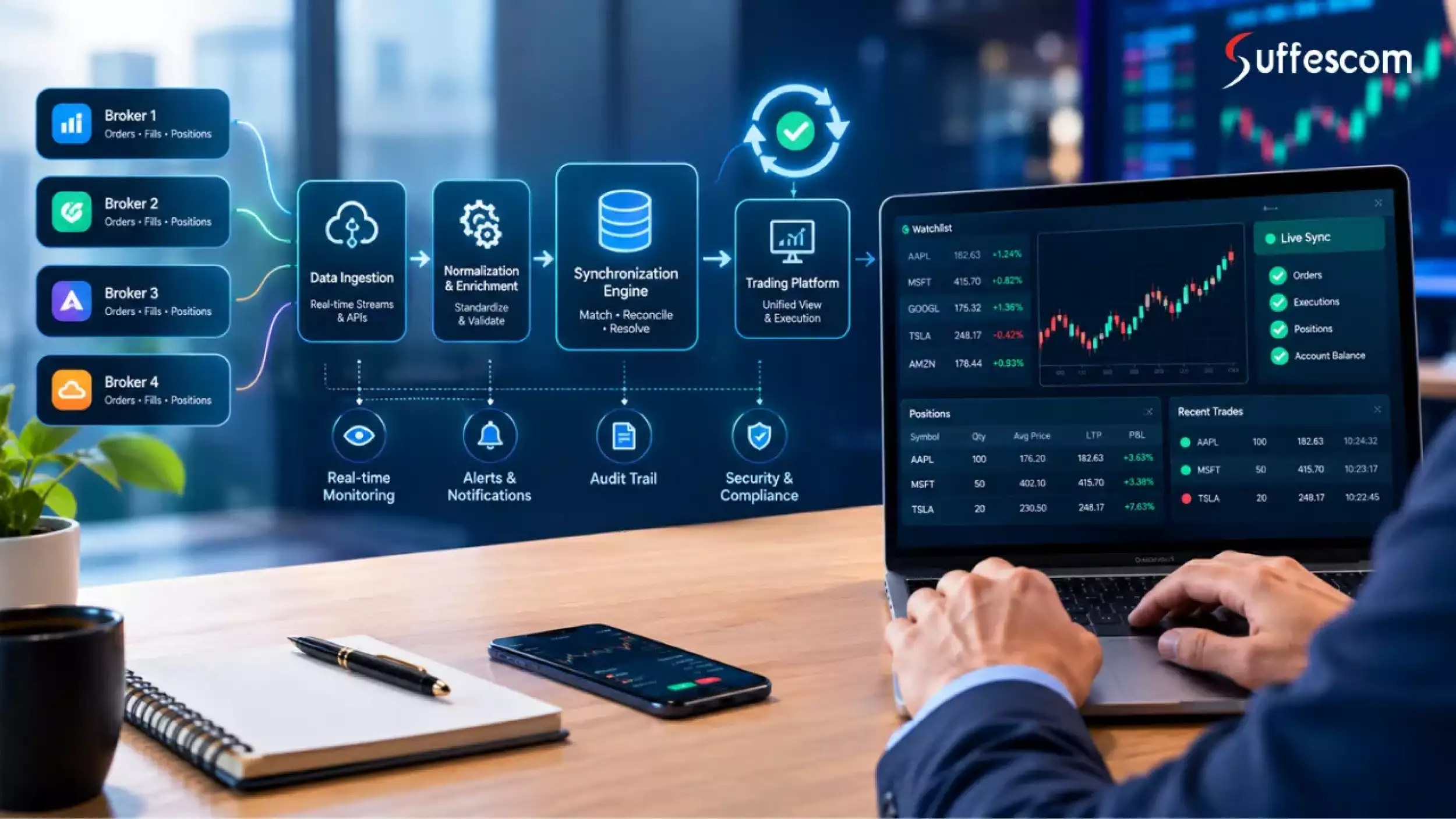
Key Takeaways
- Real-time trade synchronization is more than copying orders. A production system must keep orders, executions, fills, positions, and account states aligned while handling duplicates, delays, failures, and out-of-order events.
- Architecture determines synchronization reliability. Broker adapters, event ingestion, normalization, a synchronization engine, durable state, reconciliation, and observability should work together around a clearly defined source of truth.
- The hard part is failure handling. Idempotency, sequence tracking, partial-fill processing, event replay, checkpoints, reconciliation, and recovery workflows are essential when building a dependable multi-broker trading system.
- The market operates at an enormous scale. The BIS reported $9.6 trillion in average daily FX turnover in April 2025, with 59% of FX trading conducted electronically, highlighting the scale and complexity modern trading infrastructure must support.
- Development cost depends heavily on integration complexity. A practical 2026 estimate is 45,000–90,000 for an MVP, 90,000–180,000 for a multi-broker production system, and 180,000–350,000+ for enterprise implementations.
- Time-to-market varies with scope. Expect roughly 3–5 months for an MVP, 5–8 months for a multi-broker system, and 8–12+ months for enterprise requirements, depending on integrations, recovery, latency, security, and testing.
- The right development partner can reduce integration risk. If you need a custom synchronization engine, broker connectivity, reconciliation, recovery, and scalable trading infrastructure, Suffescom Solutions can help turn your requirements into a production-ready architecture and development roadmap.
The global trading system is massively complex. In the Bank for International Settlements (BIS) Triennial Central Bank Survey, global OTC foreign exchange trading amounted to $9.6 trillion per day in April 2025, with electronic execution making up 59% of FX trading. These are the latest comprehensive data on the global FX market, with the final results of this survey released by the BIS in June 2026.
When dealing at this size, there may be a discrepancy of only a few seconds between the orders, executions, fills, or positions in different trading systems. If you are looking to create real-time trade sync software, you can't just replicate trade data from one system to another. The platform needs to be reliable, able to integrate with several brokers or exchanges, able to fill partial and out-of-order trades, not execute duplicate trades, and able to recover from connectivity failures. This guide details the architecture, tech stack, development process, integrations, recon, recovery, security, testing, and cost of constructing a reliable trade sync system.
What is Real-Time Trade Synchronization?
Real-time trade synchronization ensures the consistency of trading events and execution state between the brokers, exchanges, accounts, and internal systems. It integrates event-driven processing and a broker API to achieve synchronization of orders, positions, and complete broker reconciliation for a precise trading state with low latency. Structured messages for orders, executions, order-state changes, and post-trade workflows are just some examples that are defined by FIX standards.
The synchronization engine captures an event, validates it, normalizes the data, executes the required action, and records the resulting state.
How trade synchronization works
The basic flow is Capture → Normalize → Validate → Synchronize → Verify → Reconcile → Recover. Events may be received via REST API, WebSockets, FIX sessions, or internal message streams.
The system then updates the target account or service, preserving event IDs, times, sequence numbers, and execution state.
Trade synchronization vs. trade reconciliation
Trade synchronization processes the trading events between systems, and trade reconciliation compares the states of two systems to find differences. Synchronization is continuous. Reconciliation ensures that positions, orders, and executions are reconciled.
| Factor | Trade Synchronization | Trade Reconciliation |
| Primary purpose | Keep trading states aligned | Find and correct mismatches |
| Timing | Continuous | Real-time or scheduled |
| Main input | Live trade events | Records from two or more systems |
| Typical action | Process and propagate events | Compare, investigate, and correct |
| Key concern | Latency and consistency | Accuracy and exception handling |
| Example | Replicate a fill to linked accounts | Detect a missing fill in one account |
What data needs to be synchronized?
A trade synchronization system should track the full order lifecycle and execution state, not only order instructions.
Typical data includes:
- Order and execution IDs
- Account and instrument details
- Side, quantity, and price
- Order status and lifecycle events
- Partial fills and executions
- Cancellations and modifications
- Position quantities
- Timestamps and sequence numbers
- Broker or exchange identifiers
- Errors and correlation IDs
A canonical data model helps normalize these fields across different providers.
Why real-time synchronization matters for trading systems
Real-time synchronization helps prevent inconsistent orders, positions, and execution states across connected systems. A missed or duplicated event can create incorrect exposure, failed execution, reconciliation exceptions, or manual intervention.
This becomes more challenging in multi-broker environments where APIs, event formats, status codes, and connection behavior vary.
Real-Time Trade Synchronization vs. Trade Replication
Trade replication copies trading actions, while real-time trade synchronization maintains a consistent trading state.
A trade copier may replicate a master order to follower accounts. A broader synchronization system also manages fills, cancellations, position changes, failures, reconciliation, and recovery.
Therefore, trade replication is better treated as a use case or component within a broader synchronization architecture.
Types of Real-Time Trade Synchronization Systems
Real-time trade synchronization can be designed around different trading workflows, account structures, and connectivity models. The following models cover the most common synchronization patterns used in modern trading software.
Master-to-Follower Trade Synchronization
Master-to-follower synchronization is a replication of trading activity from one master account to a number of follower accounts. It is usually used in copy trading and managed-account websites, where every follower might have varying dimensions or risk policies.
Multi-Account Trade Synchronization
Multiple account sync maintains consistency of trading across multiple accounts. Specific quantities, risk multipliers, instrument restrictions, and execution rules can be applied to the system per account.
Broker-to-Broker Trade Synchronization
Broker-to-broker synchronization transfers orders, executions, or positions between different broker environments. It necessitates broker API integration and normalization since the providers may have different identifiers, statuses, and event formats.
Broker-to-Internal-System Synchronization
Broker-to-internal synchronization connects broker activity with internal OMS, EMS, risk, portfolio, or analytics systems. This keeps internal execution and position data aligned with external trading activity.
Multi-Broker and Multi-Exchange Synchronization
Multi-broker and multi-exchange synchronization creates a common layer across different execution venues. Provider-specific adapters convert external events into a standardized format before the synchronization engine processes them.
Order and Position Synchronization
Order synchronization follows the order life cycle, and position synchronization ensures that the resulting holdings are synced up. Both are needed, as an order may be partially filled, canceled, rejected, or altered before it reaches completion.
Trade Replication and Copy Trading Synchronization
Trade replication and copy trading synchronization reproduce trading activity across linked accounts. A production-grade copy trading engine should also support broker connectivity, position synchronization, duplicate protection, risk controls, reconciliation, and recovery.
Who Needs Real-Time Trade Synchronization Software?
Real-time trade synchronization software can be helpful anywhere there is a need for trading data to be synchronized between accounts, brokers, exchanges, or internal systems. The precise synchronization model relies upon the organization's execution workflow, account structure, and trading connections.
Copy Trading Platforms
The copy trading platforms synchronize orders, executions, and positions between the master account and follower account. A good copy trading engine should also include risk-based sizing, duplicate protection, partial fill handling, and recovery.
Proprietary Trading Firms
Synchronization allows proprietary trading firms to stream risk, position, and execution data between multiple accounts or brokers. Automated strategies are particularly affected by low-latency event processing and precise position synchronization.
Brokers and Trading Platforms
Synchronization is employed by brokers and trading platforms in order to ensure that the system remains in a synced state with regard to the orders, executions, positions, account states, etc. in the trading infrastructure. Additionally, multi-broker connectivity entails other requirements, such as normalized events and reliable API / FIX integration.
Asset and Portfolio Management Platforms
Platforms for asset and portfolio management rely on the synchronization to ensure precise trade and position data throughout the portfolios and execution providers. This assists in tracking the portfolio, allocation, reporting, and reconciling downstream.
Multi-Account Trading Operations
When one trading workflow manages more than one account, it is necessary to synchronize multi-account operations. Execution rules, limits, and instruments can be applied to account-specific quantities without having to recreate the trading workflow.
Fintech Startups
Fintech startups can use a trade synchronization system to connect trading products with brokers, exchanges, custodians, or internal services. A modular synchronization layer makes it easier to add providers as the platform scales.
Trading Operations and Post-Trade Systems
Synchronization is used for trading operations teams to ensure the alignment of execution, confirmation, position, and settlement data. Manual intervention can be minimized, and straight-through processing can be enhanced through automated synchronization. Another key feature of FIX is the standardization of electronic allocations, confirmations, settlement instructions, and other post-trade processing.
Need a synchronization model built around your trading workflow?
Whether you need master-to-follower, multi-account, broker-to-broker, or broker-to-internal synchronization, we can map the right architecture for your use case.
Core Features of a Real-Time Trade Synchronization System
A production-ready trade synchronization solution should be able to move the trading messages between the systems, but it should do more. It must be both reliable and have capabilities to process events, manage state, recover from errors, reconcile, secure, and audit data so that there is no loss of consistency when events occur late, twice, or in an out-of-order sequence.
Order and Order-Status Synchronization
Order synchronization manages all the stages of orders throughout the entire order lifecycle, from order creation to order completion. This system should cascade new orders, acknowledgments, rejections, pending status, cancellation, and modification of these orders while maintaining provider-specific status mappings.
Execution and Fill Synchronization
Execution synchronization captures fills and updates the relevant account or downstream system. Each execution should retain identifiers, quantities, prices, timestamps, and correlation data for accurate state tracking.
Partial-Fill Handling
Partial-fill handling prevents the synchronization engine from treating an incomplete execution as a completed trade. The system should track cumulative filled quantity, remaining quantity, and each individual execution event.
Cancellation and Modification Synchronization
Cancellation and modification synchronization keeps order changes consistent across connected systems. Race conditions between fills, cancellations, and modifications must be handled through controlled order-state transitions.
Position and Balance Synchronization
Position synchronization keeps holdings aligned after executions, while balance synchronization tracks relevant account-level financial changes. These services help detect exposure differences before they become larger reconciliation issues.
Trade Confirmations
The trade confirmations give a reliable confirmation of an execution or trade event. These can contain processing status, identifiers, timestamps, etc. for downstream processing.
Multi-Broker and Multi-Exchange Support
It is necessary to normalize various APIs, message formats, identifiers, status codes, and connection behavior, which is a requirement for multi-provider support. Depending on the provider and latency requirements, REST, WebSockets, and FIX can be used. FIX provides common order, execution, and post-trade messages for various trading workflows.
Duplicate and Missing Event Handling
Duplicate and missing event handling ensures the accuracy of the synchronization in the case of lost, delayed, or duplicated messages. To prevent inconsistent state, there are idempotency keys, sequence numbers, event persistence, replay, and reconciliation.
Real-Time Reconciliation
Real-time reconciliation is the process of reconciling the expected and actual trading states as they are happening. It can detect missing executions, quantity errors, positional errors, and synchronization drift before they need to be manually investigated.
Recovery and Failover
If a broker failure, network connectivity failure, or service interruption occurs, recovery and failover mechanisms ensure synchronization is restored. Some important design features include ordered sessions, durables, retries, replay, and state resynchronization. The FIX session standard explicitly takes account of ordered messaging and resynchronization in the case of interruptions of connection.
Monitoring and Auditability
Monitoring gives visibility into event latency, synchronization drift, connection health, processing failures, and reconciliation exceptions. Event logs and audit trails can be maintained, providing teams with a record of what occurred, when it occurred, and how the system reacted to the event.
Real-time synchronization requirements
| Requirement | Development consideration |
| Low latency | Fast event ingestion and processing |
| Accuracy | Idempotent state updates |
| Availability | Connection recovery and failover |
| Ordering | Sequence and event-order management |
| Scalability | Partitioning and horizontal workers |
| Recovery | Event replay and reconciliation |
| Security | Strong authentication and encryption |
| Auditability | Persistent event history |
Design the Architecture for Real-Time Trade Synchronization
A real-time trade sync architecture should be split into the following components:
- Event ingestion
- Real-time event normalization
- Real-time event synchronization logic
- State management
- Reconciliation
- Observability
This separation simplifies scaling the system with different brokers, recovering after failures, and maintaining it as the number of transactions increases.
Real-time trade synchronization architecture
A typical architecture consists of broker/exchange connectors, an event ingestion layer, a message broker, a synchronization engine, a trade database, a position service, a reconciliation service, and a monitoring layer.
Event-driven trade synchronization architecture
An event-driven architecture deals with the trading events as they come rather than polling the database over and over. Orders, executions, fills, cancellations, and position events are converted to messages that can be independently processed downstream.
Trade event ingestion layer
Events are ingested into the ingestion layer from the various brokers, exchanges, trading platforms, and internal systems. It provides for authentication, connection management, capturing events, basic event validation, and the conversion of events into a common event format.
Synchronization engine
The synchronization engine itself is the decision layer that determines the action to take with each trade event that is presented to it. Before publishing the necessary updates, it uses account mappings, validations, risk rules, idempotency checks, routing logic, and state transitions.
Event broker and message queue
The event broker decouples synchronization workers from event producers and downstream services. It offers buffering, asynchronous processing, delivery tracking, and load balancing. Kafka can be used to send and receive large numbers of events across a distributed network, whereas traditional message queues are appropriate for sending and receiving messages for task-based asynchronous operations.
Trade database
Durable order, execution, event, and synchronization state are stored in the trade database. Have a critical state of trade in transactional storage and event history that is immutable when replay and auditability are needed.
Position and portfolio service
The position service derives and maintains current positions from validated execution events. It can also expose balances, exposure, portfolio state, and account-level synchronization status to other services.
Reconciliation service
The reconciliation service compares expected and actual states across brokers, accounts, and internal systems. It identifies missing events, duplicate processing, quantity differences, incorrect positions, and synchronization drift.
Monitoring and observability layer
The observability layer tracks event latency, processing failures, broker connectivity, queue depth, synchronization drift, reconciliation exceptions, and service health.
Real-time trade synchronization data flow
The core data flow should move from external trading events to a normalized state, synchronized execution, and independent verification.
Order → Broker/Exchange → Execution Event → Event Ingestion → Normalization → Validation → Synchronization Engine → Database → Position Update → Downstream Consumers → Reconciliation
Single-provider vs. multi-provider architecture
A single-provider architecture is simpler, while a multi-provider architecture requires an abstraction layer for different broker and exchange behaviors.
Architecture: Best suited for main consideration: single-provider One broker or exchange Simpler integration multi-provider Multiple brokers/exchanges Adapter and normalization layer hybrid Internal + external systems Strong event and state boundaries
| Architecture | Best suited for | Main consideration |
| Single-provider | One broker or exchange | Simpler integration |
| Multi-provider | Multiple brokers/exchanges | Adapter and normalization layer |
| Hybrid | Internal + external systems | Strong event and state boundaries |
Designing the system around a source of truth
The system needs a clearly defined source of truth for orders, executions, and positions. In most architectures, the durable event and trade-state layers work together: events preserve what happened, while current-state storage provides fast operational access.
Choose the Right Technology Stack
The technology stack should be chosen based on various factors such as event volume, latency, connectivity with providers, consistency requirements, recovery plan, and complexity of operations. No single stack is a good choice for all real-time trade sync projects.
Programming Languages for Real-Time Trade Processing
Any language can be used, but it should be the same language used for the system and its response time.
- Go: Strong fit for concurrent API services and event-processing workers.
- Java: Mature ecosystem for enterprise trading infrastructure and messaging.
- C++: Suitable for latency-sensitive execution components.
- Python: Useful for orchestration, analytics, services, and supporting workflows.
Kafka vs. Message Queues vs. Redis Streams
Kafka is a strong choice for high-volume event streaming and durable replay, while message queues fit task-oriented asynchronous workloads. Redis Streams can provide a lighter streaming model with consumer groups and replay.
SQL vs. NoSQL for Trade State
SQL is generally suited to transactional trade and order states where consistency and relationships matter. NoSQL can complement it for high-volume telemetry, flexible event metadata, or workloads where horizontal scaling is more important than relational queries.
Cloud and Container Infrastructure
Containers provide consistent deployment and scaling for synchronization services. Kubernetes, or managed container platforms, can support horizontal workers, service isolation, rolling deployments, and automated recovery.
Observability Stack
A production system needs centralized logs, metrics, distributed traces, dashboards, and alerts. Track synchronization latency, event lag, queue depth, failed events, broker connection status, reconciliation exceptions, and position mismatches.
Observability should answer three questions quickly: What failed? Where did it fail? What trading state was affected?
Caching and in-memory processing
Caching can reduce repeated database reads and speed up frequently accessed trading states. However, the cache should not automatically become the source of truth for critical trade records unless the architecture explicitly provides the required durability and recovery guarantees.
| Technology | Suitable use case | Key consideration |
| REST | Request/response operations | Polling overhead |
| WebSocket | Live event updates | Reconnection and state recovery |
| FIX | Institutional trading connectivity | Protocol complexity and session management |
| Kafka | High-volume event streams | Partitioning and operations |
| Message queue | Asynchronous task processing | Delivery semantics |
| SQL | Transactional trade state | Write scaling and consistency |
| NoSQL | High-scale or flexible workloads | Consistency model |
| Redis/Cache | Fast state access | Durability and source-of-truth boundaries |
Build the Real-Time Trade Synchronization System Step by Step
Building real-time trade synchronization software requires a controlled sequence from requirements and connectivity design to event processing, state management, reconciliation, and production monitoring. Each step should address both normal trading flows and failure scenarios.
Step 1: Define synchronization requirements
Start by defining what must be synchronized, between which systems, and within what latency target. Document supported asset classes, order types, account structures, event volume, accuracy requirements, recovery expectations, and synchronization rules.
Step 2: Identify systems and data sources
Identify all the systems that generate or use trade data. This can range from brokers, exchanges, OMS/EMS platforms, portfolio systems, risk engines, and databases to downstream reporting services. Record the information each of the systems provides and what events the system looks for.
Step 3: Select APIs and connectivity protocols
Select the connection method depending on the capabilities of the provider, the number of events, the latency, the reliability, and the recovery requirements. REST can handle request-based operations, while WebSockets and FIX are better suited to continuous event flows where supported. FIX provides standardized trading messages and session mechanisms for ordered, recoverable communication.
Step 4: Design the trade event schema
Before developing the synchronization engine, create a schema for the trade events. Identify fields that are part of the event ID, order ID, execution ID, account, instrument, side, quantity, price, status, timestamp, sequence number, provider, and correlation ID. This provides a common data language to different brokers and exchanges.
Step 5: Build broker and exchange connectors
Create provider-specific connectors for authenticating, subscribing, requesting, receiving, error, heartbeat, and reconnecting. Separate these adapters from the engine's synchronization logic in order to allow for the addition of new providers without redesigning the engine.
Step 6: Implement the event ingestion layer
Reliably capture event streams as they come in and add them to the processing pipeline. An ingestion layer should check the basic structure of the message, add internal identifiers if necessary, store the sequence of the events, and not allow malformed events to pass through to the downstream services.
Step 7: Normalize upcoming trade events
Map provider-specific messages to the standard trade-event schema. Normalize the status of orders, order identifiers, order timestamps, order types, quantities, and instrument data before applying the synchronization rules.
Step 8: Build the synchronization engine
Develop the core engine for validating events and finding the appropriate synchronization operation that needs to be performed. It should support account mapping, risk rules, idempotency, routing, state transitions, retries, and destination-specific execution logic.
Step 9: Persist trade events and state
Store static trade events with the current state of the order and execution. Durable persistence ensures auditability, event replay, debugging, reconciling, and recovery after service failure.
Step 10: Synchronize positions and balances
Update positions and relevant account balances from validated execution events. Track cumulative fills and position changes so the system can detect differences between expected and actual account states.
Step 11: Implement reconciliation
Compare state with broker or exchange on a regular basis. Reconcile missing events, duplicate processing, quantity discrepancies, incorrect position, and synchronization drift and send exceptions for correction.
Step 12: Add monitoring and alerting
Keep track of the signals that describe the health of the synchronization. Monitor event latency, processing failures, queue depths, connector status, retries, mismatches in recon, exceptions, etc. Alerts should be separated and differentiate between transient connection errors and inconsistencies in the trading state.
Step 13: Test failure scenarios
Test the system under the conditions most likely to break synchronization. Include duplicate events, missing events, out-of-order messages, partial fills, rejected orders, broker disconnections, API rate limits, database failures, delayed responses, and service restarts. FIX session standards specifically account for ordered messaging and state re-synchronization after connection interruptions.
Step 14: Deploy and continuously monitor
Release the system in a controlled manner, do health checks, back it up, have recovery plans, and monitor the system in production. Once launched, keep an eye on synchronization drift, latency, reconciliation outcomes, connector health, and capacity of the system.
Not sure how your broker integrations should fit into the architecture?
Share your brokers, event volume, latency requirements, and trading workflow. Our team can help define the connectors, synchronization engine, state model, and recovery architecture.
Real-Time Trade Synchronization Development Process
Building a real-time trade synchronization solution begins by learning how the trading process works and finishes with ongoing production optimization. A systematic approach ensures that the business requirements, broker integrations, event processing, security, performance, and operational reliability are converged before the system goes live.
1. Requirement Discovery and Technical Consultation
The first phase defines what the synchronization platform must accomplish and how it fits into the existing trading environment. The development team reviews:
- Business objectives and trading workflows
- Brokers, exchanges, and trading accounts
- Required API and system integrations
- Expected transaction and event volume
- Latency and availability expectations
- Asset classes and order types
- Compliance and security requirements
- Existing trading infrastructure and databases
The output is a clear functional scope, integration scope, performance targets, and development roadmap.
2. System and Integration Analysis
The team then creates a map of the current system for moving trade data. The team then sketches a trade data flow map of the current system. This comprises external consumers, databases, risk engines, portfolio systems, OMS/EMS platforms, broker APIs, and data sources.
The analysis reveals data-format differences, event sources, authentication needs, potential synchronization points, and API dependencies. This avoids integration problems being uncovered towards the end of the development process.
3. Architecture and Technology Planning
The requirements are translated into a technical blueprint during the architecture phase. Usually, these key deliverables are as follows:
- System architecture and data-flow diagrams
- Broker and exchange integration strategy
- Canonical trade and event data model
- Event-processing model
- Technology and infrastructure selection
- Security and access-control strategy
- Scalability and recovery plan
The architecture should support event ordering at its core, be idempotent, recover from failures, reconcile events, and be observable.
4. UI/API and Backend Development
Most of the development effort goes into the backend because trade synchronization is primarily an event-processing and integration problem.
The development team builds synchronization services, event consumers, integration APIs, administration services, and required internal interfaces. Administrative and monitoring interfaces can provide visibility into connected accounts, event status, synchronization exceptions, reconciliation results, and system health.
5. Broker and Exchange Integration
Each broker or exchange is integrated through a dedicated adapter or connector. The connector handles authentication, subscriptions, order requests, execution events, status mappings, rate limits, errors, heartbeats, and reconnections.
For institutional integrations, the team may implement FIX connectivity where supported. The FIX Session Protocol provides ordered messaging, sequence numbers, and session-level resynchronization mechanisms for electronic trading workflows.
6. Event Synchronization Implementation
After establishing the connectivity, the implementation of the core synchronization layer is done. Incoming events are converted into a standard model and acted upon by executing a set of rules, mapping accounts, dealing with idempotency issues, and using a state transition logic.
The system should maintain the event IDs, timelines, sequence, and correlation information to allow each synchronization action to be traced and reconciled.
7. Testing and Quality Assurance
Functional testing ensures that orders, executions, fills, cancelations, and modifications are transmitted correctly between linked systems, as well as positions and account updates.
QA should also cover duplicate events, missing messages, out-of-order events, partial fills, rejected orders, retries, reconnections, and recovery workflows. Automated regression tests help ensure that adding a new broker or feature does not break existing synchronization flows.
8. Security Testing
Security testing covers authentication, authorization, API access, encryption, secrets management, session controls, audit logging, and protection of sensitive trading data.
API endpoints should also be assessed against recognized API security risks. The OWASP API Security Top 10 provides a useful reference for identifying common API vulnerabilities such as broken authorization and authentication issues.
9. Performance and Load Testing
Performance testing determines whether the synchronization system can maintain its required latency and throughput under realistic trading loads.
Tests should measure event-processing latency, API response times, queue depth, concurrent connections, throughput, database performance, and behavior during traffic spikes. Failure and recovery tests should also verify that performance degradation does not create synchronization drift.
10. Deployment and Infrastructure Configuration
The compute resources, databases, message brokers, networking, secrets management, monitoring, backups, and recovery procedures are configured in the production environment.
Controlled deployments, horizontal scaling, service isolation, and automated deployments can be supported by containerized deployments. Health checks, rollback procedures, and environment-specific configuration should also be part of the production deployment.
11. Post-Launch Monitoring and Maintenance
After deployment, the development team monitors synchronization latency, event failures, broker connectivity, queue depth, reconciliation exceptions, position mismatches, and infrastructure health.
Collecting and correlating traces, metrics, and logs across distributed synchronization services can be achieved with the help of an observability framework like OpenTelemetry.
12. Continuous Optimization
Real-time trade data synchronization software needs continuous optimization because of the changing trading volumes, number of providers connected, and business needs. The team can optimize the capacity and performance of the event processing, database, integration reliability, retry policies, alert thresholds, and synchronization rules based on production data.
New broker connectors, asset classes, execution workflows, and monitoring capabilities can then be added without redesigning the entire platform.
Development process flow:
Discovery → Architecture → Integration → Development → Synchronization → Testing → Security → Deployment → Monitoring → Optimization
Integrate Brokers and Exchanges for Real-Time Trade Synchronization
A reliable trade synchronization system is based on broker and exchange integration. The integration layer should be capable of receiving trading events in a consistent manner from the provider, translating the provider-specific data to a common format and staying connected even if the APIs are unavailable, slow, or return unexpected responses.
Connect to Broker and Exchange APIs
First, determine the APIs provided by each broker/exchange for orders, executions, positions, account data, and trade history. REST APIs, WebSockets, FIX, or a combination of these APIs can be used for integration, depending on the provider.
REST, WebSocket, and FIX Connectivity
Use REST for operations that require a request, like retrieving an account, placing an order, or retrieving historical data. On the other hand, WebSockets are more appropriate for event streams, whereas FIX is more appropriate for a variety of institutional trading workflows with structured messaging and session management. The FIX Session Protocol supports ordered messages, sequence numbers, and session resynchronization on message interruption.
Authenticate API Connections
Secure broker connections with the authentication mechanism supported by the provider (e.g., API keys, OAuth tokens, signed requests, FIX session credentials). Keep credentials in secure storage, limit access to the necessary trading activities, and rotate or revoke credentials as needed.
Subscribe to Execution Events
Subscribe to real-time order, execution, fill, cancellation, and position events wherever the provider supports event streaming. Event-driven delivery reduces dependence on frequent polling and gives the synchronization engine a faster view of trading activity.
Normalize Broker-Specific Events
Each provider might implement the same trading event in a different manner, with different fields, identifiers, statuses, and data types. Normalize these differences before they are presented to the synchronization engine so that downstream services can use the same data to process the events.
Create a Common Trade-Event Format
Create a canonical structure for an event, with fields for the event ID, order ID, execution ID, account, instrument, side, quantity, price, status, timestamps, sequence, provider, and correlation ID. This typical format enables the same synchronization logic to be used across multiple providers.
Map External IDs and Order Statuses
Keep mappings of external broker/exchange identifiers to internal IDs. Provider-specific statuses should also be mapped to a controlled internal state model for events like pending, partially filled, filled, canceled, and rejected to be handled in a uniform manner.
Manage Provider-Specific Adapters
Separate different broker/exchange connectors from the main synchronization engine. This pattern hides provider-specific authentication, message formats, status codes, rate limits, and connection behavior, allowing for seamless integration of new providers whilst minimizing impact on the core business logic.
Handle API Rate Limits
Rate limits must be handled at the connector level using throttling, request queues, retry policies, and backoff strategies. The system should prioritize critical trading operations and prevent retries from creating duplicate orders or excessive API traffic.
Monitor Connection Health
Track connection status, last received event, message latency, sequence gaps, failed requests, authentication errors, and API response times. These signals help identify a provider issue before it causes significant synchronization drift.
Implement Heartbeats and Reconnection
Implement provider-supported heartbeats or application-level health checks to determine stale connections. If the connection breaks, the adapter should be able to reconnect without loss of safety and then check to see if any events were missed before resuming normal processing.
Buffer Events During Temporary Failures
A loss of trade events should not be considered a normal consequence of temporary broker or network failures. Events can be stored or retrieved in durable queues, event logs, or with the help of a provider-supported recovery mechanism until they can be processed by the synchronization pipeline.
Design the Trade Event Data Model
A well-designed trade event data model gives the synchronization engine a consistent representation of orders, executions, positions, and reconciliation results. It should preserve both the provider's original identifiers and the internal identifiers required for processing, auditing, and recovery.
Order Data Model
The order model represents the lifecycle of an order from creation through acknowledgment, modification, cancellation, rejection, or completion.
Execution Data Model
The execution model records what actually happened in the market. It should capture execution ID, linked order ID, filled quantity, execution price, execution timestamp, fees where available, and the source broker or exchange.
Trade-Event Data Model
The trade-event model acts as the common message structure used by the synchronization pipeline. It should identify the event type, source, sequence, timestamps, related order or execution, and processing metadata.
Position Data Model
The position model represents the current trading state after executions are applied. It can include account ID, instrument, side, quantity, average price, realized and unrealized values where required, and the last processed event or sequence.
Reconciliation Data Model
The reconciliation model records differences between expected and external trading states. Store the account, instrument, comparison timestamp, expected value, actual value, difference, related events, exception type, and resolution status.
Essential Trade Event Fields
| Field | Purpose |
| Event ID | Uniquely identifies the event |
| Order ID | Links the event to an order |
| Execution ID | Identifies the execution |
| Account ID | Identifies the trading account |
| Instrument ID | Identifies the traded asset |
| Quantity | Records the affected quantity |
| Price | Records the execution or order price |
| Side | Identifies buy or sell direction |
| Status | Represents the current state |
| Sequence | Supports event ordering and gap detection |
| Occurred At | Records when the provider generated the event |
| Received At | Records when the system received it |
| Schema Version | Supports backward-compatible processing |
| Idempotency Key | Helps prevent duplicate processing |
Implement the Trade Synchronization Engine
The synchronization engine is the core of real-time trade synchronization development. It converts normalized broker events into controlled order, execution, and position updates while preserving event history and preventing the same trading action from being applied twice.
Validate Incoming Trade Events
Before processing, verify required identifiers, account, instrument, quantity, timestamps, event type, and provider information. Reject or quarantine malformed events rather than allowing incomplete data to change the trading state.
Map External IDs to Internal IDs
Map broker order IDs, execution IDs, account IDs, and instrument identifiers to internal records. Keep both identifiers so the system can trace an internal execution back to the exact provider event.
Apply Trade-State Transitions
Process each event against an explicit order lifecycle and execution state model. Invalid transitions should be rejected or routed for reconciliation instead of silently overwriting the current state.
Persist Execution Records
Store every confirmed execution as an immutable record with its execution ID, order ID, quantity, price, timestamp, and source. This creates the audit trail required for replay, reconciliation, and position calculations.
Update Order Status
Update order status from validated execution and lifecycle events rather than from transport responses alone. Track cumulative quantity, remaining quantity, and terminal states so a late or duplicate event cannot incorrectly reopen a completed order.
Update Positions
Apply validated executions to the relevant account and instrument position. Position synchronization should use execution-level records so partial fills, multiple executions, and reversals are calculated correctly.
Publish Normalized Events
After processing, publish normalized order, execution, and position events to downstream services such as risk, portfolio, analytics, or notification systems. Include the event ID and processing status so consumers can safely handle retries.
Maintain Synchronization Checkpoints
Store the latest successfully processed sequence, event ID, or provider-specific checkpoint for each account or connection. Checkpoints allow the system to resume from a known position after a restart and identify event gaps that require recovery.
Handle Real-Time Trade Synchronization Edge Cases
Real trading systems rarely receive events in a perfect sequence. A production synchronization engine must account for duplicate delivery, delayed messages, partial fills, competing order actions, and inconsistent provider behavior without corrupting execution or position state.
Duplicate Events and Idempotency
Every processable event needs a deterministic identity or idempotency key. Before applying an event, check whether that identity has already been processed. For execution synchronization, the execution or trade ID is often a useful deduplication key.
At-Least-Once Delivery
Design for at-least-once delivery rather than assuming that every event will arrive exactly once. Persist the event before or as part of state processing, then use idempotent consumers to make retries safe.
Out-of-Order Events
An event's arrival time does not always represent when the trading action occurred. Do not apply sequence numbers, provider timestamps, lifecycle rules, and reconciliation in a blind manner when it comes to events arriving out of order; use them in an appropriate manner.
Sequence Numbers and Ordering Keys
Use provider sequence numbers where available and define ordering keys such as account ID + order ID. This allows events for the same trading entity to be processed in the correct order while unrelated accounts can continue processing concurrently.
Fill-Before-Status Scenarios
A fill can arrive before a separate order-status update. The synchronization engine should process the execution against the known order identity and derive the appropriate execution state instead of waiting indefinitely for a status message.
Cancellation-vs-Fill Race Conditions
A cancellation request does not necessarily mean the order stopped trading. A fill may occur before the cancellation reaches the venue or while the cancellation is still pending, so the engine must evaluate the actual execution event before marking the order canceled.
Partial Fills
Track each fill separately and maintain cumulative filled and remaining quantities. Never treat the first execution as the final trade unless the reported quantity and order state confirm completion.
Multiple Executions
One order can generate multiple executions, potentially at different prices and times. Store each execution independently and derive cumulative quantity and position changes from those records.
Rejected Orders
A rejected order should move to an explicit rejected state with the provider's reason or error code preserved. The system should not retry automatically unless the rejection is classified as safely retryable.
Cancelled Orders
Cancellation should be treated as a state transition confirmed by the provider, not simply as the result of sending a cancel request. A pending cancellation can still be followed by an execution or cancellation rejection.
Concurrent Position Updates
Multiple executions can update the same account and instrument at nearly the same time. Use partitioning, locking, optimistic concurrency, or another controlled serialization mechanism to prevent lost updates and incorrect position quantities.
Trade Lifecycle State Machine
Use an explicit state machine to define which transitions are valid. This prevents late, duplicate, or conflicting events from arbitrarily changing the execution state.
| Event | State transition |
| Accepted | New → Open |
| Partial fill | Open → Partially Filled |
| Additional fill | Partially Filled → Partially Filled |
| Final fill | Partially Filled → Filled |
| Cancellation confirmed | Open → Cancelled |
| Rejection | New → Rejected |
Build Trade Reconciliation Into the Synchronization System
Real-time synchronization synchronizes events on-the-fly. Reconciliation checks if the resulting order, execution, and position state still correspond to the broker/exchange. Both are required for a successful production trade synchronization system, since the two cannot be guaranteed to match simply by making event processing successful.
Real-Time Synchronization vs. Reconciliation
Synchronization runs events over and over, and reconciliation compares the external state with the internal state of the system. Synchronization is used to keep the system up-to-date, while reconciliation is employed to ensure that the synchronization drift is detected and the state is correct.
Compare Internal and External Trade Records
Compare internal orders, executions, fills, and positions with broker or exchange records using stable identifiers and account-instrument keys. Where identifiers differ, use the mapping layer to establish the relationship before comparing quantities or status.
Detect Missing Trades
Look for executions or orders reported externally but absent from the internal event history. A missing execution should be converted into a recoverable event rather than manually changing the position.
Detect Duplicate Executions
Compare execution IDs, trade IDs, or provider-specific match identifiers before applying a fill. The same execution may appear through a live stream, API response, and later reconciliation report, so deduplication must work across all ingestion paths.
Detect Quantity Mismatches
Compare the cumulative filled quantity and remaining quantity between internal and external records. Quantity breaks can indicate a missed fill, duplicate event, rejected update, or incomplete recovery.
Detect Price Mismatches
Compare execution prices using the appropriate instrument precision and tolerance rules. A small representation difference should not create a false exception, while a material difference should be retained for investigation.
Detect Position Mismatches
Compare the calculated position for each account and instrument against the authoritative external position. Position differences should trigger investigation into missing executions, duplicate processing, corrections, or incomplete event recovery.
Create Reconciliation Exceptions
Create a structured exception containing the account, instrument, affected order or execution, expected state, actual state, difference, detection time, and resolution status. Classify exceptions by type and severity so automated workflows can handle safe cases while ambiguous breaks reach an operator.
Automate Safe Discrepancy Resolution
Automate only deterministic corrections, such as importing a confirmed missing execution or rebuilding the derived position state from verified events. Do not automatically create compensating trades when the external outcome is uncertain. Reconciliation should restore the state from evidence, not hide an unresolved break.
Build a Trade Synchronization Recovery Loop
A reliable synchronization engine needs a recovery loop for connection failures, missing events, process restarts, and state divergence. The goal is not simply to reconnect but to establish exactly where processing stopped, recover the missing evidence, rebuild the affected state, and verify it before accepting new live events.
Detect Synchronization Failures
Monitor connection state, sequence gaps, event lag, processing errors, checkpoint age, and reconciliation failures. A failure becomes actionable when the system can identify which account, stream, or event range is affected.
Identify Missing Events
Use sequence numbers, checkpoints, timestamps, and provider reports to determine the recovery window. FIX, for example, uses sequence numbers and retransmission or gap-fill mechanisms to resolve message gaps.
Reconnect to the Data Source
Reconnect using the provider's session and authentication rules, but do not immediately resume normal processing. First establish whether events were missed during the disconnected period.
Request Missed Events or Snapshots
Recover the gap using provider-supported event replay, historical trade queries, order reports, or a current account snapshot. A snapshot is particularly useful when the event history needed to reconstruct the state is no longer available.
Replay Events
Apply recovered events through the same synchronization logic used for live events. This keeps recovery behavior consistent with normal trade event processing and lets existing idempotency and state-transition checks reject duplicates.
Rebuild Affected State
Recalculate affected order, execution, and position state from the recovered event history. Persist the rebuilt checkpoint so another restart does not require repeating the entire recovery operation.
Run Reconciliation
Compare the rebuilt internal state with the broker or exchange before returning to live processing. Reconciliation should confirm orders, executions, quantities, and positions, with unresolved differences remaining in an exception state.
Resume Live Processing
Once the recovered range is complete and the state has been verified, advance the synchronization checkpoint and resume live events. Keep recovery metrics and the affected event range in the audit trail for later investigation.
Recovery workflow:
Detect → Reconnect → Identify Gap → Recover → Replay → Reconcile → Resume
Is your synchronization system ready for duplicate events, outages, and recovery?
We can help design the testing, reconciliation, monitoring, and recovery controls needed before your platform handles production trading activity.
Optimize Real-Time Trade Synchronization Performance
Performance in a real-time trade synchronization system is not just about processing events quickly. The goal is to keep the full path from broker event to synchronized order, execution, and position state predictable under normal and peak trading loads.
Measure End-to-End Synchronization Latency
Measure latency across the complete pipeline: event creation, network delivery, ingestion, processing, database update, and downstream publication. Tracking only API response time can hide delays inside queues, databases, or synchronization workers.
Optimize Event Processing
Keep the hot path small by validating, normalizing, and routing events without unnecessary database reads or synchronous downstream calls. Move non-critical analytics, notifications, and reporting tasks to asynchronous consumers.
Reduce Database Write Latency
Use appropriate indexes, connection pooling, efficient transactions, and targeted writes for critical trade state. Avoid repeatedly rewriting large records when an execution-level update can change only the affected state.
Partition High-Volume Event Streams
Partition event streams using a stable key such as account ID, order ID, or account-instrument pair. This allows related events to maintain ordering while independent trading flows can be processed concurrently.
Implement Backpressure
When incoming trade events exceed processing capacity, backpressure prevents workers and databases from being overwhelmed. Monitor queue depth and consumer lag, then slow producers, apply controlled buffering, or scale consumers instead of allowing uncontrolled memory growth.
Batch Safe Database Operations
Batch operations that do not require individual transaction boundaries, such as non-critical telemetry or bulk historical writes. Keep order and execution state updates individually controlled when batching could compromise ordering, atomicity, or recovery.
Scale Synchronization Workers Horizontally
Use stateless or partition-aware workers so additional processing capacity can be added as event volume increases. The scaling model should preserve ordering for related events and prevent two workers from concurrently applying conflicting updates.
Handle Market-Open Traffic Spikes
Market open can create sudden increases in orders, executions, cancellations, and position updates. Capacity planning should include burst testing, pre-warmed workers, queue headroom, database capacity, and provider-specific rate limits rather than sizing infrastructure only for average traffic.
Key Performance Metrics
| Metric | Purpose |
| Event-to-state latency | Measures end-to-end synchronization speed |
| Consumer lag | Identifies processing backlog |
| Event throughput | Measures processing capacity |
| Reconciliation mismatch rate | Measures synchronization accuracy |
| Duplicate-event rate | Measures idempotency effectiveness |
| Sequence gaps | Detects missing or delayed events |
| Error rate | Measures processing reliability |
| Reconnection count | Measures provider connection stability |
Secure the Real-Time Trade Synchronization System
Security must protect both the trading connections and the internal state used to make synchronization decisions. A compromised API credential, unauthorized account access, or altered trade event can affect orders, positions, and downstream systems.
Secure Broker and Exchange Credentials
Store API keys, tokens, FIX credentials, and certificates outside application code and restrict each credential to the minimum permissions required. Separate read-only credentials from execution credentials where the provider supports it.
API Authentication and Authorization
Authenticate every API client and enforce authorization at the account, portfolio, and administrative-function level. Do not rely on authentication alone. OWASP identifies broken object-level and function-level authorization as major API security risks.
Encryption in Transit
Use TLS for broker APIs, internal service communication, administrative interfaces, and other connections carrying trading data. FIX environments can also use FIX over TLS where applicable.
Encryption at Rest
Encrypt databases, event stores, backups, and other persistent storage containing trading or account information. Encryption keys should be managed separately from the data they protect.
Role-Based Access Control
Apply least-privilege roles to traders, operations teams, developers, administrators, and support staff. Sensitive actions such as changing broker credentials, replaying events, modifying synchronization rules, or forcing reconciliation should require elevated permissions.
Secrets Management
Use a dedicated secrets-management mechanism rather than environment files committed to source control or hard-coded credentials. Rotate credentials and certificates periodically and immediately revoke compromised secrets.
Audit Logging
Record authentication events, configuration changes, administrative actions, order-related operations, event replays, reconciliation overrides, and access to sensitive trading records. Audit logs should be tamper-resistant and linked to user, service, timestamp, and correlation information.
Protect Sensitive Trading Data
Minimize the amount of sensitive information exposed to each service and API response. Validate external provider data before consuming it, and treat third-party API responses as untrusted input. OWASP specifically highlights unsafe consumption of external APIs as a security risk.
Test the Real-Time Trade Synchronization System
Testing should verify not only that trades synchronize correctly but also that the system remains consistent when events are duplicated, delayed, reordered, or interrupted. These scenarios are where most synchronization defects become visible.
Unit Testing
Test individual synchronization rules such as ID mapping, state transitions, quantity calculations, idempotency checks, and position updates. Include invalid state transitions and duplicate execution IDs as first-class test cases.
Integration Testing
Test each broker, exchange, database, message broker, and downstream service together. Verify that provider-specific events are correctly normalized and that the resulting execution state reaches the expected internal service.
API Contract Testing
Validate that broker and internal API contracts match the expected schemas, fields, status values, authentication requirements, and error responses. Contract tests are particularly useful when providers change API versions or response formats.
End-to-End Testing
Run complete trading workflows from order submission through acknowledgment, execution, position update, and reconciliation. Verify both the external provider state and the internal state rather than checking only API responses.
Duplicate-Event Testing
Send the same execution event multiple times and confirm that only one execution record and one position update are applied. This directly tests the idempotency guarantees of the synchronization engine.
Out-of-Order Event Testing
Deliver status, fill, cancellation, and position events in different sequences. The system should use sequence information and lifecycle rules to reach the correct final execution state.
Partial-Fill Testing
Simulate multiple fills against one order and verify cumulative quantity, remaining quantity, average execution price where applicable, and final position. Confirm that each execution remains independently traceable.
Network-Failure Testing
Interrupt broker connections during order submission, acknowledgment, and execution delivery. Test whether the system reconnects, identifies the affected event range, recovers missing data, and avoids duplicate execution.
Consumer-Restart Testing
Restart synchronization workers while events are being processed. The system should resume from its last durable checkpoint without losing events or applying previously processed executions again.
Load and Stress Testing
Generate realistic event bursts and sustained high-volume workloads. Measure event-to-state latency, consumer lag, throughput, database latency, and error rates while testing the system's behavior near capacity.
Disaster-Recovery Testing
Simulate database failure, message-broker failure, service loss, and complete environment recovery. Verify that retained events and checkpoints can rebuild affected trade and position state within the defined recovery objectives.
Reconciliation Testing
Deliberately introduce missing executions, duplicate fills, incorrect quantities, price differences, and position mismatches. Confirm that reconciliation detects each discrepancy and routes it to the appropriate automated or manual resolution path.
Monitor and Operate a Real-Time Trade Synchronization System
Production monitoring should focus on whether the synchronized state is still trustworthy, not simply whether individual services are running. Operational dashboards should connect infrastructure signals with actual trading-state impact.
Synchronization Drift Monitoring
Track differences between expected and externally reported orders, executions, and positions. Monitor drift by broker, account, instrument, and event stream so isolated synchronization failures are visible quickly.
Broker Connection Health
Monitor connection state, heartbeat failures, reconnect frequency, authentication errors, last received event, and sequence gaps for every provider. A connection can appear “up” while still receiving no useful trading events, so message freshness matters.
Event Processing Lag
Measure the time between an event occurring at the provider and the corresponding internal state update. Consumer lag and queue depth should be monitored alongside end-to-end synchronization latency.
Reconciliation Exceptions
Track unresolved reconciliation breaks by type, severity, account, and age. A growing exception backlog can indicate a deeper issue with event ingestion, broker connectivity, or position synchronization.
Execution and State Mismatches
Compare execution records, order status, and positions across connected systems. Alert on conditions such as filled quantity exceeding the order quantity, a completed order with a missing execution, or an internal position that differs from the provider state.
Common Mistakes When Building Real-Time Trade Synchronization
Most synchronization failures come from assumptions about event delivery and trading state. These mistakes can produce duplicate executions, incorrect positions, or gaps that are difficult to recover after the fact.
Assuming Every Event Arrives Exactly Once
Broker streams can deliver duplicate events or require recovery after disconnection. Design for at-least-once delivery and make execution synchronization idempotent.
Treating WebSocket Connectivity as Guaranteed
A successful WebSocket connection does not guarantee continuous event delivery. Track heartbeats, sequence gaps, last-event timestamps, and reconnection state.
Ignoring Event Ordering
Applying events in network-arrival order can produce an invalid execution state. Use provider sequence numbers, ordering keys, and lifecycle rules for events that affect the same order or position.
Ignoring Partial Fills
Treating an order as either completely filled or unfilled breaks when multiple executions occur. Store each fill separately and derive cumulative execution and position state from those records.
Updating Positions Without Idempotency
Applying the same execution twice can create a false position. Position updates must be tied to uniquely identified executions and protected against repeated processing.
Using Timestamps as the Only Ordering Mechanism
Timestamps describe when an event occurred, but they may not provide a reliable total ordering. Use sequence numbers or provider-specific ordering information where available, with timestamps as supporting metadata.
Not Retaining Raw Events
Discarding the original provider message makes debugging, event replay, and reconciliation much harder. Retain the raw event alongside its normalized representation and processing metadata.
Building Reconciliation Too Late
Reconciliation is not merely a reporting feature. It is a control mechanism for detecting missing events, duplicate executions, quantity differences, and position synchronization drift, so it should be designed alongside the synchronization engine.
Having No Recovery Mechanism
A reconnect alone does not restore lost state. The system needs checkpoints, gap detection, event recovery or snapshots, replay, state rebuilding, and post-recovery reconciliation.
Testing Only Normal Trading Scenarios
A synchronization system may pass these normal scenarios and fail in times of volatility or provider failures. Test duplicate events, partial fills, race conditions, sequence gaps, rate limits, restarts, network failures, etc., before production, and test recovery workflows.
How Much Does It Cost to Build Real-Time Trade Synchronization?
If a dedicated synchronization platform is chosen, the development range is $45,000-$90,000 for MVP, $90,000-$180,000 for a multi-broker production system, and $180,000-$350,000+ for enterprise-grade implementation.
These ranges are less expensive to build a full trading platform because a synchronization system doesn't need a trader-facing terminal, mobile applications, market data visualization, and a proprietary matching engine.
Real-Time Trade Synchronization Development Cost by Project Scope
| Project scope | Estimated cost | Typical scope |
| MVP synchronization system | $45,000–$90,000 | 1–2 providers, core order/execution synchronization, basic position updates, reconciliation, monitoring |
| Multi-broker production system | $90,000–$180,000 | Multiple brokers/exchanges, WebSocket/FIX integrations, advanced synchronization, recovery, reconciliation, production QA |
| Advanced synchronization platform | $180,000–$250,000 | High event volumes, multiple venues, advanced recovery, low-latency processing, extensive observability and security |
| Enterprise implementation | $250,000–$350,000+ | Institutional connectivity, high availability, complex reconciliation, disaster recovery, strict latency targets, extensive testing |
What Determines Real-Time Trade Synchronization Development Cost?
The main cost drivers are:
- Number of broker and exchange integrations
- REST, WebSocket, FIX, or mixed connectivity
- Real-time event volume and traffic bursts
- Required execution latency
- Number of connected trading accounts
- Complexity of the canonical data model
- Reconciliation and recovery requirements
- Security, audit, and access-control requirements
- Cloud and event-streaming infrastructure
- Monitoring and observability requirements
- Failure, load, and disaster-recovery testing
- Web, mobile, or admin interfaces, if required
- Post-launch maintenance and integration support
Each additional provider can introduce its own authentication model, event format, status codes, rate limits, and recovery behavior.
Real-Time Trade Synchronization Development Cost Factors
| Cost factor | Lower complexity | Higher complexity |
| Integrations | One provider | Multiple brokers/exchanges |
| Connectivity | REST | WebSocket/FIX/event streaming |
| Volume | Low, predictable | High and burst-heavy |
| Processing | Basic events | Complex state transitions |
| Recovery | Retry and reconnect | Replay, snapshots, reconciliation |
| Security | Standard API security | Advanced RBAC, audit, encryption |
| Monitoring | Basic logs and alerts | Full observability and SRE |
| Testing | Functional QA | Failure, load, recovery, and DR testing |
Development Effort by Project Stage
| Development stage | Relative effort |
| Discovery | Low–moderate |
| Architecture | Moderate |
| API/integration development | High |
| Synchronization engine | High |
| Reconciliation and recovery | Moderate–high |
| Security | Moderate |
| Testing | High |
| Deployment | Moderate |
| Maintenance | Ongoing |
The integration layer and synchronization engine typically involve the most engineering work, as they need to accommodate provider variations, real-time event processing, state changes, retries, and failure recovery.
Have a trade synchronization project in mind but need a realistic budget?
Tell us how many brokers, accounts, asset classes, and trading events you need to support, and we can help scope the development effort and cost.
How Long Does It Take to Build Real-Time Trade Synchronization Software?
A reasonable expectation is that an MVP will take 3-5 months, a multi-broker trading platform development will take 5-8 months, and enterprise implementation 8-12 months or more.
MVP Development Timeline
3–5 months for one or two providers, core order and execution synchronization, basic position synchronization, reconciliation, monitoring, and essential administration.
Multi-Broker Development Timeline
5–8 months when supporting several brokers or exchanges, provider-specific adapters, higher event volumes, advanced recovery, detailed reconciliation, and production-grade testing.
Enterprise Development Timeline
8–12+ months for multiple venues, institutional connectivity, strict latency targets, high availability, advanced security, extensive observability, disaster recovery, and large-scale testing.
What Affects Development Time?
The primary factors that can vary in the timeline are the number of integrations, the quality of the provider's documentation, the complexity of the FIX or WebSocket, the volume of events, latency requirements, reconciliation rules, compliance requirements, and the number of failure conditions to test.
It's not just about adding another API endpoint. There can be separate mappings, authentication, rate limiting, reconnecting, and provider-specific testing for each adapter.
Development Cost vs. Ongoing Infrastructure Cost
Development cost and operating cost should be budgeted separately.
| Cost category | What it covers |
| Engineering | Backend, integrations, synchronization engine, QA, DevOps |
| Cloud compute | Application and synchronization workers |
| Database | Trade, execution, position, and audit storage |
| Event streaming | Kafka or managed messaging infrastructure |
| Monitoring | Logs, metrics, traces, alerts |
| Third-party APIs | Broker, exchange, market-data, and other provider fees |
| Security tooling | Secrets, certificates, scanning, and security services |
| Maintenance | Bug fixes, provider changes, scaling, and new integrations |
Infrastructure is usage-dependent rather than a fixed percentage of development cost. Cloud, database, event-streaming, monitoring, and third-party provider charges should therefore be estimated separately from engineering costs.
Build vs Buy: Should You Develop a Custom Trade Synchronization System?
Whether you build or buy is determined by the amount of control the trading operation desires over integrations, execution workflows, data, and recovery logic. While a packaged synchronization product can decrease the time required to create the system, when the system requires unusual broker workflows, high event volumes, or unique synchronization rules, custom development may be more advantageous.
| Decision factor | Custom build | Off-the-shelf | Hybrid approach |
| Customization | High | Limited to vendor capabilities | High where it matters |
| Broker/exchange integrations | Full control | Depends on supported providers | Custom for unsupported providers |
| Execution workflows | Fully configurable | Vendor-defined | Custom critical workflows |
| Time to market | Longer | Faster | Moderate |
| Initial investment | Higher | Lower upfront | Moderate |
| Ongoing maintenance | Internal responsibility | Mostly vendor-managed | Shared |
| Scalability | Designed to requirements | Depends on platform | Custom core + managed components |
| Data and source-code ownership | Full control | Vendor-dependent | Varies by component |
| Best suited for | Proprietary or complex synchronization requirements | Standard synchronization needs | Businesses needing both speed and customization |
When Off-the-Shelf Synchronization Is Enough
When the brokers, asset classes, types of events, and rules of synchronization are already available, an off-the-shelf solution can be employed. It is ideal for situations where the deployment speed is more important than control of the underlying synchronization engine.
When Custom Development Makes Sense
Custom development makes sense when standard products cannot handle the required execution workflow, reconciliation logic, latency targets, account structure, or recovery model. It is also useful when synchronization is a core part of the product rather than a supporting feature.
Custom Broker and Exchange Integrations
A custom system allows provider-specific adapters to be designed around each broker or exchange's APIs, WebSockets, FIX sessions, rate limits, event formats, and recovery behavior. This avoids forcing different providers into a rigid off-the-shelf integration model.
Scalability and Extensibility
Custom architecture makes it possible to add new brokers, accounts, asset classes, and event consumers without redesigning the synchronization engine. Event-driven components and provider adapters can scale independently as trading volume grows.
Security and Ownership
Custom development provides the business with more control of credentials, access policies, audit trails, data retention, deployment environments, and the business source code. This is of significance if data or the logic for synchronization is commercially sensitive.
Total Cost of Ownership
Look at more than just the up-front cost of a license or development. These elements are subscription costs, per-account or per-trade fees, integration costs, infrastructure, provider changes, maintenance, security requirements, and migration away from the solution after installation.
Questions to Ask Before Choosing a Solution
Before choosing to build or buy, ask:
- Does it support every required broker and exchange?
- Can it handle the expected event volume and latency?
- How does it recover missed or duplicated events?
- Can we control reconciliation and position synchronization?
- Can new integrations be added without vendor changes?
- Who owns the data, source code, and synchronization logic?
- What happens if the provider changes its API or the contract ends?
Why Choose Suffescom for Real-Time Trade Synchronization Development?
Suffescom approaches trade synchronization as a financial-systems engineering problem rather than a simple API integration project. Our current fintech and trading portfolio covers stock trading, algorithmic trading, exchange connectivity, real-time financial applications, and scalable trading infrastructure.
Real-Time System Development Expertise
The development team works across backend systems, financial APIs, event-driven architectures, databases, cloud infrastructure, and real-time trading workflows. This supports synchronization systems where execution state, latency, reliability, and recovery must work together.
Broker and Exchange API Integration
Suffescom develops integrations across REST, WebSocket, and FIX-based connectivity. Our algorithmic trading development offering specifically addresses provider-specific API formats, authentication, rate limits, WebSocket behavior, and exchange connectivity.
Event-Driven Synchronization Architecture
Event-driven architecture, microservices, and high-throughput messaging can be used to separate ingestion, synchronization, state management, and downstream processing. This provides a foundation for scaling event processing without tightly coupling every trading service.
Reconciliation and Recovery Engineering
A synchronization platform can be designed around durable events, checkpoints, reconciliation, replay, and recovery workflows. This helps maintain consistent order, execution, and position state when broker connections fail or events arrive late.
Security and Auditability
Security controls can include encrypted APIs, role-based access control, key management, authentication, audit logging, and transaction traceability. Suffescom's fintech offering positions security and compliance as part of the architecture rather than an afterthought.
Scalable Trading Infrastructure
Cloud-native and microservices-based infrastructure can support growing transaction volumes, additional trading venues, and expanding account coverage. Suffescom also describes low-latency trading platform and scalable architectures for high-volume trading workloads.
End-to-End Development and Support
The scope of engagement may include technical consultation, architecture, development of the back-end, integration, testing, deployment, monitoring, support, and future feature development. The stock trading offering by Suffescom is a clear reference to consulting, development, integration, modernization, and post-launch maintenance services.
Real-Time Trade Synchronization Development Checklist
Before taking a trade synchronization system to production, verify that the architecture can preserve trading state even when events are duplicated, delayed, reordered, or interrupted. Use this checklist as a final technical review across the synchronization engine, integrations, data layer, reliability controls, and production environment.
Architecture Checklist
- Source of truth defined for orders, executions, and positions
- Event-driven processing architecture defined
- Synchronization engine separated from provider-specific adapters
- Event IDs and correlation IDs implemented
- Ordering strategy defined for related trading events
- State-transition rules documented
- Event replay path designed
Integration Checklist
- All required brokers, exchanges, and internal systems identified
- REST, WebSocket, FIX, or other connectivity requirements documented
- Provider-specific identifiers and statuses mapped
- Authentication and API permissions configured
- Rate-limit handling implemented
- Heartbeats and reconnection logic implemented
- Partial fills, cancellations, rejections, and modifications supported
Data Model Checklist
- Canonical trade-event schema defined
- Order, execution, position, and reconciliation models defined
- External and internal IDs mapped
- Sequence numbers and timestamps retained
- Idempotency keys implemented
- Raw provider events retained for replay and audit
- Schema versioning supported
Reliability Checklist
- At-least-once event delivery handled safely
- Duplicate events rejected through idempotent processing
- Out-of-order events handled
- Synchronization checkpoints persisted
- Event replay implemented
- Reconciliation implemented
- Missing-event and sequence-gap detection implemented
- Recovery process documented and tested
Security Checklist
- Broker and exchange credentials stored securely
- Authentication and role-based authorization implemented
- Encryption applied in transit and at rest
- Secrets rotation and revocation procedures defined
- Audit logging implemented
- Administrative synchronization actions restricted
- Sensitive trading data access controlled
Performance Checklist
- End-to-end synchronization latency measured
- Event throughput tested against expected trading volume
- Processing partitions and ordering keys defined
- Backpressure implemented
- Database write performance tested
- Market-open traffic spikes tested
- Consumer lag and queue depth monitored
Testing Checklist
- Unit and integration tests completed
- API contract tests completed
- End-to-end trading flows tested
- Duplicate-event testing completed
- Out-of-order and partial-fill scenarios tested
- Broker disconnection and reconnection tested
- Load and stress testing completed
- Failure and disaster-recovery testing completed
- Reconciliation scenarios tested
Deployment Checklist
- Production infrastructure configured
- Health checks and automated recovery enabled
- Monitoring, alerts, logs, and traces configured
- Backup and restore procedures verified
- Recovery objectives documented
- Rollback procedure tested
- Production runbook completed
- Post-launch reconciliation and synchronization monitoring assigned
Ready to build a production-ready real-time trade synchronization system?
Suffescom Solutions can help with architecture, broker integrations, synchronization engines, reconciliation, security, testing, deployment, and ongoing optimization.
Conclusion
Creating successful real-time trade synchronization software demands more than just broker APIs and event queues. The system needs to be able to execute with the same state, process duplicated events, process out-of-order events, recover when events fail, and reconcile positions between different trading environments. That calls for a thoughtful architecture and financial-domain engineering from the beginning.
Suffescom Solutions can help you build your production-ready synchronization platform around your broker integrations, trading workflows, latency requirements, and scalability needs. We develop solutions in event-driven trading systems, broker connectivity, execution engines, reconciliation, and low-latency infrastructure. Let's talk about your trading platform development needs, architecture, development extent, and estimated investment in our trading platform development services.
FAQs
1. What is real-time trade synchronization?
Real-time trade synchronization maintains positions, orders, and executions in sync between brokers, exchanges, accounts, and internal trading systems as trades happen.
2. How do you build a real-time trade synchronization system?
Design the trading workflow, develop an event-driven architecture, connect brokers/exchanges, develop the canonical model for the events, create the synchronization engine, add reconciliation, test, and deploy.
3. What is the working of real-time trade synchronization?
The system records a trading event, normalizes and validates that event, performs the synchronizing rule, updates the execution or position state, and reconciles this on demand.
4. Which architecture would you use to synchronize trades in real-time?
Event-driven provider adapters, message streaming, a synchronization engine, durable trade state, reconciliation, and observability are good starting points for building scalable systems.
5. Can WebSockets be used for real-time trade synchronization?
Yes. The WebSockets enable live order, execution, and position events without polling the broker APIs over and over again.
6. Can FIX be used for trade synchronization?
Yes. FIX can provide ordered messaging, sequence numbers, session management, and recovery for institutional trade synchronization.
7. How do you sync trades with multiple brokers?
Capture broker events, normalize them into a common schema, map external IDs, and send to the central synchronization engine using provider-specific adapters.
8. How do you avoid trade events being duplicated?
Repeat messages don't lead to duplicate executions or position updates by including unique event or execution IDs, idempotency keys, durable event records, and idempotent consumers.
9. How do you handle out-of-order trade events?
Utilize provider sequence numbers, ordering keys, lifecycle rules, and reconciliation. Remember, don't just use arrival time in the network.
10. How would you synchronize partial fills?
Keep all the individual fills stored and track the number of filled and remaining fills. When filling the order, use known execution information, not the first fill.
11. What is idempotent trade processing?
The key feature of idempotent processing is that processing the same trade event many times should yield the same final state as processing it once.
12. How do you recover missed trade events?
Identify gaps or stale checkpoints, reconstruct missing events from provider APIs or snapshots, re-process them in the usual processing pipeline, and reconcile the state.
13. How does trade reconciliation work?
Reconciliation is a process to check for missing orders, executions, and positions, for duplication, and for quantity differences and position differences between internal orders and the orders on the broker/exchange.
14. What database should be used for trade synchronization?
A relational database, like PostgreSQL, is appropriate for transactional order, execution, and position state. For certain high-volume workloads it can be complemented by event stores, NoSQL stores, or time-series stores.
15. How do you test a real-time trade synchronization system?
Duplicate events, out-of-order messages, partial fills, rejected orders, disaster recovery, out-of-sequence, load spikes, reconciliation failures, restarts, disconnections, normal execution flows, and tests for all of them.
16. How do you monitor trade synchronization?
Track event-to-state latency, consumer lag, connection health, sequence mismatches, processing errors, reconciliation exceptions, duplicate events, and position mismatches.
17. How much does it cost to build real-time trade synchronization?
A practical 2026 estimate is $45,000–$90,000 for an MVP, $90,000–$180,000 for a multi-broker system, and $180,000–$350,000+ for enterprise implementations.
18. How long does it take to develop a trade synchronization system?
Typical time to MVP is 3-5 months, a multi-broker production system is 5-8 months, and an enterprise implementation is 8-12+ months, based on the integrations, latency, recovery, and testing requirements.