
We build the infrastructure your connected systems
need to operate & scale.

AWS

AWS

Microsoft Azure

Microsoft Azure

Google Cloud

Google Cloud

100+

IoT Projects Delivered

40%

Improvement in Centralized Monitoring

32%

Faster Access to Operational Data

42%

Faster Identification of Equipment Issues

25%

Reduction in Manual Reporting Work

What Our IoT Cloud Implementation
Services Cover

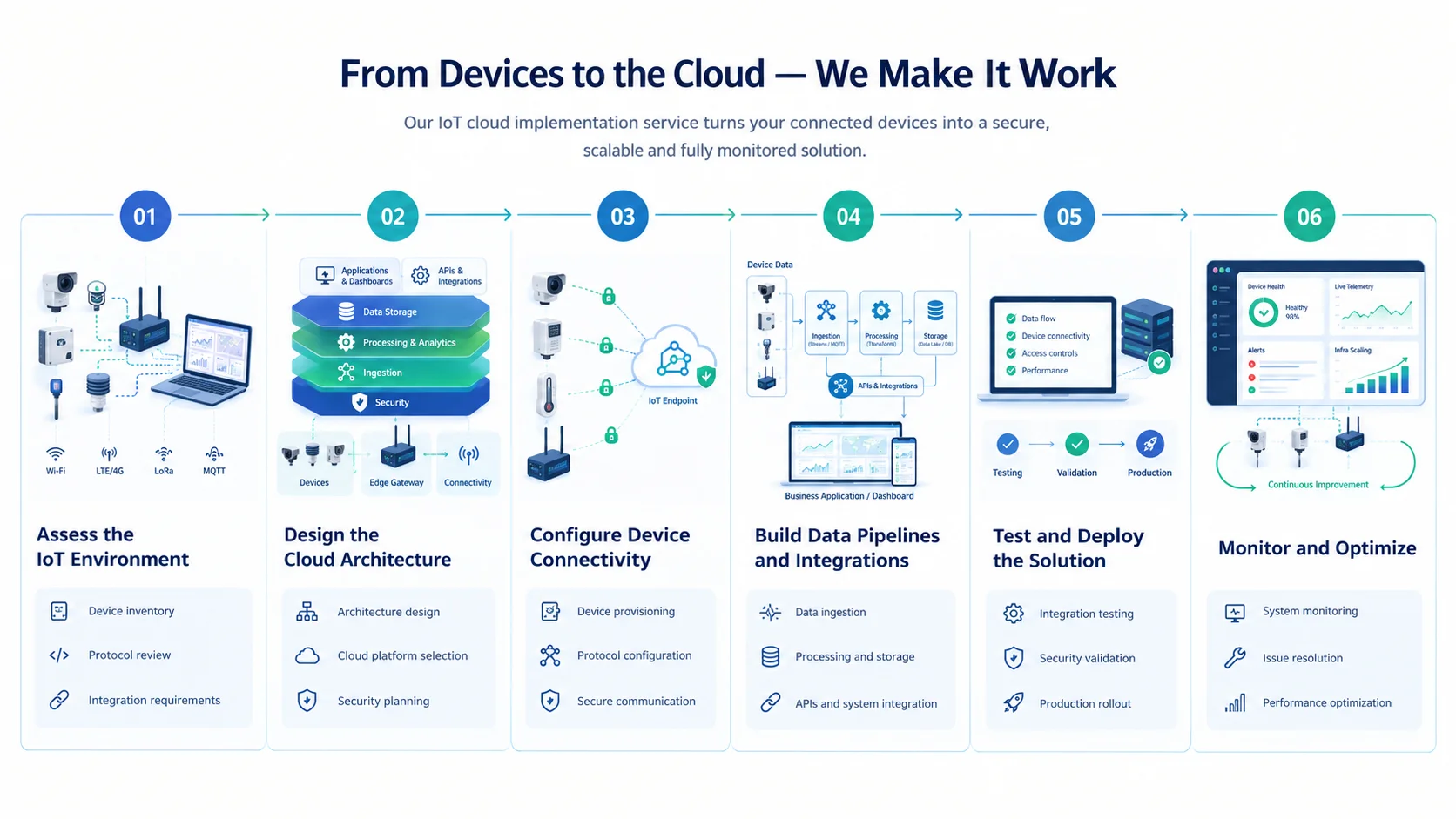
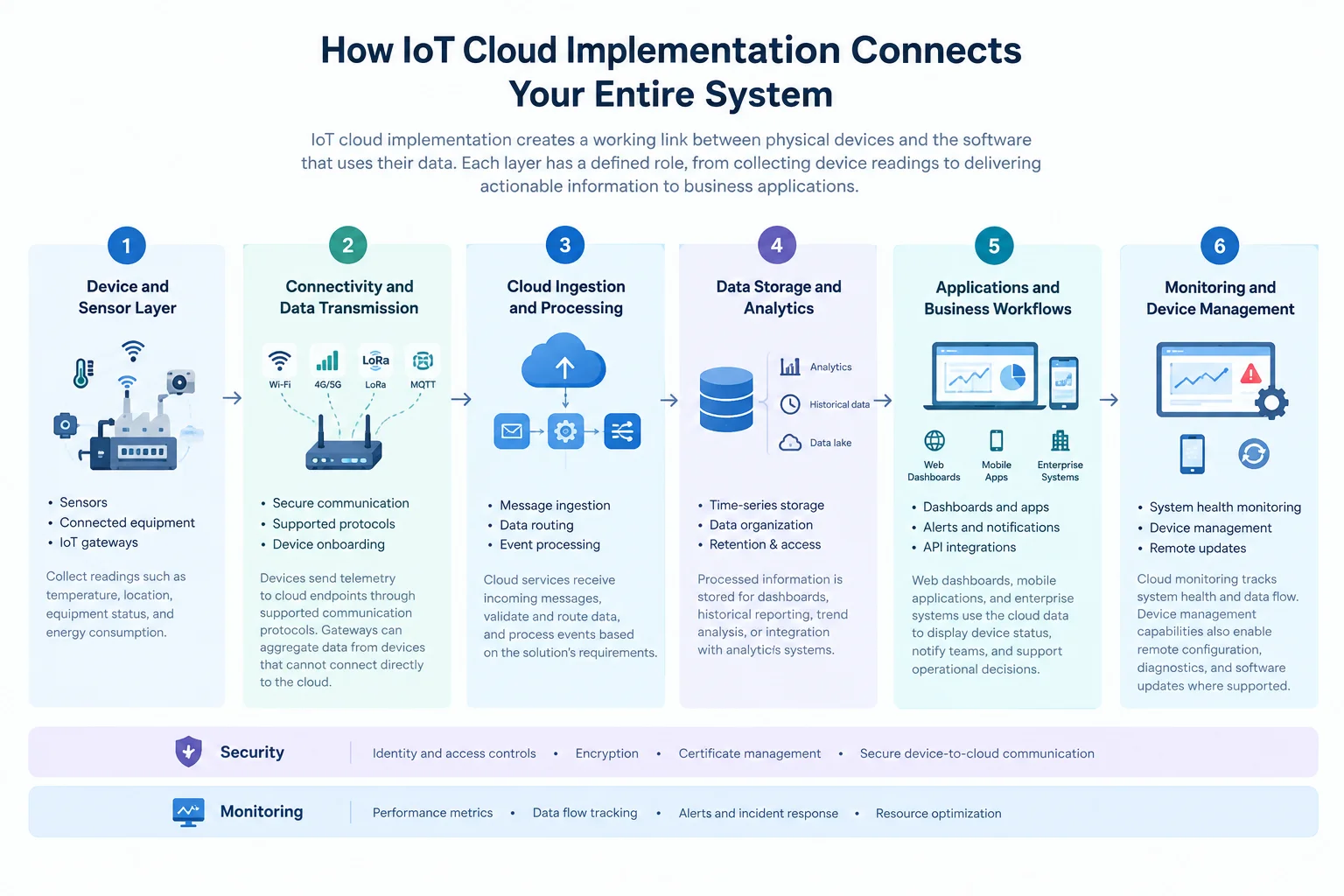
An IoT solution will not simply require a cloud connectivity solution. The devices need to communicate with the cloud services, the data needs to get to the correct service, and the applications need access to the data. We provide secure cloud infrastructure to support this process.

➥ IoT Cloud Architecture Setup

🗹We architect and build the cloud architecture for your connected devices, including the computing power, communication channels, and infrastructure required for your IoT workloads.

➥ Device Connectivity and Provisioning

🗹Secure communication is set up among IoT devices, gateways, and cloud nodes. It includes device onboarding, authentication, configuration, and provisioning processes.

➥ IoT Data Ingestion and Processing

🗹 We create data pipelines for ingesting device telemetry, routing the messages received, processing events, and transporting data to the right storage/analytics platforms.

➥ Cloud Data Storage and Management

🗹Cloud storage is set up to store telemetry data, operational data, and historical data. The structure and storage of the data have been planned based on the accessibility and the volume of data.

➥ IoT Cloud Security Implementation

🗹We apply device identity, access, encryption, and certificate controls where necessary. Security controls assist in securing the device-to-cloud communications and the data flowing through the infrastructure.

➥ IoT Application and System Integration

🗹 Cloud services are integrated with dashboards, web and mobile applications, analytical systems, and enterprise systems using appropriate application programming interfaces and data interfaces.

➥ Cloud Monitoring and Performance Optimization

🗹 Set up infrastructure monitoring, device connection notifications, and performance metrics to help teams detect failures, investigate delays, and manage cloud resource consumption.

AWS Serverless Application Development Services

Not Sure How to Get Started?

Our IoT consultants can help you understand the implementation steps your project requires.

Cybersecurity Consulting Services

IoT Cloud Implementation Across Leading
Cloud Platforms

All clouds have their own capabilities and restrictions. We design IoT cloud ecosystems according to your device needs, data flows, and current infrastructure.

  • AWS IoT Cloud Implementation

    AWS IoT Cloud Implementation

    Our device-to-cloud communication and cloud infrastructure needs can be handled with AWS services .

    • Telemetry ingestion at scale: Set up messaging and processing pipelines to support large volumes of transmission of data by connected devices.
    • Device security setup: Create device identities, certificates, and authentication rules to determine what devices are allowed access.
    • Automations through events: Connect events from devices to actions in cloud-based workflows.
    • Integration of legacy systems: Integrate IoT data with existing business applications and database management systems, and modernize legacy systems to ensure compatibility.
  • Microsoft Azure IoT Implementation

    Microsoft Azure IoT Implementation

    We deploy IoT architectures based on Azure for situations requiring security, edge computing, and enterprise data interaction.

    • Data flows from edge to cloud We design architectures capable of processing data locally when needed and synchronizing pertinent data with cloud platforms.
    • Device authentication and access control We enable device authentication and access control to deter unauthorized access.
    • Integration with enterprise systems: We connect IoT data to existing business systems from Microsoft and other vendors via appropriate APIs and data pipelines.
    • Remote device management: We develop device management features for monitoring, configuration, and updates.
  • Google Cloud IoT Implementation

    Google Cloud IoT Implementation

    Use proper Google Cloud tools and integration tools to create the IoT data infrastructure without using the IoT Core service.

    • Streaming Data Pipelines: Create pipelines for ingesting and processing the telemetry data from devices.
    • Data Storage at Scale: Store the data from the devices for historical analysis and reporting purposes.
    • Real-Time Event Processing: Process the data coming from devices and help with threshold-based alerting and time-sensitive processes.
    • Analytics Integration: Integrate the IoT data pipelines with BigQuery and other suitable tools for analytics.
  • Multi-Cloud IoT Implementation

    Multi-Cloud IoT Implementation

    If your architectural design extends beyond a single cloud provider, our business intelligence consulting services help address integration challenges arising from differences between cloud environments.

    • Data transfer within clouds: Create a safe transfer channel for data between cloud services and associated apps..
    • Access coordination: Define proper access management for the environment.
    • Compute placement: Identify which activities (ingestion, processing, analytics, and storage) need to be done in which environment (latency, cost, dependencies)..

Explore Our IoT Cloud Implementation Portfolio

Pharmaceutical Supply Chain Visibility

Pharmaceutical Supply Chain Visibility

Business Requirement: The pharmaceutical company needed a centralized view of temperature and location data from shipments carrying temperature-sensitive medicines. Scattered readings made it harder to spot potential excursions during transit..

Our Approach: We implemented a cloud-based telemetry ingestion pipeline to receive readings from connected shipment-monitoring devices. We routed the data to a centralized dashboard and configured threshold-based alerts for temperature deviations.

Outcomes:

  • Centralized visibility into shipment conditions.
  • Alerts for readings outside defined temperature limits.
  • Less reliance on manual shipment-data reviews.
View Case Study
Connected Data Integration for Digital Experiences

Connected Data Integration for Digital Experiences

Business Requirement:A digital experience platform needed a reliable way to make connected-device data available to authorized applications. The integration needed to fit the existing software environment without exposing device data indiscriminately.

Our Approach: We designed a cloud integration layer to receive device telemetry, process incoming readings, and expose approved data through APIs. Access controls were included to restrict which applications could retrieve the data.

Outcomes:

  • A defined data path between connected devices and applications.
  • API-based access to processed device readings.
  • More controlled access to connected-device data.
View Case Study
Built an IoT-Based Asset Tracking Platform for a Riyadh-Based Industrial Equipment Company

Built an IoT-Based Asset Tracking Platform for a Riyadh-Based Industrial Equipment Company

Business Requirement:The client struggled to locate equipment across multiple project sites. Manual records limited asset visibility and utilisation tracking while delaying maintenance planning and coordination between teams.

Our Approach:Developed an IoT-based asset tracking platform integrating GPS trackers and sensors with QR identification. A centralised dashboard enabled location monitoring and movement history with utilisation analytics, maintenance alerts and role-based access.

Outcomes:

  • Up to 99% asset visibility
  • 32% improvement in asset utilisation
  • 45% reduction in asset search time
View Case Study
Built an IoT-Based Asset Tracking Platform for a Riyadh-Based Industrial Equipment Company

Built IoT-Enabled Cold Chain Management System for a Logistics Company in Saudi Arabia

Business Requirement:The client struggled with manual temperature checks and limited shipment visibility. Delayed alerts and disconnected sensor data made it difficult to identify temperature excursions and respond before product quality was compromised.

Our Approach:We developed an IoT-enabled cold chain monitoring platform integrating temperature sensors, GPS devices, vehicles, and warehouses. Centralized dashboards and automated threshold alerts helped teams monitor shipments and respond to risks.

Outcomes:

  • 10,000+ temperature-sensitive shipments monitored
  • 45% faster response to temperature alerts
  • 35% reduction in manual monitoring
View Case Study

IoT Cloud Implementation Challenges We Solve

An IoT cloud-based approach can face challenges if connectivity, data processing, and cloud computing infrastructure are not properly integrated. Our IoT implementation and data analytics consulting services help address these challenges, enabling reliable data collection, processing, and analysis across interconnected systems.

01

Unreliable Device Connectivity

The problem:-Devices may experience problems with network connectivity, send duplicate messages, or find it difficult to reconnect once the network connection is restored.

How we solve itWe implement techniques for reconnection, message delivery management, and offline data storage when possible.

02

Data Overload as Devices Scale

The problem:-The architecture suitable for handling messages from a few devices will face problems if the number of messages increases.

Our solution:-Our architecture design is such that it considers the expected messages per second as well as other factors.

03

Delayed Alerts and Device Responses

The problem:-Data arriving too late could undermine the value of timely alerts, device monitoring, and automation.

Our solution:-We determine where the data needs to be processed, set up event-driven processes, and use edge computing in case an immediate response is needed on site.

04

Integration With Existing Systems

The problem:-Data formats, interfaces, and protocols used by IoT platforms and enterprise systems may differ. Integration without disrupting the workflow might be difficult.

Our solution:-We develop necessary APIs, data transformation, and integration processes to facilitate exchange of information.

05

Security Across Connected Devices

The challenge:-Each connected device introduces potential access and data-protection risks. Weak device identities or excessive permissions can expose the wider system.

How we address it:-We implement device authentication, least-privilege access, encryption, and appropriate monitoring across the cloud environment.

06

Unpredictable Cloud Operating Costs

The challenge:-High telemetry volume, retaining redundant data, and inefficient processing can drive up cloud costs as device usage grows.

Our solution:-We analyze the ingestion, storage, processing, and resource allocation to find opportunities for savings.

IoT Cloud Implementation Expertise and Recognitions

Cybersecurity Consulting Services

Businesses We Help With IoT Cloud Implementation

Each business requires IoT cloud architecture in its own way. Cloud architecture is built by us to assist machines in communicating data, monitoring in real time, and exchanging data with the software used by the business.

  • Manufacturing and Industrial Operations

    Connect machines, production sensors, and industrial gateways to cloud infrastructure. Route machine sensor data through monitoring applications so teams can monitor machine status.

  • Logistics and Fleet Management

    Develop data pipelines in the cloud for vehicle positions, vehicle performance, and shipment sensors. Connect data inputs to fleet dashboards and logistics platforms.

  • Smart Buildings and Facilities

    Link HVAC systems, occupancy sensors, and energy metering to cloud computing resources. Aggregate data so facility management staff can view their building's energy usage.

  • Energy and Utilities

    Create ingestion and storage pipelines for smart meter and device telemetry data. Ensure that all new and old data is accessible for analytics, thresholding, and reporting.

  • Agriculture and Smart Farming

    Integrate soil sensors, weather stations, and irrigation controllers to the cloud infrastructure. Analyze field data using monitoring dashboards and irrigation processes based on set conditions.

  • Healthcare and Connected Medical Devices

    Enable cloud data flows from connected monitoring devices and medical IoT devices. Connect device data to approved apps while accounting for access control and data security.

Why Choose Suffescom for IoT Cloud Implementation?

Your IoT cloud environment must work with your actual devices, data volumes, and business systems. We focus on the technical decisions that determine how well these components work together in production.

01

Architecture Built Around Your Devices

We design the cloud setup around your device protocols, connectivity requirements, and telemetry patterns instead of forcing your project into a standard architecture.

02

Integration With Your Existing Systems

We connect cloud-based IoT data with your current applications, databases, and operational workflows, helping you make use of device data without rebuilding your entire software environment.

03

Security Designed Into the Implementation

We account for device authentication, access permissions, and protected data transmission at the architecture and configuration stages.

04

Cloud Infrastructure and Software Integration

Our software development approach connects the cloud layer with the applications that use its data, keeping device communication, data processing, and business functionality aligned.

Planning an IoT Cloud Implementation?

Share your device requirements and current infrastructure with our team. We can help define a practical implementation approach for your project.

What Our Clients Say About Working With Us

CLIENT STORY Suffescom logo Client Story

"Working with Suffescom has been a positive experience. They understood what we needed and helped us bring our shipment data into one place. The improved visibility has made it easier for our team to catch potential issues early. I'd recommend them to businesses looking to make their IoT systems work better together."

Adrian Piets
Adrian Piets Chief Technology Officer at Truveris

"Good technology should make complex things feel simple. What matters to us is how well a solution fits into the systems people already use. That's the kind of thinking we value when working with technology partners, and it makes a real difference to the end result."

Igor Arouca
Igor Arouca Chief Technology Officer at Liferay

FAQs

Services can include cloud architecture design, device provisioning, connectivity configuration, telemetry pipelines, data storage, security controls, application integration, testing, and deployment.

Yes. The implementation can extend an existing IoT product by connecting devices to cloud services, modernizing data pipelines, or integrating device data with applications. The approach depends on the current architecture and device capabilities.

The choice depends on supported device protocols, data volume, processing latency, integration requirements, security needs, and expected operating costs. Existing cloud infrastructure can also influence the decision.

Not always. Edge computing is useful when devices need local processing, low-latency responses, or continued operation during connectivity interruptions. Other workloads can process data directly in the cloud.

Integration typically uses APIs, messaging services, and data pipelines to transfer device data to dashboards, analytics tools, databases, or enterprise applications. Data formats and access requirements determine the integration approach.

The architecture must account for message frequency, peak traffic, processing capacity, storage retention, and data-query patterns. Appropriate ingestion pipelines and scalable cloud resources help manage changing workloads.

Security measures may include device authentication, encrypted connections, certificate management, least-privilege access, and monitoring. The final controls depend on the device and cloud architecture.

Depending on device and gateway capabilities, the solution can use local buffering, reconnection strategies, message-delivery controls, and monitoring to manage interruptions and restore data flow.

The main cost drivers include device count, telemetry volume, cloud services, data retention, integrations, security requirements, testing, and ongoing infrastructure consumption.

Yes. A migration can involve moving data pipelines, cloud workloads, device connections, and application integrations. Compatibility, service dependencies, data transfer, and downtime requirements should be assessed before migration.

Post-deployment support can cover monitoring, troubleshooting, performance tuning, resource optimization, and changes as device workloads or business requirements evolve. Confirm the available support scope and service arrangements during project planning.

This structure gives each category a distinct purpose: scope, architecture, integration, security, and commercial planning. For the final page, I would keep around 8–10 questions and retain only those that match Suffescom's confirmed delivery capabilities.

Beware of Scams

Don't Get Lost in a Crowd by Clicking X

Your App is Just a Click Away!

Fret Not! We have Something to Offer.