+971-8000321216



The restaurant ecosystem is rapidly evolving due to shifts in customer habits and convenience needs. Based on the recent survey, the global online food delivery market is anticipated to reach USD 505.50 billion by 2030, from USD 288.84 billion in 2024, at a CAGR of 9.4%, higher than most similar domains, including brick-and-mortar retail and traditional dine-in food services.
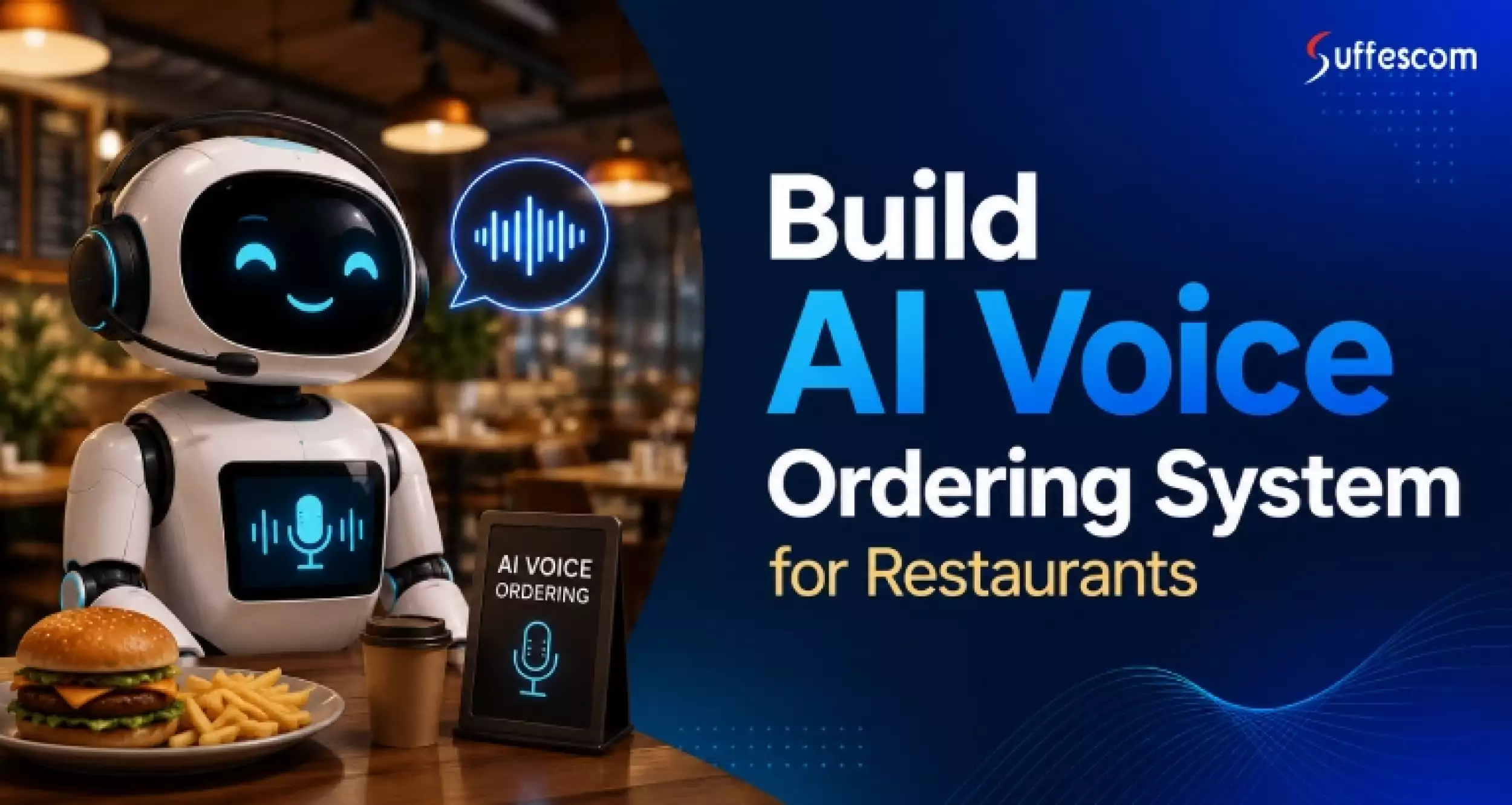
This transformation is not the result of a single day but the culmination of multiple factors reshaping large-scale business strategies. AI voice ordering system development is one of the key contributors to this shift. It allows users to order the items through voice control by replicating traditional telephonic interactions.
In this blog, we will explore AI voice ordering systems in detail, their working methodologies, development procedures, proven benefits, and how Suffescom Solutions has established its presence in the delivery market.
What is a Voice Ordering System
An AI ordering system for restaurants is a smart way of processing customer orders through voice interactions, AI-powered automation, and POS integrations. It primarily bridges the gap between customers and businesses by replicating the traditional way of phone calls, but with a slight variation.
Instead of a human, the customer is interacting directly with the digital systems to place the order.
AI Voice Ordering vs. Traditional Ordering Systems: How They Differ
Unlike conventional workflows, voice-based ordering systems provide faster customer interactions, improved scalability, and enhanced operational consistency.
| Aspect | AI Voice Ordering | Traditional Ordering |
| Interaction | Conversational voice-based ordering | Manual human interaction |
| Speed | Faster automated responses | Slower due to staff dependency |
| Availability | 24/7 order handling | Limited by operating hours |
| Accuracy | AI reduces missed orders | Human errors are more common |
| Scalability | Handles multiple orders simultaneously | Limited during peak hours |
| Personalization | Uses customer data for recommendations | Limited personalized suggestions |
| Cost Efficiency | Reduces staffing workload | Higher labor costs |
| Integration | Readily connects with POS & CRM systems | Often semi-manual workflows |
Build a Smarter Restaurant With Suffescom's AI Voice Ordering System
How Does Voice Ordering Work
A voice-ordering system works by leveraging Automatic Speech Recognition (ASR) and other similar digital technologies. These domains, when merged, assist businesses in receiving orders with up to 95% accuracy owing to reduced human intervention.
Phase 1: Customer Places the Order
The customer chooses their preferred service and places their order through a voice call in their regional language (depending upon the system’s complexity).
Phase 2: The System Interprets That Voice & Converts to Text
The system interprets the voice input and converts it into text using speech recognition models. The relevant context is drawn from that converted text, which is then sent to the database for further analysis.
Phase 3: System Matches That Text Into Their Database
The system assesses their database and identifies the item’s availability in their inventory. If the item is available, the order is reconfirmed to the customer. If not, the system may provide an alternative similar product/solution.
Phase 4: The Text (Order) is Processed After Confirmation
The final order is processed through smart Machine Learning (ML) and Artificial Intelligence (AI) algorithms. Once the customer completes the payment through the POS, it is sent to the kitchen for preparation.
Phase 5: Order is Delivered to the Customer
The kitchen team prepares the order, and the delivery team delivers it to the relevant customer. In many instances, this process is done manually; however, modern systems have facilitated fully automated deliveries through robotics-enabled technologies (powered by AI).
Role of AI in Voice Ordering System
AI helps to mitigate human errors and delivers precise, efficient solutions to users. It has broadened its functionalities across different facets of the ordering system, ranging from inventory management to customer delivery tracking.
1. Detects User Intent From Diverse Accents
What It Means: AI easily recognizes customer intent among several pronunciation differentiations, regional dialects, and speech variations.
How AI Makes It Possible: Through advanced NLP and speech recognition models and by analyzing real-time phonetics, context, and speech patterns.
Business Benefits:
- Reduces misunderstood orders
- Improves customer satisfaction
- Enhances ordering speed
Real-World Example: A fast food chain accurately processes orders by identifying its customers’ speaking accents.
2. Analyze User Behavior for Personalized Experience
What It Means: AI analyzes the past purchases of customers and suggests to them the most-fitting product(s) based on that data.
How AI Makes It Possible: By utilizing machine learning, predictive analytics, and customer data analytics to identify recurring buying patterns.
Business Benefits
- Increases customer retention
- Boosts average order value
- Enhances personalized experiences
Real-World Example: The system detects that the user has ordered a cheeseburger seven times in his last ten purchases. Based on that data, it recommended the new flavors and varieties of cheeseburgers whenever the customer places the next order.
3. Interpret Multiple Languages
What It Means: The system can easily draw the relevant conclusion from the customer’s voice despite their regional language conversation.
How AI Makes It Possible: Through AI-powered NLP, multilingual speech recognition, and language processing models that help systems detect, translate, and interpret multiple languages in real-time.
Business Benefits
- Expands customer accessibility
- Enhances user convenience
- Improves order completion rates
Real-World Example: A customer from a remote U.S. island places an order in their native language. The system analyzes that language and translates it to the understandable format for further processing.
4. Improves Order Accuracy
What It Means: AI precisely interprets human language, thus preventing misunderstood information, leading to streamlined processing.
How AI Makes It Possible: Leverages NLP, speech recognition, and contextual understanding to identify menu items, quantities, modifiers, and customer intent with higher precision.
Business Benefits:
- Reduces order errors
- Minimizes operational inefficiencies
- Enhances customer satisfaction
Real-World Example: If a customer says, “extra cheese without onion,” the AI-assisted system identifies that categorical word (with/without) and sends it for further processing to ensure the customer is receiving exactly what they have ordered.
5. Offers 24/7 Automated Order Assistance
What It Means: AI enables systems to take orders 24/7, even during off-working hours, without necessitating a human operator.
How AI Makes It Possible: Through AI-powered virtual assistants, conversational AI, and automated speech recognition that allow systems to manage customer interactions, answer queries, and process orders in real-time.
Business Benefits
- Ensures uninterrupted order processing
- Reduces staffing dependency
- Improves customer responsiveness
Real-World Example: The restaurant continues taking orders even after 10:00 PM when their employees have logged off.
Step-by-Step Guide to AI Restaurant Ordering System Development
Developing an AI voice ordering system rests on four basic components: a microphone for speech capture, an ASR (Automatic Speech Recognition) engine for transcription, a Large Language Model (LLM) for conversation logic and intent extraction, and a TTS (Text-to-Speech) system for voice playback. Once you have these components, follow the steps below:
Step 1: Define Goals & Success Criteria
Identify the key objectives behind developing an AI voice ordering system. Is it to achieve a specific result, target a specific audience base, or improve your existing KPIs? By figuring out these imperatives, you get a holistic overview of your development roadmap.
Step 2: Build Catalog & Design Conversations
Create your digital menu while listing each item’s price individually. Consult your stakeholders for further details and include those in the catalog to maintain a transparent workflow. Map out a clear picture of the sample conversations and the viable solutions. It's not mandatory to keep it comprehensive. The objective here is to guide the AI-assisted engine to perform the upcoming operations.
Step 3: Set Up Core Infrastructure
Set up the relevant backend infrastructure in your system by utilizing the services of the top custom application development companies. They will assist you in identifying the suitable backend technologies, cloud environments, and third-party APIs. This framework lays the cornerstone for successful AI drive thru app development and scalable voice ordering infrastructure.
Step 4: Integrate NLU & Voice Recognition
Integrate natural language understanding (the subset of NLP) and voice recognition technologies by training the systems to understand customers’ intent, accents, and menu-specific language accurately. The step involves a two-part approach:
- Teaching the system to accurately convert spoken audio into text.
- Then, train it to extract meaning and intent from that text.
Step 5: Connect Systems & Activate TTS
AI-based voice assistant integration in food ordering apps helps businesses connect conversational AI with POS systems, inventory management, and customer loyalty programs. Integrating AI will assist businesses to expand their functionality range with a logical workflow that can easily identify complex user contexts. This framework lays the foundation for scalable voice-enabled food ordering app development with seamless backend and AI integration services.
Step 6: Add Guardrails & Feedback Loops
Add the guardrails for safe and responsible AI behaviors, fallback responses as the backup response in case the AI fails to understand the preliminary request, and continuous learning mechanisms through Neural Networks (NNs) to enable the system to learn from previous patterns.
Step 7: Test, Launch & Improve Continuously
Test the application in real-world conditions to assess any gaps. With no gaps in place, deploy the final system. Monitor regularly for any anomaly behavior or unpredicted responses through the top custom software development services. Improve its performance over time and upgrade its features wherever necessary.
Power Your Restaurant's Future With Suffescom's AI Voice Ordering Platform
Proven Benefits of an AI Voice Ordering System
AI voice ordering for restaurants helps businesses automate customer communication, reduce operational inefficiencies, and improve order accuracy at scale.
1. Reduce Labor Costs & Increase Operational Efficiency
- The voice ordering system automates order-handling tasks by freeing employees to focus on critical tasks that necessitate complex reasoning abilities.
- It cuts the need to deploy additional staff for performing ordering operations, where AI can handle the payments and update their inventory in real time. AI chatbot integration for restaurants also helps businesses automate repetitive customer interactions, reducing staff workload while improving response times.
2. Improve Order Accuracy & Faster Service
The system curbs human errors by eliminating their interference during the working cycle. This automation is essential to maintain optimal operational efficiency. Moreover, it helps to deliver instant, precise order processing during each operation.
3. Improves Revenue via Upselling & Zero Missed Calls
- The voice ordering system captures every user interaction and intelligently suggests add-ons that reflect customers’ requirements accurately.
- This upselling capability boosts revenue while ensuring zero missed calls by improving client retention and minimizing churn rates.
4. Promote Multilingual Support
- The system is equipped with complex algorithms to understand different languages easily.
- This multilingual support helps businesses to reach a wider customer base, especially those located in remote locations like a distant island.
5. Enhance Scalability & Competitive Differentiation
- Voice AI ordering system development for small restaurants enables businesses to automate repetitive tasks while maintaining operational efficiency with limited staff resources.
- Such scalability factors position modern drive thru AI solutions at the forefront of competitors still relying on conventional manual systems.
Use Cases of AI Voice Ordering System for Restaurants
An AI voice ordering system for restaurants helps businesses automate customer interactions, streamline order management, and improve operational efficiency.
1. AI Drive Thru Ordering System Development
Example: AI drive thru restaurants utilize custom AI agent development services that greet customers, process natural speech, and automatically send orders to the kitchen.
Impact: Increased revenue by consistent upselling and mitigated labor shortages
2. Phone Order Handling
Example: An AI call ordering system for restaurants that responds to users’ calls and initiates orders automatically.
Impact: Reduces front-of-house labor costs and minimizes order errors
3. Mobile App Voice Ordering
Example: The customer places an order through an AI drive thru app using simple voice commands.
Impact: Voice ordering app development for restaurants allows customers to place orders directly through mobile applications using natural voice commands.
4. Intelligent Upselling
Example: The system listens to customer requests, identifies the user's intent, and suggests upgrades on their existing order.
Impact: Increases Average Order Value (AOV) by up to 40%
5. Multilingual Support With Accent Recognition
Example: The customer places the order in the French language while the system understands their regional accent to process the order.
Impact: Eliminates order inaccuracies and reduces per-order processing costs by up to 60-70%
6. Reservation Management
Example: A customer calls a restaurant the previous day to book a table for a family gathering on Saturday evening.
Impact: Boosts customer satisfaction, prevents missed revenues
7. Real-Time Inventory Awareness
Example: The system instantly detects the ‘out-of-stock’ item ordered by the customer and suggests a substitute.
Impact: Prevents stockouts, accelerates order processing
Key Features of an AI Voice Ordering System
The AI voice ordering systems comprise numerous features that help businesses to solve order-related challenges by streamlining their order processing, minimizing labor shortages, and reducing operational errors. For a better understanding, we have divided them under basic and advanced categories.
Basic Features
- Conversational Natural Language Processing (NLP): Access human-like interactions with the digital system.
- Seamless POS and Kitchen Integration: Helps to connect the operational department with POS to streamline order accuracy and speed.
- Real-Time Menu Synchronization: Any change in inventory is reflected in the menu database in real time.
- Multi-Channel Accessibility: Helps customers to utilize AI voice ordering systems through their preferred devices.
- Smart Menu Management: Goes beyond real-time menu synchronization by displaying other facets in the menu, such as the popular products or the least priced items.
- 24/7 Scalable Availability: Facilitate the system to easily handle multiple orders simultaneously through robust backend processing.
- Secure Payment Processing: Provide secure and trustworthy payment processing systems.
Advanced Features
- Proactive Error Handling: Prevents systems from misjudging customer statements.
- Personalized Customer Experiences: Helps the system to automatically remember the customer’s usual purchases and payment methods, so they don’t have to repeat the information next time.
- Loyalty Program Integration: Enables the system to recognize customers and apply their rewards automatically.
- Omnichannel Capability: Handles ordering from multiple devices, for instance, ordering from a laptop and paying from a smartphone.
- Analytics & Data Insights: Leverage AI predictive analytics platforms to assist businesses analyze customers’ ordering patterns and suggest data-driven solutions to improve their experience.
Limitations in Implementing an AI Voice Ordering System for Businesses
Implementing an AI voice ordering system presents several notable challenges for businesses that are effectively mitigated by Suffescom Solutions in their system design and execution processes.
1. Scripted Flow Breakdowns
The Challenge: Rigid scripted flows often fail because they don’t support bidirectional state tracking. When customers change their minds mid‑conversation, the system struggles to adapt, leaving the interaction brittle and frustrating.
Impact on Businesses: Immediate revenue loss, reputational damage, wasted labor & escalation
How to Overcome It
- Implementing dynamic intent recognition
- Decoupling interruptions from errors
- Leveraging context-aware prompts
2. Poor Handoff to Human Agents
The Challenge: The system fails to deliver complete order details to business employees, forcing clients to repeat their entire order and creating unnecessary frustration.
Impact on Businesses: Order abandonment, operational inefficiency, decreased Customer Satisfaction (CSAT), agent burnouts
How to Overcome It
- Providing context-rich transfers (no repetition)
- Optimizing escalation triggers
- Implementing AI feedback loops
3. Compliance, Privacy, and Ethical Risks
The Challenge: Capturing unauthorized biometric data, such as unconsented voiceprints, leading to compliance violations.
Impact on Businesses: Regulatory fines, vendor dependencies, loss of consumer trust
How to Overcome It
- Ensuring regulatory compliance
- Mitigating ethical risks, such as algorithmic biases
- Implementing data privacy and security measures like local edge computing
4. Integration With Existing Systems
The Challenge: Translating unstructured spoken language into rigid, programmatic codes leads to integration inaccuracies.
Impact on Businesses: Inconsistent customer experiences, operational bottlenecks, high maintenance costs
How to Overcome It
- Deploying API middleware
- Implementing asynchronous webhooks
- Using event-driven menu sync
5. Contextual Understanding
The Challenge: AI may fail to interpret conversational nuances, user intent, and complex menu logic in customers' conversations.
Impact on Businesses: Strain on human capital, revenue loss, cart abandonment
How to Overcome It
- Leveraging dynamic contextual AI models
- Connecting to real-time data (tool calling)
- Implementing domain-specific NLU and constraints
Technology Stack Needed for Developing a Voice Ordering System
Restaurant voice ordering software development relies on advanced tech stacks that power critical functions such as speech recognition, conversational AI, and backend integrations.
| Layer | Technology / Tools | Role in the System |
| Frontend UI | React.js / Next.js, Vue.js / Nuxt, React Native, Web Speech API, Tailwind CSS | Renders the ordering interface, captures microphone input, and displays live order confirmations and cart updates. |
| Speech Recognition (ASR) | Google Speech-to-Text, AWS Transcribe, Whisper (OpenAI), Azure Speech SDK | Converts customer voice input into text in real-time while handling accents, noise, and multilingual speech. |
| Natural Language Understanding (NLU) | Dialogflow CX, Rasa NLU, Amazon Lex, spaCy | Detects user intent and extracts entities like item names, quantities, and customizations from speech. |
| LLM / Conversational AI | GPT-4o, Claude 3, Gemini 1.5, and LLaMA 3 (self-hosted) | Powers contextual conversations, upselling, ambiguity handling, and multi-turn order interactions. |
| Text-to-Speech (TTS) | Google Cloud TTS, Amazon Polly, ElevenLabs, Azure Neural TTS | Generates natural-sounding voice responses for confirmations, recommendations, and follow-up questions. |
| Backend & API Layer | Node.js / Python, FastAPI / Express, REST / GraphQL, WebSockets | Manages communication between ASR, NLU, LLM, and TTS systems while handling sessions and POS connectivity. |
| POS & Menu Integration | Square API, Toast POS SDK, Olo API, Custom Webhooks | Synchronize menu data, pricing, and availability and push confirmed orders into kitchen workflows. |
| Data & Personalization | PostgreSQL / MongoDB, Redis (cache), Pinecone (vector DB), Segment / CDP | Stores customer preferences and order history and enables personalized recommendations and repeat ordering. |
| Infrastructure & Deployment | AWS / GCP / Azure, Docker + Kubernetes, Twilio (telephony), CI/CD (GitHub Actions) | Supports scalable hosting, telephony integration, containerized deployment, and automated delivery pipelines. |
Cost to Build an AI Voice Ordering System
The cost to develop AI voice ordering system solutions typically ranges between $50,000 for basic-level deployments and $300,000+ for enterprise-grade implementations. Other factors also impact this pay structure, which includes regional inflation rates and product demand.
| Deployment Level | Features & Capabilities | Scope | Estimated Cost |
| Foundational | Basic voice assistant for menus and order routing | Single-purpose deployment with limited integrations | $50,000 – $100,000 |
| Mid-Level | NLP, contextual understanding, POS connectivity, and order tracking | Scalable solution with CRM and API connectivity | $100,000 – $200,000 |
| Advanced | Custom LLMs, dynamic pricing, multilingual support, and AI-driven recommendations | Enterprise-grade automation across multiple business systems | $200,000 – $300,000+ |
Key Factors Impacting the AI Voice Ordering System Development Costs
System Complexity & AI Models: Building systems from scratch with advanced LLMs and other AI technologies is comparatively more expensive than customizing off-the-shelf voice platforms.
POS & System Integrations: A custom API development is required to integrate voice agents in your POS system, demanding higher prices. Moreover, the price increases as we integrate more APIs and features into the voice ordering system.
Deployment & Scalability: Developing for phone lines has different infrastructure costs than integrating voice order systems into mobile apps or websites.
Implementation & Maintenance: The dynamic menu management, because of shifts in customer demands, requires complex maintenance and triggers price changes.
Compliance & Security: Strict adherence to PCI-DSS and data privacy laws for sensitive data, like retaining customer credit card numbers or phone numbers, escalates the cost of security audits.
What Does the Future Hold for AI-Powered Hospitality Automation?
The future of AI-powered hospitality automation is shaped by personalized-driven technologies and rapidly scaling customer demands alongside advancing digital infrastructures.
1. AI-Driven Inventory Management
Inventory management is one of the critical components of AI voice ordering systems. While real-time automated inventory updates already align with order placements, further enhancements can be achieved by proactively forecasting potential stockouts and recommending backup stock, thereby preventing unnecessary order delays.
2. Dynamic Pricing and Revenue Optimization
Dynamic pricing is one technology that is utilized in almost every industry today, from e-commerce platforms to flight pricing. Aligning with the needs of the hospitality industry, dynamic pricing helps to modify product pricing in accordance with the demand-supply chain. For example, in peak hours, customers may experience higher pricing, while for late-day hours (after 11:00 PM), they may expect lower prices.
In the future, you may witness more considerable factors in addition to the customer demands and market fluctuations. These include weather conditions, local events, customer behavior patterns, competitor pricing strategies, inventory availability, and real-time purchasing trends.
3. Predictive Personalization
The advancements in smart algorithms and AI models have empowered voice ordering systems to intelligently predict the customer’s past purchasing patterns and suggest the most viable item that the customer is likely to order. This technology shift not only improves customer satisfaction but also drives higher revenues.
4. Automated Staff Scheduling
Previously, hospitality businesses had to manually schedule their staff's working hours based on the shifting corporate goals. However, today, the entire process is handled automatically through smart AI mechanisms.
It automatically detects the shift in business needs and allots the most suitable working hours to the company employees. In the future, you would expect advancement in staff scheduling strategies by integrating additional factors, such as employee performance trends and real-time customer footfall predictions.
5. Enhanced Client Feedback Analysis
Context understanding goes beyond the standard conclusion derivation from client feedback. As we shift to the modern ML and AI era, the system can automatically detect customer reviews, ratings, and comments and extract their likes, dislikes, and demands, unlike the conventional manual-powered mechanisms.
Meet Suffescom Solutions: AI Voice Ordering Built for Real Businesses
Suffescom Solutions possesses over a decade of expertise in voice AI restaurant software development, building scalable and performance-driven voice ordering platforms. Here are the five reasons why our development services truly stand out:
1. AI Expertise
What We Offer: Custom AI models, voice recognition, natural language understanding, real-time order processing
Key Technologies Used: TensorFlow, PyTorch, Rasa, Google Dialogflow, OpenAI GPT, Whisper, Speech-to-Text engines
2. Prioritize Security and Scalability
What We Offer: End-to-end encryption, auto-scaling infrastructure, secure payment handling, role-based access
Key Technologies Used: AWS, Azure, Kubernetes, Docker, HashiCorp Vault, OAuth 2.0, JWT
3. Compliance Adherence
What We Offer: GDPR, CCPA, PCI-DSS, HIPAA (if applicable), SOC 2 readiness
Key Technologies Used: Vanta, Drata, AWS Config, CloudTrail, and encryption libraries (AES-256 and TLS 1.3)
4. Data-Driven Improvement Plans
What We Offer: Conversation analytics, order accuracy tracking, customer sentiment analysis, performance dashboards
Key Technologies Used: Tableau, Power BI, Looker, Databricks, Snowflake, Apache Kafka, ELK Stack
5. Dedicated Support & Maintenance
What We Offer: 24/7 monitoring, proactive alerts, version updates, bug fixes, SLAs, and a dedicated account manager
Key Technologies Used: Prometheus, Grafana, PagerDuty, New Relic, Datadog, Jira, Jenkins, GitHub Actions
Ready to Go AI? Launch Your Voice Ordering System With Suffescom Solutions
Conclusion
AI drive thru ordering system technologies have rapidly transformed how businesses automate customer interactions and enable more reliable order processing across restaurants and drive thru enterprises. With the advent of advanced AI technologies such as NLP, ASR, and LLMs, systems can now easily understand user accents, differentiate between multiple languages, identify user intents, and analyze their purchasing behavior to extract the most viable solutions.
The essence lies in effective development strategies and how development companies implement them to make their audience’s experience worthwhile. Suffescom Solutions, with our team of seasoned developers, utilizes advanced digital technologies to build AI voice ordering systems that align with users’ goals and offer value beyond quality services. We don’t just build solutions; we create innovation-driven products, brand-defining experiences, and long-term digital success.
FAQs
1) What is the Cost to Build an AI Ordering System for Restaurants?
The cost to build an AI ordering system for restaurants depends on multiple factors such as AI model complexity, POS integrations, multilingual capabilities, cloud infrastructure, and customization requirements. Basic systems may start around $50,000, while enterprise-grade deployments can exceed $300,000.
2) What ROI can Restaurants Expect From an AI Voice Ordering System?
The restaurants can expect a significant rise in annual ROIs through AI voice ordering systems by mitigating missed phone calls, lowering labor costs, and increasing ticket sizes through automated upselling procedures.
3) Can AI Voice Ordering Systems be Customized for a Restaurant's Brand and Menu?
Yes, the AI voice ordering systems are highly customizable. You can easily tailor them to reflect your specific brand identity, conversational style, and menu constraints, ensuring every customer gets an experience that matches your restaurant's vibe.
4) What is the Difference Between Building a Custom AI Voice Ordering System From Scratch Versus Integrating an Off-the-Shelf White-Label Solution?
Building a custom AI voice system from scratch provides you total ownership, proprietary data advantages, and tailored workflows but requires massive upfront capital and time. Conversely, off-the-shelf solutions offer rapid, plug-and-play deployment with lower initial costs, but you sacrifice deep customization and risk vendor lock-in.