+971-8000321216



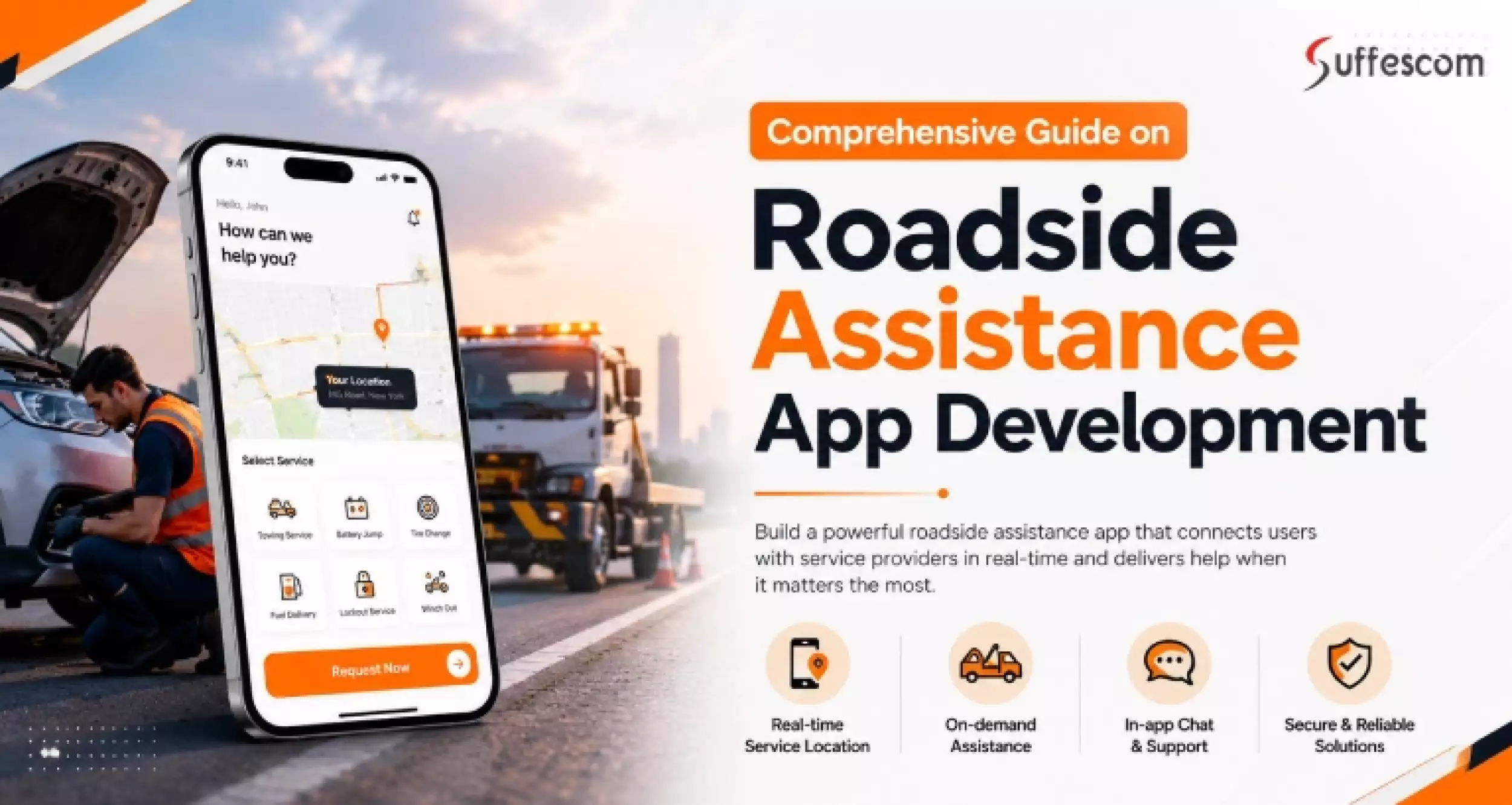
Roadside assistance apps have witnessed a significant growth in recent years. According to Yahoo Finance, a top US-based roadside assistance company receives 5,000+ fleet roadside assistance calls daily, which converts to 35,000+ calls weekly and 147,000+ calls monthly.
The key drivers behind this expansion are rising vehicle ownership, increasing reliance on smartphones and on-demand apps, and growing consumer demand for real-time safety and convenience.
In this blog, we will walk you through the key aspects of roadside assistance apps, including their core features, working methodologies, tech stacks, monetization models, and the overall development process behind these platforms.
Roadside Assistance App Development: An Overview
Roadside assistance apps are smart digital applications that allow users to book tow truck for emergency purposes by connecting them to the nearest service provider network whenever they search for roadside assistance near me.
Earlier, the apps were simply confined to taxi services or ride-hailing. With digital advancements, roadside assistance apps have found their way in the new realm of automotive support.
Real-World Examples
- Drivers can request emergency towing services after a sudden vehicle breakdown on highways.
- Users can book real-time battery jump-start assistance directly.
- Roadside assistance app development helps stranded drivers locate nearby mechanics instantly via GPS tracking.
- Fleet management companies use roadside assistance apps to reduce vehicle downtime.
- EV drivers can find charging support and towing assistance easily.
- Logistics businesses use roadside assistance apps to manage breakdowns during deliveries.
- Insurance providers integrate roadside assistance features into their customer service platforms, similar to platforms like Allstate and their allstate roadside assistance services.
- Drivers receive real-time ETAs and live tracking updates for mechanic arrivals.
- Businesses use AI-powered dispatch systems to assign the nearest available service provider automatically.
- Users can request fuel delivery services when vehicles run out of fuel during travel.
- Automobile businesses use roadside assistance software to improve customer retention and after-sales support.
Turn Your Roadside App Idea Into a Scalable Business With Suffescom Solutions
How Does a Roadside Assistance App Work at an Enterprise Level?
The goal behind roadside assistance app development is to connect three entities in real-time—the stranded driver, the service provider, and the developer team behind the app development.
After detecting the problem, the apps not only look for the nearest service providers but also search for crucial factors like
- Skills: Does the provider have the needed skills (fixing batteries or punctures)?
- Availability: Is the provider available at that point, or is the provider busy with other projects?
- Reliability: Do they possess good online ratings?
Stage 1: Driver Requests Help
- The driver opens the app and taps 'I Need Help,' OR the service provider dispatches assistance directly from the web dashboard.
- The app automatically shares the driver’s exact GPS location.
Stage 2: The “Brain” Finds the Best Helper
- The enterprise system searches for all the nearest service providers in its database to quickly fulfill requests generated through searches like roadside assistance near me.
- They harness advanced AI and ML algorithms to perform the specific task.
Stage 3: Dispatched & Tracked in Real-time
- The chosen service provider gets the notification on their app. They accept the job, and the process begins. Both drivers and service providers can now access each other's locations.
- The app automatically sends push notifications during each process to the user, for instance, “Provider Assigned” or “The Provider is on the Way.”
Stage 4: Communication & Fix
The driver and provider can easily chat or call inside the app without sharing their personal contact numbers.
The provider arrives and fixes the issue (fuel shortage, flat tire, battery jump-starting, etc.).
Stage 5: Payment & Feedback
The payment is automatically initiated via secure payment interfaces/systems. The driver rates the service and leaves their feedback.
All the details are saved in the system’s history to streamline the next similar projects.
Stage 6: Enterprise Manager Gets Full Data
This is the key "enterprise-level" component. A web dashboard gives managers a bird's-eye view of everything:
- a) Live map of all active incidents
- b) Reports on response times, costs, and provider performance
- c) Analytics to see common problems and improve operations
- d) Tools to onboard and verify new service providers (check licenses, insurance, and background)
The process completes, concluding this provider onboarding and verification working cycle of roadside assistance apps.
How to Build a Roadside Assistance App: End-to-End Development Process?
Building a roadside assistance app is a specialized process that requires the assistance of the top app development company. Broadly, the development process falls under seven steps:
Step 1: Requirement Analysis & Market Research
Before beginning, identify your target audiences and the common challenges they are facing related to roadside assistance. Analyze your competitors thoroughly and the gaps they fail to fulfill and how your company can bridge those service shortcomings.
Step 2: UI/UX Design
A simple and intuitive interface assists all user sections (e.g., users aged above 60 years) to operate the app smoothly. Select the right development approach, native or cross-platform, based on your budgets and tailored audiences. Create a roadmap for the key features that include real-time tracking and notification alerts.
Step 3: App Architecture & Technology Stack Selection
Decide on the scalable architecture (monolithic or microservice-based). Choose the right technologies to be integrated into the app. To address this, you can refer to the top app development services and share your exact requirements.
Step 4: Customer, Service Provider & Admin Panel Development
Categorize those features (check step 2) into three categories based upon
- Customers: e.g., service booking and real-time tracking
- Service Providers: e.g., job alerts & navigation and earnings tracking
- Admin Panel: e.g., robust dashboards and analytics
Optimize these features for smooth performance, user engagement, and different platform requirements (for cross-native apps).
Step 5: API Integration & Third-Party Services
To add the core functionalities, you might require APIs for easy integration with third-party apps for payments, GPS tracking, and communication services. Select your preferred APIs from the top app development services. Accordingly, adapt those platforms to address your core objectives.
Step 6: Testing & Quality Assurance
Execute functional, usability, and performance testing under high traffic and real-time conditions. Identify the bugs and anomalies during the process and mitigate them in real-time by making changes in your app.
Step 7: Post-Launch Support & Maintenance
Deploy the final-ready app on platforms like the Google Play Store and the Apple App Store. Include the relevant keywords for SEO optimization. Configure servers, databases, and cloud infrastructure. Ensure adequate compliance with the regulatory standards.
Core Features Your Roadside Assistance App Must Have
Navigating through roadside assistance app development requires intensive knowledge about its core features that will help you evaluate your business models precisely. Here are the core features that make the app practical, scalable, and holistic:
1. GPS Tracking & Live Location Sharing
- Know the exact user location using GPS through API integrations to instantly connect users searching for roadside assistance near me with nearby service providers.
- Ensure real-time visibility and effortless connectivity.
End Result: Faster response times
2. AI-Powered Provider Matching & Dispatch
- Match the users with the right service providers by leveraging smart AI algorithms and models.
- Optimize faster response time and efficient resource utilization.
End Result: Reduced operational costs
3. SOS Emergency Assistance
- Instantly call for help without navigating multiple platforms via a single tap.
- Makes it easier for users to access customized guidance quickly.
End Result: Assured regulatory compliance
4. In-App Communication
- Easily communicate between multiple stakeholders, including users and service providers.
- A secure method to protect either party's contact numbers through call masking technology.
End Result: Eliminates third-party dependency
5. Membership & Subscription Management
- Avail a small portion of fees for user subscriptions (often monthly or annually)—applicable for premium services such as priority support and exclusive content.
- Manage all forms of memberships to help users choose the most-aligned services according to their goals.
End Result: Predictable revenue streams
6. Payment Integration & Wallet Support
- Instill advanced security protocols into your payment methods to make them trustworthy and convenient for users.
- Leverage multiple wallet support to amplify your transactional strategies.
End Result: Accelerated transaction cycles
7. Analytics Dashboard
- Get the holistic overview of the entire process and performance within the app.
- Make data-driven decisions that align precisely with your business objectives.
End Result: Actionable growth intelligence
Choosing the Right Tech Stack for Roadside Assistance App Development
Choosing the right tech stack is indispensable for roadside assistance app development companies. It helps them to maximize performance and integrate features and align those capabilities effectively with the rapidly dynamic business ecosystem.
Core Technology Components
Here’s a quick tabular overview of the key technological components used in roadside assistance app development:
| Category | Recommended Tech Stack | Purpose |
| Frontend (Mobile) | React Native, Flutter, Swift, Kotlin, Objective-C | Cross-platform and native mobile app development |
| Frontend (Web) | React.js, JavaScript, Flux, Gulp.js, Browserify, SVG, Canvas 2D, WebGL, D3 | Web interface, data visualization, and rendering |
| Backend | Node.js, Python, Java, Go, C, C++, Ruby on Rails, Express.js | Server-side logic and API management |
| Real-Time Tracking | Google Maps API, Mapbox, WebGL | Live location tracking and route rendering |
| Database | MongoDB, PostgreSQL, Firebase, Riak, Cassandra, Hive, HDFS, Elasticsearch | Structured and unstructured data storage |
| Cloud Hosting | AWS, Google Cloud, Microsoft Azure, Terraform | Scalable infrastructure and deployment |
| Payment Gateway | Stripe, Braintree, PayPal, Card.io, Razorpay | Transactions, split fare, and wallet support |
| Real-Time Communication | Redis, Twemproxy, Celery Workers, Kafka, Storm, Spark | Message queuing and real-time data streaming |
| Routing & Discovery | HAProxy, Ringpop, TChannel, HyperBahn, Thrift, Protobuf | Service routing, load balancing, and inter-service communication |
| DevOps & Deployment | Docker, Mesos, Aurora, Jenkins, Packer, Vagrant, Boto, Unison, Puppet | CI/CD pipeline, containerization, and infrastructure automation |
| Monitoring & Logging | Nagios, Sphinx, Elasticsearch, Logstash, Kibana (ELK Stack) | Performance monitoring, log management, and error tracking |
Quick Selection Guide by Business Size
To make things simpler, we have devised a quick tabular guide on the recommended stack for each enterprise category:
| Business Size | Recommended Minimal Stack |
| Startup/MVP | React Native + Node.js + Firebase + Stripe + Google Maps API |
| Mid-Market Enterprise | Flutter + Python + PostgreSQL + AWS + Mapbox + Razorpay + Redis |
| Large Enterprise | React Native + Java/Go + Cassandra + Azure + Kafka + Braintree + ELK Stack + Docker |
Monetizing Models for Roadside Assistance Platforms
Roadside assistance platforms can generate revenues in several ways by leveraging AI, IoT, and data-driven services:
1. Subscription-Based Model
How It Works: Users or enterprises pay a fixed portion of fees to utilize premier services, ranging from basic towing to premium priority dispatch and AI-powered diagnostics.
Best Suited for: Fleet operators, insurance-backed platforms, and enterprise roadside networks.
Revenue Potential: High—recurring, compounding, churn-resistant
Key Advantage: Eliminates revenue unpredictability and improves clients' experience
2. Pay-Per-Use Model
How It Works: The client pays only what they consume rather than paying a flat subscription fee.
Best Suited for: Fleet management companies, enterprise mobility providers, and insurance-backed roadside assistance platforms
Revenue Potential: High—stems from customer consumption with higher net revenue retention
Key Advantages: No big upfront investment. Easy to try with lower upfront risk.
3. Commission-Based Revenue
How It Works: You earn money by taking a minor percentage of the generated revenue from the provider who gave service to the user.
Best Suited for: Insurance companies, auto clubs, fleet management firms, automotive OEMs, and telematics providers
Revenue Potential: Moderately high—although the initial growth is slow
Key Advantages: High ROI potential. Minimizes Customer Acquisition Cost (CAC). Aligns marketing expenses stringently with business growth.
4. Advertising & Sponsored Listings
How It Works: The company pays for listing their name on the top of the roadside assistance app interface whenever the user searches for a particular service.
Best Suited for: E-commerce marketplaces, classifieds, directories & aggregators, freemium mobile apps, and digital game companies
Revenue Potential: Very high—offer instant visibility and monetize user attention directly
Key Advantage: Highly scalable revenue generation. Steeper user retention rates.
5. Data Monetization
How It Works: Turning what you learn into valuable reports for others
Best Suited for: Insurance companies, municipalities/city governments, tire & auto parts manufacturers, and fleet operators
Revenue Potential: Fluctuated—depends largely on data timeliness
Key Advantage: Minimal initial investment. Harness the potential of existing data as scalable and non-depleting assets.
How Much Does it Cost to Build a Roadside Assistance App?
The total cost to build a roadside assistance app depends on the blend of controlled and uncontrolled factors. The controlled factors include app complexity, chosen platform, UI/UX design requirements, developers’ experience, third-party integrations, and post-launch maintenance. While the uncontrolled factors involve regional inflation rates and local product demand.
Realistically, the price range falls between $5,000 and $20,000 (and more) based upon these factors. We have devised a cost table for a clearer overview:
| Aspect | Estimated Cost (USD) |
| App Design (UI/UX) | $5,000 – $10,000 |
| Core App Development | $10,000 – $20,000 |
| GPS & Real-Time Tracking | $10,000 – $20,000 |
| Payment Gateway Integration | $5,000 – $10,000 |
| Backend & Cloud Infrastructure | $5,000 – $15,000 |
| QA Testing & Deployment | $5,000 – $10,000 |
| Maintenance & Support | $5,000 – $10,000 / year |
Common Development Challenges and How Suffescom Addresses Them
Developing a roadside assistance app requires addressing complex engineering problems under stressful, high-stakes conditions. These problems, if overcome, can help businesses to easily scale and expand their online presence:
1. Accurate Geolocation
Locating an exact broken vehicle in the landscape of highly remote and traffic-prone areas requires strategic methods and knowledge about advanced algorithms.
How Suffescom Addresses This Challenge
- Executing advanced reverse geocoding and accurate coordinate parsing.
- Leveraging advanced AI and ML algorithms through our seasoned team of developers.
2. Intelligent Provider Matching
Matching the customer with the exact nearby tow truck and mechanics based upon the specific vehicle type, required equipment, and service load requires advanced dispatching and real-time operational visibility.
How Suffescom Mitigates This Challenge
- Integrate accurate, real-time dashboards to help dispatchers track, assign, and manage requests with minimal delay.
- Automatically filters nearby providers by vehicle type, equipment, and availability with our AI-powered dispatch systems.
3. Third-Party APIs
Integrating the app with third-party APIs like Google Maps, SMS/push notification gateways, and secure payment processors can complicate the development cycle.
How Suffescom Approaches This Challenge
- We handle all the major third-party integrations in-house, so your development timelines stay clean and uninterrupted.
- Every API is periodically tested, thoroughly documented, and built with fallback logic to ensure zero disruption in your app's workflow.
4. Data Security
Handling sensitive user data requires robust adherence to the standard security compliances and privacy regulations, which depend on your location. Precisely, meeting these requirements with the accurate regulatory standards could be a significant challenge for businesses.
How Suffescom Manages This Challenge
- Build every app with industry-standard encryption, secure payment protocols, and location-specific compliance frameworks.
- Ensure data safety at every touchpoint so your business stays compliant without development delays.
5. Unpredictable Demand
The infrastructure needs to scale dynamically based upon the rapidly fluctuating service requests and active users, high during extreme weather conditions, and increasing traffic scenarios.
How Suffescom Handles This Challenge
- Builds cloud-based infrastructure that automatically scales during peak demands and scales down during quiet hours, saving resources.
- Your app stays fast, stable, and responsive whether you're handling 10 requests or 10,000.
Develop Your 24/7 Roadside Assistance App
Conclusion
Developing roadside assistance apps isn’t about writing code; it's about maximizing the intelligence of modern digital systems to your advantage. Typically, adapting to these frameworks requires a complete understanding of technological methodologies and assessing the market conditions closely. Moreover, with complex technological components, the implementation gets even more challenging.
Suffescom Solutions, one of the leading mobile app development companies, offers scalable and high-performance roadside assistance apps for numerous clients worldwide. All made possible by our seasoned developer team, who maintain relentless precision and strong technical expertise to build apps that reflect our success and technical excellence.
FAQs
1) Which All Industries are Roadside Assistance Apps Made for?
The top industries include automotive & towing services, insurance, fleet management, automotive manufacturing (OEMs), Electric Vehicles (EVs), and software & telematics.
2) What is the Minimum Viable Feature Set Needed to Launch a Competitive Roadside Assistance App?
For this, you need to strike a balance between user-friendly requests and a streamlined provider dashboard. The typical MVP features in this list include precise GPS tracking, transparent on-demand pricing, a digital dispatch system, and automated status updates.
3) Can the App Support Multiple Service Verticals Beyond Towing, Such as Fuel Delivery And Lockout Services?
Yes, our roadside assistance apps development aims to support multiple service verticals. These cover fuel delivery, lockout assistance, battery jump starts, and tire replacement by surpassing conventional towing and traditional roadside assistance limitations.
4) Is it Possible to Add AI Features to an Existing Roadside Assistance App?
Yes, it's possible to add these advanced AI engines to your legacy systems without entailing greenfield development. This can be achieved through modern APIs and cloud-native platforms that are robustly integrated into your existing enterprise architecture.
5) How Does the App Ensure Service Availability in Rural or Low-Coverage Geographic Areas?
To ensure optimal availability in low network coverage locations, we combine offline queuing with hybrid dispatch models. Consequently, the app temporarily stores critical information when offline and automatically sends that saved information without necessitating the user to repeat the request. Moreover, our developed app directly connects with local service providers as a backup during network failure.
6) What is the Average ROI Timeline for Businesses Investing in Roadside Assistance App Development?
Figuring out the ROI timeline can be slightly difficult with multiple factors in the equation. Generally, it takes between 6 and 12 months. The majority of companies have achieved operational profitability within 12 to 24 months.