+971-8000321216



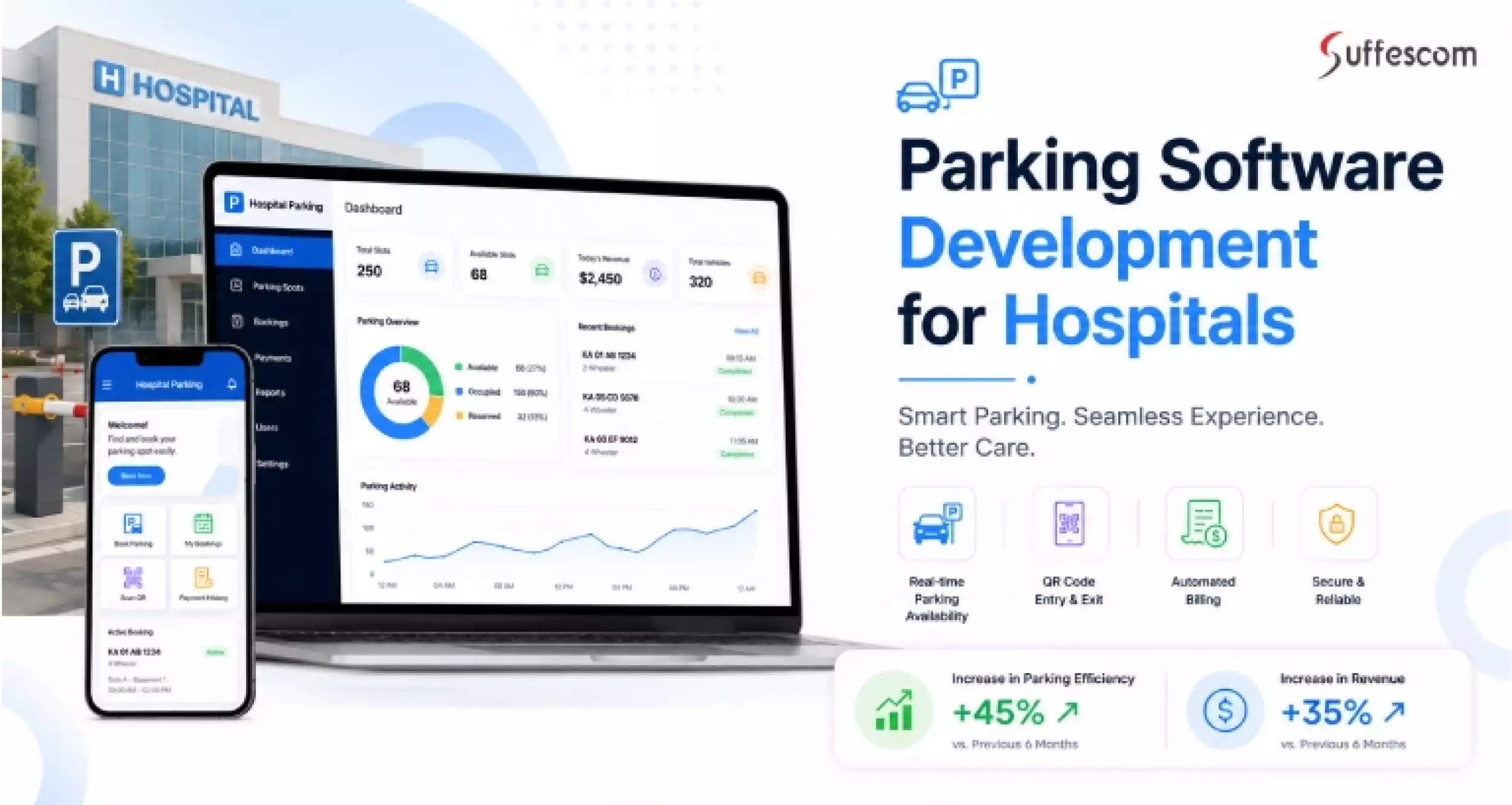
Hospitals operate around the clock, handling a constant flow of patients, visitors, medical staff, ambulances, and emergency vehicles every single day. Managing this large-scale vehicle movement has become a critical operational challenge for modern healthcare facilities.
To handle this, hospital parking management software development has rapidly transformed the dynamics of the healthcare businesses.
These platforms have not only streamlined their workflows but also improved vehicle safety through controlled traffic flows, thereby reducing resource wastage and enhancing patient experiences. In today's world, such solutions are essential assets that, when utilized effectively, can significantly enhance the modern healthcare infrastructure.
Read this guide to explore hospital parking management software in detail, including its key features, benefits, challenges, and how companies like Suffescom Solutions are effectively developing scalable parking management solutions for modern healthcare facilities.
Transform Hospital Parking Operations Digitally
What is Hospital Parking Management Software?
Hospital parking management software is a digital tool that helps healthcare businesses in managing their parking spaces in an organized and efficient manner. It aims to reduce human effort by introducing automated systems, such as parking fees, parking space monitoring, and membership card access.
In recent years, its demand has surged with the market size expected to reach USD 12.41 billion by 2030, up from USD 7.22 billion in 2025 at a CAGR of 11.40%. The core drivers behind this growth are financing accessibility, urbanization, and smart technology adoption.
Modern parking garage management software solutions are now widely adopted by hospitals to automate vehicle access, improve parking utilization, and streamline large-scale healthcare parking operations.
The hospital primarily use parking software to
- Streamline patient vehicle entry and exit
- Automate staff parking permit allocation
- Manage valet operations at emergency entrances
- Track real-time parking slot availability
- Collect contactless parking payments
- Enforce unauthorized vehicle restrictions
- Generate parking revenue and utilization reports
Types of Hospital Parking Management Software
The hospital parking management software is broadly divided into five types, depending on their technology and automation levels:
1. Semi-Automated Systems
Semi-automated healthcare parking systems use automation as a support system to manage the parking workflow. They have replaced the need for security guarding personnel through basic digital gate control in addition to other automated tasks, which are completely handled by digital machines (barriers, sensors, and license plate recognition). The tasks requiring human intervention include assisting visitors and managing exceptional cases like error management, lost passes, malfunctioning sensors, etc.
Best for: Small-to-midsize clinics, low-traffic specialty hospitals, or staff-only parking lots
2. License Plate Recognition (LPR/ANPR) Systems
License Plate Recognition (LPR/ANPR) systems use advanced, high-definition cameras to scan the vehicle’s license plate to extract its details. This data is then validated with the hospital’s existing database during entry and exit, enabling touchless and paperless ticketing.
Best for: Large, high-traffic medical centers needing fast throughput, premium VIP parking, and automated monthly staff billing.
3. Sensor-Based Smart Parking Systems
These healthcare parking systems employ in-ground IoT sensors or overhead ultrasonic cameras to detect empty parking spaces. This detail is displayed on the LED screen either at the parking lot or integrated into the existing apps to help visitors identify the spaces conveniently.
Best for: Large campus layouts where patients and visitors circle for parking, creating congestion
4. Patient & Valet Management Systems
Patient & valet management systems are a sophisticated form of parking software where users can book their parking spaces in advance. The valet staff uses mobile parking apps to digitally track car keys, issue SMS retrieval notifications, and process digital payments. The entire process is integrated with hospital operations and electronic health records (EHR).
Best for: Outpatient clinics, oncology centers, and high-end hospitals offering valet services to patients with mobility issues
5. Mechanical/Automated Stacking Systems
Mechanical/automated stacking systems maximize constrained physical spaces by using robotic puzzle parking systems to stack and retrieve vehicles. The parking software tracks and coordinates the automated car retrievals without necessitating drivers to park them manually.
Best for: Urban, multispecialty hospitals with scarce land spaces
Hospital Parking vs. Valet Parking Management Software: Key Differences
Hospital parking management software helps hospitals manage their parking spaces through intelligent digital solutions. Valet parking management software, a subcategory of hospital parking software, assists valets in handling car drop-offs, parking, and the quick return of visitors’ vehicles.
| Aspect | Hospital Parking Management Software | Valet Parking Management Software |
| Primary Purpose | Manages self-parking across the hospital facility | Manages attendant-handled vehicle drop-off and retrieval |
| Target Users | Patients, visitors, staff, and emergency vehicles | Patients with mobility issues, VIP visitors, emergency arrivals |
| Core Technology | IoT sensors, LPR, barriers, real-time slot tracking | Ticket generation, key management, mobile retrieval alerts |
| Automation Level | Highly automated with minimal human intervention | Semi-automated, reliant on attendant workflows |
| Payment Model | Self-service kiosks, mobile apps, contactless payments | Attendant-collected or app-based tipping and fee collection |
| Space Utilization | Optimizes multi-level parking structures | Maximizes limited front-entrance space efficiently |
| Access Control | RFID, LPR, QR codes, barrier gates | Ticket stubs, mobile alerts, key handoff systems |
| Emergency Vehicle Priority | Dedicated lanes and zones via automated controls | Attendant-managed priority drop-off at ER entrances |
| Best Suited For | Large hospital campuses with high daily footfall | Specialty hospitals, surgical centers, premium facilities |
| Scalability | Highly scalable across multiple lots and facilities | Limited to entry points and attendant capacity |
| Reporting & Analytics | Occupancy rates, revenue, peak hours, violations | Vehicle retrieval times, attendant performance, wait times |
| Patient Experience Impact | Reduces search time and parking stress independently | Provides a premium, hands-free arrival experience |
| Integration Capability | EHR, hospital apps, smart city infrastructure | Hospital CRM, mobile apps, payment gateways |
| Operational Cost | Higher upfront infrastructure cost, lower ongoing cost | Lower setup cost, higher ongoing labor cost |
| Regulatory Compliance | ADA accessibility, fire lane management, and data privacy | ADA drop-off compliance, liability, and insurance coverage |
Why Do Hospitals Need Smart Parking Management Software?
Hospitals require this software to eliminate traffic congestion, reduce stress for patients and medical staff, and ensure uninterrupted ambulance entry.
1. Unrestricted Emergency Access
This parking management software provides a dedicated zone for emergency services such as ambulances to ensure life-saving support for critical patients. It also enhances credibility and trust in hospitals, improving overall client retention rates.
2. Improved Patient Experience
Patients and their families are already under considerable pressure. By allowing pre-booking of parking spaces, these platforms alleviate the burden, shorten search times, reduce late arrivals, and avoid missed medical appointments.
3. Optimized Space Utilization
Administrators can easily analyze the peak parking demands and allocate permits to tailor their parking strategies, in line with the staff shifts, visitor hours, and specialized needs.
4. Streamlined Security and Automation
Modern parking garage management software helps hospitals maximize multi-level parking capacity through intelligent space allocation and real-time occupancy monitoring.
5. Reduced Environmental Impact
By directing vehicles to vacant parking spaces and reducing the need to circle busy lots, smart parking management software helps lower carbon emissions and minimize waste.
Must-Have Features of Hospital Parking Management Software
Advanced parking garage management software includes features such as automated barriers, real-time guidance systems, surveillance integration, and contactless payment processing.
Key Features
1. Entry & Exit Control With Boom Barriers: Controls the entry and exit of vehicles within the premises through a gate that opens and closes based on authorization.
2. FasTrak Integration: Similar to a toll plaza, it consists of an RFID chip that automatically scans the tag placed on the vehicle’s windshield when it passes through the barrier.
3. Real-Time Parking Guidance System: Provides real-time availability of parking spaces via your device.
4. Security & Surveillance: Ensures safety within parking areas through a unified system that alerts staff if unusual activity occurs.
5. Emergency Vehicle Access & Priority Routing: Facilitates the movement of emergency vehicles such as ambulances, police vans, and fire trucks.
6. Integrated Digital Payment Systems: Consolidates payments into one platform, supporting cards, mobile wallets, UPI, and online banking.
7. Space Reservation & Booking Management: Allow users to book parking spaces in advance, avoiding on-arrival searches.
8. Membership Management: Oversees the entire lifecycle of the memberships for the subscribed users, including their special access, contact info, and membership types.
9. Data Analytics & Reporting: Uses advanced analytics to help stakeholders monitor and optimize parking operations.
10. Parking Configuration: Configure how the parking areas would function within the hospital parking management software.
Advanced Features
1. Visitor & Patient Tiered Access: Providing access to different levels of parking or entry privileges to hospital visitors and patients based on their needs.
2. Staff Parking Modules: The key component of parking management software made specifically for employees to ensure they have organized, secure, and fair parking spaces every time.
3. Digital Valet: A smart digital system that helps users to request a valet through software instead of looking for staff manually.
4. Integrated Hospital Validation: Controls the accessibility of users to ensure their belonging to the specific parking management system.
5. Zone & Permission Hierarchy Control: A smart way of organizing parking areas so different user segments have different levels of access.
How to Build Hospital Parking Management Software: The Development Process
Similar to any other software, the hospital parking management software development involves proper planning, incorporating key features, and performing the relevant tests:
Step 1: Define Your Requirements
Before initiating the process, you need to identify the hospital’s parking challenges, target users, and operational goals. With this roadmap in mind, you can easily navigate the latter steps.
Step 2: Define Core Modules
Plan the essential parking software modules such as slot management, vehicle tracking, payment systems, staff & visitor parking, and emergency vehicle handling based on user segments.
Step 3: Identify Essential Hardware & IoT Integration
This is a critical step where you need to identify the required hardware and IoT devices like sensors, barriers, RFID systems, ANPR cameras, and digital displays for real-time parking automation.
Step 4: Choose the Technology Stack
Choose the right backend, frontend, cloud infrastructure, database, and APIs with the help of a reliable hospital parking management software development company. This step ensures the software’s scalability, security, and performance.
Step 5: Implement Key Hospital-Specific Features
Develop the key features to make the software relevant and practical for users. Scale and adjust the access control based on the audience’s needs.
Step 6: Install the Hardware
Integrate those software components on the ground level by deploying and configuring all parking hardware devices across the hospital premises to ensure seamless communication with the software system.
Step 7: Test, Troubleshoot, and Roll Out the System
Perform thorough software testing before deployment by fixing bugs, optimizing performance, and conducting staff training. Once everything is in place, deploy the final software and continuously monitor its performance over time.
Use Cases of Hospital Parking Management Software
Hospital parking management software has use cases across numerous healthcare facilities. The key reason behind the adoption of the parking software:
1. Patient Parking Management
Key Capabilities: Pre-booked slots for appointments, real-time wayfinding, touchless/digital payments, and priority access for emergency vehicles.
Who Benefits Most: Patients & visitors
2. Visitor Access Control & Management
Key Capabilities: Automate and secure the guest experience by managing time-bound credentials.
Who Benefits Most: Hospital administration & security teams
3. Staff Permit & Shift-Based Parking
Key Capabilities: Regulates entry based on specific work schedules, hospital zones, and vehicle registrations.
Who Benefits Most: Medical staff
4. Contractor & Third-Party Service Access
Key Capabilities: Seamlessly grant external vendors, freelancers, and partners access to internal systems without exposing sensitive corporate data.
Who Benefits Most: Executive administration
5. Emergency & Ambulance Access Support
Key Capabilities: Enables priority-based entry and exit for ambulances and emergency vehicles through automated barriers, reserved lanes, and instant access permissions.
Who Benefits Most: Critically ill or injured individuals, pregnant women, and remote populations
6. EV Charging in Hospital Parking
Key Capabilities: Priority access for emergency vehicles and seamless integration with hospital energy management systems to maintain clinical power continuity and sustainability.
Who Benefits Most: Patients & visitors
7. Multispecialty Hospital Parking Operations
Key Capabilities: Automated access control, real-time wayfinding, dynamic space allocation, and digital validation are all designed to minimize stress and ensure frictionless, 24/7 campus operations.
Who Benefits Most: Patients, visitors, and hospital administration
8. Private Healthcare Center Parking Management
Key Capabilities: Automates and controls vehicle access to optimize traffic flow and prevent unauthorized use.
Who Benefits Most: Administration & patients
9. Emergency & Trauma Center Access Management
Key Capabilities: Manage the critical first few hours of trauma care by centralizing communication, resource allocation, and patient tracking across regional healthcare networks.
Who Benefits Most: Trauma patients & vulnerable populations
10. Medical College & Teaching Hospital Parking
Key Capabilities: Leverage specialized capabilities to streamline access, ensure security, and optimize space utilization.
Who Benefits Most: Hospital staff and faculty, hospital administration/contractors, and emergency patients
Benefits of Parking Management Software for Healthcare Businesses
Investing in parking management software is not merely about operational efficiency; it also serves as a key component of a more sustainable and user-friendly hospital infrastructure.
1. Seamless Access Control
The parking software enables swift and secure vehicle entry into the parking spaces without requiring multiple tedious steps, like ticket collection and manual payment processing.
2. Enhanced Staff Productivity
By reducing parking search times, staff can easily save valuable time and can allocate those extra hours to their work without interruption, leading to improved staff productivity.
3. Automated Payments & Revenue Tracking
You can easily track revenues and automate payments with a simplified digital billing and monitoring system. Such automation is particularly practical for healthcare organizations in the landscape of digital-first payment systems.
4. Improved Patient & Visitor Experience
By streamlining all the parking operations like finding the right parking spaces and advanced slot booking, you can enhance the staff and patient experience with tailored parking solutions.
5. Real-Time Data & Operational Visibility
You get real-time information on the availability of parking spaces and other tailored insights, which helps you make the right decision and alert users in advance for any disruptions. Such practices optimize user experience and incorporate trust as well as credibility.
6. Safety & Security Across Parking Zones
You have better surveillance and control over parking zones, which prevents unauthorized intrusions by outside vehicles and maintains optimal safety and security for visitors.
7. Cost Efficiency & Stronger ROI
All those above-mentioned benefits result in lower operational management costs for the healthcare facilities, which boosts productivity and helps them to allocate those resources efficiently.
Monetization Strategies for Hospital Parking Management Software
Monetizing hospital parking management software requires balancing facility revenue with patient convenience. Over time, its scope has expanded with advanced technologies, making it a valuable source of revenue when implemented and managed effectively.
Why Monetization Matters for Both Operators and Vendors?
1. Creates stable long-term revenue
2. Improves hospital service quality
3. Reduces operational management costs
4. Increases software business profitability
5. Supports future technology upgrades
6. Enhances parking space utilization
7. Encourages smart infrastructure expansion
Top Monetizing Strategies for Hospital Parking Management Software
1. SaaS Licensing Fees: Hospitals pay a fee (monthly or annually) to use the software and its features. This monetizing strategy provides a consistent revenue source for the Software as a Service (SaaS) providers.
2. Dynamic Pricing: Parking charges are automatically adjusted based on traffic, peak hours, parking demand, or special hospital events by leveraging advanced AI and ML algorithms to align with the ongoing demand-supply chain.
3. Payment Gateway Commissions: The software company earns a small percentage of fees (often between 1.5% and 2.5%) for each user transaction through cards, UPI, or wallets on the integrated payment gateways.
4. Premium & Valet Booking: The hospitals charge extra fees for the special services availed, such as IP parking slots, advance reservations, or valet parking services for patients and visitors. Such a monetizing strategy enhances the working capabilities of the hospital parking management software while generating additional revenue.
5. EV Charging Integration: Electric vehicles are gradually replacing traditional gasoline vehicles. The software leverages this trend by charging fees for installing EV stations inside the hospital parking areas.
6. Hardware & IoT Integration: The company can generate income by installing and maintaining advanced smart devices like sensors, ANPR cameras, RFID scanners, and automated barriers on the hospital premises.
7. White-Labeling: White-labeling has caught significant attention in recent times for its business scalability. The software can be rebranded with the hospital’s own name, logo, and design, and hospitals may charge additional customization charges for the service.
How Much Does it Cost to Build Hospital Parking Management Software?
The total cost of building a hospital parking management system depends on factors such as software demand, regional inflation rates, complexity, and the development stage. Overall, the cost typically ranges between $8,000 and $50,000. For an accurate estimate, it is best to consult the specific company directly for customized figures.
| Cost Component | Estimated Cost Range |
| Discovery & Design | $8,000 – $15,000 |
| Core Software Development | $35,000 – $50,000 |
| Integrations | $20,000 – $35,000 |
| Mobile Apps (iOS + Android) | $12,000 – $25,000 |
| QA, Security & Deployment | $10,000 – $18,000 |
| Hardware (IoT/LPR) | $20,000 – $35,000 |
| Maintenance & Support | $18,000 – $30,000/year |
Future Growth and Trends in Hospital Parking Management Software Development
The evolution of hospital parking software management has shifted from basic access to AI-driven, cloud-native platforms. Today, these platforms can easily predict the availability of parking spaces and help stakeholders make better decisions aligned with their patient experience goals.
1. Predictive AI & IoT Sensors
The feasibility and multi-dimensional functionalities of AI and IoT make them a popular choice for healthcare businesses. Over time, as more hospitals shift to a fully digital system, you can expect exponential growth in its usage.
How it Works
- Sensor detects occupancy
- AI processes patterns
- System auto-adjusts pricing/routing
Use Cases
- Real-Time Occupancy & Wayfinding
- Predictive Demand & Traffic Forecasting
- VIP, Emergency, and Accessibility Management
Key Capabilities
- Demand forecasting
- Anomaly detection
- Predictive maintenance alerts
2. Automated Number Plate Recognition (ANPR)
Although Automated Number Plate Recognition (ANPR) is an existing technology, we have added to this list because AI, cloud computing, and real-time automation, the breakthrough technologies, serve as the core drivers behind its advancement.
How It Works
- Camera captures vehicle’s images or video frames
- AI reads plate characters
- Matches permit database to initiate the action
- Barrier action is initiated
Use Cases
- Emergency and VIP access control
- Smart parking and traffic management
- Security and perimeter protection
- Revenue generation and policy enforcement
Key Capabilities
- Automate vehicle access
- Manage parking
- Optimize security
- Enable ANPR-based vehicle tracking
3. Parking Guidance System
Parking guidance systems have become smarter with digital signage software and in-app wayfinding, the two interactive ways to guide vehicles toward the right parking space. It utilizes the big screen and smart interactive systems where vehicle owners can get a comprehensive glimpse of the entire parking system.
How it Works
- Sensors detect vehicles
- System updates availability
- Displays guide drivers
- Drivers park efficiently
Use Cases
- Patient and Visitor Wayfinding
- Emergency Vehicle Priority
- Pre-Booked Appointments
- Automated Payments and Valet Operations
Key Capabilities
- Real-Time Slot-Level Monitoring
- Dynamic LED Wayfinding
- License Plate Recognition (LPR)
- Automated "Find My Car" Kiosks
4. EV Charging & Wayfinding Integration
The technology harnesses the combination of EV charging and wayfinding (the in-app charging navigation) integration to guide the electric vehicle owners toward the right EV station using smartphones or hospital screens.
How it Works
- Detect nearby EV stations
- Guide drivers automatically
- Display charging availability
- Enable smart slot navigation
Use Cases
- Pre-Booking for Appointments
- Emergency and Ambulance Priority Routing
- Wayfinding and Valet Coordination
- Patient-Centric Accessibility
Key Capabilities
- Enable EV charging support
- Provide smart parking navigation
- Improve driver route guidance
- Reduce parking search time
5. Contactless Payments
The contactless payments are reshaped by QR, tap-to-pay, smart parking app wallet, and pay-by-plate features for frictionless checkout. Such innovations are finding broader applications in modern hospital parking management systems, where users are drawn toward ‘no-cash’ transactions.
How it Works
- Scan QR code
- Select payment method
- Process payment instantly
- Enable barrier-free exit
Use Cases
- Bedside Discharge & Billing
- Pre-Appointment & Telemedicine Invoices
- Self-Service Check-In Kiosks
- Pharmacy Purchases
Key Capabilities
- Speeds up parking transactions
- Eliminating the need to handle cash
- Reducing vehicle owners' wait times
- Promotes a hygienic transaction environment
Why Trust Suffescom Solutions for Your Next Parking Software Development Project?
Choosing a reliable hospital parking software management development company can be challenging, especially with multiple competitive players in the market. To select the right company, you need knowledge about their offerings, working framework, and, most importantly, their service quality, which can be gauged by reading their online reviews on platforms like Glassdoor. Among these organizations, Suffescom Solutions has remained the pioneer of modern parking software development for hospitals. The key reasons to choose Suffescom Solutions are:
1. Mission-Critical Reliability
Our software is accessible 24/7, which is critical during emergency patient scenarios in large hospitals. Regardless of your location, you can easily access all the features when needed without worrying about downtime.
2. Full-Stack Integration
We have a team of highly qualified developers with comprehensive knowledge of each aspect of parking software development for hospitals. We can easily integrate all the critical features and technologies via a single vendor to avoid fragmentation that aligns with your demands and broader objectives.
3. Patient-First Design
Our caring methodologies go beyond mere business requirements. Our software is designed to improve the patient experience. We believe that a satisfied patient leads to a satisfied business, which ultimately shapes our working policies.
4. Healthcare Security Compliance
All our software applications comply fully with the modern regulatory standards to ensure credibility and trustworthiness. By integrating this element into our system, we develop secure healthcare solutions that robustly protect sensitive data.
5. Scalable Platform Architecture
Our software is highly scalable to accommodate the increasing number of users by transitioning from a single unit to a multi-facility healthcare system. Consequently, you won’t experience the performance lag during the expansion.
Develop an Intelligent Hospital Parking Solution
Conclusion
Hospital parking management software development has evolved from conventional processes into predictive, intelligence-oriented ecosystems. These platforms have upgraded healthcare facilities’ parking infrastructure by automating vehicle entry and exit, permit allocation, real-time slot tracking, contactless payments, and ensuring emergency access across diverse healthcare settings.
Over time, numerous software types have emerged. Additionally, the development process follows a step-by-step progression covering requirements gathering, module planning, IoT hardware integration, tech stack selection, feature implementation, on-ground installation, and iterative testing before deployment.
However, finding the right healthcare software development company can be challenging due to the number of players in the market, each promising quality, reliability, and affordability. Since 2013, Suffescom Solutions has risen to the occasion with customized development solutions that deeply address businesses’ end goals. Our success in the parking software development for the hospitals stems from innovation, excellence, and integrity.
FAQs
1) Does Hospital Parking Management Software Need to be HIPAA-Compliant?
The relevance of HIPAA compliance depends on the type of data collected and processed. If the hospital parking management software development primarily addresses vehicle tracking, license plates, or payment transactions, it generally does not need to be HIPAA-compliant. However, if the data includes critical healthcare information—such as patient names linked to medical appointments, medical record numbers, or treatment schedules—then HIPAA adherence is required.
2) How Does Multi-Role Access Control (MRAC) Work for Staff, Patients, and Emergency Vehicles in Hospital Parking Management Software?
The process works by assigning distinct, priority-based permissions to different user groups (staff, patients, and emergency vehicles in this case). It dynamically grants entry, directs traffic, and applies billing rules using data such as shift schedules, license plate recognition (LPR), and live hospital information system (HIS/EMR) integrations.
3) How Does Hospital Parking Software Handle Peak-Load Scenarios Like Shift Changes and Emergency Surges?
To handle such peak-load scenarios, this hospital parking management software leverages automation, AI predictive analytics, dynamic space allocation, and priority routing to ensure the platform is highly scalable and seamless. These healthcare parking systems prevent gridlock during shift changes and ER surges without compromising critical medical access.
4) How Do You Manage Multiple Tariff Structures in a Hospital Parking Revenue Engine?
To address this challenge, the software requires a modern, rule-based parking management system (PMS). It should be configured to automatically categorize vehicles at the gate or through license plate recognition (LPR), applying the correct tier based on a vehicle’s status, time of day, or length of stay.
5) How is AI and Predictive Analytics Integrated Into Hospital Parking Management Software?
AI and predictive analytics are integrated through IoT sensors, CCTV, and electronic health records to anticipate demand surges, automate vehicle access, and dynamically route traffic—ultimately reducing patient anxiety and staff tardiness.