Key takeaways:
- The blockchain supply chain market is valued at $1.77 billion in 2026 and is projected to reach $12.41 billion by 2031 at a CAGR of 47.65%
- Walmart reduced mango traceability time from 7 days to 2.2 seconds using IBM Food Trust on Hyperledger Fabric — the most cited ROI data point in enterprise blockchain supply chain deployments
- Maersk's TradeLens platform connected 150+ organisations and reduced paperwork by 80% in global shipping documentation
- Blockchain can cut operational costs by up to 33% by reducing intermediaries, and smart contracts lower administrative costs by up to 42% for invoicing and settlement
- 47% of supply chain professionals in 2024 identified blockchain as a crucial technology for visibility and automation (Inspectorio)
- The three biggest implementation barriers: 60% of companies cite high costs, 30% struggle with interoperability, and 45% highlight data privacy concerns
- Blockchain supply chain development costs range from $40,000 for an MVP to $300,000+ for an enterprise platform in 2026
Want similar results? → Get a Free Quote
In an efficient, transparent, and secure environment where everything in the supply chain matters, the conventional methods just won’t do. The logistics industry is under threat due to Blockchain's potential ability to revolutionize inventory, product tracking, and trust-building within logistics ecosystems.
As a manufacturer, distributor, or retailer, developing your own blockchain supply chain solution will provide you with many advantages in terms of real-time visibility, protection against fraudulent activities, and automation. Let us take you through the process of transforming your supply chain into a blockchain network with the help of professionals.
Find your reason for choosing a blockchain supply chain for your business.
- Do you want a Live Tracking system on your platform?
- Are you looking for an Enriched Trading experience?
- Are you tired of slow Speed supply Processing?
- What's your business aim? Enhanced Traceability or else?
- Are you looking for a Huge Return On Investment?
- Do you want to build a Healthy Relationship With Consumers?
If these are your business concerns, then the blockchain supply chain system is a fantastic example for you.
What Is Blockchain Technology in Supply Chain Management?
Blockchain technology in supply chain management involves utilizing blockchain technology, which is essentially a digital ledger system, to accurately document and track each transaction taking place within the supply chain. This ensures that businesses gain increased transparency, provenance for their products, less fraud, process automation, and real-time visibility throughout the entire chain.
Blockchain Supply Chain Trends: Shaping the Future of Logistics and Transparency
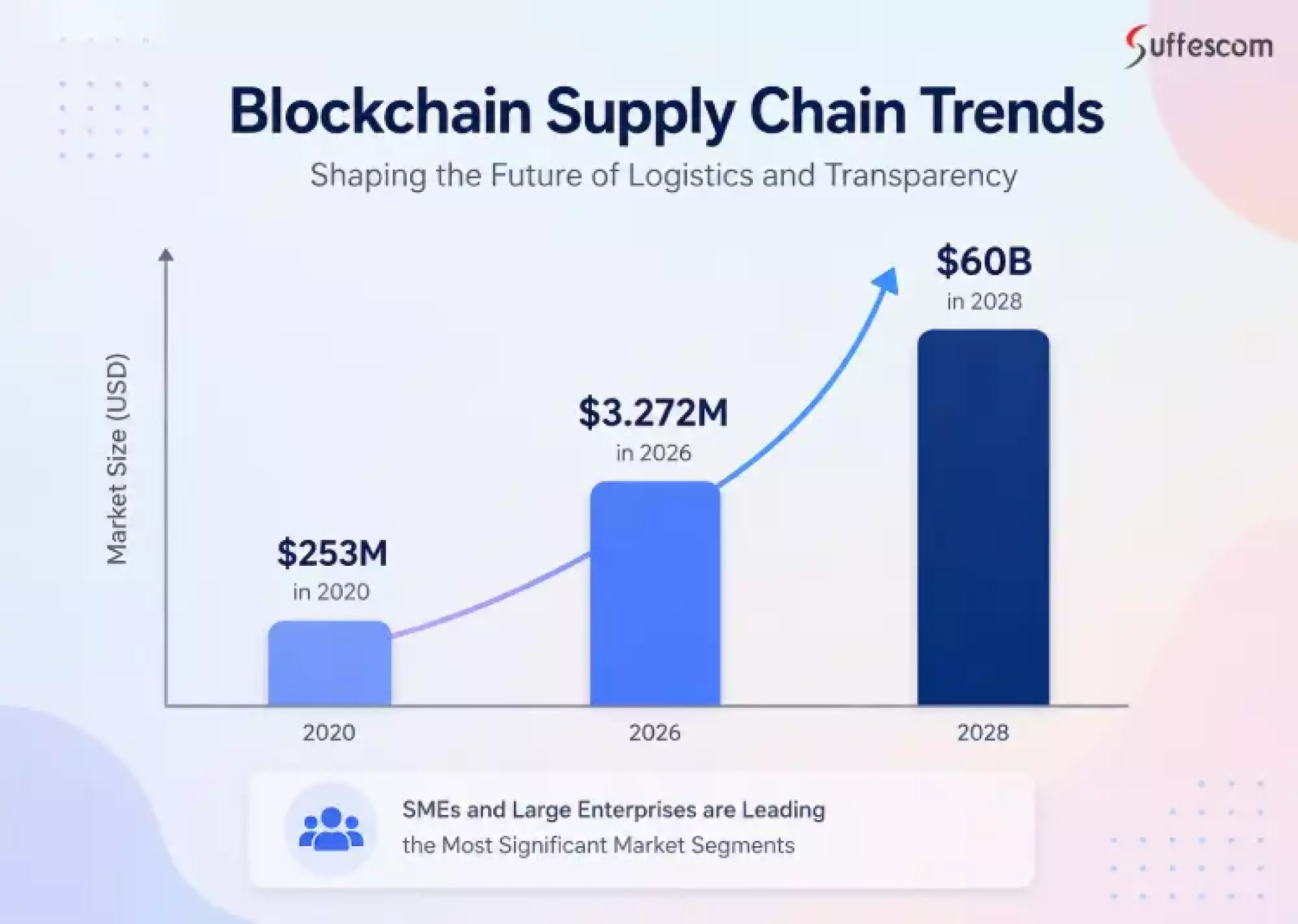
- Blockchain-based supply chain global market reached $253 million in 2020.
- In 2026, it is expected to reach $3.272 million by 2026 at a CAGR of 53.2%
- In terms of revenue, the global blockchain technology market size was valued at around USD 3.3 billion in 2021 and is projected to reach USD 60 billion by 2028.
- Today, small and medium-sized enterprises, as well as large enterprises, are leading the most significant market segments.
How Blockchain Supply Chain Systems Work?
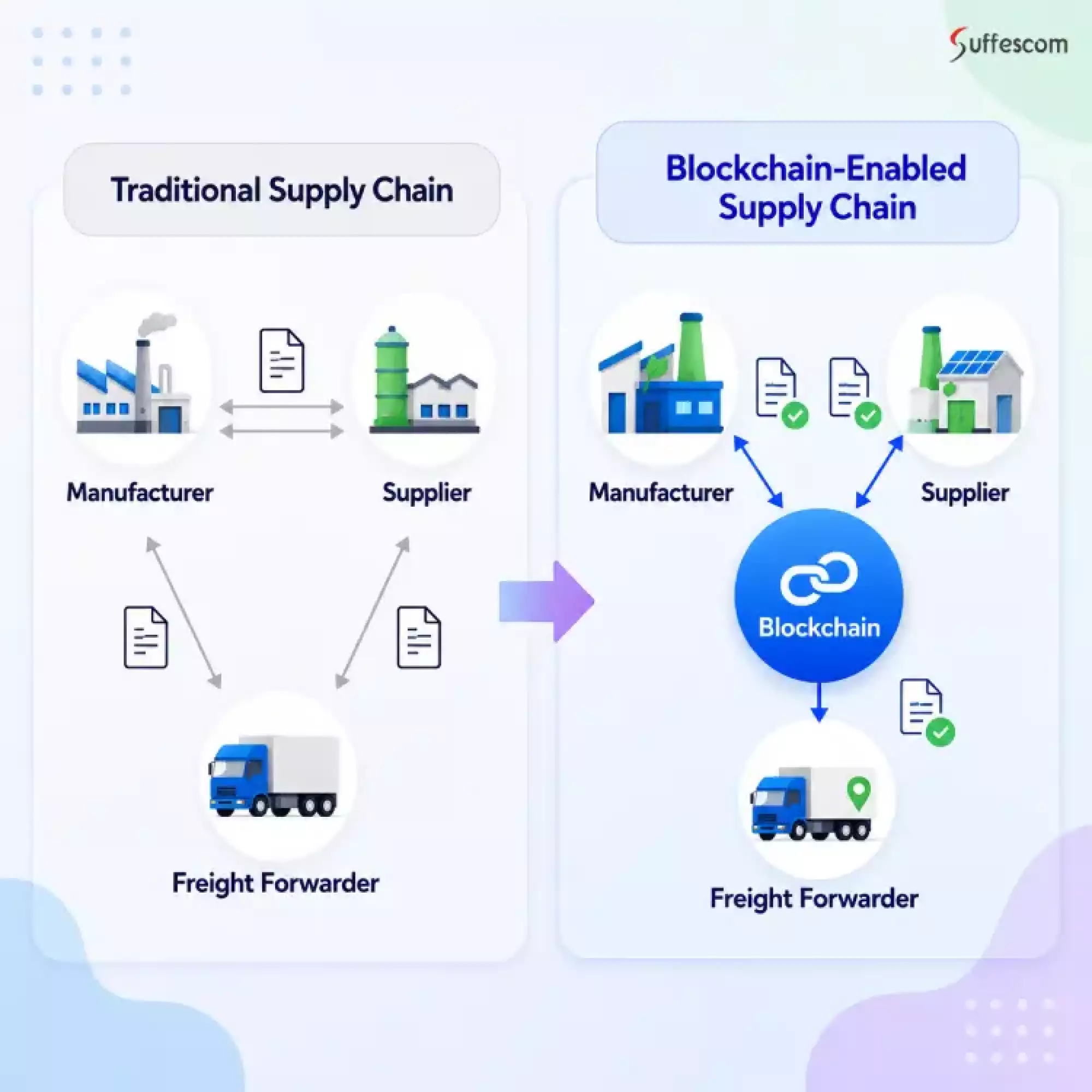
The blockchain-based supply chain system ensures that each product transaction is stored securely and permanently in the blockchain system. This allows the participants in the supply chain, including manufacturers, suppliers, logisticians, and retailers, to have access to up-to-date information at all times.
Distributed Ledger
Each and every transaction made in the process, including shipment notifications and quality verifications, is stored on the distributed ledger across various network users once they are validated. The data is permanent and accessible to relevant stakeholders.
Smart Contracts
Through smart contracts, automated transactions will happen without the involvement of any individual. For instance, transactions will only take place once the delivery is successful or when the storage criteria are violated.
Digital Assets Tracking
Assets in the form of products are given their digital IDs, which are used for storage of important information about the asset.
Permissioned Blockchain
Enterprise-based blockchain solutions rely on permissioned blockchains where only authorized individuals are allowed to access supply chain data.
Why Is Blockchain Revolutionizing Supply Chains in 2026?
Blockchain has become a cornerstone technology of modern supply chains as companies struggle to improve transparency and efficiency of their supply chains while dealing with increasing compliance needs. In 2026, several factors will help boost the use of blockchain in supply chains.
Regulations, Compliance & Transparency
More regulations and compliance measures are being introduced regarding the issues of product traceability and sustainability, and business reports need to be clear about them. Companies will be able to provide verifiable audit trails and maintain immutable records by using blockchain solutions.
Visibility in the Supply Chain
The world experienced multiple major disruptions in 2026 that emphasized the issue of poor visibility in supply chains. Using blockchain technology can increase supply chain visibility and help minimize delays and fraud.
Increased Demands from Consumers & Investors
Consumers will seek assurance from companies that their products were made using ethically sourced materials and sustainably manufactured, while many institutional investors will require transparency in supply chains to ensure ESG standards.
Competitive Advantage in the Long Term
Those who adopt blockchain technology in their supply chains at the moment will have a distinct advantage when compared to competitors due to better data management capabilities.
Perks of Choosing Blockchain For Supply Chain
1. Secure Interactions
Shipment tracking is a significant concern for delivery companies and delivery channels. Everyone wants a safe and reliable source that has the fastest delivery. Blockchain in the supply chain provides permissioned access rights to specific individuals only and helps secure the entire transaction.
2. Fair Trading
Blockchain technology verifies the end-to-end transaction. Everything is recorded in a blockchain that is virtually impossible to counterfeit from the point of origin to the material, manufacturing, and beyond. Hence, it leads to ethical trade that protects human rights.
3. Resilient Supply Chain
Supply chains are restricted by one-up visibility. However, the blockchain supply chain offers a single and shared version of the truth and provides visibility at every step.
4. Improved Customer-Retailer Relationship
The customer is a King. Improving business relationships with customers enhances a company's reputation. Protecting customer data from cybercriminals is a major concern for every business. For this, blockchain technology in the supply chain facilitates smooth transactions.
5. Improved Inventory Management
Whether you choose public or private blockchain technology, both can help you overcome inventory management scenarios. One can quickly find goods in stock, in transit, and with users with one tap.
6. Eliminate Manual Errors And Frauds
When data or records are entered manually, it increases the likelihood of fraud and errors at the time of delivery. Whereas when data is managed digitally with smart contracts, those risks can be minimized easily.
Launch Your Blockchain Supply Chain Today
Build a transparent, secure, and scalable supply chain system with blockchain experts.
Blockchain Development Solutions for Various Supply Chains
Blockchain In Manufacturing Supply Chain
We design and develop blockchain-based supply chains for manufacturing industries that facilitate transparency during the transfer and transformation of raw materials into finished products.
Blockchain In Logistic Supply Chain
Under the logistics supply chain, we ensure secure data protection from storage to the shipment of goods and services, while maintaining high efficiency during transit.
Blockchain In Food Supply Chain
To ensure food quality and safe delivery, we employ the right people to deliver food. It prevents foodborne diseases and contamination, among other benefits.
Blockchain In Agriculture Supply Chain
Our trustworthy blockchain-powered supply chain system ensures a possible way to track the time of production to delivery that generates trust between different players and keeps them updated on the crop status.
Blockchain In Pharmaceutical Supply Chain
It ensures a safe and reliable system through which prescription medicines are manufactured and delivered to patients.
Industry-Specific Applications
Food and Beverage
Food safety is the most prominent blockchain application within supply chains, and evidence on the benefits is plentiful. In addition to the use case highlighted with the Walmart and IBM partnership, blockchain allows fast identification of batches during recall situations; temperature excursion alerts for temperature-sensitive goods; end-customer provenance scanning; and certification validation of goods bearing organic, fair trade, and sustainable labels.
The value of blockchain in the agriculture and food supply chain market is estimated at $1.32 billion in 2025 and forecast to reach $27.22 billion by 2035 at a CAGR of 35.5%.
Pharmaceutical and Healthcare
There are several distinct characteristics of pharmaceutical supply chains: requirement of cold chain management, need to serialize goods across jurisdictions to comply with regulations, vulnerability of high-value goods to theft and counterfeiting, and risks that arise due to potential failures in the supply chain itself. These issues are resolved using blockchain by maintaining a record of temperatures in the cold chain, serializing products in line with regulatory requirements, identifying any counterfeits in every transaction along the way, and generating necessary documentation for customs and other regulatory bodies.
Manufacturing and Automotive
Highly complex manufacturing involving the production of automobiles, aircraft parts, and industrial machines requires many hundreds of suppliers through multiple tiers. The advantage of Blockchain is tier-1, tier-2 and tier-3 supplier traceability that standard ERP does not offer. In case there is a need for a recall of an affected component, the Blockchain technology allows identifying all vehicles or machinery in which a faulty component was installed, in addition to tracking locations of all those installations within seconds, something not feasible with traditional ERP.
The average annual cost for automotive companies in terms of recalls is about $22 billion. This technology will help in reducing the number and duration of recall events significantly.
Luxury Goods and Fashion
The issue of counterfeit luxury goods is estimated to cost businesses and consumers in excess of billions of dollars worldwide. The Blockchain technology will provide the means to track each and every item produced by a brand and thereby enable instant verification at point of sale. Additionally, Blockchain helps brands to verify ethical sourcing of their products.
Logistics and Freight
Companies including FedEx and UPS are exploring blockchain to expand their offerings and enhance transparency in shipping and delivery processes. For sensitive materials such as medications, blockchain allows for faster, more secure monitoring compared with traditional processes, ensuring items were kept at correct temperatures and not substituted with counterfeit goods.
Oil, Gas, and Energy
Energy supply chains involve complex multi-party contracts, high-value commodity transfers, and extensive regulatory compliance requirements across jurisdictions. Blockchain enables automated smart contract settlement for commodity transactions, transparent tracking of energy credits and certificates, and immutable audit trails for environmental compliance reporting.
Blockchain Network Types for Supply Chain
The choice of blockchain network type is one of the most consequential early architectural decisions in any supply chain implementation.
| Network Type | Access Model | Governance | Best For | Example Platforms |
| Private Blockchain | Single organisation controls | Centralized | Internal supply chain tracking; proprietary data | Hyperledger Fabric (private deployment) |
| Consortium / Permissioned | Multiple known organisations | Shared governance | Industry-wide supply chain networks | Hyperledger Fabric, R3 Corda, Quorum |
| Public Blockchain | Open participation | Decentralized | Consumer-facing provenance verification; token-based supply chain | Ethereum, Polygon, VeChain |
| Hybrid | Permissioned core + public verification layer | Split governance | Enterprise data privacy + public auditability | Polygon CDK, Hyperledger Besu |
Core Functionalities of Blockchain Supply Chain Platform
Product and Asset Tracking Feature
Complete lifecycle tracking of products, starting from raw materials until the end user. Incorporating barcode/RFID/QR scanning capabilities. Location tracking and custody information of all assets in the network.
Smart Contract Module
A library containing templates of common smart contracts, including purchase order, delivery confirmation, quality certification, and release of funds. Ability to create custom contracts for intricate business processes. Trigger/notification mechanism for smart contract event handling.
IoT Connectivity Framework
API integration with industrial IoT devices, such as temperature, humidity, GPS, and weight sensors. Automatic recording of data in a blockchain ledger. Automated notifications for threshold breaches.
Supply Chain Partner Portal
Participant onboarding process for integrating supply chain participants. Management of certification documents and other required information. Access controls depending upon participant roles and permissions.
Real-Time Dashboard and Analytics
Integrated dashboard for viewing real-time asset tracking information, shipments in transit and alerts. Historical database querying and audit trail capabilities. Performance analytics of suppliers, delivery, and quality analysis.
User-facing Provenance Interface
Mobile-friendly interface to scan QR or NFC codes for end customers. Journey map highlighting product origins, processing steps, and distribution phases. Display of certifications regarding organic produce, ethical sourcing, and sustainable production.
Regulatory Compliance and Reporting Module
Automatic generation of reports for submission to various regulators. Exportable audit-ready data for compliance with regulations regarding customs, food safety, pharmaceuticals, and environmental, social, and governance reporting. Jurisdictional reporting templates that can be customized according to regulatory needs.
ERP Integration
API-based integration with SAP, Oracle, Microsoft Dynamics, and bespoke ERP systems. Data transformation middleware for legacy system data and blockchain data structure. Real-time change data capture from legacy systems into the blockchain layer.
Build Your Own Blockchain Supply Chain Platform With Us
Looking for a blockchain supply chain development company, then no look further than Suffescom Solutions Inc. Our expert team will help you build a blockchain supply chain platform according to your needs.
Our Custom Blockchain Supply Chain Development Services Include
Our experts have proven experience in leveraging the combination of blockchain technology, AI, IoT, and machine learning to benefit every enterprise. Our system introduces transparency, reliability, and trust to every transaction & participant.
Audit
We introduce a logistic process system that helps identify reasons, actions, and reactions within your system.
Define Touchpoints
We aim to touch every segment of your business that helps you to flourish and sets benchmarks in existing infrastructure.
In-depth Technical Evaluation
Before delivering a project, our experts conduct an in-depth technical evaluation of your system by accessing different supply chain information nodes.
Blockchain Setup
We ensure a comprehensive set of mechanisms that govern users' permissions to view and write information, as well as conduct transactions, in blockchain technology.
Device Programming
As the key players of the Supply chain management system are devices, we build an effective tracking and tracing system for clients.
Serialization
We ensure every transaction recorded in the system involves non-sequential, non-repeatable, and unique data for effective tracking.
Ensuring The Fast Speed
Using multiple blockchain networks, we ensure the fastest transaction speed on your system.
Organizing The Identification Process
We incorporate QR Codes, 2D barcodes, and NFC or RFID systems for quick identification of processes.
Scalability
Our blockchain developers ensure that proper cloud infrastructure is set up for smooth functioning.
Technology Stack for Blockchain Supply Chain Development
| Layer | Technology | Supply Chain Rationale |
| Blockchain Platform | Hyperledger Fabric | Industry standard for enterprise permissioned networks, channels enable data privacy between competitors |
| Alternative Blockchain | VeChain, Polygon (PoS), Ethereum | VeChain for IoT-native, Polygon for token-based consumer provenance, and Ethereum for maximum security |
| Smart Contracts | Solidity (EVM chains), Go / Node.js chaincode (Hyperledger) | Go chaincode preferred for Hyperledger for performance and type safety |
| Backend | Node.js / Go + Fabric SDK | High-throughput API layer for supply chain event processing |
| IoT Integration | MQTT, REST APIs, Azure IoT Hub / AWS IoT Core | Standard industrial IoT protocols for sensor connectivity |
| ERP Integration | SAP Integration Suite, MuleSoft, custom REST APIs | Middleware for legacy system data translation |
| Frontend | React.js / Next.js | Supply chain operator dashboards and supplier portals |
| Mobile | React Native / Flutter | Field scanning apps for warehouse and logistics personnel |
| Consumer Interface | React.js PWA with QR/NFC | Consumer-facing provenance verification, mobile-optimised |
| Database | PostgreSQL (off-chain), CouchDB (Hyperledger world state) | Off-chain data for analytics; on-chain for authoritative records |
| Cloud Infrastructure | AWS / Azure + Kubernetes | Multi-region deployment; auto-scaling for peak event processing |
| Monitoring | Prometheus, Grafana, Hyperledger Explorer | Blockchain network health; transaction throughput monitoring |
A Step-by-Step Blockchain Supply Chain Development Process
Phase 1 – Business Analysis & Use Case Scoping (3-4 weeks)
Describe the existing workflows within your supply chain. Identify those areas that are both highly valuable and problematic. These could include problems with tracing products, fraud, late payments, costs related to regulatory compliance, etc. Decide on which specific blockchain applications you will implement in the scope of the first blockchain project.
Phase 2 – Regulatory & Compliance Scoping (2-3 weeks)
Learn about regulatory requirements in all target markets. They might include such things as food safety, pharmaceutical product serialization, customs/trade compliance, Environmental Social & Governance (ESG) reporting, etc. Set out the parameters for implementing the smart contracts according to regulatory requirements. Consult with specialists in legal aspects of blockchain technology and supply chains.
Phase 3 – Blockchain Network Architecture Design (3-4 weeks)
Choose the blockchain platform (most enterprise use cases leverage Hyperledger Fabric). Structure participants and design a governance model. Design channel architecture for secure data transfer between participants. Design an integration architecture for ERPs and IoT devices. Decide on consensus and endorsement policies.
Phase 4 – Smart Contracts Development (4-8 weeks)
Develop chaincode (Hyperledger) or Solidity contracts (EVM chains) for each supply chain workflow. Build contract templates for standard transaction types. Implement automated trigger and notification logic. Comprehensive unit testing against supply chain edge cases.
Phase 5 — Platform Development (8–16 weeks)
Build operator dashboards, supplier portals, and consumer-facing provenance interfaces. Develop IoT integration middleware. Build an ERP integration layer for SAP/Oracle/custom systems. Implement barcode, RFID, and QR scanning integration for field operations.
Phase 6 – Network Participant Onboarding Infrastructure (3-4 weeks)
Construct participant registration and credentialing processes. Generate onboarding materials and documentation. Create a sandbox network for participants’ testing purposes before mainnet launch.
Phase 7 – Security Testing and Auditing (3-4 weeks)
Independent audit of smart contracts' security. Testing of web and API interfaces. Security testing of chaincode. Verification of data privacy throughout participant channels.
Phase 8 – Pilot Launch and Participant Onboarding (4-8 weeks)
Launch a production pilot with a limited number of supply chain participants. Assess network efficiency, receive participant feedback, and address any integration issues.
Phase 9 – Production Rollout and Scale-Out
Scale participant onboarding for the entire supply chain. Implement production monitoring and incident response strategies. Create a governance framework for ongoing network management.
Blockchain Supply Chain Development Cost in 2026
Cost varies significantly based on the scope of the supply chain being addressed, the number of participants to be onboarded, the depth of IoT integration required, and whether the deployment begins with a focused pilot or attempts enterprise-wide rollout from day one.
| Project Scope | Estimated Cost | Timeline | What It Covers |
| Proof of Concept / Pilot | $20,000 – $50,000 | 8 – 14 weeks | Single use case, 2–5 participants, limited IoT integration |
| Mid-Tier Platform | $50,000 – $100,000 | 4 – 8 months | Multiple use cases, 10–30 participants, ERP integration, smart contracts |
| Enterprise Platform | $100,000 – $150,000 | 6 – 12 months | Full feature set, 50+ participants, IoT integration, multi-jurisdiction compliance |
| Large-Scale Network | $150,000 – $300,000+ | 12 – 24 months | Industry-wide network, 100+ participants, custom consensus, AI integration |
Budget Allocation by Development Component
| Component | % of Budget | Scope |
| Blockchain Architecture and Network Setup | ~15% | Platform selection, network design, governance, node infrastructure |
| Smart Contract Development and Audit | ~25% | Chaincode / Solidity, business logic, security audit |
| Backend Development and ERP Integration | ~20% | API layer, middleware, legacy system connectivity |
| Frontend and Portal Development | ~15% | Operator dashboard, supplier portal, consumer interface |
| IoT Integration | ~10% | Sensor connectivity middleware, data pipeline, threshold alerting |
| Security Testing and Compliance | ~10% | Penetration testing, regulatory review, privacy verification |
| Participant Onboarding and Training | ~5% | Documentation, training, sandbox environment |
Build Your Blockchain Supply Chain Solution
Get a technical specification and cost estimate from Suffescom's supply chain blockchain team within 48 hours.
Why Build Your Blockchain Supply Chain Platform with Suffescom?
Suffescom Solutions is a blockchain development firm with over 13 years of software development experience and a specialist blockchain team with deep expertise in Hyperledger Fabric, EVM-compatible smart contracts, IoT integration, and enterprise ERP connectivity.
Our blockchain supply chain practice covers use case definition and ROI analysis, network architecture design, Hyperledger Fabric and EVM smart contract development, IoT middleware engineering, SAP and Oracle ERP integration, security auditing, participant onboarding, and post-launch network management.
We work with manufacturers, logistics providers, food and beverage producers, pharmaceutical distributors, and retailers who need blockchain solutions that integrate with their existing technology infrastructure — not replace it.
Partnership With World-class Companies
Our blockchain expertise is proven by our clients' portfolios, including Universal, The Mario Blockchain, My Rare Collections, and more that trust our services.
50+ Blockchain Projects Delivered
With a team of 750 global employees, we have delivered 50+ blockchain-based projects. You can check out our case studies to learn more about us and our working style.
Supply Chain Tech Gurus
We build a comprehensive network with complex GPS, LPWAN, RFID, and other transmitting devices to form a high-speed supply chain system.
Solution for every sector/industry
We have the expertise to craft solutions for every sector and industry, such as startups, NGOs, government organizations, and mid-scale enterprises.
FAQs
1. How does blockchain improve supply chain transparency?
Blockchain enables creating an immutable, shared ledger of transactions that occurs throughout the whole supply chain cycle. Blockchain technology will enable businesses to trace products' origin, shipping, and other transaction details.
2. Is blockchain suitable for small and medium-sized businesses?
Of course! With the rise of scalable blockchain solutions, companies can improve operational efficiency, reduce the risk of human error, decrease security threats and earn more customers' trust.
3. What is the cost of developing a blockchain supply chain solution?
Depending on requirements, the price might vary. In general, a simple solution may be developed for around $40k, while an advanced solution may cost $300,000k or even more.
4. Can blockchain be used to track perishable goods?
With blockchain and the Internet of Things (IoT), it will become possible to trace perishable products – whether it's food, pharmaceuticals, agricultural products and many others. Temperature and environment monitoring, expiration date management and much more can be done using blockchain.
5. Which industries benefit the most from blockchain supply chain solutions?
Industries that rely on traceability, compliance, and product authenticity benefit the most. This includes manufacturing, logistics, agriculture, food and beverage, pharmaceuticals, retail, and healthcare, where secure data sharing and transparency are critical.
6. What are the main advantages of using blockchain for managing the supply chain?
Blockchain increases transparency in supply chains, improves traceability, minimizes fraud and increases security due to unchangeable recording. Blockchain also allows organizations to optimize processes, collaborate better and build more trust between customers.
7. In what way can blockchain decrease supply chain fraud?
As all transactions are recorded in an unalterable way in a blockchain database, it becomes harder for business organizations to change the data or commit fraudulent activities related to supply chain management.
8. Is it possible to use blockchain in existing supply chain systems?
Yes, blockchain can easily be integrated into such systems as ERP, warehouse management and logistics. Businesses can utilize blockchain together with other technologies such as IoT and AI.
9. How long will it take me to develop a blockchain supply chain platform?
It largely depends on project specifications and how many systems should be integrated into it. A simple blockchain-based supply chain can be developed within 3-6 months, whereas a complex platform may take up to a year and a half.