+971-8000321216



Key takeaways:
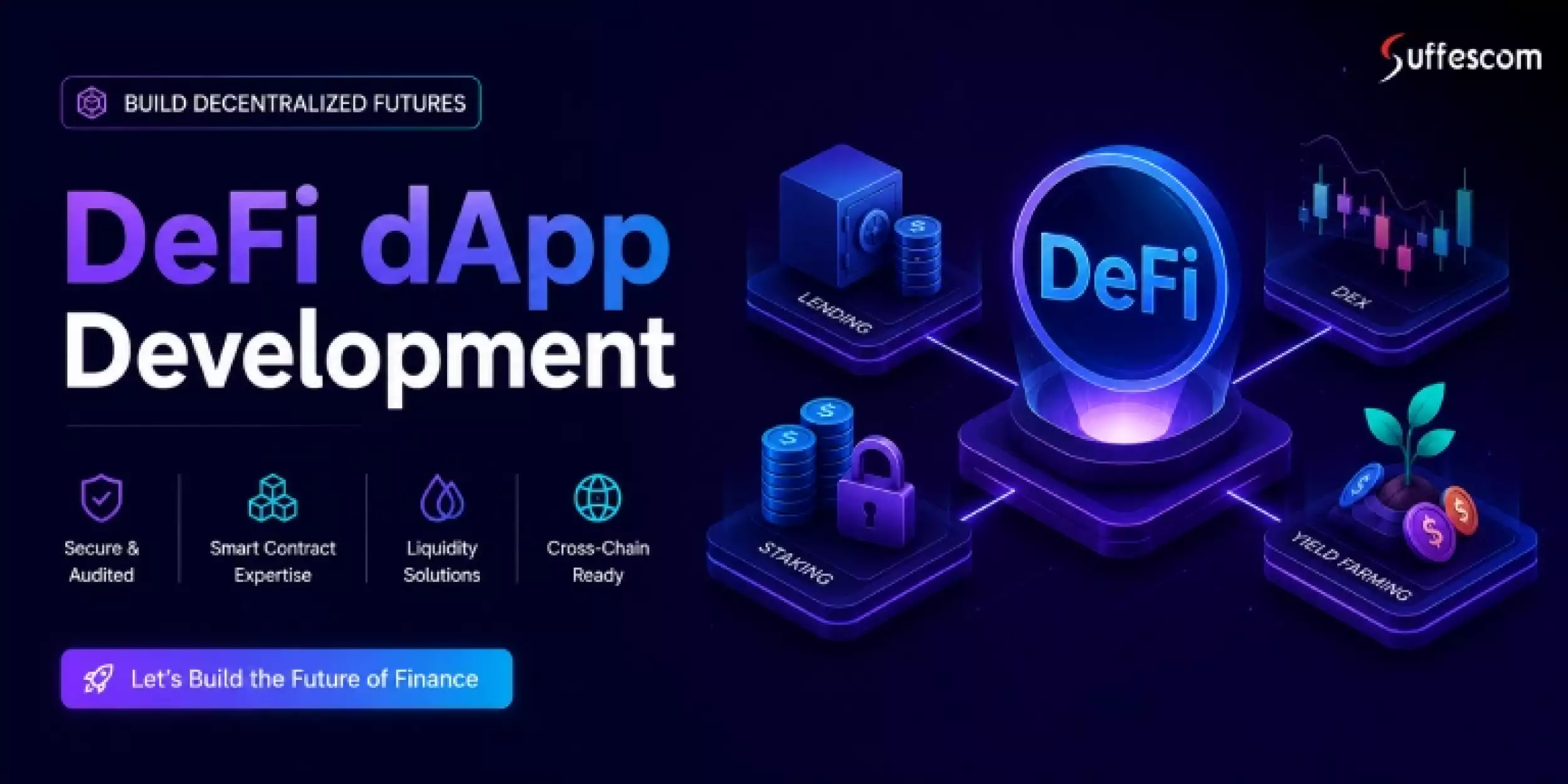
- DeFi dApp development builds financial applications on a blockchain that run through smart contracts instead of a bank or broker.
- What you can build: DEXs, lending and borrowing platforms, DeFi wallets, staking and yield platforms, DAOs, and custom protocols.
- Where it runs: Ethereum, Solana, BNB Chain, and Polygon are the primary supported networks, each with different tradeoffs on cost, speed, and ecosystem depth.
- What it costs: starts at $15,000 for a single-feature MVP on one chain, $25,000 to $60,000 for a full-featured launch, $75,000 and up for cross-chain or DAO-governed builds.
- What it takes: nine stages, from market research and tokenomics through smart contract development, security audit, testnet QA, and mainnet launch.
- What to watch for: unclear token utility, no compliance strategy, no liquidity plan, and underestimating audit time are the most common reasons DeFi launches fail or get exploited early.
Want similar results? → Get a Free Quote
DeFi dApp development is the process of building decentralized finance applications that run on a blockchain and use smart contracts to automate financial services like lending, borrowing, trading, and yield generation without a bank or broker in between. The core steps are choosing a blockchain network, writing and auditing the smart contracts, building the user-facing interface, and connecting it to crypto wallets. Suffescom Solutions builds these dApps end to end: DEXs, lending and borrowing platforms, DeFi wallets, staking and yield platforms, and custom protocols, on Ethereum, Solana, BNB Chain, and Polygon.
Why build a DeFi dApp?
If you're a founder validating a new product idea: DeFi dApps let you launch a financial product, a lending pool, an exchange, a yield platform, without the licensing overhead of a traditional financial institution. The tradeoff is that smart contract risk replaces regulatory risk, you're responsible for the code being correct, not just the paperwork being filed.
If you're an enterprise adding a DeFi feature to an existing product: the appeal is usually transparency and automation. Every transaction is auditable on-chain, and smart contracts remove manual reconciliation. This works best when you already have a user base and are extending trust you've already earned, not building trust from zero.
If you're evaluating DeFi as an investment thesis, not a builder: understanding how dApps work will tell you more about a protocol's actual risk than its marketing ever will. Worth reading before you evaluate any specific project.
Whichever occasion applies, the core advantages driving DeFi dApp adoption are:
- Security through architecture: funds and data are distributed across nodes, not held in one central, hackable location.
- Transparency: every transaction is on a public ledger, anyone can verify it.
- Automation: smart contracts execute exactly as written, with no manual processing delay or error.
- Global accessibility: no geographic restriction, no credit check, no gatekeeper.
Types of DeFi dApps, and which one fits your goal
| Type | What it does | Best for |
| Decentralized exchange (DEX) | Peer-to-peer token trading via automated market makers, no order book or intermediary | Founders building a trading venue or adding swap functionality to an existing protocol |
| Lending and borrowing platform | Users lend crypto for interest or borrow against collateral | Teams with a clear liquidation model and risk framework already scoped |
| Yield aggregator | Automatically moves funds across protocols to maximize returns | Projects targeting yield-focused users rather than active traders |
| DeFi wallet | Secure storage with direct DeFi protocol access | Any DeFi product that needs its own branded entry point instead of relying on MetaMask or similar |
| Staking platform | Lets users lock tokens for rewards while preserving some liquidity | Protocols that need to reduce token sell pressure and build long-term holders |
| DAO | Community governance over protocol decisions | Projects ready to decentralize control, not a starting point for a new protocol |
| Prediction market | Users bet on real-world event outcomes in a decentralized way | Niche, high-engagement communities, not a general-purpose first product |
Our recommendation: if this is your first DeFi build, start narrow. A single-purpose DEX, lending platform, or wallet is easier to audit, easier to secure, and easier to explain to early users than a multi-feature protocol launched all at once. Expand into staking, DAO governance, or cross-chain support once the core product has live users and a security track record
Unlock Financial Innovation with Our Expert DeFi dApp Development Services.
Drive decentralized growth with our enterprise-grade DeFi dApp development services - secure smart contracts, scalable architecture, seamless integrations, and compliance-ready solutions tailored for U.S. businesses.
Real-world DeFi dApp examples
MakerDAO is a lending dApp that lets users get loans without a third party, using collateralized debt position (CDP) contracts. Its native stablecoin, DAI, is pegged to the US dollar to reduce volatility, an example of the lending and borrowing category above.
Uniswap is a decentralized exchange that lets users swap, trade, and invest in ERC-20 tokens directly with each other. Users also pool assets into liquidity pools, earning yield from the trades that pass through them, the DEX category in practice.
Synthetix allows users to create and trade synthetic assets, tokenized versions of real-world assets like stocks or commodities, without owning the underlying asset. This sits closer to the derivatives end of the DeFi spectrum, not covered as its own row above but a useful reference point for how far the category can extend.
Aave is a lending protocol known for introducing flash loans, uncollateralized loans that must be borrowed and repaid within a single transaction, a mechanism unique to DeFi's programmable nature and impossible in traditional finance.
These examples matter for one reason: every one of them succeeded by doing one thing well before expanding. MakerDAO didn't launch with governance, insurance, and cross-chain support on day one. That's the same logic behind the "start narrow" recommendation above.
How does a DeFi dApp work?
A DeFi dApp is built on four layers working together:
Consensus mechanism: instead of a central server approving transactions, a network of independent computers (nodes) validates each transaction. Once enough nodes agree a transaction is valid, it's confirmed, no central database required. Most networks use proof-of-stake (PoS), where nodes validate transactions based on the amount of cryptocurrency they've staked, or older proof-of-work (PoW) systems.
Smart contracts: these are self-executing programs that run the actual financial logic, a loan, a swap, a stake, written in a language like Solidity (for Ethereum and EVM-compatible chains) or Rust (for Solana). Once deployed, a smart contract executes automatically whenever its conditions are met, without anyone needing to approve it manually.
Open-source architecture: most dApps are open-source, meaning anyone can audit the code and verify it does what it claims. This is the opposite of a traditional app, where users have to trust a company's internal security without being able to check it themselves.
Frontend interface: the part users actually interact with, built with frameworks like React or Next.js and connected to the blockchain and to crypto wallets (MetaMask, Phantom, and others) through libraries like Ethers.js. This layer determines whether a technically sound dApp is actually usable, most DeFi failures at the user level trace back to a confusing frontend, not a broken contract.
How to Build a Defi Dapp: Step by Step
1. Market Research
Confirm the gap you're filling, not just the demand for DeFi in general. What's already solved, and what specific problem is still unaddressed?
2. Tokenomics and Protocol Architecture
Define the economic model (how value flows, what the token does, what happens at liquidation or default) alongside the technical architecture. These two decisions are inseparable, get them wrong together and no amount of good code fixes it later.
3. UI/UX Design
Design the wallet connection flow and core transaction screens before writing contract code. A frontend bolted on at the end is how most onboarding friction gets baked in.
4. Smart Contract Development
Write the core logic in Solidity or Rust, using tools like Hardhat or Remix for development and local testing.
5. Security Audit
Internal review plus a third-party audit before any real funds touch the contract. This is not optional for anything handling user funds, and it typically takes weeks, not days.
6. Frontend Integration
Connect the audited contracts to the live interface and to wallets.
7. Testnet Deployment and QA
Run the full dApp in a simulated environment first. Bugs found here cost time. Bugs found after mainnet launch cost user funds.
8. Mainnet Launch
Deploy to the live network.
9. Maintenance and Monitoring
DeFi dApps are live financial systems. Ongoing monitoring, updates, and incident response don't stop at launch, they start there.
Which blockchain should you build on?
Ethereum
The most established DeFi ecosystem, with the deepest liquidity and the widest developer tooling through the EVM (Ethereum Virtual Machine). The strongest choice if composability with existing protocols like Aave or Compound matters to your product.
Solana
Built for speed. High throughput and low transaction fees make it a fit for high-frequency trading dApps and consumer products where cost per transaction matters. Requires Rust rather than Solidity, a real consideration for hiring and timeline.
BNB Chain
EVM-compatible with lower gas costs than Ethereum, a practical middle ground for projects prioritizing user cost over maximum ecosystem depth.
Polygon
Ethereum-compatible with Layer-2 scaling, letting you access Ethereum's ecosystem without paying Ethereum's gas fees, a common choice for teams migrating an existing Ethereum idea to something cheaper to run.
There's no universally "best" chain, the right one depends on your target users, required transaction speed, and existing team skill set. If your team already knows Solidity, defaulting to an EVM-compatible chain (Ethereum, BNB Chain, or Polygon) avoids an unnecessary language switch.
Our DeFi dApp Development Services
Divided into three categories: core, infrastructural, and end-to-end support services, there are major DeFi dApp development services as follows:
1. Core DeFi dApp Development Services
These are the essential services without whose presence the dApp's functionality reduces to nil. Let's dive!
a. DeFi Smart Contract Development
A smart contract is a keystone in the blockchain network. These services write the core logic of the DeFi apps using programming languages such as Solidity for Ethereum or Rust for Solana.
Our professionals develop smart contracts to automate processes and increase transparency and trust amongst dApps. We implement best practices for contract creation, auditing, testing, and deployment for decentralized transactions, higher automation, and transparency.
b. Decentralized Exchange (DEX) Development
Decentralized exchanges are platforms where cryptocurrencies are traded. We build a platform that smooths the crypto exchange for 24/7 trading with high security. Our decentralized exchange (DEX) development services include token swapping, liquidity pools, trading dashboards, and AMM integration.
c. DeFi Wallet Development
DeFi wallets make storage, transfer, and receipt of crypto assets as smooth as possible with DeFi protocols. DeFi acts as a gateway for the DeFi system, useful for funds management and seamless interaction.
Our DeFi wallet development services include implementing multi-chain support, private key encryption, DeFi protocol integration, and QR scanning.
d. DeFi Lending and Borrowing Platform Development
Using these platforms, the users can lend their assets and earn interest or borrow funds against collateral. In case the collateral's value falls down below a specific value, then the smart contract automatically manages the deposit and liquidation processes.
DeFi lending and borrowing platform development offers automated borrowing and lending services to provide passive income for lenders.
e. DeFi Yield Farming and Staking Platform Development
Users stake tokens and earn rewards using DeFi yield farming and staking platforms. These platforms incentivize liquidity, enabling users to earn rewards in the form of additional tokens. With a due focus on pool creation, reward distribution, gas optimization, and APY dashboards, our team creates the best yield farming and staking platforms.
f. DeFi Token Development
We develop smart contracts that further define digital tokens, representing digital currencies, rewards, and governance rights within the ecosystem. Tokens are a means of exchange for various purposes, including payment remittance, rewards, and rights.
2. App Infrastructure & Ecosystem Services
These services are responsible for developing a robust app infrastructure and ecosystem to increase the competency of the DeFi dApp.
a. Cross-Chain DeFi dApp Development
Cross-chain DeFi applications enable interactions between different blockchains. They often use bridges or interoperability protocols to move assets or data from one blockchain to another, widening the scope of functionality and liquidity.
Cross-chain app development increases the customer base by ensuring functionality across different platforms and better asset accessibility.
b. DAO Development Services
Decentralized Autonomous Organization, or DAO development utilizes the potential of smart contracts to implement collective decision-making. DAOs allow communities to govern projects and manage funds without the presence of a central authority, thus ensuring democratic decisions.
Since it is a crucial component, various tech stacks come into the picture to implement DAOs. Such tech stacks include:
- Smart Contract Languages: Rust or Solidity
- Tools: Snapshot, Aragon, DAO stack for governance frameworks
- Frontend: Web interfaces built with React.js or similar frameworks, connected to blockchain nodes
c. DeFi Insurance Platform Development
DeFi insurance platforms collect user funds to cover potential losses from smart contract failures or hacks. Smart contracts determine the payout amounts based on predefined conditions, ensuring a swift and fair claims process.
They minimize participants' financial risk by offering protection against losses, increasing trust and attracting more users to the DeFi ecosystem.
d. DeFi NFT Integration Services
NFT integration with DeFi adds supreme functionality by incorporating non-fungible tokens into the financial services. Web3 tools for connectivity play a crucial role in creating provisions for the users to use NFTs as collateral and unique staked assets to earn rewards.
NFT integration brings out new applications such as NFT-based lending, yield generation on NFT assets, and fractional ownership of high-value digital items.
3. End-to-End Support Services
Support services aim to ensure that the application runs in the smoothest manner possible.
a. Blockchain Consulting for DeFi
Get the best blockchain consulting for DeFi to plan DeFi projects for ideal use cases, tokenomics, technical requirements, and the overall roadmap. Our consulting services are a foolproof blueprint for launching a leading DeFi product.
How does our consultancy help? It assists businesses in navigating DeFi complexities, setting and implementing robust technical and economic foundations, mitigating failure risks, and increasing chances of success.
b. DeFi Auditing
Our testing team thoroughly reviews code to find security vulnerabilities, bugs, or deviations from best practices, using automated tools and manual reviews to ensure that contracts perform as intended. Effective auditing practices reduce the risk of hacks or exploits that could lead to significant financial losses.
c. DeFi Maintenance and Upgrades
Constant monitoring is essential to fix bugs, update protocols, and add new features. The maintenance and upgrade services include technical support, regular updates, and performance optimization to keep the app secure and efficient.
Regular maintenance and updates ensure seamless technical support, regular updates, and performance optimization to keep the app secure and efficient.
DeFi dApp Development Services Like No Other!
End your search for the best in class DeFi dApp development services company at Suffescom Solutions. Decentralize everything and acquire a higher customer base with our industry-oriented solutions.
How Much Does a Defi Dapp Cost?
| Tier | Starting price | What's included |
| MVP / single feature | $15,000 | One core feature (a DEX, lending pool, or wallet), one blockchain, tokenomics scoped, smart contract development, testnet-ready build |
| Full-featured launch | $25,000 to $60,000 | Multiple features, mainnet security audit, production frontend and wallet integration, QA |
| Enterprise / cross-chain | $75,000 and up, custom quote | Cross-chain support, DAO governance, custom oracle integration, algorithmic tokenomics |
When not to build a DeFi dApp
No Clear Token Utility
If your token doesn't do anything beyond serve as a fundraising mechanism, both regulators and users will notice. Governance rights, fee discounts, staking utility, name the actual function before you build.
No Compliance Strategy
DeFi doesn't mean unregulated. Depending on your jurisdiction and user base, frameworks like MiCA in the EU or FATF's travel rule guidance may apply. Build this into scope from day one, not as a retrofit.
No Liquidity Plan
A DEX or lending platform with no liquidity is a smart contract nobody uses. Know where your initial liquidity comes from before development starts.
Underestimating Audit Cost and Timeline
A real security audit takes weeks, and a serious one isn't cheap. Budgeting for a demo instead of an audited product is the most common reason DeFi launches get exploited in their first month.
Blockchain Limitations That Don't Fit Your Use Case
Most blockchains are non-scalable in practice, transaction speed degrades as user count grows, and energy or gas costs can outpace a traditional app's equivalent operating cost. If your product needs instant, high-volume transactions at near-zero cost, confirm your chosen chain can actually deliver that before committing.
Conclusion
DeFi dApps offer higher control and reduce fraud risks, making them a better alternative to traditional applications. dApps have been a central point of discussion and development within the blockchain community, mainly due to the numerous advantages they present over traditional centralized applications.
In these gradual advancements, Suffescom Solutions has been at the forefront as a reliable DeFi development company. We are committed to delivering end-to-end blockchain, token creation, and decentralized application development solutions.
To get the best results, it is important to connect with a reliable dApp development services company. Conduct comprehensive research and then make a final choice.
FAQs
1. What is a DeFi dApp?
A DeFi dApp is a financial application built on a blockchain that uses smart contracts to automate services like lending, borrowing, and trading without a bank or broker in the middle.
2. How do I create a DeFi dApp?
Start with market research to confirm the gap you're filling, then define tokenomics and architecture, design the UI, build and audit the smart contracts, and launch on testnet before mainnet.
3. How much does it cost to build a DeFi dApp?
Costs start around $15,000 for a single-feature MVP, $25,000 to $60,000 for a full-featured launch, and $75,000 and up for cross-chain or DAO-governed builds.
4. Which blockchain is best for a DeFi dApp?
Ethereum offers the deepest liquidity and ecosystem, Solana offers speed and lower fees, and BNB Chain or Polygon offer lower cost with EVM compatibility. The right choice depends on your target users and required transaction speed.
5. What's the difference between a dApp and a regular app?
A regular app relies on a central server controlled by one company. A dApp runs on a blockchain, with no single party controlling the data or the rules, and every transaction is publicly verifiable.