Suffescom is an IT and software engineering company providing ongoing expert website maintenance services for businesses to keep digital platforms secure, reliable, and optimized. With 13+ years of experience, 500+ digital products delivered, and 250+ in-house technology experts, we bring web development, QA, DevOps, and infrastructure expertise to every maintenance engagement.
Our teams support WordPress, Drupal, PHP, React, Node.js, databases, APIs, cloud environments, and third-party integrations, handling everything from routine updates and bug fixes to performance improvements and complex technical issues.
From high-traffic commerce environments to content-heavy business websites and integration-dependent platforms,
our maintenance work focuses on the technical issues that affect day-to-day operations, customer experience, and revenue.
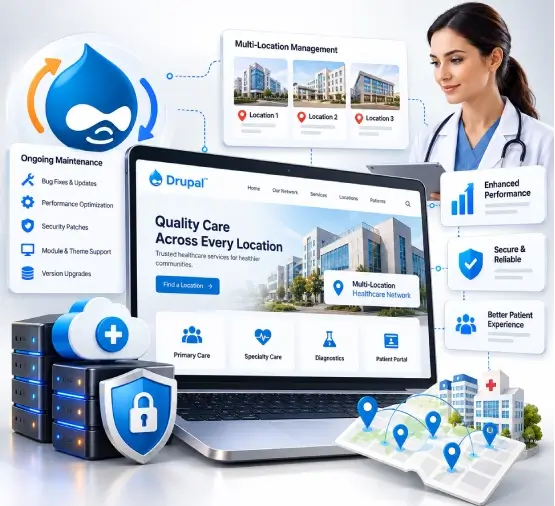
Business Requirements: A US healthcare network operating across 40+ locations needed ongoing Drupal support for provider, location, form, and content changes. Its existing platform also required consistent upkeep as modules, integrations, and business requirements evolved.
Maintenance Support: Suffescom provided website maintenance and support across Drupal core and module updates, security patches, database upkeep, and form troubleshooting. Staging-based regression checks helped validate critical templates and connected services before production releases.
Outcomes:
Business Requirements: An Australian industrial equipment distributor relied on an existing Magento website connected to its ERP, inventory, payment, and customer-account systems. Intermittent integration failures were disrupting order workflows and creating additional technical intervention.
Maintenance Support: Our website maintenance services covered the existing integration layer, extension updates, API and webhook troubleshooting, database optimization, and checkout issues. We also validated pricing, inventory, order, and payment workflows after maintenance changes.
Outcomes:
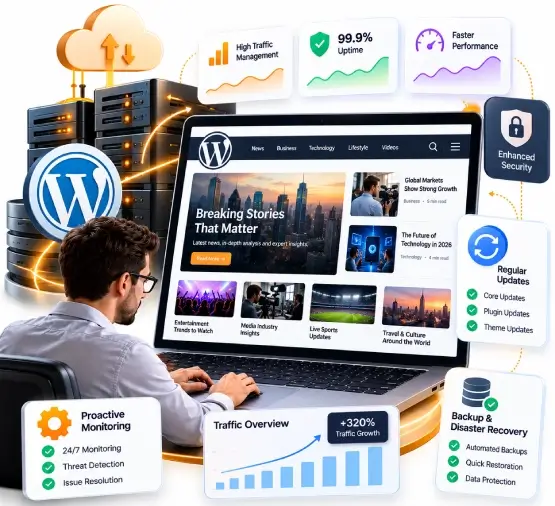
Business Requirements: A UK digital publisher needed continuous website support for an established WordPress platform handling traffic spikes and frequent editorial releases. Database bottlenecks, plugin dependencies, caching inconsistencies, and publishing errors were affecting daily operations.
Maintenance Support: Suffescom handled WordPress website maintenance across plugin and theme updates, database optimization, caching configuration, server-side troubleshooting, and post-release monitoring. Changes were checked against workflows before being introduced to production.
Outcomes:
Our website maintenance and support services cover the ongoing technical work to keep your website stable, updated, and ready for day-to-day business needs. Coverage is structured around your platform, release cycle, integrations, traffic patterns, and level of support required.
Different industries bring different website maintenance demands. Our team works across the technical requests that arise after a website is already live, from integration failures and platform updates to functionality changes and production issues.
We can provide maintenance services for any of the popular CMS and e-commerce platforms as well as for custom content management systems.
WordPress core maintenance, theme and plugin maintenance, custom functionality maintenance, integrations, and performance optimization.
Drupal website maintenance service, which covers core and module maintenance, configuration updates, custom development, integration, and security updates.
Website maintenance services for e-commerce websites with platform updates, extension maintenance, checkout, integration, and performance tuning.
Our professional website maintenance services for Shopify e-commerce websites, including theme, app, and store functionality, and integrations.
We offer custom website maintenance services for Joomla websites, which include core updates, extensions, templates, configurations, and functionality.
Technical support for websites running CMS platforms, with maintenance aligned to the underlying codebase, database, integrations, and architecture.
Website maintenance can easily get put off when everything seems to be working well. However, problems tend to build up without anyone noticing in the outdated software, integrations, databases, infrastructure, and custom features.
Vulnerabilities in unpatched CMS features, plugins, modules, libraries, and configurations tend to remain uncovered because of delayed website maintenance. Maintenance delays increase the work required to keep the environment maintained.
A broken form, API connection, database query, or frontend component may initially affect only one part of the website. Without investigation, related dependencies turn a minor issue into a wider functional or production problem.
With the increase in database size, integrations, traffic, and application complexity, performance problems arise. These can go unnoticed unless constant checks are done, since they only start to impact user flows when performance problems arise.
When platform and dependency updates are repeatedly postponed, version gaps accumulate. Updating several components at once then introduces compatibility challenges that would have been easier to manage through regular maintenance.
Websites increasingly depend on CRMs, payment providers, data data analytics platforms, marketing systems, APIs, and other external services. Changes on either side affect authentication, data exchange, webhooks, or business workflows.
A backup is only useful when it supports an actual recovery. If backup routines, retention, recovery points, or restoration procedures are not reviewed, a production incident leaves your team uncertain about how quickly the website will be restored.
Deferred fixes, outdated dependencies, inconsistent configurations, and temporary workarounds make future maintenance more complicated and expensive. Regular technical attention identifies issues before they become embedded in the website.
When there is no dependable maintenance process, marketing, product, and internal technical teams may have to investigate website problems. Dedicated website support and maintenance gives a clearer path for handling ongoing requirements.
A website maintenance engagement works best when requests, releases, testing, and ongoing monitoring follow a defined process. Our website maintenance and support approach is structured around your architecture, tech stack, priorities, and level of support required.
We begin by understanding your website's architecture, CMS, custom code, hosting environment, databases, integrations, deployment workflow, and existing maintenance practices. This establishes the technical context needed to deliver effective website support services without making assumptions about how your environment works.
We identify the areas that require ongoing attention, including platform updates, security, performance, integrations, content changes, monitoring, and issue resolution. Priorities are aligned with business-critical functionality and the operational requirements of your website, creating a practical foundation for ongoing website maintenance services.
Our expert website maintenance team monitors agreed areas of the website and reviews incoming support requests to identify problems that require investigation. Issues are assessed based on their impact, urgency, affected functionality, and potential dependencies, helping your team receive the right level of response when maintenance issues arise.
Before applying a fix, we review application behavior, logs, database activity, configurations, integrations, recent changes, and relevant infrastructure components to determine what is actually causing the problem. This approach is central to reliable website support and maintenance services, particularly for complex or highly integrated websites.
Approved updates, fixes, configuration changes, content modifications, and smaller enhancements are carried out within the appropriate development or maintenance environment. Changes are implemented while carefully considering the customizations, dependencies, and interconnected systems to ensure seamless integration and functionality.
When the environment allows for it, changes are systematically transitioned through a staging phase prior to being deployed in the production environment. We test affected functionality and relevant user journeys, including forms, integrations, checkout flows, authentication, search, and other business-critical components to reduce avoidable production issues.
Once changes have been reviewed and approved, they are deployed using the agreed release process. Production changes are handled with appropriate precautions around backups, dependencies, configuration, and deployment timing. This gives an opportunity to have a more controlled path for ongoing website maintenance and support journey.
Following the deployment, we conduct a verification to ensure that the intended change is functioning within the live environment, confirming that all aspects are operating as expected and delivering the desired outcomes. We check affected functionality and monitor for unexpected behavior, errors, or integration problems that may require follow-up.

Maintenance activity is documented so your team has visibility into completed work, outstanding issues, recurring problems, and areas requiring attention. As patterns become evident, we suggest implementing enhancements that not only minimize future maintenance efforts but also tackle any underlying technical limitations that may be present.
We maintain your website with security and compliance requirements in mind, addressing relevant vulnerabilities, updates, configurations, and controls based on your platform, data, and business environment.
Our team works across frontend and backend technologies, databases, cloud infrastructure, APIs, and third-party integrations, allowing us to support websites according to their existing technology stack and architecture.
Flexible website support and maintenance services structured around your website's workload, complexity, and technical requirements.
Regular technical support on a monthly basis. Covers routine updates, monitoring, fixes, and other maintenance services.
A dedicated team that understands your website, technology stack, integrations, and maintenance history.
Better for businesses that need flexible website support and maintenance services without a recurring commitment.
Suitable for CMS upgrades, website migrations, performance work, security remediation, database optimization, and major integration changes.
Choose a maintenance plan based on your website's technical complexity, platform, and ongoing support requirements.
$5,000 – $8,000/year
$400 – $700 / month
$8,000 – $15,000/year
$700–$1,300/month
$15,000 - $20,000+/year
$1,300+ / month
Choosing a maintenance partner means giving another team responsibility for a website that already supports your business. Suffescom approaches website maintenance and support as an ongoing engineering responsibility, with attention to the systems, dependencies, and workflows behind the visible website.
We take the time to understand your website before implementing any changes to ensure a smooth and effective transition. Our team considers the CMS, custom code, databases, integrations, hosting environment, deployment process, and dependencies when planning maintenance work.
Our developers work across established CMS platforms, custom web applications, e-commerce systems, APIs, databases, and supporting infrastructure. This allows maintenance work to be handled according to your existing technology rather than forcing the website into a predefined support model.
We delve into issues, exploring their root causes beyond just the symptoms. Whether the issue involves application logic, database behavior, third-party integrations, configuration, or frontend functionality, our engineers work toward identifying the underlying cause before implementing and validating a fix.
Updates and changes are managed via a comprehensive process appropriate for staging, testing, checks, backups, and releases to ensure stability and performance. This is important for websites where downtime or broken functionality affects leads, transactions, customers, or internal workflows.
Your website will change over time. New integrations, platform updates, content requirements, traffic patterns, and business priorities introduce new maintenance needs. Our website maintenance and support services evolve with those changes instead of remaining limited to a fixed list of routine tasks.
You receive visibility into completed work, issues identified, recurring problems, and areas that may require further attention. This gives business and technical stakeholders a clearer understanding of what is happening across the website and where maintenance effort is being directed.
Whether you need recurring website maintenance services, a dedicated maintenance team, on-demand assistance, or a defined technical project, we structure support around your workload and operational requirements rather than applying the same engagement to every website.
The goal is to close individual maintenance tickets. We get familiar with your website’s recurring issues, architectural constraints, integrations, and previous changes and understand them in context. That continuity makes ongoing website maintenance and support more consistent as your website evolves.
Our acknowledgements reflect our experience delivering technical solutions for businesses across different platforms and requirements.
Here’s what clients have to say about working with Suffescom on the day-to-day technical side of their websites.
Website maintenance covers CMS and dependency updates, bug fixing, security patches, backups, performance checks, database upkeep, integration troubleshooting, content changes, technical SEO, monitoring, and production support. The exact coverage depends on your website's platform, integrations, traffic, and maintenance requirements.
Our indicative plans start at $400–$700/month for smaller websites, $700–$1,300/month for mid-sized and e-commerce websites, and $1,300+/month for enterprise environments. Annual plans range from approximately $5,000 to $20,000+, depending on technical complexity, support volume, integrations, infrastructure, and required coverage.
Routine maintenance is typically handled on a monthly or scheduled basis, while critical security patches, production issues, and major integration failures may require immediate attention. Platform updates, backups, performance checks, and technical reviews are scheduled according to the website's release cycle and operational needs.
A maintenance plan can include platform and dependency updates, proactive monitoring, issue resolution, staging and regression testing, security patching, backups, performance checks, integration support, content changes, technical SEO checks, production releases, reporting, and dedicated technical assistance. The plan is structured around your website's architecture and expected support volume.
Maintenance handles scheduled technical upkeep such as updates, security patches, performance checks, and backups. Support covers troubleshooting, production issues, functional changes, integration problems, and other requests that arise during day-to-day operations. Together, they provide continuous website support and maintenance rather than isolated fixes.
Suffescom can take over maintenance for websites developed by another agency, internal team, or legacy environment. We first assess the CMS, codebase, database, hosting, integrations, deployment process, documentation, and known issues before defining the ongoing support scope.
Our WordPress website support services cover core, theme, plugin, configuration, custom functionality, performance, and integration maintenance. Drupal website maintenance and support includes core and module updates, dependency checks, configuration reviews, security patches, custom functionality, database work, and release testing.
Routine maintenance can include smaller content, configuration, UI, and functional improvements. Larger enhancements such as CMS migrations, major upgrades, new integrations, substantial feature development, or architectural changes can be scoped separately so they do not disrupt the recurring maintenance plan.
We assess updates against the existing CMS, framework, custom code, plugins, modules, dependencies, and integrations before release. Where staging is available, changes are tested there first, followed by functional and regression checks on affected pages, forms, workflows, and integrations before production deployment.
The team investigates the affected component, recent changes, application logs, configuration, dependencies, and connected systems to identify the cause. Depending on the situation, we may apply a compatibility fix, adjust configuration, change the affected version, or roll back the release before implementing a permanent correction.
Security maintenance includes reviewing outdated components and known vulnerabilities, applying relevant patches, checking configurations and access controls, validating backups, and investigating suspicious application behavior. Security work is performed according to the website's technology stack, hosting environment, and business requirements.
Integration support covers CRMs, ERPs, payment gateways, analytics, marketing platforms, inventory systems, search services, and other APIs. We investigate authentication failures, API changes, failed requests, webhook errors, data mismatches, and synchronization problems affecting business workflows.
Legacy maintenance starts with an assessment of outdated CMS versions, frameworks, dependencies, custom code, hosting constraints, and security risks. From there, the team can handle controlled updates, compatibility fixes, remediation work, or a planned modernization path where direct changes create significant risk.
Performance work begins with identifying the actual bottleneck. Depending on the architecture, this may involve database queries, application code, caching, server resources, APIs, frontend assets, CDN configuration, or hosting. Changes are then validated against measurable performance behavior.
High-traffic websites can receive ongoing support covering performance monitoring, database health, caching, infrastructure coordination, release management, integration troubleshooting, and production incident response. Maintenance is planned around traffic patterns and business-critical user journeys.
A dedicated maintenance team can continuously work with your website's technology stack, architecture, integrations, deployment process, and maintenance history. This model is suited to businesses that need recurring technical assistance, ongoing improvements, and faster issue handling rather than occasional one-off support.
• SUFFESCOM SOLUTIONS
Build Smarter. Scale Faster. Grow More.
Have a Vision? Let’s Turn It Into a Digital Reality.
Get a quick response from our best experts in under 10 minutes.
Share Your Requirements. Our Experts Will Shape the Solution.
• SUFFESCOM SOLUTIONS
Build Smarter. Scale Faster. Grow More.
Have a Vision? Let’s Turn It Into a Digital Reality.
Get a quick response from our best experts in under 10 minutes.
Share Your Requirements. Our Experts Will Shape the Solution.
Fret Not! We have Something to Offer.