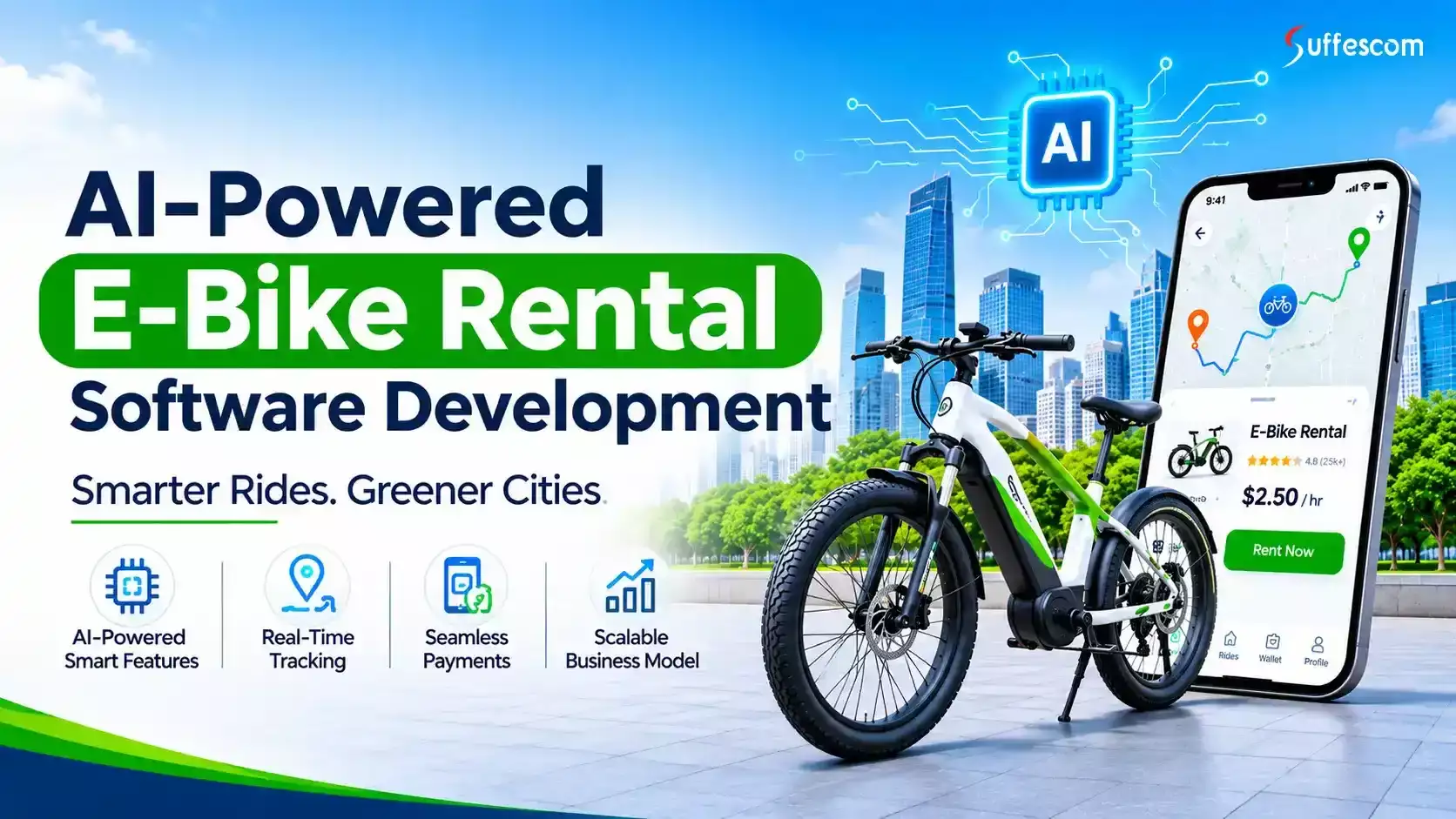
The increasing popularity of electric mobility opens new avenues for entrepreneurs, mobility service providers, bicycle rental firms, tourist guides, and cities to offer bike-sharing services that utilize e-bikes. Nevertheless, the management of a collection of electric bicycles goes beyond just booking and charging payments. The management of e-bikes requires knowledge of availability, state of batteries, location, duration, maintenance, access, pricing, and efficiency.
The smart software system can perform these functions using a mobile app for customers, a rental management cloud service, IoT-connected e-bikes, and an analytical engine based on artificial intelligence. This allows companies to automate rental processes, manage their fleet remotely, enhance efficiency, and improve the customer experience.
AI-powered e-bike rental software development involves building a connected digital ecosystem that enables users to locate, reserve, unlock, ride, and return electric bicycles while giving operators complete visibility into their business operations. Depending on the business model, the platform can support dock-based, dockless, or hybrid rental operations.
Build a Smarter E-Bike Rental App
Why Businesses Are Investing in AI-Powered E-Bike Rental Software
The development of an e-bike rental business can provide opportunities in urban transport, tourism transport, business transport, last mile transport, and recreational transport. Nevertheless, the success of such a business will depend on efficient management of its resources and effective cost control.
AI-enabled rental management software helps businesses make data-driven decisions instead of relying on manual monitoring and operational guesswork.
Growing Demand for Flexible Mobility
Customers increasingly seek flexible transportation options for short-distance commuting, tourism, campus mobility, and local travel. E-bike rental platforms provide access to transportation without requiring customers to purchase or maintain their own electric bicycles.
Businesses can offer hourly, daily, weekly, monthly, or subscription-based rental plans to address different customer needs.
Automated Fleet Operations
Managing dozens or hundreds of e-bikes manually can become complicated. Rental software automates bookings, vehicle allocation, payments, returns, fleet availability, and maintenance notifications.
Operators can manage multiple locations, rental stations, and fleets through a centralized dashboard.
Better Vehicle Utilization
AI-powered analytics can identify underutilized bicycles, high-demand locations, popular rental periods, and seasonal demand patterns. Operators can use these insights to reposition vehicles, adjust rental prices, and improve fleet utilization.
Connected Vehicle Monitoring
GPS, IoT sensors, smart locks, and battery telemetry enable operators to monitor vehicle location, battery status, movement, and operational health remotely.
Scalable Business Operations
A cloud-based platform allows businesses to expand from a small rental fleet to multi-location or city-wide sharing operations without rebuilding their entire software infrastructure.
A Practical Roadmap to Starting an E-Bike Rental Business
Starting an e-bike rental business requires a clear operating model, suitable fleet infrastructure, a digital rental platform, and a strategy for managing daily operations.
1. Identify Your Target Market
Before investing in bicycles and software, identify the customers and locations your rental business will serve.
Potential markets include:
- Tourists exploring cities, beaches, resorts, and recreational destinations.
- Urban commuters traveling short distances.
- Corporate employees using shared mobility for workplace transportation.
- College students and campus communities.
- Delivery businesses requiring electric bicycles.
- Residential communities and gated societies.
- Hotels, resorts, and hospitality businesses offering rental services.
Market research helps determine fleet size, rental duration, pricing structure, operating locations, and software requirements.
2. Select an E-Bike Rental Business Model
The operating model determines how customers access vehicles, how bikes are returned, and what infrastructure your business requires.
Station-Based E-Bike Rental
Customers collect and return e-bikes at designated rental stations or docking locations. This model works well for tourist destinations, campuses, hotels, and controlled transportation networks.
Dockless E-Bike Sharing
Customers locate bicycles through a mobile application, unlock them digitally, and park them within approved service zones.
This model offers greater flexibility but requires GPS tracking, geofencing, intelligent fleet management, and theft prevention capabilities.
Hybrid E-Bike Rental Model
A hybrid model combines fixed docking stations with dockless operations. Customers may collect vehicles from designated locations while returning them within approved parking zones or other supported locations.
This model can support businesses that want to maintain organized fleet operations while offering flexible customer experiences.
Subscription-Based E-Bike Rental
Customers pay recurring fees to use e-bikes for longer periods, such as weekly or monthly rentals. This model is suitable for commuters, delivery professionals, corporate employees, and residential communities.
3. Plan Your Fleet and Hardware Infrastructure
Determine the type and number of electric bicycles required based on your market, operational capacity, and rental model.
Infrastructure considerations include:
- E-bike models and motor configurations.
- Battery capacity and charging requirements.
- GPS and telematics hardware.
- Smart locks and access-control devices.
- Docking stations or parking infrastructure.
- Charging stations and battery-swapping arrangements.
- Maintenance facilities and spare parts.
- Connectivity requirements, including cellular data or eSIM.
- Insurance, safety, and regulatory requirements.
Hardware compatibility should be evaluated before software development because different manufacturers may use different communication protocols, locking mechanisms, battery systems, and telemetry APIs.
4. Develop the Rental Management Software
Build a digital platform that connects customers, rental operators, e-bikes, payment providers, and IoT devices.
The platform should support bookings, rental pricing, digital unlocking, vehicle tracking, fleet monitoring, maintenance management, customer support, and reporting.
Depending on the operating model, the solution may include a mobile application, web-based admin dashboard, cloud backend, IoT management layer, and AI-powered operational tools.
5. Launch and Optimize Operations
After development and testing, deploy the software, onboard the fleet, configure service areas, establish pricing rules, and train operational teams.
Use business analytics to monitor rental demand, fleet utilization, revenue, maintenance costs, customer retention, and vehicle performance. Gradually introduce additional locations, fleet capacity, AI automation, and new revenue models
Scale Your E-Bike Rental Operations with AI
The Role of AI in Revolutionizing E-Bike Rental Operations
Artificial intelligence can transform e-bike rental operations by converting vehicle, booking, location, payment, and customer data into actionable business intelligence. Instead of managing fleets through manual processes and fixed operational rules, businesses can use AI to automate decisions, anticipate operational issues, and optimize rental performance.
AI integration should be based on actual business requirements, data availability, and measurable operational benefits rather than adding AI features without a clear purpose.
1. AI-Powered Demand Forecasting
AI models analyze historical bookings, rental durations, location activity, weather conditions, holidays, events, and seasonal patterns to forecast rental demand.
Operators can use demand forecasts to:
- Predict the number of bikes required at different locations.
- Identify high-demand and low-demand time periods.
- Plan fleet repositioning before demand increases.
- Optimize staff and charging resources.
- Reduce idle fleet inventory.
2. Predictive Maintenance and Vehicle Health Monitoring
AI can analyze battery telemetry, motor performance, usage history, sensor readings, maintenance records, and reported faults to identify potential vehicle issues.
The software can generate maintenance alerts when an e-bike exhibits abnormal battery degradation, repeated hardware errors, unusual usage patterns, or performance deviations.
This helps businesses reduce unexpected breakdowns and improve vehicle availability.
3. Intelligent Fleet Rebalancing
AI-powered fleet optimization can recommend where bicycles should be moved based on demand forecasts, current availability, battery levels, rental activity, and operational constraints.
For dockless and hybrid operations, this can help fleet teams prioritize vehicle redistribution and reduce the number of bikes unavailable in high-demand areas.
4. Dynamic Rental Pricing
AI-based pricing engines can analyze demand, vehicle availability, rental duration, location, time of day, and seasonal patterns to recommend rental prices.
Operators can define pricing boundaries and business rules to prevent excessive pricing fluctuations while optimizing revenue.
Examples include:
- Higher rental demand during weekends or holidays.
- Discounted long-duration rentals.
- Promotional pricing for low-utilization areas.
- Corporate or membership-based pricing.
- Location-specific rental rates.
5. AI-Powered Customer Support
AI chatbots and virtual assistants can answer rental questions, help customers locate vehicles, explain pricing, assist with booking issues, and guide users through unlocking or returning an e-bike.
With integrations into booking and fleet systems, AI support can provide contextual responses based on the user's active rental, payment status, vehicle availability, and operational policies.
6. Fraud Detection and Risk Analysis
Machine learning models can identify suspicious booking behavior, payment anomalies, repeated account misuse, unusual rental patterns, and potential unauthorized vehicle movement.
Risk-based verification can help businesses improve security while reducing unnecessary friction for legitimate customers.
7. AI-Based Business Intelligence
AI analytics can summarize operational performance, identify revenue trends, compare fleet utilization across locations, and recommend actions based on business data.
An AI-powered dashboard may answer questions such as:
- Which locations generate the highest rental revenue?
- Which e-bikes experience frequent maintenance issues?
- When should the fleet be expanded?
- Which pricing plans generate the best customer retention?
- How can idle bicycles be reduced?
A Complete Solution for Launching and Scaling Your E-Bike Rental Business
The e-bike rental solution will be a combination of a mobile application, cloud-based software, control systems, connected devices, and operation-related tools into one complete platform.
Organizations may opt to utilize a solution tailored to station, dockless, or hybrid bike rentals based on their business infrastructure and clientele.
Solutions for Hybrid Operation Models: Docked and Dockless
A hybrid operating model supports multiple vehicle access and return methods within one rental ecosystem.
Dock-based operations provide structured pickup and return locations with docking infrastructure, controlled charging, and organized fleet availability.
Dockless operations enable customers to access vehicles through mobile applications and return them within designated geofenced zones.
Hybrid operations combine both systems, allowing businesses to accommodate different locations, user needs, and fleet management strategies.
The software should provide centralized control over vehicle availability, rental policies, location rules, pricing, and fleet operations across these models.
Smart Control Panel with Built-In IoT System
An IoT-enabled smart control panel acts as the communication and control layer between the rental software and connected e-bikes.
Depending on the hardware configuration, it may support:
- GPS-based vehicle tracking.
- Smart locking and unlocking.
- Battery and vehicle status monitoring.
- Cellular network connectivity.
- Device communication and diagnostics.
- Remote commands and alerts.
- Ride status and usage telemetry.
- Hardware security and access management.
The exact capabilities depend on the selected control hardware, e-bike manufacturer, supported protocols, and integration APIs.
Cloud Rental System: App and Backend
The cloud rental system controls customers’ applications, operators’ dashboards, the rental process, bookings, payments, the fleet management system, and the IoT communication.
A cloud-based structure provides central fleet management, multi-location management, synchronization, scalability, and remote software update capabilities.
Compatible Global eSIM and Data Plan Solutions
Interconnected e-bikes will need connectivity through cellular technology to enable functionalities such as GPS tracking, IoT connectivity, remote locking, telemetry, and device monitoring.
In this regard, the use of an eSIM-based connectivity solution will enable the deployment of the devices in several regions without the need to physically handle individual SIM cards by the operators.
Integration with E-Bike and Powertrain Systems
The software ecosystem can integrate with compatible e-bike components and powertrain systems to exchange operational information.
Potential integrations include:
- Battery management systems (BMS).
- Motor controllers.
- GPS and telematics modules.
- Smart locks.
- Vehicle sensors.
- Charging systems.
- Electronic control units.
Integration capabilities must be validated with the specific manufacturer and hardware configuration. Not every e-bike exposes the same telemetry or remote-control functionality.
Must-Have Features to Consider While Building E-Bike Rental Software
An effective e-bike rental platform requires features that support customer convenience, operational control, connected hardware, fleet management, and business growth.
1. Customer Mobile Application
The customer application acts as the primary interface for renting and using electric bicycles.
User Registration and Verification
Customers can register using email, mobile number, supported social login methods, or identity verification workflows.
The application can maintain user profiles, rental history, payment methods, membership details, and account security settings.
E-Bike Discovery and Availability
Users can view available e-bikes on an interactive map, filter by vehicle type, battery level, location, rental price, and availability.
Booking and Reservation
Customers can reserve bicycles for hourly, daily, weekly, or monthly rentals. The booking system should prevent conflicts and synchronize vehicle availability in real time.
QR Code Scanning and Digital Unlocking
Customers scan a vehicle's QR code or use an in-app digital key to initiate a rental.
Depending on hardware, access may be enabled through Bluetooth, cellular connectivity, NFC, or a connected locking mechanism.
Rental Pricing and Payment
Users can view pricing, estimated rental charges, deposits, add-ons, taxes, and applicable fees before confirming a booking.
The platform can integrate payment gateways, digital wallets, recurring payment options, and refund workflows.
Trip and Rental Monitoring
Customers can access rental duration, vehicle status, trip information, estimated charges, and return instructions.
Return and Parking Verification
The application can guide users to approved return locations, validate geofenced parking, and confirm vehicle locking or rental completion where supported by the hardware.
Customer Support and Notifications
Push notifications and in-app assistance can provide booking confirmations, payment receipts, rental reminders, battery alerts, return instructions, and support updates.
2. Smart Control Panel
A smart control panel is essential for connected e-bike operations that require centralized access to hardware and fleet controls.
Dock-Lite System
A dock-lite system can support controlled vehicle access or organized parking without requiring a traditional full docking station for every bicycle.
Its exact functionality depends on the selected implementation, such as lightweight parking infrastructure, electronic locking, or IoT-enabled access control.
e-Locking Box
An electronic locking box or connected lock can enable authorized users to access e-bikes through digital credentials, app-based commands, QR codes, or compatible communication technologies.
Patented Locking System
If the deployment uses a proprietary or patented locking system, the software can integrate the corresponding hardware controls, authentication workflows, and security mechanisms.
Patent claims, availability, and integration compatibility should be verified with the relevant hardware provider.
Frame e-Lock
A frame-integrated electronic lock can support keyless vehicle access, rental initiation, and return confirmation.
The application should coordinate unlocking, rental status, authentication, and locking confirmation with the hardware's supported communication protocol.
3. Cloud Platform for Rental Operations
A cloud rental platform provides centralized management for the complete e-bike sharing ecosystem.
It can include the following integrated management modules:
| Module | Purpose |
| DMS (Device Management System) | Manage connected devices, hardware configurations, device status, and diagnostics |
| Credential Management | Manage authentication credentials, user permissions, and digital access tokens |
| OTA (Over-the-Air Updates) | Remotely deploy firmware and supported software updates to connected devices |
| KMS (Key Management System) | Securely manage encryption keys and access credentials |
| eSIM Management | Manage connectivity profiles and supported cellular data configurations |
| CRM | Manage customer profiles, communications, support, memberships, and retention |
| Secure Element | Support hardware-based security for sensitive authentication and cryptographic operations |
| Fleet Manager | Manage vehicle inventory, status, locations, battery data, rental availability, and maintenance |
These modules should be designed with appropriate access controls, secure device communication, auditability, and integration boundaries.
4. Admin Dashboard and Rental Management
The admin dashboard allows rental operators to manage business operations from a centralized interface.
Fleet Management
Administrators can monitor bicycle inventory, vehicle availability, GPS locations, rental status, battery condition, hardware connectivity, and operational health.
Booking Management
Manage upcoming bookings, active rentals, cancellations, extensions, rental durations, refunds, and customer requests.
Pricing and Subscription Management
Configure rental rates, membership plans, deposits, discounts, promotional campaigns, corporate pricing, and subscription billing.
Maintenance Management
Create maintenance schedules, assign repair tasks, track service history, identify damaged vehicles, and temporarily remove bicycles from the rental inventory.
User and Staff Management
Manage customers, operational staff, administrators, permissions, verification records, and account activity.
Payment and Revenue Management
Track payments, refunds, invoices, transaction records, rental revenue, commissions, and financial reports.
Analytics and Reporting
Monitor booking performance, fleet utilization, rental revenue, vehicle downtime, location performance, customer retention, and operational expenses.
AI Software Development with Capabilities to Manage E-Bike Rental Businesses
AI-enabled software can provide operators with intelligent recommendations, automated workflows, and predictive insights for managing daily rental operations.
For example, the system can analyze the usage of each e-bike and recommend whether it should remain in service, be repositioned, or be scheduled for maintenance. It can also identify rental locations where additional vehicles could improve availability and revenue.
The AI engine can be developed using historical rental data, real-time IoT telemetry, operational records, customer behavior, and external contextual information.
The platform should also allow administrators to review AI recommendations, configure operational rules, and override automated decisions when necessary.
Development Process of AI E-Bike Rental Software
Developing AI-powered e-bike rental software requires a structured approach that covers business requirements, application design, hardware integration, AI development, testing, deployment, and ongoing optimization.
Step 1: Requirement Analysis and Business Discovery
Identify the business model, target customers, fleet size, service locations, rental duration, hardware requirements, operational workflows, revenue models, and AI use cases.
Step 2: Solution Architecture and Technical Planning
Define the mobile applications, cloud backend, database, IoT architecture, AI infrastructure, third-party integrations, security requirements, and deployment strategy.
Step 3: UI/UX Design and Prototyping
Design customer applications, operator dashboards, fleet monitoring interfaces, booking workflows, connected vehicle controls, and AI-powered analytics interfaces.
Step 4: Application and Backend Development
Develop mobile applications, admin dashboards, booking engines, payment integrations, fleet management modules, APIs, cloud infrastructure, and business logic.
Step 5: IoT and Hardware Integration
Integrate smart locks, GPS devices, e-bike telemetry, battery systems, control panels, eSIM connectivity, and supported device management services.
Step 6: AI Model Development and Integration
Develop and integrate AI models for demand forecasting, predictive maintenance, pricing recommendations, fleet optimization, customer support, and operational analytics.
Step 7: Testing and Quality Assurance
Conduct functional, integration, security, performance, device compatibility, payment, IoT, AI model, and real-world field testing.
Step 8: Deployment and Launch
Deploy applications and backend infrastructure, configure service locations, onboard connected vehicles, activate payment systems, and launch the rental service.
Step 9: Monitoring, Maintenance, and Optimization
Monitor platform performance, vehicle connectivity, AI model accuracy, fleet utilization, customer feedback, and operational efficiency while continuously improving the software.
Technology Stack to Build AI-Powered E-Bike Rental Software
The technology stack should be selected based on the platform's scalability, real-time communication requirements, hardware compatibility, security, AI capabilities, and development budget.
Mobile Application Development
| Technology | Application |
| React Native | Cross-platform Android and iOS applications |
| Flutter | Cross-platform mobile application development |
| Kotlin | Native Android application development |
| Swift | Native iOS application development |
Cross-platform frameworks can reduce development duplication, while native development may be appropriate for advanced Bluetooth, hardware, background location, or device-specific integrations.
Backend Development
| Technology | Application |
| Node.js | Scalable backend services and APIs |
| Python | AI/ML services, data processing, analytics |
| Java / Spring Boot | Enterprise backend and high-volume systems |
| Go | High-performance services and IoT communication |
Cloud Infrastructure
| Technology | Application |
| AWS | Cloud infrastructure, compute, storage, IoT, analytics |
| Microsoft Azure | Cloud hosting, AI services, IoT, enterprise integrations |
| Google Cloud | Cloud infrastructure, data analytics, AI/ML |
| Docker | Containerized application deployment |
| Kubernetes | Container orchestration for larger deployments |
Database and Data Processing
| Technology | Application |
| PostgreSQL | Relational business and rental data |
| MongoDB | Flexible application data |
| Redis | Caching, real-time state, session management |
| TimescaleDB | Time-series vehicle telemetry |
| Apache Kafka | Event streaming and large-scale data pipelines |
AI and Machine Learning
| Technology | Application |
| Python | AI model development |
| TensorFlow | Machine learning and deep learning |
| PyTorch | AI model training and inference |
| Scikit-learn | Predictive analytics and traditional ML |
| OpenAI APIs or other LLM services | AI customer support, assistants, and natural language analytics |
| Vector databases | Retrieval-based AI applications and knowledge assistants |
Payment and Mapping Integrations
- Stripe, PayPal, Adyen, or regional payment gateways.
- Google Maps Platform or Mapbox.
- GPS and geofencing services.
- Push notification services.
- Email and SMS communication APIs.
- Identity verification and fraud prevention services.
How Does an E-Bike Rental Business Generate Revenue?
An e-bike rental business can generate revenue through multiple monetization strategies. A combination of short-term rentals, recurring subscriptions, corporate agreements, and additional services can help businesses diversify income and improve fleet profitability.
1. Hourly, Daily, and Weekly Rentals
Customers pay based on how long they use an e-bike. Businesses can offer different pricing tiers for hourly, half-day, full-day, weekend, and weekly rentals.
This model is suitable for tourists, recreational users, and customers requiring temporary transportation.
2. Monthly and Subscription-Based Rentals
Customers pay recurring fees to access e-bikes for a defined period. Subscription plans can include unlimited rides within certain limits, maintenance, insurance, charging support, or discounted rental rates.
Recurring revenue helps businesses improve revenue predictability and customer retention.
3. Corporate and B2B Fleet Rentals
Businesses can provide e-bikes to employees, delivery professionals, campuses, hotels, and residential communities under contractual rental agreements.
Companies may charge per vehicle, per user, per month, or based on usage.
4. Membership and Passes
Operators can offer memberships with benefits such as discounted rentals, free unlocks, extended rental periods, priority access, or bundled usage credits.
Memberships encourage repeat customers and create predictable revenue.
5. Rental Marketplace Commissions
A marketplace platform can connect independent e-bike owners, rental shops, fleet operators, and customers.
The platform earns commissions on completed bookings, listing fees, subscription charges, or premium marketplace services.
6. Delivery and Pickup Charges
Businesses can offer delivery and collection services for e-bikes rented by tourists, hotels, event organizers, corporate customers, or residential communities.
These services can generate additional revenue through distance-based, fixed, or location-specific fees.
7. Accessories and Add-On Services
Operators can monetize additional services, including:
- Helmets and protective equipment.
- Child seats and accessories.
- Extended battery or charging services.
- Guided cycling tours.
- Insurance or protection packages.
- Premium e-bike upgrades.
- Late return fees, subject to rental terms.
- Damage-related charges based on contractual policies.
8. Advertising and Strategic Partnerships
Businesses can collaborate with hotels, travel agencies, local businesses, tourism platforms, brands, and event organizers.
Advertising placements, sponsorships, referral commissions, and promotional partnerships can create additional income streams.
9. Franchise and Licensing Model
Businesses can license their rental platform, operating procedures, brand, and fleet management infrastructure to franchise operators or local partners.
The central business can generate revenue through franchise fees, recurring software licensing, hardware packages, operational support, and revenue-sharing agreements.
Get an Estimate for Your E-Bike Rental App Development
How Much Does E-Bike Rental App Development Cost?
The e-bike rental app development cost depends on the application's complexity, number of platforms, fleet size, AI capabilities, IoT integrations, hardware requirements, and development team's location.
Estimated E-Bike Rental Software Development Cost
| Development scope | Estimated cost | Timeline |
| Basic rental MVP | 20,000–40,000 | 3–5 months |
| Standard rental platform | 40,000–80,000 | 4–7 months |
| AI-enabled rental software | 70,000–150,000 | 6–10 months |
| Advanced IoT and smart mobility platform | 120,000–250,000+ | 8–14+ months |
Indicative planning estimates for custom software development. Actual project costs depend on requirements, integrations, hardware, team rates, and implementation complexity.
Cost Breakdown by Development Component
| Component | Estimated cost |
| UI/UX design | 3,000–10,000 |
| Customer mobile application | 10,000–30,000 |
| Backend and cloud platform | 10,000–30,000 |
| Admin and fleet management dashboard | 8,000–25,000 |
| Payment and booking integrations | 3,000–10,000 |
| IoT and smart lock integration | 8,000–35,000+ |
| AI capabilities and analytics | 10,000–40,000+ |
| QA and security testing | 4,000–15,000 |
| Deployment and launch | 2,000–8,000 |
These components are not additive in every project because costs vary based on reuse, scope, development team composition, platform choices, and integrations.
Factors Affecting E-Bike Rental App Development Cost
Platform Requirements
Developing Android, iOS, and web applications separately may increase the cost compared with a cross-platform approach.
Software Complexity
Advanced booking rules, subscription billing, multi-location fleet management, corporate accounts, marketplace features, and AI analytics increase development effort.
IoT and Hardware Integration
Connected e-bikes, smart locks, docking stations, GPS trackers, eSIM services, and device management integrations require hardware-specific development and testing.
AI Integration
Demand forecasting, predictive maintenance, dynamic pricing, AI customer support, and fleet optimization require data pipelines, model development, validation, deployment, and ongoing monitoring.
Security and Compliance
Identity verification, payment security, encryption, access control, privacy requirements, audit trails, and regulatory compliance affect development and testing costs.
Maintenance and Infrastructure
Cloud hosting, connectivity, monitoring, AI inference, software updates, support, and hardware maintenance contribute to ongoing operating costs.
For a startup, the most practical approach is to launch with a well-defined MVP and expand AI and IoT capabilities after validating demand, fleet operations, and revenue.
Who Can Benefit from AI E-Bike Rental Business Management Software?
AI-powered e-bike rental software can support businesses across rental, shared mobility, fleet management, transportation, and connected vehicle industries.
Traditional Bike Rental Businesses
Traditional bicycle rental operators can digitize bookings, payments, inventory, rental agreements, customer records, maintenance, and vehicle availability.
They can also expand their existing operations by adding electric bicycles and app-based self-service rentals.
Corporate Carpool and Shared Mobility Operators
Corporate transportation providers and shared mobility operators can use configurable fleet management capabilities to manage shared vehicles, employee access, reservations, usage schedules, and operational analytics.
For organizations operating e-bike fleets alongside other shared mobility vehicles, the platform can be extended to support additional vehicle categories and fleet workflows.
Bicycle Dealers and E-Bike Retailers
Bicycle dealerships can offer rental services alongside sales, allowing customers to test e-bikes, rent before purchasing, or access subscription-based rental options.
Software can manage rental inventory, customer profiles, bookings, maintenance, rental-to-purchase programs, and dealership operations.
Rental Companies
Vehicle rental companies can expand into electric bicycle rentals by integrating digital booking, connected vehicle access, fleet monitoring, customer management, and automated payments.
The platform can support multiple rental locations and configurable vehicle categories.
Investors and Mobility Startups
Entrepreneurs and investors can launch scalable e-bike rental platforms, mobility marketplaces, subscription businesses, or city-wide bike-sharing operations.
A custom software platform can support business expansion, partner onboarding, fleet growth, revenue optimization, and investor reporting.
Municipality Authorities
Municipalities and public transportation authorities can deploy e-bike sharing systems to improve last-mile connectivity, reduce dependence on private vehicles, and encourage alternative mobility.
The software can support station-based, dockless, or hybrid operations, including service area management, fleet availability, usage analytics, and public mobility integrations.
Hotels, Resorts, and Tourism Operators
Hospitality businesses can provide e-bike rentals to guests through integrated booking applications, hotel management systems, fleet dashboards, and digital access solutions.
These systems can improve guest convenience and create an additional source of service revenue.
How to Choose the Right E-Bike Rental Software Development Approach?
Businesses have different requirements depending on their operational scale, technology needs, and investment plans.
| Development approach | Suitable for | Key considerations |
| Ready-made software | Small rental businesses | Faster launch, limited customization |
| Custom software development | Growing rental companies | Tailored features, scalability, ownership |
| AI-enabled custom platform | Large fleets and mobility operators | Intelligent automation, analytics, advanced integrations |
| IoT-integrated platform | Connected e-bike sharing businesses | Hardware control, telematics, device security |
A custom solution is particularly useful when the business requires proprietary hardware integration, unique pricing models, multi-location management, AI-based fleet optimization, marketplace functionality, or enterprise-level operational workflows.
Turn Your E-Bike Rental Idea into a Market-Ready Platform
Why Choose Suffescom for AI E-Bike Rental Software Development?
Developing an e-bike rental platform requires expertise in mobile application development, backend engineering, IoT integration, cloud infrastructure, payment systems, data analytics, and artificial intelligence.
Suffescom can help businesses plan and develop custom AI-powered e-bike rental software based on their operational requirements and business objectives.
Our development approach can include:
- Custom rental application development for Android and iOS.
- AI-powered e-bike rental business management software.
- Fleet management and connected vehicle platforms.
- IoT and smart-lock integration.
- Cloud-based rental management systems.
- AI-driven analytics and predictive maintenance.
- Booking, payment, subscription, and marketplace integrations.
- Enterprise mobility solutions and scalable infrastructure.
Whether you are launching a new e-bike sharing startup, modernizing an existing rental business, or expanding into connected mobility, the software architecture can be designed around your fleet, business model, and growth requirements.
Conclusion
Custom-made software will assist in optimizing the work of any company involved in rentals, whether it be conventional rental companies and bike sellers, mobility companies, corporations with vehicle fleets, tour operators, or municipalities.
The best approach for developing such software would involve starting with basic functions of renting and fleet management, ensuring hardware compatibility and connectivity, and adding AI functionalities step by step.
Frequently Asked Questions.
1. What is the difference between dockless and dock-based e-bike rental software?
A basic rental platform may cost 20,000–40,000, while AI-enabled and IoT-integrated solutions can cost 70,000–150,000 or more, depending on complexity.
2. How much does custom AI e-bike rental software development cost?
A basic rental platform may cost 20,000–40,000, while AI-enabled and IoT-integrated solutions can cost 70,000–150,000 or more, depending on complexity.
3. Can e-bike rental software integrate with existing bikes and smart locks?
Yes, software can integrate with compatible e-bikes, GPS trackers, smart locks, battery management systems, and IoT devices through supported APIs, SDKs, or communication protocols. Hardware compatibility must be validated before development.
4. What AI features are most valuable for an e-bike sharing business?
Demand forecasting, predictive maintenance, intelligent pricing, fleet rebalancing, fraud detection, and AI-powered customer support can deliver significant operational value. The best features depend on fleet size, data availability, and business objectives.
5. Can one software platform manage multiple e-bike rental locations?
Yes, a cloud-based rental management platform can centralize fleet tracking, bookings, payments, maintenance, pricing, customer management, and reporting across multiple locations, cities, or operational partners.