Healthcare services in Saudi Arabia are shifting to mobile apps. People want to book doctor appointments, check test results and talk to doctors using one app on their phone. It works like a simple healthcare assistant that stays with them all the time. Also, this is changing how hospitals and clinics provide their services across the country.
A good example of this change is Sehhaty, an app launched by the Ministry of Health (MOH). The app brings many healthcare services in one place and allows users to handle their health without visiting hospitals again and again. Because a lot of people are using Sehhaty, business owners are now really interested in creating similar apps that follow Saudi health rules and support a huge user base.
Market insights also show increasing demand for such solutions, as the hospital services market in Saudi Arabia is anticipated to reach 36.90 billion dollars by 2030, depicting the growing need. But, this raises one question for businesses: What is the cost to develop a healthcare app like Sehhaty?
So, in this blog, to clear all doubts, we will discuss how the Sehhaty app works, its cost, and what factors affect its app development cost. We also talk about hidden healthcare app development costs, smart budgeting tips, and practical ways to build a healthcare app that fits the Saudi digital healthcare system.
Understanding the Sehhaty App and Its Business Model
Sehhaty works as a national health access layer built on top of Saudi Arabia’s digital infrastructure. It connects citizens, clinics, hospitals, pharmacies, and government systems through one controlled platform. The app is designed around identity verification, service coordination, and centralized medical data access.
Moreover, according to a report by Sensor Tower, the Sehhaty app ranked among the top 5 Health & Fitness apps on Android in Saudi Arabia during Q3 2024, indicating growth in downloads and user engagement.
Identity First Architecture
Every interaction inside Sehhaty starts with first verifying their identity. Users log in through Nafath (National Single Sign-On) and Absher, which links the account directly to official government records. This structure avoids any duplicate profiles and safeguards sensitive health information.
This identity based structure is the foundation of the entire system. Without it, medical record access and prescription validation would not function reliably.
Service Access and Scheduling Logic
The platform connects directly with government healthcare databases to display available time slots at primary healthcare centers and hospitals. Appointment booking is synchronized with real clinic systems which prevents any repetitive scheduling and manual issues.
Users can book physical visits, can take virtual consultations when needed, cancel appointments and receive automated reminders. Behind the interface, the system manages everything like resource allocation and doctor availability.
This reduces operational load at healthcare facilities and improves patient flow control.
Digital Consultation
A healthcare app like Sehhaty supports remote medical consultations with secure video communication. The system protects both audio and video data using encrypted transmission standards. During sessions, patients can share reports and doctors can upload prescriptions or clinical notes.
The telemedicine support also includes structured symptom input before booking so that patients are guided to appropriate care channels.
Building this module in a healthcare app requires secure infrastructure, encrypted storage, clinical documentation systems and regulatory compliant data handling.
Centralized Medical Record Storage
Inside the app, users can access their lab results, medical certificates, vaccination records and prescription history. This feature is really helpful because it is more like a digital record center connected to multiple healthcare providers.
Also, patients can view and download these records, while only authorized medical staff can update clinical information. All modifications are logged for traceability.
Technically, this requires role-based access systems and consistent data formatting standards.
Pharmacy and Laboratory Connectivity
Sehhaty is linked to the Wasfaty prescription network. Once a doctor issues a digital prescription, it becomes available at registered pharmacies through national ID verification. No printed document is required.
Laboratory services are also connected in the Sehhaty app, which helps with test scheduling and automatic report updates inside the app. These integrations depend on structured API communication between providers and government health systems.
Preventive Health and Device Integration
The platform also supports wellness monitoring. Users can sync data such as step count, sleep cycles and heart rate from mobile health applications. This gives individuals visibility into their daily health indicators and supports preventive care initiatives.
This layer extends the app beyond clinical services and encourages long term health tracking.
Also Read: Self Help App Development for Wellness
Emergency Response Integration
Sehhaty also connects with the Asfany emergency response app. Through this integration, users can get urgent medical assistance directly from the app. The system shares verified identity details and location data with emergency services to speed up response coordination.
This integration enables routine healthcare access and emergency medical support, creating a complete digital health ecosystem that supports urgent care services.
Transform your healthcare services into a powerful mobile app today
Key Features of a Healthcare App Like Sehhaty
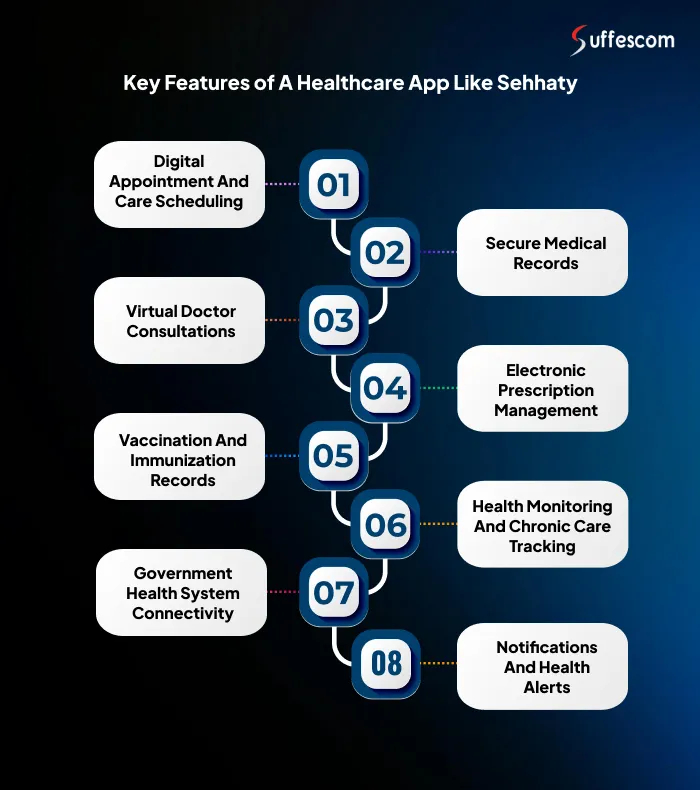
Now, let’s explore the main features that you need to include during healthcare app development in Saudi Arabia.
Digital Appointment and Care Scheduling
A healthcare app like Sehhaty allows users to arrange medical visits without calling hospitals or waiting in queues. Both physical and remote consultations are managed inside the platform with availability.
Key capabilities include
- Booking in-person clinic visits
- Scheduling remote doctor sessions
- Managing follow up appointments
- Instant confirmation notifications
- Access to nearby healthcare centers
Secure Medical Records
Users can access their clinical information through a dashboard. This guarantees transparency and also helps with maintaining strict data privacy standards.
Core functions include
- Viewing diagnostic reports and lab results
- Accessing historical medical records
- Downloading medical certificates
- Monitoring prescription history
Virtual Doctor Consultations
A feature of remote consultations helps connect patients with licensed medical professionals through secure communication channels. This reduces physical visits for non-emergency cases.
This feature supports
- Live video consultations
- Audio based medical advice sessions
- Secure document sharing
- Digital consultation summaries
Electronic Prescription Management
Doctors can upload prescriptions digitally after virtual or even physical consultations. Patients can store or present them directly at linked pharmacies.
Important elements include
- Digital prescription issuance
- Renewal request submission
- Pharmacy pickup through ID verification
- Prescription validity tracking
Vaccination and Immunization Records
The app should have a feature that maintains all the vaccination history for users. This helps with travel documentation and public health verification.
Included functions
- Access to immunization records
- Display of vaccination status
- Downloadable vaccination certificates
- Integration with national vaccination databases
Health Monitoring and Chronic Care Tracking
The platform supports ongoing health supervision for users managing chronic conditions or daily wellness goals.
Functional coverage includes
- Tracking blood pressure, glucose or other vital indicators
- Recording daily health updates
- Monitoring long term condition progress
- Integration with wearable health devices
Government Health System Connectivity
The app connects with national healthcare infrastructure through secure API integration. This ensures that all records and prescriptions reflected are also recorded in government data.
Technical foundations include
- Real time synchronization with national health databases
- Verified identity authentication
- Secure and encrypted data exchange
- Centralized health record alignment
Notifications and Health Alerts
Timely alerts help keep users informed and know about their upcoming appointments, medication schedules and public health updates.
This includes
- Appointment reminders
- Medication refill alerts
- Vaccination due notifications
- Health campaign announcements
Together, all these features besides the basic one define the functionality of a healthcare mobile app like Sehhaty. During healthcare app development, each module requires a secure backend architecture and compliance with Saudi health regulations.
Estimating the Development Cost of an App Like Sehhaty
Developing a healthcare app like Sehhaty involves precise budgeting in each phase be it planning, timeline, complexity, or more. Since healthcare mobile app development includes secure integrations and regulatory compliance, cost planning should be detailed.
Development Cost by App Complexity
The more features and system integration there are, the higher the cost of healthcare app development will be. Also, healthcare apps with AI-integrated functionalities cost more than basic apps
| App Version | Included Capabilities | Estimated Cost (USD) | Estimated Cost (SAR) |
| Basic MVP Healthcare App | Login, appointment booking, limited record access | $8,000 – $12,000 | 30,000 – 45,000 |
| Standard Healthcare App | Teleconsultation, e-prescriptions, lab reports | $12,000 – $22,000 | 45,000 – 82,500 |
| Advanced Integrated App | Pharmacy sync, health tracking, admin panel, API integrations | $22,000 – $35,000 | 82,500 – 131,250 |
Start with an MVP app development if you focus on validating patient flow and booking functionality first. The advanced version includes deeper backend development and secure API integration.
Cost By Development Stages
Healthcare application development in Saudi Arabia follows defined technical phases. Each stage contributes to the total cost to develop an app like Sehhaty.
| Development Stage | Scope of Work | Cost Range (USD / SAR) |
| Requirement Analysis | Feature planning, technical documentation | $800 – $3,500 / SAR 3,000 – SAR 13,125 |
| UIUX Design | Wireframes, interface design, usability flow | $1,200 – $5,250 / SAR 4,500 – SAR 20,000 |
| Backend Development | Database, APIs, server logic | $2,800 – $12,250 / SAR 10,500 – SAR 46,000 |
| Frontend Development | Mobile app screens and functionality | $1,600 – $7,000 / SAR 6,000 – SAR 26,000 |
| Testing and QA | Functional testing, bug fixes | $800 – $3,500 / SAR 3,000 – SAR 13,000 |
| Deployment and Setup | Cloud hosting, launch preparation | $800 – $3,500 / SAR 3,000 – SAR 13,000 |
| Support & Maintenance | Bug fixes, version updates | 10-15% of the total cost yearly |
Backend and integration typically consume the largest share, where support and maintenance are an ongoing process because healthcare application development requires secure data handling and updates from time to time.
Cost of Hourly Rates of Developers
A healthcare platform of this scale, like a super app, requires a reliable mobile app development team. Each app developer contributes differently to the overall healthcare software development cost.
| Role | Responsibility | Hourly Rate (USD) |
| Project Manager | Planning and coordination | $40 – $100 |
| Business Analyst | Requirement documentation | $30 – $80 |
| UI UX Designer | Interface and user flow design | $25 – $70 |
| Mobile App Developer | iOS and Android development | $35 – $110 |
| Backend Developer | APIs, database, integrations | $40 – $120 |
| QA Engineer | Testing and validation | $25 – $75 |
| DevOps Engineer | Cloud and deployment management | $40 – $110 |
| Security Specialist | Data protection and audits | $60 – $120 |
If you are hiring based on an hourly-based engagement model, then the hours allocated determine the final cost. For instance, if backend development requires 300 hours at $50 per hour, that phase alone equals $15,000.
Healthcare App Development Time Estimate
App development timeline depends on feature depth and integration level, and this, as well, can increase or decrease app development cost.
| Phase | Estimated Duration |
| Planning and Documentation | 2 – 3 weeks |
| UI UX Design | 3 – 4 weeks |
| Core Development | 8 – 14 weeks |
| Testing and Optimization | 3 – 4 weeks |
| Deployment | 1 – 2 weeks |
For instance:
A basic MVP healthcare app can be completed in 3 to 4 months and will cost less whereas an advanced integrated version may take 5 to 7 months, depending on testing and API integration complexity.
Factors That Influence the Cost of Developing an App Like Sehhaty
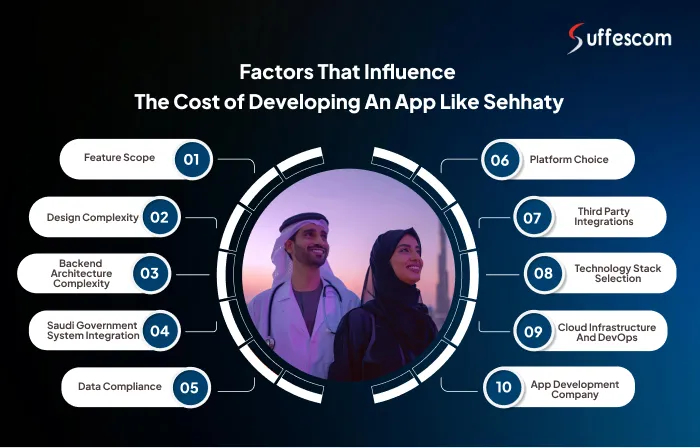
When estimating healthcare app development cost in Saudi Arabia, the technical scope alone is not enough. Regulatory alignment, national system integration, and infrastructure decisions increase the overall investment. Let’s discuss the factors as well that can impact the cost.
1. Feature Scope
The number of features included in the application directly defines the base budget. A simple healthcare consultation app with basic features within a limited cost. Once you add digital prescriptions, health wallet access, chronic care tracking, analytics dashboards and emergency integration, development effort expands.
Also, advanced functionality such as AI symptom triage or wearable device syncing requires more backend engineering and testing.
2. Design Complexity
Saudi is an Arabic first market. Developing a healthcare app for this audience means building a full right-to-left interface.
RTL optimization involves mirrored layouts, culturally appropriate interface structure, and proper Arabic typography like Tajawal or Cairo fonts. Privacy considerations may also affect user flow in healthcare sections.
Proper RTL implementation can increase design needs by nearly 5-10 percent compared to standard left-to-right interfaces.
3. Backend Architecture Complexity
Healthcare apps require structured database management, encrypted APIs and real time synchronization with hospital systems. If the platform supports telemedicine and wearable device tracking, the backend architecture becomes more complex and more work would be required.
Scalable microservices architecture, audit logs, secure storage, and performance optimization all increase development time and cost.
4. Saudi Government System Integration
To build a healthcare app that is best in Kingdom, integration with national systems is mandatory.
This includes
- Nafath integration for verified identity access
- Wasfaty integration for digital prescriptions
- Insurance eligibility checks through NPHIES
- Connectivity with Ministry of Health databases
These integrations require approved API access and structured data exchange. Government level integrations can add SAR 20,000 to SAR 45,000 to the development phase, depending on scope.
5. Data Compliance
Under the Saudi Personal Data Protection Law, healthcare information is classified as sensitive data. This creates additional legal and infrastructure requirements.
Healthcare data should be hosted in Saudi based cloud regions such as AWS Riyadh or Oracle Cloud Jeddah. Hosting outside the country may violate regulatory guidelines. That’s why security audits and National Cybersecurity Authority compliance validation are mandatory and increase the total cost of the project.
6. Platform Choice
The decision to develop for Android, iOS, or both platforms affects the total healthcare app development cost.
Developing separate native applications for Android and iOS requires additional frontend engineering hours. A cross platform solution can reduce development duplication but may require optimization for performance and security-sensitive healthcare workflows.
If the platform also includes a web based admin dashboard or provider portal, this adds another layer of frontend and backend development.
7. Third Party Integrations
Beyond government systems, healthcare apps may also need to integrate with:
- Payment gateways
- Wearable device APIs
- Laboratory systems
- Emergency response platforms such as Asfany
- Insurance claim processing systems
Each integration requires secure API development, testing environments, and long term maintenance.
8. Technology Stack Selection
The choice of development framework impacts scalability and cost. Native app development may increase initial investment but improve performance. Cross-platform frameworks may reduce initial cost but require customization for advanced integrations.
If AI-driven triage systems or predictive health monitoring are added, backend processing requirements increase. Implementing a custom AI layer can increase backend cost.
9. Cloud Infrastructure and DevOps
Healthcare apps require cloud storage, encrypted databases, automated backups and uptime monitoring.
Saudi based hosting increases infrastructure expenses in comparison to generic cloud hosting. DevOps configuration and compliance monitoring increase the operational cost.
10. App Development Company
When developing a Sehhaty-like app, it is important to choose a healthcare app development company with regulatory experience. The cost also depends on the engagement model you choose.
An experienced team understands Saudi integration standards, PDPL compliance, and secure health data architecture. Lack of experience can lead to rework and additional compliance costs later.
How to Save on Sehhaty-Like App Development Costs
Let’s explore some ways by which you can save on healthcare app development costs in Saudi.
Prioritize Features
Start with a Minimum Viable Product that includes only developing core functionality such as secure login and basic consultation support.
This approach allows you to
- Validate real user demand
- Launch faster
- Reduce upfront investment
- Collect feedback before scaling
Non-essential features such as advanced analytics, AI symptom checkers, wearable integrations, etc., can be added in phase wise updates once the core system is stable.
Use Open Source Tools and Frameworks
Open source frameworks decrease licensing expenses and speed up app development. Pre-built authentication modules and backend frameworks lower coding time.
Low-code or no-code tools can also be used for:
- Admin dashboards
- Internal management panels
- Prototype testing
However, the main healthcare modules should still be custom developed to maintain security and scalability.
Consider Cross-Platform Development
Building separate native apps for Android and iOS increases frontend cost. Cross-platform frameworks allow a single codebase for both platforms.
Pros
- Faster development cycle
- Lower initial cost
- Easier maintenance
Cons
- Limited deep hardware optimization
- May require native modules for complex integrations
For mid range healthcare apps, cross platform development can reduce frontend cost by 20 to 30 percent.
Choose Modular Architecture
Develop the platform in independent modules like booking, telemedicine and prescriptions. This allows you to scale features without rebuilding the entire backend.
Modular development helps
- Reduce future rework
- Simplify updates
- Control long term maintenance cost
Outsource Strategically
Instead of hiring a full in-house team, it is better to partner with a healthcare app development company in Saudi Arabia for the initial build.
This approach helps
- Avoid recruitment cost
- Access experienced engineers
- Reduce project delays
A structured outsourcing model can significantly control overhead during the early development stage.
Apply For Government Grants
Saudi Arabia supports digital health innovation through various funding programs like Research, Development, and Innovation Authority (RDIA), which offers grants for health apps and Vision 2030 initiatives. HealthTech startups may qualify for
- Government innovation grants
- Incubator or accelerator funding
- Public health partnership programs
Securing partial funding reduces financial risk during early healthcare mobile app development stages and improves project sustainability.
Hidden Healthcare App Development Cost in Saudi Arabia
Several indirect app development costs appear during or after development. These are not always visible in initial decisions but can impact the final budget.
1. API Transaction and Usage Charges
After integration with systems like Nafath or insurance networks, every verification request or eligibility check may carry a per-transaction fee. These costs scale with user growth.
For instance, identity verification requests can be charged individually. If your app processes thousands of logins daily, the operational cost increases monthly. This expense is rarely included in early development estimates.
2. App Store Review Delays and Resubmissions
Healthcare apps need stricter review processes on Google Play and the App Store. If compliance documentation or health data handling explanations are incomplete, the app may be rejected.
Each resubmission may need more development time and legal clarification. Delays can also impact launch timelines and marketing budgets.
3. Data Migration from Legacy Systems
If hospitals already use older record systems, then migrating that data into the new healthcare app requires validation, and cleaning.
Inconsistent patient records and incompatible database structures increase backend work. Data migration projects can add unexpected development hours.
4. Downtime Recovery and Backup Systems
Healthcare platforms should operate with high reliability. Setting up automated backup systems and redundancy servers adds additional expense.
In case of technical failure, rapid recovery systems are important to protect patient data and maintain service continuity. These safeguards are planned after initial budgeting.
Best 5 Healthcare Apps in Saudi Arabia
Mawid
Mawid is an app developed by the Ministry of Health focused on managing appointments at public healthcare centers. It is used for primary care scheduling.
Unique Features
- Direct booking with government primary healthcare centers
- Integration with national health databases for instant slot availability
Cura
Cura is a doctor appointment and telemedicine app that connects patients with licensed doctors for paid online consultations.
Unique Features
- On demand video consultations with certified doctors
- Digital prescription issuance after consultation
Altibbi
Altibbi combines telemedicine consultation with Arabic medical content and health awareness resources.
Unique Features
- 24/7 doctor consultation via chat or call
- Preventive health guidance and symptom advice
Vezeeta
Vezeeta is an all-in-one healthcare platform that includes doctor discovery and an appointment booking platform focused on private healthcare providers.
Unique Features
- Search doctors by specialty and ratings
- Online booking for private clinics
Seha
Seha app is a government led digital healthcare initiative that connects multiple hospitals under one virtual system for virtual care and preventive health information.
Unique Features
- Remote specialist consultations across regions
- Centralized access to advanced medical expertise
All these apps provide different functionalities, but are booming in Saudi Arabia just like Sehhaty. So, while developing a healthcare app, it is important that you integrate each of these apps' features and add features that users do not even know they need to outshine your app in the market.
Steps to Develop a Healthcare App like Sehhaty
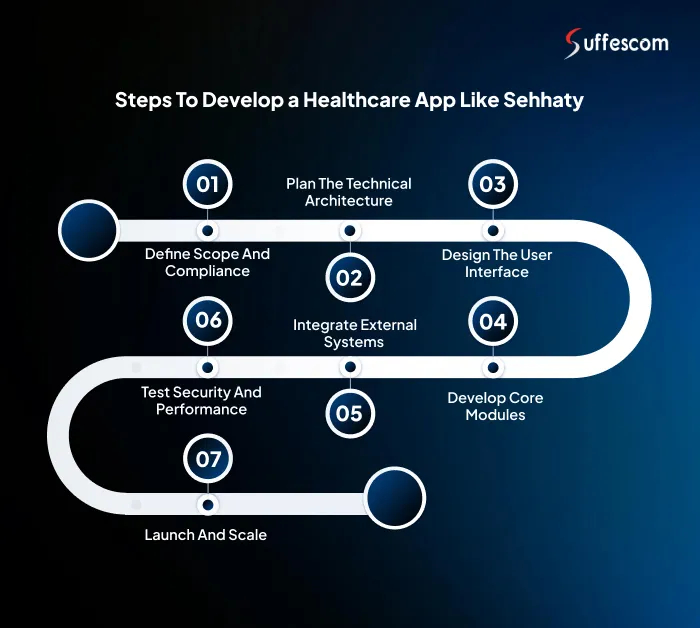
Step 1: Define Scope and Compliance
The process begins with defining the exact purpose of the app. You decide what services it will provide. At the same time you review Saudi regulations and confirm integrations like Nafath Wasfaty and insurance systems. This step creates a clear and legal foundation.
Step 2: Plan the Technical Architecture
Once requirements are finalized, the backend structure is planned. This includes database design and Saudi based cloud hosting. The system should be built to handle sensitive medical data and scale as the user base increases.
Step 3: Design the User Interface
After architecture planning, the design phase begins. The interface is built in accordance with Arabic first layout and simple navigation. User journeys such as login and viewing reports are mapped carefully to avoid any kind of confusion.
Step 4: Develop Core Modules
Development begins with creating essential features, which can be verified login, telemedicine and medical record access. Each module is tested internally before moving forward.
Step 5: Integrate External Systems
When core features are stable, the app is connected with pharmacy networks and emergency systems. Integration testing ensures that real time data flows correctly between systems.
Step 6: Test Security and Performance
Before launching the healthcare app, it is tested for security audits and compliance validation. This guarantees alignment with PDPL and national cybersecurity standards.
Step 7: Launch and Scale
After approval, the app is deployed on mobile platforms. Performance is monitored and improvements are introduced in phases. New features can be added once the system proves stable.
Teck Stack Used to Build Sehhaty-Like Healthcare App
Selecting the right tech is very important in developing a Sehhaty like healthcare app to ensure the final app is built as needed.
| Component | Technologies Used |
| Mobile App Development | Flutter, React Native, Swift, Kotlin |
| Web Admin Dashboard | React.js, Angular |
| Backend Development | Node.js, .NET Core, Java Spring Boot |
| Database | PostgreSQL, MySQL, MongoDB |
| Cloud Hosting | AWS Riyadh, Oracle Cloud Jeddah, Azure KSA |
| Authentication & Identity | OAuth 2.0, OpenID Connect, Nafath API |
| API Integration | REST APIs, GraphQL |
| Video Consultation | WebRTC, Twilio, Agora |
| Security Layer | SSL TLS, AES 256 Encryption, JWT |
| DevOps & Deployment | Docker, Kubernetes |
| Monitoring & Analytics | Firebase Analytics, Datadog |
| AI & Smart Features | Python, Machine Learning Frameworks |
Top 5 Healthcare App Development Companies in Saudi Arabia
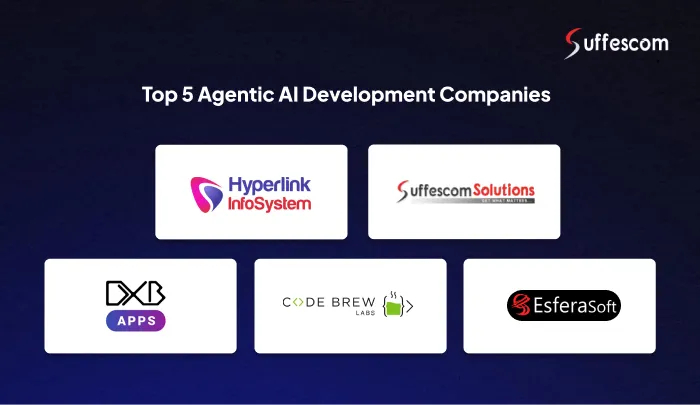
To help you choose the right development partner, we have created a list of top healthcare app development companies with whom you can develop your custom Sehhaty like app.
Hyperlink InfoSystem
Hyperlink InfoSystem is a top mobile app development company in Saudi Arabia with experience in healthcare mobile app development and custom healthcare software solutions. The company works on secure patient portals and digital prescription modules. Their team of app developers focuses on developing healthcare solutions based on business needs.
Suffescom Solutions
Suffescom Solutions focuses on advanced healthcare app development in Saudi Arabia including telehealth platforms, AI-driven symptom checkers, and HIPAA compliant systems. The company has 13+ years of experience building healthcare platforms. Their approach emphasizes secure data handling and features rich digital health ecosystems.
DXB Apps
DXB Apps provides custom healthcare app development services across various industries including healthcare. They specialize in building appointment booking apps, doctor consultation platforms, and healthcare management systems. Their solutions combine user friendly design with secure backend development tailored for regulated markets.
Code Brew Labs
Code Brew Labs develops digital health applications that support telemedicine and patient management systems. They focus on creating intuitive healthcare mobile apps supported by API integrations and scalable cloud infrastructure. Their projects often include multilingual support and compliance aligned development practices.
Esferasoft Solutions
Esferasoft is next in our list of top healthcare app development companies that delivers custom AI healthcare software development services including mobile health apps, electronic medical record systems, and telehealth platforms. The company emphasizes structured development processes and secure system architecture.
Overview of Top Healthcare App Development Companies in Saudi Arabia
| Rank | Company Name | Location | Core Healthcare Expertise |
| 1 | Hyperlink InfoSystem | Riyadh, Saudi Arabia | Telemedicine apps, patient portals, secure mobile healthcare solutions |
| 2 | Suffescom Solutions | Riyadh, Saudi Arabia | AI driven healthcare apps, EHR systems, compliant telehealth platforms |
| 3 | DXB Apps | Riyadh, Saudi Arabia | Appointment booking systems, doctor consultation apps, healthcare web portals |
| 4 | Code Brew Labs | Riyadh, Saudi Arabia | Pharmacy integration, multilingual healthcare apps, scalable mHealth platforms |
| 5 | Esferasoft Solutions | Riyadh, Saudi Arabia | Custom EMR systems, mobile health apps, healthcare software development |
Conclusion
Developing a healthcare app like Sehhaty is more than building a simple mobile product. It requires secure identity verification integration with national systems and full compliance with Saudi health regulations. From appointment booking and telemedicine to digital prescriptions and pharmacy connectivity, every feature must be built with backend architecture.
The cost to develop a healthcare app like Sehhaty depends on feature scope, system integrations and the reliable healthcare app development company you choose. An MVP can be launched with a controlled budget, while a fully integrated healthcare platform needs deeper technical planning and long term support.
With a clear strategy, phased development and regulatory alignment, businesses can build a scalable healthcare mobile app that fits Saudi Arabia’s growing digital healthcare ecosystem.
Ready to build a healthcare app like Sehhaty?
FAQs
Q1. How much does it cost to develop an app like Sehhaty in Saudi Arabia?
Ans. The cost to develop a healthcare app like Sehhaty typically ranges between $8,000 and $35,000 for a mid scale solution. The final budget depends on feature scope, integrations with Nafath or Wasfaty, backend complexity, and compliance requirements.
Q2. How long does it take to build a Sehhaty-like healthcare app?
Ans. An MVP version can take around 3 to 4 months. A fully integrated healthcare platform with government system connectivity may require 5 to 7 months, depending on complexity.
Q3. Is integration with Nafath mandatory for healthcare apps in Saudi Arabia?
Ans. If your app handles sensitive health records or government level services, Nafath integration is strongly recommended. It ensures verified identity authentication and compliance with national standards.
Q4. Can I start with a basic version and upgrade later?
Ans. Yes. Many businesses begin with a Minimum Viable Product that includes secure login, appointment booking, and telemedicine. Advanced features like AI triage and wearable integration can be added later.
Q5. What are the biggest cost drivers in healthcare app development?
Ans. The main cost drivers in healthcare app development include:
- Backend architecture
- Government API integration
- Data compliance
- Cloud hosting
Q6. Do I need to host healthcare data inside Saudi Arabia?
Ans. Yes. Under PDPL regulations, healthcare data must be hosted in approved Saudi cloud regions to ensure data sovereignty and regulatory compliance.
Q7. Can I build the app for Android only to reduce cost?
Ans. Yes. You can build the app on a single platform which reduces initial development cost. However, if your target audience uses both Android and iOS, cross platform development may be a better long term strategy.
Q8. What security measures are required for a healthcare mobile app?
Ans. Healthcare app development requires encrypted data storage, secure APIs, identity verification, role based access control, and regular security audits.
Q9. Is telemedicine expensive to integrate into the app?
Ans. Telemedicine increases development cost because it requires encrypted video infrastructure, secure data handling, and real time communication systems. However, it significantly improves app value.
Q10. How do healthcare apps make money in Saudi Arabia?
Ans. Revenue models for healthcare apps in Saudi Arabia can include:
- Subscription plans
- Consultation fees
- Partnership with clinics
- Pharmacy integrations
Q11. Do I need approval from Saudi authorities before launching the app?
Ans. If your app connects with government systems or handles regulated medical services, approvals and API access permissions may be required before launch.
Q12. Can AI features be added to a healthcare app?
Ans. Yes. AI can be used for symptom checking, predictive health insights, and appointment recommendations. However, adding AI increases backend development and infrastructure cost.
Q13. How do I choose the right healthcare app development company?
Ans. Choose a company with experience in healthcare software development, regulatory compliance knowledge, and proven integration capability with secure systems. Reviewing case studies and technical expertise is essential before finalizing a partner.