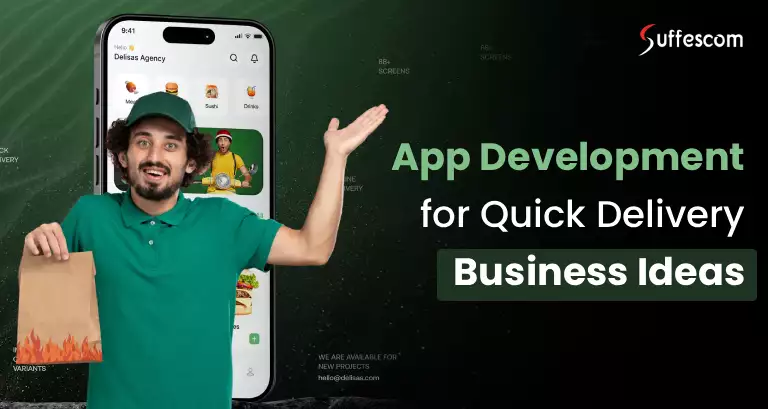
The on-demand app market is rapidly growing. Driven by convenience and speed, these apps are connecting users instantly with services like rides, food, or tasks via smartphones. Even though the on-demand market is mature and highly competitive, especially in areas like general food delivery and ride sharing, there is still significant space for new entrants who want to focus on niche markets and have unique value propositions. If you are also planning to build an app for a quick delivery service or start your quick delivery business, this blog post covers everything you need to know about delivery in minutes app development. So, let’s dive in!
What is an Instant Delivery App?
An instant delivery app is a specialized on-demand platform that connects users to nearby inventory, delivery partners, and fulfillment operations in real time, and hence allows them to quickly receive the services within minutes.
Market Size & Scope
Over the recent years, instant delivery apps have become an ingrained habit for many consumers. They need these services frequently in their day-to-day lives. The global quick commerce market was valued at approximately USD 48.3 billion in 2024 and is expected to reach over USD 306 billion in 2033, growing at a CAGR of 20.18%. This conveys how on-demand services are no longer considered luxuries but ‘lifelines’ of modern urban living as they are deeply integrated into our daily routines.
Key Market Trends and Insights
- 60% of the U.S. consumers use delivery apps weekly.
- In India, platforms like Zepto and Blinkit reached millions of daily orders within a few years, highlighting a strong demand.
- Quick delivery apps are becoming mainstream across urban markets in countries such as the US, UK, and India.
- Quick delivery is growing beyond groceries into pharmacy, prepared meals, electronics, and essentials.
- This diversification creates greenfield opportunities in markets like the UAE, Australia, and the UK, where urban users increasingly rely on instant delivery for multiple daily needs.
How Does Instant Delivery Apps Work? (End-to-End Flow)
What appears as a flawless and intuitive experience to the customer, placing an order in a few taps and receiving products within minutes, can take months of detailed planning, real-time engineering, and operational design behind the scenes. Every second counts in quick commerce, and delays or inventory mismatches can ruin the promise of ‘instant delivery.’
A quick delivery app must have a clear flow that ensures orders move from the customer to delivery in the fastest and most reliable way possible. This flow is the backbone of your platform. Here is how you can design it perfectly.
Customer Flow
To make ordering fast and frictionless, here are the key things your app will need:
- Real-time inventory sync: We will help you build a real-time inventory sync, event-driven architecture, and store-level APIs so your customers see only available items.
- Smart product listing & discovery: We will enable dynamic sorting by proximity, stock, and ETA.
- Instant checkout & payment integration: To enable a fast checkout, we will include multiple payment methods and one-tap checkout.
- Front-end UX optimization: To build an intuitive UX, we will focus on designing for minimal taps. Plus, we will enable features such as predictive search, saved addresses, favourites, and pre-filled carts.
- Real-Time Notifications: Provide real-time notifications for order confirmation, payment success, and delivery updates.
Order Reservation & Inventory Stage
To ensure there is no overselling even under peak demand, we will focus on the following key aspects:
- Hard vs soft stock locks: Decide which items are reserved immediately and which can be substituted.
- Atomic inventory updates: Prevent race conditions when multiple customers order the same item.
- Substitution logic: Implement rules to automatically replace unavailable items or notify customers.
- Inventory monitoring dashboards: Ops can detect low stock and prevent failed deliveries.
Rider Assignment & Delivery Stage
To get the right rider to the right order in the fastest possible time, here are the key things we will include in your product:
- Smart dispatch algorithms to assign riders based on location, workload, route, and SLA.
- Routing & navigation integration to map APIs, traffic predictions, and multi-stop optimization.
- Real-time rider tracking to update customer and ops dashboards continuously.
- Exception handling for lost items, customers unavailable, rider delays, and urgent priority deliveries.
- Rider incentives & monitoring to ensure fair pay, performance tracking, and gamification to improve efficiency.
Operationals & Control Stage
To orchestrate an end-to-end system so orders, inventory, and riders flow smoothly, we will employ the following:
- Order monitoring system: To track all orders in real time and automatically flag delays or exceptions.
- Centralized vs. store-level inventory logic: To decide where items are picked and how inventory is synchronized across multiple stores.
- Dynamic routing engine: To assign orders to stores and riders based on ETA, stock, and load balancing.
- Analytics & predictive tools: To forecast demand, peak hours, and stock replenishment needs.
- Ops intervention tools: To quickly reroute orders, approve substitutions, or resolve issues without customer disruption.
Customer Feedback & Post-Delivery Stage
To capture the insights, improve experience, and maintain loyalty, we will help you build the following tools and features:
- Automated rating & review prompts: To collect real-time feedback.
- Returns & refunds workflows: For seamless customer support integration.
- Data analytics: To detect repeat issues and improve systems.
- Retention tools: For loyalty programs, subscription passes, and personalized offers.

- Quick Delivery App Service
- Readymade Instant Delivery App
- MVP Solutions for Instant Delivery Business
Popular Business Models in Instant Delivery Markets
Not all kinds of instant delivery apps are similar. Because in quick commerce, the success is defined less by what you deliver and more by how your delivery system is structured. Two companies that deliver groceries in 10 minutes can have completely different cost structures, tech stacks, and scaling paths. It is just the core idea of "delivery in minutes" that remains the same, but from a development perspective, each app has its unique operational constraints, inventory logic, and technology requirements. Below are the most common quick delivery business models, along with what founders need to build for each.
Inventory Led Model
In this model, you own or control inventory and fulfil orders from micro-warehouses. To run an instant delivery business in this way, you will need:
- Dark store management system
- Tight SLA enforcement
- SKU-level real-time inventory with hard locks
- High rider density per store
- Demand forecasting & replenishment logic
It is a suitable model if you are planning to target high-density cities and your key focus lies on repeat orders and predictable demand.
Marketplace-Assisted Model
In this type of business model, you don’t own inventory but aggregate nearby merchants. Here is what you will need to get a marketplace-assisted model designed:
- Merchant onboarding & catalog normalization
- Strong exception handling workflows
- Variable prep-time handling
- Ops tools for merchant performance monitoring
- Store-level inventory sync (often unreliable)
Hybrid Inventory + Marketplace Model
This type is a mix of dark stores and third-party merchants. We can help you develop this kind of model as we specialize in developing the following:
- Dual inventory logic (owned + external)
- SLA prioritization rules
- More complex ops dashboards
- Smart routing between fulfillment sources
Subscription-First Quick Delivery Model
Here, the revenue is driven by memberships, not per-order fees. This type of model requires:
- Subscription management system
- Retention & churn analytics
- Priority order routing
- Member-only inventory allocation
It is suitable for dense delivery zones where user frequency is generally high.
B2B Instant Replenishment Model
We can also help you build an app for quick-delivery services, particularly for delivering urgent supplies to businesses such as clinics, retailers, and cafes.
To build this kind of business model, you will need:
- Bulk and repeat order workflows
- Account-level pricing rules
- Scheduled + instant delivery app development hybrid logic
- Credit-based or postpaid billing
Eventually, when you start your own quick delivery business, and have to pick the right business model, it all comes down to your choice regarding:
- Who owns inventory?
- Who controls fulfillment speed?
- What breaks first when order volume doubles?
- Where does revenue primarily come from?
Popular Niches in Instant Delivery Markets and Novel Concepts
The instant delivery market is expanding rapidly, but not every niche offers the same opportunities. Some areas are crowded and highly competitive, while others are emerging and hold significant potential for new entrants. Here are some of the popular and emerging niches in instant delivery app development that are showing high demand. Let’s take a look at them:
Food Delivery
Food delivery is undoubtedly the most recognizable and widely used segment in the instant delivery market. Urban consumers across the globe expect their meals delivered fast, often within 15-20 minutes. This makes it a natural starting point for entrepreneurs looking to enter the quick commerce space.
The market saturation in the food delivery industry is extremely high. However, despite this, demand continues to grow because food is a recurring need, and convenience drives repeat usage.
Novel ideas in this space, if you want to start your own quick delivery business:
While general food delivery is competitive, micro-niches like the following still have opportunities:
- Healthy meals, diet-specific menus, or late-night comfort foods
- Regional cuisines or underrepresented categories
- Hyper-localized delivery in smaller cities or underserved neighborhoods
Overall, food delivery is a high-volume and high-frequency niche, which means operational efficiency can make or break your app. Even a small improvement in delivery speed or inventory management can provide a competitive edge.
Grocery and Convenience
This niche is growing rapidly but moderately saturated in top metros. Unlike food, which people order multiple times a day, groceries and essentials are recurring needs that touch almost every household, making it a high-demand niche with strong retention potential.
Novel ideas in this space, if you want to start your own same day delivery grocery business app:
While brands like Getir, Careem, DashMart, and Blinkit have built strong footholds in major cities, the market remains largely unpenetrated. Many urban areas, tier 2 cities, and even smaller neighbourhoods in countries such as the US, the UAE, and Australia remain underserved.
New entrants can explore product segments such as eco-friendly groceries, organic produce, and imported items to make their mark in this space.
Pharmacy & Health Products
Pharmacy and health product delivery is becoming an important part of instant delivery recently, especially in urban areas. While players like PharmEasy (India), Capsule (US), Boots Instant Delivery (UK) are dominating, there is still room for new players, especially in cities and regions where instant pharmacy delivery has not yet become mainstream.
Novel concepts new entrants can introduce:
- Integration with telemedicine or prescription verification services
- Offering subscription or recurring delivery models for chronic medication users
Electronics & Gadgets
Electronics and gadget delivery is still relatively new in the instant-delivery space. Very few players offer instant delivery for electronics, creating a clear opportunity for new entrants.
Novel concepts new entrants can introduce:
- Bundled services like repair kits delivered with spare parts
- Small, essential electronics with high replacement frequency (chargers, cables, batteries, headphones)
- Integration with ecommerce platforms for instant top-up stock
Perfume Delivery
Lifestyle and luxury delivery is one of the most novel niches in instant delivery app development. Very few players focus on ultra-fast same delivery of luxury items like perfumes, accessories, and cosmetics, especially in cities like Abu Dhabi and Dubai.
Why this niche can succeed:
- Luxury items allow for delivery fees without eroding profits
- Premium buyers are often likely to repeat purchases if services are reliable and convenient
- Novel concepts entrepreneurs can introduce:
- Premium subscription models offering curated luxury packages or monthly essentials.
Fuel Delivery
Fuel delivery is an emerging niche in the instant delivery ecosystem, enabling users to get petrol, diesel or gasoline delivered directly to their vehicle location. Whether at home, office, or roadside, users can request fuel via an app, eliminating the need to visit gas stations. This niche is gaining traction due to its convenience, especially for busy urban users and fleet operators.
Why this niche can succeed:
- Users can avoid long queues and detours by getting fuel delivered directly to their location.
- Fleet operators and logistics companies benefit from reduced downtime and better fuel management.
- Fuel is a daily necessity, enabling repeat orders, subscriptions, and long-term customer retention.
- Custom Same Day Delivery App Development
- MVP Solutions for Instant Product Delivery App
- Readymade Instant Delivery App
Core Features Required to Develop a Quick Delivery App?
In quick commerce, platform or app development is largely focused on having essential features. Each feature exists to solve a specific operational bottleneck. Missing or underbuilding any of these can directly impact your delivery time, order success rate, or unit economics.
To successfully design the features in your app, you should first map out the system responsibilities. Here is how:
Real-Time Inventory Availability
It is a must-have feature during instant delivery app development because, without it, the customer might place an order for an item that is actually out of stock. This can lead to failed deliveries, refunds, loss of trust, and substitutions.
Inventory Reservation at Checkout
It’s not enough to show stock. You need to reserve items the instant a customer confirms an order. When reservation logic is not in place, two customers might place an order for the same item at the same time. This can cause operational chaos.
Event-Driven Order State Management
Instant app delivery is all about providing immediate access to goods or services to customers. This is all possible when event-driven state management ensures that every change, like picked, packed, or out for delivery, is propagated instantly to all stakeholders. Without it, riders wait unnecessarily, stores miscommunicate, and customers lose trust.
Intelligent Rider Assignment
It is a very important tool to ensure that available riders are used effectively and the system can balance the workload across the fleet. It also plays a crucial role in minimizing downtime between deliveries and ensuring faster service, which is a key driver of customer satisfaction.
Without an intelligent system, delivery operations revert to manual assignment or a simple, inefficient mode.
Real Time Location Tracking
It is a core feature that connects riders, customers, and operations. Live location updates let the app adjust ETAs, reroute riders if needed, and keep customers informed. Without it, your app feels opaque, and your delivery reliability suffers.
Store Side Picking and Substitution Workflow
Picking and substitution workflows within the store are a critical feature as they ensure that items are packed correctly, substitutions are handled according to customer preferences, and delays are minimized. Ignoring it can lead to operational bottlenecks.
Operational Control & Manual Overrides
Ops dashboards and manual override tools are core features for managing exceptions. When the unexpected changes happen, like store stock mismatch, sudden traffic, etc, operations must be able to intervene right away. Otherwise, small issues can snowball into big failures.
Exception & Support Automation
This feature handles all the inevitable mistakes that happen in instant delivery. When a rider is delayed due to traffic or route issues, or a substitution does not match the customer’s preference, the system automatically detects the issue and triggers the appropriate corrective action, such as issuing a refund.
Technology Architecture Behind Ultra-Fast Grocery & Convenience Delivery
Your technology architecture is the foundation that makes real-time inventory updates, intelligent rider assignment, and other features work flawlessly. Without a solid architecture, the features we discussed cannot function properly and may fail under pressure from scale, peak hours, or citywide expansion.
In this section, we will discuss the key architectural choices and explain how they keep your app fast and ready to grow.
Prioritizing Speed
In ultra-fast delivery, customers expect their orders in minutes. That means speed matters more than handling huge volumes at once. Traditional e-commerce systems work well when you can process orders in batches, but with quick commerce, apps cannot wait, as they need everything to happen immediately. So, design your system so that each order is processed as soon as it comes in, instead of waiting for a batch of orders.
For this, you will need to focus on the following key things:
- Fast updates for inventory
- Rider assignment
- Order status
- Testing the system under peak load
Monolith vs Microservices
During instant delivery app development, one of the first architectural questions founders face is whether to start with a monolithic system or microservices. This choice affects everything from data consistency to how quickly your features, like real-time inventory and rider assignment, can work together.
Monoliths are generally ideal for early-stage apps or single-city launches. Because here all components, such as the customer app, ride app, store interface, and inventory, live in a single system. This setup can simplify state management, debugging, and deployment, making it easier to ensure that features like real-time inventory and order tracking work reliably.
However, many startups find adopting microservices too early tempting. It is worth noting that while they offer modularity and independent scaling, starting with them can introduce network delays, distributed state issues, and coordination overhead. In a quick-commerce app, even a 100-200 ms delay across services can cascade into failed deliveries and frustrated customers.
So, it is always better to begin with a monolith but design with future microservices boundaries in mind, so scaling to multiple cities or stores later can be carried out easily.
Event-Driven Systems
Once the core architecture is decided, the next question becomes how the system reacts to change. In instant delivery, orders move, inventory shifts, and stores update availability all within minutes. A traditional request-response model simply cannot keep up with this pace.
This is where an event-driven system becomes crucial. Instead of waiting for a component to ask for updates, the system broadcasts events like “order placed,” “item reserved” to all relevant parts of the system immediately.
Real-Time Only Where It Matters
Not everything in your system needs real-time updates, so overusing this technology can increase the cost and complexity of your project. Also, underusing it in the wrong places can start affecting your delivery efficiency.
So, identify your mission-critical areas such as:
- Inventory reservation
- Rider assignment
- Order tracking
Inventory Consistency
Inventory errors are one of the biggest killers for quick-commerce apps. To prevent this, you need to:
- Decide on soft vs hard reservation for items
- Ensure updates happen immediately across all relevant stores and riders
- Handle edge cases like multiple people ordering the last item or substitutions automatically
Keep Dispatch Logic Simple
Machine learning engines and complex routing can sound impressive, but they are difficult to debug and prone to unpredictable failures. That’s why you should start off with the simple rule-based dispatch, where you assign riders based on location, availability, and SLA, and only introduce optimization engines once you have enough data and operational stability.
Scale by City
You should plan the scaling based on one city’s traffic and demand spike rather than the system size; otherwise, it can break the whole system. It allows you to manage the specific operational complexities, logistical challenges, and local market nuances inherent to each new region.
Factors That Impact The Cost of Instant Delivery App Development
There are various factors in instant delivery app development that determine the overall cost to build a one-minute delivery app. Understanding these helps entrepreneurs plan the app development wisely and avoid surprises later on. Here are some major influential factors that make up the cost:
How do you want your real-time system to be designed?
The biggest cost driver in instant delivery apps is the required level of system real-time. A basic implementation may only update the order status. But a more advanced build will require real-time inventory locking, live ETA recalculation, instant failure handling, and substitutions. Every real-time dependency increases backend complexity along with the infrastructure planning and testing effort.
1. Number of Apps
Instant delivery development app cost can suddenly increase with the number of independent apps required. A minimal setup may include only a customer app and a basic admin panel; on the other hand, a production-grade instant delivery platform usually require:
- Customer app
- Rider app
- Admin and operations dashboard
- Store or picker app
Each app will add the frontend development, API coordination, QA cycles, and long-term maintenance overhead.
2. Geographic & Delivery Logic Complexity
Building for a single city with fixed delivery zones is far simpler than handling dynamic location logic. Development effort increases when the app needs:
- Multiple zones per city
- Different delivery rules per area
- Location-based inventory logic
- Variable service availability
3. Scalability Preparedness at Launch
If you want to get an app developed for a limited order volume, the development costs will stay lower. But if you want it to handle peak hour spikes, high concurrency, and flash demand from day one, the costs can go up.
4. Integration Load
Every external integration will add development time and risk. A low-cost build may include only:
- Maps and routing
- Payment gateway
While a more advanced build often includes:
- Analytics
- Push notifications
- Customer support tools
- Error monitoring
5. Internal Tools & Admin Capabilities
You can have a basic admin panel for viewing orders and users. But you will need advanced internal tools to enable manual order intervention, rider reassignment, exception resolution, and more.
6. Post Launch Engineering Scope
Some businesses plan for minimal iteration after release. Other budget for continuous optimization, feature evolution, and performance tuning based on real usage. Instant delivery apps usually fall into the second category.
7. Typical budget ranges by approach
There are three ways you can build an instant delivery app. Let’s figure out how much it costs in each approach:
A. MVP for a single city
It is an ideal option for businesses and founders who want to validate demand in one controlled market. This kind of build will basically cover the following:
- One City
- Limited delivery zones
- Predictable order volume
- Core ordering and delivery flow only
- Basic real-time updates
- Manual operational fallbacks
- Minimal internal tools
B. Multi-city expansion-ready build
This approach is chosen by founders who already understand the market and want to avoid rebuilding after early traction.
It comes with:
- City-based configuration
- Flexible delivery logic
- Clear separation between services
- Stronger real-time guarantees
- Architecture supports growth
- Systems are tested under higher concurrency
- Expansion logic is built in from day one
C. Enterprise-grade quick-commerce platform
This is a long-term infrastructure investment that comes with:
- High order volume
- Peak-hour traffic spikes
- Complex inventory behavior
- Advanced internal operations
- Deep real-time dependencies
- Robust internal tooling
- Extensive monitoring and observability
- Strong fault tolerance and recovery systems
Achieve Success with Quick Delivery Startups Business App: Avoid Mistakes
Most quick-delivery startups don’t fail because demand isn't there; they fail because they make mistakes in their decision-making. And when they launch their app in the real world, it fails to take on the challenges and pressure. Here are the most common mistakes they make that you need to avoid:
Treating Quick Delivery Like Normal Food Delivery
Many founders build instant delivery apps using assumptions borrowed from food delivery or e-commerce. Now, this only works until the order volume is low. Once the threshold is reached (which they usually set very low), the system collapses.
That’s why it’s very important to make sure of the following things while getting an instant delivery app designed:
- Inventory is dynamic
- Failures cascade instantly across systems
- Delivery windows are measured in minutes, not hours
Underestimating Inventory Complexity
Most failures in quick delivery platforms are inventory failures disguised as delivery problems. To reduce initial build costs or accelerate launch, many businesses choose to keep inventory simple. That decision is reflected in development through stock syncs, no reservation logic, and limited handling of edge cases. As the demand grows, this decision causes issues like the following:
- Two customers are ordering the last unit of the same product
- ETAs slipping without clear explanations
- Riders are waiting while substitutions are decided manually
- Pickers discovering stock issues mid-order
Prioritizing Cost Over Latency in Development Decisions
This mistake arises when founders treat infrastructure and engineering choices as a budget exercise first, instead of a service-level promise.
Initially, it sounds like:
- Picking a cheaper server over a costly one
- Going for batch updates instead of real-time syncing
- And assuming that a few seconds of delay won’t matter for customers
From a development perspective, these decisions can limit how fast the system can process orders, update inventory, or reassign riders during peak demand. And eventually, it all results in:
- ETAs becoming accurate
- Customers start receiving late deliveries despite the app saying “instantly delivered.”
- Frequent cases of rider and inventory mismatches
Top 5 Companies for Quick-commerce Convenience Service App
If you are looking for a reliable agency with extensive experience in building quick commerce and instant delivery apps, this list provides some of the top contenders in the space. These companies have helped various startups and established businesses develop quick delivery apps:
1. Suffescom Solutions
Suffescom Solutions is one of the most experienced and trusted mobile app development agencies. They help high-growth businesses develop quick delivery apps. They have over a decade of experience in building scalable digital products. Since its founding in 2013, they have grown into a global development firm with offices and clients across the US, UK, UAE, India, Singapore, and Australia.
Over the years, they have consistently delivered thousands of mobile and web application solutions across industries, making it a strong contender for entrepreneurs who want to develop quick delivery apps. Their portfolio features apps similar to Blinkit, Zepto, Careem Quik, Noon Minutes, DashMart, and Getir.
They offer a full range of services, from MVP launches to custom builds designed to scale and enterprise needs. Their capabilities include:
- MVP & prototype development to test product‑market fit.
- Custom app development for deeply branded and differentiated experiences.
- White‑label solutions for rapid deployment under your brand.
- Delivery in minutes app development
- Real‑time systems and integrations with maps, payments, and delivery APIs.
- Post‑launch support, maintenance, and scaling services to ensure apps perform reliably long after launch.
- Ultra-fast grocery and food delivery app development
They have received multiple industry accolades, like Best Design Award from DesignRush, recognition from Hindustan Times as an emerging tech innovator, and multiple top rankings on independent review platforms.
Clients consistently praise the company for its affordable and launch-ready solutions that perfectly balance cost with scalability. Their high ratings across leading and most trust review platforms like Clutch, GoodFirms, and Techreviewer showcase a strong customer satisfaction rate.
2. HyperLocal Inc.
Hyperlocal Cloud Inc. is a well-established on-demand app development agency that specializes in building feature-rich solutions for hyperlocal businesses and digital marketplaces. They serve clients across the world. Their main focus lies on providing custom and white‑label development for hyperlocal delivery, marketplace apps, and on‑demand platforms. Over the years, they have delivered around 150 clone apps and served more than 200 clients.
Their full spectrum of app and software development services includes:
- White label solutions
- Delivery in minutes app development
- Feature-rich and scalable apps
- Cross-platform mobile and web applications
- Third-party integrations
- Ultra-fast grocery and food delivery app development
- Post-launch support and maintenance
3. RisingMax
RisingMax is a well-established mobile app and custom software development company with over 13 years of industry experience. They have completed over 1,000+ projects and delivered value to 500+ clients across 30+ countries.
They offer end-to-end technology services that go beyond basic coding. Their range of services includes the following:
- Custom mobile and web app development
- Cross-platform mobile solutions
- Real-time systems and inventory management logic
- Delivery in minutes app development
- Integration with payment gateways, maps, and tracking systems
- Ultra-fast grocery and food delivery app development
They have been featured and recognized by notable industry outlets various times, including the title of Top Rising AI Development Partners in the USA by The New York Times, Top Enterprise Software Development Agency by Forbes, and more.
4. AI Development Services
AI Development Services is a technology agency specializing in end-to-end AI and software development solutions that help businesses develop quick delivery apps and intelligent & scalable solutions. They bring advanced AI and machine learning expertise to digital products, making them a strong choice for businesses looking to build quick-commerce platforms with smarter operations and personalization.
Key Services They Offer:
- Generative AI
- Adaptive AI
- AI chatbots
- Ultra-fast grocery and food delivery app development
5. MindInventory
Mindinventory is a well-established software development agency with over 15 years of experience. They help startups and growing businesses build user-centric applications across industries, including on-demand platforms and quick commerce apps. They claim to have delivered over 2,500 projects. Their broad development experience makes them a solid choice for founders building instant delivery platforms.
Key Services They Offer:
- End-to-end digital transformation
- Software development
- Delivery in minutes app development
- IT consulting services
- Ultra-fast grocery and food delivery app development
Wrapping Up
The rapid growth of the on-demand economy has made quick delivery apps an essential part of modern urban life. While the market is highly competitive, there are still significant opportunities for new entrants who focus on niche segments, underserved geographies, and unique value propositions. But the success in this space is not about simply copying the existing platforms but building a system that can reliably operate under extreme time constraints and operational pressure. That’s why businesses must carefully consider the business model and operational approach before starting the development. In short, building a successful quick delivery app is a delicate balance of market insights, operational excellence, and, most importantly, technical prowess.