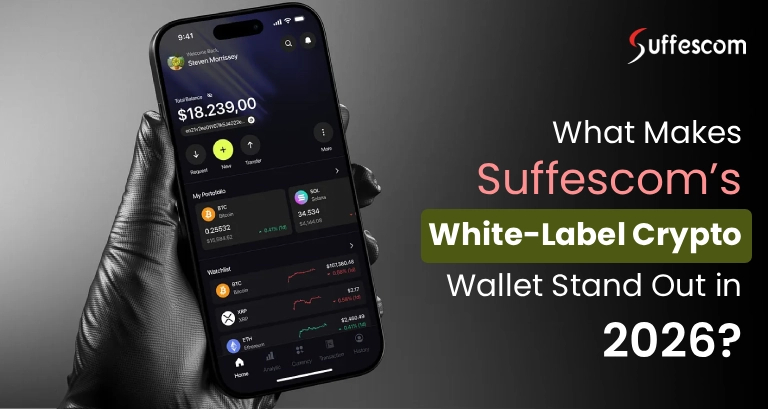
Enterprises in 2026 are not just launching wallets; they are building full financial ecosystems. The digital wallet is no longer a secondary capability; it works at the center of how consumers manage their finances. The rise of Web3, DeFi, and embedded finance has become the foundation for generating revenue, retaining customers, and enabling cross-platform engagement.
This shift has developed demand for platforms that are secure, compliant, and ready to scale from day one. That is where Suffescom’s white-label cryptocurrency wallet app stands apart. Engineered as an enterprise-grade digital finance system, it allows businesses to launch faster, retain control over their brand, and monetize transactions across Web3 and fintech ecosystems with confidence.
Market Trends Fueling the Adoption of White-Label Crypto Wallet Solutions in 2026
- The DeFi sector, Web3, and institutional digital asset storage solutions are driving demand for enterprise-level wallets.
- The adoption of Crypto Wallet-as-a-Service (WaaS) is growing to facilitate API-based wallet integration and simplify blockchain infrastructure.
- The preference for wallet solutions with ready-to-integrate microservices and cloud-native scalability is on the rise.
- The emphasis on robust security features, such as MPC key management, multisig authorization, and encrypted key vaults, is also accelerating.
- The need for multi-chain and multi-asset wallet solutions that support tokens, NFTs, and stablecoins is growing.
How Does Suffescom Turn a Crypto Wallet Into a Revenue Growth Engine?
Suffescom’s wallet framework is built around monetization logic, not just asset storage. Each layer is optimized to generate measurable business value.
- Fee-based fiat-crypto on/off-ramp monetization
- Configurable transaction fee routing
- Subscription-based wallet tiers
- Embedded DeFi yield and staking modules
- NFT and digital asset commerce flows
- Loyalty token and incentive logic
Build a Future-Ready White-Label Cryptocurrency Wallet App With Suffescom
A Practical Approach to Enterprise White-Label Crypto Wallet Development
Suffescom delivers enterprise white-label crypto wallets that are secure, scalable, and fully customizable. With our solutions, businesses can accelerate growth and maximize user engagement globally.
1. Product Scope and Monetization Strategy Definition
Determine if the wallet will be custodial, non-custodial, or a combination of both. This concurrently determines monetization strategies such as fee-based, subscription, or card interchange models. This helps keep the engineering, legal, and business teams in sync from the very start.
2. Regulatory and Compliance Framework Establishment
Bring in the legal and compliance teams early on to address licensing, AML/KYC, and international regulatory requirements. By incorporating auditable logs and a modular compliance framework, the wallet can easily adapt to evolving regulations.
3. Development of a Sound Key Management Infrastructure
Identify key management tools, such as MPC, HSM, or a multisig combination, based on the custody strategy. Emphasize recovery paths and cryptographic excellence to minimize single points of failure.
4. Modular Wallet-as-a-Service Stack Development
Develop an API-first WaaS stack with endpoints for keys, transactions, on-chain monitoring, and fiat rails. This modularity enables seamless integration with exchanges, card issuers, and KYC services.
5. Security and Threat Detection Enhancement
Employ multi-layered security with secure enclaves, transaction signing protection, and anomaly detection. Automated monitoring and response playbooks safeguard against fraud and operational threats.
6. UX and Enterprise Admin Interface Development
Develop intuitive UX flows for onboarding, transfers, and recovery, and implement role-based enterprise admin interfaces.
7. Integrate Fiat Rails
Connect with regulated payment processors, banking-as-a-service solutions, and liquidity networks.
8. Launch, Monitor, Iterate, and Scale
Deploy the wallet to a controlled segment of users to track performance and transaction flows. Collect data, resolve issues, and optimize features before expanding to full-scale operations.
Why Suffescom Leads in Enterprise White-Label Crypto Wallet Development?
Delivering secure, modular wallets that drive growth, user engagement, and long-term ROI
1. Revenue-Oriented Architecture
A rules-based monetization engine that controls fee logic, commission distribution, and pricing tiers.
2. Secure Multi-Custody Infrastructure
Support for non-custodial, custodial, and hybrid wallet frameworks using MPC, multisig, and HSM layers.
3. Modular WaaS Backend
An API-first Crypto Wallet-as-a-Service stack with blockchain connectors, transaction orchestration, and real-time monitoring.
4. Advanced Threat & Risk Controls
Automated anomaly detection, cryptographic logging, and continuous security validation.
5. Fully Customizable UI & Workflow Logic
White-label branding, role-based dashboards, and configurable user journeys without code rewrites.
6. Native Fiat & Liquidity Integrations
Embedded payment processors, banking rails, and liquidity engines for real-time fiat conversions.
7. Analytics-Driven Growth Layer
Wallet telemetry, conversion tracking, and revenue performance dashboards.
8. Global Scalability Framework
Cloud-native infrastructure with geo-routing, failover, and compliance adaptability.
Crypto Wallet Development Cost in 2026: Why White-Label Wins
| Cost Factor | Custom Wallet Development | White-Label Crypto Wallet |
| Infrastructure Build Costs | High investment in blockchain nodes, cloud servers, APIs, and DevOps | Pre-built infrastructure reduces setup and maintenance costs |
| Compliance Overhead | Separate spending on AML/KYC tools, audits, and legal frameworks | Built-in compliance modules lower regulatory implementation costs |
| Security Engineering Spend | Requires in-house cryptography, key management, and penetration testing teams | Uses pre-tested security architecture, reducing security expenses |
| Time-to-Revenue | Long development and testing cycles delay monetization | Faster deployment enables quicker market entry and revenue generation |
Maximize ROI With Scalable White-Label Crypto Wallet Solutions
Why WaaS Is the Smartest Deployment Model in 2026
Suffescom’s white-label crypto wallet is powered by a Crypto Wallet-as-a-Service (WaaS) framework that enables enterprises to launch faster and scale with less operational complexity. Instead of managing blockchain nodes, security updates, and backend infrastructure, businesses can focus on product growth and user acquisition.
The WaaS model enables:
- Faster go-to-market
- Reduced development risk
- Lower infrastructure cost
- Continuous feature scalability
Ensuring Global Compliance for Enterprise Crypto Wallet Platforms
Launching a white-label crypto wallet across multiple countries involves more than basic legal approvals. Every region has different financial regulations, licensing rules, and data protection standards. A future-ready wallet must be built with an adaptive compliance architecture. Below is how a globally scalable wallet framework addresses regulatory expectations across key markets.
North America: Regulatory Alignment & Financial Oversight
In the U.S. and Canada, wallet providers must align with FinCEN requirements, register as MSBs, and comply with state-level money transmission laws. This includes advanced AML programs, OFAC screening, and audit-ready transaction reporting systems.
European Union: Data Protection & MiCA Compliance
EU operations require integration with MiCA standards for custody, governance, and disclosures. Wallets must also follow GDPR by supporting user consent workflows, data minimization, and automated rights management.
United Kingdom: FCA Governance & Risk Controls
UK-based wallet services must comply with FCA guidelines for crypto businesses. This involves KYB verification for enterprise users, continuous transaction monitoring, and structured risk management frameworks.
Middle East: Licensing & Custody Standards
In jurisdictions such as ADGM and VARA, regulatory approval focuses on fit-and-proper assessments, institutional cold storage practices, and transparent risk reporting.
APAC: Multi-Jurisdiction Compliance Frameworks
Markets like Singapore, Hong Kong, and Australia require region-specific licensing, segregation of customer funds, and automated incident reporting to financial regulators.
Latin America: AML & Transaction Transparency
LATAM regulations emphasize strong AML mechanisms, detailed audit trails, suspicious activity reporting, and secure onboarding for high-volume users.
Africa: Adaptive Compliance & Mobile-First Security
In emerging markets, wallets must support mobile-based KYC, transaction risk scoring engines, and verified banking integrations to maintain regulatory stability.
Why Enterprises Choose Suffescom Over Generic Wallet Providers?
| Generic Platforms | Suffescom Wallet Platform |
| Static wallets | Revenue-centric financial layer |
| Fixed compliance | Modular regulatory engines |
| Limited monetization | Configurable revenue logic |
| Basic security | Enterprise cryptographic architecture |
| One-size branding | Full white-label control |
Launch a Secure, Compliant, and Revenue-Driven Crypto Wallet With Suffescom
Partner with Suffescom for Scalable White-Label Crypto Wallet Solutions
A white-label cryptocurrency wallet app in 2026 is more than just a digital wallet. It is an essential system that ties everything together: users, payments, compliance, and revenue. Suffescom provides enterprise-grade white-label crypto wallet development solutions that enable businesses to operate securely, handle value in both fiat and cryptocurrency, and scale without technical hurdles. Our aim is to keep things simple, stable, and scalable in the long run.
With a highly adaptable Crypto Wallet-as-a-Service (WaaS) approach, Suffescom serves as a reliable crypto wallet development company, providing tailored solutions that meet every business requirement. From customized UI to fee-based fiat-crypto on/off ramps, our crypto wallets are engineered to be fast, stable, and always cost-effective, allowing businesses to effectively manage crypto wallet development costs while developing a successful digital finance product.
FAQs
1. Why should enterprises integrate a white-label crypto wallet into their platform?
It enables companies to own the user experience, manage transaction flows, and unlock new revenue streams. A wallet further enhances customer retention by keeping users in the brand ecosystem.
2. What is driving the rapid demand for white-label crypto wallets in 2026?
The emergence of Web3, DeFi, and payment services has made wallets an essential financial service. Companies are eager to launch quickly and affordably without having to develop complex blockchain infrastructure from scratch.
3. How fast can a business launch a white-label crypto wallet app?
With a platform at hand, launching can be done in weeks, not months. White-label platforms do away with the need for lengthy development and testing phases.
4. Is a white-label crypto wallet secure for enterprise use?
Yes, when built with MPC key management, encryption, and compliance-ready security layers. Enterprise-grade wallets adhere to strict data protection and risk management standards.
5. What industries benefit most from customized crypto wallet solutions?
Fintech, Web3 platforms, crypto exchanges, NFT marketplaces, and digital banks gain the most value. Any business handling digital assets or payments can benefit.
6. How do white-label crypto wallets help businesses generate revenue?
They generate revenue from transaction fees, fiat-to-crypto on- and off-ramp fees, staking rewards, and subscription services. In particular, a white-label crypto-to-fiat app enables businesses to convert and manage assets efficiently while leveraging wallet data for cross-selling and strategic collaborations.
7. How does Crypto Wallet-as-a-Service (WaaS) reduce operational complexity?
WaaS removes the need to manage blockchain nodes, security updates, and backend infrastructure. Businesses can focus on growth while the provider handles maintenance.