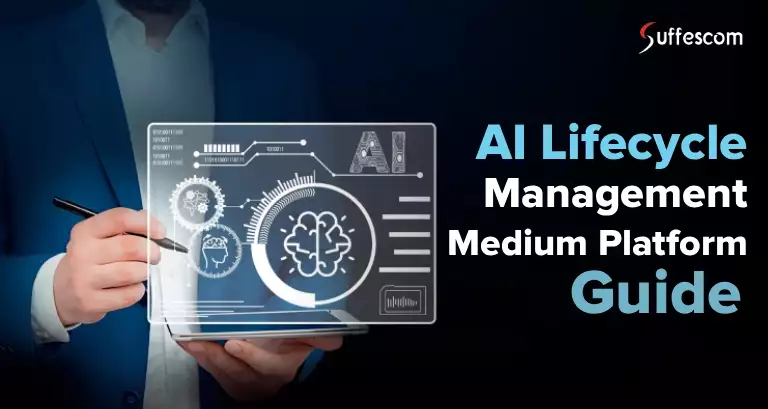
Today, AI has been widely adopted and integrated in enterprises to drive critical business decisions. It touches sensitive data, impacts customers, and operations. Despite all this, many entrepreneurs who are developing it or integrating AI solutions often struggle to understand which AI models are actively running in production, who owns each model, what data it uses, and how to manage risk from vendors’ AI systems. And this uncertainty gives rise to challenges like model sprawl, regulatory exposure, and hidden vendor risks. These issues can delay projects or unexpectedly increase operational costs. That’s why there is a growing need for AI lifecycle management and governance solutions that can provide accountability and control across every stage of an AI model’s life.
Let’s understand how these solutions ensure that AI models are developed, deployed, monitored, and retired in a way that reduces risk, satisfies compliance requirements, and flawlessly integrates with your enterprise workflows.
What is AI Lifecycle Management?
When an enterprise, government agency, or regulated organization develops an AI model, it needs a structured process to manage it throughout its lifecycle. AI lifecycle management ensures that the model is effective, compliant, and low risk from the moment it is conceived until it is retired.
Who needs AI Lifecycle Management?
AI Lifecycle management is critical for:
- Enterprises with multiple AI models in production
- Organizations growing their AI footprint
- Companies relying on AI for critical business decisions
- Organizations using third-party or vendor AI models
- Regulated industries (finance, healthcare, insurance, public sector)
Why Governance Solutions Are Needed
AI lifecycle management is about controlling and managing AI from start to finish. Here are the key stages involved in it:
1. Planning & Approval
Every AI initiative begins with a clearly defined use case and stakeholder approval. Here, governance plays a crucial role in establishing accountability regarding whether the AI project aligns with business objectives or not and whether it meets ethical and regulatory standards.
2. Data Preparation
Next, the important stage is data preparation. As we know, data is the foundation of any AI model. So, even the slightest of errors can propagate downstream risks.
Here, governance ensures data accuracy, completeness, and compliance with laws like GDPR and HIPAA.
3. Model Development
In the next stage, AI models are iteratively created, tested, and refined. Here, governance ensures version control and documentation of experiments.
4. Validation & Testing
Before deployment, models undergo rigorous validation.
At this stage, governance allows you to:
- Perform testing against real-world scenarios
- Detect bias and consider ethical compliance
- Prevent models from causing unintended harm or regulatory violations
5. Deployment Approval & Integration
Then comes the deployment stage that requires controlled workflows like:
- Who can deploy the model?
- Under what conditions and thresholds?
6. Monitoring & Maintenance
During production, models can drift or start behaving unexpectedly. This is where governance protects the business from operational and reputational risks by carrying out the following:
- Continuous monitoring of performance, risk, and bias
- Incident response protocols
- Structured restraining processes
7. Retirement
When model finally reaches end-of-life, governance ensures:
- Secure decommissioning and archival
- Documentation for audits and regulatory compliance
This can prevent obsolete models from causing risk or confusion.
Risks That May Arise Without Proper Governance
When governance is not carried out properly, it can give rise to the following risks:
- Multiple teams might end up creating overlapping models. This is known as model sprawling.
- Untracked models make compliance and audit difficult, posing regulatory risk.
- Third-party or vendor AI introduces hidden risks.
- Integrating AI into workflows without governance can bring operational risks.
How Governance Solutions Solves These Problems?
1. Visibility
In large enterprises, multiple teams may develop AI models independently. Without oversight, it’s easy to lose track of which models are in production, who owns them, and what data they use.
But governance solutions don’t allow this to happen as they act as a central inventory tracking all models across the enterprise. It records:
- Model ownership and team responsibilities
- Data sources and lineage
- Version history and updates
2. Control
Without oversight, teams might end up deploying models that have not been properly tested or approved.
Governance tools prevent this by letting the enterprise define and enforce rules at every stage of the AI lifecycle, and don't let models move forward unless they meet the standards.
3. Compliance
Regulators or auditors may require evidence of model validation, testing, and use. Without proper documentation, enterprises risk sanctions, fines, or reputational damage.
But governance solutions automatically track and log every action, like who created, modified, or approved a model. It also tracks data lineage, usage history, testing, validation, and bias assessment results.
4. Risk Reduction
AI models, especially those developed by third-party vendors, likely bring hidden risks such as errors or misaligned outputs. Governance handles this issue by providing continuous monitoring and risk assessment.
Existing Governance Tools and Why They Are Not Enough
Many enterprises assume that their current governance tools are sufficient to manage AI systems, but in practice, these tools only cover a portion of the required governance. Understanding their limitations is critical before deciding whether to extend them or build a dedicated governance layer.
Existing governance tools refer to software or processes that enterprises already use for various types of organizational control. They are provided by a mix of vendors:
- Cloud providers and AI platform vendors like AWS, Microsoft Azure
- MLOps and AI infrastructure platforms like Kubeflow, SageMaker.
- Compliance and risk management vendors like ServiceNow GRC, MetricStream
- Internal manual processes
1. AI Development and MLOps Platforms
The main purpose of AI development and MLOps platforms is to track, deploy, and monitor models. They manage versions and experiments. MLflow, Kubeflow, SageMaker, and Vertex AI are typical examples of such tools.
But they are focused on model operations and not model governance. They don’t enforce approval workflows, assign accountability, or track decision-related risk.
Also they don't provide audit-ready evidence or enforce enterprise-wide AI policies.
2. Cloud Security and Access Control Tools
Their key purpose is to manage the following:
User Access
- Permissions
- Logging for infrastructure
These tools are operated by IT/security teams. They focus on security but not AI decision-making. So, they don’t ensure that business rules, risk policies, or regulatory requirements are applied to AI models.
3. Compliance and Risk Management Platforms
Risk and compliance teams operate these tools to manage the policies, audits, and controls across the organization. They are basically designed for traditional risk workflows. They cannot track model drift, retraining, and automated decisions. They also don’t integrate with AI pipelines or provide a complete view of AI-related risk.
4. Manual Processes
Spreadsheets, document trackers, email approvals, and Confluence pages cannot provide a centralized and auditable view across multiple models and teams. Besides, they are also non-scalable and prone to human errors.
Platforms That Offer AI Governance Tools
Below are the major platforms and tools that provide AI lifecycle governance:
Cloud Provider & Native Ecosystem Governance
These are often part of a broader cloud AI stacks:
Microsoft Responsible AI/Azure ML
They provide built-in tooling for fairness, explainability, responsible AI practices, and policy enforcement within Azure workflows.
Amazon SageMaker Responsible AI/SageMaker Clarify
Ideal for bias detection, explainability reporting, monitoring, and governance hooks tied to AWS AI operations.
Google Vertex AI Governance
Metadata tracking, drift monitoring, risk insights, and lineage in GCP environments.
Dedicated AI Governance & Lifecycle Platforms
These are more focused on governance across the full model lifecycle:
IBM Watson OpenScale/ watsonx Governance
Bias monitoring, performance oversight, explainability, drift detection, and compliance documentation.
DataRobot AI Cloud (Governance Suite)
Centralized model registry, automated compliance reporting, fairness & drift controls, and policy enforcement.
Fiddler AI
Explainability, bias/fairness monitoring, and trust/guardrail controls are often used in regulated environments.
Adjunct Data & Policy Governance
The following are not purely governance platforms, but they are often used in support:
- Atlan/Collibra/Microsoft Purview (data governance with some AI‑adjacent controls)
- Credo AI/Truera (specialized in compliance and explainability layers)
Are These Platforms Reliable for Enterprise AI Governance?
Many enterprises assume that any platform labeled “AI governance” will automatically solve their governance challenges. In practice, reliability depends on whether the platform can cover the full AI lifecycle from planning, data preparation, model development, validation, deployment, and retirement.
The next important part is whether it can support vendor and third-party AI. Would it be able to track, monitor, and enforce rules on models that originate outside the enterprise?
Besides, would it be able to enforce policy and workflows and provide audit-ready reporting? And lastly, would it be able to scale across teams, geographies, and cloud environments to handle multiple AI models without gaps in control? Based on these aspects, here is what current platforms deliver and where they fall short.
1. Cloud-native platforms like AWS SageMaker, Azure Responsible AI, and Vertex AI can integrate well with existing cloud infrastructure, but they come with the following limitations:
- Limited full lifecycle coverage
- Weak vendor AI management
- May not provide audit-ready documentation
2. Dedicated AI governance platforms like Holistic AI, IBA Watson, and OpenScale come with full lifecycle coverage and all the benefits mentioned above, but they come with the following trade-offs:
- May require customization to fit enterprise workflows
- Multi-cloud setups
- Hybrid AI environments
3. Observability tools like Fiddler and Arthur AI are excellent at real-time monitoring, drift, and bias detection, but below are some of their downsides:
- Offers operational governance only
- They don’t force approvals
- They don’t manage the entire lifecycle
How to Decide Whether a Platform is Suitable for Your Needs?
The enterprise must evaluate platforms against its unique AI footprint. Here is how:
1. Keep the visibility at the key focus. Make sure the platform you choose can give you a clear picture of all AI models in production. Now, if you only have internal models that are low risk, then even a simple monitoring dashboard might be enough for your specific needs. However, if you rely on third-party or vendor AI, basic dashboards won’t show hidden risks. In that case, you may need a custom solution that tracks every external module.
2. Pick the platform that lets you define rules, approval workflows, and conditions for model deployment. If your enterprise is heavily regulated or subject to audits, ensure the tools can enforce compliance automatically; otherwise, a custom build may be necessary.
3. If your enterprise has large teams developing AI in parallel, make sure the platform you pick can centralize governance across all your organizations. This is generally possible through a custom solution.
4. Check if the platform offers audit-ready logs, documentation, and reporting. If your models directly impact regulated outcomes, off-the-shelf monitoring tools alone may not be sufficient.
5. Map governance features to the potential consequences of errors in AI decisions. Small errors in low-stakes models might be fine with simple monitoring. But high-stakes models like fraud detection or patient risk prediction require full lifecycle oversight. So, if your risk exposure is high, a dedicated or custom governance platform will be needed.
6. Many enterprises use third-party AI without realizing the hidden operational and regulatory risks. Don’t commit the same mistake. Before choosing the platform, confirm if it can track updates, performance, and risk of vendor-provided AI models. Usually, if your AI ecosystem includes external models, you may need a custom layer or integration to ensure full governance.
Should enterprises extend existing tools or build a custom platform?
The next important question is how to implement governance. Most organizations already have some tools (cloud platforms, MLOps tools) in place, so the decision usually comes down to whether to extend what already exists or build a dedicated governance platform. Here is how enterprises typically approach this decision:
1. When Extending Existing Tools Makes Sense
Extending existing tools is reasonable when governance needs are narrow and contained. This approach works if:
- The number of production models is manageable.
- AI models are developed internally.
- Governance is mainly about model performance and basic risk checks.
- Compliance requirements are light or well-defined.
- Few teams are involved in AI development.
What is realistically possible to extend:
- Adding model metadata tracking
- Connecting monitoring tools to detect drift or performance issues
- Enforce basic deployment conditions
- Store logs related to training and deployment
- Generate basic internal reports
In these cases, extending tools helps reduce operational risk, even if governance is not fully centralized.
2. Where Extending Existing Tools Doesn't Work
If you have the following conditions, it’s better to go with a custom governance solution rather than going for an extension:
- AI is used in regulated or high-impact decisions
- Policies must be enforced consistently across systems
- Audit trails must be complete and regulator-ready
- Governance rules differ by model, region, or use case
- Vendor or third-party AI models are involved
3. Simple Rule of Thumb
1. Extend existing tools when governance is mostly about monitoring and basic control.
2. Don’t rely on extensions when governance involves compliance, accountability, or vendor risk.
3. When governance must be centralized, enforceable, and auditable, a custom governance platform is required.
Key Governance Challenges in Enterprise AI
Even with clearly defined AI lifecycle stages, many enterprises struggle in practice to enforce governance. In real-world enterprise environments, gaps in ownership and decision traceability are where most governance-related challenges arise and create blind spots that simple monitoring tools cannot cover. The following challenges highlight the areas the enterprise must address to make governance truly effective.
Ownership, Accountability & Decision Traceability
As AI systems move from experimentation into production, the most difficult challenge is no longer technical performance but accountability. Effective AI governance requires that ownership and traceability be built into the system, not reconstructed after an incident or audit.
A mature governance framework assigns and enforces responsibility across multiple owners:
- Business ownership, accountable for how AI outputs are used and their downstream impact
- Technical ownership, accountable for model behaviour, updates, and reliability.
- Data ownership, accountable for data quality, lawful use, and provenance.
- Risk or compliance ownership, accountable for regulatory exposure and ethical alignment.
They must be actively enforced through governance workflows that ensure every change to an AI system has a clearly accountable party.
Accountability Depends on Traceable Approval Decisions
Governance is not just about knowing who owns a model, but also who authorized it to act. Every meaningful lifecycle event, such as training, deployment, retraining, or configuration change, represents a decision that carries risk. So, the enterprise must be able to trace:
- Who approved the action
- Under which policies or risk thresholds
- Based on which classification of model impact
- At what point in time
This decision context must persist even as models evolve. Without it, accountability can erode, and organizations will eventually be forced to rely on assumptions rather than evidence during audits.
Get Started Building Effective AI Governance
Effective AI governance starts with understanding both the technology and the enterprise environment in which it operates. Enterprises need solutions that account for the full AI lifecycle, manage vendor and third-party models, and align with regulatory and operational requirements. Our approach ensures all these needs are met, providing you with full visibility across all AI initiatives.
We support enterprises across the entire AI lifecycle, from initial model design to deployment, monitoring, and governance. Here is how:
1. Full AI System Development
Designing and building AI models for specific enterprise use cases, including:
- Predictive analytics
- Recommendation engines
- Decision-support systems
- Chatbots, virtual assistants, and conversational AI that integrate smoothly with enterprise workflows.
2. AI Integrations Across Systems
- Connect AI models with existing enterprise apps, databases, and cloud platforms
- Ensure real-time data flow and operational alignment
3. Lifecycle and Governance Ready Design
- Structure AI systems to support version control, audit logs, bias, monitoring, and compliance reporting
- Design that supports scalable monitoring, automated alerts, and controlled deployment workflows
4. Vendor and Third-Party AI Management
- Integrating and tracking external AI modules and third-party models within governance frameworks.
- Reducing hidden risks while maintaining operational efficiency.
5. Cross-Industry Solutions
- Experience in delivering AI systems in finance, healthcare, insurance, retail, logistics, and other regulated sectors.
- Development processes are informed by real-world compliance, operational, and risk considerations, not just technical feasibility.
Bottom line
Today, AI is widely adopted by enterprises for critical decision-making and operational processes. But without structured AI lifecycle governance, there are major risks involved that can delay projects, inflate costs, or even cause reputational damage. That’s why there is a dire need for effective AI governance to ensure accountability and control across the entire lifecycle of the project. While existing tools offer partial oversight, they rarely cover full lifecycle governance and enforce proper approval workflows. Businesses, therefore, must evaluate whether off-the-shelf governance platforms meet their needs or whether a custom solution is required, especially when dealing with high-stakes models and third-party AI.
FAQs
1. How do I know if my AI models are at risk without proper governance?
Signs your models may be at risk:
- Models give inconsistent results.
- Teams don’t know which models are live or who owns them.
- Vendor AI is used without oversight.
- There is no audit trail or performance tracking.
We can audit all your AI models and track ownership so you know which models are at risk and can act before a problem arises.
2. How do we choose between extending existing tools vs building a custom governance solution?
We can help you evaluate what aligns with your project needs in a free consultation session. Book now!
3. Can you manage AI lifecycle governance for both internal and third-party AI models?
Yes, we will design a platform to centralize governance across both internal and external models.
4. Can you support AI governance for large-scale, multi-cloud environments?
Yes. We design solutions that work across AWS, Azure, GCP, and hybrid environments. Our platform provides:
- A single view of all models across clouds
- Policy enforcement that works everywhere
- Alerts for drift, bias, or risk regardless of location
5. Have you designed governance solutions that scale across teams and geographies?
Yes, we specialize in building platforms that enforce consistent workflows across teams and locations, with role-based access, automated approvals, and centralized dashboards.