+971-8000321216




Key takeaways:
- Mobile banking app development costs range from $40,000 for a basic MVP to $500,000+ for a full enterprise platform in 2026
- Regulatory compliance, PCI DSS, PSD2, GDPR, KYC/AML add $30,000–$100,000 to total project cost and cannot be retrofitted after development
- Digital banking app downloads surged 54% in 2025; the global mobile banking market is projected to reach $1.36 trillion by 2028 at an 11.9% CAGR
- 57% of millennials and 64% of Gen Z now hold accounts with non-traditional financial institutions
- Post-launch maintenance averages 15–20% of initial development cost annually, an operating expense that must appear in your business case from day one
- Hidden costs such as QA testing, backend infrastructure, security audits, hosting, and licensing fees can significantly impact the overall banking app budget
- Mobile banking app development timelines typically range from 4 to 12+ months, depending on app complexity, integrations, compliance needs, and feature requirements
- Investing in strong security measures such as biometric authentication, fraud detection, and data encryption is essential to maintain compliance and user trust
Want similar results? → Get a Free Quote
The development of a mobile banking application in 2026 is not restricted to conventional banking enterprises anymore. Today, neobanks, fintech companies, financial payment providers, and other types of businesses invest in robust banking apps. The only thing that is yet to be determined when planning such projects is the price for developing a banking app.
The mobile banking app development cost in 2026 can vary from $20,000 up to more than $250,000 based on factors such as app complexity, required features, platforms, security requirements, third-party services, and the approach to development. The app offers only simple operations with bank accounts, which will cost a developer much less than a banking app featuring AI technologies or cryptocurrency integration.
This guide provides you with a detailed overview of the banking app development cost in 2026, including different types of apps, the price of particular features, hidden fees, security issues, development timeframe, and some optimization methods.
Get a Transparent, Compliance-Aware Cost Estimate
Our fintech architects will review your requirements and return a milestone-based estimate with compliance scope included — within 48 hours.
Mobile Banking App Cost: Quick Reference (2026)
| Complexity Tier | Development Cost | Timeline | What's Included |
| Basic MVP | $40,000 – $80,000 | 3 – 5 months | Account management, transfers, transaction history, basic KYC, single platform |
| Mid-Level Platform | $80,000 – $200,000 | 5 – 9 months | Biometric login, bill payments, open banking APIs, PCI DSS compliance, iOS + Android |
| Advanced Platform | $200,000 – $350,000 | 9 – 14 months | AI fraud detection, multi-currency, investment tools, PSD2 compliance, analytics |
| Enterprise Platform | $350,000 – $500,000+ | 12 – 24 months | Multi-market compliance, core banking integration, white-label architecture, custom infra |
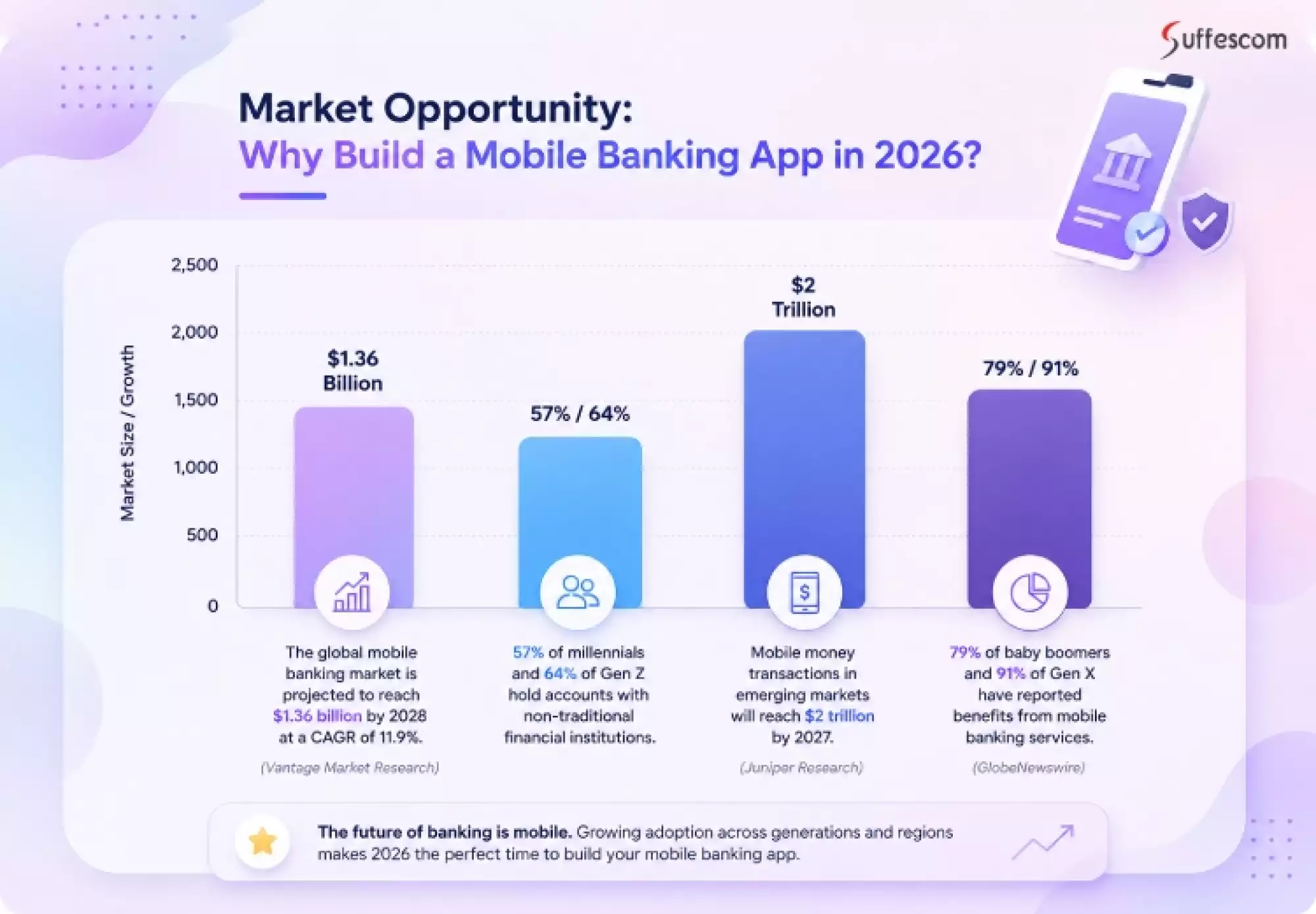
Market Opportunity: Why Build a Mobile Banking App in 2026?
Before examining costs, the business case matters particularly for founders and institutions comparing this investment against expected returns.
The global mobile banking market is projected to reach $1.36 billion by 2028 at a CAGR of 11.9% (Vantage Market Research)
According to GlobeNewswire, the increasing popularity and user adoption of mobile banking apps have significantly impacted the global mobile banking market, which is estimated to reach $1.36 billion by 2028.
57% of millennials and 64% of Gen Z hold accounts with non-traditional financial institutions
Mobile money transactions in emerging markets will reach $2 trillion by 2027
79% of baby boomers and 91% of Gen X have reported benefits from mobile banking services
According to Juniper Research, the total value of mobile money transactions in emerging markets will reach $2 trillion by 2027.
Cost by Mobile Banking App Type
Different banking app categories carry fundamentally different technical requirements, compliance obligations, and cost structures. Knowing which type you are building is the first step to an accurate budget.
| App Type | Estimated Cost Range | Primary Technical Drivers | Compliance Complexity |
| Retail Banking App | $80,000 – $200,000 | Account management, transfers, card controls, PFM | PCI DSS, KYC/AML, GDPR |
| Neobank / Challenger Bank | $100,000 – $300,000 | Full account lifecycle, virtual cards, real-time payments | E-money license, PCI DSS, AML |
| Corporate / Business Banking | $120,000 – $350,000 | Multi-user roles, payroll, bulk payments, invoicing | AML, KYB, open banking |
| AI-Powered Banking App | $150,000 – $400,000 | ML fraud detection, PFM insights, NLP support, credit scoring | Standard + AI governance requirements |
| Crypto Banking App | $120,000 – $350,000 | Blockchain integration, multi-chain wallet, fiat/crypto bridge | VASP registration, AML/CFT |
| Investment / Wealth App | $100,000 – $300,000 | Portfolio management, market data feeds, robo-advisory | MiFID II (EU), SEC/FINRA (US) |
| White-Label Banking App | $20,000 – $80,000 (setup) | Configurable core + custom branding | Compliance inherited from platform provider |
| Super App with Banking Module | $200,000 – $500,000+ | Full lifestyle + embedded banking, multi-service backend | All banking compliance + data aggregation |
UPI Payment App
A UPI payment app provides the ability to perform peer-to-peer transactions and merchant payments based on India’s Unified Payments Interface system. App development involves QR code scanning, digital bank transactions, biometric authorization, and P2P phone number transactions. Check out our separate article on UPI payment app development cost breakdown.
Neobank App
Neobanks are virtual banks that compete with classic banks based on user experience, convenience, and innovative services. Neobank app development includes digital onboarding (without using paper forms), rich dashboards with all necessary features, and fintech API integrations providing unique functionalities.
Crypto / Decentralized Banking App
Companies developing crypto banking apps use blockchain technology, ensuring maximum user privacy and decentralization. Blockchain technology implementation, creating a set of smart contracts (self-executing code) for automation, and building a crypto wallet are among essential expenses here.
AI Banking App
AI banking applications leverage machine learning capabilities, enabling users to get customized recommendations, automatically detect any fraud activity, and use an advanced AI-based chatbot for 24/7 customer service. The extra cost is needed for AI model creation, infrastructure setup, and improvement systems.
Virtual Banking App
Virtual banking apps provide the full suite of banking services through a digital interface only, with no physical branches. They require the most comprehensive tech stack, broadest compliance coverage, and deepest integration with payment networks, making them the most expensive category to build.
Development Stage Cost Breakdown
Understanding how a budget distributes across phases reveals where scope decisions have the greatest financial impact and where cost-cutting carries the highest risk.
| Development Phase | % of Total Budget | Core Deliverables |
| Discovery and Architecture | ~8% | Requirements, regulatory scoping, system design, API selection |
| UI/UX Design | ~12% | User research, wireframes, design system, prototype, accessibility |
| Backend Development | ~25% | Core banking logic, API layer, database, transaction processing, integrations |
| Mobile Frontend | ~18% | iOS/Android app client, wallet UI, onboarding flows, biometric integration |
| Compliance Engineering | ~15% | KYC/AML, consent management, PCI DSS controls, audit logging, SCA |
| Security Testing and QA | ~12% | Functional testing, load testing, penetration testing, compliance review |
| Deployment and Infrastructure | ~10% | Cloud setup, CI/CD pipelines, monitoring, disaster recovery |
Complete cost breakdown with all-in estimates:
| Component | Basic MVP | Mid-Level | Enterprise |
| Discovery and Architecture | $3,000 – $6,000 | $8,000 – $15,000 | $20,000 – $40,000 |
| UI/UX Design | $5,000 – $12,000 | $15,000 – $30,000 | $35,000 – $70,000 |
| Backend Development | $15,000 – $25,000 | $30,000 – $70,000 | $80,000 – $180,000 |
| Mobile Frontend | $10,000 – $18,000 | $20,000 – $50,000 | $60,000 – $120,000 |
| Compliance Engineering | $5,000 – $10,000 | $15,000 – $35,000 | $40,000 – $80,000 |
| Security Testing and QA | $4,000 – $8,000 | $10,000 – $25,000 | $30,000 – $60,000 |
| Deployment and Infrastructure | $3,000 – $6,000 | $8,000 – $18,000 | $20,000 – $45,000 |
| Core Development Total | $45,000 – $85,000 | $106,000 – $243,000 | $285,000 – $595,000 |
| KYC/AML Integration | $8,000 – $15,000 | $12,000 – $20,000 | $20,000 – $40,000 |
| PCI DSS Certification | $10,000 – $20,000 | $20,000 – $35,000 | $35,000 – $60,000 |
| Total All-In Estimate | $63,000 – $120,000 | $138,000 – $298,000 | $340,000 – $695,000+ |
9 Key Factors That Affect Mobile Banking App Development Cost
Understanding what drives cost gives you control over your budget. These nine variables have the biggest impact on your total mobile banking app development investment.
Let’s understand these factors in detail to determine the cost of developing a robust mobile banking app.
1. App Complexity
The feature scope is the #1 cost driver. Basic balance-and-transfer apps cost a fraction of AI-powered platforms with investment tracking and personalized financial insights. Every additional feature multiplies development and testing effort.
2. Platform Choice
An iOS-only or Android-only approach reduces cost significantly. Building for both natively doubles frontend effort. Cross-platform frameworks (React Native, Flutter) reduce two-platform costs by 30–50% while delivering near-native performance.
| Platform Strategy | Cost Profile |
| Native iOS only | Baseline |
| Native Android only | Similar to iOS |
| Dual native (iOS + Android) | +70–90% vs. single |
| Flutter (cross-platform) | +30–50% vs. single |
| React Native | +35–55% vs. single |
| PWA | Lowest cost |
3. App Type
The type of banking app fundamentally changes the tech stack, compliance requirements, and third-party integrations needed, making it one of the most significant cost variables. UPI apps are the cheapest; virtual banking apps are the most expensive.
4. Design Complexity
A clean, standard UI/UX design costs less than a custom brand-led design system with micro-animations, custom components, and dark/light mode variants. Design typically accounts for 10–15% of the total development budget.
5. Security & Compliance
PCI DSS compliance, MFA, biometrics protection, end-to-end encryption, and compliance with regulations (such as GDPR, PSD2, and FFIEC) raise costs significantly. Yet, none of those can be avoided when building any live banking application involving real users' money.
6. Location & Expertise of the Team
Team based in the US/Europe: $80-$200/hr. Team based in Eastern Europe: $40-$80/hr. Team based in India/SE Asia: $20-$60/hr. An offshore team with banking experience can save 40%-60% of project costs compared to the equally skilled US team working on similar projects.
| Region | Junior | Mid-Level | Senior / Architect |
| United States / Canada | $80 – $120/hr | $120 – $180/hr | $180 – $280/hr |
| Western Europe | $65 – $95/hr | $85 – $130/hr | $110 – $170/hr |
| Eastern Europe | $35 – $55/hr | $50 – $85/hr | $70 – $110/hr |
| India | $20 – $35/hr | $30 – $55/hr | $45 – $80/hr |
| Southeast Asia | $20 – $35/hr | $30 – $50/hr | $40 – $70/hr |
| Latin America | $35 – $55/hr | $50 – $75/hr | $65 – $95/hr |
7. Integration With Third-Party Services
Integrations with payment gateways, APIs of the credit bureau services, open-banking services (such as Plaid or Yodlee), KYC/AML vendors (Jumio or Sumsub), and financial data feeds will prolong development time and generate additional monthly expenses.
| Integration Category | Providers |
| KYC / Identity Verification | Onfido, Sumsub, Jumio |
| AML / Sanctions Screening | ComplyAdvantage, Chainalysis |
| Payment Processing | Stripe, Adyen, Checkout.com |
| Open Banking APIs | Plaid, TrueLayer, Yapily |
| Banking as a Service (BaaS) | Railsr, Treezor, Synapse |
| Card Issuing | Marqeta, Stripe Issuing |
| Push Notifications | Firebase |
8. Quality Assurance
A banking application requires more testing than any other type of mobile app due to functional tests, security penetration testing, performance, and compliance testing. Typically QA takes up 15%-20% of overall development costs.
9. AI & Advanced Technology Integration
Integrating advanced technologies into the app, such as AI (fraud detection, personalization, chatbots, voice banking, and spending analytics), comes with an additional cost of $20,000-$60,000+. Blockchain technology implementation for cryptocurrencies is also pricey.
Essential Features for a Mobile Banking App and Their Cost Impact
The features you choose directly determine both the development effort and the final cost. Here are the core and advanced features of a competitive mobile banking app, with notes on how each affects your budget.
Account Management
Offers easy checking of account balances, reviewing of transaction history, and monitoring real-time account activity, providing a comprehensive overview of financial status at the fingertips.
Fund Transfers
Intra-bank and inter-bank transfers, recurring transfers, and scheduled payments. Standard for mid-level apps and above.
Bill Payments
Facilitate bill payments in such a way that enables customers to make them online, set up automatic payments for bills, and receive reminders of important bill payments that should be made.
Mobile Deposits
Enable customers to deposit cheques using their cell phone cameras and obtain immediate updates regarding the deposited funds without having to physically go to the bank.
Alerts And Notifications
Keep your customers informed about their transactions, balances and all the happenings in their accounts through various alerts and notifications.
Card Management
Debit/credit card activation, spending limits, freeze/unfreeze, and lost card reporting. Requires secure card processor API integration.
Budgeting And Financial Planning
Spending categorization, budget goals, and financial reports. Advanced feature — ML-powered categorization adds development complexity.
Mobile Wallet Integration
Apple Pay, Google Pay, and PayPal compatibility. For crypto banking apps, our experts also develop crypto wallets and integrate them for seamless digital asset transactions.
AI Chatbot Support
24/7 automated customer support via AI chatbot solutions. Reduces customer support costs while improving satisfaction. Adds $10,000–$25,000 depending on sophistication.
Bank & ATM Location
Integrate GPS into your mobile banking platform and let users find your bank locations and ATMs with ease.
Biometric Authentication
Fingerprint and Face ID login. Now expected as standard, it should be included in any banking app launched in 2026.
Investment Tracking
Portfolio management, real-time market data, and stock/crypto prices. Advanced feature requiring financial data API integration adds $15,000–$40,000.
UPI & QR Payments
UPI payment app features include QR code scanning, P2P transfers via phone numbers, and instant settlement.
Regulatory Compliance Costs: The Non-Negotiable Budget Line
Security is the non-negotiable foundation of any banking application. Unlike consumer apps, banking apps handle highly sensitive financial data and are subject to strict regulatory oversight. Here is what compliance costs look like in 2026.
| Compliance Standard | What It Covers | Applicable To |
| PCI DSS | Payment card data security | Any app processing card payments |
| GDPR | EU user data privacy and consent | Any app with European users |
| PSD2 / Open Banking | Secure third-party API access | Apps in EU/UK banking ecosystem |
| KYC / AML Integration | Identity verification, anti-money laundering | All banking apps handling real funds |
| SOC 2 Type II | Security, availability, and confidentiality | Enterprise banking platforms |
| Biometric/MFA Security | Multi-factor authentication layer | All modern banking apps |
Full Compliance Cost Summary
| Regulation | Market | One-Time Setup |
| PCI DSS | Global (card data) | $15,000 – $50,000 |
| PSD2 / Open Banking | EU, UK | $15,000 – $35,000 |
| GDPR | EU + global (EU users) | $10,000 – $25,000 |
| CCPA | US (California) | $5,000 – $15,000 |
| KYC / AML | All markets | $8,000 – $20,000 |
| BSA / FinCEN | US | $10,000 – $30,000 |
| E-money license (EU) | EU (if issuing e-money) | $50,000 – $200,000 (legal) |
Get Your Mobile Banking App Built Right — The First Time
Share your app type, target market, and must-have features. Our fintech specialists will return a scoped cost estimate, recommended tech stack, and compliance roadmap within 24 hours.
Mobile Banking App Development Process — 8 Key Stages
Understanding the development process helps you evaluate timelines, manage stakeholders, and catch cost overruns before they happen. Here is what a professional mobile banking app development process looks like from discovery to launch.
1. Discovery & Requirement Analysis
Describe your target audience, determine the banking app type and jurisdiction, list main functionalities and features, define the monetization method, etc. In this stage, you get a detailed technical specification document that allows scope changes to be avoided. Allocate about 8-10% of the total development budget to this step; its benefits will be felt several times.
2. Compliance & Regulatory Framework Designing
Identify all necessary regulations (PCI DSS, GDPR, PSD2, KYC/AML) before starting to design the system architecture. Compliance requirements determine the way the banking app architecture is designed (encryption, data storage and management, APIs, and other integrations). Adding compliance after development can cost up to 3-5 times more.
3. Architecture Design & Tech Stack Choice
Design system architecture in detail, including back-end services, data storage architecture, APIs, integration with third parties (payment processing gateways, KYC and others, Open banking APIs), and cloud infrastructure. This stage is critical because you choose platform and technology stack at
4. UI/UX Design and Prototyping
Banking apps have to offer a wide range of functionality but, in addition to that, provide for an intuitive, seamless user experience. Users work with their money; even the slightest glitch will destroy their trust. High-fidelity Figma prototypes are tested with potential users ahead of development to minimize costs associated with redrawing after development.
5. Backend Development and Third-Party API Integration
The core banking logic will be developed, which includes transactions processing, accounts, user authentication, push notifications, and administrative systems. The application will integrate payment gateways and other external services such as Plaid and Yodlee for financial information, Jumio and Sumsub for KYC/AML, and open banking APIs. In case the bank uses AI, this process will include training the machine learning model.
6. Frontend Development
Development of the mobile app interface. Implementation of all user-oriented features: dashboard, transactions, account management, biometric authentication, and push notifications. In case it is a crypto bank, the frontend implementation will also involve integration with a Web3 library.
7. Security Auditing and QA
Banking applications need the highest level of QA among all other application types: functional testing, security penetration testing, performance testing, compliance testing, and user acceptance testing.
8. Deployment, App Store Submission & Post-Launch
Deploy backend infrastructure on a secure cloud (AWS, Google Cloud, or Azure); submit to the App Store and Google Play (banking apps face extended review timelines); and launch with monitoring infrastructure in place. Post-launch support covers bug fixes, security patches, OS compatibility updates, and new feature development funded by user growth.
Technology Stack for Mobile Banking App Development
Every technology choice in a banking app carries security and compliance implications that do not exist in other app categories. This table explains not just what to use, but why each choice matters for banking specifically.
| Layer | Technology |
| Mobile (primary) | Flutter |
| Backend — Core | Java (Spring Boot) |
| Backend — API Layer | Node.js / TypeScript |
| Backend — AI/ML | Python (FastAPI) |
| Primary Database | PostgreSQL |
| Cache | Redis |
| Cloud Infrastructure | AWS / GCP + Kubernetes |
| KYC / Identity | Sumsub, Onfido, Jumio |
| Payment Processing | Stripe, Adyen |
| Open Banking | Plaid, TrueLayer, Yapily |
| Security Testing | OWASP ZAP, Burp Suite |
| CI/CD | GitHub Actions, Jenkins |
| Notifications | Firebase (FCM) |
Hidden Costs Involved in the Cost of Developing a Mobile Banking Application
Although the development costs will be used for implementing basic functionalities, there are additional expenses that must be considered while developing a mobile banking application. The following list comprises costs that are often overlooked by developers.
Testing & Quality Assurance (QA)
Cost: 15% – 25% of the total development budget
The QA process is crucial when developing banking apps. It includes functional testing, performance testing, security testing, and cross-platform testing to make sure that the application works flawlessly and is free from any bugs.
Backend Infrastructure Costs
Monthly Cost: $200 – $5,000+
An app designed for financial transactions needs a reliable infrastructure to handle payments, data encryption, API calls, and other operations. These expenses will keep increasing depending upon the growth in users.
Costs Related to App Maintenance
Cost: 15% – 20% of the initial development cost per year
The app needs constant updates to maintain its security and functionality after its official release. This expense depends on various aspects, such as updating iOS and Android SDKs, fixing bugs, etc.
App Hosting & Store Listing Fees
Cost: $25 (Google Play - once), $99-$299/year (Apple App Store)
In order to launch your banking application, you will need to pay listing fees on the platforms where you want to publish your app. Although these expenses are not that high, their importance lies in ensuring visibility of your product.
App Marketing & User Acquisition
Cost: Varies Widely
Every banking app requires marketing efforts. Your expenditure might involve ASO, advertising, content marketing, social promotion, and other measures aimed at promoting your app.
Security & Compliance Costs
Cost: $5,000-$100,000+
Your banking mobile app must be safe for users. Data encryption, fraud prevention, biometric authentication, compliance audits, and security testing are features that require additional investments but are absolutely vital for a financial application.
Legal & Licensing Fees
Cost: $1,000-$50,000+
Financial applications have to meet certain legal standards regarding licenses, regulations, and compliance. You should consider legal protection for your project in advance to prevent any issues.
| Cost Category | Monthly Range | Annual Estimate | Notes |
| Quality Assurance (QA) & Testing | Variable | 15–25% of development budget | Includes functional, security, usability, and performance testing |
| Infrastructure & Backend Costs | $2000–$5,000+ | $2.4K–$60K+ | Depends on cloud hosting, APIs, database, and user traffic |
| App Maintenance & Post-Launch Support | Variable | 15–20% of initial app cost | Covers bug fixes, updates, and OS compatibility |
| App Hosting & Store Listing Fees | Minimal | $25 (Google Play) + $99–$299 (Apple) | Fixed publishing and hosting-related costs |
| App Marketing & User Acquisition | Variable | $10K–$100K+ | Includes ASO, paid ads, social campaigns, and promotions |
| Security & Compliance Costs | Variable | $5K–$100K+ | Covers encryption, fraud detection, audits, and compliance |
| Legal & Licensing Fees | Irregular | $1K–$50K+ | Depends on legal agreements and financial regulations |
White-Label vs. Custom vs. Hybrid: Decision Framework
| Dimension | White-Label / BaaS | Hybrid (Custom UX + BaaS Core) | Full Custom |
| Time to market | 4 – 12 weeks | 3 – 6 months | 4 – 18 months |
| Initial cost | $20,000 – $80,000 | $60,000 – $180,000 | $80,000 – $500,000+ |
| Ongoing cost | SaaS fee + revenue share (0.5–1.5% of volume) | Infrastructure + BaaS subscription | Infrastructure + maintenance (15–20% annually) |
| Compliance ownership | Platform provider maintains core compliance | Shared — BaaS provider handles core; you handle UX layer | You own all compliance |
| Customization | Branding + feature configuration | Full UX and product feature control; BaaS handles core | Complete control of every component |
| IP ownership | Limited | Partial | Full |
| Long-term flexibility | Dependent on provider roadmap | High on product; limited on core banking | Unlimited |
| Best for | MVP launch, market validation, speed-to-market | Ambitious products needing speed + differentiation | Long-term banking brand; institutional-grade platform |
How to Optimize Your Banking App Development Budget
Cost efficiency should not involve compromises concerning security and regulation; rather, it entails a wise approach towards spending your money.
1. Start with an MVP
Launch with core features — account management, transfers, and notifications then add advanced capabilities based on real user feedback. An MVP approach reduces initial investment by 40–60% while generating the revenue and data needed to justify the next development phase. This is the most important cost reduction strategy for any banking app startup.
2. Use Cross-Platform Development
React Native and Flutter deliver near-native performance for banking apps while cutting two-platform development costs by 30–50%. Unless your use case requires cutting-edge platform-specific features (like ultra-low-latency trading), cross-platform is the correct choice for the vast majority of banking app projects.
3. Choose the Right Development Partner
A mobile app development company with specific fintech and banking domain expertise will avoid the costly mistakes that general development agencies make, wrong compliance approach, inadequate security architecture, or third-party integrations that don't meet banking API standards.
With Suffescom’s FinTech software development services, you can accelerate your product launch by eliminating the complexities of building core financial infrastructure from scratch.
4. Design for Scalability from Day One
While it might cost you a little extra money at the outset to have a scalable system, you can save between 3-5 times that amount in refactoring your architecture as you scale up. Scalable system design is achieved through microservices architecture, horizontally scaled systems infrastructure, and modular feature design.
5. Prioritize Features Ruthlessly
Each additional feature means more money spent on development, testing, and maintenance of the application. Before you build in a feature, ask yourself: does it add directly to customer retention, generate revenue, or satisfy regulatory requirements? If not, then leave it out of the product until future releases.
Why Choose Suffescom for Mobile Banking App Development?
Suffescom is a renowned mobile app development company, offering secure, scalable, and feature-packed banking solutions to fintech companies, enterprises, and financial organizations. Whether it is virtual banking, neobanks, AI-based, or crypto banking solutions, Suffescom leverages its technical skills and extensive industry knowledge to deliver future-proof banking solutions.
More than 13+ Years in the Industry
The Suffescom team knows how to develop fintech applications and solutions for a variety of markets. We have a profound understanding of evolving user needs, compliance issues, and modern banking trends.
Knowledgeable in Banking Industry Processes
The Suffescom team possesses in-depth knowledge of such processes as payment gateways, PCI DSS, PSD2, KYC/AML regulations, and open banking standards. It means your banking application will always be safe, compliant, and ready to go on the market.
Full-Cycle App Development
The Suffescom specialists conduct all stages of development, starting from the initial consultation through architecture, design, coding, testing, and optimization of your mobile banking app.
Project Delivery Models
The Suffescom team offers such project delivery models as fixed-price projects, time-and-material projects, and dedicated development teams. Our flexible approach allows customers to select the right model depending on
Transparency Pricing Model
You will not be surprised by the price; our approach includes clear project scoping. We maintain complete transparency throughout the development process.
Agile Development Process
Our process involves iterative development and milestone-based project deliverables. This helps accelerate development while ensuring consistent improvements.
Post-Launch Application Support
Your application will be continuously monitored, optimized, and updated by our team. We ensure your app stays compatible with evolving technologies and user demands.
FAQs
1. What is the cost of mobile banking application development in 2026?
The price tag of building a mobile banking application varies greatly depending on various circumstances. Thus, the development of a basic MVP starts at $40,000 and reaches $80,000, while creating a full enterprise application costs anywhere from $350,000 to even more than $500,000. Most enterprise products end up costing somewhere in the middle – around $80,000 to $250,000.
2. What elements affect the price of banking app development?
There are multiple factors affecting the price of your project. First of all, these are complexity and quality of development, design of the user interface and experience, integration with various additional services, and requirements for security and data privacy.
3. Which banking application is cheaper to make?
Creating a simple application will be cheaper than an advanced one. In the latter case, you might need to include some sophisticated features like machine learning abilities and cryptocurrency support. These will increase the price of the project significantly.
4. What time will it take to develop a banking app?
A banking app can be developed within two to six months, but it highly depends on the type of product and specific features included, as well as the company's development strategy and the selected platform.
5. Is it cheaper to build a banking app for iOS or Android first?
There may be some savings by developing for one platform only first, but the development process can also become more efficient through cross-platform development frameworks such as Flutter or React Native. It all depends on what you aim to achieve.
6. What will be the costs associated with operating a mobile banking application?
The development stage is not the only place where costs may arise; there are also operational costs involved. You will need to allocate resources for hosting, monitoring, upgrades, and other expenses.
ach $1.36 billion by 2028 at a CA