+971-8000321216




Building a digital product today is less about writing code and more about validating the right problem. Despite access to frameworks, a large share of startups fail because early product decisions are made without market feedback. Also, recent studies indicate that 90% of startups fail due to a lack of product–market fit, which emphasizes the importance of MVP development in 2026.
The UK has become a market for MVP development because it combines product thinking with engineering depth. But businesses often struggle to find the right UK-based MVP development company that prioritizes discovery and iterative delivery over feature-heavy builds, while also trying to understand what MVP development actually costs.
To make this process simpler, we have created a curated list of top 10 MVP development companies in UK in 2026, along with practical insights into MVP development costs. This guide is designed to help UK businesses identify the right development partner while setting realistic budget expectations for building an early, market-validated product.
How We Selected the Top MVP Development Companies in UK
This list is created to help founders and product teams make decisions with confidence. Rather than relying on promotional claims, each MVP development company was reviewed using a clear and consistent formula focused on various aspects.
Evaluation Criteria
Every company was assessed using the same baseline criteria. This included delivery capability and relevance to MVP focused projects. The goal was to filter out general app development companies and highlight teams that actively specialize in MVP delivery.
Technical Expertise and Tech Stack
We reviewed the technical depth of each company, including their use of modern cloud technologies. Preference was given to teams that show flexibility in their tech stack and choose tools based on product needs.
Industry Experience
Top MVP development companies with experience in multiple industries were ranked higher, and working in domains like fintech and marketplaces shows their ability to adapt product strategy to different regulatory requirements.
Client Reviews and Case Studies
Public client feedback and documented case studies were closely examined. These signals help validate delivery consistency, communication quality, and the ability to meet early-stage goals within limited timelines and budgets.
Pricing Transparency and Engagement Models
Clear pricing structures and well-defined engagement models were key factors. Companies that openly explain their MVP pricing approach, whether fixed scope or dedicated team, were prioritized for offering predictable costs and smoother collaboration.
Turn Your Idea into a Market-Ready MVP
List of Top 7+ MVP Development Companies in UK
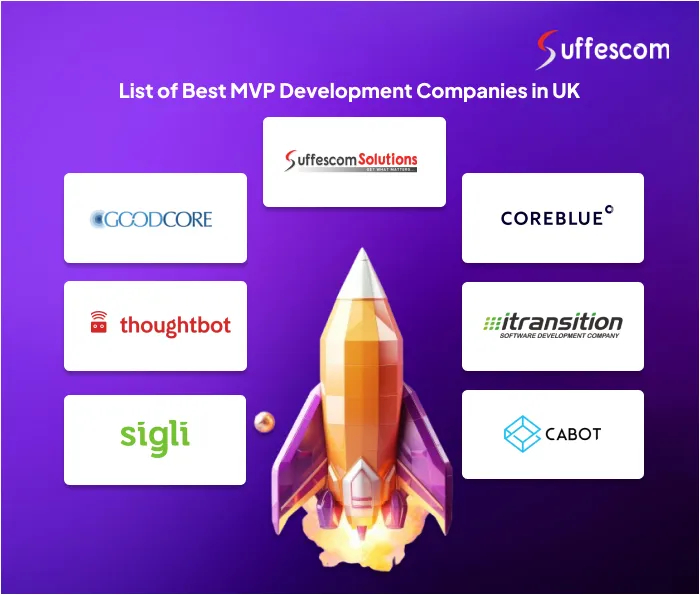
1. Suffescom Solutions- Top MVP Development Service Provider in UK
| Founded in: | 2011 |
| Location: | London, UK |
| Team Size: | 250+ |
| Hourly Cost: | £20–£30 |
| Google Rating: | 5.0/5 |
| Projects Completed: | 1000+ |
| Industries Served: | Logistics, SaaS, FinTech, HealthTech, eCommerce |
Suffescom is the top MVP development company with 13+ years of experience delivering validation-focused products for startups and growing businesses. The company has supported more than 63 startups from the idea stage to market entry and has delivered over 550 MVP solutions globally. Suffescom has also delivered 50+ niche MVPs and 150+ ready-made scripts. Some of their clients include NBC and Stripe. If you are looking for an MVP development service provider that combines speed and product clarity, then Suffescom is the best choice for you.
MVP Development Services
- Concierge MVP
- Single-Feature MVP
- Piecemeal MVP
- Explainer Video MVP
- Crowdfunding MVP
- Software Prototype MVP
- Low-Code/No-code MVP
- AI MVP Development
- White-Label MVP App Development
Contact Now at +44 808 164 8700
2. Sigli
| Founded in: | 2015 |
| Location: | London, UK |
| Team Size: | 50+ |
| Hourly Cost: | £60–£90 |
| Google Rating: | 4.9/5 |
| Projects Completed: | 200+ |
| Industries Served: | B2B SaaS, Data & AI, Integrations, Enterprise Platforms |
Sigli is a UK-based MVP and PoC development company aimed at building products that can be measured from day one. The company is best for startups with data-driven ideas and where validation is based on precise metrics and not assumptions. Sigli works with a structured discovery-to-prototype-to-release approach, which guarantees that analytics and learning loops are embedded early to support informed product decisions after launch.
MVP Development Services
- Proof of Concept (PoC) Development
- MVP Strategy and Discovery
- Data-Driven MVP Development
- Crypto-Wallet MVP
- API and System Integrations
- Analytics-First MVP Builds
- Post-Launch Optimization and Iteration
3. GoodCore Software
| Founded in: | 2005 |
| Location: | Croydon, UK |
| Team Size: | 51-200 |
| Hourly Cost: | £25–£30 |
| Google Rating: | 4.7/5 |
| Projects Completed: | 250+ |
| Industries Served: | B2B Software, SaaS, Healthcare, Enterprise Platforms |
GoodCore is one of the best 5 MVP development agencies in UK that focuses on turning early product ideas into usable MVPs built for fast validation. Their approach is centered on the Build Measure Learn loop with emphasis on core features and future scalability. They develop and deliver MVPs within three to four months with full lifecycle ownership from discovery to launch. GoodCore is a good option for founders who need predictable timelines and a clear path from MVP to scalable product.
MVP Development Services
- MVP discovery and product strategy
- Core feature definition and prioritisation
- UX prototyping and usability testing
- Full cycle MVP software development
- Data-driven iteration and enhancement
- Post-launch support and scaling roadmap
4. Coreblue
| Founded in: | 2015 |
| Location: | Bristol, UK |
| Team Size: | 50+ |
| Hourly Cost: | £70–£100 |
| Google Rating: | 4.9/5 |
| Projects Completed: | 200+ |
| Industries Served: | B2B Software, SaaS, Healthcare, FinTech, Data Platforms |
Founded in 2015, Coreblue is a top startup product development company in Bristol known for creating technical MVPs for different software products. The team of 50+ app developers works with growing businesses to translate rough ideas into reliable systems with an engineering foundation. Coreblue is often chosen for MVP development, where scalability and long-term maintainability must be addressed from the first release.
MVP Development Services
- MVP discovery and technical feasibility analysis
- Custom MVP and software development
- UX and product design for early-stage products
- Cloud-native backend development
- API and third-party system integrations
- Post-MVP scaling and iteration
5. Thoughtbot
| Founded in: | 2003 |
| Location: | London, UK |
| Team Size: | 150+ |
| Hourly Cost: | £90–£130 |
| Google Rating: | 4.8/5 |
| Projects Completed: | 1,000+ |
| Industries Served: | SaaS, HealthTech, Media, B2B Platforms, Consumer Products |
Another entry in our top 7 MVP development agencies list in UK is Thoughtbot, which is known for combining strategy and engineering into a single delivery model. Their teams help businesses shape MVPs that are aligned with business goals and ready for market entry. The company also provides AI development services and has deep experience in agile delivery and user-centered design. Thoughtbot supports organizations that need both product direction and execution while preparing internal teams for long-term ownership.
MVP Development Services
- MVP shaping sprints and product strategy
- Roadmap definition and risk mitigation
- UX design with accessibility standards
- Web and mobile MVP development
- Cross-functional product leadership
- Go-to-market and iteration support
6. Itransition
| Founded in: | 1998 |
| Location: | London, UK |
| Team Size: | 3,000+ |
| Hourly Cost: | £50–£90 |
| Google Rating: | 4.7/5 |
| Projects Completed: | 1,500+ |
| Industries Served: | SaaS, FinTech, Healthcare, Retail, Media, Enterprise Software |
Itransition brings over 25 years of software development experience to MVP development, making it a strong choice for products that require structure from day one. With teams distributed across the UK and Europe, the company supports MVP builds that often extend into long-term platforms. Itransition has delivered 1,500+ projects, many of which started as MVPs and evolved into enterprise-grade systems.
MVP Development Services
- MVP discovery and requirements validation
- Custom web and mobile MVP development
- Data and cloud-based MVP solutions
- API and enterprise system integration
- QA-driven MVP testing and release
- Post-MVP scaling and optimization
7. Cabot Solutions
| Founded in: | 2006 |
| Location: | London, UK |
| Team Size: | 200+ |
| Hourly Cost: | £45–£80 |
| Google Rating: | 4.7/5 |
| Projects Completed: | 700+ |
| Industries Served: | Healthcare, FinTech, eCommerce, Travel Security, Automotive Insurance |
Cabot Solutions is a top app development company in London, UK, that builds MVPs for founders working against tight launch windows. The company operates from major tech hubs and focuses on turning early concepts into usable products within 8 to 12 weeks. Cabot is often selected for MVPs that need real users, real data and clear signals before full scale investment decisions are made. If you have the same requirements, you can select them.
MVP Development Services
- MVP mobile development
- MVP product development
- Custom MVP software builds
- Prototype to launch delivery
- Analytics setup for early usage tracking
- Post-launch iteration support
Top MVP Development Companies in the UK – Comparison Table
| Rank | Company Name | Founded In | Hourly Cost | Core MVP Services |
| 1 | Suffescom Solutions | 2011 | £20–£30 | Concierge MVP, single-feature MVP, low-code/no-code MVP, AI MVP, crowdfunding MVP, white-label MVP |
| 2 | Sigli | 2015 | £60–£90 | PoC development, MVP strategy, data-driven MVPs, AI MVPs, analytics-first builds, system integrations |
| 3 | GoodCore Software | 2005 | £25–£30 | MVP discovery, product strategy, UX prototyping, full-cycle MVP development, post-launch scaling |
| 4 | Coreblue | 2015 | £70–£100 | MVP discovery, custom MVP development, cloud-native backends, API integrations, scalable architecture |
| 5 | Thoughtbot | 2003 | £90–£130 | MVP shaping sprints, product strategy, UX design, web & mobile MVPs, go-to-market support |
| 6 | Itransition | 1998 | £50–£90 | MVP discovery, web & mobile MVPs, cloud and data MVPs, enterprise integrations, QA-led delivery |
| 7 | Cabot Solutions | 2006 | £45–£80 | Rapid MVP development, mobile MVPs, feature scoping, analytics setup, prototype-to-launch delivery |
MVP Development Cost in UK
MVP pricing depends on scope depth and delivery speed. Costs change based on feature count, technical complexity and the time required to reach validation. Faster timelines and broader functionality increase overall spend.
In the UK, MVP app development costs usually fall between £6,000 and £25,000+. These ranges help founders set realistic expectations and review proposals with better context.
Average MVP Development Cost in UK Based on App Complexity
| MVP Type | Average Cost | Timeline Weeks | Scope |
| Basic MVP | £6,000–£10,000 | 4–8 | • One user action • Minimal logic • Manual backend handling • Validation-first release |
| Lightweight MVP | £10,000–£15,000 | 6–10 | • Defined user journeys • Limited automation • UI adapted for feedback • Essential third-party tools |
| Standard MVP | £15,000–£20,000 | 10–16 | • Complete user workflows • Structured data management • Cross-device compatibility • Initial performance tuning |
| Advanced MVP | £20,000–£25,000+ | 16–24+ | • Complex decision rules • Compliance-ready setup • Scalable system design • Load and security planning |
These figures reflect UK market averages for 2026. Final pricing depends on the requirements, provider location and delivery model.
Typical MVP Cost Breakdown Based on Stages
End-to-end MVP builds usually include the following work areas. Balanced proposals cover each stage.
- Scope definition and planning 10–15%
- UI UX design and prototyping 15–20%
- Core development 50–60%
- Testing QA and launch 15–20%
- Post-launch support 15-20% yearly
Proposals that exclude discovery testing or delivery might lead to rework and delays.
Factors That Influence MVP App Development Cost in UK
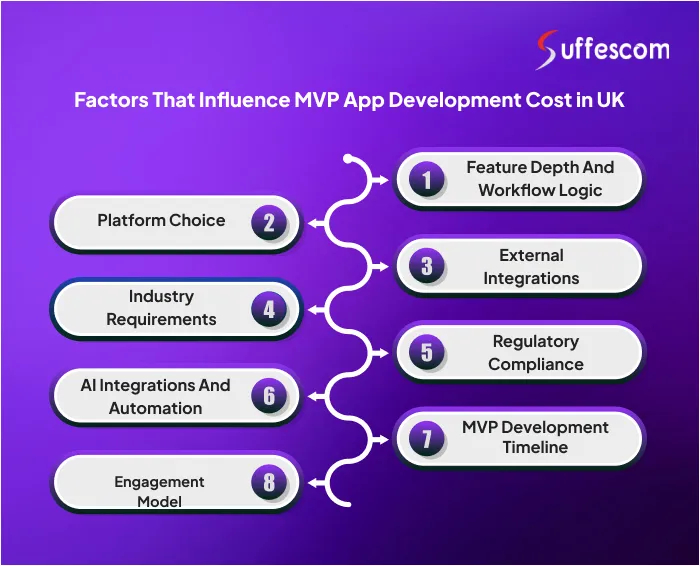
Several decisions directly impact MVP app development cost. Even small changes can change the budget.
Feature Depth and Workflow Logic
Single-action features cost less. Multi-step flow approval logic or role-based access requires more development and testing.
Example: A signup and submit form MVP costs far less than a multi-role dashboard with approvals.
Platform Choice
Web MVPs launch faster with lower cost. Mobile apps require platform-specific builds and store compliance. Cross-platform adds testing overhead.
Example: A browser-based SaaS MVP is cheaper than iOS and Android apps launched together.
External Integrations
Each third-party tool adds setup time, error handling and maintenance effort. Costs increase with dependency count.
Example: Stripe payment integration adds more cost than a basic contact form with email alerts.
Industry Requirements
Regulated industries need extra validation, data control and reporting layers. This increases build time.
Example: A fintech MVP needs transaction logging while a content app does not.
Regulatory Compliance
Compliance affects architecture from day one. Changes made later are expensive.
Example: GDPR consent tracking adds data flow controls and storage rules.
AI Integrations and Automation
AI features require model setup, data pipelines and monitoring logic. Even simple automation adds complexity.
Example: Rule-based alerts are cheaper than an AI-driven recommendation engine.
MVP Development Timeline
Short deadlines increase cost due to parallel work and higher team load. Longer timelines allow cost control.
Example: A 6-week MVP costs more than the same scope delivered in 12 weeks.
Engagement Model
Fixed-price limits change flexibility of the project. Time-based models support iteration but require budget discipline.
Example: A time-based engagement allows scope changes after user feedback.
Budget Planning Guidance
Early estimates rarely stay fixed once real users interact with the product. Budgeting should have room for minor adjustments.
- Keep a 10–20% beyond the initial quote
- Focus spend on validation outcomes
- Compare proposals by delivery logic, not price alone
A strong MVP budget supports learning speed and decision accuracy rather than the lowest development cost.
Hidden and Often Ignored MVP Development Costs in UK
MVP budgets usually focus on development expenses only but in the process several expenses might appear after development starts and can affect total cost if not planned early.
Discovery Shortcuts
Skipping proper discovery might lower the initial quote, but can lead to scope changes or redesigns.
Iteration After First Release
User feedback requires changes to flow logic or onboarding. These updates are very rarely included in base MVP quotes.
Third-Party Services
Tools for payments analytics or messaging come with monthly fees and these costs increase as usage grows.
Infrastructure and Hosting
Cloud services are estimated for low traffic and spikes during testing or pilot launches can raise hosting costs fastly.
Compliance and Legal Adjustments
Industries like fintech or marketplaces require extra work for data handling, security and audits, which may surface mid-project.
Post-Launch Fixes
Early releases often reveal performance or usability issues that require immediate fixes outside the original scope.
Planning for these costs early prevents budget stress and keeps MVP validation moving without delays.
MVP Development Timelines and Delivery Flow in United Kingdom
An MVP is not built in one straight sprint. Most UK MVP projects take 6 to 14 weeks based on how clearly the problem is defined and how much technology is involved. Products with simple workflows move faster while those with payment data or third-party tools require more time.
MVP delivery usually moves through these phases:
Defining Problem (Week 1–2)
The team works with founders to narrow the idea into a testable product. Non-essential features are removed and success metrics are set early.
Design (Week 2–4)
Screens and flows are designed to show how users move through the product. This step helps catch usability issues before development starts.
Initial Product Build (Week 4–8)
Developers create the first usable version of the product. Only core functionality is included so real users can start interacting with it.
Limited User Launch (Week 8–10)
The MVP is shared with early users or internal teams. Feedback is collected through usage data rather than opinions.
Continuous Updates (after launch)
The product evolves based on how users behave. Features are added only when demand is proven.
How to Choose an MVP Development Company in UK
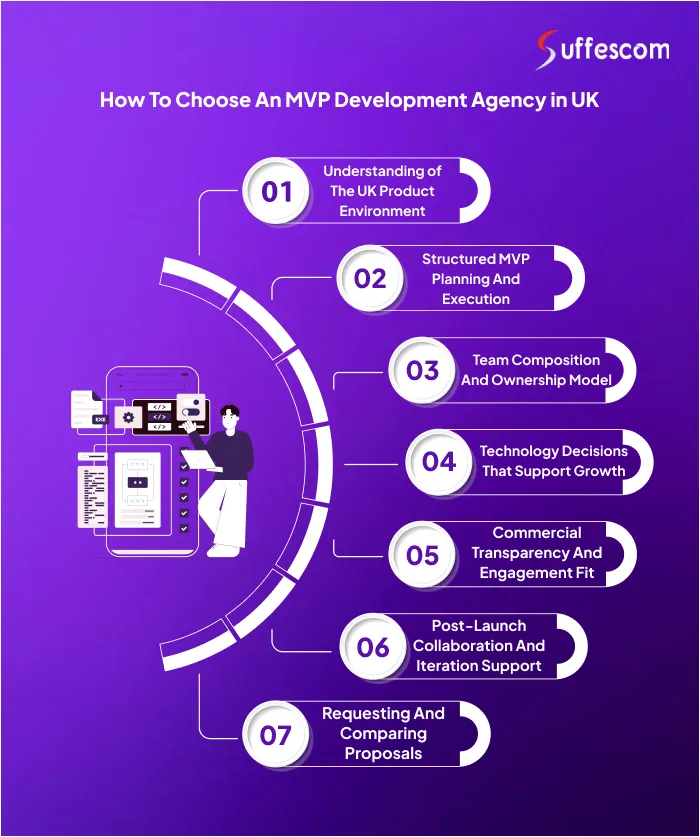
Selecting an MVP development partner in the UK is a decision that shapes how efficiently your idea is validated and how confidently you move toward scale. In MVP (Minimum-Viable-Product) development, discipline and product thinking matter more than size or reputation.
Understanding of the UK Product Environment
The UK ecosystem has distinct expectations around compliance, user trust and product quality. A partner familiar with this environment can guide early decisions more effectively.
- Awareness of UK data protection and compliance standards
- Experience building products for UK users and businesses
- Familiarity with local market dynamics and buyer behavior
Structured MVP Planning and Execution
A focused MVP requires a disciplined development approach rather than feature accumulation. Also, the MVP market is expected to grow at a CAGR of 9.31% by 2031.
- Clear validation goals defined before MVP software development begins
- Feature prioritization tied to learning and feedback
- Short iteration cycles with measurable outcomes
Team Composition and Ownership Model
Decision-making must be clear when timelines are tight and hire no-code app developers that can follow all your requirements. Also, UK Government investment states that London accounts for 59% of the total value of the British tech sector.
- Dedicated product and technical leads assigned to the project
- Direct communication with the delivery team
- Clear ownership of scope and timelines
Technology Decisions That Support Growth
Technology choices at the MVP stage should support both speed and future expansion and when selecting an MVP development company, you should clarify all the specific frameworks you want to use.
- Tech stack selected based on product goals and constraints
- Balance between rapid delivery and scalability
- Readiness for integrations and performance needs
Commercial Transparency and Engagement Fit
Budget control is critical during early validation, so select a company that provides the engagement model that you want, whether it be its full-time dedicated team or on an hourly basis.
- Clearly defined engagement models such as fixed scope or milestone-based
- Transparent pricing with deliverables mapped to outcomes
- Flexibility to refine scope based on validation results
Post-Launch Collaboration and Iteration Support
The MVP launch marks the start of learning not the finish line. Choose an app development agency in UK that can also change the initial version into a full product.
- Support for analyzing user feedback and usage data
- Guidance on next iterations and roadmap planning
- Continuity of the same team for future development
Requesting and Comparing Proposals
Once you shortlist 2-3 of the best MVP development agencies based on the above criteria, the final step is to request proposals that align with your MVP goals.
- Share a clear problem statement and validation objective
- Ask for a phased delivery plan rather than a full product quote
- Compare proposals based on approach and clarity not just cost
Future Trends in MVP Development in the UK
MVP development in the UK is evolving as founders look for faster validation without sacrificing technical readiness. The following trends show how early-stage products are being shaped to meet market regulatory, and investment expectations.
AI-Powered MVPs
AI integration is becoming a core part of MVP development rather than a later upgrade. UK teams are using lightweight models and pre-trained services to validate intelligence-driven features early.
No-Code and Low-Code MVPs
No-code/low-code platforms are increasingly used to reduce build time and cost at the MVP stage. This approach helps validate workflows and business logic before committing to custom engineering.
Increased Focus on Security and Compliance
Security and compliance are considered from the first MVP release because in the UK, where data protection expectations are high, compliance is important.
Sustainability-Driven Product Development
Sustainability is influencing MVP decisions as UK startups align with long-term operational efficiency and ESG expectations.
Conclusion
Building an MVP in 2026 is about validating the right idea quickly while not spending too much. The UK offers a strong ecosystem of top MVP development companies that emphasize discovery and lean execution. Selecting the right company impacts not only product traction but also how efficiently your budget is used in the early stages.
Among the top MVP development company listed, Suffescom Solutions stands out due to its experience delivering hundreds of MVPs across multiple industries. Its focus on speed and cost-effective solutions makes it a strong option for startups and growing businesses.
A well-planned MVP investment supports faster decision-making and prevents unnecessary spending as the product evolves.
Validate Your MVP App Idea in 15 Days
FAQs
1. What is MVP development and why is it important for startups in the UK?
MVP development focuses on building the smallest usable version of a product to test market demand. In the UK, where startup costs and compliance expectations are high, MVPs help founders validate ideas early without over-investing in full-scale development.
2. How much does MVP development cost in the UK in 2026?
MVP development costs in the UK typically range from £6,000 to £25,000+. The final cost depends on feature scope, technical complexity, timeline, and the engagement model used by the development company.
3. What factors influence MVP development pricing the most?
The main factors that influence the MVP development cost the most are:
- Feature integration
- Platform choice
- Third-party integrations
- Compliance requirements
- AI integration
- App development timeline
4. How long does it take to build an MVP in the UK?
The time required to build an MVP in UK usually takes 6 to 14 weeks to develop. Simple MVPs for validation only are delivered faster, while products involving payments or data processing might take more time.
5. Is it better to build a web MVP or a mobile MVP first?
Web MVPs are usually faster and more cost-effective for early validation. Mobile MVPs are suitable when user behavior depends on native features such as push notifications or device access.
6. What industries benefit the most from MVP development?
The industries that benefit from MVP development the most are:
- SaaS
- Fintech
- Healthcare
- Logistics
- Real Estate
7. What hidden costs should founders plan for during MVP development?
Common hidden costs that founders should plan during MVP development include:
- Post-launch iterations
- Cloud hosting increases
- Third-party subscriptions
- Compliance adjustments
- Performance fixes
8. How do I choose the right MVP app development company in UK?
When selecting the right MVP app development company in UK, prioritize companies that specialize in MVPs instead of full-scale app development. Look for those that offer transparent pricing, emphasize the discovery phase, and have proven experience with UK compliance standards and early-stage validation.
9. Are fixed-price or time-based MVP engagement models better?
Fixed-price models offer budget predictability but limited flexibility. Time-based models allow scope changes based on user feedback but require stronger budget control. The right choice depends on validation uncertainty.
10. Can MVPs be built using low-code or no-code platforms in the UK?
Yes. Many UK MVP development companies use low-code/no-code platforms to reduce cost and speed up validation. This approach works well for workflow testing but may need custom development for scalability later.
11. How many features should an MVP include?
An MVP usually includes 1–3 core features focused on validating the main user problem. Adding more features often slows learning and increases cost.
12. Which are the top MVP development companies in UK?
The top MVP development companies in UK are:
- Suffescom
- Sigli
- GoodCore Software
- Coreblue