+971-8000321216



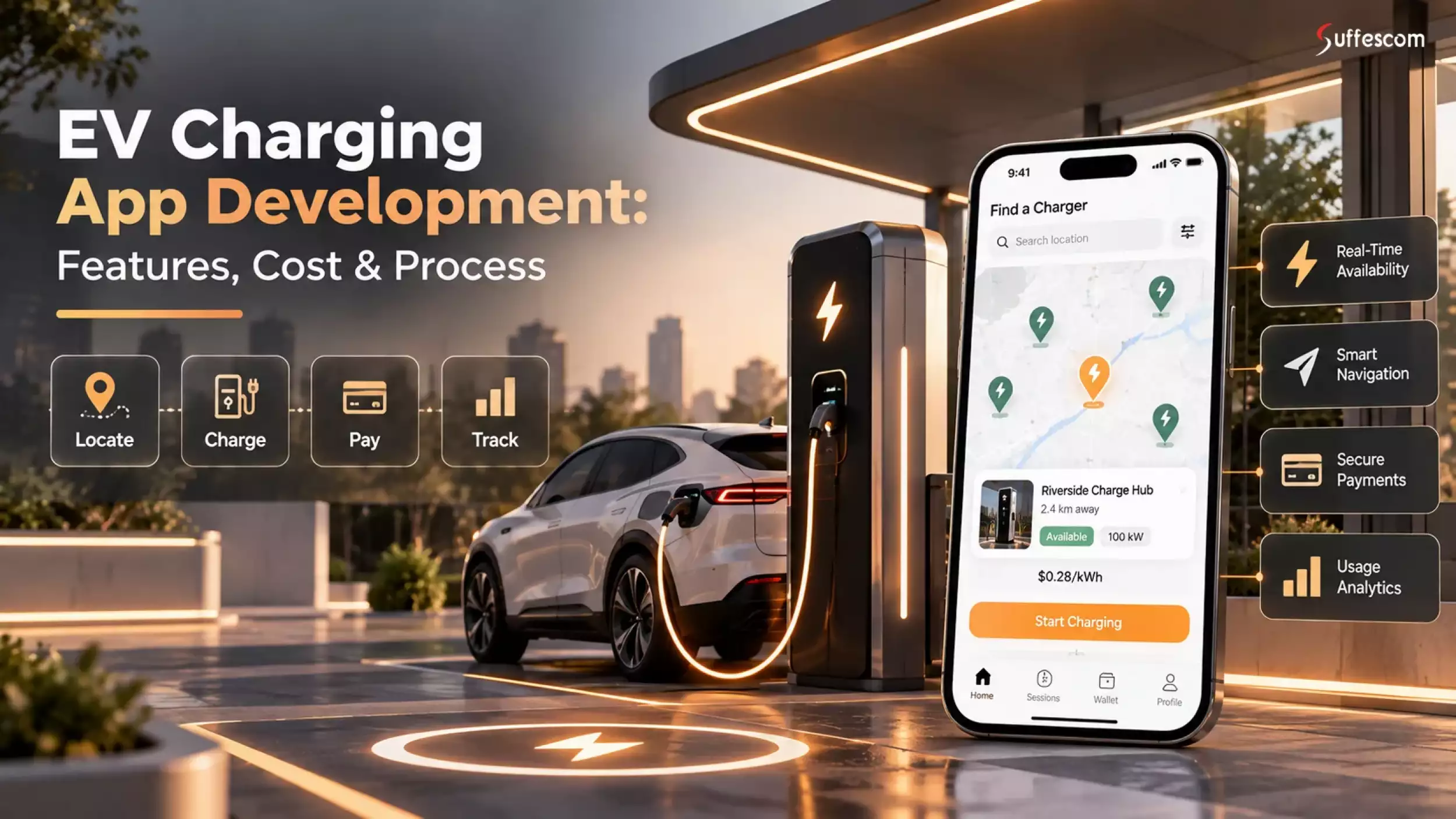
Charging EVs has turned into a software-oriented experience. Drivers want to easily locate an appropriate charger, check its current availability, be informed about pricing, initiate charging, pay for the service, and get to their destination without having to switch between applications. This is where EV charging app development comes into play.
The global EV charging infrastructure market size was estimated at approximately $36.4 billion in 2023 and will reach about $100.5 billion by 2030, according to MarketsandMarkets. The growing number of charging infrastructure requires software solutions that would help both drivers and operators connect to chargers, handle payments, monitor energy consumption, user accounts, and network performance.
A modern EV charging app may meet different business needs, as well as serve different business models from charging point operators (CPOs) to mobility providers, property owners, fleet operators, charging networks, startups, and others. Depending on the product, an app could act as a station finder, charging network application, roaming platform, fleet management solution, and even a full-fledged EV charging software ecosystem.
This guide describes the key features, charging station integration, tech stack, development process, security measures, timeline, and cost of developing an EV charging app.
What Is EV Charging App Development?
EV charging app development is the creation of a software solution that connects EV drivers with charging stations. Based on the specific business model and requirements, an EV charging application can provide users with the ability to locate, reserve, navigate to, start charging sessions, pay for charging sessions, and monitor their history. For charging station operators, an ecosystem may include features such as charger status control, pricing, user accounts, transactions, energy consumption monitoring, etc.
For instance, for a public charging network, an app together with a web-based charging network management system may be required, while a fleet operator may focus more on assigning vehicles, charging schedules, costs, and user access. A property owner will require a different set of functionalities.
Thus, EV charging app development covers much more than the development of mobile apps. An enterprise-level EV charging system usually involves mobile apps, backend services, integration with the charging network, payments, real-time communication, database management, maps, push notifications, admin dashboard, etc.
How an EV Charging App Works
The basic architecture follows this flow:
Driver → Mobile App → Backend → Charging Network → Charger → Payment → Session Data
- Driver: User launches the app, finds a station he wants to use and chooses the corresponding charging spot.
- Mobile app: The app shows station information, such as its availability, cost, connector type, and charging speed.
- Backend: The backend validates the user, handles requests, keeps track of session states and communicates with external charging systems.
- Charging network: The charging network or charging management system sends commands and gets back data from chargers.
- Charger: Physical charger responds to the request and starts the charging process.
- Payment: The platform charges corresponding fees for the energy consumption, session duration, parking, and services.
- Session data: Consumption of energy, duration of the session, charger status, transaction data, and other events are recorded.
For example, when a user presses the Start Charging button in the application, the app does not just initiate the charger's operation. The process could include the steps of authentication, validation on the backend side, network calls, authorization of the charger, and updating of the session state.
What Can Users Do With an EV Charging App?
A properly designed EV charging station application enables users to:
- Locate the nearest EV chargers based on GPS
- Verify the availability of chargers in real time
- Select stations depending on the type of connector, speed, cost, or network
- View the charging capacity and availability of ports
- Compare pricing before starting a session
- Control charging on or off from the app
- Pay for charging through the app
- Monitor energy usage and charging time
- Get notified about the start or completion of charging
- Favorite commonly used EV chargers
- Get access to charging history and invoices
- Schedule charging stops based on routes
For example, a driver who wants to travel over a long distance could find fast chargers along the way instead of just finding the nearest stations. The app can use location, charger availability, charging speed, and estimated charging time to make the information more useful.
EV Charging App vs EV Charging Management Software
A significant difference is that an EV charging application is not always the complete charging system. The driver application is concerned with the user experience, whereas EV charging management software takes care of the functional aspects of the infrastructure.
| Area | Driver App | Charging Management Platform |
| Station search | Yes | Yes |
| Charging session | Start, monitor, stop | Monitor and control |
| Payments | Make payments | Billing and transaction management |
| Charger health | Limited visibility | Detailed monitoring |
| User management | Personal account | Advanced roles and permissions |
| Energy management | Limited | Advanced |
| Reports | Personal history | Business and operational reports |
| Fleet management | Optional | Yes |
| Pricing management | View pricing | Configure pricing |
| Charger configuration | No | Yes |
| Operational alerts | User notifications | Charger and system alerts |
The CPO, for instance, would need both the driver-side app and a management system for the chargers. On one hand, the driver will know about the availability of the charger, whereas the operator will know about its status: online, faulted, occupied by some session, etc.
There is another requirement for a fleet business. The end-users could use the app for charging, while fleet administrators will be interested in the dashboard with their fleet cars, expenses on charging, history of sessions, etc.
Such differentiation plays a key role at the moment of EV charging app development because the architecture to be developed, integrations, users, and overall development costs will strongly depend on the product type.
Why Build an EV Charging App?
With the increase in EV charging infrastructure comes the need for software that facilitates easy discovery, usage, payment, and management of EV chargers. In the United States, there are over 192,000 public EV charging ports deployed across 69,000 charging stations, according to data from the U.S. Department of Energy's Alternative Fuels Data Center (AFDC). AFDC has a repository of data on charging locations, networks, ports, connection options, and station availability, emphasizing the huge amount of data related to the infrastructure that is needed by an EV charging application.
For businesses, the scope is not only limited to creating a station finder; an effective EV charging application will also help to bridge the gap between drivers and charging infrastructure while providing charging operators, fleet managers, and property owners with better management tools.
Growing Need for Public EV Charging
With the increasing number of charging stations comes an increasing amount of information that needs to be evaluated. The driver has to take into account the location of the charging station, compatibility of chargers, charging speed, availability, price and the time it takes to charge the battery.
The Electric vehicle charging app brings all the above-mentioned information together. This allows a person driving down the road to locate a charger that is compatible with their EV, available, see what the prices are and how much time the charging will take.
From the business standpoint, the above mentioned infrastructure is sufficient for discovering stations, managing sessions, payments, customer accounts and operations.
The Real Problem EV Drivers Face
Locating a charging point is just one aspect of the charging process. There may be problems such as:
- Inoperative or offline chargers
- Out-of-date availability information
- Unspecified charging rates and extra charges
- Multiple charging networks
- Long queues at charging points
- Connectivity problems
- Limited routing of charging points
- Charging payments difficulties
All of which may make the proximity of a charging point useless when the information presented on the app does not match the real situation.
Why a Better App Can Win Users
The possibility here is not just about "displaying chargers on the map." The app should assist its users in making four decisions:
Where should I charge, will the charger work, how much will it cost, and how long will I need to wait?
As another instance, rather than presenting the driver with a list of five stations in proximity, it could evaluate distance, charging speed, availability, cost, reliability, and waiting time to assist the driver in making an appropriate choice.
This opens up possibilities for distinct characteristics such as reliability of chargers, waiting line forecasts, cost estimates, route-based recommendations, and real-time alerts.
The State-by-State Charging Gap
The charging infrastructure and demands may differ in each location. Therefore, for a scalable EV charging software architecture, there should be consideration for the differences in:
- Availability of chargers per state
- Charging corridors on highways
- Urban or rural coverage
- Charging speed
- Availability of connector
- Local pricing structure
- Demand for fleet charging
- Station density
The AFDC provides charging infrastructure data at the state level, which can facilitate station discovery, location analysis, and market planning. These can also help organizations find out areas where the need for charging facilities is still underdeveloped.
For instance, an application built to work with urban charging may emphasize proximity of stations, parking information, and availability, while one built around highway charging may give more importance to route information, reliability of chargers, charging speed, and low connectivity.
Types of EV Charging Apps You Can Build
An appropriate EV charging app development strategy should consider users, charging stations, and your business goals. A driver-focused product may need an app with features such as charging station search and payments, whereas charging station operators will need more complex solutions including charger monitoring, management, analytics, billing, and network integrations.
EV Charging Station Finder App
A station finder app allows drivers to easily find and compare all charging stations using one app. Such an application includes map features, location service, information about chargers, availability, price information, charger types, and directions. For instance, a startup may develop an app that aggregates charging stations and assists drivers in finding compatible fast chargers based on planned routes.
EV Charging Network App
A charging network app is designed for charging point operators (CPOs) who own or manage charging stations. Using the app, drivers are able to find stations managed by the operator, check availability of those stations, initiate charging sessions, pay, and view the history of their charging sessions.
EV Roaming App
EV Roaming App connects drivers with charging stations managed by different networks. This means that a user does not have to sign up to separate services provided by different charging networks. Typically, the backend contains information about charging station data, tariffs, authorizations, sessions, and transactions. A mobility provider can offer access to charging stations managed by several participating networks.
Fleet EV Charging App
The fleet charging app is more centered on the requirements of enterprises that deploy electric cars. It may link driver accounts with cars, charging schedules, charging costs, and usage statistics. The charging activities of electric vans deployed by a logistics company may be tracked using such an app.
EV Charger Management App
An EV charging management application is developed for charging station owners/management. Such an app gives an overview of charging station operations, including station health, charges, faults, prices, usage, and other operational events. Thus, a facility manager who oversees multiple parking stations and their charging stations can use one app interface.
White-Label EV Charging App
With a white label EV charging app, a business does not have to start building each of the elements that the platform contains to develop its own branded charging application. The company can customize the brand, the user experience, pricing policies, payment methods, and selected functionalities. For instance, an energy company can create a branded EV charging app but operate on the existing charging software infrastructure.
Smart EV Charging App
A smart charging app implies more than just the ability to control the charging process. It means scheduling the vehicles' charge times and the amount of energy they consume. The platform takes into consideration such factors as charging schedule, site capacity, energy needs, and prices to optimize the process of charging. A commercial charging station can do that to organize the charging process for multiple vehicles.
EV Charging + Energy Management Platform
A sophisticated EV charging platform can be integrated with energy management functions. This could link EV chargers with energy production, battery storage, energy usage, and energy management systems. The platform could be used to integrate vehicle charging with energy availability using such systems as solar panels and battery storage for a business center.
Advanced EV Charging App Features That Competitors Often Miss
The basic EV charging application can assist users in locating stations and starting charging sessions. The advanced version of an EV charging platform may utilize previous session statistics, charger events, pricing information, and user feedback in order to assist users in making good decisions before arriving at the station. All these features will help charging providers gather more data about utilization of their stations and services.
Charger Reliability Score
Even though a charger is "available", that doesn't mean it's the most reliable. A reliability score could incorporate uptime, successful and unsuccessful charge attempts, times when the charger has been offline, charger errors, and user reports to give more information.
For instance, two 150 kW chargers may be both "available" in the same location, but one could have a good history with recent successful sessions while the other had frequent problems. The application could highlight that difference rather than showing both chargers as equal.
Queue and Wait-Time Prediction
Availability itself might become deceptive at busy stations. There might be a case where the car arrives and sees a station being occupied by someone else, or there are already several cars waiting to plug into it.
Prediction of queue functionality can help make calculations regarding waiting time through occupancy level, previous usage statistics, ongoing reservations, average charging session length, and other factors. For instance, an app could tell a driver that a station is currently hosting two cars and has a 15-minute wait time.
The prediction itself needs to be communicated as a prediction, not a guarantee of wait time.
Total Charging Cost Before You Start
The charge cost could contain more than just the energy price. The actual cost may vary according to session charges, time charges, parking charges, taxes, and others depending upon the charging station type and pricing model.
An app could give the total cost estimate before the user begins charging his car. Suppose a driver wants to get a certain amount of energy. In that case, the app could tell him the total cost of energy, with time and session charges added.
This way, users would be able to compare charging stations easily.
Charger Confidence Indicator
A confidence indicator may convey how reliable the current charger status information is, rather than showing all statuses with the same level of confidence.
| Status | Meaning |
| High confidence | Recently confirmed working with current data |
| Medium confidence | Limited or less-recent status information |
| Low confidence | Offline, stale data, or repeated charging failures |
For instance, a charger which has successfully reported some of its sessions recently will earn a higher confidence score compared to a charger which has not received any network report about its status for a long time.
"Best Charger for Me" Recommendation
An AI-powered charger recommendations engine is capable of analyzing more than one variable in real time and based on history rather than displaying the nearest charging stations. This could take into account the battery capacity of the car, charging level, type of plug, rate of charging, availability, waiting time, price, traffic situation, reliability, distance of the route, and even past experience of the driver with the charging stations.
For instance, the driver with a low battery and a distant destination would be recommended to go to a high-reliability fast charger located slightly far away, while the other driver with extra battery would prefer to go to an economical charger located slightly off route. In case of changing circumstances, the recommendation system can make new calculations, considering factors like charger occupation, increasing queues, changes in traffic, and price.
At the same time, the AI system can learn from the historical charging activities of the user without being fully based on personalization. Information such as favorite networks, charging speed preference, usual charging locations, and previous station selection can be useful in giving recommendations in the future. Thus, the station finding becomes a contextual assistance feature rather than a mere map-based search task.
Low-Data and Weak-Signal Mode
Charging applications are frequently employed while taking road trips during which mobile connectivity may be unstable. In such a situation, a weak-signal mode can allow access to crucial station information using cached data and light map resources, as well as last-known charger information.
To illustrate, in case a driver loses the signal while traveling down a rural road, the application can continue showing cached charger locations and station information and then update the information when connectivity is restored.
Accessibility Features
Accessibility needs to become part of the charging process and not just a design fix at the end. Larger and scalable font sizes, accessibility for screen readers, adequate contrast of colors, clear touch targets, voice directions, and a simple checkout process might make this app more accessible for a larger number of drivers.
For instance, status updates need to go beyond color. The charger should indicate whether it is "Available," "Occupied," or "Out of service," using visuals to convey the message irrespective of any accessibility requirements.
All these features would take this electric vehicle charging mobile app from a station locator app to a decision support platform. It is important at this point that the backend architecture of data collection is considered as well, since reliability ratings, wait time estimates, cost calculation, and recommendations are useless without proper charging data.
How EV Charging Apps Connect With Chargers
The communication between the EV charging app and charger is not the same in all cases. The app operates on the back-end systems and standards for data interchange regarding charger status, sessions, pricing, and authorizations. It is important to know the standards while planning EV charging app development, especially for multi-network or roaming platforms.
What Is OCPP?
The Open Charge Point Protocol (OCPP) is an open protocol for communication between a charging station and its central management system. It can handle operations including the exchange of charger status information, session management, fault management, configuration, and metering data.
For instance, once the driver initiates a session using the mobile app, the request can be sent through the backend and charging management system via OCPP to the charger.
OCPP 1.6 vs OCPP 2.0.1
| Area | OCPP 1.6 | OCPP 2.0.1 |
| Charger communication | Yes | Yes |
| Device management | Basic | More advanced |
| Security | Available security options | Stronger security framework |
| Smart charging | Supported | More advanced |
| Monitoring | Standard | More detailed |
The OCPP 2.0.1 offers better options in terms of device management, security, monitoring, and smart charging; thus, it is a key consideration when choosing the protocol in the architecture of any new charging system.
What Is OCPI?
Open Charge Point Interface (OCPI) facilitates the communication between charging networks and e-mobility platforms. It allows information exchange such as station location information, tariffs, sessions, and CDR (Charge Detail Record).
For instance, the roaming service of electric vehicles could leverage OCPI to share station and transaction details with the charging networks involved.
What Is ISO 15118?
ISO 15118 is a standard for communication between the electric vehicle and the charging station. One of the common uses of this standard is Plug & Charge, which allows a compliant car to communicate and authenticate itself on a compliant charging station without having the driver start every single session via the app.
There are other communication abilities covered by this standard that are used for smart and bidirectional charging.
OCPP vs OCPI vs ISO 15118
| Protocol | Primary Role | Example |
| OCPP | Charger ↔ management system | Charger status and session control |
| OCPI | Network ↔ network/platform | Roaming and tariff exchange |
| ISO 15118 | EV ↔ charging system | Plug & Charge |
How Charger Data Reaches the Mobile App
The architecture usually resembles:
Charger → OCPP → CPMS → API → Backend → Mobile App
The Charging Point Management System (CPMS) is responsible for charger communication and data management, while the backend takes care of application logic, user management, payments, and APIs. In turn, the mobile app shows all related data such as availability, pricing, session status, and charging history.
The U.S. Department of Energy states that charging network software manages the following operations, among others: station access, fees, station monitoring, utilization data, station search, status checks, and payments. Therefore, the software layer becomes one of the key components of the whole charging process.
EV Charging App Tech Stack
The technology stack for an EV charging app must be able to manage real-time charger communication, location data, payment security, scalable backend processing, and data synchronization. The exact technology stack depends on the features of an app, supported charger protocols, expected traffic, and integrations.
| Technology Layer | Recommended Technologies | Purpose |
| Mobile App | Flutter, React Native, Swift, Kotlin | Driver and operator applications |
| Backend | Node.js, Python, Java, .NET | APIs, business logic, and session management |
| Database | PostgreSQL, MySQL, MongoDB | Users, chargers, sessions, payments, and reports |
| Cache | Redis | Fast access to frequently updated data |
| APIs | REST, GraphQL | Mobile, backend, and third-party integrations |
| Charger Protocols | OCPP 1.6, OCPP 2.0.1 | Charger-to-management-system communication |
| Roaming | OCPI | Network and charging-platform interoperability |
| Vehicle Communication | ISO 15118 | EV-to-charger communication and Plug & Charge |
| Maps & Location | Google Maps, Mapbox, Apple MapKit | Station discovery, mapping, and navigation |
| Real-Time Communication | WebSockets, MQTT | Live charger and session updates |
| Payments | Stripe, Braintree, Adyen | Payments, refunds, and transaction processing |
| Cloud | AWS, Microsoft Azure, Google Cloud | Hosting, storage, scaling, and infrastructure |
| Notifications | Firebase Cloud Messaging, APNs | Charging, payment, and reservation alerts |
| Analytics | Firebase Analytics, Mixpanel, Power BI | User and operational analytics |
| Security | OAuth 2.0, MFA, TLS, encryption | Account, API, and data protection |
| Monitoring | Sentry, Datadog, CloudWatch | Application and infrastructure monitoring |
EV Charging App Development Process
Developing an EV charging application is not only developing a mobile application for drivers. Such a product requires connecting the driver’s side to the charging station, back office, payment gateway, and real-time information about chargers. A proper process of developing such an application allows detecting integration and operational risks that might arise during the process.
Step 1: Business and User Research
Begin by determining the target users, charging infrastructure, competitors, and business needs. Determine whether the product is meant for drivers, CPOs, fleet managers, property owners, or a combination of several user types.
Step 2: Choose the EV Charging Business Model
Determine how the platform is going to function and generate income. Possible business models may include commission-based charging sessions, subscription plans, fleet SaaS, white-label solutions, or charging management services.
Step 3: Define MVP Features
Divide must-have features from potential improvements. The usual MVP can have station discovery, real-time availability, station info, charging sessions, payments, notifications, and an admin panel.
Step 4: Create UX and Wireframes
Identify key user flows before any coding happens. It's necessary to design flows for station search, choosing a port, starting charging, payments, and viewing charging history.
Step 5: Design the UI
Convert accepted wireframes to a user interface for mobile and web apps. Focus on map clarity, station status, price clarity, accessibility, and easy control over charging sessions.
Step 6: Plan Backend and Charger Integration
Describe the architecture of the backend and charger integration before actually integrating physical stations. API calls, databases, authentication, real-time events, charging sessions, and protocols like OCPP/OCPI can be used here.
Step 7: Develop Mobile Apps
Develop the mobile app for the driver and, where necessary, the mobile apps for the operator/fleet separately. Platforms such as Flutter and React Native may be used if it makes sense within the project scope.
Step 8: Connect Charging Networks
Implement the necessary charging network and its management system. The development team will need to map out the flow of charger status, charging session commands, tariffs, metering data, and other events from the charger to CPMS, the back end, and the application.
Step 9: Add Payments
Provide for payment functionality by adding a secure payment provider and implementing charging transaction flows. These include authorizations, confirmations, failed charges, refunds, receipts, and fees.
Step 10: Test With Real Charger Scenarios
Testing real-world hardware should be treated differently than normal mobile app testing. The screen could be performing well while the underlying charger session is failing.
Testing should cover scenarios such as:
- Starting and stopping a real charging session
- Charger going offline during a session
- Network connectivity loss
- Failed or delayed payment
- Incorrect session status
- Unexpected charger disconnection
- Session timeout and recovery
Test using different charger types under varying network conditions, as this might expose problems that are not seen in simulation environments.
Step 11: Security and Compliance Review
Check for authentication, authorization, API security, payment processing, encryption, location data usage, logging, and regulations compliance before the release.
Step 12: Launch
Deploy the backend architecture, release the mobile apps, set up monitoring, and roll out the system. Controlled deployment can aid in the identification of integration and operational problems prior to full-scale rollout.
Step 13: Monitor and Improve
Once deployed, monitor the uptime of chargers, failed sessions, API performance, payment failures, crashes, user actions, and support tickets. These metrics can aid in improvements like charger suggestions, integration with other networks, fleet management capabilities, and predictive maintenance.
How Much Does EV Charging App Development Cost?
EV charging app development cost may vary within the range of about $25,000 for a specific MVP to $300,000 and higher for an enterprise-grade charging ecosystem. This gap is defined by the nature of the solution, not just the number of screens of the mobile application.
Building a simple station locator with account management and a payment system is much simpler in terms of development resources than building a system capable of communicating with charging stations via OCPP, connecting several networks via OCPI, managing fleets, handling live charging session processing, and providing smart energy features.
The following cost ranges can be considered for estimation purposes only. They do not reflect fixed development costs. Your project budget will highly depend on the infrastructure of charging stations, integration capabilities, platforms, and other features.
Estimated EV Charging App Development Cost
| App Type | Estimated Development Range | Typical Scope |
| Basic MVP | $25,000–$60,000 | Locator, accounts, basic payments |
| Mid-Level | $60,000–$150,000 | Real-time data, booking, payments, admin |
| Advanced | $150,000–$300,000+ | CPMS, OCPP, roaming, fleet, analytics |
| Enterprise | $300,000+ | Multi-network, large fleets, smart energy, advanced integrations |
What Changes the Cost of an EV Charging App?
Most of the time, the most expensive elements are not related to the design but to the integration and complexity of the backend.
Charger integration: The communication with the chargers is associated with the protocol implementation, session management, status handling, meter data parsing, and recovery from errors. In the case of OCPP integration, the cost is considerably higher than that for the station directory.
Real-time charging data: Real-time availability, status of the charging session, power consumption, prices, and alerts about faults involve event-driven architecture and synchronization of the chargers, charging management platform, and mobile app.
Multiple charging networks: The roaming solution may require multiple OCPI implementations with different charging networks. Each implementation can vary in data mappings, authentication, pricing policies, and operating procedures.
Payments: Payments through card, digital wallet, stored payment options, refunds, receipts, taxes, authorizations, and transaction failure recovery add to development and testing requirements.
Fleet management: Fleet accounts, vehicle assignment, charging schedule, driver access rights, cost distribution, reporting, and utilization metrics make for significant scope additions.
Smart charging and energy management: Energy load balancing, charging schedules, dynamic pricing, energy forecasting, solar power, battery storage, or bidirectional charging add to business logic and infrastructural needs.
Platforms and administration: Supporting iOS, Android, web dashboard, and different interface designs for the driver, operator, fleet manager, and administrator means more effort in development and testing.
EV Charging App Development Cost by Feature
| Feature or Component | Cost Impact |
| UX/UI design | Low to Medium |
| Maps and location | Medium |
| User accounts | Low to Medium |
| Real-time charger status | High |
| Payment integration | Medium to High |
| Reservations | Medium |
| OCPP integration | High |
| OCPI roaming | High |
| Fleet management | High |
| Analytics dashboard | Medium to High |
| Smart charging | High |
| AI-based predictions | High |
| Security and compliance | Medium to High |
| Real hardware testing | High |
How to Reduce EV Charging App Development Cost
Firstly, start with creating a well-defined MVP without trying to incorporate all features of the application during the very first iteration. The first iteration may include functions for the charging stations, their status, charging process, payments, notifications, and an admin panel.
Secondly, it makes sense to use cross-platform technologies, share backend infrastructure between mobile and web applications and implement charging station networks addition in case of necessity.
It is also reasonable to leave complex AI-driven recommendations, predictive maintenance, fleet management and energy optimization till you have enough data collected in the platform.
Finally, but most importantly, it is vital to outline charging ecosystem in advance. The number of charging stations, networks, protocols, user roles, payment processes and physical world situations can play even more significant role in development costs than the number of app screens.
Compliance and Security for EV Charging Apps
The app for EV charging collects more than account data. It may deal with payment data, exact location, vehicle info, charging sessions, station data, and operations. As such, security should address the mobile app itself, the backend, API, payment system, and communication with charging infrastructure.
Moreover, there is no universal compliance standard that would apply to all EV charging apps. The compliance requirements depend on the model of the product, type of data, payment procedure, infrastructure, and applicable jurisdiction.
Payment Security
Ensure the usage of a PCI DSS-compliant payment provider and avoid storing any raw card data within the application backend. It is recommended that payments include capabilities for tokenization, authorization, transactions validation, refunds, failure handling, and receipt generation. Backend system must also handle the problem of duplicate charges for the same payment flow.
User Data Protection
Only collect the necessary information required for the service, and establish retention policies regarding account, vehicle, session, and transaction information. Privacy policies need to inform users about the information that is collected, its usage, and disclosure. Access to personal data needs to comply with least privilege requirements.
Location Data Privacy
Charging applications typically ask for accurate locations to help discover and navigate stations. Location permissions should always be asked for only where necessary, and their usage should be clearly stated. Location histories should not be kept unless absolutely necessary for a documented product feature.
Secure Charger Communication
Secure charger communication is necessary at the protocol and network levels. OCPP connections need to employ suitable transport security and authentication methods offered by the charging infrastructure. In addition, charger messages should be validated, and specific commands should be restricted to certain backend components.
Authentication and Access Control
Implement strong authentication with MFA where possible, limited-time access tokens, session management, password security, and role-based access control. The permissions for a driver should not be the same as those for a fleet manager or a charging network manager.
Audit Logs
Capture security-relevant events such as authentication attempts, permission updates, charging commands, payments, configurations, and administrative operations. Audit logs should contain timestamps and identifiers without storing any unnecessary sensitive information.
Data Encryption
Ensure data in transit is protected using up-to-date TLS configuration settings and use encryption for any sensitive data stored. Keys used for encryption should not reside within the same application as the data. Any secrets like API keys and payment keys should never be hardcoded into the mobile application code.
EV Charging Infrastructure Requirements
Infrastructure requirements vary based on the charging program, source of funding, location and surroundings, and jurisdiction. Applicable infrastructure requirements can be technical interoperability, cybersecurity, payment handling, reporting capabilities, uptime or availability requirements, and accessibility obligations.
For programs connected to public charging programs, refer to the requirements of relevant authorities like the Federal Highway Administration and Department of Energy, as well as the standards and program-related documentation. There are different standards such as OCPP, OCPI, and ISO 15118 that cover different components of the charging ecosystem and should not be used as substitutes for compliance requirements.
Accessibility and Inclusive Design
Accessibility considerations must be incorporated into user experience design and not left to be addressed later on in the development process. Ensure that there is readable text, large touch target areas, screen reader support, keyboard access for the web dashboard, good contrast, and error message descriptions. Avoid conveying charger status only via colors. The inclusion of accessible payment, station location, and session control options makes the application more accessible for users.
EV Charging App Monetization Models
An EV charging app may monetize through charging, recurring payments, fleet solutions, operator tools, licensing, and analytics. An appropriate strategy depends on whether the platform caters to drivers, CPOs, fleets, property management, and charging brands. A single platform can employ multiple business models too.
Charging Session Commission
The platform can make money as a commission on each transaction of a charge session made by the driver using the app. An independent EV charging platform can earn a small commission for each charging session, as the electricity/charging cost will go to the charging station operator. The platform's backend must properly differentiate energy cost, parking, tax, and platform fee on the payment screen.
Subscription Plans
A subscription, either on a monthly or yearly basis, would be able to give advantages to people who frequently drive and are willing to pay for them. For instance, an electric vehicle charging application might provide lower platform charges, charger filters, better routing suggestions, and a complete charging history for its subscribers.
Fleet SaaS Plans
Businesses with a fleet can pay a subscription fee on either a per-vehicle or per-charging-asset basis. Assume an electric van delivery service with 200 vans. In such case, their fleet dashboard will monitor the state of charging, allocate drivers, control charging expenses, and prepare monthly reports. Therefore, the charging software can introduce the per-vehicle subscription plan in addition to driver-specific plans.
CPO Software Fees
Charging point operators can subscribe to a charging management software to have full access to the management platform. A CPO with hundreds of chargers can use the software to monitor the state of chargers, active sessions, tariff configuration, fault detection, and charging utilization all from a single dashboard. This creates recurring B2B software revenue.
White-Label Licensing
The technology provider may license their platform to the energy company, mobility brand, or property management company for branding purposes. The white-label product can comprise the mobile application, back-end, admin console, payments, and charging infrastructure integration. Possible income streams may comprise licensing fees and/or customization fees.
Advertising
The relevant businesses have an opportunity to advertise their services during the charging process. In this regard, an eatery located next to the charging point could offer its services to those drivers who are already waiting for their cars to recharge. The advertisement should be contextual and should not block basic functions such as navigation and control of the session.
Premium Route Planning
Route planning is one of the paid features that can be offered to drivers on long routes. Premium route planning involves evaluating charging stations in terms of distance, type of connector, speed of charging, availability, waiting time, and even the costs of charging rather than just giving the closest station.
Data and Analytics Services
Charging operators have the option to purchase analytics derived from the aggregate operational data. For instance, CPOs can utilize analysis of session success ratios, peak charging times, average session time, charger usage, and regular faults to determine which stations need maintenance or capacity increase.
Any analytics solution must adhere to proper privacy standards and cannot reveal any personally identifiable information about the drivers unless there is a justification and consent.
Dynamic Pricing
The operator is able to use software to determine pricing rules for charging based on variables such as time, demand, charging period, or even location. For instance, charging networks can have different pricing at different times of day. It is important that the app shows the correct pricing before confirming the session.
EV Charging App Revenue Models
| Model | Customer | Revenue Method | EEAT-Based Example |
| Commission | Drivers/CPOs | Fee per session | A charging network adds a clearly disclosed platform fee to completed charging sessions. |
| Subscription | Drivers | Monthly or annual fee | Frequent drivers pay for advanced routing and reduced platform fees. |
| SaaS | Operators | Monthly software fee | A CPO pays for charger monitoring, tariff management, and operational dashboards. |
| Fleet | Businesses | Per vehicle/month | A delivery fleet pays according to the number of electric vehicles managed through the platform. |
| White Label | Charging brands | License + support | An energy company launches a branded charging app using licensed backend and charger management software. |
| Analytics | Operators | Data subscription or reporting fee | A CPO uses aggregated utilization and fault analytics to identify underperforming charging sites. |
How to Make an EV Charging App More Profitable
Profitability is not simply about putting more chargers in place or raising the session fee. A much better approach would be to focus on charger utilization, decreasing the number of failed charging sessions, retaining drivers, and building recurrent B2B business.
Improve Charger Utilization
Take into account the demand patterns, station performance, and time-based data on the use of chargers to find which chargers have poor utilization rates. Station discovery and routing can help users find unused capacity of the chargers.
Reduce Failed Charging Sessions
Failed sessions may lead to refunds, support tickets, and dissatisfied users. Track down session errors, payment failures, disconnections, and timeouts to find the root causes of the issue.
Increase Repeat Usage
Ensure that users have a stable charging experience. Save vehicles in the system, use favorite stations, charging history, reliable notifications, personal recommendations, and a consistent pricing policy.
Add Fleet Customers
Fleet owners can generate regular B2B revenue from per vehicle or software subscription models. The fleet dashboard can consolidate information on charging costs, driver behavior, vehicle assignments, scheduling, and utilization reports.
Use Dynamic Pricing Carefully
Time-based or demand-based pricing can help operators balance charging demand. However, pricing needs to be transparent. The applicable rates and additional charges must be clearly presented prior to the start of a charging session.
Build Network Roaming
Roaming network integration can enable the drivers to find and use chargers on the participating networks using one application. It can help to increase station coverage without acquiring each charger.
Sell Operator Analytics
CPOs can be offered dashboards featuring utilization rate, session success rate, peak demand, charger faults, revenue trends, and performance reports for stations. These analytics can become a recurring software revenue stream.
Turn Reliability Data Into a Product
Chargers should not just be marked as Available or Unavailable. A better way to use charger reliability is to use:
Availability + uptime + recent failures + user feedback + charging speed + price + queue = charger quality score
For instance, there might be two available fast chargers that look the same on a map, but one of them recently had some issues connecting and has longer wait times. Providing this kind of differentiation helps drivers make better decisions and gives CPOs performance metrics.
The Reliability Economy of EV Charging
Reliability data can enhance driver trust, charger rankings, route calculations, reporting, customer retention, and revenues. Ultimately, the reliability layer could evolve into a product itself, becoming a source of premium recommendations for drivers and performance insights for charging operators.
Common Problems in EV Charging App Development
The EV charging app needs mobile networks, cloud servers, payment systems, charging protocols, and actual chargers. Issues in any of the layers could impact the end user experience. Early detection of such issues allows for preventing unreliable connections and costly support issues after deployment.
Incorrect Real-Time Availability
A charging station might be presented as available in the application while actually being used by another driver or having some issue. It is caused by outdated information or misprocessing of charger events.
Solution: Implementation of reliable charger availability synchronization and processing of charger events, use of timestamps, and fallback status in case of unavailability of recent data.
Charger Goes Offline
A charger may disconnect from the network or fail to communicate with the charging management system. It might be displayed as available, while in reality it will not be usable by the driver.
Solution: Identify disconnections, flag the charger accordingly, store its latest state, and inform users where necessary.
Payment Failure
The charging process may experience failures because of rejected payments, expired payments, gateway issues, or delayed authorization. Thinking of all payment failures as a mistake can lead to duplicate payments or misreporting the status of sessions.
Solution: Create payment statuses of authorization, successful transaction, failed transaction, retry, refund, and cancel.
GPS Problems
Low accuracy in the GPS system may be a problem for the outcomes of the stations near, navigation, and path calculation in case of tunnels, dense areas, and low signal availability.
Solution: Combining location services with map data, last-known location, manual destination choice, and path validation.
Different Charger Protocols
The infrastructure may support different protocol versions and network integration levels. Direct coupling of application logic to the logic of specific chargers complicates platform maintenance.
Solution: Implement a protocol abstraction layer that will isolate charger-related communication from core business logic. It will make future integrations easier to handle.
Poor Rural Connectivity
Drivers may have a poor mobile connection between charging stations. An application that relies on constant connectivity becomes inconvenient to use.
Solution: Store required data locally, minimize loading of heavy screens, and sync data upon restoration of connectivity.
Charger Session Does Not Stop
The stop request could fail due to a network issue, a problem with charger communication, or an unusual state of the device. The application might display the session as open, even though the actual charging has stopped.
Solution: Develop session recovery logic on the backend, which will take into account charger events, meter readings, timeouts, and user actions before closing the last session.
High Cloud Costs
The real-time charging events may cause significant backend traffic growth as the network scales. Processing all these events without efficiency may be costly.
Solution: Implement efficient event filtering, message processing, caching, monitoring, and cloud architecture. Monitor infrastructure utilization and application performance.
Too Many Features in the First Release
The first release of features such as roaming, fleet management, AI recommendations, intelligent charging, loyalty, and advanced analytics may increase cost and validation time.
Solution: Develop an MVP concentrating on core charging experience and adding advanced capabilities according to user behavior and business needs.
EV Charging App MVP: What Should You Build First?
The MVP of an EV charging app must demonstrate the ability for a driver to find a proper charging point, ensure that it is operational, finish the charging process, and make payment. Including all advanced features at the initial stage will be more costly and make it difficult to pinpoint essential product features.
Must-Have MVP Features
For an EV charging app development project, the first release should include all charging process steps covered. The list of must-have features includes:
- Registration: Email, phone, password recovery, and basic account management.
- Location: GPS-based station discovery and location permissions.
- Charger Map: Interactive map showing nearby charging stations.
- Search and Filters: Connector type, charging speed, availability, price, and distance.
- Station Details: Address, charger type, power output, pricing, operating hours, and current status.
- Real-Time Status: Available, occupied, offline, or unavailable charger states.
- Start/Stop Session: Secure commands for initiating and ending charging.
- Payments: Payment method management, transaction processing, receipts, and refunds.
- Charging History: Previous sessions, duration, energy consumed, and charging costs.
- Notifications: Session started, session completed, payment issues, and important charger updates.
- Admin Dashboard: User management, station monitoring, session records, payments, and basic reports.
For instance, when a charging company starts its operations, it does not need artificial intelligence for route prediction or a loyalty program. Instead, it needs station detection, charger communication, payments, and session management.
Features to Add in Version 2
With the stability of the core process of charging established, it is possible to grow the solution by adding reservations, fleet management services, loyalty programs, charging roaming, advanced analytics, and dynamic pricing.
These features become more useful once there is a sufficient amount of data on users and charging sessions collected in the system.
Features to Add Later
Features like AI-based forecasting, V2G, advanced energy management, predictive maintenance, and advanced personalization can be developed as the charging network and its data architecture evolve.
The phased strategy helps companies verify their product and make investments in integration only after that.
EV Charging App Development Timeline
The timeline for EV charging app development is influenced by number of platform support, charger connections, back-end considerations, payment flow, and testing considerations. Some standard planning periods could include the following:
| Development Stage | Estimated Time |
| Research | 1–2 weeks |
| UX/UI | 2–4 weeks |
| Backend architecture | 2–4 weeks |
| Mobile development | 6–12 weeks |
| Charger integrations | 4–10 weeks |
| Payments | 1–3 weeks |
| Testing | 3–6 weeks |
| Launch preparation | 1–2 weeks |
These stages usually overlap rather than follow one after another. For instance, backend architecture work can start even as UX/UI is still being finalized, and the integration of the charger and payment development could be performed in parallel with the mobile app development process. In other words, just by summing all the rows, we cannot get the real calendar timeframe.
An MVP could be implemented within 3 to 5 months; however, in the case of a multi-network application, which incorporates CPMS, roaming functionality, fleet management, data analysis, and hardware testing, it might take much more time.
Future of EV Charging Apps
The future of EV charging applications is shifting away from station search and payment functions towards automated charging, predictive analytics, and energy management. But their realization won't only be dependent on the software itself. Their viability is affected by many factors such as vehicles, charging stations, utilities, communication protocols, etc.
Plug & Charge
Plug & Charge could make the charging process more streamlined, as a compatible EV could self-identify and self-authorize itself through a compatible charging station. In the future, a charging app could be used just for account, preference, receipt, and charging history management without manual session authorization every time.
AI-Based Charging Recommendations
AI could take into account the availability of a charging station, charging speed, cost, traffic situation, demand, range of the car, and personal preferences to make recommendations about possible charging points. Predictions should still be data-driven, as availability or waiting times could change.
Predictive Charger Maintenance
AI-powered predictive maintenance can help examine charger malfunction incidents, failed charging attempts, communication failures, usage trends, and previous performance data to detect potential problems with chargers that may need to be checked out. Rather than waiting for failure after failure to occur, the system can detect abnormal situations and assist in prioritizing maintenance tasks. This information could inform decision-making but would not replace any inspection or maintenance practices.
Smart Energy Management
Future charging software will enable the ability to schedule charging based on electricity demand at the site, battery storage, electricity production from solar energy, charging time frames, and available electrical capacity. Smart load management is a method that can further extend this technology to distribute available electrical energy among connected charging stations based on the site's limitations, vehicle needs, departure time frames, charging priorities, and available electricity.
Vehicle-to-Grid
V2G technology would enable EVs with compatible charging systems to supply electricity to the electric grid. The EV charging app would be able to schedule both charging and energy export in the future; however, it is subject to certain limitations.
Vehicle-to-Home
Vehicle-to-Home (V2H) provides the means for a compatible electric vehicle to serve as an energy supplier to a residence or building through battery discharges. A charge app that works with an EV can facilitate scheduling V2H activities based on energy needs at home, energy costs, need for back-up power, time when the car will leave, and limitations on the battery.
Dynamic Electricity Pricing
The charging platform may start using time-dependent electricity rates and demand conditions when setting prices. The apps will give the user an estimate of how much the charge will cost before the charging process begins.
Fleet Charging Automation
Fleet platforms can automatically schedule charge cycles based on vehicle availability, required route planning, charge status, and other operations priorities. For instance, delivery vehicles that return to a depot can be sorted by their next departure times.
Autonomous Charging
Automatic charging may ultimately decrease drivers' involvement in plugging in and scheduling charge sessions. Robotic charging stations and autonomous cars can communicate with charging platforms to arrange charge sessions, but this requires compatible technologies and site infrastructure.
Charging Data Platforms
Charging Data Platforms will play an increasingly important role as operators have to deal with bigger charging networks, various types of cars and more complex energy flows. Such platforms can gather data related to charging sessions, usage, tariffs, occupancy, transactions, errors and maintenance in order to deliver charging analytics regarding energy consumption, charging session length, charging station usage, peak loads, efficiency of charging, charging station occupancy, revenue and charging station performance.
Why Choose Suffescom for EV Charging App Development?
An EV charging solution demands more than just a mobile app interface. It must include an efficient backend system, real-time data processing, secure transactions, geolocation, a network of chargers, and scalable cloud solutions. Suffescom specializes in software development and integrations and provides assistance in developing EV charging solutions compatible with charging infrastructure and third-party networks.
End-to-End EV Charging Software Development
Suffescom can develop the software ecosystem for your EV charging station business, which includes applications for drivers, web interfaces for operators, management systems for fleets, management systems for charging stations, payments, and administration panels. Development of the software can be scoped in terms of your current chargers, network, or hardware supplier.
Scalable Backend Architecture
A system for managing EV charging may have to operate multiple users, stations, connections, charging sessions, payments, notifications, and real-time data on chargers at once. Suffescom can help you create APIs, databases, authentication, event processing, cloud hosting, and monitoring systems to cope with growing load.
Charger and Network Integrations
The software can be integrated with compatible charging hardware and third-party charging networks according to industry standards, such as OCPP and OCPI, depending on the project requirements. An abstraction layer can separate charger-specific communication from the application's core business logic to facilitate future integrations.
Real-Time Charging Workflows
The development phase can consider different charging states such as available, occupied, offline, start, charging, stop, and complete. Backend event handling and session management allow maintaining the synchronization of the mobile application and charging infrastructure.
Secure Payments and User Data
Charging applications deal with payments, accounts, locations, and charging history. Suffescom is able to implement secure authentication, role-based access control, encryption, payment gateway integrations, API security, and auditing as needed by the application.
Software Testing for Charging Integrations
Despite Suffescom not developing or supplying charging hardware, the software can be designed and tested with the help of the APIs, protocols, simulators, testing environments, and specifications supplied by our customers or our hardware and network partners. This will enable us to recognize the problems related to sessions, statuses, payments, and communications prior to actual deployment.
Post Launch Software Support
Once deployed, the software might need some updates to its API capabilities, performance, security, networking capabilities, bug fixes, and improvements. Suffescom can offer software support services as the charging platform changes and grows.
Conclusion
EV charging apps are increasingly becoming a necessary software component that connects drivers, charging stations, fleets, and the entire charging network. A good platform will require much more than just station maps. Up-to-date status of each charging point, session management, safe payment processing, integration with networks, route navigation, and good backend infrastructure all affect the charging experience.
The right approach for developing an EV charging app includes a narrow MVP followed by continuous growth as users, charging data, and network connections increase. Features like AI-powered recommendations, smart energy management, predictive maintenance, and V2G are possible when the appropriate ecosystem exists.
If you are planning to create an EV charging platform, Suffescom can provide product scoping, architecture development, integration of compatible networks, and mobile and web app development.
FAQs
1. How much does it cost to develop an EV charging app?
An EV charging app costs $25,000-$60,000 for a minimum viable product, $60,000-$150,000 for an average product, and $150,000-$300,000 for an advanced application. Enterprise platforms with many networks and energy integrations can be more costly.
2. How long does it take to build an EV charging app?
The development of an EV charging MVP takes about 3 to 5 months. More advanced systems with charger integration, roaming capabilities, fleet management, analytics, and complex backend operations can take longer, depending on scope.
3. What are the most important features of an EV charging app?
Basic features of such an app are the location of chargers, map, search and filtering, real-time availability, station information, charging sessions, payment, navigation, notifications, and charging history. An operator platform should have administration, pricing, charger monitoring, and reports.
4. Can an EV charging app connect to different charging networks?
Yes, an EV Charging app may integrate with various charging networks by means of available APIs and standards such as OCPI. Roaming integrations can provide the user with the ability to locate and use chargers of various networks via one app.
5. What is OCPP in EV charging app development?
OCPP (Open Charge Point Protocol) is the protocol used for communication between charging points and their management systems. The protocol supports such features as the status of chargers, session control, meter data, configuration, and fault reporting.
6. What is OCPI and why does an EV charging app need it?
OCPI (Open Charge Point Interface) is used for communication between charging networks and e-mobility platforms. This protocol allows the exchange of data on stations' locations, tariffs, sessions, and charging logs.
7. Can I build an EV charging app like ChargePoint or EVgo?
Yes, you can create something similar, including station finding, current status, charging sessions, payments, and networking. But your application must have its own brand, design, software, and product strategy instead of copying some other company's proprietary property.
8. Can EV charging apps support real-time charger availability?
Yes, it is possible. The charger or charging management system must send the current status to the backend. The backend processes and sends the information to the app. It is necessary to synchronize everything correctly in order to solve any problems related to delays, outdated information, and offline charger status.
9. Can users reserve EV charging stations through an app?
Yes, the reservation functionality could enable the user to choose between a suitable charger and time slot. The system has to handle reservation management issues like conflicts, expirations, cancellations, no-shows, and session authorizations.
10. How does an EV charging app make money?
The most common approaches include charging fees, subscriptions, operator SaaS models, fleet subscriptions, white labeling, and analytics. The app can earn from both transactional income and subscription-based fees for enterprise software.
11. Which technology stack is best for an EV charging app?
There isn't one specific stack that will perform the best for developing an app. Depending on the requirements, programmers could opt for Flutter/React Native, Node.js, Python, Java, .NET or other technologies along with PostgreSQL, Redis, cloud services, WebSockets, OCPP, OCPI and payment APIs.
12. Should I build a native or cross-platform EV charging app?
A native approach would include developing an application using Swift or Kotlin programming languages. Flutter or React Native can be used to create a cross-platform application that can share common code on multiple platforms.
13. Can an EV charging app support fleet management?
Yes. Fleets could manage vehicles, drivers, charging costs, permissions, scheduling, sessions, and reporting. Fleets could use dashboards to track their charging activities and know the cost of charging per vehicle or the entire fleet.
14. How do EV charging apps handle payments?
The apps could handle cards, digital wallets, saved payment methods, billing, refunds, and receipts using a payment gateway integration. The backend needs to take care of authentication, transaction status, failed transactions, and duplicate charges.
15. How can I start an EV charging app development project?
Firstly, decide on your users, business model, charging stations, integrations, features in the MVP, and payments. After that, choose the architecture and the development process. Contact Suffescom to know more about your EV charging app requirements, MVP scope, integrations, and development plan.