+971-8000321216



Key Takeaways:
- The fleet management market is growing fast. It is expected to reach $11.61 billion in 2026. By 2034, it could reach $47.81 billion at a 19.4% CAGR.
- Fleet software is more than GPS tracking. Modern platforms connect vehicles, drivers, dispatchers, and managers. They can include GPS, telematics, ELD, OBD-II, IoT, routing, fuel, maintenance, analytics, and mobile apps.
- Real-time data needs a strong architecture. Large fleets generate thousands of vehicle events every minute. The system must handle data ingestion, queues, stream processing, normalization, storage, offline devices, duplicate events, and real-time updates.
- AI can make fleet operations smarter. Use cases include predictive maintenance, route optimization, driver risk scoring, fuel analytics, anomaly detection, ETA prediction, automated dispatch, and natural-language analytics.
- You have three development choices. You can buy, customize, or build a fleet platform. A basic MVP can cost $30,000 to $60,000. Mid-level platforms can cost $60,000 to $120,000. Enterprise platforms can reach $120,000 to $250,000+.
- The right roadmap controls cost and complexity. Start with core features such as GPS tracking, vehicle management, drivers, dashboards, and alerts. Then add integrations, automation, AI, and enterprise features as your fleet grows.
Want similar results? → Get a Free Quote
Still calling drivers to find out where they are? Checking spreadsheets for vehicle updates? Finding out about delays only after a delivery is missed? These small gaps can become expensive problems when you manage a growing fleet.
Fleet management software development brings vehicles, drivers, dispatch, routes, maintenance, and operations into one connected platform. You can track vehicles in real time, automate routine tasks, optimize routes, and make faster decisions using live fleet data.
Here, we'll explore how custom fleet management software development can help your business simplify daily operations.
- Fleet & Logistics Experience
- IoT & Telematics Integration
- Cloud Development
- Web & Mobile Applications
- Post-Launch Support
Discuss Your Fleet Management Platform
Fleet Management Software Development at a Glance
The global fleet management software market is expected to attain $11.61 billion by 2026 with the increasing demand for connected fleet operations. The market would grow at a CAGR of 19.4% to reach $47.81 billion by 2034 due to enhanced real-time visibility, connected vehicles, IoT, and AI-based fleet intelligence. With increasing connectivity of fleet operations, businesses are increasingly looking for platforms that can combine vehicle data, drivers, dispatch, maintenance, and analytics.
What Is Fleet Management Software Development?
Fleet management software development is the process of creating a customized digital system that handles the management of vehicles, drivers, trips, and fleet operations from a single system. It links vehicles, drivers, GPS, telematics, dispatch, maintenance, and analytics to give fleet managers real-time visibility and automate all day-to-day fleet workflows.
Who Needs a Custom Fleet Management Platform?
| Industry | Typical Fleet | Key Requirements |
| Logistics | Trucks, vans | GPS tracking, routing, dispatch |
| Last-Mile Delivery | Vans, bikes | Dispatch, route planning, proof of delivery |
| Construction | Trucks, heavy equipment | Asset tracking, utilization, maintenance |
| Field Services | Service vehicles | Scheduling, dispatch, technician tracking |
| Rental & Leasing | Cars, trucks | Utilization, geofencing, vehicle tracking |
| Waste Management | Collection vehicles | Route optimization, tracking, fleet analytics |
| Transportation | Commercial vehicles | Driver management, compliance, dispatch |
What Does a Fleet Management Platform Typically Include?
A custom fleet management platform can bring the following capabilities and integrations into one connected system:
- Real-Time GPS Tracking
- Fleet Dashboards
- Driver Management
- Dispatch Management
- Vehicle Maintenance
- Fuel Management
- Route Optimization
- ELD/HOS Workflows
- Fleet Analytics
- Alerts & Notifications
- Compliance Management
- Telematics Device Integration
- OBD-II Integration
- IoT Sensor Integration
- Mapping & Routing Services
- ELD Provider Integration
- Enterprise Software Integration
Why Businesses Are Investing in Custom Fleet Management Software
As fleets grow, manual processes and disconnected tools make it harder to control costs, track vehicles, manage drivers, and prevent downtime. Custom fleet management software connects these operations in one platform, giving businesses better visibility, automation, and control.
Rising Fleet Operating Costs
Fuel, idle time, unnecessary mileage, maintenance, and downtime impact fleet profitability in every way. A recent study revealed that 51% of fleets were most concerned about fuel and energy costs, while 28% were worried about avoidable vehicle downtime as a key cost issue.
The custom fleet software can integrate fuel data, GPS, mileage tracking, and vehicle activity data to pinpoint inefficiencies and aid in improved fleet decisions.
Lack of Real-Time Fleet Visibility
Without connected systems, it is hard to understand the location of vehicles, what drivers are doing, and where delays are occurring. The centralized fleet management system integrates GPS, telematics, dispatch, and operational data into a single dashboard, which supports fleet managers in responding more quickly.
Driver Safety and Performance
Driver behavior directly impacts the risk of operation, fuel usage, vehicle wear, and safety. These events can be gathered via telematics and connected devices with a custom fleet tracking platform. The data can then be used by fleet managers to detect speeding, hard braking, hard acceleration, unsafe turns, multiple events, and more. Driver scorecards and alerts can then be used to provide more personalized coaching, rather than just occasional manual audits.
Unplanned Vehicle Downtime
Unforeseen failures impact vehicle availability, schedules, customer commitments, maintenance budgets, and other areas. Preventive maintenance is therefore emerging as a key priority for fleets. Fleet management software can link maintenance schedules to the odometer readings, engine diagnostics, inspection records, fault codes, and telematics data.
This enables teams to spot future service needs, set up maintenance alerts, monitor repair records, and transition from reactive to scheduled maintenance.
Manual Dispatch and Administrative Work
Manual trip assignments, status updates, driver coordination, and spreadsheet tracking consume valuable operational time. With 30.8% of fleet managers still using spreadsheets for tracking, automation remains a clear opportunity.
A connected platform can automate repetitive workflows. Dispatchers can assign vehicles and drivers, monitor active trips, update routes, trigger alerts, and share status information from one interface.
Compliance and Digital Recordkeeping
Compliance of the fleet is a matter of records, alerts, and workflows. A custom platform can provide one place to keep driver qualifications, inspections, electronic records, duty status information, compliance alerts, and audit trails. Additionally, where permitted, ELD and HOS workflows can also be integrated via proper integration, eliminating the need for manual checks and disconnected records.
Fragmented Fleet Data
GPS, fuel, maintenance, driver, and dispatch data can be found in a variety of systems. These sources can be integrated into a fleet management system via APIs, providing comprehensive operational visibility for reporting, analytics, and decision-making.
Fleet KPIs That Software Can Improve
A well-designed platform can help teams monitor and optimize:
- Vehicle utilization
- Fuel consumption
- Idle time
- Cost per mile
- On-time delivery rate
- Route efficiency
- Vehicle downtime
- Maintenance costs
- Driver safety incidents
- Fleet productivity
From Manual Operations to Connected Fleet Management
Manual Fleet Operations
↓
Fragmented Data → Delays → Higher OPEX
Connected Fleet Platform
↓
Real-Time Data → Automation → Better Visibility & Utilization
The goal of custom fleet management software development is to connect the data, workflows, and people responsible for fleet performance, creating a more measurable and responsive operation.
Custom Fleet Management Software vs. Off-the-Shelf Solutions
For businesses with a standard fleet and tracking and fleet management requirements, off-the-shelf fleet platforms can be a viable option. However, if operations require specialized workflows, complex integration, specific business logic, or long-term scalability needs, custom fleet management software development offers more control over the platform's operation and development.
| Factor | Custom Software | Off-the-Shelf |
| Workflows | Tailored to operations | Predefined |
| Integrations | Custom APIs and systems | Vendor-dependent |
| UI/UX | Fully customisable | Standardised |
| Scalability | Requirement-driven | Vendor-dependent |
| Business Rules | Built around your processes | Limited/configurable |
| Data Control | Greater control | Vendor-dependent |
| Features | Business-specific | Package-based |
| Initial Investment | Generally higher | Generally lower |
| Flexibility | High | Depends on the provider |
Build vs. Buy vs. Customize: Which Approach Is Right for Your Fleet?
Not every business needs to build fleet management software from scratch. The right approach depends on how standard your operations are, how much flexibility you need, and whether the software is strategically important to your business. In practice, businesses generally have three options: buy an existing SaaS platform, customize an existing solution, or build a fully custom fleet management platform.
| Approach | Best For | Cost | Flexibility |
| Buy SaaS | Standard fleet needs and quick deployment | Low | Low |
| Customize Existing Platform | Businesses needing moderate workflow or integration changes | Medium | Medium |
| Build Custom | Unique, strategic, or highly specialized fleet operations | High | High |
Buy a Fleet Management SaaS
Buying an existing SaaS platform works well when your fleet has standard requirements such as GPS tracking, basic reporting, driver management, and alerts. It usually offers the fastest deployment and lowest initial investment, but businesses must work within the provider's available features, integrations, pricing model, and product roadmap.
Customize an Existing Platform
Customization can be a practical middle ground when an existing platform covers most requirements but needs additional workflows, integrations, dashboards, or business rules. It can reduce development effort compared with building everything from scratch while providing more control than a standard SaaS product.
Build a Custom Fleet Platform
Building custom software makes more sense when fleet operations depend on unique workflows, proprietary business logic, complex integrations, high-volume telemetry, advanced analytics, or specialized user experiences. It requires a higher initial investment, but it provides greater control over the architecture, features, data flows, integrations, and future product roadmap.
A Simple Decision Rule
Choose Buy when your requirements are standard and speed matters most. Choose Customize when an existing platform covers most of your needs but requires meaningful changes. Choose Build when fleet software is strategically important and your operations require capabilities that standard platforms cannot support effectively.
When Does Custom Fleet Management Software Make Sense?
Custom development is worth considering when your fleet requires:
- Specialized workflows
- Proprietary integrations
- Multi-fleet management
- Advanced telematics
- ELD capabilities
- AI-driven analytics
- Tailored fleet management app
Also makes sense when your software must integrate tightly with existing ERP, CRM, dispatch, fuel, maintenance, or business systems.
If the business has simple needs, it might need an out-of-the-box solution. Custom fleet management system development can offer companies the control and flexibility they require to expand their operations without being tied to a vendor's roadmap, especially for those companies that are aiming to create a differentiated fleet operation or technology product.
How Fleet Management Software Works
A fleet management platform gathers data from vehicles and drivers, stores the data in the cloud, and transforms the data into valuable information for fleet managers. This establishes a seamless chain of activity to real-time information and automated responses.
Vehicle → Device → Data Transmission → Cloud/API → Processing → Database → Analytics → Dashboard → Alerts & Automation
The system gathers data from the fleet, makes sense of it, and assists teams in making decisions.
Step 1: Collect Data From Vehicles
GPS trackers, ELDs, OBD-II devices, IoT sensors, telematics systems, and mobile apps capture data including vehicle location, vehicle speed, vehicle mileage, fueling data, vehicle health, and driver data.
Step 2: Send Vehicle Data to the Platform
The data gathered by vehicles and connected devices is encrypted and relayed via cell networks, protocols, and APIs to the fleet management system.
Step 3: Process and Store the Data
The platform collects, validates, and arranges the data that comes in before saving it in the cloud. The data from multiple devices can also be standardized to be viewed and utilized in a uniform way.
Step 4: Convert Data to Meaningful Insights
The system processes the data and uses predefined rules to detect events like driving the wrong way, too much idling, geofence violations, maintenance requirements, and risky driving behaviour.
Step 5: Display Everything on One Dashboard
Information processed can be displayed on a single dashboard that provides live vehicle locations, fleet status, routes, KPIs, alerts, maintenance, and driver activity.
Step 6: Trigger Alerts and Automate Actions
Specific conditions can trigger automatic alerts to the platform for maintenance, geofence alerts, driver-behavior alerts, fuel-anomaly alerts, route updates, revised ETAs, or any other alerts.
Fleet Management Software Architecture
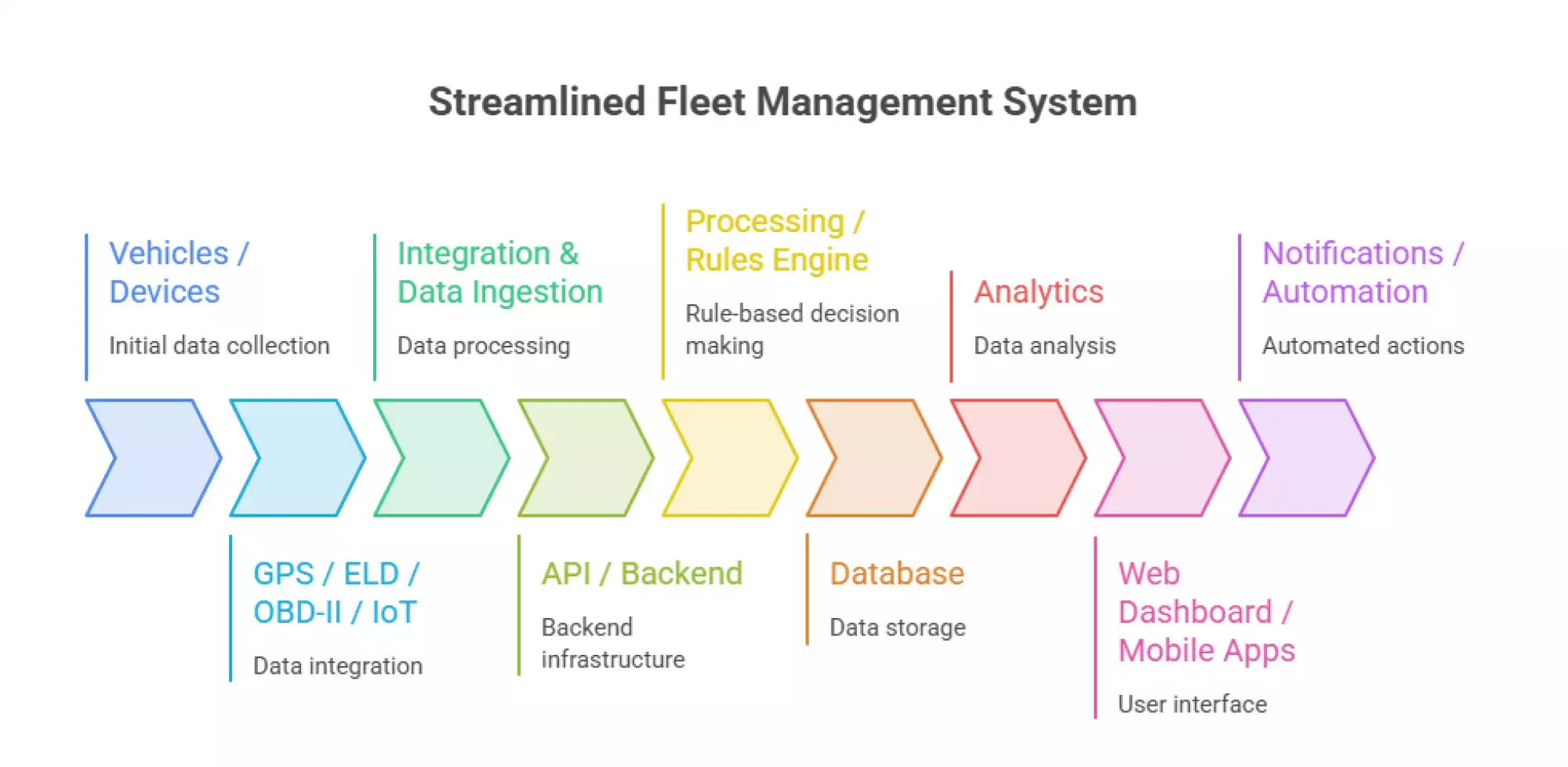
A reliable fleet platform needs more than a GPS map and dashboard. Its architecture must move vehicle data securely from connected devices to the applications, analytics, and automated workflows that fleet teams use every day.
Vehicles / Devices
↓
GPS / ELD / OBD-II / IoT
↓
Integration & Data Ingestion
↓
API / Backend
↓
Processing / Rules Engine
↓
Database
↓
Analytics
↓
Web Dashboard / Mobile Apps
↓
Notifications / Automation
Device & Telematics Integration Layer
This layer connects GPS trackers, ELDs, OBD-II devices, IoT sensors, and telematics platforms. It receives vehicle and driver data and normalizes information from different hardware providers for consistent processing.
Real-Time Telemetry Data Processing at Scale
High-frequency telemetry requires more than a standard API and database. A fleet platform must be able to ingest, process, validate, store, and distribute continuous vehicle events without slowing down as the fleet grows. For example, 5,000 vehicles sending one telemetry event every five seconds can generate around 1,000 events per second. Larger fleets or more frequent reporting intervals can create considerably higher volumes.
The telemetry pipeline can be designed around the following flow:
Vehicle Devices → Event Ingestion → Message Queue → Stream Processing → Data Normalization → Storage → Analytics → WebSocket Delivery
Event Ingestion
The ingestion layer receives telemetry from GPS trackers, telematics devices, ELDs, OBD-II systems, IoT sensors, and other connected hardware. It should accept high volumes of incoming events without directly overloading application servers or operational databases.
Message Queues
A message queue can temporarily hold incoming telemetry and separate data collection from downstream processing. This allows the system to absorb traffic spikes, process events asynchronously, and scale individual components as data volumes increase.
Stream Processing
Stream-processing services can validate and process telemetry as it arrives. They can calculate vehicle status, detect geofence events, identify route deviations, evaluate driver behaviour, and trigger alerts without waiting for batch processing.
Data Normalization
Different device manufacturers may send different data formats, field names, units, timestamps, and event structures. A normalization layer converts these inputs into a consistent internal data model so that the rest of the platform can work with standardized telemetry.
Handling Duplicates and Out-of-Order Events
Connected devices may resend data after network interruptions, while delayed packets can arrive after newer events have already been processed. The platform should use event identifiers, timestamps, sequence numbers, and suitable processing rules to detect duplicate events and handle out-of-order data without corrupting vehicle history.
Device Reconnects and Offline Buffering
Vehicles can temporarily lose cellular or network connectivity. Devices may therefore need to buffer telemetry locally and transmit stored events after reconnecting. The platform should also identify offline devices, distinguish delayed data from current data, and prevent a reconnect from creating an uncontrolled processing spike.
Time-Series Data Storage
High-frequency location and telemetry data can benefit from storage designed for time-based queries. The architecture can separate frequently accessed operational data from historical telemetry so that live dashboards remain responsive while large historical datasets remain available for reporting and analytics.
Hot and Cold Data Storage
Recent telemetry can be kept in fast-access storage for live tracking, dashboards, alerts, and operational queries. Older telemetry can be moved to lower-cost archival storage for long-term reporting, compliance needs, analytics, or historical modeling. Retention policies should be defined according to business, regulatory, and analytical requirements.
Real-Time WebSocket Delivery
Processed events can be delivered to fleet dashboards and mobile applications through WebSockets or other suitable real-time communication methods. This allows vehicle locations, statuses, alerts, ETAs, and operational events to update without requiring users to repeatedly refresh the application.
Scalable Telemetry Architecture
The exact architecture depends on fleet size, reporting frequency, device types, data retention requirements, integrations, and expected growth. For larger deployments, ingestion, processing, storage, analytics, and real-time delivery should be capable of scaling independently rather than relying on a single application server or database.
Frontend & Application Layer
Web dashboards and mobile apps offer fleet manager, dispatcher, driver, tech, and admin user interfaces based on role. The interface could be customized to be suitable for each user's work and operations.
Backend & API Layer
The backend will handle business logic, authentication, fleet management, integration, and data exchange. APIs enable the platform to interact with telematics service providers, mapping, ERP, CRM, fuel, maintenance, and other enterprise systems.
Database & Data Storage
The data layer stores vehicle records, GPS history, trips, driver activity, maintenance records, alerts, and operational events. Storage can be structured to support both fast operational queries and long-term fleet analytics.
Analytics & Reporting Layer
Analytics services convert fleet data into actionable KPIs, such as fuel usage, vehicle utilization, route efficiency, downtime, driver performance, and maintenance trends.
Notification & Automation Engine
A rules-based engine can detect specific events and trigger actions automatically, such as geofence breaches, maintenance thresholds, route deviations, fuel anomalies, and driver-risk events.
Cloud Infrastructure
Cloud infrastructure development provides the scalability and availability needed to handle continuous telemetry from growing fleets. Services can be designed to scale independently as vehicle, user, and data volumes increase.
Security Layer
Security should span every architectural layer, covering identity and access controls, encrypted data transmission, API protection, audit logging, and tenant-level data isolation. Fleet platforms also need to account for connected devices as part of the overall security boundary.
Multi-Tenant Architecture for Fleet Platforms
Multi-tenant architecture provides the advantage of shared infrastructure for SaaS development while separating the fleet data for each customer. As the platform scales, you can mitigate cross-customer data exposure by using tenant-aware access controls, role-based permissions, and database-level isolation.
Fleet Management Software Features
A customized fleet platform can integrate vehicle tracking, dispatch, drivers, maintenance, compliance, and analytics into a seamless system. The exact modules can be tailored through fleet management software development to match your fleet size, workflows, and operational requirements.
Vehicle & GPS Tracking
A tracking module gives fleet teams a real-time view of vehicle movement, location, and activity. These capabilities help monitor journeys, identify exceptions, and improve fleet visibility.
- Real-Time Location
- Trip History
- Geofencing
- Mileage Tracking
- Speed Monitoring
- Idle Time
- Route History
- Vehicle Status
Fleet Manager Dashboard
The dashboard brings critical fleet information into one operational view. Managers can monitor vehicles, drivers, alerts, maintenance, and KPIs without switching between multiple systems.
- Fleet Overview
- Active Vehicles
- Driver Status
- Live Map
- Alerts
- Fuel KPIs
- Maintenance Status
- Fleet Utilization
Fleet Maintenance Management
Maintenance features help teams move from reactive repairs to planned vehicle upkeep. The system is able to link up service schedules to mileage, inspections, and vehicle data.
- Preventive Maintenance
- Service Schedules
- Maintenance History
- Parts Tracking
- Inspection Reminders
- Breakdown Alerts
Driver Management
A driver management module centralizes driver information and performance data. It helps managers assign resources, monitor behavior, and maintain required records.
- Driver Profiles
- Driver Assignment
- Driver Behavior
- Performance Scoring
- Training Records
- Driver Documentation
Driver Mobile App
A driver app extends fleet management from the office to the road. It gives drivers the tools needed to manage jobs, update trips, complete inspections, and communicate with dispatch.
- Driver Login
- Assigned Jobs
- Navigation
- Trip Status
- Digital Proof of Delivery
- Vehicle Inspection
- Incident Reporting
- Documents
- Notifications
- Messaging
Route Planning & Optimization
Route optimization enables dispatchers to optimize routes while taking into consideration constraints. It can also compare planned routes with actual vehicle movement.
- Multi-Stop Routing
- Traffic-Aware Routing
- Delivery Windows
- Route Deviation
- ETA Calculation
Fuel Management
Fuel management connects consumption, mileage, and vehicle activity to provide a clearer picture of fuel efficiency. It can also help identify unusual usage patterns.
- Fuel Consumption
- Fuel Cards
- Mileage Analysis
- Idling Analysis
- Fuel Anomaly Detection
ELD & HOS Management
ELD and HOS capabilities help digitize driver logs and hours-of-service workflows. These features can be delivered through integrations with appropriate ELD providers.
- Electronic Logs
- HOS Tracking
- Violation Alerts
- ELD Integration
Dispatch Management
Dispatch features connect jobs, drivers, vehicles, and live fleet data in one workspace. This helps teams coordinate assignments and respond quickly when plans change.
- Job Creation
- Driver & Vehicle Assignment
- Live Dispatch
- Exception Management
- Trip Status
Asset & Trailer Tracking
Asset tracking extends visibility beyond powered vehicles to trailers, containers, equipment, and other valuable assets.
- Asset Location
- Geofencing
- Utilization Tracking
- Movement Alerts
Reporting & Fleet Analytics
Analytics makes operational data into measurable fleet performance insights. Different teams can use custom reports to help them concentrate on key performance indicators that are important to them.
- Fleet Reports
- Operational KPIs
- Driver Analytics
- Custom Dashboards
- Historical Analytics
Alerts & Notifications
Automated alerts assist teams in acting in response to key events without constant monitoring of all vehicles. Rules can be configured around operational and business requirements.
- Maintenance Alerts
- Geofence Alerts
- Driver Behavior Alerts
- Route Alerts
- Fuel Alerts
- ETA Updates
Document & Compliance Management
With digital document management, all of these vehicle, driver, and compliance data are stored in one system. Automated reminders will help teams stay on top of expiry dates.
- Vehicle Documents
- Driver Documents
- Expiry Alerts
- Inspection Records
- Audit Trails
Admin & Role-Based Access Control
With administration tools, businesses have control over users, fleets, branches, and permissions. Role-based access allows people to see only what is relevant to their role and function.
- User Management
- Role-Based Access
- Fleet & Branch Management
- Permission Controls
Fleet Management Software User Roles
A well-designed fleet platform gives each user access to the tools and data relevant to their responsibilities. Role-based workflows keep daily operations organized while maintaining appropriate access to fleet information.
| User | Main Capabilities |
| Fleet Manager | Fleet visibility, KPIs, vehicle utilization, maintenance |
| Dispatcher | Routes, trips, assignments, live tracking |
| Driver | Jobs, navigation, inspections, trip updates |
| Admin | Users, permissions, configurations, system settings |
| Operations Manager | Productivity, utilization, operational analytics |
| Maintenance Manager | Vehicle health, servicing, inspections, repair history |
Types of Fleet Management Software We Develop
Different fleets need different levels of tracking, automation, compliance, and operational control. Our fleet management software development services can cover focused fleet applications or combine multiple capabilities into a unified platform.
GPS Fleet Tracking Software
GPS fleet tracking software is meant for companies that need to see and understand the location and use of their vehicles at all times. It is a combination of GPS and telematics data, maps, vehicle activity, trip history, and geofencing.
- Live GPS tracking
- Geofencing and route history
- Mileage and speed monitoring
- Vehicle status and trip tracking
- Real-time fleet dashboards
Fleet Maintenance Management Software
Fleet maintenance software can help companies ensure that vehicles are in proper condition for service by managing vehicle health and preventive maintenance. Integrates service schedules, inspections, repairs, and maintenance history into one workflow.
- Preventive maintenance
- Service scheduling
- Inspection management
- Repair and parts tracking
- Maintenance history and alerts
Fleet Fuel Management Software
Fuel management software gives businesses better visibility into how much fuel vehicles consume and where fuel costs are increasing. It can connect fuel transactions with mileage, vehicle activity, and idling data.
- Fuel consumption tracking
- Fuel card integration
- Mileage and idling analysis
- Fuel cost reporting
- Fuel anomaly detection
Driver Management Software
Driver management software centralizes the information businesses need to assign, monitor, and manage drivers. It can combine driver records with behavior, performance, training, and compliance data.
- Driver profiles
- Driver assignment
- Behavior monitoring
- Performance scoring
- License and training records
ELD & Compliance Software
ELD and compliance software digitizes driver records and helps fleets manage hours-of-service and regulatory workflows. Integrations can connect the platform with supported ELD providers and related compliance systems.
- ELD integration
- HOS tracking
- Electronic driver logs
- Violation alerts
- Compliance records
Dispatch Management Software
Dispatch management software connects jobs with available drivers, vehicles, and routes. Dispatch teams can use live fleet information to assign work, monitor trips, and respond when schedules change.
- Job creation and assignment
- Driver and vehicle allocation
- Live dispatch
- Trip tracking
- Exception management
Last-Mile Delivery Fleet Software
Last-mile fleet software is designed for delivery businesses managing frequent stops, tight delivery windows, and distributed drivers. It combines route planning, mobile workflows, tracking, and proof of delivery.
- Multi-stop route planning
- Delivery scheduling
- Driver mobile app
- Digital proof of delivery
- ETA and delivery tracking
Transportation Management Platforms
Transportation management platforms integrate an enterprise's transportation and logistics operations with the fleet. They can integrate vehicles, drivers, dispatch, freight, routes, customers, and enterprise systems into one platform.
- Fleet and trip management
- Dispatch and routing
- Driver workflows
- Freight visibility
- Analytics and integrations
Asset & Trailer Tracking Software
Asset and trailer tracking software extends visibility beyond powered vehicles. It provides asset tracking, asset movement, asset utilization, and asset availability to help businesses keep track of trailers, containers, equipment, and more.
- GPS and IoT tracking
- Asset geofencing
- Movement alerts
- Utilization monitoring
- Location history
Enterprise Fleet Management Platforms
Enterprise fleet platforms are engineered for companies with large and/or distributed fleets, business units, or teams. They can integrate with advanced analytics, permissions, and automation and combine fleet operations.
- Multi-fleet and branch management
- Advanced role-based access
- Telematics and IoT integrations
- Enterprise API integrations
- Advanced analytics and automation
- Scalable multi-tenant architecture
Advanced Features That Can Differentiate Your Fleet Platform
Beyond core tracking and fleet workflows, advanced capabilities can turn a fleet platform into a more predictive and automated system. These features can be integrated based on historical, operational, vehicle, and telematics data and the business's goals.
AI-Powered Predictive Maintenance
Using AI models, maintenance history, mileage, diagnostics, and telematics data can be analyzed to detect patterns that could predict potential vehicle problems. This can assist teams in transitioning from scheduled maintenance to more data-informed maintenance decisions.
- Failure-risk prediction
- Maintenance recommendations
- Vehicle health scoring
- Service forecasting
AI-Based Route Optimization
AI in transportation can analyze traffic, delivery schedules, vehicle availability, past routes, and other operational considerations to suggest the most efficient paths.
- Dynamic route planning
- Multi-stop optimization
- Traffic-aware routing
- Continuous route adjustment
Driver Risk Scoring
Driver risk models can be used to integrate many telematics events, such as speeding, harsh braking, harsh acceleration, cornering, idling, and more, to produce customizable safety scores.
- Risk scoring
- Behaviour trends
- Driver comparisons
- Coaching insights
Predictive Fuel Analytics
Machine learning can analyze fuel consumption against mileage, routes, vehicle type, idling, and historical patterns. This can help identify unusual consumption and potential efficiency opportunities.
- Consumption forecasting
- Fuel anomaly detection
- Vehicle-level efficiency analysis
- Idling insights
Automated Dispatch
Intelligent dispatch can use vehicle location, availability, driver status, capacity, job requirements, and route conditions to recommend or automate assignments.
- Automated job allocation
- Vehicle-driver matching
- Real-time reassignment
- Exception handling
ETA Prediction
Predictive ETA models can combine GPS position, traffic, route conditions, historical travel times, stops, and delivery patterns to provide more context-aware arrival estimates.
- Dynamic ETAs
- Delay prediction
- Customer updates
- Delivery performance tracking
Anomaly Detection
Anomaly detection can be used to detect activity that is not in line with the defined vehicle, driver, fuel, or operation patterns. This can assist in exposing issues that may not be detected in the surface layer by rule-based alerts.
- Unusual fuel usage
- Unexpected vehicle movement
- Irregular driving behavior
- Route or operational anomalies
Natural-Language Fleet Analytics
With a natural-language interface, authorized users can get answers to inquiries about fleet data without having to create each report manually. Its value relies on the quality of the data it contains, the reporting needs, and the analytics system design.
- Ask questions in plain language
- Generate KPI summaries
- Query operational trends
- Create report-ready insights
Computer Vision & AI Dashcams
AI cameras can provide a breakdown of road and driver behavior to determine events like distraction, fatigue signs, unsafe following, or potential collisions. Implementation will vary based on camera equipment, video quality, privacy needs, and model specifications.
- Driver attention monitoring
- Distraction detection
- Collision event detection
- Video-based incident review
Digital Twin for Fleet Operations
A digital twin can create a continuously updated virtual representation of vehicles, assets, routes, and operational conditions using connected data. It is most valuable where sufficient real-time and historical data exist to model fleet behavior.
- Virtual fleet representation
- Asset and vehicle simulation
- Scenario modelling
- Operational forecasting
Basic Fleet Platform vs Intelligent Fleet Platform
| Basic | Intelligent |
| GPS tracking | Predictive insights |
| Manual dispatch | Automated dispatch |
| Historical reports | Predictive analytics |
| Basic alerts | AI anomaly detection |
| Manual maintenance | Predictive maintenance |
| Static routing | AI optimisation |
The objective is not to add AI for its own sake. Advanced capabilities should be introduced where the available data, operational complexity, and expected business value justify them.
Devices & Technologies Used in Fleet Management Systems
Fleet management systems rely on connected hardware to collect vehicle, driver, and asset data. During fleet management system development, these devices can be integrated with the software through manufacturer APIs, telematics platforms, and suitable communication technologies.
GPS Tracking Devices
GPS trackers give real-time location data that enables the platform to track vehicle activity, speeds, mileage, trips, and geofence activity.
ELD Devices
Electronic Logging Devices capture driver duty status and hours-of-service information. ELD integrations can bring these records into the platform for compliance monitoring and digital workflows.
OBD-II Devices
OBD-II devices can retrieve vehicle diagnostic data, including fault codes, engine data, mileage, and other parameters, which can help link vehicle health to maintenance workflows.
IoT Sensors
The sensors can detect data like temperature, humidity, cargo status, door activity, or asset movement, which can be helpful for specific fleet and logistics applications.
Dashcams
Drivers can access video and incident data for driver safety, incident investigation, and AI-based monitoring, depending on camera hardware and integration.
RFID
RFID technology is used to identify vehicles, assets, equipment, or authorized items as they move through supported readers to help automate asset identification and movement tracking.
Smartphones & Tablets
By eliminating the need for dedicated hardware for each function, driver smartphones and tablets can deliver GPS location, job updates, navigation, inspections, proof of delivery, messaging, and other mobile workflows.
Telematics Control Units
Telematics control units collect data from vehicle systems and connected devices and transmit it to backend platforms. Integrating TCUs can provide a broader data layer for vehicle diagnostics, location, driving behavior, and operational telemetry.
Common Devices and Their Development Use
| Device | Data Captured | Development Use |
| GPS | Location, speed, mileage | Tracking and geofencing |
| ELD | HOS, duty status, driver logs | Compliance |
| OBD-II | Diagnostics, fault codes, vehicle data | Vehicle health |
| IoT Sensors | Temperature, movement, asset conditions | Monitoring |
| Dashcam | Video, driving events | Safety and incident review |
| RFID | Asset or vehicle identification | Asset management |
| Smartphone/Tablet | Location, jobs, inspections, POD | Driver workflows |
| TCU | Vehicle telemetry and diagnostics | Telematics integration |
Fleet Data Communication Technologies
Different fleet devices and providers may use different methods to transfer data. The suitable technology is related to the device, data frequency, integration model, and application requirements.
- REST APIs: Integrate the platform with telematics providers, ELDs, mapping, and enterprise apps.
- WebSockets: Enable live updates between the back-end and web or mobile apps.
- MQTT: Enable lightweight, continuous messaging for appropriate use cases in IoT and telemetry.
- HTTPS: Secure data transmission between applications, devices, and cloud services.
- APIs for Telematics: Integrate vehicle and device data from compatible telematics providers and drive it to the fleet platform.
The final device and communication stack should be selected around the fleet's hardware, data requirements, integration availability, security needs, and operating environment, rather than forcing one technology across every deployment.
Fleet Management Software Integrations
Integrations allow a fleet platform to work with the systems and devices a business already uses. Instead of creating isolated software, fleet tracking software development can connect vehicle data, dispatch, fuel, finance, communication, and business operations through APIs and secure data exchange.
GPS & Mapping APIs
Mapping integrations provide the location, routing, distance, traffic, and geospatial data needed for fleet operations.
- Route Planning
- Live Tracking
- Traffic Data
- Geofencing
ELD & Telematics APIs
ELD and telematics integrations bring vehicle and driver data directly into the platform instead of requiring teams to manage separate systems.
- ELD Data
- Vehicle Telemetry
- Driver Events
- Real-Time Data
Fuel Card Systems
Fuel integrations connect transaction data with vehicles, drivers, mileage, and consumption records.
- Transaction Sync
- Fuel Analysis
- Anomaly Detection
- Cost Reporting
ERP & Accounting Systems
ERP and accounting integrations connect fleet activity with financial and operational processes.
- Expense Data
- Invoicing
- Financial Reporting
- Data Synchronization
CRM Platforms
CRM integrations connect fleet operations with customer information and service workflows.
- Customer Data
- Job Management
- Delivery Updates
- Service History
Payment Gateways
Payment integrations can support platforms that collect delivery, transportation, rental, service, or other fleet-related payments.
- Online Payments
- Transaction Records
- Payment Status
- Automated Workflows
Communication & Notification APIs
Communication integrations ensure drivers, dispatchers, customers, and managers receive important updates through the channels they already use.
- SMS & Messaging
- Push Notifications
- Event Alerts
IoT Platforms
IoT integrations allow fleet software to consume data from connected sensors and devices beyond standard GPS tracking.
- Sensor Data
- Asset Monitoring
- Condition Alerts
- Device Management
Business Intelligence Tools
BI integrations extend fleet analytics into broader business reporting environments.
- KPI Analysis
- Custom Dashboards
- Historical Trends
- Data Export
Third-Party Logistics Platforms
3PL integrations connect fleet operations with external logistics software and transportation ecosystems.
- Order Synchronization
- Dispatch Coordination
- Shipment Visibility
- Proof of Delivery
Need to integrate with an existing telematics or ELD provider?
Connect your existing fleet technology with a custom platform designed around your workflows and data requirements.
Fleet Management Software Development Process
The proper and intelligent fleet management software development process creates a connected digital system of fleet operations. It entails business discovery, product design, engineering, device integrations, testing, deployment, and continuous optimization, all of which deliver specific results to the following phases.
1. Business & Fleet Requirements Discovery
We first identify the areas of delay, cost, or data loss in your current processes and map how your fleet is operating. The discovery includes fleet size, types of vehicles, types of users, workflows, integrations, compliance requirements, reporting needs, etc.
Deliverables: Product requirements document, feature priorities, user roles, and technical scope.
2. Market & Competitor Analysis
Competition amongst fleet platforms, expectations, target users, and technologies is assessed. This can help identify what features are critical and how your platform can deliver a better user experience.
Deliverables: Competitor analysis, feature benchmark, insights into the market, and product positioning.
3. Technical Feasibility & Architecture Planning
We perform feasibility validation of the needed GPS, telematics, IoT, ELD, OBD-II, APIs, data processing, cloud infrastructure, and security architecture. The solution is designed based on user expectations, vehicles, telemetry frequency, future integration, and scalability.
Deliverables: System architecture, tech stack, integration process, and development roadmap.
4. UI/UX Design & Interactive Prototype
We build interfaces according to the real process of fleet management, dispatch, drivers, maintenance, and administration. Live maps, dashboards, trip management, inspections, alerts, reports, and other key screens are turned into an interactive prototype.
Deliverables: User flows, wireframes, interactive prototype, and approved UI designs.
5. MVP Development
The central platform is built upon the highest-value operational workflows, not to try to build everything at once. The MVP development can consist of GPS tracking, fleet dashboards, dispatch, driver management, maintenance, route management, and reporting, among other features, depending on the scope.
Deliverables: MVP with core web and mobile functionalities.
6. IoT, GPS, ELD & API Integration
The MVP is hooked up to the necessary hardware and external systems. These can be GPS trackers, telematics, ELDs, OBD-II, IoT sensors, mapping services, fuel systems, ERP platforms, and other APIs.
Deliverables: The delivered integration layer is validated and has reliable device and third-party data flows.
7. Testing & Security Validation
The platform is tested for functional integration, API performance, usability, and device data. Security controls include authentication, role-based access, data protection, API security, and others based on discovery requirements.
Deliverables: Tested, validated, and release-ready platform.
8. Pilot Deployment
A controlled pilot will be completed with a specific set of vehicles, drivers, or locations. The tracking accuracy, integrations, workflows, usability, and system performance are validated using real operating data prior to the broader rollout.
Deliverables: Findings, solved problems, and production readiness assessment in the pilot.
9. Production Deployment
The platform then enters the live fleet operations phase, following pilot validation. Production infrastructure, user permissions, integrations, monitoring, backups, and deployment configuration are set up for the agreed rollout strategy.
Deliverables: Deployed fleet management platform that is production-ready and usable for live users.
10. Monitoring, Maintenance & Feature Expansion
As fleets grow, devices increase, users grow, and integrations evolve, the platform remains reliable with post-launch support. The roadmap can then further grow to include AI-powered analytics, predictive maintenance, automated dispatch, advanced reporting, new device integrations, and other workflows.
Deliverables: A platform for the fleet that is kept, monitored, and continually improved.
10-Step Development Roadmap
Business Discovery → Market Analysis → Architecture → UI/UX → MVP → Integrations → Testing → Pilot → Production → Continuous Improvement
This way, companies can test the foundation of the platform early, integrate with the current fleet infrastructure, and add services to the platform as they grow.
Fleet Management Software MVP: What Should You Build First?
A fleet platform does not need every advanced capability at launch. A focused MVP can validate the core workflows, connect essential fleet data, and generate user feedback before larger investments in automation and AI. This approach can also make the fleet management software cost easier to control during the initial release.
Must-Have MVP Features
The first release should focus on the functions fleet teams use every day. These features establish the foundation for tracking vehicles, managing drivers, and monitoring operations.
- GPS Tracking
- Vehicle Profiles
- Driver Management
- Basic Dashboard
- Alerts
- Basic Driver App
Features to Add in Phase 2
Once the core platform is validated, Phase 2 can address more advanced operational workflows. These capabilities can improve efficiency without making the initial product unnecessarily complex.
- Route Optimisation
- Fuel Analytics
- Maintenance Automation
- ELD Integration
- Advanced Reporting
- Advanced Driver Workflows
Enterprise Features for Phase 3
Enterprise capabilities should be introduced when fleet scale, operational complexity, or data availability justifies them. This is where the platform can evolve into a more intelligent and distributed fleet ecosystem.
- AI Predictions
- Digital Twin
- Advanced AI
- Multi-Region Scaling
- Enterprise Integrations
- Full Mobile Ecosystem
Recommended Development Roadmap
| MVP | Phase 2 | Enterprise |
| GPS tracking | Route optimisation | AI predictions |
| Vehicle profiles | Fuel analytics | Digital twin |
| Driver management | Maintenance automation | Advanced AI |
| Basic dashboard | ELD integration | Multi-region scaling |
| Alerts | Advanced reporting | Enterprise integrations |
| Basic driver app | Advanced driver workflows | Full mobile ecosystem |
The goal is not to build less. It is to be built in the right order. Start with the workflows that solve the most immediate operational problems, then use real user feedback and fleet data to determine what should come next.
Fleet Management Software Development Cost in 2026
The price of fleet management software development is based on the scope of the platform, the number of applications, integrations, fleet complexity, the volume of data, and the level of automation. Industry estimates for custom fleet software range from $10,000 for a specific MVP to $200,000 and up for enterprise-level solutions in 2026.
A good initial approximation for budgeting is:
| Complexity | Indicative Cost |
| Basic MVP | $30,000–$60,000 |
| Mid-Level Platform | $60,000–$120,000 |
| Enterprise Platform | $120,000–$250,000+ |
These are only estimates of Suffescom pricing and not a fixed price. The final quotation depends on your company size, the need for modules, your web and mobile platforms, integrations, compliance needs, and technical architecture.
How Much Does It Cost to Develop Fleet Management Software?
A basic, streamlined version of the fleet tracking system that only includes a web dashboard, driver app, GPS tracking, vehicle management, and basic alerts and reporting can usually begin at $30,000 - $60,000. The $60,000 to $120,000 range can be reached with telematics, route optimization, fuel management, ELD workflows, advanced analytics, and multiple integrations.
AI, predictive analytics, multi-region operation, complex integrations, IoT application development, and high-volume real-time data processing go together to create enterprise platforms that cost as much as $120,000-$250,000+ per platform. The ranges are in line with the 2026 estimates from Saigon Technology and Taction Software.
Fleet Software Development Cost by Complexity
Basic MVP: $30,000–$60,000
Suitable for proving the core product with GPS tracking, vehicle and driver profiles, dashboards, basic alerts, trip management, and a driver mobile app.
Mid-Level Platform: $60,000–$120,000
Increases operational depth by optimizing routes, managing fuel, streamlining maintenance processes, integrating ELD/telematics, delivering advanced reporting, and enabling more sophisticated mobile functionality.
Enterprise Platform: $120,000–$250,000+
Ideal for large-scale and complex deployments that need AI development capabilities, IoT, predictive analytics, multi-tenant architecture, enterprise integration, advanced security, and multi-region deployments.
Factors That Affect Development Cost
The most expensive factors are not just the number of features. Development effort can vary considerably based on architecture, data flows, integrations, and operational complexity.
- The number of platforms: Web dashboards, driver applications, manager applications, and admin portals are all additional development areas.
- User roles: More roles require additional workflows, permissions, and interfaces.
- Feature complexity: Basic tracking is less expensive than real-time optimization or predictive workflow.
- Fleet Size: The size of the fleet demands more robust data processing, scalability, and monitoring.
- GPS integration: Device compatibility and real-time location processing have an impact on the level of integration.
- Telematics: Different hardware vendors may need different APIs, data formats, and normalization.
- ELD/HOS: Compliance workflows need special integrations and compliance handling.
- IoT Hardware: Sensors, TCUs, OBD-II devices, and cameras introduce integration and data-processing needs.
- Mobile Apps: Driver and Manager Apps expand development and maintenance requirements.
- AI: Special engineering and data are needed for predictive maintenance, route optimization, risk scoring, and anomaly detection, among other uses of AI.
- Cloud Infrastructure: It's essential to have scalable infrastructure and data storage for high-frequency telemetry and large fleets.
- Security: Encryption, RBAC, audit trails, monitoring, and secure APIs add engineering requirements.
- Compliance: Must meet country, industry, and fleet operation requirements.
- Third-party APIs: API integrations like telematics, mapping, fuel, ERP, CRM, and ELD can add to development and ongoing costs.
- Geographic Coverage: Multi-country operations may add other currencies, languages, regulations, data residency, and regional workflows.
Cost of GPS & Telematics Integration
When using a proven provider API, integration with GPS is relatively simple; additional costs arise if the platform needs to support multiple hardware types, high-frequency telemetry, device management, and custom data normalization.
Data telematics integration may include GPS data, OBD-II data, CAN data, vehicle diagnostics, driver events, fuel data, and sensor data. The final cost will vary based on the number of device providers and the complexity of the data pipeline required.
Cost of Mobile App Development
A driver mobile app development is an additional application layer that can be added to the platform. It will vary in cost depending on the number of platforms you need an app on, as well as the amount of functionality drivers demand.
Navigation, job assignments, inspections, proof of delivery, messaging, offline workflows, location tracking, and incident reporting all expand the scope. An extra development effort would be required for an app for managers and dispatchers.
Cost of AI & Predictive Analytics
AI development features can significantly increase the development budget because they require suitable historical data, data preparation, model development, testing, and ongoing evaluation.
Typical advanced capabilities include:
- Predictive maintenance
- AI route optimization
- Driver risk scoring
- Fuel prediction
- Anomaly detection
- Demand forecasting
- Natural-language analytics
AI should therefore be added where the available fleet data and business case justify it, rather than treated as a standard feature in every project.
Cloud Infrastructure & Third-Party Costs
Development cost is only part of the total technology investment. Cloud hosting, map requests, SMS, storage, telemetry processing, device connectivity, API subscriptions, and third-party services may create recurring expenses.
Post-Launch Maintenance Costs
A fleet platform needs continuous upkeep, as devices, APIs, operating systems, security needs, and regulatory procedures evolve over time.
Typical post-launch work includes:
- Bug fixes and performance optimization
- Security patches
- API and device integration updates
- Cloud infrastructure management
- Compliance updates
- OS and mobile app updates
- New feature development
Fleet Management Software Cost by Feature
| Feature | Relative Cost Impact |
| GPS tracking | Low–Medium |
| Driver app | Medium |
| Route optimisation | Medium |
| ELD integration | Medium–High |
| IoT integration | High |
| Predictive AI | High |
| Computer vision | High |
| Enterprise analytics | High |
Important: These figures represent indicative project budgeting ranges, not universal prices. The actual fleet management software cost should be calculated after defining the required platforms, modules, integrations, fleet scale, data architecture, security requirements, and deployment model.
Fleet Management Software Development Timeline
Fleet management software development time depends on the number of platforms, features, integrations, fleet size, and testing needs. A focused MVP can be discovered and piloted in a few months. Whereas enterprise deployments take more time for integrations and scale.
| Stage | Typical Duration |
| Discovery | 1–2 weeks |
| UI/UX | 2–4 weeks |
| MVP Development | 8–16 weeks |
| Integration & Testing | 3–6 weeks |
| Pilot Deployment | 2–4 weeks |
| Enterprise Scaling | Project dependent |
Security, Compliance & Data Privacy for Fleet Platforms
Fleet platforms also store critical fleet information, such as vehicle locations, driver information, trip records, diagnostics, and compliance records. Security cannot therefore be seen as developed post the application, APIs, devices, cloud infrastructure, and data lifecycle.
Data Encryption
Fleet data should be safeguarded while being sent and when it is saved. Sensitive data such as GPS locations, driver logs, telemetry, documents, etc., can be protected from unauthorized access through encryption.
Authentication & Authorization
Strong authentication is the process of establishing who is accessing the platform, and authorization is the process of establishing what the user can access or modify. This may involve safe password security, multi-factor authentication, session management, and permission policies, among other things.
Role-Based Access Control
RBAC limits access according to responsibilities. A dispatcher may manage trips, while a maintenance manager accesses vehicle servicing data and an administrator manages users and system settings.
API Security
APIs between GPS, telematics, ELD, IoT, and business systems are used to exchange a tremendous amount of data across the fleet platforms. They are protected by APIs that implement authentication, authorization, validation, rate limiting, and monitoring.
Device Security
Connected GPS trackers, ELDs, OBD-II devices, sensors, and dashcams can serve as gateways into the fleet ecosystem. Security of the provider, firmware management, appropriate provider security, access controls, and secure communication should be taken into account during the integration.
Audit Logs
Audit trails can log important activities like user logins, changes in permissions, changes in configuration, changes in data, and administrative actions. This enhances accountability and will help to respond to security or operational incidents.
Data Backup & Disaster Recovery
Improper backup or recovery processes should be implemented to minimize the impacts of infrastructure failure, data corruption, or service disruption in fleet systems. The choice of backup frequency and retention should be based on operational and regulatory needs.
U.S. Fleet Compliance Considerations
U.S. fleet platforms may need to support requirements related to FMCSA regulations, HOS records, ELDs, driver records, and supporting documentation, depending on the fleet's operations. Requirements can vary based on vehicle type, operation, and applicable exemptions.
FMCSA, ELD & HOS Integration Considerations
For applicable carriers, ELD integrations should be designed around the required HOS and electronic record workflows. The specific ELD must be registered with FMCSA, and carriers remain responsible for using an appropriate device and maintaining required records.
FMCSA also requires applicable ELD records and supporting documents to be retained for six months, with a separate backup copy of ELD records and protections for driver privacy.
Compliance Disclaimer
Software compliance support does not mean automatic regulatory compliance.
A fleet platform can be designed to support compliance workflows, but actual compliance depends on factors such as
- Applicable regulations and jurisdiction
- Correct ELD hardware and configuration
- Device registration and certification requirements
- Data collection and transfer
- Record retention
- Business workflows and implementation
- Driver and carrier procedures
- Ongoing regulatory changes
For U.S. operations, the specific requirements should be validated against current FMCSA rules and the fleet's applicable operating conditions before deployment.
Why Choose Suffescom for Fleet Management Software Development?
Choosing a fleet management software development company should come down to relevant engineering capability, integration experience, and the ability to support the product beyond launch. Suffescom's published logistics work provides relevant evidence across transportation, last-mile delivery, tracking, integrations, and operational software.
Relevant Fleet & Logistics Experience
Suffescom has published work covering transportation management, last-mile delivery, real-time tracking, route management, and logistics integrations. This experience is directly relevant when building platforms that connect fleet operations, dispatch, delivery workflows, and tracking data.
Full-Stack Product Development
The team can take a fleet product from requirements and UI/UX through backend development, APIs, integrations, testing, and deployment. It ensures one development process instead of multiple processes for web, mobile, back-end, and integration among various vendors.
IoT & Telematics Integration
Reliable data from GPS trackers, telematics systems, ELDs, OBD-II devices, and IoT sensors is essential for fleet platforms. Suffescom's logistics software development capabilities include IoT and third-party integration work, providing a relevant foundation for connected fleet applications.
Web & Mobile Expertise
Fleet managers, dispatchers, drivers, technicians, and administrators need various interfaces to streamline fleet operations. Suffescom can create responsive web dashboards for workflows such as job assignments, navigation, inspections, trip updates, and proof of delivery, in addition to mobile applications.
Cloud & Data Engineering
All location, vehicle, driver, and operational data are continuously processed through real-time fleet platforms. High-frequency data processing and future fleet expansion can be supported by cloud-based architecture, APIs, scalable databases, and structured data pipelines.
Security & QA
Fleet software handles operational records, driver information, location data, and connected-device data. Security controls, role-based access, API protection, functional testing, integration testing, and performance validation should therefore be incorporated throughout development.
Long-Term Product Support
Once a fleet software is launched, it continues to grow and mature as devices, APIs, laws, operating systems, and business processes change. As the platform continues to develop, Suffescom can help maintain the platform, integrate new updates, optimize performance, fix bugs, and add new features.
Build Your Custom Fleet Management Platform
Tell us about your fleet size, vehicle types, workflows, integrations, and target platforms. Our team can help define the architecture, MVP scope, development roadmap, and estimated investment for your fleet management platform.
Conclusion
By developing fleet management software, businesses can integrate GPS tracking, IoT, telematics, drivers, vehicles, and day-to-day operations into a single system. Businesses can invest in software development that can scale with their fleet and operational demands through the use of web and mobile applications, automation, and AI-powered features, handling data securely and efficiently.
Looking to create a fleet platform for your business processes? Partner with Suffescom to establish MVP, architecture, integrations, development roadmap, and investment.
FAQs
1. How much does it cost to develop fleet management software?
The cost of custom fleet management software ranges from $30,000 to $250,000+, with the price influenced by features, integrations, platforms, fleet size, security, and AI needs. The final estimate will be dependent on the project.
2. How long does it take to build fleet management software?
Typically, it will take about 3-5 months to develop and integrate the core features of a focused MVP. Integrations, testing, compliance, and scaling might take longer for more complex enterprise platforms.
3. What are the key elements of fleet management software?
GPS tracking, fleet dashboards, driver management, dispatch, maintenance, route planning, fuel management, alerts, reporting, and compliance workflows are among the essential features.
4. What is fleet management software?
It gathers information from GPS, telematics, ELDs, OBD-II devices, and IoT sensors and analyzes it using APIs and cloud systems and provides visibility via dashboards, reports, alerts, and automation.
5. What are the differences between custom and off-the-shelf fleet management software?
Custom software is developed to support your unique workflows, integrations, and business rules. Off-the-shelf software will have predefined features and workflows, which may need to be configured to your operations.
6. Can fleet management software integrate with GPS and telematics devices?
Yes. Through a custom platform, supported GPS trackers, telematics devices, OBD-II systems, IoT sensors, and telematics APIs can be integrated to gather and process vehicle information.
7. Can fleet management software integrate with ELD systems?
Yes. Supported ELD providers can be accessed from fleet platforms to handle HOS data, driver duty status, electronic logs, and compliance workflows.
8. How does fleet management software support FMCSA compliance?
It can enable ELD, HOS, electronic recordkeeping, and workflows. But software alone does not ensure FMCSA compliance. Compliance is dependent on the regulations, hardware, configuration, implementation, and operational procedures.
9. Can I build a fleet management mobile app for drivers?
Yes. Job assignments, navigation, trip updates, vehicle inspection, proof of delivery, incident reports, documents, notifications, and messaging are all features that can be incorporated into a driver app.
10. What technology stack can be used to build fleet management software?
The stack may vary based on project needs and may involve React and other frontend frameworks, native or cross-platform mobile technologies, Node.js or Python/.NET backends, cloud infrastructure, SQL/NoSQL databases, REST APIs, WebSockets, and MQTT, if applicable.
11. Can AI be integrated into fleet management software?
Yes. As long as there is enough quality data, AI can be used to create predictive maintenance, route optimization, driver risk scoring, fuel analytics, anomaly detection, ETA prediction, and natural-language analytics.
12. How can fleet management software reduce operating costs?
It can help uncover unnecessary idling, inefficient routes, excessive mileage, maintenance problems, vehicle downtime, and fuel issues, providing fleet teams with information to better manage their operations.
13. What types of businesses need fleet management software?
It can help logistics, last-mile delivery, construction, field services, rental, waste management, transportation, and more businesses with vehicles or mobile assets.
14. How do I choose the right fleet management software development company?
Seek out experience with fleet or logistics, the ability to integrate GPS and telematics, web and mobile skills, cloud and data engineering, security, QA, and post-launch support.
15. Can an existing fleet management system be customized or migrated to the cloud?
Yes. The plan for modernization, integration, cloud migration of an existing system, or its replacement over time will depend on the system architecture, data, integrations, security requirements, and business goals.