+971-8000321216




Key Takeaways:
- Payment reconciliation systems automate reconciliation between payments, invoices, settlements, credits, fees, and accounting entries.
- Fundamental functionalities consist of data ingestion, automated matching, settlement reconciliation, cash application, exception handling, reporting, and ERP/GL integration.
- AI may help in transaction matching, exception handling, anomaly detection, and reporting for reconciliation.
- Real-time reconciliation needs to have event-based systems, webhooks, idempotency, state management, and error handling.
- Security and financial controls must have access controls, audit trails, segregation of duties, data protection, and approvals.
- The cost of development is based on transaction volume, number of payment providers, integrations, level of reconciliation, real-time reconciliation, AI, and security.
Companies may make payments via several banks, payment gateways, processors, wallets, marketplaces, accounting software, etc. Each system might employ its own format of transactions, transaction references, settlement dates, and fees. Manual comparison of these documents will not only make the process lengthy but also increase the chances of missing errors. That's what payment reconciliation software solves.
Custom payment reconciliation software solutions can be used by businesses that have high volumes of payments or complex financial workflows. Custom payment reconciliation software can be built around certain payment sources, reconciliation criteria, approvals, accounting integration, security, and other factors.
If you plan on creating your own payment reconciliation software for your unique business needs, this development guide provides insight into the development process, cost, features, and other important details.
What Is Payment Reconciliation Software Development?
A payment reconciliation platform is a foundational fintech software that verifies the consistency between payment, transaction, settlement, and accounting data to ensure the funds received by the company match what was expected.
This eliminates the need to reconcile data manually across multiple banks, payment gateways, processors, ERPs, and accounting systems.
A payment reconciliation system usually includes:
- Data gathering on payments and settlement: Extracts transaction data from banks, gateways, PSPs, processors, ERPs, and other financial systems.
- Normalization of transactions: Translates data in different formats, dates, currencies, statuses, and reference fields into a common format.
- Matching of payments: Links payment transactions with invoices, orders, customers' accounts, or expected settlements.
- Identification of discrepancies: Detects non-receipt of payments, amount differences, duplicates, unexpected charges, discrepancies in timing, refunds, or chargebacks.
- Resolution of exceptions: Directs unmatched or exceptional transactions to finance departments for verification and approval.
- Posting accounting records: Posts matched transactions and settlement-related journal entries.
- Audit Trail: Tracks the decision-making, modifications, approvals, exceptions, and documentation of matching processes.
The objective is to minimize manual reconciliations and provide a consistent view of what has been paid, what has been received, and how expectations vary from actuals.
How Payment Reconciliation Works
Payment reconciliation follows a series of steps from the original payment to the final accounting record. Here is what happens at each stage:
- Payment is made: A customer pays for the order, invoice, subscription, etc.
- Payment is processed: This step involves processing the transaction via a payment gateway, PSP, bank, or card processor.
- Settlement is received: The processor or the payment provider transfers the money to the merchant account; sometimes deductions or fees occur at this stage.
- Transaction data is ingested: The reconciliation platform gathers transaction and settlement data via different API integrations, webhooks, or files.
- Data is normalized: Data obtained from multiple sources is transformed into one consistent format for further comparison by the system.
- Transactions are matched: The transaction matching engine compares payments with invoices, orders, settlements, or any other expected transaction.
- Exceptions are found: Transactions that don't pass the configuration of the matching algorithm become exceptions.
- Review and resolve: Exceptional cases are reviewed, evidence is attached, corrections are performed, or solutions are approved.
- ERP/GL is updated: Reconciled transactions are transferred to the accounting system.
- Reconciliation is done: The final status is recorded by the system; the whole history is preserved.
What Data Does a Reconciliation System Compare?
The exact fields depend on the payment workflow, but a reconciliation system may compare:
| Data Field | What It Helps Verify |
| Payment ID | Identifies the payment transaction |
| Order ID | Links payment to a customer order |
| Invoice ID | Links payment to an invoice |
| Customer ID | Identifies the customer or account |
| Transaction amount | Confirms the expected payment amount |
| Currency | Confirms the transaction currency |
| Payment date | Identifies when the payment was initiated or completed |
| Settlement date | Shows when funds were settled |
| Processing fee | Accounts for gateway or processor charges |
| Tax | Accounts for applicable taxes |
| Refund amount | Identifies returned funds |
| Chargeback amount | Tracks disputed or reversed payments |
| Gateway reference | Links the transaction to a payment provider |
| Bank reference | Links the transaction to a bank record |
| Settlement batch ID | Connects transactions to a processor settlement batch |
The system can use one or several of these fields to determine whether two records represent the same financial event.
Payment Reconciliation vs Bank Reconciliation
Payment reconciliation involves only payment transactions and how they flow through the payment systems, whereas bank reconciliation involves the comparison between the accounting records of the business and the bank statement.
| Factor | Payment Reconciliation | Bank Reconciliation |
| Main purpose | Match payments, settlements, orders, invoices, and processor records | Match bank transactions with the company's books |
| Main data sources | Gateways, PSPs, processors, banks, billing systems, ERPs | Bank statements and accounting records |
| Typical matching | Payment to invoice, transaction to settlement | Bank transaction to ledger entry |
| Common issues | Gateway fees, missing settlements, refunds, chargebacks, partial payments | Unrecorded bank fees, outstanding transactions, timing differences |
| Primary users | Finance, AR, payments, treasury, operations | Accounting and finance teams |
Both methods can be used simultaneously. For instance, a company may reconcile payment gateway activities against the processor and then reconcile the bank deposits with the general ledger.
Payment Reconciliation vs Account Reconciliation
Account reconciliation is a wider concept in the field of accounting and involves the process of checking whether there is any agreement between an account balance or financial statement and its respective source of truth.
On the other hand, payment reconciliation refers to a particular kind of reconciliation where the emphasis is on payments or settlements.
For instance, account reconciliation might involve:
- Bank accounts
- Accounts receivable
- Accounts payable
- Credit card accounts
- Accrued liabilities
- Intercompany accounts
- General ledger accounts
In contrast, payment reconciliation might go through the process of a customer payment from the time of making the transaction up until the end of accounting.
Hence, payment reconciliation software can become a part of a more extensive account reconciliation system.
Need reconciliation workflows built around your business?
Why Businesses Need Payment Reconciliation Software in 2026
Here are the top reasons why payment reconciliation matters in 2026:
More Payment Sources
Firms can receive payments via banks, payment gateways, PSPs, card processors, cryptocurrency digital wallets, BNPL companies, marketplaces, and open banking solutions.
Each channel creates its own transaction data and settlement data. The reconciliation tool consolidates all the information and matches the transactions using a unified procedure.
Fragmented Payment Data
The different payment methods will be able to identify the same transaction using different transaction numbers, field names, formatting, status, and settlement reference numbers.
For instance, a gateway may assign a transaction number, while the bank reference and the ERP assign one based on the invoice number.
The reconciliation system first standardizes the records before matching, making it easier to determine whether they are the same transaction.
Transaction, Settlement, and Accounting Dates Differ
A payment will not necessarily be received by the bank or accounts on the same day that the transaction took place.
Transaction date ≠ Settlement date ≠ Accounting date
This is what a reconciliation process helps you determine by identifying the difference between all three dates.
More Payment Exceptions
Common reconciliations exclude the following and hence send only the unresolved transactions to finance teams for review:
- Partial payments
- Duplicate transactions
- Missing payments
- Refunds
- Chargebacks
- Failed settlements
- Gateway and processing fees
- Currency differences
Faster Financial Close
Manual reconciliation can leave finance teams with a large number of transactions to investigate before closing the books.
Automation helps businesses:
- Reconcile transactions more frequently
- Reduce manual investigation
- Improve cash visibility
- Shorten month-end reconciliation work
- Identify unresolved differences earlier
Move Toward Continuous Reconciliation
Firms are also going beyond reconciliation on a daily or periodic basis towards real-time or continuous reconciliation.
The use of APIs, webhooks, and event-based processing makes it possible for transactions and other settlement events to be integrated into the reconciliation process as they happen. This will ensure that the records are matched, exceptions are detected, and their status updated even before the next batch process starts.
Reconciliation is, therefore, a continuous financial process.
Types of Payment Reconciliation Software You Can Develop
The kind of payment reconciliation software to develop depends on the business requirements regarding the payment method, accounts payable process, transaction amount, and matching criteria. Some systems are built for a particular payment method, while others reconcile transactions across multiple entities and currencies.
Bank Payment Reconciliation Software
Links bank transactions with internal payments, invoices, and accounting data. The matching process usually employs bank references, transaction amounts, dates, customer data, and account data.
Payment Gateway Reconciliation Software
It compares transactions via the gateway against orders, invoices, and settlements. This can take into account gateway charges, refunds, failed transactions, and settlement discrepancies.
Merchant Settlement Reconciliation Software
Ensures that the processor or PSP settles the correct amount to the merchants. The system analyzes amounts involved in transactions, deductions, and settlements.
Card Payment Reconciliation Software
Reconciliation of card transactions between processors, acquiring banks, and internal systems. It may involve handling authorization, capture, refund, chargeback, interchange fee, and settlement data.
Accounts Receivable Reconciliation Software
Matches customer payments against open invoices and the accounts receivable records. Useful for companies that have a high number of customer payments coming in from various sources.
Cash Application Software
This automates the process of allocating received funds to the correct account or invoice for the right customer. This may be based on payment details, customer details, invoices, amounts, and remittances.
Marketplace Reconciliation Software
Reconciliation of marketplace orders, fees, returns, seller transactions, and payouts from the marketplace. Reconciliation usually involves reconciliation at the order level and the seller level, along with payout reports.
Subscription Payment Reconciliation Software
Links recurring billing records to actual payments and settlements. It reconciles subscription fees, payment failures, retry attempts, reversals, credits, and recurring invoices.
Multi-Entity Reconciliation Software
Benefits businesses with several legal entities, subsidiaries, or business units. It is necessary for the system to be able to differentiate between entity-based transactions, accounts, currencies, and accounting policies.
Multi-Currency Reconciliation Software
Handles transactions where the currency of payment is different from that of settlement. Matching will involve exchange rates, converted values, currency codes, and tolerances.
Cross-Border Payment Reconciliation Software
A cross-border payment app also requires reconciliation to track international transactions across banks and payment providers, including currency conversions, exchange rates, fees, settlement timing, and intermediary charges.
Intercompany Reconciliation Software
Matches intercompany transactions such as bills, payments, transfers, and adjustments. The software requires consistency in terms of references and rules to make sure that both parties involved in an intercompany transaction are on the same page.
In larger organizations, all of these features can be incorporated into one package. For instance, a business could require multi-entity, multi-currency, gateway, bank, and intercompany reconciliation in one package.
Payment Reconciliation Software Use Cases
Payment reconciliation systems can facilitate various payment processes, ranging from the reconciliation of customer payments to batch processing across several entities. Some of the applications include:
| Use case | What the software handles | Example |
| Payment-to-invoice matching | Matches incoming payments with invoices using amount, reference, customer, and invoice data | HighRadius |
| Gateway-to-bank reconciliation | Compares gateway transactions with bank settlements, fees, refunds, and chargebacks | Stripe-based reconciliation solutions |
| Marketplace reconciliation | Reconciles seller orders, commissions, refunds, and marketplace payouts | Cointab |
| Subscription reconciliation | Matches recurring payments, invoices, failed payments, refunds, and renewals | Zuora |
| Cash application | Matches incoming customer payments with outstanding receivables | BlackLine |
| Card settlement reconciliation | Reconciles card transactions, processor settlements, fees, and chargebacks | FIS/Worldpay-related reconciliation workflows |
Core Modules of Payment Reconciliation Software
Most payment reconciliation software incorporates functions such as data integration, transaction matching, exceptions management, accounting, reporting, and access control. Different software modules may be used depending on payment types and processes.
Payment Data Ingestion Module
This module collects payment, settlement, banking, and accounting data from different sources. It should support:
- REST APIs
- Webhooks
- SFTP
- CSV and Excel files
- Bank statements
- ISO 20022 messages
- Processor settlement files
- ERP exports
It should also validate incoming records, detect malformed files, and prevent duplicate data from entering the reconciliation workflow.
Data Mapping & Normalization Engine
Different systems may use different field names, formats, and transaction statuses. The normalization engine converts this data into a common structure before matching.
It can handle:
- Field mapping
- Currency formats
- Date formats
- Transaction statuses
- Reference formats
- Merchant identifiers
- Customer identifiers
Transaction Matching Engine
This is the core of the reconciliation system. It compares transactions from different sources and determines whether they represent the same financial event.
The engine can support exact, rule-based, tolerance-based, partial, one-to-many, many-to-one, and fuzzy matching. More advanced systems can add confidence scoring and AI-assisted matching.
Settlement Reconciliation Module
This module compares processed transactions with the amount actually settled by a bank, gateway, or payment processor.
It can account for:
- Settlement batches
- Processing fees
- Refunds
- Chargebacks
- Adjustments
- Settlement timing differences
Invoice Matching Module
The matching module matches payments to open invoices using various criteria such as the invoice number, customer ID, amount of the transaction, and many others.
Cash Application Module
This module automates the allocation of received payments to customer accounts and invoices. Payments that cannot be matched with sufficient confidence can be sent to the appropriate team for manual review.
Refund & Chargeback Module
This module tracks refunds and chargebacks alongside their original transactions. It helps verify the amount, status, reference, and accounting treatment of each reversal or dispute.
Exception Management Workspace
Unmatched or inconsistent transactions are routed to a centralized workspace where finance teams can investigate and resolve them.
Key capabilities can include:
- Exception queues
- Filters and search
- Exception categorization
- Assignment
- Supporting documents
- Comments
- Resolution status
- Escalation
Reconciliation Approval Module
Some reconciliations require human approval before records are posted to accounting systems. This module supports configurable approval workflows based on factors such as transaction value, exception type, entity, or user role.
ERP & General Ledger Posting Module
Once transactions are reconciled and approved, the system can send the relevant records to the ERP or general ledger.
The module can support journal preparation, account mapping, posting status, and error handling for failed accounting updates.
Reporting & Analytics Module
This module gives finance and operations teams visibility into reconciliation performance.
Common reports include:
- Match rate
- Unmatched transactions
- Exception volume
- Exception aging
- Settlement variance
- Reconciled transaction value
- Processing fees
- Reconciliation status
Audit Trail Module
The audit trail shows what has been done to the reconciliation record, such as any matching decisions, updates, exceptions, approvals, overrides, and postings.
This provides a historical track record for use by finance, audit, and compliance departments when reviewing reconciliation activity.
User, Role & Permission Management
This module controls who can access financial data and perform specific actions.
It can support:
- Role-based access control
- User and team management
- Entity-level permissions
- Approval permissions
- Segregation of duties
- Multi-factor authentication
- Access logs
For an enterprise system, these permissions should be configurable so users can access only the transactions, entities, and actions relevant to their responsibilities.
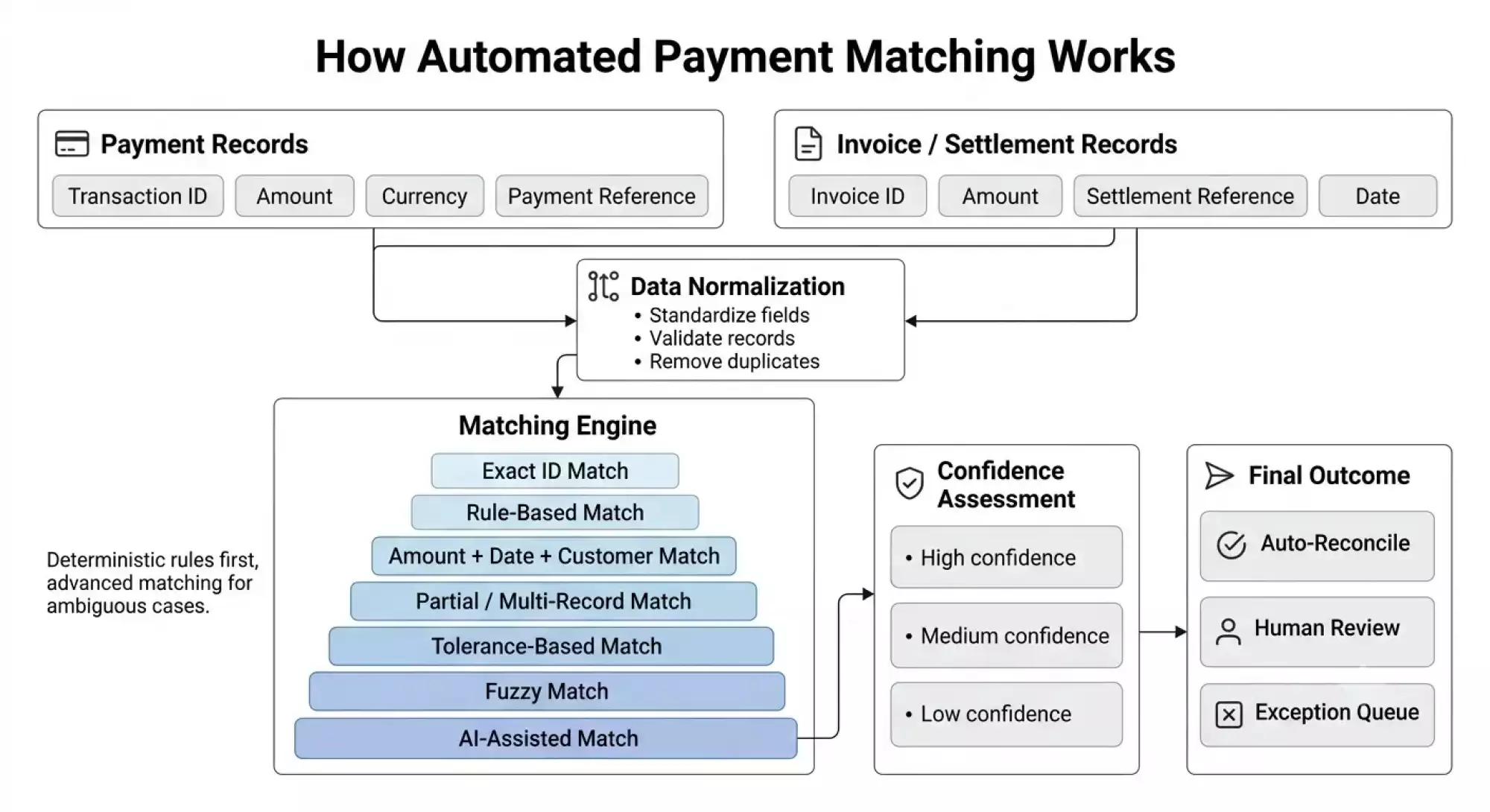
How Automated Payment Matching Works
Automated payment matching helps in identifying whether entries from multiple accounting systems relate to one and the same transaction. In this case, the reconciliation system first begins with high-confidence matching rules and then resorts to increasingly flexible matching techniques if an exact match cannot be found.
These include exact matching, rules-based matching, partial payments, multi-record matching, tolerances, fuzzy matching, and AI-powered matching. The high-confidence transactions may be automatically reconciled by the software, while less certain matches may be sent for manual reconciliation.
Let us get familiar with the process of automated payment matching in reconciling transactions through the following workflow:
AI-Powered Payment Reconciliation Software Features
AI can enable reconciliation to transcend rigid rules through enhanced transaction matching, anomaly detection, exception management, and financial analysis.
- Smart Transaction Matching: Uses many attributes to match payments against invoices, orders, customers, and settlements.
- Reference Variations: Detects different invoice numbers, order numbers, customer names, and descriptions of payments.
- Transaction Type: Defines transactions as either payments, refunds, chargebacks, fees, settlements, adjustments, or transfers.
- Transaction Exceptions: Detects abnormal amounts, fees, settlement timing, transaction volume, or refund trends.
- Root-Cause Analysis: This helps relate the possible causes to the transactions, settlement fees, refunds, and accounting documents.
- Exception Summary: It helps to transform complicated exceptions into simple explanations.
- Predictive Exception Detection: This involves the use of past reconciliation data to detect possible future exceptions.
- Reconciliation Copilot: Enables finance teams to query transactional information, exceptions, and settlement through natural language.
- Automated Reconciliation Report: Provides reconciliation matching statistics, exceptions, settlement differences, and unsettled transactions.
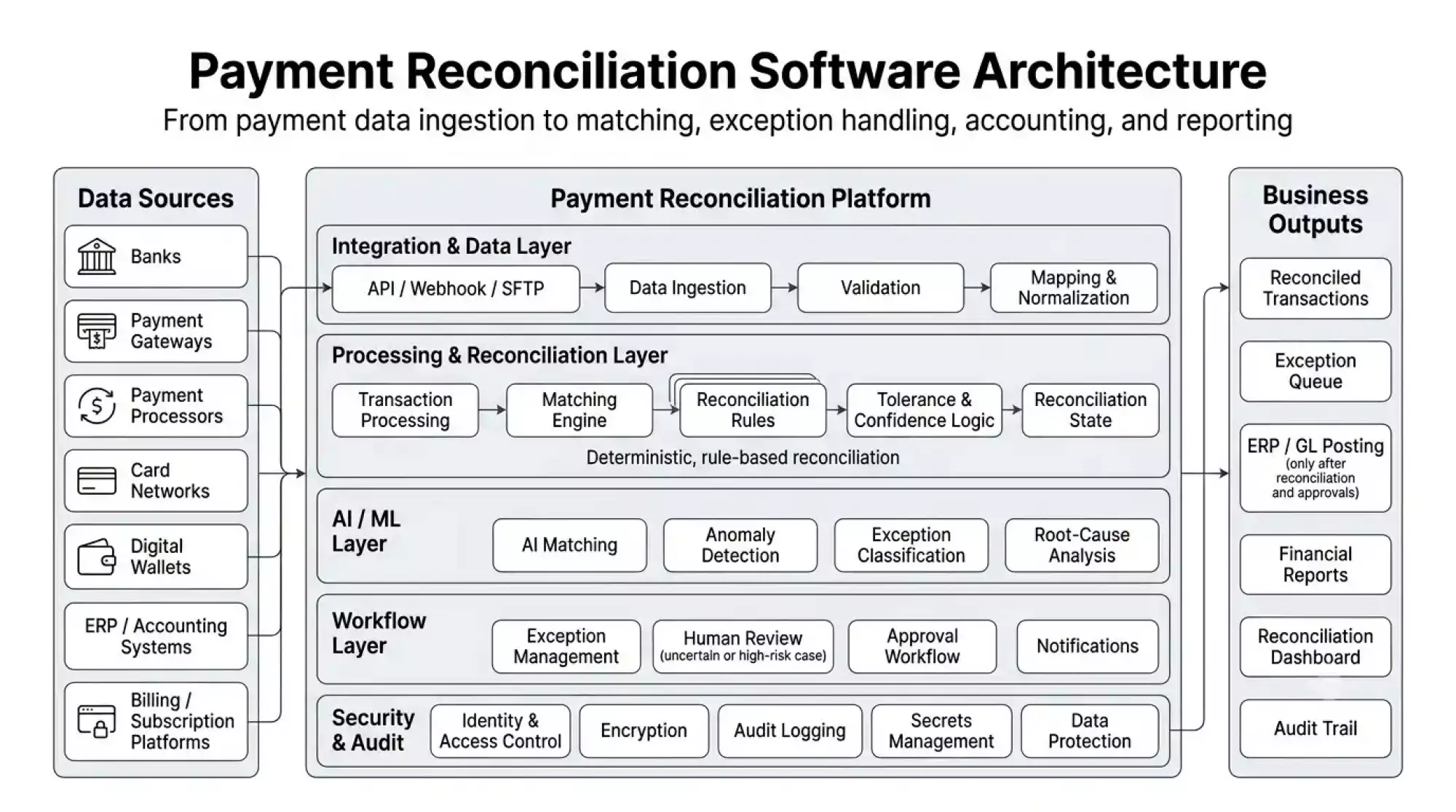
Payment Reconciliation Software Architecture
A payments reconciliation system generally employs a multi-layered architecture where payments data is transferred from the external source of payments to the system using a process involving normalization, matching, exception management, and accounting. The architecture needs to cater to both batch and real-time payments reconciliation while ensuring segregation between transaction processing, AI services, integration, security, and auditability.
The following is an illustration of such an architecture:
Planning to connect multiple payment sources and financial systems?
We can design and develop the integration and reconciliation architecture around your existing systems.
Real-Time Payment Reconciliation Architecture
Real-time payment reconciliation is not simply about plugging payment APIs into the system. Rather, the system should process events in real time, manage the state of the transactions, detect duplicates or late events, and find exceptions without performing end-of-day reconciliation.
Batch Reconciliation Architecture
In the batch approach, data related to payments and settlements is collected in batches at predetermined times.
The system can be configured to load bank statements, gateway files, process files, or ERP data at intervals of an hour, day, or other specified period. The batch approach is easier to manage and can perform well for organizations that do not need immediate reconciliation.
Discrepancies might go unnoticed until the next time the process runs. Batch systems are thus better suited to periodic settlement reconciliation than processes requiring real-time transaction visibility.
Event-Driven Reconciliation Architecture
The event-driven architecture performs the financial event processing in real time and not by scheduling file exchanges.
The payment event can lead to transaction validation, normalization, matching, exception processing, and updates. The event bus or the message broker is used to isolate these services and thus handle them independently.
The event-driven approach enables continuous reconciliation and scaling of the platform according to the growth in the volume of transactions.
Webhook-Based Transaction Updates
A payment gateway or payment processor can generate webhooks on certain critical events like payment success, refund, chargeback, or settlement events.
The reconciliation engine will receive those events at a secure endpoint. It will validate the source and event payload. It will check if this particular event was already processed before and then pass the same to the relevant processing service.
Handling of webhooks should consider all the aspects of re-sends, delays in delivery, erroneous payload, and unordered events.
Streaming Payment Events
For high throughput payment systems, the transaction events could be processed using a streaming platform rather than processing them as separate API calls.
The events pertaining to payments, refunds, settlements, fees, and chargebacks could be published to distinct topics or streams. These events could be consumed and used for matching, exceptions, reporting, fraud analysis, or accounting purposes.
In a stream-processing environment, the system can handle high volumes of events without having all downstream services dependent on the payment provider.
Real-Time Matching
Real-time matching involves comparing payment/settlement events to available transaction, invoice, and accounting data.
In this regard, matching is done using deterministic criteria including transaction identification number, invoice number, amount, currency, and payment reference number. Advanced matching may be able to compare for part-payment, tolerance, related transactions, and similarity in reference number.
In case there is a match that achieves the predetermined threshold of confidence level, the transaction is automatically reconciled. In case of uncertainty, there is a need to keep the match in a pending state.
Real-Time Exception Detection
This system is capable of detecting reconciliation issues as soon as events related to them occur.
They could be an unforeseen amount paid out, absence of the payment reference, duplicate event, unsuccessful reconciliation, unusual fee, wrong currency, or an untraceable payment for some expected transaction.
Early detection of such issues helps to investigate them before they create any bigger backlog in reconciliation.
Idempotency
Idempotency guarantees that multiple processes of the same payment event will not result in double entry into financial accounts or the triggering of the same process several times.
An idempotency key can be assigned to a provider event ID, transaction reference, or any other unique identifier by the platform. Before proceeding with the event, the system determines whether the ID has been processed before.
It is particularly relevant in case of payment webhooks where providers can re-deliver the event in case of unsuccessful delivery of a previous one.
Duplicate Event Handling
Duplicated events may arise due to webhook retries, network errors, provider behavior, and re-sent files.
The duplicate events must be identified before they are passed to the matching and accounting levels. Event ID, transaction ID, timestamp, source IDs, and processing status could play an important role in identifying the legitimacy of repeated business events.
The duplicate events must be logged and processed without posting any extra transactions.
Event Ordering
Events of payment may not necessarily be received in the same order in which they have occurred.
For instance, an event of refund might come before the event of settlement. This means that the design must keep track of time stamps of events, sequence numbers, and versions of events from providers, wherever applicable.
In case an event comes out of turn, the system can hold onto it until it receives the preceding state.
Retry & Dead-Letter Queues
Failures of this kind must not result in the loss of financial events.
A process can be retried in case of failure through the application of controlled retry policies like delay between successive attempts. Failures that do not allow more than the allowable number of retries may be sent to the dead letter queue for examination.
Dead-letter queues act as an alternative venue for events that need manual examination/reprocessing.
Reconciliation State Management
Reconciliation needs the system to be able to track the current state of the transaction throughout its lifetime.
The transaction can go through several states including received, validated, pending matching, matched, reconciled, exception, approved, posted, or reversed. The transition from one state to another needs to be controlled so as not to allow an invalid or duplicate event to change the financial state of the transaction.
Moreover, having a persistent state allows for recovery from any service failure and resuming the process without losing the history of the transaction.
Payment Reconciliation Integrations
The payment reconciliation program has to connect with different programs because the payment details are stored in various programs like the bank system, payment systems, accounting systems, billing systems, and internal systems. This will ensure that all necessary information is considered during the reconciliation process.
Bank Integrations
Integration with banks allows obtaining the required information about payments and settlements that were supposed to be made and have been made on the bank account.
There are different integration methods available, depending on the country and the bank itself; API, Open Banking, statements, and file transfer may be used to get information about payments.
Payment Gateway Integrations
The integration of the payment gateway brings in the information regarding the payments.
This includes information such as transaction ID, payment status, amount, currency, customer reference, fee, refund, and other specific gateway fields. This information can now be compared against the bank settlements or invoices.
Payment Processor Integrations
Integration of processors enables one to get more details concerning transactions and settlements, which are not available from the gateway alone.
Reconciliation is made possible through processor integration because it allows the comparison of captured payments with settlement batches, processing fees, refunds, chargebacks, and adjustments. It is aimed at identifying discrepancies in the transaction value processed and the settlement value.
Card Network Data
Card network data can provide additional information for businesses processing large volumes of card payments.
Depending on the available data and business arrangement, reconciliation can involve authorization, clearing, settlement, interchange-related amounts, chargebacks, and adjustments. Matching these records with processor and merchant data helps explain differences between the original card transaction and the final settlement.
Digital Wallet Integrations
Digital wallets provide yet another source of funds that must be reconciled with orders, payments, refunds, and bank settlements.
The reconciliation process can be fed with wallet transaction IDs, payment status, amounts, currency, refunds, fees, and settlement details. It is helpful in cases where companies accept payments from various wallets.
ERP Integrations
ERP integrations connect payment reconciliation with financial and operational records maintained in the enterprise system.
Common ERP integrations include:
- SAP: Reconcile payment and settlement records with financial accounting and related ERP transactions.
- Oracle: Synchronize payment, receivables, settlement, and accounting information.
- NetSuite: Connect payment and customer transaction data with accounting and financial records.
- Microsoft Dynamics: Exchange payment, invoice, receivables, and general ledger information.
The integration should support data synchronization, field mapping, posting status, error handling, and controlled updates rather than simply transferring transaction records.
Accounting Platform Integrations
Integrations with accounting platforms are those that link the reconciliation platform to the platform that is in charge of recording finances.
This particular software is capable of synchronizing invoices, payments from customers, refunds, fees, journal entries, adjustments, and reconciliation process status. In accordance with the workflow, reconciled transactions will either be ready to post or transferred to the accounting platform once necessary approvals have been made.
Billing & Subscription Platforms
Billing and subscriptions integrations will provide details on recurring fees, invoices, transactions, renewals, cancellations, credits, and failed payment transactions.
This way, the reconciliation solution can make comparisons between expected subscription income and actual payment transactions. It can also detect failed collections, duplicate billing, missed payments, and discrepancies between billings and payments.
CRM Integrations
Integration with the CRM will tie customer information and account details to payment details.
Information such as Customer ID, Account Reference Number, Order Information, and other payment-related information can be used by the reconciliation engine to reconcile the incoming payment to the right customer/business account. CRM information can also provide additional information for unmatched transaction investigations.
API, Webhook & SFTP Connectivity
Payment reconciliation platforms typically need multiple connectivity methods because every financial system exposes data differently.
APIs help in the structured and demand-based transfer of data between banks, payment systems, ERP systems, and other business applications.
Webhooks enable an external system to inform the reconciliation system about an event, like a successful payment, refund, chargeback, or any change in the settlement.
SFTP can transfer files periodically when banks, processors, or other legacy finance systems provide transactions and settlement files instead of APIs.
A good integration layer must also have functionalities related to authentication, data validation, field mapping, retry logic, duplicate detection, error handling, monitoring, and versioning.
Exception Management in Payment Reconciliation
Not all transactions can automatically be matched. The payment matching system requires an exception handling process for those transactions that are either not complete, not consistent, or fall out of scope of the configured matching criteria. An exception handling process allows the financial personnel to determine why the problem occurred and how it was handled.
Common Exception Types
Some common payment reconciliation exceptions are:
- Amount exception: The amount that is received or settled is different from the amount that was expected.
- Missing transaction: The expected transaction record for a payment or settlement is not found in the source file.
- Duplicate transaction: The expected payment or event record appears more than once.
- Invalid reference: The reference of the payment or transaction is not valid and does not match the expected record.
- Date exception: The transaction and the settlement have happened during different accounting periods.
- Currency exception: There is a difference due to currency/foreign exchange conversion between the records.
- Fee exception: The fees that have been charged are different from the expected amount.
- Partial settlement exception: Part of the transaction has been settled.
Exception Prioritization
All exceptions are not created equally; therefore, they do not necessarily require the same degree of priority. The organization may use several factors to set the priority for processing exceptions such as transaction amount, financial significance, age of the exception, customer, exception type, risk factor, or SLA.
For instance, an exception involving large settlement differences should get more priority compared to a small rounding difference exception.
Automated Exception Classification
The system is able to automatically categorize the exceptions by taking into account transaction information, match result, rule, and previous patterns.
The exceptions may be categorized as amount discrepancy, reference not found, duplication, timing difference, fee problem, or non-settlement. Machine learning will help in doing so in cases where patterns of exceptions are complicated.
Exception Assignment
The system will then allocate the exception to the relevant finance, accounting, treasury, or operations team after an exception has been established.
Allocations could be based on exception type, business organization, payment source, amount of transaction, geographical location, or workload of the team. The system will also allow for reassignment of the exception cases where more specialized knowledge is needed.
SLA-Based Escalation
The system is capable of tracking the time each exception takes to get resolved and automatically escalating when certain service levels have been breached. For instance, an unresolved exception regarding high-value settlements can be escalated to a more senior finance user after a certain time limit has been breached.
Exception Investigation Workspace
An investigation workspace provides all the details necessary for the user to comprehend and solve the exception problem without having to look at various systems.
The workspace may present the original payment, related invoice, settlement, fees, refund, chargeback, matches attempted, bookings, and past actions. Search, filtering, commenting, case status, and assignment options may assist users to cope with exceptions in bulk.
Supporting Evidence
Reconciliation decisions should be backed up by the accounting data behind them.
The system can associate source transaction data, settlement files, invoices, payment IDs, banking data, API responses, processor reports, and other pertinent documents to the exception. This provides the documentation that is required to substantiate the proposed solution.
Resolution & Approval
The user is able to fix this problem through the process of selecting an action that will address the exception, for example, fixing a mapping, linking to a transaction, recording a time difference, posting an adjustment, or asking for more information.
All material financial changes must follow an approval workflow process. It should be documented who suggested the fix, who approved it, and what was done and when.
Exception Closure & Audit History
Closing of an exception can only occur after successful completion of all the necessary processes and approvals.
A history of the case should be kept in the system that includes classification of the case, assignment to an investigator, the results of the investigation, evidence presented, matching decisions, user override information, approvals, and resolution.
Payment Reconciliation Security, Compliance & Financial Controls
Financial controls should also prevent unauthorized changes, preserve reconciliation history, and ensure that sensitive actions can be traced and reviewed. That's why it needs the following:
Encryption
Encryption should be used to protect sensitive data in transit and in storage.
TLS should be used to secure data that is transmitted between the reconciliation platform and connected systems. Sensitive data stored in databases, backup systems, and file storage systems should also be encrypted. The encryption keys should not be stored with the data.
Tokenization
Tokenization may be used for replacing sensitive payment information with non-sensitive tokens.
For instance, payment card information may be tokenized to avoid storage of actual payment card information in the reconciliation platform. This may result in less handling of sensitive payment information by the application.
PCI DSS Considerations
If the reconciliation platform stores, processes, or transmits cardholder data within PCI DSS scope, the system should be designed around the applicable PCI DSS v4.0.1 requirements. Tokenization and third-party payment providers can reduce the cardholder data handled by the platform, but they do not automatically remove all PCI DSS responsibilities.
PSD2/PSD3
Payment reconciliation platforms for the EU payment industry must take into consideration PSD2 requirements as well as future PSD3 and Payment Services Regulation (PSR) of the EU. Requirements may impact payment service processes, authentication, security, and API integration.
GDPR
When personal data are processed under GDPR scope, data minimization, access control, encryption, data retention and data deletion policy, auditability and measures for international data transfer should be included in development.
SOC 2
SOC 2 is not a payment regulation but rather an assurance framework. Its controls may have an effect on how the payment platform deals with security, access control, logging, monitoring, change control, incident response and backups.
ISO 20022
ISO 20022 is a financial messaging standard, not a regulation. If connected banks or payment networks make use of ISO 20022, then the payment reconciliation system must support these message formats and retain structured payment information, such as payment reference, amounts, currency, date, payer/receiver information and remittance data.
Role-Based Access Control
Role-Based Access Control (RBAC) restricts access to a system based on what a user does.
Finance users will need to research anomalies, whereas accounting users will require posting access, and administrative users might configure settings. Access can also be limited based on business unit, account, geographical location, or transaction.
Segregation of Duties
It ensures that no single individual can control all the processes involved in the sensitive process of finances.
For instance, the individual creating an adjustment for reconciliation is not necessarily the same one approving it and posting it. Different permissions can be assigned to reconciliation, overrides, approval, configuration, and posting.
Multi-Factor Authentication
Multi-Factor Authentication requires an additional step of validation above and beyond the user ID and password.
It would be advisable for MFA to be implemented for those who have access to financial information, reconciliation rules, approval, administration, and accounting integration. Authentication requirements may also vary depending on user types.
API Security
Banks, payment providers, ERP systems, and internal applications must all use APIs that are secured using authentication and authorization.
The platform must check that requests are valid, limit access according to the scope, enforce rate limiting, secure the API from typical threats, and monitor unusual API traffic. Credentials and payment information must not be exposed via log files, URLs, and error messages.
Secrets Management
Secrets like API keys, database credentials, encryption keys, certificates, etc., must never be hardcoded in the application code.
A separate secrets management system can control everything related to storing, accessing, rotating, and revoking credentials. Production secrets must be segregated from dev/test environments.
Audit Logging
An audit log provides an account of significant activities done through the reconciliation platform.
A log may capture user access, reconciliation decisions, manual overrides, policy changes, approvals, exception handling, AI-assisted activity, configuration changes, and accounting posting. The logs must be protected from any form of alteration and must contain sufficient information to aid in investigations.
Data Retention
The retention period for each type of financial and operational data needs to be defined.
The retention periods can be different for transaction data, reconciliations, audit trails, documentation, and personal data. The required periods will depend on the applicable regulations, contract terms, accounting principles, and company policies.
PII & Financial Data Protection
Payment reconciliation software may have PII, customer information, account information, and financial data in its databases.
The application must gather only those pieces of data that are necessary for its processes, limit access to any sensitive data, ensure protection during transport and storage of data, and implement proper data retention and deletion procedures. Sensitive data must be masked where complete values are not needed by the user.
Immutable Reconciliation Records
The completed records for reconciliation should have controls to prevent any kind of alterations from happening without authorization.
Instead of giving the user the ability to modify a completed record, the computer system could keep the result that has been produced and make further changes as modifications.
Disaster Recovery
Disaster recovery facilitates the restoration of reconciliation services and financial records following any disaster.
It is imperative for the organization to have a plan in place regarding the frequency of backups, backup security measures, RPOs, RTOs, failover process, and recovery testing. Transaction and audit data must be protected via backup and restoration procedures.
Business Continuity
Business continuity focuses on keeping critical reconciliation operations available during disruptions.
The platform can use redundant infrastructure, multiple availability zones or regions where appropriate, monitored integrations, recovery procedures, and manual fallback processes. Critical workflows should have defined procedures for handling payment and settlement data when a connected bank, processor, or accounting system becomes temporarily unavailable.
AI Governance for Payment Reconciliation
A governed reconciliation system should establish:
- Define which activities AI can recommend, automate, or only assist with.
- Route uncertain matches to human review rather than treating confidence as proof.
- Keep the payment, invoice, settlement, reference, amount, date, and other records behind each recommendation.
- Require authorized users to approve sensitive accounting actions and overrides.
- Record AI recommendations, evidence, model versions, user decisions, and resulting transactions.
- Track match accuracy, false positives, false negatives, acceptance rates, and human overrides.
- Monitor model drift and maintain version histories for models, prompts, matching logic, and retrieval sources.
How Reconciliation Software Applies These Controls
Real-world reconciliation platforms show how AI and automation can operate within financial controls.
- Trintech combines AI-powered transaction matching with configurable rules and guided exception workflows. They claim their platform can report 99%+ auto-match rates across millions of daily reconciliations, while routing unresolved items into workflows with ownership, documentation, and audit trails.
- BlackLine similarly combines transaction matching with business rules, exception identification, and auditability. BlackLine reports that SiriusXM automatically matches more than 7 million transactions per month with 99.9% accuracy.
Please note that these figures are vendor-reported customer results rather than an independent industry benchmark.
What to Measure After AI Deployment
Measure governance continuously rather than treating it as a one-time implementation task. Useful metrics include:
- AI match acceptance rate
- Human override rate
- False-positive and false-negative rates
- Percentage of transactions requiring human review
- Percentage of high-value transactions requiring approval
- Exception resolution rate
- Model-drift alerts
- Audit-trail completeness
- Unauthorized actions prevented
Ready to add AI to payment reconciliation?
Build AI matching, exception investigation, and controlled agent workflows on a reliable reconciliation foundation.
Payment Reconciliation Software for Different Business Teams
Reconciliation software for payments can be used by different teams within the finance and operations departments. Different teams may use the same transactional data but different dashboards, workflows, and permission sets based on their needs.
Finance Teams
The finance department uses reconciliation software to track payment matching, exception investigation, and the close process.
Treasury Teams
The treasury department needs visibility into how cash flows from the bank accounts and other payment processors.
Accounts Receivable Teams
Reconciliation software is mainly used by accounts receivable groups for cash application and invoice matching.
Accounting Teams
Accounting staff utilize reconciliation reports for performing general ledger reconciliations and preparing journals.
Operations Teams
The platform can be used by the operations teams to track payment transactions and address any operational exceptions.
Audit & Compliance Teams
Evidence needs to be provided to demonstrate the process behind the decision-making and approval for the reconciliation.
CFO Dashboard
CFO dashboard shows high-level analysis of the performance of the reconciliation process without the need for executives to analyze individual transactions.
Some of the metrics may include:
Value reconciled: Total value of transactions that were reconciled.
Unmatched value: Value of transactions that still await their match.
Number of exceptions: Number of pending reconciliations.
Exception aging: Duration of pending exceptions.
Percentage of matches: Percentage of transactions that were matched within the measurement period.
Settlement difference: Difference between the expected and actual settlement amounts.
Closing state: Reconciliation and financial close state of related entities or periods.
The dashboard could also enable executives to drill down to the exceptions, payment sources, business entities, or reconciliation periods from high-level metrics.
Payment Reconciliation KPIs and ROI
Payment reconciliation KPIs will help companies gauge how effectively they match transactions, how quickly they resolve anomalies, and how much human intervention the process requires. Measuring such KPIs both pre- and post-implementation can also help in quantifying the financial value added by the software.
Automated Match Rate
Automated match rate measures the percentage of eligible transactions that the system matches without manual intervention.
A faster rate typically implies that more transactions can go through the process of reconciliation without the finance team having to review them separately.
Straight-Through Reconciliation Rate
Straight-through reconciliation ratio refers to the percentage of transactions that go through the entire reconciliation process using the automatic process. This measure gives a wider picture of automation as compared to match rate since it may happen that the transaction gets matched automatically, but there is still another manual intervention needed.
Exception Rate
Exception ratio calculates the proportion of transactions that cannot be reconciled on their own and have to be investigated.
Monitoring this ratio will allow you to find out any regular problems related to payments’ references, settlement, fees, integration, or matching.
Exception Resolution Time
Exception resolution time is the time that it takes to resolve an exception through investigation. Exception resolution time can be measured as an average or median, and by exception type, payment source, organization, or value.
Unmatched Transaction Aging
Unmatched transaction aging is useful in determining how long a transaction has been left for reconciliation.
An aging report may categorize transactions according to durations such as transactions below one day old, between one day and seven days old, and over 30 days old.
Reconciliation Cycle Time
Reconciliation cycle time is the amount of time needed to reconcile a specified group of transactions, settlement group, account, or accounting period.
Shortening cycle time may assist finance departments in transitioning from periodically reconciling to continuously reconciling.
Cash Application Rate
The cash application ratio is used to gauge the amount of incoming payments that have been applied to the right customer accounts.
This becomes very important for accounts receivable because good cash application makes receivables visible.
Settlement Variance
The variance of settlement is the discrepancy between the expected settlement amount and the actual settlement amount.
This indicator may be monitored on the basis of payment service provider, batch of settlement, currency, merchant account, or business.
Cost Per Reconciled Transaction
Reconciliation cost per transaction measures the amount of operating expense needed to reconcile one transaction.
Firms can measure their labor, cost of processing, infrastructure related to the software used, among other related costs, relative to the number of reconciled transactions.
Month-End Close Duration
The time spent on month-end close will reveal the duration of reconciliation activities performed during the closing process.
The comparison of this measure pre-automation and post-automation will reveal whether reconciliations help the accounting staff perform their tasks faster.
AI Agent Resolution Rate
AI agent resolution rate indicates the ratio of eligible reconciliation activities performed by the AI agent successfully without any need for human intervention.
This indicator must be considered along with error rate, human override rate, and financial effect. A good resolution rate by itself doesn’t imply that an AI agent is making the right decision.
Measuring ROI
The ROI of payment reconciliation software can be evaluated through comparison of benefits realized from automation versus the cost of developing, running, and maintaining the system.
It is usually a sum of the following:
- Labor saved
- Lower number of mistakes in reconciliation
- Quicker cash application
- Less exception handling
- Faster close
A company can set a benchmark prior to the introduction of the new system and then compare the key performance indicators post-implementation. This will help to quantify changes in reconciliation work, exceptions, processing times, and costs instead of using ROI percentage alone.
Payment Reconciliation Software Maturity Model
Automation of payment reconciliation is a gradual process where companies do not need to transition from spreadsheets right to automated systems. There is a framework that helps understand at what stage the company is and what functions it can automate.
| Level | Reconciliation Capability | Automation |
| 1 | Spreadsheet/manual reconciliation | Low |
| 2 | Rule-based matching | Moderate |
| 3 | Rules + ML matching | High |
| 4 | AI-assisted reconciliation | Very high |
| 5 | Agentic reconciliation | Exception-focused |
Level 1 to Level 2
Level 1 requires the use of spreadsheet tools, manual comparisons, and individual reconciliations.
Moving towards Level 2 begins with consolidating payment information and creating deterministic rules for matching. Transaction IDs, invoices, amounts, dates, and other specific fields can be compared automatically.
Level 2 to Level 3
Level 2 is very useful in handling predictable transactions but may have some difficulty when reference or transaction data differs.
However, in Level 3, organizations can use probabilistic and machine learning-based matching with confidence scoring. The system can establish relationships even in cases of no exact match.
Level 3 to Level 4
At level 4, AI moves from transactional matching to investigative support and decision-making.
Features may include AI-driven exception investigation, anomaly detection, root cause analysis, exception summary reporting, and an AI-powered natural language reconciliation copilot. Human reviewers will be able to perform investigations in complex cases more quickly, while maintaining control over crucial decisions.
Level 4 to Level 5
At level 5, there are AI agents that can execute reconciliation processes with defined tasks within the scope of approved tools and data sources.
AI agents may be able to conduct investigations about exceptions, obtain supporting documents, develop solutions, and initiate workflow activities. The permissions of the tool, limitations in transactions, approvals, and audits must be incorporated into the workflow to ensure the AI agents work within defined parameters.
The maturity level is based on the number of transactions, complexities of reconciliation processes, risk appetite of the business, current systems, and the degree of automation that the business can handle.
Payment Reconciliation Software Development Process
Payment reconciliation software development includes identifying payment processes, interfacing with financial applications, implementing matching and exception logic, and validating the system prior to implementation.
Business Workflow Discovery
Map the flow of payment, settlement, refund, chargeback, invoices, and accounting transactions within the business process. Highlight the manual reconciliation processes and areas for automation.
Payment Data Source Assessment
Identify banks, payment gateways, processors, ERPs, accounting software, billing software, and others as potential sources of data. Examine their APIs, webhooks, files, data formats, and transaction volumes.
Reconciliation Rule Definition
Define how matching and reconciliation will take place. This covers exact matching, partial payments, tolerances, settlements, differences, and scenarios requiring manual investigation.
Compliance & Security Analysis
State requirements for securing payment information, access controls, audit trail, data retention, authentication, and compliance.
Architecture Design
The system design should take into account transaction volume, number of integrations, real-time processing, matching difficulty, and artificial intelligence needs.
UX/UI Design
Create dashboards, transaction screens, match screens, exception queues, investigation screens, approval workflows, and reports for the right users.
Data Integration Development
Develop and test the integrations with banks, payment processors, accounting systems, ERP systems, and other sources of data. Standardize the incoming data.
Matching Engine Development
Create the matching engine according to the reconciliation rules that have been defined. Introduce tolerances, partial, fuzzy, and confidence matching wherever needed.
Exception Management Development
Create processes for exception categorization, assignment, investigation, resolution, authorization, and escalation.
ERP/GL Integration
Link the reconciliation system with the ERP or general ledger system for consistency between the reconciled transactions, journal entries, and postings.
AI Matching Development
Apply machine learning/AI matching once transaction data and matching rules have been set up in a reliable fashion. Test AI output against transaction history prior to live deployment.
AI Agent Development
For more complex systems, create managed agents to perform activities like exception investigation and resolution preparation. Establish permission levels and clearance process prior to production use.
Testing & Validation
Perform tests on matching accuracies, integrations, duplicates, partial payments, settlement differences, exceptions, security controls, and fail-safe modes. False positives and negatives should also be tested with respect to the AI capabilities.
Pilot Deployment
Apply the system to a small number of transactions, payments, or business units. Use the findings from this process to fine-tune the rules and integrations.
Production Rollout
Move the validated system into production, using a phased rollout where required. Monitor transaction processing and reconciliation results closely during the initial deployment.
Monitoring & Optimization
Track match rates, exception rates, processing failures, settlement variance, and reconciliation cycle time. Use these results to improve matching rules, integrations, AI models, and system performance.
Recommended Technology Stack for Payment Reconciliation Software
A tech stack for payment reconciliation systems needs to have support for high-volume transactions, security in financial information processing, integration support, event handling, and artificial intelligence when applicable. The technology stack is determined by the transaction volume, architecture, integrations, and other factors.
| Layer | Technology Options |
| Frontend | React / Next.js |
| Backend | Node.js / Java / Python |
| API | REST / GraphQL |
| Event Processing | Kafka / RabbitMQ |
| Database | PostgreSQL |
| Transaction Storage | PostgreSQL / Distributed data store |
| Cache | Redis |
| AI/ML | Python / PyTorch / ML libraries |
| LLM | Enterprise LLM APIs / Private models |
| Vector Search | Vector database |
| Cloud | AWS / Azure / Google Cloud |
| Monitoring | OpenTelemetry / Cloud monitoring |
| Authentication | OAuth 2.0 / OIDC |
| Infrastructure | Docker / Kubernetes |
Choosing Between Rules, ML and LLMs
Not all reconciliation tasks require AI; similarly, not all AI tasks require LLMs. Choosing the right technologies for different processes can increase accuracy, lower cost, and improve process control.
- Rules: Recommended for deterministic transactions where the match criteria are clearly defined, for example, transaction IDs, invoice numbers, or amounts.
- ML: Good for finding similarities, classifying transactions, spotting anomalies, and finding patterns that are hard to detect via rules.
- LLMs: Good for investigation based on context, summarizing exceptions, analyzing payment descriptions, and communicating in natural language with reconciliation data.
- Agents: Good for executing workflows, like investigating an exception, gathering necessary data, and preparing the decision for approval.
In financial reconciliation, it is recommended to use deterministic rules to cover the most obvious cases first and ML and LLM abilities to deal with more complicated cases.
Build vs. Buy vs. Customize Payment Reconciliation Software
Selection between build, buy, and customize relies heavily on the complexity of reconciliation, customization requirements, integration, and development resources.
When to Build Custom Software
Develop custom software if you need reconciliation algorithms, complex payment processes, extensive integrations, or full system management.
When to Buy a Reconciliation Platform
Choose a pre-existing platform if the essential integration and reconciliation components are already available in that platform.
When to Customize Existing Software
If the platform satisfies most requirements but requires modifications to the integration, match criteria, processes, or reporting, then customize the software application.
When a Hybrid Approach Makes Sense
The hybrid model involves using an existing reconciliation tool in conjunction with tailor-made tools, for example, customizations to integrations or artificial intelligence services.
Build vs Buy vs Customize Comparison
| Factor | Build | Buy | Customize |
| Control | High | Lower | High |
| Launch time | Longer | Faster | Moderate |
| Custom logic | High | Limited | High |
| Integrations | Fully controlled | Vendor dependent | Flexible |
| Maintenance | Internal | Vendor | Shared |
| Initial investment | Higher | Lower initially | Moderate |
Cost to Develop Payment Reconciliation Software in 2026
Payment reconciliation application development cost depends on a variety of factors such as number of payment systems involved, number of integrations needed, volume of transactions, difficulty in matching, requirement for AI, and security needs. The cost of a simple MVP version is cheaper compared to that of an enterprise-level system.
Payment Reconciliation Software Cost by Complexity
| Development Level | Scope | Cost |
| MVP development | Data ingestion, basic matching rules, and dashboard | $25,000 – $45,000 |
| Mid-level | Multiple integrations, advanced matching, exception management, and reporting | $50,000 – $90,000 |
| Enterprise | Real-time processing, AI agents, multi-entity support, and advanced controls | $100,000 – $250,000+ |
Factors Affecting Development Cost
The main factors include:
- Transaction volume
- Number of payment sources
- Number and complexity of integrations
- Matching and reconciliation rules
- Real-time processing requirements
- AI and automation requirements
- Multi-currency and multi-entity support
- Security and compliance requirements
- Data migration
- Cloud infrastructure
- Testing and quality assurance
- Post-launch support
AI-Specific Costs
Adding AI introduces costs beyond standard software development. These can include:
- Model inference
- AI evaluation and testing
- Vector storage
- Data engineering
- Model monitoring
- AI agent infrastructure
The cost depends on how often AI models are used, the amount of data processed, model complexity, and whether AI agents can perform actions or only provide recommendations.
Development Timeline
Typically, payment reconciliation applications are built in a phased manner; however, depending on their scope and complexity, the time frame differs.
| Development stage | Typical timeline |
| Discovery & requirements | 1–2 weeks |
| Architecture & UX | 2–4 weeks |
| MVP development | 6–10 weeks |
| Integrations | 3–8 weeks |
| AI implementation | 3–8+ weeks |
| Testing & security | 2–4 weeks |
| Production deployment | 1–2 weeks |
- Discovery: Identify workflow, data sources, rules of reconciliation, and requirements.
- Architecture: Identify data, integration, process, security, and AI architecture.
- MVP: Create basic ingestion, matching, exception handling, and reporting functionalities.
- Integrations: Integrate banks, payment gateways, processors, ERP systems, and other data sources.
- AI: Implement AI matching, anomaly detection, investigations, or agentic workflows, if necessary.
- Testing: Test the matching accuracy, integration, security, performance, and exception handling.
- Production: Deploy, monitor, and optimize the application.
An MVP can be created in less time compared to enterprise-level applications; however, more integrations, real-time processes, AI agents, and financial controls can increase the time period significantly.
Common Payment Reconciliation Software Development Challenges
The payment reconciliation system should be able to process data from various financial systems without compromising on accurate matching, processing, and financial control. Some of the development issues include:
Inconsistent Payment Data
Banks, gateways, processors, and accounting systems might be using their own formats, field names, date formats, currencies, and transaction statuses. An abstraction layer needs to be provided to form a standardized internal data structure.
Poor Transaction References
The payment record transactions and invoice number details could be incomplete, abbreviated, or even inconsistent. The matching process will therefore require the use of further variables like amount, date, customer, and order details.
Duplicate Transactions
Duplicate transactions can happen due to repetition of files, webhooks, or integrations. Use of unique identifiers for transactions and events, together with idempotent handling, assists in avoiding duplicates.
Partial Payments
Payment for an individual invoice can be made using several different transactions. The system requires policies concerning partial payments and the outstanding balance.
Multi-Currency Differences
Differences can be caused by the exchange rate, timing of conversion, and rounding. The application requires well-defined rules for handling currency and foreign exchange.
Settlement Timing Differences
It is possible for payments to be made on one day and accounted for at a later date. There must be clear separation between transaction date and settlement and accounting dates.
Gateway Fees
The fees can be deducted even before settling transactions. Reconciliation involves segregating gross payment amounts, fees, refunds, and net settlement amounts.
Legacy ERP Integration
Legacy ERP or accounting software applications could have old interfaces or integration challenges. Custom connectors, file-based integration, or middleware solutions might be necessary.
False Positive Matches
An automated system could potentially identify similarities in two different transactions. High-risk identifications should incorporate confidence levels and manual reviews before updating financial records.
High Transaction Volumes
Large transaction volumes can lead to higher processing time and database overhead. Processing scalability, query efficiency, queuing, and batch processing aid in maintaining performance.
Real-Time Processing
Real-time reconciliation needs reliable event processing and handling of duplicate, delayed, or out-of-sequence events. It is more complex than batch reconciliation for this reason.
AI Explainability
The reason for any AI-driven match or recommendation must be clear. It will be much simpler to review the reasoning behind the decisions with the help of transactional data and provenance data.
Financial Data Security
Strong access control, encryption, auditing, and secure integration are needed for payments and financial records. More security is also necessary when there is more sensitive data to handle.
Model Drift
Accuracy issues may arise as AI models respond poorly to changes in payment methods or transaction patterns. It is therefore imperative to conduct periodic evaluations.
Managing Human Overrides
The system can be used to override or alter matches made automatically. It is important that such overriding be done in a manner that ensures financial accountability.
How to Mitigate These Challenges
A robust approach to integration development would include the following considerations:
- Normalization of data before performing a match.
- Use of deterministic criteria for transaction integrity.
- Use of confidence levels for fuzzy matching.
- Idempotency and duplication checks in integrations.
- Transaction, settlement, and account state separation.
- Ability to process batches as well as real-time.
- Human interaction in case of risk or ambiguity.
- Monitoring of machine learning accuracy and model drift.
- Audit trails for automated or manual operations.
- Testing of integrations, matching, exceptions, and failures before go-live.
How to Choose a Payment Reconciliation Software Development Company
It is vital to choose the proper developer because payment reconciliation solutions involve handling finance-related information, numerous integrations, and automatic matching. The selection should be made based on a partner's technical expertise, knowledge of the financial sector, security policies, and support of the solution post-launch.
Payment & Fintech Experience
Seek experience in payment systems, fintech systems, accounting systems, or financial systems. This would assist in understanding the processes involved in transactions, settlements, refunds, charges, and reconciliations.
Bank and PSP Integration Expertise
It is important that the organization has experience connecting banks, payment service providers, gateways, processors, and any other payments via APIs, webhooks, or files.
ERP Integration Experience
Look to see if the company uses systems like SAP, Oracle, NetSuite, or Microsoft Dynamics and is capable of handling financial data mapping and postings.
Financial Data Engineering
The development partner should be able to normalize data from different sources and build reliable pipelines for high-volume transaction processing.
AI Matching Experience
If AI is part of the project, assess experience with AI-based matching, classification, anomaly detection, and confidence scoring. Ask how the team validates AI results before they affect financial records.
Real-Time Architecture Experience
For real-time reconciliation, the team should understand event-driven processing, message queues, idempotency, retries, and event ordering.
Security & Compliance Knowledge
Evaluate how the company handles encryption, access control, audit logs, sensitive financial data, and applicable payment security requirements.
Testing & Auditability
The software should be tested for matching accuracy, duplicate transactions, integration failures, exceptions, and financial posting errors. Automated and manual actions should also be traceable.
Post-Launch Monitoring
Ask what support is provided after deployment, including system monitoring, integration failures, performance issues, rule updates, and AI model monitoring.
Questions to Ask a Development Partner
Before hiring a development company, ask:
- How will you design the matching architecture?
- How will payment data from different sources be normalized?
- How will AI matching decisions be explained?
- How will banks, PSPs, gateways, and ERP systems be integrated?
- How will exception workflows and approvals work?
- How will sensitive financial data be protected?
- Which reconciliation actions require human approval?
- Who owns the source code, data, and system documentation?
- How dependent will the solution be on a specific AI provider?
- What SLA and post-launch support do you provide?
How to Make Payment Reconciliation Software AI-Ready
Payment reconciliation software does not necessarily have to be started by AI agents. Rather, the more appropriate way would be to start off with a reliable data and matching system, which can later incorporate AI functionalities.
Standardize Financial Data
Develop a standardized data format that applies to payments, invoicing, settlement, refunds, charges, chargebacks, and accounting. This provides consistent input for AI processing.
Create a Reliable Transaction History
Keep detailed transaction history, transaction matching, exceptions, and resolution logs. This information can then be used to review and enhance AI models.
Build an API-First Integration Layer
Consider utilizing APIs and Webhooks wherever possible when linking payment providers, banks, processors, and bookkeeping tools. Integration must be kept separate from AI and Matching.
Introduce Deterministic Matching First
Begin by doing exact-match transactions that have unique identifiers and amounts. AI should take over from there in cases where deterministic rules cannot do the job.
Add Confidence Scoring
AI results should be assigned confidence scores. Thresholds are used to decide which results can be automated and which need to be manually checked.
Capture Human Resolution Decisions
Keep track of user acceptance, rejection, and amendment of AI matches. Such records can be used as valuable information for analyzing future AI results.
Build an AI Evaluation Dataset
Make use of historical transactions and reconciliation results to develop datasets for evaluating the AI matching, classification, and exceptions process.
Introduce AI Exception Investigation
Use AI for unmatched transactions analysis, identification of matching records, exceptions summary, and recommended solutions.
Add Controlled AI Agents
After the consistency of the AI system has been achieved, agents will be able to manage reconciliation duties that include record retrieval and exception research.
Establish AI Governance
Establish guidelines regarding AI access, human authorizations, data uses, monitoring, model updates, and audit logs prior to the utilization of AI in financial operations.
Optimizing Payment Reconciliation Software for AI Search
AI assistants are becoming another way buyers research financial software. Clear, structured, and well-supported content can make payment reconciliation software easier for these systems to understand and retrieve.
How Buyers Research Financial Software Through AI Assistants
Buyers may use AI assistants to compare software, understand features, explore integrations, and research vendors. This makes clear product and technical information important.
Structuring Product Information for AI Retrieval
Use clear headings, short explanations, consistent terminology, and structured sections covering features, integrations, pricing, security, and use cases.
First-Party Data & Original Research
Publish original data, product documentation, technical insights, case studies, and research that provide information beyond generic industry content.
Clear Product Capabilities
Clearly explain what the software does, including matching, exception management, reporting, AI features, integrations, and financial controls.
Comparison Tables
Use concise tables to compare software types, features, deployment options, or development approaches. Keep the information factual and easy to scan.
FAQ and Structured Content
Answer common questions directly about development costs, features, integrations, security, AI, and implementation.
Schema Markup
Use relevant structured data where applicable to help search systems understand page content, products, organizations, FAQs, and other entities.
Source Attribution
Support factual claims with reliable sources and clearly identify the source of statistics, research, regulations, and industry information.
Demonstrating Integration, Security and Audit Capabilities
Clearly document supported integrations, security controls, audit trails, access controls, and reconciliation workflows. Specific technical details provide stronger evidence than broad claims.
Future of Payment Reconciliation Software
Payment reconciliation is moving toward continuous, AI-assisted, and increasingly automated financial operations.
Autonomous Reconciliation Workflows
AI agents will handle more reconciliation tasks, including matching transactions, investigating exceptions, and preparing resolutions with defined controls.
Continuous Accounting
Instead of relying mainly on period-end processing, transactions and reconciliation results can be processed continuously as financial data arrives.
Real-Time Financial Close
Real-time data processing and automated reconciliation can reduce the amount of work left for month-end and period-end close.
Predictive Exception Prevention
AI can identify patterns behind recurring exceptions and flag potential issues before they create reconciliation problems.
Agentic Cash Application
AI agents can help identify incoming payments, match them to invoices, and prepare cash application actions for approval.
ISO 20022-Native Reconciliation
As financial institutions adopt ISO 20022, reconciliation systems can use richer structured payment data to improve matching and reduce manual interpretation.
Reconciliation-as-a-Service
Reconciliation capabilities can increasingly be delivered through APIs and cloud services, allowing businesses to add reconciliation without building the entire platform themselves.
Embedded Reconciliation
Payment reconciliation can become part of payment, billing, accounting, and commerce platforms rather than operating as a separate financial system.
Multimodal Financial AI
AI can process different forms of financial information, including structured transaction data, documents, statements, and supporting records.
Privacy-Preserving Financial AI
Financial AI systems will place greater emphasis on minimizing sensitive data exposure through techniques such as data masking, controlled access, and private or isolated model environments.
Distributed Ledger-Based Reconciliation
Distributed ledger technology may support shared transaction records between organizations, reducing some reconciliation work where multiple parties rely on the same trusted ledger.
Have a reconciliation project in mind?
Get a development estimate based on your integrations, transaction volume, automation requirements, and technical scope.
Conclusion
Payment Reconciliation Software is used by companies to automate transaction matching, exception management, settlement reconciliation, and accounting procedures. Choosing the most appropriate software requires taking into account payment sources, volume of transactions, integration, complexity of reconciliation, security, and automation needs.
AI will further enhance your reconciliation process through intelligent matching, anomaly detection, exception investigations, and cash application. However, AI performs best when applied to financial data of high quality, with appropriate rules and controls in place.
Phased development makes it possible for companies to begin with basic reconciliation functionality and move on to real-time reconciliation, AI applications, and automation.
Planning to build a custom software for payment reconciliation? Get a solution tailored to your payment workflows, integrations, transaction volume, and business requirements. Call us now to get a project estimate.
FAQs
1. Can payment reconciliation software be customized for different payment workflows?
Yes. The customized platform will have the ability to accommodate business-specific matching, approval, settlement, exceptions, and accounting rules rather than requiring all transactions to fit within the same rules.
2. Can payment reconciliation software reconcile transactions when payment and settlement amounts differ?
Yes. The software can account for legitimate differences caused by processing fees, taxes, refunds, chargebacks, currency conversion, or settlement adjustments. Instead of treating every amount difference as an exception, reconciliation rules can identify expected deductions and reconcile the net settlement against the original transactions. Unexpected differences can then be sent for review.
3. Can existing reconciliation rules be migrated into new software?
Yes, reconciliation could be introduced as a stand-alone service integrated with existing payment, accounting, ERP, billing, and banking systems. This avoids replacing efficient systems while creating opportunities for targeted legacy system modernization.
4. Can payment reconciliation software support different rules for different entities?
In multi-entity setups, different matching criteria, different currencies, different approval procedures, and different accounting standards can be used, yet still retain a single system administrator.
5. Can users configure reconciliation rules without changing the code?
A rule engine that is configurable would permit authorized personnel to create and update rules for amount tolerances, match fields, priorities, and exceptions without requiring a software upgrade.
6. Can payment reconciliation software work with large historical datasets?
Yes. Historically collected data can be brought in and processed in batches. The data must go through the process of validation, de-duplication, mapping, and reconciliation status before being used for reporting and machine learning purposes.
7. Can reconciliation software support manual reconciliation alongside automation?
Yes. They can manually reconcile, reject, split, or reconcile transactions when no automated rules match them.
8. Can AI recommendations be tested before they are allowed to automate reconciliation?
Yes. AI can initially operate in a recommendation or shadow mode, where its matches are evaluated against human decisions without affecting financial records. Automation can be introduced after performance is validated.
9. Can payment reconciliation software be deployed in a private or controlled environment?
Yes. Depending on security and organizational requirements, the software can be deployed in a public cloud, private cloud, dedicated environment, or other controlled infrastructure.
10. Can reconciliation software continue working when an integration goes down?
It could be configured such that it is able to queue up any events or files that come in, try to connect again after a failed connection, and restart processing once the source becomes available.
11. Can reconciliation software be expanded after the initial launch?
Absolutely. The modular architecture enables organizations to incorporate new payment methods, rules, entities, currencies, reporting, AI functions, and processes without reworking the whole system.
12. What should I prepare before starting payment reconciliation software development?
Gather information on your payment sources, volume of transactions, current system, reconciliations, exception handling, accounting processes, access roles, security needs, and history. It will give the development team more solid grounds to estimate the scope of work and design the system.