+971-8000321216



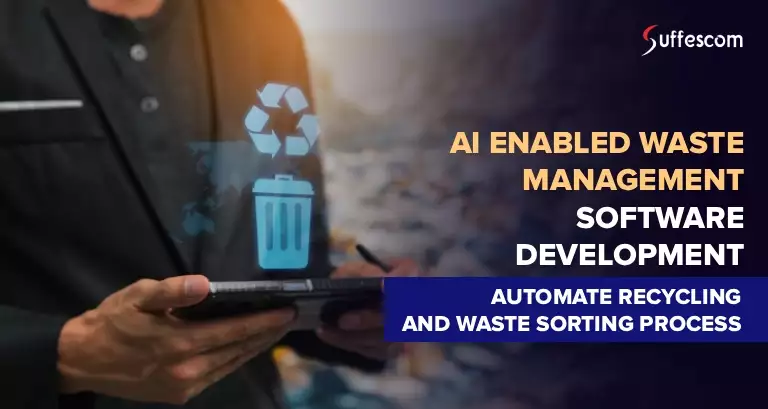
With humans sorting only 40-60 items per minute, global waste generation continues to rise. This leads to decreased efficiency and compromises worker safety. It has also raised a new question about how AI is transforming waste management.
Waste sorting with AI enhances accuracy, speeds up the process, and enables intelligent sorting. These capabilities are beyond what humans can achieve. Waste management companies are using IoT sensors, edge devices, and cloud dashboards. By converting conventional bins into smart ones, they facilitate the consolidation of waste analytics in real time.
Smart waste management software development improves automated operations, predictive scheduling, and landfills monitoring.
Market challenges highlight the need for an AI-based waste management system
Businesses need structured AI waste management software development to modernize operations. Enterprises with AI-powered solutions have improved traceability, automation, and reporting accuracy.
To address market challenges, businesses hire AI developers for waste management systems. It helps them build a scalable infrastructure and measurable operational controls.
Inefficiencies present in the operational process of traditional sorting
Manual labor dependency
Traditional waste-sorting systems relied more on human intervention. As a result, errors arose, limiting the system's scalability. Automation through AI-powered waste-sorting solutions reduces reliance and maintains consistent results.
High contamination rates
Improper segregation leads to lower recyclable value and cross-material contamination. Use of an AI waste sorting system for recycling plants improves confidence scores. It also increases the accuracy of trained detection models.
Inconsistent sorting accuracy
Inconsistency in the sorting system is due to manual decisions. It is influenced by the operator and shift. Structured smart waste management software development ensures consistent material recognition. It uses algorithms and model validation metrics.
Rising labor costs
With manual labor and the expansion of compliance staffing, operational expenditures increase. Businesses investing in AI waste management software development solutions notice lower labor costs.
Regulatory & ESG Pressures
Sustainability mandates
Businesses need to document recycling rates and diversion metrics. An AI waste management platform for enterprises enables digital tracking and audit-ready documentation.
Carbon reduction targets
The integration of route optimization and monitoring modules reduces emissions.
Circular economy initiatives
Businesses are required to recycle materials and feed them back into supply chains. AI-based waste sorting solutions help to increase the quality of materials.
Compliance reporting challenges
Manual reporting can be time-consuming and error-prone. Landfill management software with AI and automated dashboards improves reporting. It makes the reporting process structured, traceable, and export-ready.
Data blind spots in waste analytics
Lack of Real-Time Tracking
In the absence of sensor integration, the collection plans are less reactive. Real-time waste analytics platform enables live monitoring of bins. Also, it improves facilities and transport units.
No visibility into waste composition
Facilities may also lack granular material breakdown information. AI-based waste sorting management software collects classification information at the object level.
Limited predictive capabilities
Conventional systems don’t forecast waste quantities or contamination risks. Predictive models in smart waste management software development forecast waste quantities. This model analyzes historical data.
Launch Readymade AI Waste Management Software with Our Experts
Schedule your technical consultation today and hire our expert AI developers to create customized waste management solutions tailored to your needs!
Working Model of the Smart Waste Management Software Development
The workflow of landfill management software is broken down into small steps. It is a combination of computer vision, machine learning, and advanced sensors. It is an intelligent sorting process that surpasses human capabilities. It results in improved speed and accuracy.
1) Input Entry
The initial step of the software process starts with the input entry as an image or a video of waste. The input must be in JPEG, JPG, PNG, or MP4 format.
2) Inception Model
The input image or video is then processed by the Inception model. It is a type of deep learning model used for AI image recognition.
3) Image Recognition & Processing
The image is then processed for feature extraction. It lets the system automate waste sorting management and the recycling process.
4) Extraction of Feature
The next step in the inception model is to extract image features. It is essential to recognize the waste category.
5) Evaluation of Features
The extracted features are then analyzed by an AI predictive model. It provides analytics on the waste category.
6) Waste Prediction
An AI waste management platform for enterprises helps with waste prediction. It segregates waste into paper, plastic, cardboard, metal, or trash.
7) Waste Segregation & Disposal
Once segregation is complete, disposal begins. The appropriate disposal method is chosen for an efficient software process.
Core Features of an Enterprise-Grade AI Waste Sorting Management Software Solution
An enterprise-grade waste sorting system operates on an integrated system. It is connected to computer vision models, IoT devices, cloud infrastructure, and analytics engines.
It also has compliance modules in one unified architecture. Features are divided for recycling plants, operators, and environmental enterprises.
1) AI-Based Waste Classification
AI-based features help data analysis with deep learning models. Visual data is analyzed using trained deep learning models. Then, deployed through optimized algorithms.
- Real-time image processing: Users use GPU-accelerated inference engines. It classifies waste objects within milliseconds.
- Multi-class categorization: Convolutional neural networks classify waste into plastic, paper, or residual waste. It uses convolutional neural networks trained on labeled datasets.
- Contamination detection: Users with Object-level detection models identify cross-material contamination and detect contamination.
- Confidence scoring: Softmax probability outputs generate confidence values. It supports automated decision thresholds and quality control validation.
2) Operational Analytics Dashboard
It lets admins classify, convert data, and read sensor readings. The operational analytics dashboard also turns operational logs into structured business insights. It is beneficial for plant managers and enterprise stakeholders.
- Waste composition breakdown: The analytics dashboard provides the percentage distribution of waste categories. It is divided by shift or collection route.
- Volume & throughput metrics: Metrics track processed items per minute and support operational benchmarking.
- Performance heatmaps: Admins get an overview of gaps, contamination zones, and underperforming assets.
- Predictive trend analysis: AI predictive analytics forecast seasonal waste volume and contamination risks.
3) Incentive & Gamification System
Behavioral engagement mechanisms in the software ecosystem drive recycling participation and environmental outcomes.
- Token-based rewards: Blockchain-based recycle-to-earn systems issue digital credits for verified recycling actions.
- Environmental impact tracking: Automated metrics define the contribution levels at the user, facility, and enterprise levels.
- Achievement systems: Rule-based engines trigger milestone badges based on predefined recycling thresholds.
- Leaderboards: Real-time ranking systems compare participation metrics across users, departments, or geographic zones.
4) Facility & Logistics Optimization
This layer connects smart infrastructure, routing engines, and inventory forecasting tools. It reduces operational costs and improves recovery yield.
- Smart bin integration: IoT-capable bins provide fill level information, weight data, and contamination alerts. It is done via secure MQTT or HTTP communication.
- Route optimization insights: GPS and telematics information are analyzed with route optimization algorithms. It minimizes fuel consumption and idle time.
- Inventory forecasting: This feature provides updates on inventory volume. Whether it’s understocked or overstocked, to maintain a balanced inventory level.
- Recycling yield optimization: Real-time recovery rate analysis enables parameter adjustment. It is used to sort lines to optimize recyclables.
5) ESG & Compliance Reporting Module
This module provides admins with regulatory compliance and document organization. It is done via automated data flows and reporting systems.
- Automated reporting: Templates are set up to combine operational and environmental data. They convert the data into exportable PDF, CSV, or API-compliant formats.
- Carbon offset tracking: Conversion factors help calculate emission reductions. Calculations are based on diversion rates and transportation factors.
- Sustainability KPIs: Key performance indicators track landfill diversion, recycling rate, and contamination reduction.
- Audit-ready documentation: Audit-ready records provide transparency for regulatory and third-party audits.
Essential Technologies for Smart Waste Management System Development for Maximum Impact
For an efficient smart waste management system use of innovative technologies is important. It enables automated waste sorting and recycling while reducing operational errors. It also provides real-time monitoring.
Below is a list of the technologies used to develop AI-powered waste-sorting solutions. It also discusses the role in optimizing waste management operations.
Technology | Tools | Role in Smart Waste Management | Example Use Case |
AI/ML Frameworks (TensorFlow, PyTorch) | TensorFlow, PyTorch, Scikit-learn, Keras | Powers waste classification models, automating sorting and learning from data. | Train models to classify waste materials like plastics and metals in real-time. |
Computer Vision Models | OpenCV, YOLO, TensorFlow, Keras | Used for visual identification and sorting of waste materials. | Classify waste materials (plastic, paper) on sorting lines using cameras. |
Mobile/Web Platforms (Flutter, React, Django) | Flutter, React Native, Django, Angular, Vue.js | Enables real-time monitoring, reporting, and user interaction. | Build apps for tracking waste collection, recycling participation, and rewards. |
Blockchain (for Incentivized Reward Systems) | Ethereum, Hyperledger, Stellar, Solidity | Facilitates transparent recycling reward systems. | Implement a Recycle-to-Earn platform where users earn tokens for recycling. |
APIs and Edge Computing Strategy | AWS IoT, Azure IoT Hub, Google Cloud IoT, Docker, Kubernetes | Enables real-time waste tracking and system communication. | Use edge computing for local data processing from smart bins for quick decision-making. |
Cost Breakdown of Components of End-to-End Waste Management Software Development Services
To design a smart waste management solution, understanding the cost-impacting elements is necessary. These elements justify the overall software development budget. The cost of AI waste sorting for recycling plants ranges between $8,000 to $15,000.
Below is the list of the cost-affected components of end-to-end waste management software development services.
Component | Cost Range | Description |
1. 1-1 Consultation (Free of Cost) | $0 | Initial project consultation to understand business requirements, goals, and technical specifications. |
2. AI Model Development | 20%–35% | Development of machine learning models for waste classification and sorting. |
3. Backend Infrastructure | 15%–25% | Building the server-side architecture, databases, APIs, and data pipelines necessary for system operation. |
4. Frontend & Dashboard Development | 15%–20% | Designing and implementing user-facing interfaces for monitoring waste data and system performance. |
5. Blockchain Layer (Optional) | 10%–20% | Implementing a blockchain layer for reward systems, transparency, and traceability of recycling data. |
6. IoT & Hardware Integration | 15%–30% | Integration of IoT devices and sensors for real-time data collection and communication. |
7. Testing, QA & Deployment | 10%–15% | Testing and quality assurance to ensure the system works efficiently across all components. |
Breakdown of Development Cost Factors Affecting Costing of AI-Powered Waste Sorting Solutions
Building an enterprise-grade waste management system involves multiple technical layers. It includes engineering costs, infrastructure setup, hardware integration, and compliance models.
The development cost is directly proportional to architectural decisions. Below are the factors that determine the system's overall cost.
1) Solution Complexity
The complexity of the solution determines the software's cost. Factors such as engineering effort, testing cycle, and system requirements increase the complexity.
- Number of waste categories: More categories state a higher complexity level. It increases dataset size, model training time, labeling cost, and validation effort.
- Real-time vs batch processing: Real-time processing requires GPU acceleration, low-latency APIs, and architecture. Meanwhile, batch processing reduces infrastructure load and limits responsiveness.
- Edge processing vs cloud inference: Edge processing uses lightweight models and hardware-optimized systems. Meanwhile, cloud inference involves scalable server clusters and bandwidth planning.
- Blockchain integration: Blockchain integration involves development, management, and security audits. For example, smart contract development, node management, security audits, and transaction cost planning. They are due to the addition of distributed ledger infrastructure.
2) Deployment Model
Infrastructure architecture and deployment strategy have a major impact on capital and operational costs.
- Single facility vs multi-location deployment: Multi-location deployment involves centralized management, multi-tenant infrastructure, and data synchronization for secure operations.
- On-premise vs cloud-native infrastructure: On-premise infrastructure involves server, networking, and personnel costs. Meanwhile, cloud-native infrastructure involves subscription-based compute, storage, and containerization services.
- IoT hardware integration requirements: Integrating IoT hardware involves additional costs. It includes device purchases, firmware setup, and compatibility testing.
3) Model Sophistication
Model development complexity affects data engineering work, computational resources, and performance optimization loops.
- Custom-trained models vs pre-trained adaptation: Custom models require complete dataset preparation, model architecture search, and longer training time. Whereas pre-trained models reduce development time but may affect domain-specific accuracy.
- Dataset acquisition & annotation volume: Large and adequately labeled datasets involve image acquisition procedures, annotation tools, quality review, and storage infrastructure.
- Accuracy benchmarks: Increased accuracy levels affect experimentation loops, hyperparameter search, cross-validation, and production testing effort.
4) Platform Scope
The platform scope determines the functionality and the development costs for frontend, backend, analytics, and compliance.
- Web dashboard only: A web-only interface is primarily concerned with operational monitoring. It also decreases cross-platform development expenses.
- Mobile app integration: Native or cross-platform mobile apps need API enhancements, user authentication tiers, and device compatibility testing.
- Reward & token system: Incentive systems require wallet functionality, transaction management, a rule engine, and fraud prevention mechanisms.
- Advanced analytics & ESG reporting module: Predictive analytics engines, carbon calculation functionality, and automated reporting infrastructure need additional data modeling and reporting automation layers.
Build a Scalable Waste Management Platform with Measurable ROI
Design, deploy, and scale a data-driven smart waste management system development solution tailored to your business needs.
Development Roadmap: Building an AI-Powered Waste Sorting Solution
Building a scalable, secure, and operationally aligned platform requires a structured development roadmap. Each phase of development is executed with clear technical documentation. It also defines milestones and measurable business outcomes.
Below are the steps for building an enterprise-grade waste management system.
1) Discovery & Requirement Engineering
This phase defines the process for mapping business needs into system specifications and architecture diagrams. It includes system objectives, operational workflows, waste categories, and integration points.
2) Data Strategy & Model Preparation
Create a plan to collect images, video streams, sensor logs, and material labels from sorting lines. Data is cleaned, validated, and organized to support model training and benchmarking.
3) Model Development & Training Pipeline
The model is then configured using selected frameworks and trained on labeled datasets. Then, the model is optimized for inference speed and exported for integration.
4) Platform Development
Core platform development starts with an API-driven architecture. It handles image processing, analytics, and user management. Web dashboards and mobile interfaces are built for monitoring waste composition, operational metrics, and reporting.
5) Blockchain Integration for Recycle-to-Earn Models
Ledger-based transactions or recycle-to-earn models are integrated to implement recycling actions. Security audits and transaction testing are conducted before production release.
6) Testing Stage
The next phase is testing the software. It includes unit, integration, model, and stress testing that simulate operational loads. User acceptance testing (UAT) is conducted to check with operational teams before the final approval.
7) Deployment & Integration Strategy
After successful testing, the software is then deployed to staged environments such as development, staging, and production to reduce the operational risk. Integration with cameras, smart bins, ERP systems, and logistics platforms is completed through secure APIs and protocol adapters.
8) Post Launch Stage
Once the software is deployed, the experts provide post-launch support. It includes tracking updates, security patching, bug fixes, and feature enhancements. It optimizes workflows and scales infrastructure as usage grows.
Enterprise Waste Management Solutions Built for Scale, Intelligence & Profitability
Waste management platforms are designed to handle high data volumes, multi-location operations, regulatory tracking, and measurable revenue generation. Solutions built on scalable architecture, data pipelines, and secure system integration are essential to ensuring operational continuity and financial returns.
IoT-Enabled Waste Management Software
A connected system that captures live operational data from field devices. It enables automated monitoring and optimized collection planning. The app architecture enables automated decision-making and reduces manual oversight across facilities.
Smart Bin Management Software
A sensor-driven platform that tracks bin status, prevents overflow, and improves route scheduling efficiency. It integrates with fleet systems and maintenance logs to improve asset utilization and extend equipment lifecycles.
Predictive Analytics for Waste Management
A data processing engine that forecasts waste generation patterns to support planning and cost control. Predictive analytics processes historical volume data, seasonal trends, and route performance metrics. These factors forecast future collection. Businesses use this model to reduce operational cost while maintaining service-level agreements.
AI Blockchain-Powered Waste Management
A secure ledger-based reward system that records verified recycling actions. It distributes digital incentives through recycle-to-earn mechanisms. Moreover, it creates transparent incentive programs for businesses. It ensures audit-ready traceability for enterprise sustainability reporting.
Monetization Models for AI Waste Management Software Development Curated For Businesses
Businesses with the right monetization strategy ensure long-term revenue, stability, and scalability of a waste management platform. The monetization models are aligned with infrastructure cost, deployment scale, data processing load, and client operational size.
Below are the monetization models suitable for enterprise-grade deployments.
1) Subscriptions
Subscriptions provide a recurring revenue stream for businesses. It is billed monthly or annually for selected features and operational capacity.
2) SaaS Model
The SaaS model is delivered on a cloud-hosted solution. This model includes centralized maintenance, automatic updates, and managed infrastructure. Businesses reach out to other partners in the field and sell the SaaS model on a fixed-fee basis. It also supports scalable multi-tenant deployment.
3) Usage-Based Pricing
A business's revenue cost is directly proportional to measurable activity. It includes the number of processed images, API calls, or IoT device connections. Billing is calculated based on actual consumption metrics through monitoring tools.
4) Tokenized Incentives
Revenue is generated through transaction fees, enterprise licensing of reward engines, or managed digital wallet infrastructure. Businesses with engagement programs generate revenue by charging administrative fees for the distribution of rewards.
5) Recycle-to-Earn
The recycle-to-earn model integrates verified recycling actions with digital reward allocation. It creates an ecosystem where users earn incentives for measurable waste segregation. Revenue is also generated through brand sponsorships, partner participation fees, and enterprise licensing.
Suffescom Strategic Waste-Tech Services & Its Use Cases for Enterprises
Suffescom Solutions delivers waste management technology solutions. These solutions are designed for enterprises, municipalities, and environmental service providers. Our focus is on building scalable platforms, secure infrastructure, and measurable operational systems. It supports automation, reporting, and monetization.
MVP Software Model for Waste Management
The MVP model focuses on a functional core system with essential modules. Functionalities such as waste classification, dashboard reporting, and IoT integration. Development begins with a defined feature scope and a reduced initial investment. It also allows performance testing and stakeholder feedback before a full-scale rollout.
No Code App Development
No Code app development enables businesses to launch operational waste tracking or collection management apps. The launch is done using pre-configured modules and workflow builders. No code developers configure platforms with database schemas, user roles, and reporting templates without deep custom coding.
SaaS Based Software Development
SaaS software development delivers a cloud-hosted waste management platform with centralized infrastructure. API integrations and multi-tenant architecture support multiple facilities. It undertakes the development under a single system with secure access controls.
White Label Waste Management Solutions
White label apps for sale help businesses generate revenue by providing rebranded software. It includes the client's identity, domain, and feature configuration. It also has configurable dashboards, user modules, and reporting frameworks tailored to enterprise needs.
Transform Waste Operations into A Data-Driven Revenue Software
Connect with Suffescom Solutions to architect a smart waste management system development and unlock new monetization opportunities.
Future Trends Revolutionizing AI-Powered Waste Sorting Solutions
Modern AI trends are replacing manual inspection. The modern system includes automated image recognition, sensor fusion, and cloud-based analytics. For industrial waste management software, businesses frame solutions that integrate landfill monitoring, recycling automation, and predictive analytics into a unified architecture.
Organizations leverage AI-powered capabilities to build a scalable platform that improves operational transparency.
1) Hybrid Model
Hybrid architecture improves response time while maintaining enterprise-level visibility. It combines edge-based inference at sorting lines with centralized cloud processing for analytics and reporting. The tasks run on local devices to reduce latency, and data is synchronized with cloud servers.
2) Adaptive AI
Adaptive AI models use newly captured waste data and periodic retraining cycles for the update of classification models. It improves consistent accuracy when new packaging types or material variations enter the waste stream.
3) AI Image Recognition
High-resolution camera feeds and optimized inference engines enable AI image recognition. It is used for object detection, segmentation models, and feature extraction pipelines to improve material identification. Continuous dataset expansion strengthens recognition capability over time.
4) AI Predictive Analytics
The predictive analytics models process historical data volumes, contamination rates, and operational metrics. It helps to forecast demand and performance gaps. It supports route planning, staffing allocation, and inventory management decisions.
5) AI Anomaly Detection
Anomaly detection systems monitor classification outputs, sensor data, and throughput metrics to identify irregular patterns. Threshold-based alerts and deviation models detect faults, contamination spikes, or abnormal waste composition. It reduces operational risk and supports preventive maintenance planning.
Conclusion
Enterprise waste sorting platforms are changing recycling. They use data pipelines, computer vision models, and IoT integration. However, analytics-driven control systems are important.
Businesses seek secure infrastructure and Measurable reporting frameworks. These factors lead to better efficiency and revenue.
At the end, a good development roadmap is needed. Hire AI developers and ensure stable deployment. It also helps control costs. If your goal is long-term performance, then Suffescom Solutions is the right partner.
FAQs
1) What is the cost of developing waste management software at Suffescom?
AI-powered waste sorting solutions range from $8,000 to $15,000. However, it depends on feature scope, IoT integration level, deployment model, and more.
2) What timelines are required by Suffescom for smart waste management system development?
An MVP can be created in a few weeks, while a full custom solution takes 2-4 months. However, the white label waste management system timeline can be increased depending on business requirements.
3) What core features does Suffescom integrate into smart waste management Software development?
The listed below are the core features included:
1) Waste classification modules
2) IoT device connectivity
3) Operational dashboards
4) Route optimization
5) ESG reporting
6) Optional reward systems
4) How long does it take to train and deploy an AI waste management software Development model?
The training duration of AI waste sorting management software depends on various factors. It includes dataset size, number of material classes, annotation quality, and accuracy targets.
5) What technologies are used in end-to-end waste management software development services?
Listed technologies are included:
1) Computer vision frameworks
2) REST APIs
3) Cloud infrastructure
4) Containerization tools
5) IoT communication protocols
6) Database management systems
6) Can waste sorting software for municipalities integrate with the existing ERP system?
Yes, integration is achieved using secure APIs, middleware connectors, and data synchronization layers.
7) What accuracy benchmarks are achievable in AI waste management platform for enterprises?
Accuracy depends on dataset diversity and model tuning. Enterprise targets exceeding 85% under controlled operational conditions.
8) Is blockchain necessary for recycle-to-earn waste platforms?
Blockchain is optional and used for these requirements:
- Transparent transaction logging
- Token management
- Reward traceability
9) How is data security managed in waste management software platforms?
AI waste sorting for recycling plants is maintained through encrypted data transmission. Other ways are role-based access control, secure authentication protocols, and audit logs.
10) Why should I hire AI developers for a waste management systems?
Hire AI developers for multi-tenant architecture and cloud-native deployment models. It also centralize monitoring across multiple facilities.