+971-8000321216



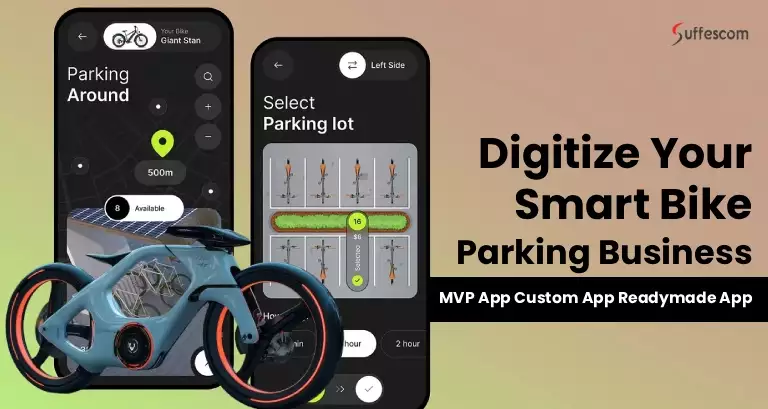
Leading smart parking apps are transforming the way businesses help people discover locations, pay online, and manage permits for parking. Urban mobility is shifting toward intelligent infrastructure with smart parking systems to solve the urban parking challenges.
The market is projected to reach USD 53.38 billion by 2033, growing at a CAGR of 23.3%, significantly showcasing the demand for IoT-Based Smart Parking Mobile Application Development. An IoT-enabled white label smart bike parking app integrates real-time IoT sensors, cloud-based microservices, and AI-driven predictive analytics to manage occupancy, reservations, and digital payments for businesses.
Scalable architectures, secure APIs, and machine learning models create data-driven parking ecosystems that let businesses accelerate cycling adoption and optimize urban mobility infrastructure.
Understanding Urban Cycling Challenges in Smart Cities
Urban cycling has infrastructure gaps that are impacting the full potential of the app. As cities are inclining towards digitized transport ecosystems, the challenges are encouraging businesses to build a technology-enabled parking and security framework that supports scale. This is why businesses are building white label smart mobility software, powered by IoT and AI.
How White Label Smart Mobility Software helps Overcome it
Congestion
Unmanaged bike parking creates micro-congestion in high-density zones, and informal sidewalks create cluttered sidewalks and inefficient space utilization. From a development perspective, a clone app development company integrates live slot availability, GPS-based navigation, and predictive demand forecasting that help users identify peak usage hours and dynamically allocate parking capacity.
Parking Scarcity
Cloud-Based Parking Management Software without digital management layers can not accurately measure utilization rates or plan expansion. The scalable app development addresses this challenge through cloud-based slot management systems connected to smart racks via LoRaWAN, NB-IoT, or BLE-enabled IoT devices. Also implementation of dynamic reservation engines, API-driven booking modules, and automated allocation logic maximizes infrastructure usage without expansion.
Safety & Theft Concerns
Traditional bike racks offer minimal protection and lack monitoring capabilities. A robust smart bike parking system integrates RFID authentication, QR-based access control, smartlock mechanism, and AI-powered anomaly detection to ensure the system is scalable and reliable. With the implementation of role-based access control, encrypted payment gateways, and real-time notifications and alerts, development layers for businesses.
The Role of IoT-Based Smart Systems in white label smart parking platform for bicycles
IoT systems transform traditional static racks into smart, connected infrastructure with real-time monitoring, predictive analytics, and automated access control. For businesses, IoT is more than just a hardware addition; it is the foundational layer that enables scalability, operational visibility, and data-driven monetization.
To build a modular, secure, and cloud-compatible White label smart parking app, businesses need to develop a solution that supports multi-location deployments and third party API integration with an IoT system. Below is the role of IoT systems components.
Sensor Networks
The IoT Bike Parking App enabled sensors, such as IR, RFID, or BLE, to detect real-time bike occupancy and rack status. It enables businesses to ensure data accuracy, device scalability, and operational reliability across multiple locations.
Wireless Communication Protocols
Communication through LoRaWAN, NB-IoT, or LTE-M channels with TLS encryption enables lightweight, low-latency communication between IoT device management software and cloud servers, enabling real-time data synchronization.
Edge vs Cloud Processing
Cloud-native microservices manage analytics, dashboards, AI forecasting, and multi-tenant scalability to support centralized business operations and revenue optimization. However, edge computing handles immediate tasks like occupancy and smart locks.
Accelerate Your Smart Mobility Vision with a Scalable White Label Solution
Partner with our experts and launch a fully integrated white label smart bike parking app tailored to your brand and business model.
Core Feature Breakdown for White Label Bike Parking Solution for Scalable Business-Oriented
For businesses, it is important to accelerate app development with modular features to support users, operators, and administrators within a unified platform.
Below is the feature breakdown with a multi-panel architecture built by a clone app development company with robust features that support automation, analytics, and revenue optimization within a bicycle parking management system.
User Panel
The user interface layer of an IoT Bike Parking App focuses on accessibility, automation, and secure transactions within an Automated Parking Payment System.
User Profile
Users can sign up and create a profile to access features like ride history tracking, payment preferences, and other features.
Real-Time Availability
Receive real-time occupancy data that reflects actual rack status using IoT sensor integration.
Reservation & Scheduling
The booking modules via APIs feature pre-booking of slots with allocation based on time.
Navigation Guidance & Geo-Location
GPS and map SDK integration (Google Maps API) allows for optimized routes to existing bike parking areas.
Digital Payments & Wallet Integration
Support for integrating Stripe, Razorpay, or PayPal SDK to enable safe in-app payments and subscriptions.
User Reviews & Ratings
Feedback modules provide structured data for service quality improvement and data-driven infrastructure decisions.
Wearables Integration
BLE and smart watch API allow us to use QR-free authentication.
Customer Support
Integrated AI chatbots or ticketing APIs, which improve issue resolution and user retention.
Parking Manager / Operator Panel
This layer ensures operational control and infrastructure monitoring for enterprise-level deployments.
Documents Management
For secure upload and verification of compliance documents, use encrypted cloud storage.
Slot Management
Centralized dashboard to configure rack availability, zone mappings, and capacity allocation.
Occupancy Analytics & Reporting
Real-time dashboards created through business intelligence toolsets provide visualization benefits for utilization metrics and demand heatmaps.
Dynamic Pricing Engine
The machine learning algorithms control the rate based on peak hours and forecasted demand.
Automated Alerts & Notifications
Event-driven trigger types inform the operator of anomalies, overcapacity, or maintenance requirements.
Accept/Reject Parking Management
The manual override capabilities can be used to approve or deny access based on different business rules.
Admin Panel
The administrative layer manages governance, scalability, and system-wide intelligence in a white label parking app.
User Management & Role Access
RBAC (Role-Based Access Control) facilitates multi-tenancy management across cities or enterprise campuses.
Data Analytics & Machine Learning Insights
AI-powered dashboards offer predictive insights on trends and performance related to revenue and occupancy.
Revenue Dashboard
Financial system software that is integrated includes monitoring tools for transactions, commissions, and ROI.
Cloud Backup & Security Controls
Automated backup functionality, as well as the use of TLS and DevOps pipelines in a secure manner, are employed for the white label parking app.
Parking Bookings Management
A centralized control panel monitors reservations, cancellations, and refunds through the system.
Advanced Technology Stack Used for the Architecture of a White Label Smart Bike Parking App
IoT Bike Parking App development architecture layers define the performance and reliability of the app. Below is the breakdown of the layers that are required to create a Bicycle Parking Management System. Implementation of these layers helps businesses understand which components, tools, and technologies are important at each stage.
Architecture Layer | Technical Overview | Key Technologies & Tools |
Sensor Layers and Bike Spot Detection | The IoT architecture's perception layer detects real-time bike occupancy using smart racks with various sensors. | Hardware: Ultrasonic Sensors, IR Sensors, RFID, BLE Beacons, IP Cameras Edge Devices: Raspberry Pi, ESP32, Arduino Firmware: C/C++, MicroPython Computer Vision: OpenCV, TensorFlow Lite |
Communication Stack | This layer facilitates secure data transmission from IoT devices to centralized servers. | Protocols: MQTT, HTTP/HTTPS, CoAP Connectivity: LoRaWAN, NB-IoT, LTE-M, Wi-Fi, 5G Security: TLS/SSL Encryption, X.509 Certificates Gateway Platforms: AWS IoT Core, Azure IoT Hub |
Cloud Infrastructure | The cloud layer manages data ingestion, storage, and analytics with a microservices architecture for scalability. | Cloud Platforms: AWS, Microsoft Azure, Google Cloud Databases: PostgreSQL, MongoDB, DynamoDB Architecture: Microservices, Kubernetes, Docker Data Processing: Apache Kafka, AWS Lambda AI/ML: Python, TensorFlow, Scikit-learn |
Mobile App Architecture: Frontend + Backend Integration | The application layer provides real-time availability, reservations, digital payments, and secure access control. | Frontend: Flutter, React Native, Swift, Kotlin Backend: Node.js, Django, Spring Boot APIs: REST, GraphQL Authentication: OAuth 2.0, JWT Payments: Stripe API, Razorpay, PayPal SDK |
Development Cost Drivers That Defines Overall Budget for White Label Smart Parking Solution for Bikes
A white label smart bike parking app cost involves multiple technical layers, each contributing to the overall budget. The typical cost ranges from $8,000 to $15,000, depending on feature complexity, IoT integration, AI/ML capabilities, cloud infrastructure, and mobile app development.
Allocating budget effectively across these components for smart bike parking software development cost breakdown ensures businesses create a scalable, secure, and real-time smart parking ecosystem.
Development Component | Technical Focus | Estimated Cost |
IoT Hardware & Firmware | Occupancy detection sensors (ultrasonic, IR, RFID, BLE, cameras), edge computing, OTA firmware updates, secure device provisioning | $2,500 – $4,000 |
AI/ML Components | Predictive analytics for occupancy forecasting, anomaly detection, dynamic pricing; model training, deployment, and iteration | $1,500 – $3,000 |
Cloud Infrastructure | Cloud-native microservices, real-time data ingestion, databases, device management, analytics dashboards, secure APIs | $2,000 – $3,500 |
Mobile App Development | Cross-platform or native app, real-time availability, reservations, digital payments, user/admin dashboards, authentication | $2,000 – $4,500 |
MVP Launch vs Full-Feature Deployment
MVP (4–8 weeks)
- Core IoT integration
- Basic reservation engine
- Real-time availability
- Payment integration
Full Deployment (12–20 weeks)
- AI-powered forecasting
- Multi-location scalability
- Advanced analytics dashboard
- Dynamic pricing logic
- Third-party API integrations
White Label vs Custom Build: Pros/Cons
Aspect | White Label Solution | Custom Build |
Time-to-Market | Significantly faster deployment | Longer development cycles |
Brand Customization Flexibility | Supports branding customization while maintaining core architecture. | Highly flexible but requires more development effort. |
Cost Efficiency | Lower upfront development costs | Higher initial investment |
Maintenance & Updates | Pre-built modules are easier to update. | Maintenance is fully managed in-house. |
Must-Have Technologies and Frameworks for Ready-Made Smart Bike Parking App Development
Developing a bicycle parking management system requires an integrated architecture that connects with IoT hardware, AI engines, and cloud-native systems. Businesses with advanced technologies and frameworks build a solution that supports MVP app development, API integrations, and mobile app maintenance across the entire mobile app life cycle.
Internet of Things (IoT) Technology Stack
For future-proof mobile app development, an IoT system is the backbone, enabling real-time occupancy detection and automated access control in a Cloud-based parking management software ecosystem.
Microcontrollers & Sensor Firmware
Microcontrollers such as ESP32 and STM32 run secure C/C++ software to process sensor inputs (ultrasonic, IR, RF ID) and provide exact and timely rack occupancy data.
Wireless Protocols
The lightweight protocols MQTT and CoAP over LoRaWAN and NB-IoT enable secure and low-power communication between devices and the cloud.
Device Management Platforms
Platforms like AWS IoT Core or Azure IoT Hub provide features for remote provisioning, firmware updates, device authentication, and monitoring for locations.
AI and Machine Learning Components
AI-Powered parking management app improves operational efficiency by transforming raw IoT data into predictive business models.
Predictive Machine Learning Models
Models for time series forecasts built with TensorFlow or Scikit-learn technologies forecast occupancy trends to plan the allocation of slots.
Anomaly Detection for Occupancy Patterns
The models detect irregular usage patterns, sensor malfunctions, or suspicious activity, which improves security and operational stability.
Reinforcement Learning for Dynamic Pricing
Adaptive pricing algorithms can be used to adjust the parking fee according to the elasticity of demand to optimize revenue generation in an Automated Parking Payment System.
Cloud & Edge Computing Synergy
A hybrid model architecture of mobile app development delivers scalability, performance, and resilience for an enterprise-grade project.
Edge Compute for Low Latency
Devices on the periphery enable real-time validation, lock control, and data filtering to reduce latency and dependence on a network.
Analytics on the Hybrid Cloud
Cloud-native microservices deployed via Docker and Kubernetes support centralized analytics, dashboards, and multi-tenant scaling.
Serverless Functions for Backend Logic
Frameworks like AWS Lambda offer cost-efficient backend processing for bookings, notifications, and payment workflows.
Transform Urban Parking System Infrastructure into a Revenue-Generating Ecosystem
Schedule a consultation today to explore how our ready-made smart bike parking app can maximize long-term business growth.
Development Lifecycle: From Concept to Deployment of White Label Bike Parking Solution
A successful white label bike parking solution, it requires following a structured and engineering-driven approach that aligns IoT infrastructure, cloud-native architecture, and AI modules. The development process of a ready-made smart bike parking app includes backend integration, predictive analytics, long-term DevOps strategy, and firmware engineering.
Below is the roadmap to follow for building a white label bike parking management system.
Step 1: Research and Requirement Analysis
The first stage of the development process includes defining technical scope, scalability goals, market research, audience requirements, and market gaps to cover while building white label smart parking platform for bicycles.
Step 2: UX/UI Design & Prototype
This step involves the creation of a prototype to test the app workflow, role-based dashboards, and ensure intuitive navigation and scalable panel design. A clean and user-friendly UX/UI design ensures a smooth user experience and improves user retention.
Step 3: Backend, Features & API Development
This is the phase where the actual development process starts with Relational and NoSQL databases, Low-latency APIs, stream, and OAuth 2.0, JWT authentication. These core development integrations are structured to manage users, devices, bookings, payments, and analytics.
Step 4: Testing Stage
IoT based white label smart parking system is tested for accuracy, stability, performance, and update functionality. The rigorous testing stage ensures the app’s operations during peak traffic and tests cloud communication.
Step 5: Deployment Stage
Once the testing phase is complete, the app is deployed to google play store and apple store. AI models are optimized, machine learning models undergo validation, and microservices are deployed via containerized environments to ensure scalability and redundancy.
Step 6: Continuous Support After Deployment
After app launch, ongoing validation of the app ensures compatibility across IoT devices, APIs, and payment systems. With experts' support, app updates, feature enhancement and bug fixes are taken care of.
How Suffescom White Label Bike Parking Management System Improves Operational Process and Scalability
White label solutions at Suffescom are engineered to streamline infrastructure operations, enhanced security, and multi-city scalability for enterprises. The solutions we build are modular, cloud-based, with AI-driven analytics and a microservices architecture to deliver long-term growth across geographies.
Security and Data Protection
We focus on robust cybersecurity and compliance-ready architecture with end-to-end encryption using TLS 1.3 and AES-256 that secures payment transactions and user data across cloud environments. Businesses' reliance on secure boot mechanisms ensures devices are protected from unauthorized access or tampering.
Multi-City & Multi-Zone Expandability
The team of experts build white label smart parking solution for bikes that supports horizontal scaling without system reconfiguration. Also, it enables location-based pricing rules, taxation logic, and compliance settings for businesses.
Predictive Analytics and Continuous Optimization
Use of AI algorithms, AI behavioral analytics, and machine learning models analyzes the historical IoT data to predict occupancy trends and provides businesses with the actionable insights that can help infrastructure platforms. With real-time-based analytics let analyze demand elasticity and peak-hour traffic.
AI-Powered Parking Management App Enhancements for Smart Bike Parking Optimization
Business operators integrating AI into a white label bike parking management system ensure predictive decision-making, automated pricing logic, and infrastructure optimization at scale. The new AI-powered capabilities are transforming traditional infrastructure systems into an intelligent, self-optimizing ecosystem and revenue growth platform.
Predictive Analytics & Dynamic Availability Forecasting
AI predictive analytics analyzes historical data, seasonal trends, and peak-hour usage to predict slot demand and dynamically adjust availability in real time.
Machine Learning for Demand Patterns
Learning algorithms cluster user behavior, ride frequency, and geo-location trends to identify recurring demand patterns across multiple parking zones.
Predictive Models & Anomaly Detection
ML Models detect irregular occupancy spikes, suspicious activities, and improved reliability within white label smart parking platforms for bicycles. The AI anomaly detection feature improves the app’s performance and secures data.
Reinforcement Learning for Dynamic Pricing
AI adaptive pricing engines use reinforcement learning to optimize parking fees based on elasticity, demand, and ROI needs.
Conclusion
A white label app built on IoT, AI, and cloud-based solutions enables businesses to launch a scalable bicycle parking management system with faster time-to-market.
Enterprise with modular apps optimizes infrastructure, reduces operational friction, and generates recurring revenue through a secure, future-ready digital ecosystem and reliability. Automated parking apps also bring a new shift in the market with AI capabilities like predictive analytics and AI workflow automation to stay ahead of the competition.
FAQs
1. How long does Suffescom take to build a white label smart parking app?
Suffescom usually delivers an MVP in a few weeks and a full-featured AI-powered solution in 2-4 months, depending on the complexity involved in IoT and Third Party API Integration.
2. What is the white label bike parking system pricing at Suffescom?
The estimated cost ranges from an approximate value of 8,000-15,000, depending on a number of features, such as AI, cloud, Automated Parking Payment System, etc.
3. What monetization models are linked to a white label parking app?
Revenue models vary from pay-per-use booking fees to subscription-based models, dynamic pricing, enterprise licenses, and commission-based parking partnerships.
4. What are the key features of artificial intelligence included in white label parking apps?
The important aspects of AI include the prediction of occupancy, anomalies, heatmaps of demand, and dynamic pricing through the use of reinforcement learning.
5. What are the greatest challenges when creating a white label parking app?
Challenges that arise primarily include IoT sensor calibration, device provision security, cloud scaling, real-time data synchronization, and long-term mobile app maintenance.
6. Can a clone app development company or no code developers build this solution?
Yes, no code developers can develop a Backend architecture, Security Compliance, and AI model incorporation which is required for the development of an enterprise-class IoT Bike Parking App.
7. In what ways does Cloud-Based Parking Management Software increase scalability?
With cloud-native microservices, Kubernetes, and serverless backend logic, horizontal scaling, monitoring, and extension for multi-tenant B2B applications are supported.