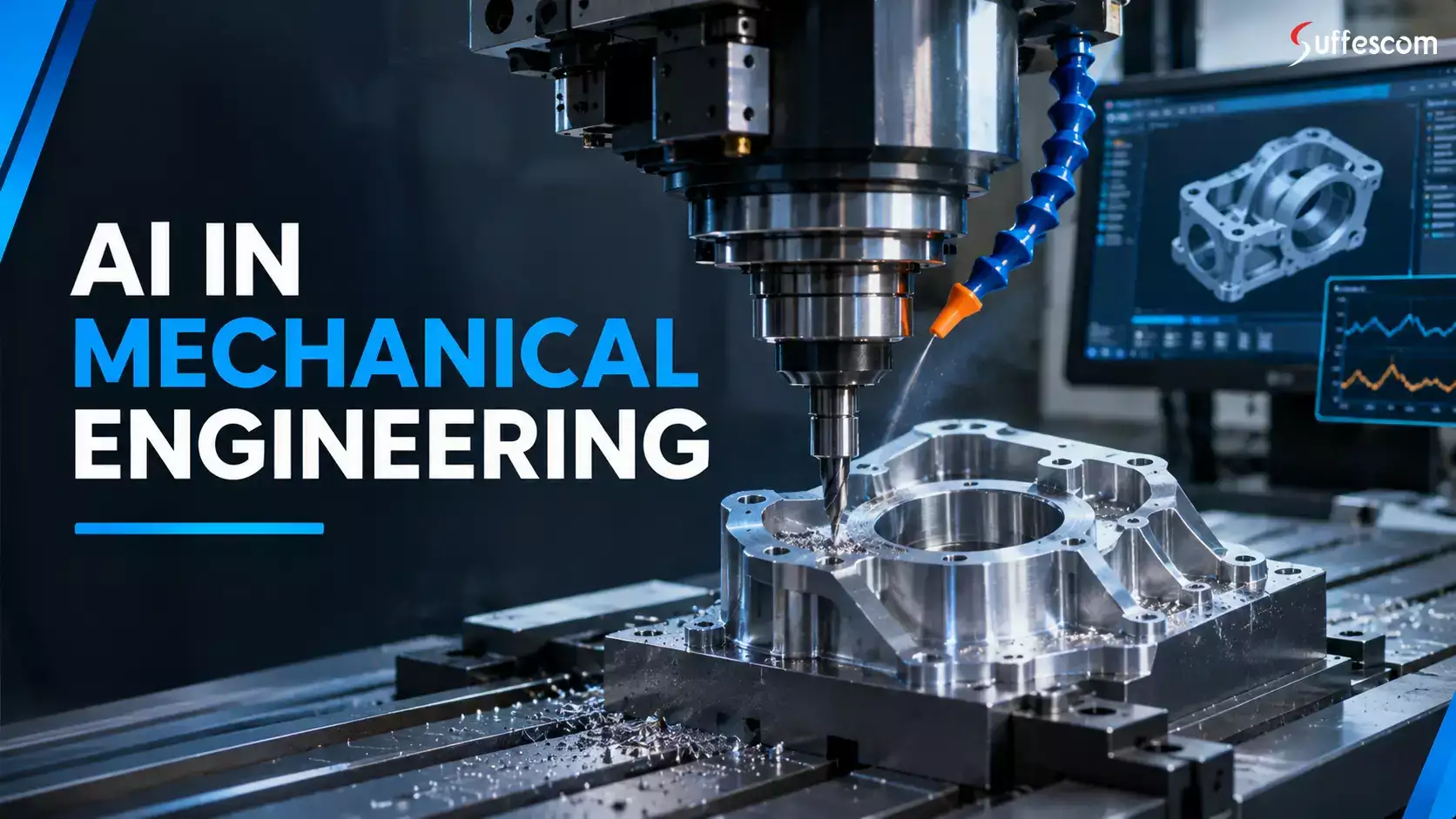
AI in mechanical engineering uses machine learning, generative design, and physics-informed models to speed up design iterations, predict component failures, and automate manufacturing.
AI tools don't replace mechanical engineers; they shift daily work from manual trial and error to framing constraints upstream and validating physical outcomes downstream.
AI's contribution is huge, especially in mechanical parts design. Although accuracy still needs continuous refinement, AI-generated mechanical designs today are highly detailed and useful.
Here are some images of a radio-controlled buggy generated by GPT-6.2 Astra:
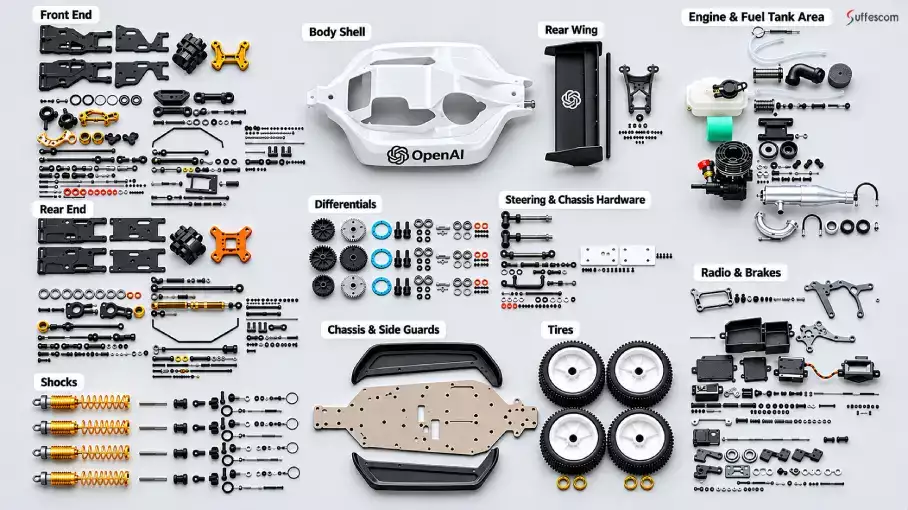
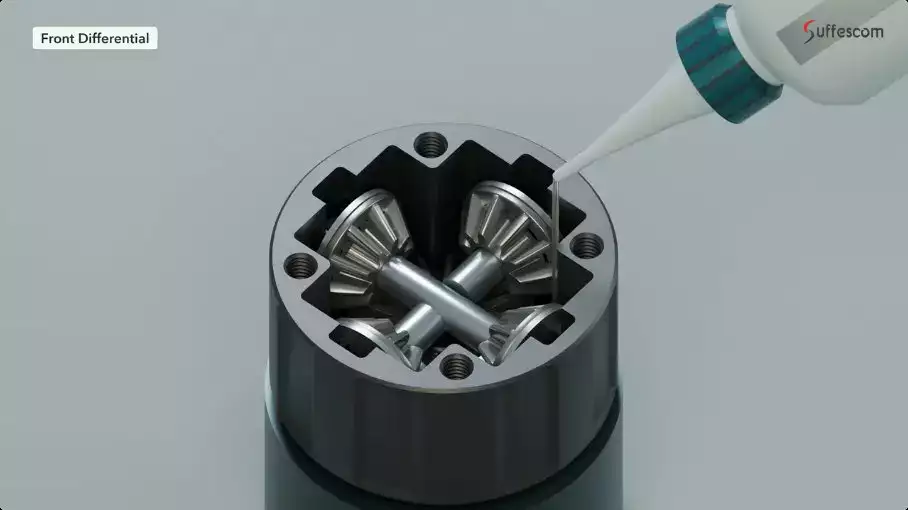
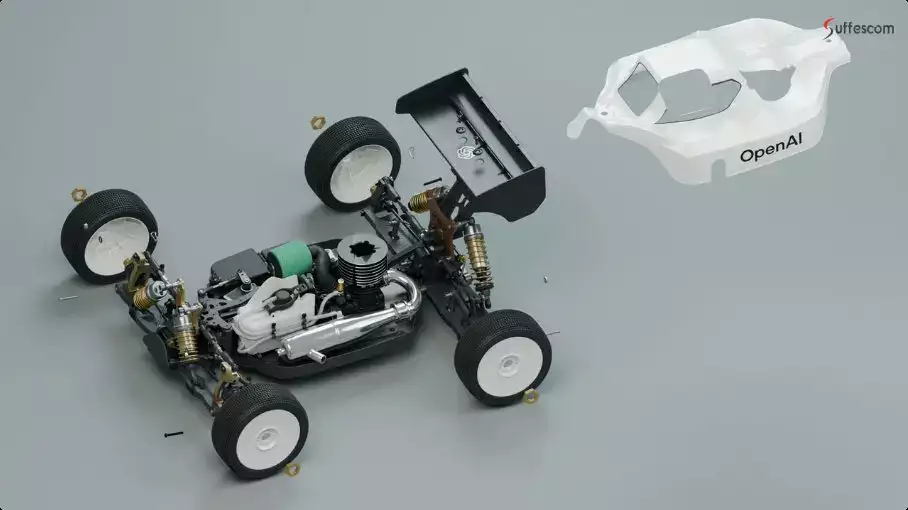
Source: X
Undoubtedly, AI is accelerating physical engineering product development and documentation.
Build Production-Ready AI for Mechanical Engineering Applications
Accelerate innovation with secure, physics-informed AI for PLM and predictive maintenance.
Practical AI Applications in Mechanical Engineering & Popular Tools
The role of AI in mechanical engineering applications is more than a copilot across CAD design, simulation, manufacturing, and maintenance.
Generative Design & CAD
- No need to design every curve & rib manually.
- Engineers define only the design goal and constraints.
- The system requires mounting points, applied loads, materials, and manufacturing methods (such as 3D printing & CNC milling).
- Algorithms rapidly explore and test thousands of different shape variations.
- The process generates lightweight, organic-looking structures that meet strength targets while using minimal material.
Notable Tools
- Autodesk Fusion.
- nTop
- PTC Creo
- Altair Inspire
Practical Trade-off
- Upfront effort to clean messy legacy PLM data or configure company-specific GD&T rules.
- Complex, organic geometries can be harder to inspect for quality assurance.
- Non-traditional shape designs are difficult to achieve with traditional machining methods.
Simulation (FEA & CFD)
- Conventional FEA & CFD models solve complex physics equations from scratch often takes hours or days per run.
- AI uses physics-informed models trained on historical simulation data to bypass manual recalculation.
- Engineers can predict structural stress, airflow, and heat transfer in seconds.
Notable Tools
- Ansys SimAI
- SimScale
- Altair PhysicsAI
- Neural Concept
Practical Trade-off
- Allows engineers to test and evaluate hundreds of design variations early in the development cycle.
- Final designs still require conventional physics solvers for comprehensive verification.
- Physical testing remains mandatory to achieve final safety certification.
Design Review & Knowledge
Engineering teams invest a lot of time checking 2D drawings for GD&T errors. Searching for old PLM files to understand past design failures also demanded a lot of time. AI automatically scans drawings against internal company guidelines and ISO/ASME standards.
The system identifies and flags design-for-manufacturability issues early. AI quickly searches and surfaces past engineering decisions to prevent repeating previous mistakes.
Notable Tools
- CoLab AutoReview
- Leo AI
- Bananaz
Practical Trade-off
- Catches drafting mistakes early before parts reach the machine shop.
- Helps junior engineers get up to speed faster by easily surfacing institutional knowledge.
Predictive Maintenance
AI continuously monitors live sensor data such as:
- Vibration patterns
- Motor current
- Temperature
- Acoustics from factory equipment.
Machine learning models detect subtle anomalies that signal early bearing wear or misalignment weeks before failure.
Notable Tools
- Industrial IoT platform
- Custom ML pipelines
- Digital twins
Practical Trade-off
Minimizes unplanned factory downtime, though it requires reliable sensor instrumentation and clean historical failure data to avoid false alarms.
Scripting & Calculations
- Generate scripts to automate repetitive CAD operations and workflows.
- Write scripts to organize, analyze and interpret engineering test data.
- Develop scripts for automating hand calculations and mathematical models.
- Identify coding errors and suggest corrections.
- Generate technical documentation and explain complex scripts to improve maintainability.
Notable Tools
- MATLAB scripts
- Python
- LLMs (Claude, Gemini, ChatGPT)
Practical Trade-off
Currently the most widely adopted day-to-day AI use case because it requires zero new enterprise software. Though engineers must still verify every equation and unit conversion manually.
Where Mechanical Engineers See Immediate AI Value
MATLAB & Python Scripting
- Generate engineering scripts
- Debug engineering scripts
- Optimization engineering scripts
Maintenance Data Organization
Structure maintenance records and identify recurring equipment issues.
Technical Documentation Search
Quickly retrieve relevant information from internal engineering documents.
Engineering Workflow Support
Automate repetitive tasks and simplify routine technical work.
CAD Assistance
Support design workflows without relying on AI to independently build complex 3D assemblies.
Physics-Informed AI Improves Prediction Reliability
Integrate Physical Laws
Embed physics-based constraints directly into machine learning models.
Improve Prediction Accuracy
Align model predictions with established physical principles.
Handle Unstable Systems
Improve model reliability when analyzing chaotic or non-linear systems.
Reduce Unrealistic Predictions
Prevent outputs that violate known physical constraints.
Improve Generalization
Help models perform more reliably beyond their training data.
Why Human Expertise is Essential
Manage Tolerance Stack-Ups
Validate dimensional variations across assembled components.
Address Machining Variations
Account for supplier-specific manufacturing limitations and machining quirks.
Handle Legacy Data
Review inconsistent CAD models and outdated PLM records.
Verify AI-Generated Designs
Check generated parts and simulations against engineering requirements.
Approve Production Readiness
Require engineer sign-off before tooling, manufacturing, or production.
Real-World Use Cases of AI in Mechanical Engineering Applications
AI in mechanical engineering applications is already dominating and transforming manufacturing at scale with precision and accuracy. Many leading companies in automotive, aerospace, HVAC, etc., have deployed AI in their workflows and improved production with complete quality control.
General Motors
GM used Autodesk design algorithms to re-engineer an automotive seat belt bracket. Consolidated 8 separate stamped components into a single 3D-printed stainless steel part that is 40% lighter and 20% stronger than the original assembly.
GE Aerospace
Utilizing AI-trained reduced-order models and co-simulation tools, heavy equipment engineers test excavator bucket geometries and fluid-soil interactions in under a minute - boosting bucket filling efficiency by 20% without waiting hours per traditional CFD runs.
BMW
BMW utilizes computer vision models on its automotive assembly lines to inspect and detect spot weld defects/finishes in real time. This allows automatically defects detection without slowing the line speed.
Top Bottlenecks of AI in Mechanical Engineering Applications
Data Scarcity & Fragmentation
Data from CAD and other tools are often trapped in disconnected legacy systems.
Significant Computational & Energy Costs
Massive GPU infrastructure and energy consumption are required to train neural networks on complex 3D geometries and fluid dynamics.
Physics Law Bottlenecks
AI struggles to understand complex physics laws, making it unreliable for predicting material behavior under extreme conditions and temperatures.
Hallucinations
General-purpose AIs often struggle to understand engineering terminology. Misapply units and fail to adhere to strict regulatory codes like ASME or ISO standards.
Tough Geometries
Sometimes create weird organic shapes that are too hard to manufacture on a real factory production line, are very expensive, and have no practical usefulness.
- Lacks draft angles
- Ignore tools access
- Tolerance stack-ups
Assembly & System-Level Failure
Struggles to understand how dozens of moving parts work together inside a complete machine.
- Multi-part kinetics
- Complex assemblies
- Competing trade-offs
Spatial Information Transfer
Typing a text prompt is a slow, clumsy way to describe complex 3D shapes compared to just drawing them directly in CAD software.
- Hard to describe unique, complicated 3D shapes
- Missing structural details
- More accurate and faster to draw by own
Accountability & Liability
Deep learning models cannot easily explain the reason behind design or failure prediction. This creates massive legal and safety risks in mission-critical industries like aerospace, automotive, and medical services.
Skill Atrophy & Automation Bias
Junior engineers over-relying on AI risk losing foundational intuition for hand calculations, debugging, and spotting subtle simulation setup errors.
IP Leakage & Cybersecurity
Using public AI tools and connected factory systems puts private company designs at risk of theft or hacking.
Solutions to AI Bottlenecks in Mechanical Engineering
Physics-grounded AI deployment is required to overcome hallucinations and data security hurdles in dedicated mechanical engineering softwares.
PLM Standardization & Synthetic Data
Unify legacy CAD/FEA silos into clean data lakes and generate synthetic datasets using high-fidelity simulations.
Surrogate & Edge Models
Replace heavy FEA/CFD runs with fast ML surrogates and deploy lightweight, quantized models on shop-floor hardware.
Federated Learning
Train models across decentralized datasets to improve accuracy without exposing proprietary design.
Physics-Informed Neural Networks
Embed governing differential equations directly into model training.
Mechanical Engineering Specific RAG
Ground AI assistants strictly in verified material databases, datasheets and ASME/ISO compliance codes.
DFMA Constraint Hard Coding
Enforce tool clearances, draft angles, wall thickness and tolerance limits inside generative design boundaries.
Multimodal Spatial Interfaces
Combine 3D bounding box sketches, point clouds, and parametric scripts rather than relying solely on text prompts.
Subcomponent Scoping
Limit AI to part-level optimization while keeping system-level kinematics and MBSE architectures human-led.
Deterministic Verification Gates
Require traditional FEA/CFD validation, explainable AI and uncertainty quantification before sign-off.
Human In The Loop Reviews
Mandate manual checks on boundary conditions and safety factors to prevent automation bias and skill atrophy.
On-Premise Deployment
Run models inside secure, zero data retention enterprise environments to protect company's data in CAD systems.
Why Suffescom Is the Top-Priority Partner for Compliant, IP-Safe AI in Mechanical Engineering Applications
Suffescom's expertise relies on the AI development ecosystem, from integration to consulting & development, all under one roof. A top team of GenAI engineers proficient in emerging and widely used secure AI technologies across the mechanical engineering domain, following a compliant, secure approach.
- ISO certified company.
- OpenAI verified partner.
- Compliance-focused, multi-industry expertise.
- Secure & advanced technological capabilities, including Blockchain, IoT, AR/VR, Metaverse, Cloud, Cybersecurity & Data Analytics.
- Recognized and trusted by Clutch, DesignRush, Trustpilot, GoodFirms & more.
- Several case studies and testimonials showcasing proven expertise.
- Global Clutch award winner.
- No vendor lock-in AI services.
- A strong compliance and security-governance-prioritized working process.
- Top-tier technology partnerships.
- Senior AI architects promised for complete project lifecycle handling.
- Team training, proactive maintenance support, and ROI focused (token optimization) development approach.
Integrate AI Into Engineering Workflows Without Risking Your IP
Talk to Suffescom’s senior AI engineers to map out an IP safe, compliant AI roadmap tailored to your CAD, PLM and manufacturing stack.
FAQs
Do mechanical engineers need to learn code to use AI?
Not necessarily for commercial tools like Ansys SimAI or Autodesk Fusion, though basic Python knowledge helps customize workflows and verify LLM-generated scripts.
Can AI-generated mechanical design be patented?
Yes, provided a human engineer meaningfully conceived, constrained, validated, and refined the invention. As patent offices require human inventorship.
How does AI assist with repetitive CAD modeling tasks?
AI predicts next-step modeling commands, auto-constrains sketches, automates fastener placement, and recognizes features on imported STEP/IGES files.
What is the typical payback period of AI investment in mechanical engineering?
Low-cost scripting and knowledge search tools often deliver ROI within a couple of months, while enterprise simulation or predictive maintenance deployments typically pay back within 9 to 18 months.
How does AI help reduce carbon emissions in mechanical product design?
AI runs rapid Life Cycle Assessment during the CAD phase, comparing the embodied carbon of different alloys, polymers, and manufacturing processes before cutting a single part.
What is the future of AI in mechanical engineering?
The future is leaning towards AI-assisted workflows where autonomous algorithms handle repetitive tasks, including design, simulation, and diagnostics, while human engineers focus on system architecture, safety, feasibility, and innovation.