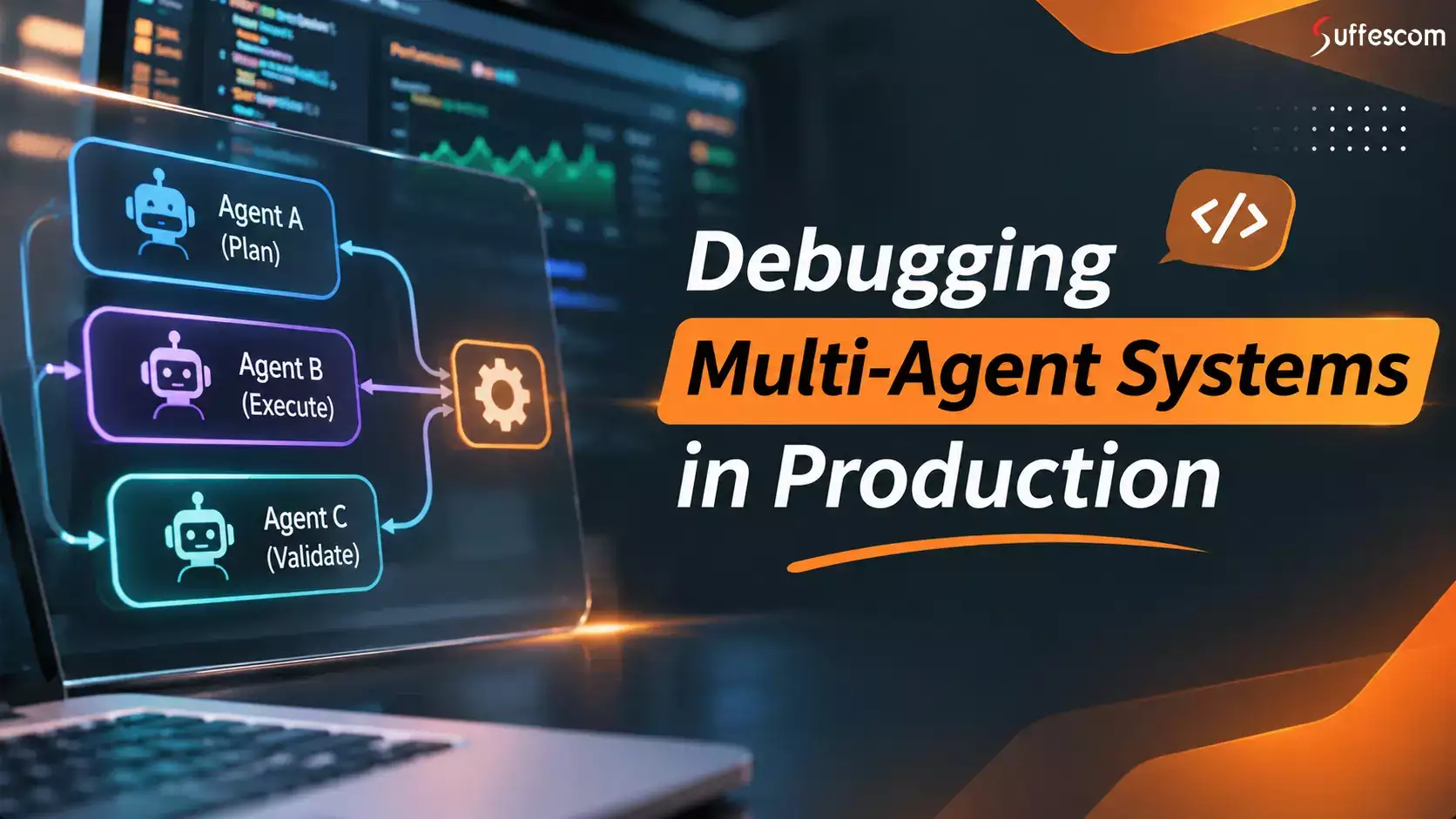
Debugging multi-agent AI systems in production requires treating them as concurrent, non-deterministic state machines rather than simple chains of API calls.
Subtle prompt conflicts or malformed state passed between agents over several steps cause bad output at the end of a workflow, and traditional logging fails.
Distributed Causal Tracing
Look for specific bugs like infinite loops, runaway token spend, and bad tool calls.
End-to-End Span Trees
Track and monitor every AI agent step, from LLM call to tool execution, with a shared trace_id and parent_span_id, so you can reconstruct the exact execution trees across parallel agents.
Rich Payload Capture
- Log the exact inputs
- Outputs
- System prompts
- Model parameters
- Token counts
- Tool arguments at every step.
Open Standards
Many engineering teams build AI agents on OpenTelemetry with OpenInference semantic conventions to avoid vendor lock-in while exporting traces to tools like Arize Phoenix or custom databases.
Need Help Setting Up End-to-End Tracing For Your AI Agents
Suffescom’s GenAI engineers help you to architect, trace, and harden your agents for production.
Inter-Agent Contracts & Guardrails
The hardest bug to catch happens when Agent A completes its task without crashing and passes slightly malformed data to Agent B, and Agent B confidently executes a destructive action.
Strict Schema Validation
Enforce explicit input/output schemas at every handoff boundary. If a payload fails validation, block the transition immediately instead of letting the downstream agent hallucinate a fix.
Deterministic Execution Gates
Wrap agent loops in fast and rule-based checks, like:
- Type checkers
- Linters
- Regex filters
- Permission checks
Before allowing any side-effecting tool call.
Circuit Breakers & Budget
Set hard ceilings on recursion depth, execution time and token spend per trace so a stuck agent loop fails fast instead of draining API quotas.
State Snapshotting & Time Travel Replay
LLM outputs vary between runs, making production bugs hard to reproduce by simply resubmitting the same user prompt.
Immutable State Checkpoints
Save the complete conversation history, shared memory state, and tool responses after every single agent turn.
Deterministic Replay & Forking
Build a replay harness that loads a failed production trace, mocks the external tool responses with the recorded outputs, and lets you fork execution from a specific step with a modified prompt or zero temperature to test a fix in isolation.
Versioning & Controlled Rollouts
A large percentage of production regressions stem from unversioned prompt tweaks, model swaps or retrieval changes that clash with another agent’s instructions.
Immutable Configurable Bundles
Treat prompts, model IDs, temperature settings, and tool definitions as code. Version them together in Git or a config registry and tag every production trace with an exact config hash.
Canary Splits & Shadow Traffic
Route a small percentage of live traffic to updated agent configurations or run new agent versions asynchronously in shadow mode to compare output against the baseline before cutting over.
Automated Production Evals
Manual log review doesn't scale once a system handles thousands of multi-turn traces per day.
Trace Level Grading
- Run asynchronous evaluation jobs over sampled production traces.
- Utilize a separate judge model to score specific failure modes.
Whether an agent's answer was grounded in tool outputs or whether an orchestrator routed a task to the right specialist.
Failure to Dataset Pipeline
Automatically convert production traces that trigger guardrails, human escalations, or negative user feedback into regression test cases that run in CI before any future prompt or code change ships.
What to Build First
| Priority | Component | Primary Failure Mode Prevented |
| 1 | Structured span tracing | Blindness to token loops, latency bottlenecks, and tool errors |
| 2 | Handoff schema validation | Cascading hallucinations caused by malformed inter-agent state |
| 3 | Config & Prompt Versioning | Mystery regressions from untracked prompt or model edits |
| 4 | Checkpointed replay harness | Inability to reproduce non-deterministic production bugs locally. |
Real-time Sentinel Guardrails & Semantic Anomaly Detection
These guardrails let businesses identify bugs early and act before AI agents create losses and impact customers. Acts as a kill switch as well.
Inline Sentinel Classifiers
Before an agent executes a high-stakes tool call, a tiny, ultra-fast model or rule engine inspects the proposed action in milliseconds.
If a rule trips, the system immediately:
- Blocks the tool call
- Halts the workflow
- Fires a high-priority PagerDuty or Slack alert with the exact trace_id.
Behavioral Anomaly & Drift Alerts
Monitoring pipelines track real-time statistical baselines across all active agent sessions.
Sudden Spikes in Tool Retries
If an agent normally calls a search tool once per session but suddenly averages four retries in a 5-minute window, an API contract likely broke or the prompt is looping.
Sentiment & Frustration Signals
Lightweight, real-time sentiment scoring on incoming user replies flags conversions where users repeatedly use words that signal a bad or incorrect response. Alerting engineers within minutes of a bad deployment.
Token Cost Burn Alarms
Alerting when cost per trace jumps by >30% over a rolling 15-minute window catches subtle prompt regressions before they burn thousands of dollars overnight.
Confidence & Uncertainty Routing
Agents can be instructed or evaluated via token log probabilities to emit a structured confidence_score alongside their reasoning.
When the score goes below the set threshold, the agent triggers an automatic graceful degradation path, handing the ticket to a human operator instead of guessing.
Automated Canary Rollbacks
When rolling out a new prompt or model version to 5% of traffic, automated deployment controllers watch guardrail trip rates in real time.
If the canary group triggers schema validation errors or business-rule blocks even 1% more often than the baseline, the router automatically rolls traffic back to 0% without human intervention.
How Debugging Varies Across Different Types of AI Agents in Production
Different AI agent architectures fail in distinct ways, so teams must adapt tracing and guardrail strategies to specific workflows.
Autonomous & Multi-Operations AI Agents
Idempotency keys and state tracking are essential to prevent infinite loops and costly duplicate actions, since these agents run and execute tasks mostly without human oversight.
Customer Facing & Voice Sales Agents
To debug customer-facing voice sales agents effectively, teams must link audio transcripts directly to reasoning logs so they can separate speech-to-text errors from LLM logic flows.
Commerce & Financial Execution Agents
Agents executing payments or on-chain transactions operate with zero margin for error. Whether managing agentic commerce workflows or crypto AI agents, debugging requires strict permission controls and pre-execution simulations before committing funds.
Data Analysis & Back Office Finance Agents
To catch silent schema bugs in data analysis and payroll AI agents, teams log every generated query, intermediate dataframe, and schema snapshots so they can audit how final numbers were calculated.
Code Generation & Developer Agents
To fix coding AI agents that fail from context overflow or stalled test-fix loops, teams log file-retrieval traces, sandbox exit codes, and Git diffs at every iteration.
How Suffescom Helps Businesses In Debugging & Shipping Reliable AI Agents
Suffescom's expertise relies on the AI agent development ecosystem, from integration to consulting & debugging, all under one roof. A top team of GenAI engineers proficient in emerging and widely used secure agentic AI technologies across the mechanical engineering domain, following a compliant, secure approach.
- ISO certified company.
- OpenAI verified partner.
- Compliance-focused, multi-industry expertise.
- Secure & advanced technological capabilities, including Blockchain, AI, IoT, AR/VR, Metaverse, Cloud, Cybersecurity & Data Analytics.
- Recognized and trusted by Clutch, DesignRush, Trustpilot, GoodFirms & more.
- Several case studies and testimonials showcasing proven expertise.
- Global Clutch award winner.
- Senior AI architects promised for complete project lifecycle handling.
Eliminate Production Failures & Unpredictable AI Spend
Strict handoff contracts, deterministic replay hardness, and automated eval pipelines.
FAQs
What is the cost of AI agent debugging in production?
Debugging and hardening AI agents in production typically costs between $500 and $2400+ per month for observability software or $10,000 to $50,000+ for custom engineering and audit services.
How to distinguish between a RAG bug and an AI agent reasoning error?
Inspect the captured context window snapshot for the failing span. If the required facts are missing or buried behind irrelevant chunks, the issue is in retrieval. If the right facts are present, the issue lies in the AI agent's prompt or model reasoning.
How can businesses measure whether an AI debugging setup is actually improving reliability?
CTO's track mean time to detection for silent failures, mean time to resolution via trace replay, guardrail false-positive rates, and the percentage of production bugs converted into automated regression tests.
What happens when a fine-tuned model degrades an agent's tool calling reliability?
Fine-tuning a model on domain prose can unintentionally weaken its structure, JSON formatting, or instruction-following behavior. Teams run side-by-side trajectory evaluations comparing the fine-tuned checkpoint against the base model across all tool schemas before deploying.