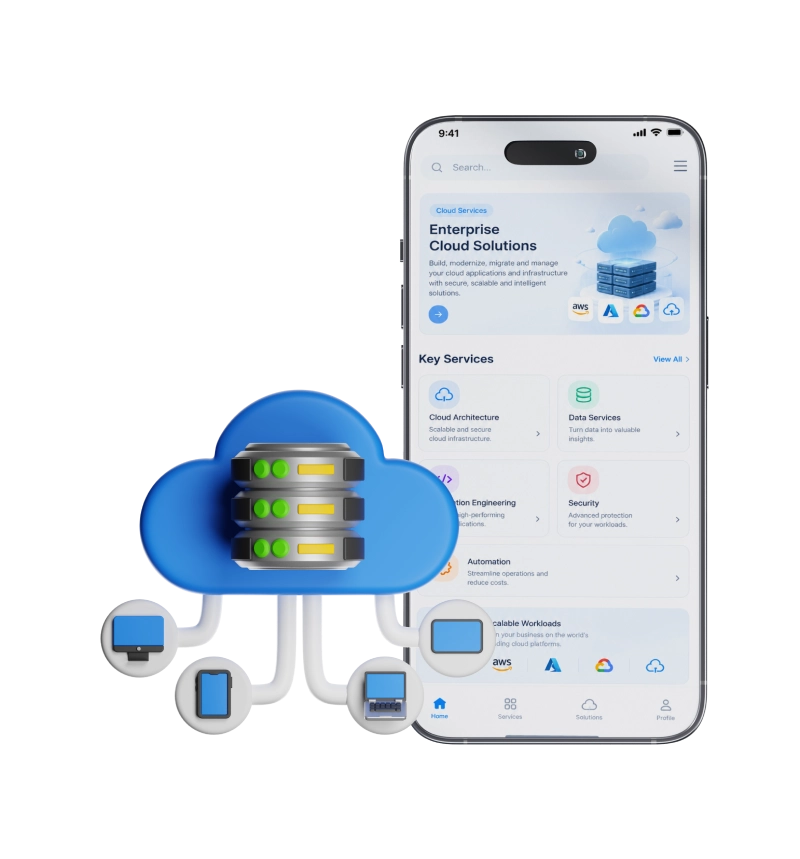
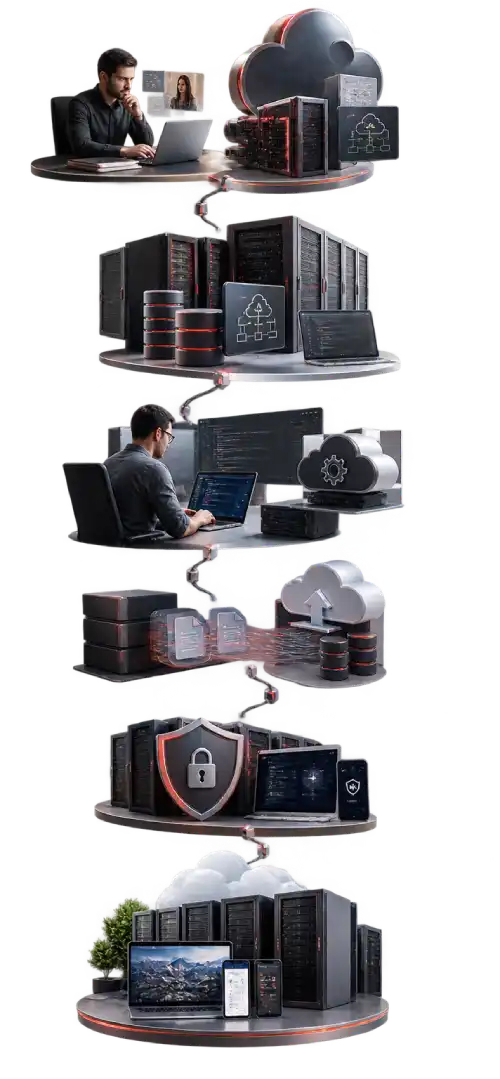
At Suffescom, we offer enterprise cloud services that assist organizations in creating, modernizing, migrating, and managing cloud applications and infrastructure. Through our cloud architecture, application engineering, data services, security, and automation services, we provide scalable enterprise workloads on AWS, Microsoft Azure, Google Cloud, and hybrid cloud platforms.
Suffescom combines software engineering and cloud technology know-how to help companies build, update, and administer their cloud environments. Suffescom realizes that the cloud environment for enterprises is more than just infrastructure; it involves design choices around applications, data, security, integration, and operations.
We have experts across all the technical layers to design cloud environments based on the needs of workloads, application architecture, performance, scalability, and availability. This helps us to provide both cloud solutions and migration & modernization services.
0+
Enterprise Cloud Projects
0+
Technology & Engineering Specialists
0+
Cloud Technologies
0%+
Availability Targets Supported
End-to-End Enterprise Cloud Solutions for Modern Businesses
Our team assists businesses in embracing cloud environments, creating cloud solutions, upgrading old systems, and developing architecture in the context of public, private, hybrid, and multi-cloud environments. Some of our solutions provided in enterprise cloud computing include the following:
Cloud Computing & Infrastructure
Cloud computing environments are developed based on enterprise workloads. These workloads include compute, network, database, container, and infrastructure components. Our enterprise cloud computing solutions are architected to be scalable, available, and isolated as per changing application environments and workloads.
Cloud Application Development
Our solutions involve the development of cloud-based enterprise applications , APIs, microservices, and distributed platforms to function efficiently in cloud environments. This includes architecture and engineering for scalable workloads, application availability, service integration, and cloud-native deployment requirements.
Cloud Migration & Modernization
We enable companies to migrate applications, databases, and workloads from on-premises or legacy to cloud-based environments, considering compatibility, architecture, performance, and scalability. Cloud solutions for enterprise include rehosting, replatforming, refactoring, and modernization depending on the state and value of the solutions.
Cloud Integration
We bring together enterprise applications, APIs, databases, third-party platforms, and cloud-based services in order to enable them to communicate and be able to form a unified technology environment. This allows cloud-based enterprise solutions to integrate with current business systems without rebuilding all applications and workflows.
Cloud Storage Architecture
Our cloud storage and data architectures are designed and built around workloads, access patterns, scale, performance, and retention needs. We encompass a diverse range of solutions, including applications, databases, analytics workloads, and file and object storage, as well as additional services tailored to meet various business needs.
Cloud Security & Operations
Security measures, continuous monitoring, automation processes, access management protocols, and operational procedures are integrated into our enterprise cloud environment. The goal is to offer a secure base to operate critical business applications with respect to security, availability, governance, and ongoing operational requirements.
Ready to Build a Scalable Cloud Environment?
From cloud architecture and engineering to migration, modernization, security, and optimization, our cloud experts help you build and manage cloud environments aligned with your business goals.
Learn about cloud engineering in practice with real-world examples from Suffescom.
Cloud-Native Commerce Platform for a US Retailer
Business Context: An e-commerce firm in Chicago required a cloud design that could deal with traffic variability in their seasonal campaigns. Their current design made it necessary to have excess capacity even in times when there was no peak traffic and had very little room for scalability.
Cloud Solution: We reconfigured the application environment by adopting scalable computing, managed databases, object storage, CDN distribution, load balancing, and automatic scaling. Application modules with diverse workloads were segregated to be scaled separately while standardizing infrastructure configuration across all environments.
Outcomes:
3xIncrease in peak traffic capacity
34%Reduction in compute expenditure
AutoIndependent scaling for high-demand application components
Azure Application Modernization for a German Healthcare Provider
Business Context: A healthcare provider in Munich was operating patient-facing applications on traditional infrastructure. Scaling individual services required changes to the wider environment, while application releases and infrastructure updates involved significant coordination.
Cloud Solution: We introduced an Azure-based architecture with segmented networking, managed application services, centralized identity, encrypted data services, and scalable application infrastructure. Selected components were modernized to support independent deployment and scaling without requiring a complete rewrite of the existing platform.
Outcomes:
49%Faster application release cycles
43%Reduction in infrastructure administration effort
AutoIndependent scaling for high-demand application components
Cloud Management & Optimization for a US SaaS Company
Business Context: A New York-based SaaS company has grown its cloud footprint in different environments due to an increase in customers. Higher computing consumption, underutilization of computing resources, and lack of standardization were leading to unnecessary infrastructure costs.
Cloud Solution: The engagement involved evaluating resource utilization, performance of workloads, capacity needs, and configuration of the environments. The engagement included rightsizing, resource scheduling, autoscaling improvements, storage optimization, monitoring enhancements, and infrastructure governance to balance cost, performance, and availability.
Outcomes:
31%Reduction in monthly cloud infrastructure costs
↑Improved resource utilization across production environments
+Better visibility into workload performance and capacity
Have Complex Workloads That Need a Better Cloud Strategy?
Your cloud architecture should reflect how your applications, databases, integrations, data, security controls, and users actually operate. We design and implement workload-specific cloud solutions across public, hybrid, and multi-cloud environments.
Enterprise Cloud Computing Solutions for Scalable Workloads
We build cloud infrastructure for enterprise applications, APIs, microservices, processing-intensive operations, and business platforms. The choice and configuration of compute resources are made considering application architecture, processing needs, traffic patterns, performance goals, availability needs, and anticipated workload growth.
Plan computing infrastructure for app requirements for VMs, cloud instances, containers, and serverless computing resources. The configurations considered appropriate depend on CPU, memory, processing, and workload requirements.
Elastic and Scalable Computing
Plan scaling and resource provisioning as per changes in application demand. Scaling strategies must match traffic, resource usage, scheduled workload, and application-specific metrics.
Workload-Specific Compute
Match compute resources to different enterprise workloads, from traditional web applications and APIs to high-throughput processing, background jobs, microservices, and data-intensive applications.
Container & Serverless Computing
Containerize applications for deployment on Kubernetes and other managed platforms for portability, isolation, and scaling. For event-driven workloads, serverless computing minimizes the underlying servers.
Load Balancing and High Availability
Create compute architectures that incorporate load balancing, redundant computing instances, health checks, and failover capabilities in order to distribute workload and lessen dependence on single compute instances.
Optimizing Compute Resources
Analyze the use of compute resources and their workload characteristics to find underused resources. This will significantly enhance the efficiency of the infrastructure, leading to improved performance and resource utilization.
Monitoring and Capacity Planning
Develop monitoring strategies for CPU usage, instance status, application performance, scaling activities, and resource consumption. This is crucial for capacity planning with the increasing workloads of companies.
Multi-Environment Compute Design
Design identical compute environments for development, testing, staging, and production. While infrastructure and deployment configurations must be standardized, set production workloads at the correct capacity and availability levels.
Hybrid and Multi-Cloud Computing
Design workloads in public, private, hybrid, or multi-cloud infrastructures in case of the need for distributed deployments from a compliance, performance, continuity of operations, or workload perspective.
Cloud Infrastructure Architecture for Enterprise Applications
Suffescom develops cloud infrastructure and architecture needed for running enterprise applications, data platforms, APIs, and distributed workloads. We establish the cloud foundation across networking, environments, compute boundaries, connectivity, availability, and infrastructure automation.
Enterprise Cloud Landing Zones
We establish structured cloud foundations for organizations adopting cloud solutions for enterprise workloads across multiple accounts, subscriptions, environments, or business units. This includes account hierarchy, network foundations, identity integration, policy controls, logging, resource standards, and environment separation.
VPC / VNet & Network Architecture
We design the network layer, which plays a crucial role in defining and facilitating the seamless communication between workloads both inside and outside of the cloud environment. We have an architecture that covers VPCs/VNets, subnets, routing tables, gateways, load balancers, private endpoints, DNS, firewalls, and managed ingress and egress.
Multi-Region and High Availability Architecture
Workloads will be designed across availability zones and geographical regions based on the enterprise application's need for high resilience, fault tolerance, and geographic availability. This architecture considers the dependencies, routing of traffic, redundancy, failures, and the infrastructure for maintaining the availability of applications.
Cross-Environment Cloud Architecture
We integrate our public cloud environment with on-premises data centers, private cloud, or other cloud environments if the workloads are present in multiple cloud environments. This includes network connectivity, workload placement, traffic routing, identity considerations, and defined architecture boundaries between environments.
Infrastructure as Code
We convert cloud infrastructure into repeatable, version-controlled configurations using Terraform, AWS CloudFormation, Azure Bicep, or equivalent technologies. This enables provisioning of enterprise cloud computing solutions, infrastructure review through development workflows, and reduced dependence on manual configuration.
Environment & Resource Architecture
We structure development, testing, staging, and production environments according to application requirements and enterprise governance. Resource grouping, account boundaries, access separation, networking, quotas, and environment-specific configurations to enable engineering teams to develop and release without production dependencies.
Workload-Specific Cloud Architecture
We select infrastructure according to how individual workloads actually operate rather than applying one architecture pattern across every application. Depending on requirements, this involves virtual machines, containers, serverless components, distributed services, managed cloud services, or combinations of these models.
Capacity & Scalability Planning
We evaluate traffic patterns, workload behavior, resource consumption, and expected growth to determine appropriate infrastructure capacity. Architectures incorporate horizontal scaling, autoscaling, load distribution, resource limits, and capacity thresholds so enterprise cloud computing environments respond to changing demand.
Cloud Infrastructure Standardization
We help enterprises replace inconsistent or manually configured infrastructure with standardized architecture patterns and provisioning methods. Common infrastructure components, naming conventions, resource policies, network patterns, and deployment configurations are defined to make enterprise cloud solutions easier to operate and extend.
Scalable Cloud Storage & Data Solutions for Enterprise Applications
Suffescom designs cloud storage and data architectures around how enterprise applications generate, access, process, and retain data. We implement the appropriate storage and database services while addressing availability, scalability, performance, security, and data lifecycle requirements.
Object, Block & File Storage
Design and configure storage environments for application assets, documents, media, persistent workloads, databases, and shared enterprise applications. We select storage models according to access patterns, performance requirements, capacity, and workload behavior.
Cloud Database Architecture
Implement managed relational, NoSQL, distributed, and workload-specific databases based on data models, transactions, queries, consistency, and expected growth. Database environments are structured for production, testing, replication, and high-availability requirements.
Data Architecture & Storage Design
Define how application data is distributed across databases, storage services, caches, and supporting data components. We consider data relationships, access patterns, partitioning, replication, indexing, and app dependencies to create a maintainable data layer.
Performance & Capacity Planning
Map storage and database resources to expected throughput, latency, transaction volumes, concurrent access, and capacity growth. This helps determine suitable storage tiers, database configurations, scaling approaches, and capacity thresholds for production workloads.
High-Availability Data Systems
Design resilient data architectures using replication, redundancy, distributed databases, failover mechanisms, and availability-zone or region-level configurations. The architecture is aligned with availability requirements rather than a one-size-fits-all resilience model.
Data Lifecycle Management
Establish how enterprise data moves between active, infrequent-access, archival, and deletion stages. We configure storage tiers, retention policies, archival mechanisms, and lifecycle rules according to business usage, regulatory requirements, and long-term data growth.
Scalable Data Platforms
Build data layers that support increasing users, transactions, files, and application workloads without requiring major architectural changes at every growth stage. Scaling strategies are selected around actual workload characteristics and application requirements.
Data Replication & Synchronization
Configure replication and synchronization mechanisms for distributed applications, separated environments, read replicas, and other multi-copy data requirements. Designs account for consistency, replication frequency, data latency, and application dependencies.
Analytics & Data Platforms
Connect operational data sources with cloud data warehouses, data lakes, and reporting environments to support data analytics across enterprise applications. This combines operational data with reporting, business intelligence, or analytical processing.
Cloud Backup & Disaster Recovery Solutions for Business Continuity
Suffescom architects cloud backup and disaster recovery environments for enterprise applications, databases, virtual machines, containers, files, and critical business data. Our approach connects backup policies, replication, recovery infrastructure, and application dependencies to defined RPO, RTO, retention, and business continuity requirements.
01. Enterprise Cloud Backup Architecture
Design comprehensive centralized backup architectures for applications, databases, virtual machines, containers, and enterprise data, with workload-specific schedules, defined recovery points, detailed retention policies, and strategically organized storage tiers.
02. Backup Policies & Retention
Configure backup frequency, retention windows, archival policies, and lifecycle rules based on application criticality and recovery requirements. This helps organizations maintain the right recovery points without treating every workload with the same backup policy.
03. Cross-Region Backup & Replication
Replicate backup data and workloads across availability zones, regions, or isolated environments to protect against failures and regional outages. Architecture is selected according to recovery objectives, data volume, latency, and operational requirements.
04. Application & Database Recovery
Build recovery workflows that account for databases, application services, configurations, dependencies, and infrastructure components. This enables recovery of complete application environments rather than relying only on file-level backup restoration.
05. RPO/RTO-Based Recovery Design
Translate business recovery requirements into technical backup and disaster recovery mechanisms. Workloads are grouped according to data loss and downtime, with appropriate backup frequency, replication, standby infrastructure, and restoration procedures.
06. Disaster Recovery Environments
Design secondary cloud environments that host workloads when the primary production environment becomes unavailable. Depending on requirements, this includes warm or standby infrastructure, replicated data, automated provisioning, and controlled workload activation.
07. Failover & Failback Workflows
Define and automate procedures for moving applications and services to recovery infrastructure during a disruption and returning them to the primary environment after recovery. Workflows account for data sync, app dependencies, DNS or traffic routing, and operational validation.
08. Recovery Automation & Testing
Implement automated recovery procedures where practical and conduct scheduled restoration and disaster recovery tests. Testing helps verify that backup copies are usable, dependencies are recoverable, and documented procedures achieve the expected RPO and RTO.
09. Immutable & Isolated Backup Copies
Architect protected backup copies that limit the ability of unauthorized users or compromised workloads to modify or delete recovery data. Isolation, access controls, retention mechanisms, and recovery procedures should be incorporated into the overall backup architecture.
10.Distributed Backup & Recovery
Design backup and recovery workflows for environments spanning cloud, on-premises infrastructure, multiple regions, or distributed application environments. This provides a consistent recovery strategy without requiring workloads to follow an identical model.
11. Business Continuity Architecture
Connect technical recovery capabilities with business-critical applications, operational dependencies, acceptable downtime, and recovery priorities. The resulting architecture defines what must be recovered first and how supporting infrastructure is brought online.
Enterprise Cloud Migration and Application Modernization Solutions
Suffescom helps enterprises move existing applications, databases, and infrastructure to cloud environments while addressing the architectural limitations that prevent workloads from benefiting from the move.
Cloud Readiness & Assessment
−
We assess applications, databases, infrastructure, integrations, dependencies, and workload characteristics to determine migration readiness. This helps identify what to move directly, what requires replatforming, and where deeper modernization is justified.
Migration Strategy & Planning
+
We define workload-specific migration plans covering migration waves, target environments, dependencies, data movement, testing, cutover, and rollback. This gives enterprise teams a structured path for moving critical workloads with controlled operational risk.
Rehosting & Replatforming
+
We support lift-and-shift migrations where minimal change is appropriate and replatform workloads when managed cloud services improve scalability, availability, or operational efficiency without requiring a complete rewrite.
Application & Legacy Modernization
+
We upgrade legacy applications, coupled architectures, limited scalability, or difficult release processes. This includes restructuring app components, containerization, selective refactoring, or gradual transition toward cloud-native architectures.
Database & Data Migration
+
We migrate enterprise databases and supporting data, along with schema compatibility, data volume, replication, consistency, downtime, and application dependencies. Where appropriate, workloads are transitioned to managed cloud database services.
Hybrid Cloud Migration
+
We support environments where applications or data must remain across on-premises and cloud infrastructure. This includes secure connectivity, workload placement, identity integration, and coordinated access between environments.
Migration Validation & Optimization
+
We validate functionality, data integrity, performance, security, and infrastructure configuration before cutover. After migration, we optimize resource usage, architecture, and operational processes to ensure the cloud solution is properly aligned with business goals.
```
Connect Your Enterprise Applications With Modern Integrations
Suffescom connects enterprise applications, cloud services, APIs, data platforms, and third-party systems while modernizing application components for better scalability, interoperability, and maintainability.
Enterprise API Integration
We design and implement APIs that connect applications, databases, cloud services, partner platforms, and internal enterprise systems. API-based integration provides controlled access to business capabilities while reducing tightly coupled dependencies between applications.
Enterprise Application Integration
We connect ERP, CRM, payment gateways , SaaS applications, databases, and other applications using APIs, middleware, messaging, and event-driven patterns. These integrations also support AI workflow automation to streamline processes across business systems.
Application Restructuring & Microservices
We restructure suitable monolithic applications where tightly coupled components create deployment, scaling, or maintenance limitations. Selected services are separated and independently deployed or scaled without unnecessarily rebuilding the entire application.
Cloud-Native Application Modernization
We introduce containers, managed cloud services, asynchronous processing, serverless components, and other cloud-native patterns with a practical architectural advantage. This helps existing applications evolve into more maintainable cloud-based enterprise solutions.
Data & Event Integration
We implement real-time and asynchronous communication using APIs, messaging, queues, and event-driven architectures. This supports applications that need reliable data exchange without forcing every system to remain dependent on another application's availability.
Third-Party & SaaS Integration
We integrate enterprise applications with external APIs, SaaS platforms, payment services, identity providers, analytics systems, and other technology ecosystems. Integration considers authentication, data mapping, API limits, failure handling, retries, and monitoring.
Application Modernization Roadmaps
We assess existing application architecture and identify components that should be retained, restructured, replaced, or exposed through APIs. This creates a phased path to modernize legacy apps and adopt a cloud solution without taking on full-system redevelopment.
```
Cloud Security & Compliance Solutions for Enterprise Environments
Suffescom helps organizations establish secure, governed cloud environments for business-critical applications and data. Our cloud security services cover access control, network protection, encryption, governance, monitoring, and compliance controls across the cloud infrastructure and workloads we implement.
Identity & Access Management
We design role-based access, least-privilege permissions, service identities, privileged access controls, authentication policies, and environment-level access boundaries. This helps enterprises control who accesses cloud resources, what actions they perform, and how access is managed across development, staging, and production environments.
Network Security & Segmentation
We implement private and public network boundaries, security groups, firewalls, routing controls, ingress and egress policies, VPN connectivity, and workload isolation. Network architecture is designed around application communication patterns so sensitive services and enterprise workloads are not unnecessarily exposed.
Data Protection & Encryption
We protect sensitive enterprise data through encryption at rest and in transit, key management, secrets handling, access policies, and controlled data flows. These controls are applied across databases, storage services, applications, APIs, and other cloud resources based on data classification and business requirements.
Cloud Security Governance
We establish standards for resource provisioning, configuration, identity, environment separation, logging, and security policies across cloud accounts, subscriptions, and workloads. Governance helps enterprise teams maintain consistent controls as their enterprise cloud computing solutions expand across applications and environments.
Security Monitoring & Auditability
We integrate cloud activity logs, infrastructure events, access records, monitoring systems, and security signals to improve visibility into the environment. Centralized logging and audit trails support incident investigation, operational monitoring, compliance reviews, and detection of unexpected configuration or access activity.
Compliance & Regulatory Controls
We map technical cloud controls to applicable organizational and regulatory requirements, including requirements related to access, data protection, logging, retention, and governance. The implementation is tailored to the organization's actual compliance scope rather than treating a compliance framework as a one-size-fits-all cloud architecture.
Application & Deployment Security
We incorporate security controls into application infrastructure, APIs, deployment workflows, cloud services, and environment configuration. This helps organizations maintain security requirements as applications are developed, released, scaled, and modified instead of relying only on perimeter-level protection.
Your Cloud Strategy Is Only as Strong as the Architecture Behind It.
Whether you are starting a new cloud initiative or rethinking an existing environment, we help connect application architecture, infrastructure, data, security, integration, and operations into a practical cloud solution designed for your business and workload requirements.
We help businesses get more value from their cloud investments by improving resource utilization, controlling unnecessary spend, strengthening operational visibility, and automating recurring infrastructure activities across enterprise workloads.
Cloud Resource & Environment Management
We organize and manage compute, storage, networking, databases, and other cloud resources across development, staging, and production environments. Resource ownership, tagging, provisioning standards, and lifecycle policies improve visibility and operational control as cloud solutions for enterprise environments expand.
Resource Utilization & Rightsizing
We analyze CPU, memory, storage, network usage, and workload patterns to identify overprovisioned, underutilized, or idle resources. Rightsizing recommendations help align infrastructure capacity with actual application requirements while maintaining the performance and availability expected from enterprise workloads.
Cloud Cost & Usage Optimization
We review cloud consumption, resource utilization, storage usage, and service-level costs to identify unnecessary expenditure. Budget visibility, usage controls, lifecycle policies, and resource optimization help organizations maintain a better balance between cloud spending and workload requirements.
Performance Optimization
We identify infrastructure and application bottlenecks affecting response times, throughput, resource utilization, or workload stability. Optimization may involve resource tuning, configuration changes, scaling adjustments, or targeted architecture improvements based on actual performance data.
Monitoring & Observability
We implement monitoring for infrastructure health, application performance, availability, resource utilization, logs, and operational events. This gives engineering teams the visibility required to detect abnormal behavior, investigate issues, and maintain reliable production environments.
Autoscaling & Capacity Management
We configure scaling and capacity policies around traffic patterns, workload demand, performance thresholds, and availability requirements. This enables enterprise cloud computing solutions to respond to changing demand without relying on continuously overprovisioned resources.
Infrastructure Automation
We automate recurring activities such as resource provisioning, configuration updates, environment changes, and infrastructure lifecycle management. Automation improves consistency across environments and reduces manual operational effort as cloud infrastructure grows.
Cloud Governance & Operational Controls
We establish practical controls around resource provisioning, environment standards, operational access, tagging, configuration, and lifecycle management. These controls assist technical teams in ensuring consistency and uniformity across accounts, subscriptions, applications, and teams, facilitating operations and collaboration.
Real-World Enterprise Cloud Use Cases & Applications
Suffescom designs and implements cloud-based enterprise solutions around these specific use cases, selecting the appropriate infrastructure, application architecture, data services, security controls, and operating model for each environment.
Enterprise Application Hosting
Enterprise Application Hosting
Deploy business-critical applications on cloud infrastructure with the compute, networking, storage, database, availability, and monitoring capabilities for production. This supports CRM platforms, enterprise applications, SaaS products, and transaction-heavy systems while maintaining separate development, staging, and production environments.
Legacy Workload Modernization
Legacy Workload Modernization
Move applications running on aging servers or traditional infrastructure toward more maintainable cloud architectures. Depending on the workload, modernization involves rehosting, replatforming, containerization, managed services, or selective refactoring while preserving business-critical functionality that does not need to be rebuilt.
Cloud-Native Application Delivery
Cloud-Native Application Delivery
Build applications specifically for cloud operating models using containers, managed services, APIs, serverless components, automated infrastructure, and elastic resource allocation where appropriate. This approach is useful for new digital products and applications that require independent deployment, rapid scaling, and automated operational workflows.
High-Availability & Resilient Workloads
High-Availability & Resilient Workloads
Design applications that need greater resilience against infrastructure failures, traffic spikes, or availability-zone disruptions. Architectures incorporate redundancy, load balancing, distributed resources, automated scaling, health monitoring, and failover mechanisms based on the application's availability requirements.
Data-Intensive & Analytics Workloads
Data-Intensive & Analytics Workloads
Use cloud infrastructure for applications that process large datasets, analytical workloads, transactional data, or rapidly growing information volumes. The architecture combines scalable storage, managed databases, data processing services, and workload-specific compute to handle changing data and processing requirements.
Multi-Cloud Environments and Workloads
Multi-Cloud Environments and Workloads
Support enterprises that need to distribute workloads between on-premises infrastructure, private environments, and multiple public cloud platforms. We design connectivity, workload placement, identity, data access, and operational controls so systems work across environments without creating unnecessary architectural complexity.
Development, Testing & Engineering Environments
Development, Testing & Engineering Environments
Create consistent cloud environments for development, QA, testing, staging, and release workflows. Automated provisioning, infrastructure as code, environment isolation, and reusable configurations help engineering teams create and retire environments faster while reducing differences between development and production infrastructure.
Scalable Digital Platforms
Scalable Digital Platforms
Build cloud architectures for applications experiencing unpredictable traffic, rapid user growth, geographic expansion, or seasonal demand. Elastic compute, autoscaling, distributed services, load balancing, caching, and appropriate data architectures allow capacity to adjust as requirements for the workload processes change.
Business Continuity & Disaster Recovery
Business Continuity & Disaster Recovery
Use cloud infrastructure as part of recovery strategies for applications and data that require protection against infrastructure failure, regional outages, or other disruptive events. Depending on RPO and RTO requirements, implementations include cloud backup, replication, standby environments, recovery infrastructure, and tested restoration workflows.
Our Implementation Process From Assessment to Cloud Deployment
Our implementation process is structured around the existing technology environment, workload requirements, security constraints, and business objectives. We start with the current architecture and progressively move toward the target environment, validating each stage before production adoption.
Discovery & Requirements
We review applications, infrastructure, data, integrations, users, workloads, operational processes, and business requirements to establish the scope and technical priorities.
Architecture & Solution Design
We define the target cloud architecture, workload placement, networking, compute, storage, database, security, availability, and integration requirements based on the intended model.
Assessment & Planning
When migrating to the cloud, we assess dependencies, technical risks, migration complexity, resource requirements, and implementation sequencing before execution begins.
Cloud Environment Setup
We establish the required accounts, subscriptions, environments, networking, identity controls, infrastructure components, monitoring, and governance foundations.
Where applicable, we migrate applications, databases, and data while implementing APIs, connectivity, authentication, and other integrations between cloud and existing systems.
Testing & Validation
We validate functionality, performance, security, availability, data integrity, integrations, backup/recovery procedures, and infrastructure behavior before production release.
Production Deployment
We conduct the production rollout using established deployment and verification processes. Critical workloads are transitioned according to maintenance and continuity requirements.
Optimization & Ongoing Management
After deployment, we review utilization, performance, costs, monitoring, security controls, and processes to identify improvements and keep it aligned with workload requirements.
How Much Does an Enterprise Cloud Implementation Cost
The cost of enterprise cloud implementation depends on the number of workloads, existing infrastructure, migration complexity, architecture requirements, security controls, integrations, and level of modernization involved. Based on the project scope, our typical engagement ranges are:
Planning a Cloud Migration, Modernization, or New Enterprise Cloud Platform?
Tell us about your applications, infrastructure, cloud strategy, and operational requirements. Our team helps you evaluate the current environment, define the target architecture, and determine the right implementation roadmap.
Cloud requirements vary by industry based on workload criticality, data sensitivity, compliance requirements, scalability, and application architecture. We design cloud environments around these operational and technical requirements.
API integration, real-time data processing, and scalable cloud infrastructure
Resilient architectures for distributed operational workloads
SaaS & Technology
Multi-tenant SaaS platforms, APIs, microservices, and cloud-native applications
Containerized infrastructure, managed databases, and automated scaling
Cloud architecture designed for rapid product growth and global delivery
Real Estate & PropTech
Property management , real estate marketplaces, tenant portals, and property platforms
Cloud infrastructure for property data, transactions, document management, and customer-facing applications
Secure integrations with CRM, payment, listing, and third-party real estate systems
Media & Entertainment
Streaming platforms, content management, digital media, and user-facing applications
Scalable storage, CDN, distributed processing, and high-availability architecture
Cloud environments optimized for variable traffic and large media workloads
Education & EdTech
Learning management systems, virtual classrooms, school platforms , and education portals
Scalable application infrastructure, cloud data platforms, and secure integrations
Reliable environments for high-concurrency learning workloads
Key Benefits of Moving Enterprise Workloads to the Cloud
Well-designed cloud environments improve how enterprises build, deploy, operate, secure, and scale their technology platforms. The actual benefits depend on the workload and architecture but typically include:
01
Faster Application Delivery
Automated infrastructure provisioning, standardized environments, and repeatable deployment workflows help teams move applications and infrastructure changes from development to production efficiently. This reduces manual setup and makes delivery processes more consistent across enterprise environments.
02
Scalable Infrastructure
Cloud computing provides elastic compute, storage, networking, and application resources that adapt to changing workload demand. Organizations scale capacity for traffic growth, seasonal demand, geographic expansion, or new workloads without designing every environment around fixed infrastructure capacity.
03
Higher Availability & Resilience
Multi-zone architectures, load balancing, redundant components, replication, and automated recovery mechanisms reduce the impact of infrastructure and service failures. These capabilities allow cloud solutions for enterprise workloads to be designed around defined availability and resilience requirements.
04
Cost & Resource Efficiency
Rightsizing, autoscaling, utilization analysis, lifecycle policies, and cloud usage monitoring help organizations align resources with actual workload requirements. Instead of simply reducing infrastructure spend, the objective is to achieve an appropriate balance between cost, performance, capacity, and availability.
05
Stronger Security & Governance
Centralized identity controls, network segmentation, encryption, secrets management, logging, and configuration policies provide greater control over applications, infrastructure, and sensitive data. These controls also create a stronger foundation for organizations operating regulated or compliance-sensitive workloads.
06
Simplified Cloud Operations
Infrastructure automation, centralized monitoring, standardized configurations, and managed cloud services reduce repetitive administration and improve consistency across environments. Engineering teams spend less time maintaining infrastructure and more time supporting application and business requirements.
07
Modern Application Capabilities
Cloud environments provide a foundation for containers, managed databases, APIs, microservices, event-driven architectures, and other modern application patterns. These capabilities support application modernization where the existing architecture creates limitations around deployment, scalability, integration, or maintainability.
08
Improved Business Continuity
Cloud-based backup, replication, disaster recovery environments, and recovery automation help protect critical applications and data during infrastructure failures or other disruptions. Recovery architectures are designed around defined RPO and RTO requirements rather than relying solely on periodic backups.
09
Greater Business Agility
Cloud infrastructure makes it easier to provision environments, introduce new application capabilities, support changing workloads, and expand into new regions or markets. This flexibility allows organizations to adapt their technology environment as business requirements change without rebuilding the underlying infrastructure each time.
10
Continuous Optimization
Monitoring and usage data provide visibility into performance, availability, resource consumption, and operational behavior. Organizations use this information to continuously improve their enterprise cloud computing solutions, refine infrastructure capacity, address bottlenecks, and optimize cloud operations as workloads evolve.
Work With Suffescom for Reliable Enterprise Cloud Solutions
We combine software product engineering , cloud architecture, infrastructure, application modernization, security, and integration expertise to design and implement environments around the systems your organization actually operates.
01 Step 1
ENGINEERING
Software Engineering + Cloud Expertise
We approach cloud projects from both the infrastructure and application side. This allows us to understand how cloud architecture affects application code, databases, APIs, integrations, deployments, and ongoing operations.
02 Step 2
ARCHITECTURE
Architecture-Led Approach
We design the target environment by considering the specific workload requirements, dependencies, availability, security considerations, performance metrics, and anticipated growth, rather than applying a one-size-fits-all cloud architecture to every project.
03 Step 3
IMPLEMENTATION
End-to-End Implementation Capability
Our teams provide expert cloud consulting services throughout the entire lifecycle, from initial assessment and architecture design to infrastructure setup, migration, modernization, integration, security measures, thorough testing, and ongoing optimization.
04 Step 4
WORKLOAD
Workload-Specific Solutions
We distinguish between application hosting, migration, modernization, data platforms, backup and recovery, integration, and infrastructure optimization. The resulting architecture is selected according to what each workload actually requires.
05 Step 5
MULTI-CLOUD
Experience Across Complex Environments
We work across public cloud, private infrastructure, and hybrid environments when applications, data, compliance, or operational requirements make a single environment impractical for achieving optimal performance and flexibility.
06 Step 6
SECURITY
Security Integrated Into Architecture
Identity, access, encryption, network controls, secrets, monitoring, and governance are considered during solution design and implementation, ensuring they are not an afterthought but rather foundational elements that enhance security and functionality.
07 Step 7
AUTOMATION
Automation & Infrastructure as Code
We use infrastructure automation and repeatable deployment practices as legitimate DevOps practices to improve consistency, reduce manual configuration, and make cloud environments easier to manage and reproduce, leading to efficient operations and reduced errors.
08 Step 8
MODERNIZATION
Modernization Without Unnecessary Rebuilds
We evaluate whether workloads should be rehosted, replatformed, or refactored instead of assuming every application needs a complete rewrite. This helps preserve valuable systems while addressing genuine architectural limitations.
09 Step 9
SUPPORT
Ongoing Optimization & Support
Our involvement continues after implementation through performance monitoring, resource optimization, cost analysis, infrastructure improvements, and operational support as workloads evolve and adapt to changing demands.
01 Software Engineering + Cloud Expertise
01 ENGINEERING + CLOUD EXPERTISE
02 Architecture-Led Approach
02 ARCHITECTURE-LED APPROACH
03 End-to-End Implementation
03 END-TO-END IMPLEMENTATION
04 Workload-Specific Solutions
04 WORKLOAD-SPECIFIC SOLUTIONS
05 Multi-Cloud & Hybrid Environments
05 MULTI-CLOUD & HYBRID
06 Security Integrated Into Architecture
06 SECURITY INTEGRATED
07 Automation & Infrastructure as Code
06 SECURITY INTEGRATED
08 Security Integrated Into Architecture
06 SECURITY INTEGRATED
09 Security Integrated Into Architecture
06 SECURITY INTEGRATED
Hear From Our Clients
Hear from businesses that worked with Suffescom to modernize their cloud environments, improve scalability, and optimize their infrastructure.
CLIENT STORIES
“The biggest improvement for us was handling traffic without constantly worrying about capacity. The platform now scales much better during our busy periods, and the infrastructure is easier for our team to manage.”
Shael Rodriguez VP of Engineering, Chicago, USA
“We didn’t want to rebuild the whole platform just for the sake of modernization. Suffescom helped us identify what actually needed to change and moved those parts to Azure without disrupting the existing applications.”
Anna Keller Director of IT, Munich, Germany
“We knew our cloud costs were growing, but we didn’t have enough visibility into where the waste was. The optimization work helped us understand our usage better and bring costs under control without affecting application performance.”
Ben Foster Chief Technology Officer, New York, USA
Awards & Recognition
Suffescom’s recognition across cloud engineering, software development, and technology services reflects its broader capabilities in designing, building, modernizing, and managing enterprise cloud environments.
Technology Stack for Cloud Infrastructure & Application Engineering
The technology stack is selected based on the workload architecture, existing environment, performance requirements, and implementation goals.
Enterprise cloud solutions are cloud-based architectures, applications, infrastructure, and services designed around the requirements of larger organizations. They include cloud computing, infrastructure, storage and data, migration, modernization, security, integration, backup, disaster recovery, and ongoing optimization.
Suffescom provides cloud architecture and infrastructure, cloud computing, storage and data solutions, backup and disaster recovery, cloud migration and modernization, application integration, security and compliance, and cloud management and optimization.
Cloud environments are closely connected to application architecture, databases, APIs, integrations, deployments, and business workflows. Suffescom combines software engineering with cloud capabilities, allowing the cloud environment to be designed around how the organization's applications and systems actually operate.
Yes. We assess the existing applications, infrastructure, databases, integrations, security requirements, workloads, and operational model before defining the target architecture. This allows the solution to address the organization's actual technical environment rather than forcing workloads into a predefined architecture.
We assess workloads, dependencies, data, infrastructure, and business requirements before selecting an appropriate migration strategy. Depending on the workload, this includes rehosting, replatforming, database migration, or selective application modernization.
Yes. Where legacy architecture creates limitations around scalability, deployment, integration, or maintainability, we modernize selected components during the migration process. The approach may involve restructuring application components, containerization, refactoring, or gradual transition to modern cloud architectures.
Yes. For organizations that need to retain certain applications or data on-premises, we design hybrid architectures connecting existing infrastructure with cloud workloads. This includes secure networking, identity integration, workload placement, and coordinated data access.
We begin with workload assessment and dependency analysis, then define migration waves, testing requirements, cutover procedures, validation checkpoints, and rollback plans. Critical workloads are transitioned according to their technical dependencies and business continuity requirements.
Yes. We design and implement enterprise cloud backup solutions around application and data protection requirements, including backup policies, retention, encryption, replication, recovery workflows, and recovery testing. Backup architecture is aligned with defined RPO and RTO objectives.
We implement security controls across identity, access, networks, data, infrastructure, applications, and cloud operations. Depending on the environment, this includes IAM, least-privilege access, encryption, secrets management, network segmentation, logging, governance, and controls aligned with applicable compliance requirements.
Yes. We assess resource utilization, performance, infrastructure configuration, scaling, cloud usage, monitoring, and operational processes. We then implement rightsizing, autoscaling, automation, performance improvements, and cost optimization based on actual workload requirements.
Yes. Depending on the engagement, ongoing support includes infrastructure monitoring, performance optimization, troubleshooting, resource management, automation, security improvements, cost analysis, and operational maintenance as workloads evolve.
Typical project costs range from $25,000–$50,000 for Cloud Foundation & Architecture, $50,000–$120,000 for Cloud Migration & Modernization, and $120,000–$250,000+ for Enterprise Cloud Transformation, depending on the scope and technical complexity of the engagement.
Timelines vary according to the number and complexity of workloads, migration requirements, integrations, security controls, and testing needs. A focused implementation may take several weeks, while large migration or modernization programs extend over several months and multiple phases.
Our process typically covers discovery and requirements, architecture and planning, cloud environment setup, infrastructure and application implementation, migration or integration, testing and validation, production deployment, and post-deployment optimization.
Yes. We work with major cloud platforms and technologies across compute, containers, networking, storage, databases, infrastructure as code, CI/CD, monitoring, security, integration, and backup. The technology selection depends on the existing environment and the requirements of the workload.
🍪We use cookies
Our website requires some cookies to function properly.
•SUFFESCOM SOLUTIONS
Build Smarter. Scale Faster. Grow More.
Have a Vision? Let’s Turn It Into a Digital Reality.
Get a quick response from our best experts in under 10 minutes.
“
Suffescom easily understood our main goal and delivered the best digital solution. Their team was very cooperative, and it was a very good experience working with them. I would highly recommend them.
James AndersonFounder & CEO, FinTech Company
“
Working with Suffescom was a really great experience. Their developers demonstrated technical knowledge and delivered our mobile app solution with all required functionalities on time.
Sarah MitchellProduct Manager, Healthcare Startup
“
Suffescom helped us build a logistics software solution that completely improved our fleet operations. Their professionalism and transparency are what make them a reliable technology partner.
Michael RobertsCEO, Logistics Company
Our Customer Say:EXCELLENT★★★★½✓ Goodfirms
Have a project idea or need expert guidance? Share your requirements at sales@suffescom.com and our team will get back to you shortly.
Share Your Requirements. Our Experts Will Shape the Solution.
Expert consultation within 10 minutes.Your project details are completely secure under NDA protection.
Get Outstanding Business Outcomes With Future Ready Solutions
Get Free Consultation From Top Industry Experts
Begin A Generous Partnership Now
•SUFFESCOM SOLUTIONS
Build Smarter. Scale Faster. Grow More.
Have a Vision? Let’s Turn It Into a Digital Reality.
Get a quick response from our best experts in under 10 minutes.
“
Suffescom easily understood our main goal and delivered the best digital solution. Their team was very cooperative, and it was a very good experience working with them. I would highly recommend them.
James AndersonFounder & CEO, FinTech Company
“
Working with Suffescom was a really great experience. Their developers demonstrated technical knowledge and delivered our mobile app solution with all required functionalities on time.
Sarah MitchellProduct Manager, Healthcare Startup
“
Suffescom helped us build a logistics software solution that completely improved our fleet operations. Their professionalism and transparency are what make them a reliable technology partner.
Michael RobertsCEO, Logistics Company
Our Customer Say:EXCELLENT★★★★½✓ Goodfirms
Have a project idea or need expert guidance? Share your requirements at sales@suffescom.com and our team will get back to you shortly.
Share Your Requirements. Our Experts Will Shape the Solution.
Expert consultation within 10 minutes.Your project details are completely secure under NDA protection.