Key Takeaways:
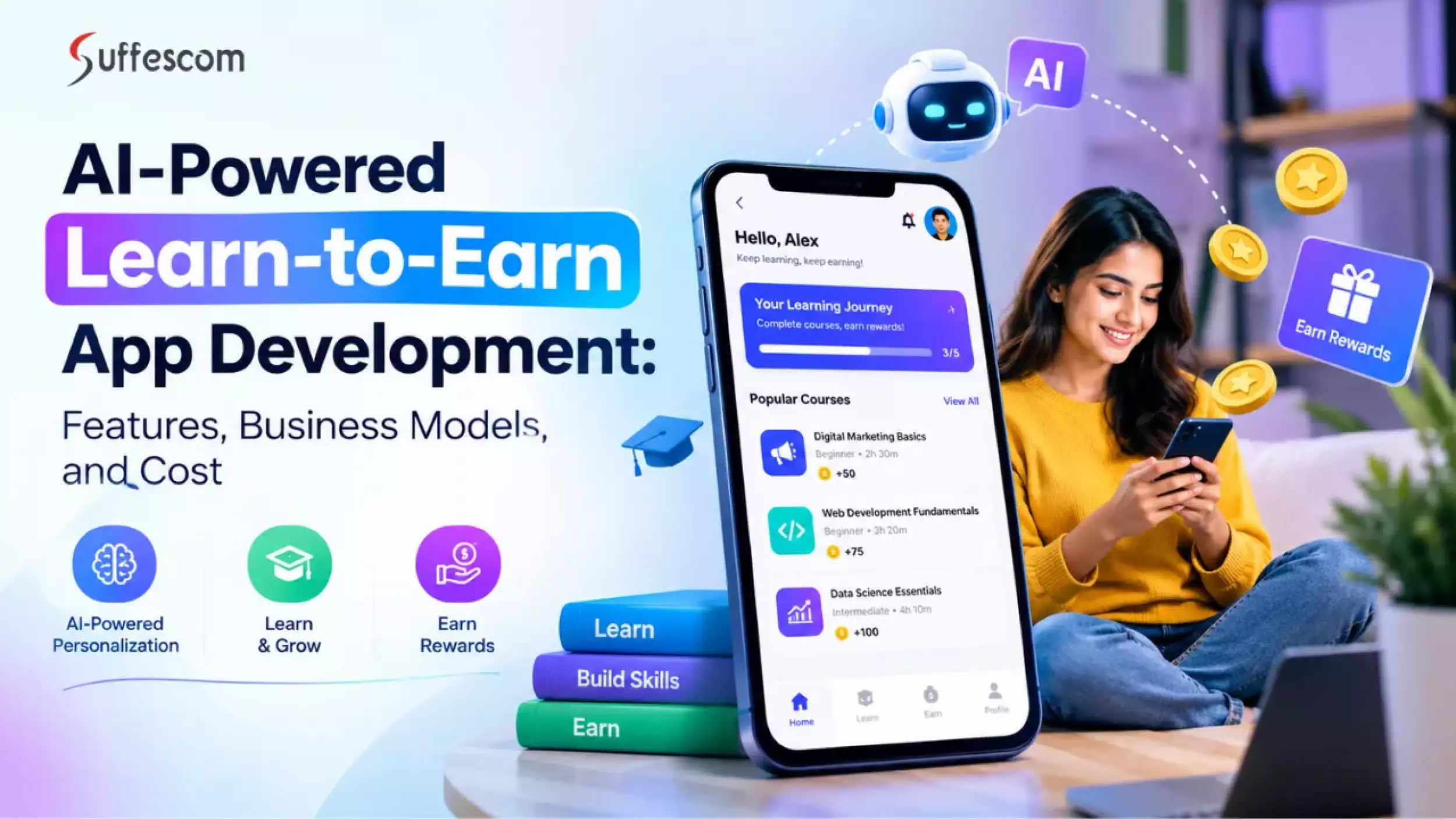
- AI-powered learn-to-earn app development combines personalized learning, interactive assessments, progress tracking, and rewards tied to verified learning activities.
- An MVP should prioritize learning content, AI-assisted guidance, assessments, reward rules, learner dashboards, and secure reward tracking.
- AI can personalize learning paths, generate practice questions, and identify knowledge gaps, while backend rules validate reward eligibility and prevent manipulation.
- Development costs depend on AI complexity, learning management features, reward models, integrations, and infrastructure requirements.
- Businesses should evaluate AI accuracy, learner privacy, reward fraud, and recurring inference costs before scaling their platforms.
Introduction
Businesses are investing in digital learning to help employees and customers develop new skills, while AI is creating opportunities to make learning more personalized and accessible. The World Economic Forum's Future of Jobs Report 2025 estimates that 39% of workers' existing skills will be transformed or become outdated between 2025 and 2030.
This creates an opportunity for businesses to build learning platforms that encourage participation while helping users demonstrate measurable progress. Learn-to-earn applications connect educational activities with incentives such as points, badges, certificates, discounts, or premium access. Artificial intelligence can strengthen this model through personalized learning paths, AI-assisted tutoring, adaptive assessments, and progress-based recommendations.
However, building an effective platform requires more than combining a chatbot with a reward system. The application needs structured learning content, reliable assessment workflows, transparent reward rules, secure data management, and analytics that help administrators measure outcomes.
AI-powered learn-to-earn app development brings these capabilities together in a platform designed around learning outcomes and meaningful incentives. This guide covers the essential features, business models, AI architecture, development process, technical challenges, and estimated costs involved in building such an application.
How an AI-Powered Learn-to-Earn App Works
A learn-to-earn application connects educational activities with a system that records progress and awards incentives when learners meet predefined criteria. AI can personalize the learning experience, while the application backend manages authoritative progress and reward records.
A typical workflow follows these steps:
- Learner onboarding: Users create an account, select their learning goals, and provide relevant information about their interests, experience, or skill level.
- Learning path generation: The platform recommends courses, lessons, or practice activities based on learner preferences and available performance data.
- Content delivery: Learners access videos, interactive lessons, reading materials, simulations, or instructor-led sessions.
- AI-assisted learning: An AI tutor explains concepts, answers questions using approved learning materials, or provides additional practice.
- Assessment and progress validation: The system evaluates quiz results, assignment completion, or other defined learning milestones.
- Reward eligibility verification: Backend rules validate the activity against the reward policy, including completion requirements, attempt limits, and fraud-prevention checks.
- Reward allocation: Eligible learners receive the applicable points, badges, certificates, discounts, or other benefits.
- Progress monitoring: Learners review their achievements, while administrators use analytics to understand engagement, performance, and course completion.
For example, a professional training platform could recommend a cybersecurity module based on a learner's assessment results. After the learner completes the lessons and passes a required assessment, the backend verifies the result and awards points that can be redeemed for an eligible course or certification discount.
The important distinction is that AI can guide learning, but reward eligibility should follow transparent, verifiable rules. This separation makes the system easier to audit and reduces the risk of incorrect or manipulated rewards.
Learn-to-Earn App Business Models
The business model determines how the platform earns revenue, who funds the rewards, and which learning activities qualify for incentives. It also influences the application's feature set and operational costs.
1. Subscription-Based Learning
Businesses offer monthly or annual subscriptions that provide access to courses, personalized learning paths, assessments, AI tutoring, or advanced analytics.
A free tier can introduce learners to the platform, while paid plans unlock premium content, additional AI assistance, or specialized learning programs.
Best suited for: Professional development platforms, skill-building applications, language learning products, and continuous education services.
2. Corporate Learning and Enterprise Licensing
Organizations pay to provide employees with structured training, skill assessments, learning dashboards, and incentive programs. An AI-powered LMS for corporate training can support personalized learning paths, employee skill development, and training progress tracking.
For example, an enterprise could reward employees for completing compliance training, passing product knowledge assessments, or demonstrating proficiency in specific skills.
Revenue may come from per-user licenses, annual contracts, or organization-wide subscriptions. Enterprise requirements may include single sign-on, role-based access, learning management system integrations, reporting, and administrative controls.
3. Sponsored Courses and Brand Partnerships
Companies, institutions, or industry organizations sponsor learning programs relevant to their products, services, or professional domains.
A sponsor might fund a course and offer discounts or other benefits to learners who complete the required modules. The platform can generate revenue through sponsorship agreements, campaign fees, or approved partner offers.
Sponsored rewards should be clearly disclosed, and recommendations should remain relevant to the learner's needs.
4. Paid Certifications and Assessments
The platform provides free or incentivized learning content while charging for formal assessments, verified certificates, advanced examinations, or professional credentials.
For example, learners might earn points through practice activities and then purchase an independently administered certification exam.
The application should distinguish participation badges from credentials that represent verified competence. Certificate claims should reflect the actual assessment and verification process.
5. Freemium and Premium AI Features
The platform provides basic learning tools for free and charges for advanced capabilities, such as extended AI tutoring, personalized study plans, additional practice assessments, or detailed performance analytics.
Because AI usage creates recurring costs, premium features should have clear usage limits or pricing rules where appropriate. Businesses should monitor whether the revenue generated by these features covers inference, storage, and support expenses.
6. Institutional and Education Partnerships
Training providers, universities, nonprofits, and other educational organizations may license the platform or pay to deliver learning programs to defined audiences.
This model can support cohort-based learning, instructor-led programs, sponsored access, and institution-specific reporting.
For organizations building a broader learning product, education app development provides a relevant starting point for considering the underlying educational application requirements. A learn-to-earn implementation adds the reward logic, eligibility checks, and incentive analytics required by its business model.
Essential Features of an AI-Powered Learn-to-Earn App
Feature planning should begin with the learning journey and reward mechanism. AI features should address specific learning needs rather than being added simply to label the application as AI-powered.
1. User Registration and Learner Profiles
Learner profiles help the platform maintain progress, preferences, achievements, and relevant learning history.
Core capabilities include:
- Email, phone, or supported social sign-in
- User profiles and learning preferences
- Skill levels and learning goals
- Course enrollment and learning history
- Achievement and reward history
- Account settings and privacy preferences
For enterprise platforms, access management may also include organization accounts, team assignments, single sign-on, and role-based permissions.
Personalization should rely only on the data required for the learning experience. Users should be able to understand how their information is used and manage applicable privacy preferences.
2. Course and Learning Content Management
The platform needs a structured way to create, organize, publish, and update learning materials.
Useful features include:
- Courses, modules, lessons, and learning paths
- Video, audio, text, and interactive content
- Quizzes and assignment creation
- Prerequisites and course completion rules
- Instructor and administrator tools
- Content versioning and publication controls
Content management should also track which material a learner has completed and which version of a lesson or assessment was used. This is important when course requirements or reward eligibility rules change.
Businesses with more complex learning requirements can explore e-learning software development when evaluating course delivery, learner management, and intelligent learning capabilities.
3. AI-Personalized Learning Paths
A personalized learning engine recommends content according to learner goals, previous performance, knowledge gaps, and course prerequisites.
For example, if a learner repeatedly struggles with a particular concept, the system can recommend a simpler explanation, a revision lesson, or additional practice questions before progressing to advanced material.
Key capabilities include:
- Personalized lesson recommendations
- Adaptive learning sequences
- Difficulty adjustment based on assessment results
- Recommendations for revision and practice
- Skill-gap identification
- Progress-aware learning suggestions
The system can begin with rule-based recommendations and gradually incorporate machine learning when sufficient data is available. This approach can make an MVP easier to build and evaluate before introducing more complex personalization models.
4. AI Tutor and Learning Assistant
An AI tutor helps learners understand material without requiring an instructor to answer every routine question.
Potential capabilities include:
- Natural-language explanations
- Follow-up questions and concept clarification
- Step-by-step hints
- Summaries of approved learning content
- Practice questions and revision assistance
- Recommendations for relevant lessons
The tutor should use appropriate course materials as its reference source when answering curriculum-specific questions. Retrieval-augmented generation (RAG) can help retrieve relevant passages from approved content before the language model generates a response.
The interface should also communicate uncertainty when the system cannot find a reliable answer. AI-generated explanations should not be treated as verified educational facts without appropriate evaluation.
5. Adaptive Quizzes and Assessments
Assessments help the platform determine whether learners have understood the material and whether they meet reward requirements.
Features may include:
- Multiple-choice and short-answer questions
- Timed quizzes and practice tests
- Difficulty adjustment
- Explanations for incorrect answers
- Assessment history and score tracking
- Configurable pass marks and attempt limits
- Instructor-reviewed assignments where required
AI can help generate draft questions, provide formative feedback, or recommend practice activities. However, high-stakes assessments require stronger validation, appropriate human oversight, and safeguards against answer leakage or inconsistent grading.
For reward eligibility, the application should record the assessment result and the rules used to evaluate it. AI-generated feedback alone should not automatically establish that a learner has met a formal competency requirement.
6. Points, Badges, Certificates, and Reward Management
The reward engine connects learning achievements with incentives. Its rules should be clear enough for learners to understand and administrators to audit.
Possible reward mechanisms include:
- Points for completing eligible learning activities
- Badges for defined milestones
- Certificates for meeting course or assessment requirements
- Discounts or coupons
- Premium content access
- Sponsor-funded benefits
- Approved redemption options
Administrators should be able to define which activities qualify, how rewards are calculated, and whether limits apply.
For example, a platform might award points for completing a lesson and passing a quiz, while limiting repeated rewards for the same activity. The backend should validate each qualifying event before issuing the reward and retain a transaction record for audit and dispute resolution.
7. Progress Tracking and Learning Analytics
Learners need a clear view of their progress, while administrators need insight into platform performance.
Learner-facing features may include:
- Completed and remaining lessons
- Assessment scores and skill progress
- Earned points and badges
- Available rewards and redemption history
- Learning streaks and milestones
- Recommended next activities
Administrative analytics can track enrollment, completion rates, assessment performance, learner retention, reward redemption, and course engagement.
AI-assisted analytics may identify patterns associated with disengagement or repeated learning difficulties. These signals should guide investigation rather than be treated as definitive judgments about an individual learner's ability or motivation.
8. Notifications and Reminders
Notifications help learners return to unfinished activities and stay informed about relevant milestones.
Examples include:
- Reminders for incomplete lessons
- Notifications about new learning content
- Assessment and course completion updates
- Reward eligibility and redemption confirmations
- Upcoming course deadlines
- Relevant learning recommendations
Notification rules should avoid excessive messaging. Frequency controls, user preferences, and appropriate consent mechanisms help keep reminders useful.
9. Admin and Instructor Dashboard
Administrators and instructors need tools to manage content, users, rewards, and learning outcomes.
Essential capabilities include:
- Course and content management
- Learner and cohort management
- Assessment configuration
- Reward rules and eligibility settings
- Reward issuance and redemption records
- AI usage and quality monitoring
- Learning analytics and reporting
- Role-based access control
The dashboard should make it possible to review disputed rewards, investigate suspicious activity, correct errors through authorized workflows, and maintain an auditable record of important changes.
AI Technologies and Architecture for Learn-to-Earn Apps
The technology architecture determines how learning content, AI services, assessments, reward rules, and analytics work together. The most suitable design depends on the platform's size, data requirements, expected usage, and existing systems.
1. Large Language Models and Retrieval-Augmented Generation
Large language models can power conversational tutoring, explanations, summaries, and natural-language assistance.
However, a general-purpose model may produce inaccurate answers or introduce information that is not present in the course materials. RAG can reduce this risk by retrieving relevant content from an approved knowledge base before generating a response.
A typical workflow includes:
- The learner submits a question.
- The application authenticates the user and checks access permissions.
- The retrieval layer searches approved course content.
- Relevant passages are passed to the language model.
- The model generates an answer based on the retrieved context.
- The application applies appropriate output checks and returns the response.
The platform should evaluate answer accuracy, source relevance, refusal behavior, latency, and cost. RAG can improve grounding, but it does not guarantee correctness.
2. Recommendation and Personalization Systems
Recommendation systems help select the next lesson, practice activity, or course that best fits a learner's needs.
Early implementations may use straightforward rules, such as recommending revision after a low assessment score or requiring prerequisite lessons before advanced content. More mature systems can incorporate machine learning to identify patterns across course interactions and assessment history.
Possible inputs include:
- Learner-selected goals
- Course prerequisites
- Assessment outcomes
- Completed learning activities
- Explicit content preferences
- Relevant historical engagement data
Recommendations should be explainable enough for administrators to review and should avoid unfairly restricting learning opportunities based on incomplete or biased data.
3. AI-Assisted Assessment and Content Generation
AI can assist educators by drafting quiz questions, creating practice variations, summarizing learning material, and providing formative feedback.
A responsible implementation should include content review, answer validation, difficulty calibration, and version control. If AI-generated questions contribute to formal assessments, they should be tested against the learning objectives before use.
Where grades determine certificates, professional eligibility, or valuable rewards, businesses should use a defined evaluation process with human oversight when appropriate.
4. Reward Engine and Verification Layer
The reward engine should be implemented as a controlled backend service rather than relying on AI to decide when a user deserves a reward.
Its responsibilities may include:
- Validating completed learning activities
- Checking assessment scores and eligibility requirements
- Applying reward caps and attempt limits
- Preventing duplicate reward transactions
- Recording issuance and redemption events
- Supporting authorized reversals and corrections
- Maintaining an auditable reward ledger
AI may help identify suspicious patterns, but the final reward transaction should follow explicit application rules. This makes reward allocation more consistent and easier to investigate.
5. Example System Architecture
A typical logical architecture may follow this structure:
Learner app or web portal
- Registration and learner profiles
- Course player and interactive lessons
- AI tutor interface
- Assessments and progress dashboard
- Reward wallet or points display
↓
Application backend and API layer
- Authentication and authorization
- Course and content services
- Learning progress service
- Assessment service
- Reward engine
- Notification service
↓
AI and data services
- Language model and RAG pipeline
- Content retrieval and indexing
- Recommendation service
- Assessment assistance
- Analytics and anomaly detection
↓
Data and infrastructure layer
- Relational database for users, courses, assessments, and reward records
- Object storage for learning media and supporting files
- Cache for appropriate frequently accessed data
- Queue or event-processing infrastructure for asynchronous tasks
- Logging, monitoring, and security controls
The AI services and application backend should have clearly defined interfaces. Reward transactions and assessment records should not depend solely on the successful completion of an AI request.
6. Recommended Technology Stack
| Layer | Possible Technologies | Purpose |
| Mobile application | Swift, Kotlin, Flutter, React Native | iOS and Android learner experiences |
| Web application | React, Next.js, or another suitable framework | Browser-based learning and administration |
| Backend | Node.js, Python, Java, or .NET | APIs, business rules, identity, and application workflows |
| AI and machine learning | Hosted language models, Python-based ML frameworks, embedding models | Tutoring, recommendations, and learning analytics |
| Data storage | PostgreSQL, MySQL, object storage, and Redis where appropriate | Learning records, reward transactions, content, and caching |
| AI retrieval | Vector search or hybrid search over approved learning content | Context retrieval for AI-assisted answers |
| Infrastructure | AWS, Azure, Google Cloud, or another suitable provider | Hosting, storage, security, scaling, and operations |
| Monitoring | Application logs, metrics, tracing, and AI evaluation tools | Reliability, cost tracking, and quality assurance |
These are possible technologies rather than a mandatory combination. Selection should account for the team's expertise, existing systems, security requirements, integration needs, and expected operating costs.
How to Build an AI-Powered Learn-to-Earn App: Step-by-Step
A structured development process helps businesses validate their reward model, establish the right AI capabilities, and avoid investing in complex features before the core learning experience works.
Step 1: Define the Audience and Learning Outcomes
Identify who the platform serves and what users should achieve through it.
The target audience could include employees completing professional training, learners developing new skills, customers learning how to use a product, or students participating in structured learning programs.
Define measurable learning outcomes, the types of activities users will complete, and the evidence required to demonstrate progress. These decisions will influence the assessment model and reward eligibility rules.
Step 2: Design the Business and Reward Model
Determine how the platform will generate revenue and how rewards will be funded.
Define:
- Eligible learning activities
- Assessment and completion criteria
- Points or reward calculation rules
- Redemption options and restrictions
- Sponsor or employer responsibilities
- Limits on repeated rewards
- Processes for failed, disputed, or reversed transactions
Reward economics should be sustainable. Estimate the cost of incentives and administration against subscription revenue, sponsorship funding, enterprise contracts, or other applicable revenue sources.
Step 3: Define the MVP Scope
Prioritize the minimum features needed to deliver a complete learning-to-reward journey.
A practical MVP may include:
- Learner registration and profiles
- Course and lesson management
- Basic AI-assisted tutoring
- Quizzes and assessments
- Rule-based points and badges
- Progress tracking
- An administrative dashboard
- Reward history and basic analytics
Advanced recommendation models, automated content creation, complex integrations, and extensive reward marketplaces can be introduced after the core workflows have been tested.
Step 4: Design the User Experience
Map the learner journey from registration through course discovery, lesson completion, assessment, and reward redemption.
The interface should make it clear what learners need to do to qualify for a reward, what progress they have made, and why a reward has or has not been issued.
Administrative interfaces should also support content review, reward configuration, suspicious-activity investigation, and correction workflows.
Step 5: Select the AI Approach and Technology Stack
Choose the appropriate models, retrieval methods, recommendation logic, application framework, databases, and infrastructure.
For an MVP, a hosted language model combined with approved course content and rule-based recommendations may be sufficient. A custom machine learning model should be considered when the use case, data availability, performance requirements, and expected return justify the additional effort.
Define AI evaluation criteria before launch, including accuracy, latency, cost per interaction, and handling of unsupported questions.
Step 6: Develop the Application and Backend
Build the learner interface, course management features, APIs, data models, authentication, and administrative dashboard.
Implement explicit state transitions for course completion, assessment results, reward issuance, and redemption. Apply role-based permissions and validate important actions on the server.
Step 7: Integrate AI, Assessments, and Rewards
Connect the AI services with course content and learning workflows. Implement retrieval, personalized recommendations, assessment evaluation, and any required content-generation features.
Integrate the reward engine with verified application events. Use transaction-safe updates and idempotency controls to prevent duplicate rewards when requests are retried.
Test how the platform handles incomplete activities, failed AI requests, assessment retakes, suspicious behavior, and reward reversals.
Step 8: Test Security, Accuracy, and Performance
Testing should cover both conventional application functionality and AI-specific risks.
Key test areas include:
- Authentication and role permissions
- Learning progress and assessment correctness
- Reward eligibility and duplicate prevention
- AI answer accuracy and content grounding
- Prompt injection and unauthorized data access
- Privacy and sensitive information handling
- Concurrent users and infrastructure load
- AI latency, token usage, and recurring costs
- Accessibility and device compatibility
Where rewards have material financial or professional value, the platform should undergo stronger validation of assessment integrity and reward controls.
Step 9: Deploy, Monitor, and Improve
Deploy the platform with appropriate logging, alerting, backups, access controls, and incident-response procedures.
Monitor course completion, assessment outcomes, reward issuance, suspicious activity, AI quality, and infrastructure expenses.
Use these measurements to refine the experience after launch. Improvements may include better recommendations, clearer learning content, revised reward rules, additional courses, or more efficient AI workflows.
Technical Challenges and How to Solve Them
AI-powered learn-to-earn applications combine educational content, generated responses, assessment workflows, and reward transactions. The following challenges should be addressed during design and testing.
1. Inaccurate AI-Generated Learning Content
The challenge: An AI tutor may provide incorrect explanations, misinterpret course material, or generate misleading quiz questions. This can affect learning outcomes and undermine confidence in the platform.
How to solve it:
- Ground curriculum-specific answers in approved content using RAG where suitable.
- Establish clear instructions and response boundaries for AI services.
- Evaluate outputs against representative questions and learning objectives.
- Use human review for high-impact content and formal assessments.
- Provide a way to report incorrect responses and improve the content pipeline.
AI output should be treated as generated content requiring evaluation, not as an automatically authoritative educational source.
2. Reward Manipulation and Fraudulent Activity
The challenge: Users may attempt to exploit repeated quiz submissions, scripted interactions, duplicate accounts, or weaknesses in the reward rules to earn benefits without meeting the intended learning requirements.
How to solve it:
- Validate learning events and reward eligibility on the server.
- Apply idempotency and transaction-safe reward processing.
- Set appropriate attempt limits and cooldowns.
- Monitor unusual activity patterns and repeated reward claims.
- Apply rate limits and account verification where justified by risk.
- Provide audit trails and authorized review procedures.
AI-based anomaly detection can help identify patterns that deserve investigation, but it should not be the only control. Transparent rules and secure backend enforcement remain essential.
3. Personalizing Learning at Scale
The challenge: Personalization can increase processing demands, particularly when the platform generates AI responses or recommendations for many concurrent learners.
How to solve it:
- Start with simpler rules and introduce more complex models when justified.
- Cache suitable results and frequently used content.
- Process non-urgent analytics asynchronously.
- Set request limits and timeouts for AI services.
- Monitor response latency, error rates, and usage costs.
- Evaluate smaller or more cost-effective models for routine tasks.
Not every learner action requires an AI call. Deterministic logic is often faster, cheaper, and easier to audit for straightforward decisions.
4. Protecting Learner Data and Privacy
The challenge: Learning histories, assessment results, user profiles, and AI conversations can contain sensitive information. Poorly designed integrations may expose data to unauthorized users or external services.
How to solve it:
- Collect only the information needed for defined purposes.
- Enforce authentication and role-based access controls.
- Encrypt data in transit and at rest where appropriate.
- Review data retention and deletion policies.
- Check how AI providers handle submitted data and retention.
- Prevent sensitive information from being unnecessarily included in prompts or logs.
- Assess applicable privacy and education-related requirements for the target market.
Security and privacy controls should be built into the architecture rather than added only before launch.
5. Controlling AI and Infrastructure Costs
The challenge: AI usage can create variable operating expenses as the number of learners, tutoring sessions, generated questions, and processed documents increases.
How to solve it:
- Estimate expected usage per learner and per course.
- Track token consumption and cost per AI-assisted activity.
- Apply reasonable usage limits and rate controls.
- Use retrieval and caching where they reduce repeated work.
- Choose model sizes based on task complexity.
- Monitor video, storage, database, and analytics expenses alongside AI costs.
Cost optimization should not compromise educational accuracy or expose users to unpredictable limits without clear communication.
Security, Privacy, and Reward-Fraud Prevention
An AI-powered learn-to-earn app must protect learner data and ensure rewards are issued fairly. Key safeguards include:
- Data privacy: Encrypt sensitive data, apply role-based access controls, and limit the personal information shared with third-party AI services.
- Reward validation: Verify quiz results, course completion, and reward eligibility on the server rather than relying on client-side events.
- Fraud prevention: Use rate limits, duplicate-event protection, activity monitoring, and audit logs to detect reward abuse.
- Responsible AI: Review AI-generated learning content for accuracy and use anomaly detection to flag suspicious activity for further review.
These controls help maintain learner trust, protect sensitive information, and keep reward distribution reliable.
How Much Does AI-Powered Learn-to-Earn App Development Cost?
Development cost depends on the platform's feature scope, AI capabilities, reward mechanics, integrations, security requirements, and supported devices.
The following figures are illustrative USD planning estimates, not verified market averages or an official Suffescom quotation. They assume custom application development and should be validated against the project's requirements and current delivery rates.
| Development Scope | Estimated Cost | Illustrative Timeline |
| Basic MVP with rule-based rewards and limited AI features | $25,000–$50,000 | 3–5 months |
| Mid-level platform with AI tutoring, assessments, and personalized recommendations | $50,000–$100,000 | 4–7 months |
| Advanced platform with enterprise dashboards, integrations, and expanded AI workflows | $100,000–$200,000+ | 6–10+ months |
| Enterprise platform with advanced analytics, complex integrations, and custom AI components | $200,000–$350,000+ | 9–12+ months |
These ranges are intended for initial budgeting. Actual timelines and prices depend on the number of platforms, team composition, third-party dependencies, content requirements, and quality assurance scope.
Factors That Influence Development Cost
1. Application platforms: Supporting web, iOS, and Android may require additional implementation, testing, and maintenance. Cross-platform frameworks can reduce duplicated work in some projects but do not eliminate platform-specific requirements.
2. AI complexity: A basic integration with a hosted language model generally has a different cost profile from custom recommendation models, extensive retrieval pipelines, AI evaluation systems, and advanced analytics.
3. Learning management functionality: Course authoring, content versioning, instructor workflows, prerequisites, and assessment management affect development scope.
4. Reward and redemption logic: Simple points and badges are less complex than sponsor-funded benefits, discounts, complex eligibility rules, redemption workflows, and enterprise reward programs.
5. Integrations: Single sign-on, learning management systems, customer relationship management tools, payment services, enterprise systems, and external content platforms add implementation and testing work.
6. Security and governance: Access controls, privacy features, audit logs, AI safety evaluation, and formal security testing contribute to project cost.
7. Data and infrastructure requirements: Content storage, analytics pipelines, model inference, monitoring, and concurrent usage affect both development and operating expenses.
How to Monetize an AI-Powered Learn-to-Earn App
The most suitable monetization model depends on the target audience, the value of the learning experience, and who funds the rewards.
1. Freemium Subscriptions
Offer free access to basic lessons and learning tools, with paid plans for advanced courses, additional AI tutoring, personalized study plans, or detailed analytics.
The platform should monitor subscription conversion, retention, and AI usage to ensure that premium features remain commercially sustainable.
2. Enterprise Training Licenses
Sell access to organizations that need employee onboarding, compliance training, product education, or professional development.
Revenue can come from per-seat licenses, annual subscriptions, or enterprise agreements. Reward programs may be funded by the employer and tied to verified training milestones.
3. Sponsored Learning Programs
Allow approved organizations to sponsor courses or learning campaigns. Sponsors may pay for program delivery, relevant learner engagement, or agreed campaign outcomes.
The platform should clearly identify sponsored content and ensure that incentives do not misrepresent course quality or learner achievement.
4. Paid Certifications and Premium Assessments
Offer advanced examinations, verified certificates, or specialized learning programs for a fee. Free learning activities can introduce users to the platform, while premium offerings provide a path to deeper engagement.
Certification claims should accurately represent the assessment process and any formal recognition attached to the credential.
5. Institutional Partnerships
Partner with educational institutions, training providers, professional associations, or nonprofits to deliver learning programs to specific audiences.
Partnerships may provide licensing revenue, funded learner access, or recurring program contracts. The platform may require organization-level administration, cohort management, reporting, and integration with existing learning systems.
6. Premium AI Learning Features
Charge for advanced AI tutoring, additional practice sessions, personalized feedback, or specialized learning assistants.
This model should account for the marginal cost of AI usage. Rate limits, fair-use policies, and clear subscription terms can help businesses manage expenses while maintaining a useful learning experience.
Why Choose Suffescom for AI-Powered Learn-to-Earn App Development?
Building an AI-powered learn-to-earn platform requires coordinated application engineering, AI integration, learning workflows, reward validation, analytics, and security controls. The right implementation depends on how the business intends to deliver learning, measure progress, and fund incentives.
Suffescom Solutions provides mobile app and software development services for businesses planning custom digital products. For a learn-to-earn project, the development scope can be organized around the core learner experience, AI-assisted learning features, verified assessment workflows, and a reward system aligned with the business model.
When evaluating a development partner, businesses should consider its ability to:
- Build learner-facing applications and administrative dashboards
- Integrate AI tutoring, content retrieval, and personalization capabilities
- Implement secure assessment and reward workflows
- Connect existing learning systems and third-party services
- Test AI quality, application performance, and reward integrity
- Support deployment, monitoring, maintenance, and future enhancements
Suffescom's AI development services are relevant starting points for businesses evaluating AI capabilities for a learning platform. The appropriate approach should be based on the actual use case, available data, product requirements, and expected operating costs—not on adding AI features without a clear purpose.
Planning an AI-powered learn-to-earn platform? Define the learning outcomes, reward model, AI requirements, and MVP scope first. These decisions provide a clearer foundation for estimating development costs and selecting an architecture that can evolve with the product.
Frequently Asked Questions
1. How much does AI-powered learn-to-earn app development cost?
AI-powered learn-to-earn app development may cost approximately $25,000–$50,000 for a basic MVP, $50,000–$100,000 for a platform with AI tutoring and personalized recommendations, and $100,000–$200,000 or more for advanced platforms with enterprise integrations. These are illustrative planning estimates; the actual cost depends on the feature scope, AI architecture, reward rules, integrations, and infrastructure requirements.
2. How long does it take to develop a learn-to-earn app?
A basic MVP may take around 3–5 months, while a feature-rich platform may require 4–7 months. Enterprise platforms with advanced AI workflows, complex integrations, and extensive testing may take 9–12 months or longer. Timelines depend on team size, content readiness, technical complexity, and approval cycles.
3. How is AI used in a learn-to-earn app?
AI can recommend personalized learning paths, power conversational tutors, generate practice questions, explain concepts, identify knowledge gaps, and analyze learning progress. The selected capabilities should address specific learner needs and be evaluated for accuracy, privacy, latency, and operating cost.
4. How do learn-to-earn apps reward users?
These applications can award points, badges, certificates, discounts, premium content access, or other eligible benefits. Reward rules should define qualifying activities, assessment thresholds, attempt limits, and redemption conditions. The backend should validate learning events before issuing rewards.
6. How can a learn-to-earn app prevent reward fraud?
The application should validate completed lessons and assessment results on the server, prevent duplicate reward transactions, apply appropriate attempt limits, and monitor suspicious activity. AI-based anomaly detection can help flag unusual patterns, but transparent eligibility rules and secure backend validation should remain the primary controls.
7. Which AI technologies are suitable for learn-to-earn app development?
Suitable technologies may include large language models for tutoring, retrieval-augmented generation for answers grounded in approved learning materials, recommendation systems for personalized learning, and analytics models for identifying performance patterns. The right combination depends on the use case, available data, accuracy requirements, and budget.
8. How can a learn-to-earn app generate revenue?
Common revenue models include subscriptions, enterprise training licenses, sponsored learning programs, paid certifications, institutional partnerships, and premium AI learning features. The platform should account for reward expenses, AI usage, content management, infrastructure, and customer support when evaluating profitability.
9. What should businesses prioritize when building an AI-powered learn-to-earn app?
Businesses should first define their target audience, learning outcomes, reward model, and revenue strategy. The MVP should establish a complete learning-to-reward journey, with reliable assessments, transparent eligibility rules, appropriate AI safeguards, and analytics. More advanced personalization and automation can be introduced after the core experience has been validated.