
Cross-border payment providers are evaluating stablecoin infrastructure to change how they manage international settlement, liquidity allocation, and payment processing.
For MTOs, banks, PSPs & neobanks, building a stablecoin-based remittance platform requires more than token integration. It involves connecting blockchain networks with fiat payment rails, institutional wallets, FX providers, liquidity sources, along with regulatory controls.
However, the development approach varies as per the business model. A financial institution issuing its own fiat-backed stablecoin has different infrastructure requirements from a payment provider integrating an existing stablecoin for cross-border settlement.
This guide covers how to build & launch a stablecoin remittance platform, including its technology, financial integrations, compliance, security, and development costs.
Move Your Payment Operations Beyond Traditional Banking Delays!
Understanding a Stablecoin Remittance Platform
A remittance platform that uses stablecoins (such as USDT, USDC, EURC & XSGD) to process cross-border transactions. These are pegged to fiat currencies and transfer digital value across supported blockchain networks.
The platform integrates blockchain networks, digital wallets, smart contracts, along with payment services to facilitate fund transfers. It can also include fiat-to-stablecoin conversion, stablecoin transfers, as well as stablecoin-to-fiat payouts.
Businesses use these platforms to support international payments, B2B settlements, global payroll, and remittance services. Transaction speed, costs, and availability depend on the blockchain network, payment providers, liquidity, and regulatory requirements.
Why Are Financial Businesses Adopting Stablecoin-Based Remittance Infrastructure?
Unlike traditional cross-border payment infrastructure, stablecoins introduce a blockchain-based settlement asset that is transferred between compatible wallets without requiring every movement of value to pass through the same correspondent banking chain. Businesses use this settlement layer alongside their existing banking as well as payment relationships.
The decision to adopt stablecoin infrastructure generally consists of the following business requirements:
Reduce Dependence on Correspondent Banking Chains
A stablecoin-based settlement model allows participating institutions to transfer supported digital assets directly between designated wallets. This overcomes the number of intermediary settlement stages involved in the digital asset movement.
However, it does not eliminate the need for banking relationships. Businesses still require suitable fiat collection, conversion, redemption & payout arrangements.
Establish More Flexible Settlement Operations
Blockchain settlement introduces another operating model in which transactions are submitted and confirmed independently of conventional banking hours, subject to network availability along with the platform's confirmation policy. For PSPs & neobanks, this creates an opportunity to coordinate digital asset settlement separately from fiat payment processing.
The development requirement is to connect blockchain confirmation events with the institution's internal ledger as well as settlement workflows. Without this integration, an on-chain transfer may be recorded as complete while the corresponding financial obligation remains unresolved.
Improve Liquidity Allocation Across Payment Corridors
Stablecoin infrastructure introduces an additional mechanism for holding as well as transferring settlement assets between participating entities. A financial institution can evaluate whether stablecoin-based treasury transfers can reduce certain prefunding requirements or improve the allocation of available capital across supported corridors.
The actual benefit depends on destination-side redemption access, local currency liquidity, banking partnerships, along with the cost of converting between fiat & digital assets.
Integrate Programmable Settlement Into Existing Payment Products
Stablecoin transactions can interact with smart contracts & API-driven payment workflows. For instance, a PSP can develop a settlement engine that releases a payment instruction after predefined verification conditions are satisfied. A financial institution can also use smart contracts to enforce transaction limits, authorized wallet permissions, or settlement-specific rules.
These capabilities require careful integration with the institution's existing approval systems, accounting records, and regulatory controls.
Types of Stablecoins to Build Based on Their Pegging Mechanisms
Stablecoins are categorized into the following four categories based on the assets or mechanisms used to maintain their value:
Fiat-Backed Stablecoins
These maintain a 1:1 peg with a traditional currency, such as the US dollar or euro. Their issuers hold reserve assets, which may include cash, bank deposits & short-term government securities, to support the value of the tokens in circulation. For instance, USDC (USD Coin), USDT (Tether), and EURC.
How They Work:
- An authorized issuer receives fiat currency from a customer or institutional partner.
- The issuer issues the same amount of stablecoins in line with its policies of issuance & reserves.
- Businesses have the ability to transfer these tokens onto supported blockchain systems.
- Eligible holders can redeem tokens through the issuer or an authorized intermediary, subject to applicable terms & requirements.
Considerations for Stablecoin Adoption: Businesses must assess the issuer's reserve composition, redemption arrangements, banking relationships, regulatory status, along with supported blockchain networks. Dependence on the issuer & its banking partners also introduces counterparty and operational risks.
Crypto-Backed Stablecoins
Crypto-backed stablecoins use other digital assets as collateral to maintain their target value. Since the underlying cryptocurrencies experience significant price fluctuations, these systems generally require overcollateralization, meaning the value of deposited assets must exceed the value of stablecoins issued against them. Best examples include DAI (issued within the MakerDAO ecosystem).
How They Work:
- A user deposits eligible cryptocurrencies into a smart contract-based collateral system.
- The protocol permits stablecoins to be generated against the deposited collateral, subject to predefined collateralization requirements.
- Smart contracts monitor collateral values using price oracles.
- If collateral falls below the required threshold, liquidation mechanisms sell or otherwise dispose of the collateral to protect the system.
Key Business Considerations: Businesses must evaluate collateral volatility, liquidation thresholds, oracle reliability, smart contract security, as well as available market liquidity. Sudden declines in collateral value trigger liquidations while also affecting the stablecoin's peg.
Commodity-Backed Stablecoins
Commodity-backed stablecoins derive their value from physical assets such as gold. The issuer or an associated custodian holds the underlying commodity, while digital tokens represent contractual or beneficial claims linked to that asset, depending on the token's legal structure. Tether Gold (XAUt) & PAX Gold (PAXG) are the best examples.
How They Work:
- The issuer or custodian holds the underlying commodity.
- Tokens are issued according to the product's asset-backing and issuance arrangements.
- Token holders can transfer these digital assets across supported blockchain networks.
- Redemption for the underlying commodity may be available under specific eligibility, minimum quantity, and fee conditions.
Key Business Considerations: Businesses need to assess physical asset custody, independent reserve verification, legal ownership rights, redemption procedures, storage costs, as well as liquidity. These requirements differ from fiat-backed stablecoins and may make commodity-backed tokens less suitable for everyday fiat-denominated remittance settlement.
Algorithmic Stablecoins
These stablecoins use software-controlled mechanisms to maintain a target price rather than relying primarily on conventional fiat or commodity reserves. Under this model, these mechanisms adjust token supply, use incentive structures, or rely on relationships with other tokens to influence market prices. For instance, TerraUSD (UST) is a historical example that lost its peg in May 2022.
How They Work:
- Smart contracts implement predefined rules for managing token supply or market incentives.
- The protocol may mint or burn tokens in response to changes in market conditions.
- Some designs use a linked token or arbitrage mechanism to encourage the stablecoin to trade near its target value.
- Market participants respond to these incentives, influencing supply along with demand.
Key Business Considerations: Businesses must assess the stability mechanism, market liquidity, incentive sustainability, governance controls & stress performance. If market confidence declines or the supporting mechanism fails, the stablecoin may experience a severe depegging event.
How a Stablecoin Remittance Platform Works: Step-by-Step Technical Flow
A stablecoin remittance platform facilitates cross-border payments by using digital assets such as USDC or USDT as settlement instruments. It integrates fiat payment rails, liquidity providers, blockchain networks, as well as local payout partners to enable international fund transfers. Below is the completed working model of a stablecoin-based remittance platform:
Payment Initiation:
- A business or PSP initiates a cross-border payment through the stablecoin remittance API or dashboard.
- The request consists of sender details, beneficiary details, source currency, destination currency & transfer amount.
- The platform validates the payment request and generates a transaction ID.
Compliance and Transaction Verification:
- The compliance engine performs KYC/KYB, AML, sanctions, as well as transaction screening based on the platform's regulatory & partner requirements.
- Sender and beneficiary details are verified.
- Transactions that fail compliance checks are rejected, held, or flagged for manual review.
Exchange Rate and Fee Calculation:
- The platform retrieves real-time exchange rates along with stablecoin liquidity quotes from integrated liquidity providers.
- It calculates the conversion rate, transaction fees, network fees, and final payout amount.
- The business receives a payment quote before execution.
Fiat-to-Stablecoin Conversion (OnRamp):
- The sender's fiat currency is collected through an integrated banking or payment partner.
- The onramp provider converts the fiat amount into a supported stablecoin, such as USDC or USDT.
- The stablecoins are credited to the platform's designated wallet or settlement wallet.
Blockchain Settlement:
- The platform initiates a blockchain transaction to transfer stablecoins to the recipient's digital wallet or a designated liquidity partner's wallet.
- The transaction is securely authorized and signed through wallet or custody infrastructure.
- The selected blockchain network broadcasts, processes, and validates the transaction.
- The platform monitors transaction status, tracks network confirmations, and verifies blockchain settlement once the required confirmation threshold is met.
- Upon successful settlement, the platform updates the transaction record and triggers the next step, such as liquidity processing or local fiat payout, depending on the remittance flow.
Stablecoin to Fiat Conversion (Off-Ramp):
- The receiving-side liquidity or off-ramp partner receives the stablecoins.
- The partner converts the stablecoin amount into the destination fiat currency.
- The converted funds are made available for local payout.
Local Currency Payout:
- The payout partner transfers the destination currency to the beneficiary's bank account or supported payment network.
- Depending on the destination market, payouts may be processed through local rails such as UPI, IMPS, ACH, or SEPA.
- The platform receives payout confirmation from the integrated partner.
Reconciliation and Transaction Reporting:
- The platform updates the transaction status across its internal ledger.
- It reconciles fiat collection records, stablecoin transfers, conversion records, fees, as well as payout confirmations.
- Businesses access transaction history, settlement records, fees, along with payment reports through APIs or dashboards.
Make Cross-Border Payments Work Smarter with Stablecoins!
Technical Architecture of a Stablecoin Remittance Platform
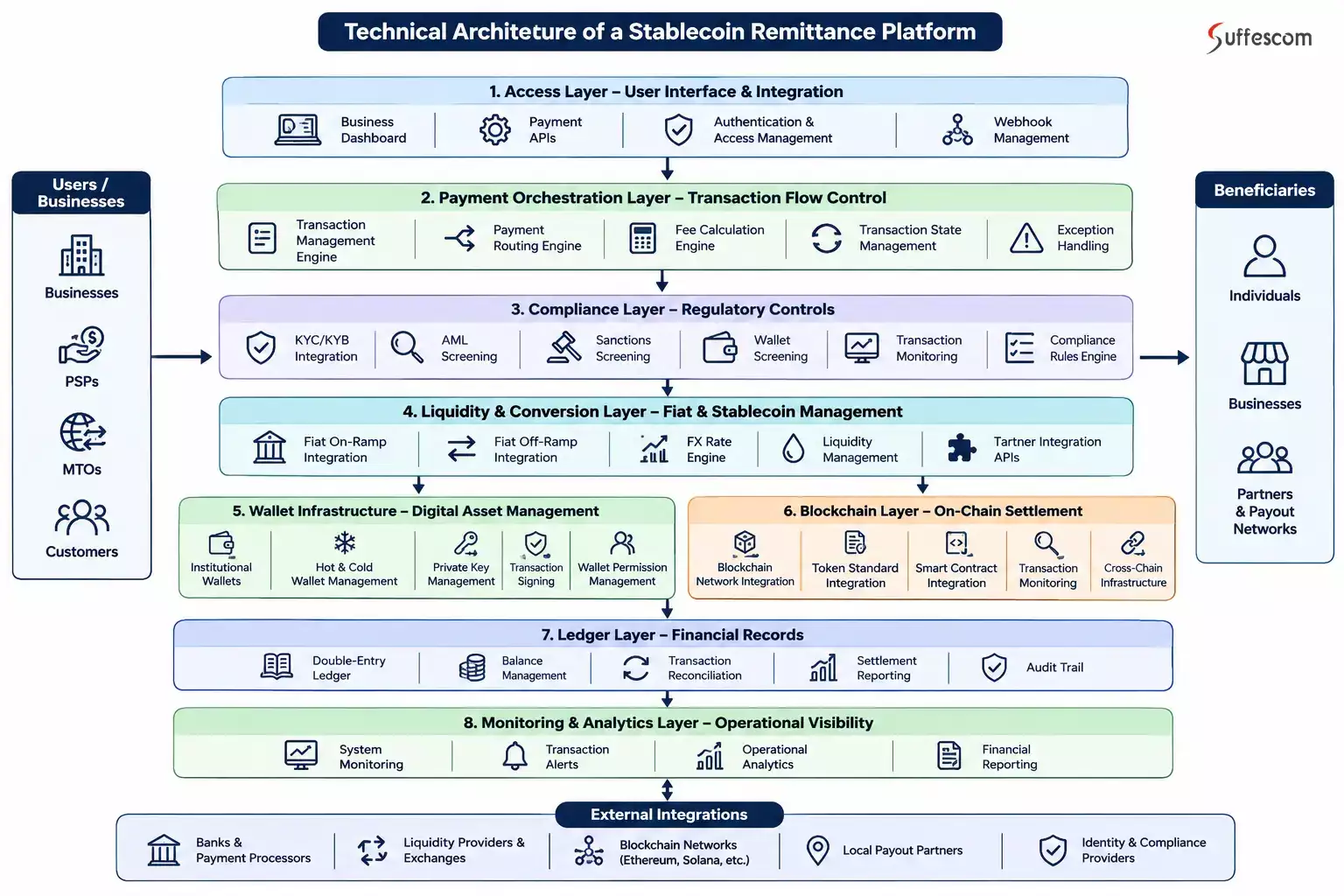
A stablecoin remittance platform comes with a multi-layer architecture that handles specific operational functions, while APIs connect the platform to external financial institutions, liquidity providers, as well as blockchain networks:
Application and API Layer
This layer provides the interface through which businesses, payment service providers (PSPs), money transfer operators (MTOs) & their customers can initiate and manage cross-border transactions. It has the following components:
- Business Dashboard: Provides access to payment initiation, transaction history, settlement status, account balances, as well as reporting.
- Payment APIs: Allow external applications and financial platforms to submit payment requests, retrieve transaction details & receive payment status updates.
- Authentication and Access Management: Implements API authentication, role-based access control, authorization, along with request validation.
- Webhook Management: Sends transaction updates to integrated systems when payment requests, blockchain transfers, or beneficiary payouts change status.
Payment Orchestration Layer
This layer coordinates the full transaction lifecycle across fiat payment systems, stablecoin infrastructure & local payout networks.
- Transaction Management Engine: Creates transaction records, assigns unique identifiers, while also manages payment states throughout the transfer lifecycle.
- Payment Routing Engine: Selects suitable payment partners, blockchain networks & payout channels based on destination, currency, availability and transaction requirements.
- Fee Calculation Engine: Calculates platform charges, network fees, conversion costs as well as applicable partner fees.
- Transaction State Management: Tracks payment progress across collection, conversion, blockchain settlement, along with final payout.
- Exception Handling: Manages failed transfers, delayed confirmations, rejected payouts, duplicate requests, and transaction reversals where supported.
Compliance and Risk Management Layer
Applies financial compliance controls before and during payment processing. It links the platform with identity verification providers, transaction monitoring systems & sanctions screening services. It’s main components are:
- KYC/KYB Integration: Verifies individual customers and business entities according to applicable onboarding requirements.
- AML Screening: Screens transactions and customer activity against applicable anti-money laundering requirements.
- Sanctions Screening: Checks relevant individuals, businesses and transactions against applicable sanctions lists.
- Wallet Screening: Evaluates blockchain wallet addresses for exposure to sanctioned entities and other identified financial crime risks.
- Transaction Monitoring: Identifies unusual transaction patterns, suspicious activity & transfers requiring additional review.
- Compliance Rules Engine: Applies transaction limits, jurisdictional restrictions, risk thresholds, and approval requirements.
Overall, the compliance layer should connect with payment orchestration so that transactions requiring additional verification are held before settlement or payout.
Fiat Payment & Liquidity Integration Layer
This layer connects the remittance platform to traditional financial infrastructure and digital asset liquidity providers. It manages conversions between source fiat currencies, stablecoins & destination currencies. Its components consist of:
- Fiat On-Ramp Integration: Connects with banking partners as well as payment processors to collect funds from senders and convert eligible fiat balances into stablecoins.
- Fiat Off-Ramp Integration: Links with digital asset exchanges, liquidity providers, or payment partners to convert stablecoins into destination fiat currencies.
- FX Rate Engine: Retrieves exchange rate quotes for supported currency pairs & calculates the applicable conversion rate.
- Liquidity Management: Monitors available stablecoin, along with fiat balances across payment corridors, to support transaction execution.
- Partner Integration APIs: Connects with banks, payment gateways, exchanges, as well as local payout providers to coordinate fund transfers.
For businesses operating across numerous remittance corridors, this layer must also account for partner availability, conversion costs, liquidity requirements, as well as destination-country payout capabilities.
Wallet and Custody Infrastructure
The wallet infrastructure manages stablecoin balances, transaction authorization, along with the movement of digital assets across supported blockchain networks. Its primary infrastructure elements are:
- Institutional Wallets: Maintain stablecoin balances utilized for operational payments & settlement.
- Hot & Cold Wallet Management: Separates frequently used operational funds from assets held in offline storage, according to the custody model.
- Private Key Management: Uses secure key management systems, such as HSMs or MPC-based infrastructure, to protect cryptographic signing credentials.
- Transaction Signing: Authorizes blockchain transactions through controlled signing policies and approval workflows.
- Wallet Permission Management: Defines authorized users, wallet permissions, transaction limits, along with administrative controls.
For institutional remittance operations, wallet infrastructure should also support transaction monitoring, balance tracking, and controlled access to settlement funds. When managing multiple stablecoins across different blockchain networks, businesses can build a multi-currency wallet to organize and manage their digital asset holdings within a unified wallet system.
Blockchain & Smart Contract Layer
This layer handles not only stablecoin transfers but also on-chain settlement between participating wallets. Its implementation depends on the selected blockchain network, based on whether the platform uses an existing stablecoin or issues its own. Core elements are:
- Blockchain Network Integration: Connects with supported networks such as Ethereum, Solana, or Polygon through RPC providers or blockchain infrastructure services.
- Token Standard Integration: Supports the token standards used by the selected stablecoins, such as ERC-20 on Ethereum-compatible networks.
- Smart Contract Integration: Interacts with token contracts to execute transfers, check balances & retrieve transaction events.
- Transaction Monitoring: Tracks transaction hashes, network confirmations, gas fees, as well as settlement status.
- Cross-Chain Infrastructure: Supports transfers between different blockchain networks when the business model requires it, using appropriate interoperability or bridging mechanisms.
If the business issues its own fiat-backed stablecoin, this layer additionally requires token minting along with burning contracts, supply controls, administrative permissions & reserve management mechanisms.
Internal Ledger and Reconciliation Layer
Maintains the platform's financial records while also making sure that fiat movements, stablecoin transfers, fees, and beneficiary payouts are accounted for consistently.
- Double-Entry Ledger: Records debit & credit entries for sender funds, platform balances, partner accounts, fees, along with settlement obligations.
- Balance Management: Keeps records of available, pending, reserved, as well as settled balances across relevant currencies and accounts.
- Transaction Reconciliation: Matches internal ledger entries with banking records, blockchain transactions, exchange conversions & payout confirmations.
- Settlement Reporting: Generates transaction-level and corridor-level settlement records for financial operations.
- Audit Trail: Maintains timestamped records of payment instructions, balance changes, approvals, along with transaction status updates.
The ledger must distinguish between on-chain transaction confirmation & completion of the corresponding fiat payout. A blockchain transfer alone does not establish that the beneficiary has received the funds.
Monitoring and Reporting Layer
This layer provides operational visibility across the platform and its external integrations. It consists of:
- System Monitoring: Tracks API availability, blockchain connectivity, transaction processing, and partner integration health.
- Transaction Alerts: Generates alerts for failed transfers, delayed confirmations, unusual activity, as well as reconciliation mismatches.
- Operational Analytics: Offers insights into transaction volumes, processing times, fees & payment corridor performance.
- Financial Reporting: Produces settlement summaries, transaction statements, along with reconciliation reports for business operations.
This layer confers end-to-end operational visibility, from transaction initiation to final settlement and reconciliation.
Must-Have Core Features of a Stablecoin Remittance Platform
The following are the core features that make a stablecoin remittance platform ideal for cross-border payments:
Remittance Corridor Management
- Corridor Configuration: Configure payment routes such as USD-to-EUR with supported currencies, stablecoins, blockchain networks, liquidity providers, payout partners, transaction limits & settlement rules.
- Currency and Network Mapping: Map each fiat currency to eligible stablecoins & blockchain networks. For example, configure USDC on an approved network for a specific payment route.
- Country-Specific Payment Rules: Set destination-specific transaction limits, beneficiary requirements, payout methods, along with compliance checks under applicable local regulations.
Stablecoin Wallet and Custody Management
- Business Wallet Creation: Create dedicated blockchain wallets to hold, receive, as well as transfer stablecoins. Assign separate wallets to operational funds, treasury reserves & settlement activities.
- Deposit Address Management: Generate unique deposit addresses for business accounts or incoming transfers. Validate the address format, along with the selected blockchain, before accepting deposits.
- Private Key Management: Integrate MPC wallet infrastructure or Hardware Security Modules (HSMs) to protect private keys & authorize blockchain transactions without exposing sensitive signing credentials.
- Wallet Balance Tracking: Retrieve on-chain balances through blockchain nodes or RPC providers. Also maintain separate records for available, pending, and reserved funds.
- Transaction Approval: Apply multi-level authorization policies based on transaction value, wallet permissions, as well as user roles before signing and broadcasting transfers.
Stablecoin Transaction Processing
- Payment Initiation: Accept remittance instructions through APIs or the business dashboard, such as sender details, beneficiary information, transfer amount, destination currency & payout instructions.
- Transaction Validation: Verify wallet addresses, token contract addresses, network compatibility, available balances, transaction limits, and approval status before creating a blockchain transaction.
- Blockchain Transaction Execution: Not only prepare the transaction payload, calculate the required network fee, obtain the authorized wallet signature, but also broadcast the transaction to the selected blockchain.
- Transaction Confirmation: Retrieve the transaction hash & monitor block confirmations or network finality status before updating the payment record.
- Failed Transaction Management: Capture reverted transactions, insufficient gas errors, rejected transfers, as well as network timeouts. Maintain the failure reason & transaction reference for investigation and eligible retry operations.
Fiat On-Ramp and Off-Ramp Integration
- Fiat On-Ramp: Integrate banking partners, exchanges, or regulated conversion providers to receive fiat funds also convert them into supported stablecoins. Record the deposit reference and resulting token credit.
- Fiat Off-Ramp: Connect exchanges or liquidity providers to convert incoming stablecoins into the beneficiary's local currency before initiating payout.
- Banking API Integration: Connect bank APIs or payment processors to manage fiat deposits, withdrawals, account verification, along with payment status updates.
- Local Payout Integration: Incorporate destination-country banks & payment networks to deliver converted funds through supported rails, such as ACH, wire transfers, or local bank transfer systems where available.
- Provider Settlement Tracking: Store provider references, conversion amounts, fees, along with settlement confirmations against the original remittance ID.
FX Rate and Fee Management
- FX Rate Integration: Retrieve currency exchange rates from connected liquidity providers or exchanges to calculate the conversion value for each remittance corridor.
- Rate Locking: Secure a quoted exchange rate for a defined validity period. If the transfer is not executed before expiry, retrieve a new quote before processing.
- Fee Configuration: Configure platform fees, FX margins, blockchain network charges, as well as payout partner fees separately for each corridor or transaction type.
- Recipient Payout Calculation: Calculate the beneficiary's expected payout after applying the quoted FX rate and relevant deductions before the sender confirms the transfer.
- Quote Expiry Management: Track quote validity & prevent payment execution against expired rates without revalidation.
API and Webhook Integration
- Payment APIs: Allow partner fintech applications & business systems to create remittance requests, retrieve quotes, initiate payments, and check transfer statuses.
- Wallet APIs: Stablecoin-based remittance API integration provides controlled endpoints for wallet creation, deposit address retrieval, balance checks, as well as authorized stablecoin transfers.
- FX and Conversion APIs: Permit external applications to retrieve exchange rates, calculate payout amounts, and request conversion operations.
- Webhook Notifications: Send event-based updates to connected systems when a transfer is initiated, confirmed, settled, rejected, or flagged for compliance review.
- API Authentication & Security: Use OAuth 2.0, scoped API credentials, request-signature verification, along with rate limits to control access to financial operations.
KYC, KYB, and AML Compliance
- Customer Identity Verification (KYC): Incorporate identity verification services to validate individual customers through government-issued identification, document checks, as well as required verification methods.
- Business Verification (KYB): Collect & verify company registration details, beneficial ownership information, business addresses, along with authorized representatives.
- Sanctions and PEP Screening: Screen customers, beneficiaries & relevant business entities against applicable sanctions lists and politically exposed person databases.
- AML Transaction Monitoring: Evaluate transaction amounts, frequency, account activity, as well as payment patterns against configured risk rules to identify potentially suspicious transfers.
- Blockchain Address Screening: Integrate blockchain analytics services to assess wallet exposure to sanctioned addresses, illicit funds & other high-risk entities.
- Compliance Case Management: Route flagged payments to compliance reviewers with screening results, transaction details, investigation notes, along with approval records.
Internal Ledger and Financial Reconciliation
- Double-Entry Ledger: Record each financial movement through corresponding debit & credit entries across customer balances, operating accounts, fees, along with settlement accounts.
- Transaction State Management: Maintain payment lifecycle records covering initiated, pending, processing, settled, failed & reversed states.
- Blockchain Balance Reconciliation: Compare internal wallet records with on-chain balances to identify missing credits, unrecorded transfers, as well as balance differences.
- Bank and Provider Reconciliation: Match bank statements, exchange reports & payout partner records against internal transaction entries using payment references, amounts, and settlement dates.
- Fee & Adjustment Records: Maintain separate entries for FX margins, conversion charges, network fees, partner deductions, and approved financial adjustments.
Business Dashboard and Transaction Management
- Transaction Overview: Permits evaluation of transfer volumes, settlement values, transaction statuses, fees, and corridor-level payment activity.
- Transaction Search: Retrieve payment records using remittance IDs, wallet addresses, customer details, beneficiary information, transaction hashes & processing dates.
- Operational Alerts: Generate alerts for failed transfers, delayed blockchain confirmations, insufficient wallet balances, along with unavailable financial integrations.
- Role-Based Access Control: Assign specific permissions to treasury, finance, compliance & operations teams to view records, approve transfers, and manage platform settings.
- Audit Logs: Record user actions, payment approvals, wallet operations, as well as configuration changes with timestamps and user references.
Advanced Capabilities That Set a Stablecoin Remittance Platform Apart in the Market
The following smart capabilities make a stablecoin remittance platform a dependable, scalable infrastructure partner for businesses, built to support growth, reduce operational friction, and meet enterprise expectations.
Intelligent Routing and Liquidity Optimization
- Dynamic Route Optimization: Compare liquidity providers, blockchain networks & payout partners in real time based on transaction costs, processing speed, along with success rates.
- Automatic Provider Failover: Automatically redirect transactions to backup liquidity providers or payout partners when the primary provider becomes unavailable or fails to meet defined performance thresholds.
- Direct Issuer Mint and Redeem: Integrate directly with stablecoin issuers to mint tokens against fiat deposits & redeem tokens for fiat currency. This decreases reliance on exchange-based conversions and can minimize trading spreads & slippage for high-volume corridors.
- Cross-Stablecoin and Cross-Chain Conversion: Convert between supported stablecoins or transfer value across blockchain networks within a single payment workflow.
- Internal Netting: Offset opposing payment obligations across customers or corridors before initiating blockchain or bank transfers. This overcomes external settlement volume along with the liquidity required to process net payment obligations.
Treasury and Risk Management
- Automated Liquidity Rebalancing: Automatically move funds between treasury wallets, bank accounts & liquidity pools when balances fall below predefined thresholds to maintain sufficient funds for corridor payouts.
- Liquidity Forecasting: Calculate future funding requirements for each corridor using transaction history, pending transfers & expected payouts to determine when and where liquidity needs replenishment.
- Stablecoin Depeg Monitoring: Track stablecoin prices against their reference currencies, along with trigger predefined actions, such as suspending transactions or switching to another supported stablecoin, when the peg deviates beyond set limits.
- FX Exposure and Hedging Controls: Track currency exposure between transaction quotation as well as settlement, and apply automatic conversions or predefined hedging rules to manage exchange-rate fluctuations.
- Provider Risk Scoring: Evaluate liquidity providers, banks & payout partners based on transaction success rates, settlement delays, pricing, liquidity availability, and uptime to support provider selection and routing decisions.
Payout and Recipient Experience
- Beneficiary Account Validation: Verify beneficiary account details, including account names and numbers, against available bank or wallet validation services before initiating payouts. This helps prevent misdirected payments, returned transfers, and correction costs.
- Scheduled and Recurring Payments: Configure payments to execute at predefined intervals or business events, such as payroll dates and supplier payment cycles. This automates repeat payment workflows without requiring a new manual initiation for every transaction.
- Automated Refund and Return Handling: Automatically process failed or returned payouts by reversing the corresponding transaction in the original currency or asset and recording matching ledger entries. This streamlines payment reconciliation and reduces manual resolution efforts.
- Gas Fee Abstraction: Manage blockchain transaction fees through a centralized gas payment mechanism, allowing senders and payment partners to transact without holding native network tokens. This simplifies payment execution and prevents failures caused by insufficient gas balances.
- Payment Status Normalization: Map transaction statuses from different payment providers, banking networks, and blockchains into a standardized status framework. This provides consistent payment tracking, API responses, and reporting across integrations.
Platform and Integration Capabilities
- Multi-Tenant & Sub-Account Structure: Create separate accounts for partner fintechs with independent customers, transaction limits, fee structures, and branding under one platform.
- Virtual Accounts for Inbound Funds: Generate unique virtual account details or payment references to identify incoming fiat payments as well as automatically allocate them to the correct customer or invoice.
- Idempotent and Retry-Safe APIs: Use unique idempotency keys to prevent duplicate payment creation when API requests are repeated due to timeouts or failed responses.
- ERP & Accounting Integration: Synchronize transaction records, processing fees, along with settlement data with accounting and ERP systems such as NetSuite, QuickBooks & SAP.
- Corridor and Cost Analytics: Track transaction costs, success rates, settlement times, along with margins by corridor, payment provider, and transaction route.
- Sandbox with Failure Simulation: Test payment workflows by simulating transaction failures, reversals, settlement delays, compliance holds & provider outages before deploying to production.
Security and Resilience
- Anomaly Detection with Auto-Hold: Detect transactions that deviate from established account behavior, such as unusual amounts, frequencies, or destinations & automatically hold them for review.
- Address Allowlisting with Time Delays: Restrict withdrawals to pre-approved wallet addresses & enforce a waiting period before newly added addresses become eligible for transactions.
- Multi-Region Redundancy and Disaster Recovery: Run platform services across multiple geographic regions with defined RTOs & RPOs to maintain operations as well as recover data during regional outages.
- Security Framework Alignment (SOC 2 & ISO 27001): Establish and document security controls for access management, data protection, monitoring, along with incident response in line with SOC 2 and ISO 27001 requirements.
Move Beyond Conventional Cross-Border Payment Systems with Industry Experts!
Right Stablecoin Development Model for Remittance Businesses
Before beginning development, businesses must decide which model to pursue. This decision determines the further project requirements:
Develop a Proprietary Fiat-Backed Stablecoin
A financial institution or qualified issuer can develop its own fiat-backed stablecoin to represent a claim denominated in a specified currency. Developing this model requires the following elements:
- Token contract: Implement minting, burning, transfer permissions & administrative controls.
- Reserve management infrastructure: Connect token issuance records with reserve balances and custody information.
- Issuance authorization: Restrict minting operations to approved institutional roles, along with verified funding events.
- Redemption management: Establish workflows to accept tokens, validate redemption requests, as well as arrange fiat payments.
- Reserve reporting: Maintain records connecting outstanding token supply with eligible reserve assets.
- Issuer governance: Define operational responsibilities, approval hierarchies & emergency procedures.
A critical engineering requirement is not only maintaining consistency between the token supply but also the issuer's reserve records. It’s best fit for businesses planning to operate a proprietary settlement asset, subject to the necessary regulatory authorization.
Integrate Existing Stablecoins Into the Remittance Infrastructure
Businesses that do not intend to become stablecoin issuers can integrate existing assets such as USDC or USDT into their payment infrastructure. Under this approach, the development team not only builds the software but also integrates the layer required to support stablecoin transactions. It consists of:
- Integrating supported token contracts and blockchain networks
- Establishing institutional wallet infrastructure
- Connecting regulated exchanges and liquidity providers
- Integrating fiat onramp and offramp services
- Implementing transaction verification and reconciliation
- Configuring wallet screening and payment monitoring
- Managing network-specific transaction fees & confirmation policies
This methodology permits an MTO, PSP, or neobank to introduce stablecoin settlement without developing a new token or taking on the issuer's responsibilities. However, the business must assess the selected stablecoin’s issuer, redemption terms, liquidity, supported jurisdictions & network-specific availability.
Hybrid Stablecoin Payment Infrastructure
A hybrid model combines established stablecoins with proprietary payment orchestration and financial infrastructure. For instance, a remittance operator integrates USDC for blockchain settlement while developing its own institutional wallets, treasury dashboard, FX engine, and payment routing system. The major components:
- Existing stablecoin integration for settlement
- Proprietary wallet and custody management
- Internal ledger and transaction reconciliation
- Multiple banking and payout integrations
- Automated liquidity allocation
- Business-specific compliance and transaction controls
This model is particularly relevant to established financial businesses that want control over their payment infrastructure without issuing or maintaining a new stablecoin.
Building a Stablecoin Remittance Platform: Step-by-Step Process
As a reliable stablecoin development company, we help financial businesses build stablecoin infrastructure that makes day-to-day cross-border transactions more efficient & cost-effective.
Step 1. Define the Business Model and Remittance Corridors
Firstly, establish the platform's operating model, target markets, as well as supported remittance corridors, such as USD-to-INR or USD-to-EUR. The requirements for each corridor include:
- Payment Collection: Supported banking channels, payment gateways & collection partners.
- Stablecoin Selection: Supported assets and blockchain networks.
- Conversion Providers: Fiat-to-stablecoin and stablecoin-to-fiat providers.
- Liquidity Sources: Available liquidity, conversion limits & settlement currencies.
- Payout Methods: Bank transfers, mobile wallets, and local payout partners.
- Commercial Rules: Transaction limits, exchange-rate spreads, fees, and settlement expectations.
- Regulatory Requirements: Applicable licensing, KYC/KYB, AML, and reporting obligations.
These requirements establish the integrations and transaction workflows needed for each corridor.
Step 2. Select Stablecoins and Blockchain Networks
Stablecoin & blockchain selection depends on asset reliability, liquidity, transaction costs, along with availability across target markets. The assessment consists of:
- Stablecoin Credibility: Issuer reputation, reserve transparency & redemption arrangements.
- Transaction Fees: Estimated network costs at expected transaction volumes.
- Settlement Finality: Confirmation requirements before considering an on-chain transfer settled.
- Network Compatibility: Native stablecoin support & token contract verification.
- Liquidity Availability: Access to exchanges, market makers, along with off-ramp providers.
- Network Reliability: RPC availability, congestion, transaction processing capacity.
The selected asset-network combinations support the complete remittance process, such as conversion & recipient payout.
Step 3. Design the Platform Architecture
The architecture defines how different financial and blockchain components communicate and exchange transaction data. The following are the important elements:
| Component | Technical responsibility |
| Customer Management | Sender, beneficiary, and business account records. |
| Transaction Engine | Payment orchestration and transaction state management. |
| Wallet Management | Wallet creation, balances, and transaction authorization. |
| Blockchain Integration | Transaction submission and confirmation monitoring. |
| Conversion and Liquidity | Exchange quotes, conversions, and liquidity records. |
| Compliance Engine | Identity verification, screening, and transaction monitoring. |
| Financial Ledger | Double-entry accounting and financial records. |
| Reconciliation Engine | Matching ledger, blockchain, and provider records. |
The architecture also defines API contracts, database structures, event handling, authentication, encryption, along with recovery mechanisms. The system maintains separate transaction states for fiat collection, blockchain settlement, as well as beneficiary payout.
Step 4. Develop Wallet and Blockchain Integrations
At this point, the key implementation areas consist of:
- Wallet Creation: Generate or assign wallet addresses for supported accounts & networks.
- Key Management: Integrate MPC or HSM-based security for private-key protection and transaction signing.
- Balance Monitoring: Track incoming as well as outgoing stablecoin transactions.
- Gas Management: Estimate network fees & maintain sufficient native-token balances.
- Transaction Execution: Sign and broadcast stablecoin transfers through blockchain nodes or RPC services.
- Confirmation Tracking: Monitor transaction hashes, block confirmations, along with settlement finality.
- Failure Handling: Manage stuck transactions, nonce conflicts, and failed submissions.
Verify wallet addresses & token contracts to avoid transfers to unsupported networks or assets.
Step 5. Integrate Fiat On-Ramp, Off-Ramp, and Payout Providers
Financial integrations connect the blockchain infrastructure with traditional payment systems.
- Fiat On-Ramp: Integrate banking APIs, payment gateways, or regulated providers to collect sender funds along with initiating stablecoin conversion.
- Fiat Off-Ramp: Connect exchanges or liquidity providers to obtain conversion quotes & execute stablecoin-to-fiat transactions.
- Payout Integration: Connect local payment partners to distribute converted funds to beneficiary bank accounts or mobile wallets.
Each integration requires API authentication, request validation, idempotency, webhook verification, provider transaction references, as well as error handling. These mechanisms help maintain consistent transaction records across external systems.
Step 6. Implement Compliance and Risk Controls
Compliance controls are integrated into customer onboarding and payment processing workflows. The platform requires:
- KYC/KYB Verification: Verifying identities and businesses.
- Sanctions Screening: Screening customers, beneficiaries & relevant counterparties.
- Wallet Screening: Checking blockchain addresses for exposure to sanctioned entities as well as suspicious activity.
- Transaction Monitoring: Detecting unusual transfer amounts, frequency, velocity & payment patterns.
- Risk-Based Limits: Applying transaction thresholds and account restrictions.
- Manual Review: Routing flagged transactions for compliance investigation & approval.
Audit records maintain screening results, risk decisions, timestamps, as well as reviewer actions.
Step 7. Build the Transaction Engine & Financial Ledger
The transaction engine coordinates the complete remittance lifecycle through a state-based workflow. The transaction stages consist of payment initiation, fiat collection, stablecoin conversion, blockchain submission, confirmation, off-ramping, beneficiary payout & completion. Each stage maintains its own status while also processing records.
Furthermore, the financial ledger uses double-entry accounting to record:
- Fiat deposits and customer fund liabilities
- Stablecoin purchases and wallet movements
- Conversion amounts, exchange rates, and spreads
- Blockchain and provider fees
- Payout obligations and completed disbursements
- Refunds, reversals, and settlement adjustments
Transaction IDs & blockchain references link ledger entries to payment events, making sure failed payouts are not marked as completed.
Step 8. Develop Business APIs and Administrative Dashboard
The stablecoin remittance development solutions provide APIs & administrative interfaces for business clients along with internal operations.
Business APIs consist of:
- Transfer initiation and transaction status retrieval
- Beneficiary registration and management
- Exchange-rate and conversion quote retrieval
- Payment notifications through webhooks
The administrative dashboard includes:
- Transaction search and monitoring
- Wallet balances and blockchain activity
- Corridor and payment provider configurations
- Liquidity and conversion records
- Compliance reviews and flagged transactions
- Reconciliation exceptions and financial reports
Role-based access controls and approval workflows restrict sensitive financial as well as administrative operations.
Step 9. Test the Platform and Financial Integrations
Once development of the stablecoin remittance platform is completed, the QA team takes over & tests individual components and the full remittance lifecycle across blockchain networks & financial providers. During testing, experts perform:
- Functional Testing: Onboarding, transfers, conversion & payouts.
- API Testing: Authentication, request validation, and webhooks.
- Blockchain Testing: Wallet operations, signing, fees, along with confirmations.
- Integration Testing: Banking, liquidity, exchange, and payout connections.
- Security Testing: Key management, encryption, access controls & penetration testing.
- Compliance Testing: KYC/KYB, sanctions screening, and transaction monitoring.
- Ledger Testing: Double-entry records, balances & fee calculations.
- Reconciliation Testing: Matching the ledger, blockchain, and provider records.
- Recovery Testing: Duplicate requests, timeouts, network failures & failed payouts.
Step 10. Deploy and Monitor the Platform
After testing, deploy the platform to the selected app stores and supported backend infrastructure. Post-deployment monitoring should track:
- Blockchain connectivity & confirmation delays
- Fiat collection and payout success rates
- Liquidity availability across remittance corridors
- Provider API performance and failures
- Transaction processing errors
- Reconciliation mismatches
- Compliance alerts and system availability
Ongoing maintenance keeps the platform up to date through blockchain network updates, third-party API changes, security patches, as well as infrastructure adjustments as transaction volumes & supported corridors expand.
Advanced Tech-Stack: The Backbone of Stablecoin Remittance Platform Development
The following are the top-rated technologies that are used to build robust & scalable stablecoin-based remittance platforms:
| Technologies | Tech Components |
| Blockchain and Smart Contract |
|
| Backend Development |
|
| Frontend Development |
|
| Mobile & Web |
|
| Database and Data Management |
|
| Wallet and Custody |
|
| Payment, Banking, and Stablecoin Integration |
|
| Messaging and Event Processing |
|
| Security and Compliance |
|
| Cloud Infrastructure and DevOps |
|
| KYC, KYT and Travel Rule |
|
Types of Blockchain Network Considerations and Stablecoin Standard with Technical Characteristics
Businesses should evaluate networks based on their intended settlement operations rather than selecting a blockchain solely because it advertises low transaction fees.
Evaluate Blockchain Networks for Institutional Settlement
The development team should assess the following technical characteristics before selecting a network:
- Transaction finality: Determine when a transaction is sufficiently irreversible for the platform's settlement policy.
- Network throughput: Evaluate the network's ability to handle the expected transaction volume and concurrent payment requests.
- Fee predictability: Assess transaction costs under normal and congested network conditions.
- Stablecoin availability: Verify whether the selected asset is natively supported on the network.
- Custody compatibility: Confirm that institutional wallet providers support the network and its token standards.
- Infrastructure availability: Evaluate RPC reliability, indexing services, monitoring tools, and node provider redundancy.
- Liquidity access: Verify the availability of exchanges and institutional conversion providers.
Compare Blockchain Networks
The following networks are suitable for stablecoin-based payment infrastructure.
| Blockchain | Technical characteristics | Development considerations |
| Ethereum | Established smart contract ecosystem and ERC20 token standard | Gas costs, confirmation policy, custody support & network congestion |
| Solana | High-throughput architecture and SPL token ecosystem | Transaction processing, RPC reliability, and token account management |
| Tron | TRC20 token ecosystem and established stablecoin usage | Resource management, bandwidth, energy & institutional support |
| Stellar | Payment-oriented architecture and asset issuance capabilities | Asset authorization, trustlines, anchors, and fiat integration |
| Polygon | EVM-compatible network and ERC-20 ecosystem | Bridge dependencies, token availability, and network-specific settlement policies |
The final selection should reflect the supported stablecoin, target corridors, institutional counterparties, along with available liquidity. For better understanding, an institution already operating ERC20-compatible custody infrastructure may find Ethereum or an EVM-compatible network easier to integrate than introducing an entirely different wallet and transaction-signing stack.
A payment provider prioritizing Stellar-based asset issuance may instead evaluate its asset authorization & anchor infrastructure.
Evaluate Stablecoin Standards and Network Compatibility
Stablecoin standards determine how tokens interact with blockchain applications and wallet infrastructure. For example:
- ERC20: A fungible token standard used across Ethereum & compatible networks.
- TRC20: A token standard used within the TRON ecosystem.
- SPL: Solana's token framework for fungible and other tokenized assets.
- Stellar issued assets: Assets issued through Stellar's native asset infrastructure, with authorization and trustline considerations.
The development team must verify the actual token contract or asset identifier rather than relying solely on the stablecoin's name. The same stablecoin brand may have different contract addresses across networks.
Therefore, a platform must maintain an approved asset registry containing the network identifier, contract address, decimal precision, issuer information, along with supported transaction rules.
Plan Cross-Chain Interoperability
Businesses supporting multiple blockchain networks need a defined approach to moving assets between them. Cross-chain interoperability can involve native issuer-supported transfers, authorized interoperability protocols, or third-party bridging mechanisms. Each method introduces different verification, custody & liquidity requirements. The architecture should also account for:
- Sourcechain transaction finality
- Destination chain asset verification
- Bridge contract permissions
- Liquidity availability
- Failed cross-chain messages
- Recovery and dispute procedures
Keep in mind that two tokens with the same ticker are interchangeable across networks. Thus, verify their issuance arrangements, redemption rights, and underlying contracts independently.
Join 50+ Financial Institutions Powering Their Remittances with Stablecoins
How to Generate Revenue with Your Stablecoin Remittance Platform?
A stablecoin remittance platform allows businesses to generate revenue in the following ways:
- Transaction Processing Fees: Charge customers a fixed fee or percentage of the transfer amount whenever they send money through your platform. Every successfully processed remittance generates fee revenue.
- Foreign Exchange (FX) Margins: Add a markup to the exchange rate offered to customers and earn the difference between the quoted rate as well as the rate received from liquidity providers.
- Withdrawal and Payout Fees: Charge recipients for withdrawing stablecoins into bank accounts, mobile wallets, or cash pickup services. You can generate income by collecting a service fee for facilitating the final payout through banking & payment partners.
- Business Subscription Plans: Offer monthly or annual subscription plans to businesses using your platform for recurring cross-border payments. Generate recurring revenue by providing tiered access to payment dashboards, bulk transfer capabilities, transaction reports & higher transaction limits.
- API Access and Integration Fees: Permit other fintech companies, payment providers, as well as businesses to connect with your remittance infrastructure through APIs. This way, you charge integration fees, monthly API access fees, or usage-based charges for processing transactions through your infrastructure.
- White-Label Platform Licensing: License your stablecoin remittance software to banks, MTOs & fintech companies that want to operate under their own brands. Generate revenue through one-time setup fees, recurring licensing charges, or transaction-based commissions.
- Merchant Payment Processing Fees: Permit recipients to use their stablecoin balances to pay participating merchants. Platform owners earn revenue by charging merchants a processing fee on each successfully completed payment processed through the platform.
Why Stablecoin-based Remittance Platform Development Matters
Explore the following use cases:
- Cross-Border Supplier Payments: Businesses face intermediary bank charges, FX conversion costs, as well as settlement delays when paying international suppliers. A stablecoin-based remittance platform enables cross-border supplier payments, with funds converted into the supplier's local currency through integrated payout partners.
- Global Payroll and Contractor Payments: Companies managing international teams deal with multiple banking arrangements, currency conversions & country-specific payout processes. With a stablecoin remittance wallet, businesses process bulk payroll and contractor payments through stablecoin transfers, with local currency disbursement where required.
- Remittance Partner Settlement: Money transfer operators rely on correspondent banks & prefunded accounts to settle balances with overseas agents and payout partners. Stablecoins facilitate inter-partner settlement through institutional wallets, with transaction tracking and reconciliation.
- International Merchant Settlements: Problem: Payment service providers and acquiring businesses face delays when settling cross-border merchant transactions through traditional banking networks. These platforms offer an alternative settlement route, allowing payment providers to transfer merchant funds and arrange local-currency payouts.
- Cross-Border Insurance Disbursements: Insurance companies handling international claims face banking delays, intermediary charges, as well as currency conversion requirements. However, with stablecoins, insurers can use stablecoins to transfer claim funds to international partners or eligible recipients, with local currency conversion through payout providers.
- Institutional Treasury & Liquidity Transfers: Banks, PSPs, and remittance operators maintain funds across multiple markets to meet settlement & payout obligations. Businesses move stablecoin liquidity between supported markets, monitor wallet balances, as well as convert funds to local currencies according to payout requirements.
Challenges for Businesses Building a Stablecoin Remittance Platform with Solutions
Building a stablecoin remittance platform consists of technical as well as operational challenges that businesses must address during the development process:
Challenge 1: Network traffic increases transaction confirmation times & gas fees, affecting transfer costs and settlement speed.
Solution: Engineers implement dynamic network routing using real-time gas fee estimates and blockchain congestion data to select the most suitable network for each transaction.
Challenge 2: Insufficient stablecoin or local currency liquidity can interrupt conversions and delay recipient payouts.
Solution: Integrate multiple liquidity providers with automated liquidity routing along with balance monitoring.
Challenge 3: Different networks use different token standards, address formats & transaction protocols, creating transfer compatibility issues.
Solution: Experts build chain-specific adapters and token validation mechanisms for each supported blockchain.
Challenge 4: Price differences between stablecoin conversion and fiat payout can create settlement discrepancies and reduce margins.
Solution: To resolve the issue, incorporate real-time FX feeds with rate-locking, along with automated conversion execution.
Challenge 5: Unauthorized access to wallet keys can expose platform funds to irreversible transfers.
Solution: Implement MPC-based wallet infrastructure, HSM-backed key storage, and multi-signature transaction authorization.
Challenge 6: Banking partner downtime, rejected transfers, and unsupported payment methods can interrupt final settlement.
Solution: To avoid such issues, use multiple payout APIs with automated provider routing & webhook-based status tracking.
Challenge 7: Repeated API requests or webhook events can trigger duplicate payment instructions and incorrect ledger entries.
Solution: Engineers implement idempotency keys, unique transaction references, as well as event deduplication to avoid duplicate payment instructions & incorrect ledger entries.
Challenge 8: Differences between blockchain records, conversion entries, and bank payout records can create settlement mismatches.
Solution: Incorporate automated reconciliation using blockchain transaction hashes, provider references, and a centralized transaction ledger.
Challenge 9: A stablecoin trading below its intended value can create conversion losses and settlement exposure.
Solution: Experts implement real-time peg monitoring with predefined deviation thresholds along with automated asset restrictions.
Challenge 10: Incorrect contract conditions or insufficient gas can cause transactions to revert or remain unprocessed.
Solution: Use automated contract testing, gas estimation, as well as audited contract deployment procedures.
Frequently Asked Questions:
How do businesses develop a stablecoin-based remittance platform?
The following is the best way to develop an effective stablecoin-based remittance platform:
- Define the settlement model
- Select an existing stablecoin or develop a proprietary token
- Design the required blockchain & payment architecture
Once this is done, evaluate the institutional wallets, payment orchestration, banking integrations, FX conversion, liquidity management, compliance, & reconciliation.
How quickly can I launch a stablecoin remittance platform?
Well, it depends on the development model you will choose:
- White-label stablecoin platform: 2 to 4 weeks
- MVP stablecoin remittance platform: 3 to 5 weeks
- Fully customized platform: 8 to 16 weeks
What APIs are required to develop a stablecoin remittance platform?
Typical integrations consist of:
- Banking APIs
- Fiat onramp
- Offramp APIs
- Exchange & liquidity provider APIs
- Blockchain RPC interfaces
- Custody services
- KYC/KYB systems
- Blockchain analytics tools
- Local payout provider APIs
How do stablecoin remittance platforms manage liquidity?
They combine wallet balance monitoring, liquidity provider integrations, FX pricing, prefunding arrangements, along with treasury management systems. The platform tracks available stablecoin & fiat balances across supported markets to determine whether it can execute a settlement instruction.
Which blockchain network best supports stablecoin remittance infrastructure?
Ethereum, Solana, Tron, Stellar & Polygon can be evaluated depending on token availability, settlement requirements, liquidity, transaction fees, custody compatibility, as well as institutional support. The appropriate choice depends on the business's intended payment corridors and existing infrastructure.
Can an existing banking system integrate with blockchain settlement infrastructure?
Of course! Businesses connect existing banking & payment systems through APIs, middleware, as well as payment orchestration services. This allows the institution to maintain its existing financial infrastructure while introducing blockchain-based settlement as an additional processing layer.
How much does it cost to build a stablecoin remittance platform?
The cost of developing a stablecoin remittance platform typically ranges from $20,000 to $100,000+ based on project requirements, including architecture, blockchain integration, smart contract development, fiat on/off-ramp integrations, compliance requirements, transaction management capabilities, and more. However, estimated costs may lie between:
- A basic-level platform cost: $20,000 to $40,000+
- Mid-level or MVP platform: $40,000 to $70,000+
- Fully Customized platform cost: $70,000 to $100,000+
What are the major risks of developing stablecoin remittance infrastructure?
Major risks may include:
- The shortage of liquidity
- Limited fiat conversion access
- Depegging of stablecoin
- Redemption interruptions,
- Blockchain network failures
- Custody vulnerabilities
- Regulatory differences & settlement reconciliation errors
These risks require separate technical, financial, as well as operational controls.
Can businesses support multiple stablecoins and blockchain networks?
Absolutely! The platform uses a modular blockchain integration layer and an approved asset registry to support several stablecoins & networks. However, each combination requires separate validation of token contracts, custody support, transaction rules, liquidity, as well as redemption arrangements.
How do businesses maintain compliance when integrating stablecoins?
Compliance workflows are configured to meet each jurisdiction's regulatory requirements, covering customer as well as business verification, AML transaction monitoring, sanctions screening, wallet risk assessment, applicable Travel Rule obligations & regulatory reporting. Stablecoin issuers must also comply with the relevant reserve management and redemption requirements.
How do you keep funds safe and prevent fraud?
Fund security is maintained through MPC-based wallet custody, role-based access controls & multi-level transaction approvals. Smart contracts undergo security audits before deployment, while regular penetration testing identifies vulnerabilities in platform updates. Additional safeguards, including wallet risk screening, configurable transfer limits & real-time fraud monitoring, help detect suspicious activity and prevent unauthorized transfers.
How long does it take to develop a stablecoin remittance platform?
It varies based on your project scope, selected blockchain networks, existing banking integrations, custody architecture, compliance requirements, and whether the business is issuing a proprietary stablecoin. A platform integrating an established asset generally has a different development scope from an institutional stablecoin issuance & settlement system.
Why should I choose Suffescom for stablecoin remittance platform development?
As a reliable blockchain development company, we combine our blockchain expertise with fintech development, smart contract engineering, multi-chain integration & secure payment architecture to help businesses build reliable stablecoin remittance platforms and streamline cross-border payment operations.