Key Takeaways:
- AI sports coach training app development combines personalized training plans, performance analytics, and AI-powered feedback to support athlete development.
- Essential features include computer vision, real-time coaching guidance, wearable integration, progress tracking, and coach management dashboards.
- The development process involves defining the target sport, selecting suitable AI technologies, building the app, integrating data sources, and testing AI recommendations.
- AI sports coach app development costs can start at $25,000 and exceed $300,000, depending on feature complexity, custom AI models, and third-party integrations.
- Subscription plans, premium coaching features, white-label solutions, and team licensing offer potential monetization opportunities for AI sports coaching platforms.
Sports coaching is becoming increasingly data-driven. Athletes and coaches can now use digital tools to analyze performance, monitor training progress, identify weaknesses, and adjust workout plans based on individual goals. Artificial intelligence (AI) takes these capabilities further by turning performance data into personalized training recommendations and actionable feedback.
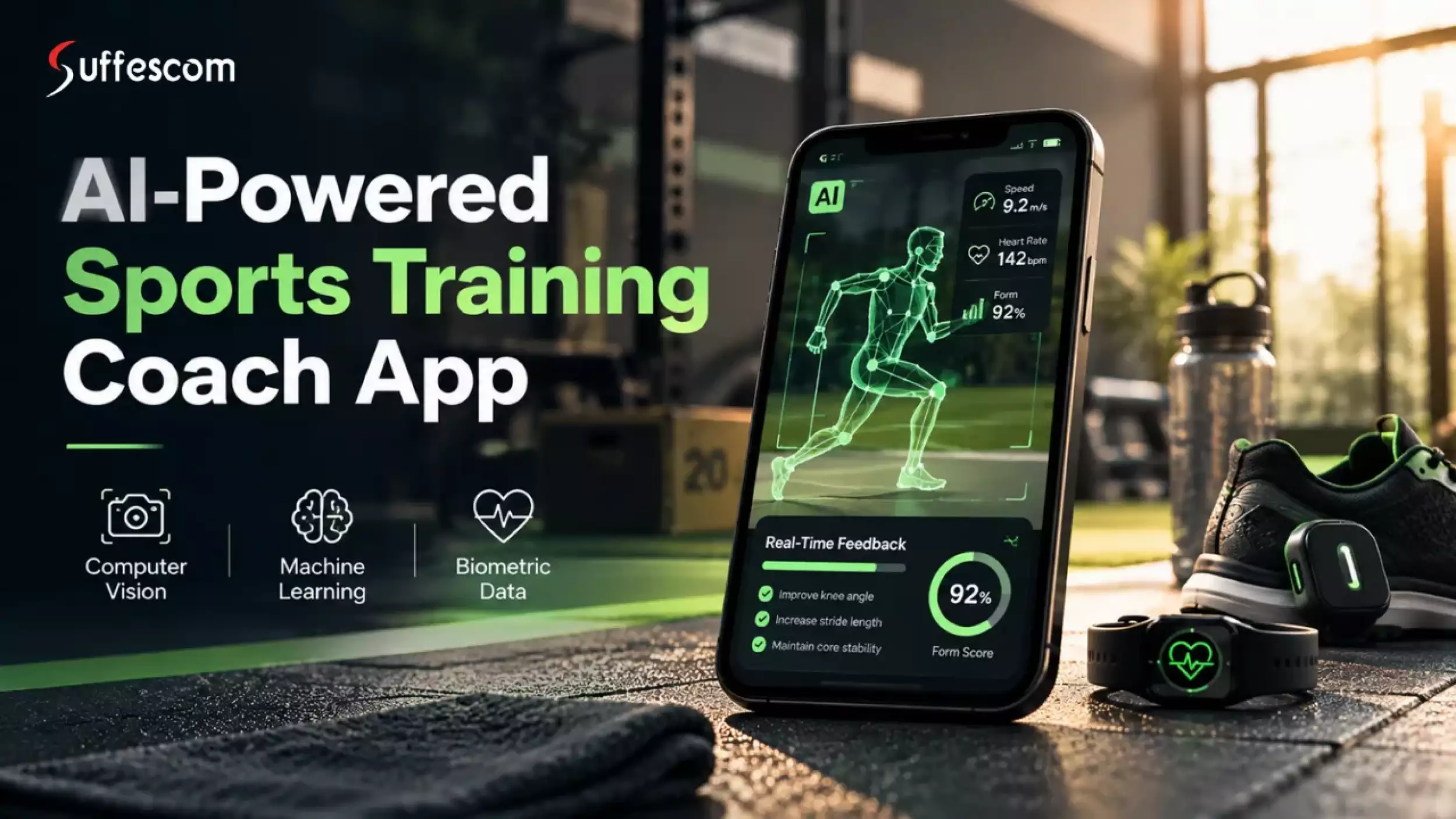
An AI sports coach app can combine machine learning, computer vision, wearable integrations, and performance analytics to help athletes train more effectively. Depending on the sport and intended audience, the app may analyze movement techniques, recommend exercises, monitor training intensity, and track progress over time.
For businesses, sports academies, fitness startups, and sports technology providers, AI sports coach app development creates an opportunity to deliver personalized coaching experiences at scale. However, success depends on more than adding an AI chatbot. The software must understand the target sport, work with reliable athlete data, provide useful feedback, and support coaches in making informed training decisions.
This guide explains how AI sports coaching apps work, their essential features, the development process, technology requirements, estimated costs, and monetization opportunities.
What Is an AI Sports Coach App?
An AI sports coach app is a digital coaching platform that uses artificial intelligence and athlete performance data to personalize training programs, evaluate progress, and provide feedback. It can support individual athletes, personal trainers, sports academies, and professional teams.
Unlike conventional workout applications that primarily deliver predefined exercise routines, an AI sports coaching app can adapt recommendations based on an athlete's skill level, training history, performance metrics, and goals.
For example, a tennis training app could analyze a player's serve video, identify potential technique inconsistencies, and recommend targeted drills. A running coach app could use pace, distance, heart rate, and recovery data to adjust training intensity.
Businesses developing these solutions can draw on approaches used in AI-powered training solutions for athletes, where personalized programs and performance insights can support more structured training experiences.
An AI sports coach app may serve several user groups:
- Individual athletes: Receive personalized workouts, performance insights, and progress reports.
- Coaches and trainers: Review athlete performance, assign training programs, and monitor development.
- Sports academies: Manage training schedules, evaluate athletes, and coordinate coaching activities.
- Professional teams: Analyze selected performance metrics and support training decisions across a roster.
The exact capabilities depend on the sport, the available data, the accuracy of the AI models, and the level of human coaching involved.
Working Model of an AI Sports Training App
An AI sports training app typically follows a continuous cycle of data collection, analysis, personalized recommendations, and performance evaluation.
1. Athlete Profile and Goal Setting
The athlete creates a profile containing relevant information such as sport, experience level, training objectives, preferred schedule, and available equipment. Where appropriate, the app may also collect baseline performance measurements and training history.
These details establish a starting point for generating relevant training recommendations.
2. Training Data Collection
The app collects information from athlete activities, workout logs, video recordings, connected wearables, or compatible sports equipment. Depending on the use case, this may include speed, repetitions, movement patterns, heart rate, distance, and training duration.
Data collection should be limited to information needed for the app's intended purpose, with appropriate user consent and permissions.
3. AI-Powered Performance Analysis
Machine learning models analyze structured performance data, while computer vision models can evaluate supported movements from video. The system compares observations with relevant benchmarks, previous sessions, or validated technique criteria.
The quality of these insights depends on the model, the quality of the input data, and the sport-specific context.
4. Personalized Training Recommendations
The app uses analyzed results to suggest exercises, adjust training difficulty, recommend drills, or highlight areas that may need improvement. For example, a runner whose pace drops during longer sessions may receive a recommendation to review endurance training and recovery patterns.
Recommendations should account for the athlete's goals and limitations rather than applying the same plan to every user.
5. Feedback and Progress Tracking
After each session, the app presents performance summaries, progress indicators, and suggested next steps. Athletes can review their development over time, while coaches can use dashboards to evaluate progress and adjust training plans.
6. Continuous Improvement
With appropriate consent and data governance, new session data can help refine personalization and improve the system's recommendations. Model updates should be tested before deployment to ensure they do not reduce accuracy or introduce unsafe advice.
AI-Powered Sports Training Coach App Development Process
Developing an AI sports coach app requires a clear product scope, suitable data infrastructure, sport-specific AI capabilities, and careful testing. The following steps provide a practical development approach.
Step 1: Define the Sport, Audience, and Use Case
Start by identifying the sport the app will support, such as running, football, tennis, basketball, or strength training. Define the target audience, whether individual athletes, fitness enthusiasts, professional teams, or sports academies, and identify the main problem the app will solve.
Next, establish measurable product goals, such as personalizing training plans, analyzing techniques, tracking performance, or improving training consistency. A clearly defined use case helps prioritize essential features and keeps the initial development scope manageable.
Step 2: Plan Features and Data Requirements
Determine the core features according to the selected sport and user requirements. These may include AI-generated training plans, performance dashboards, video-based technique analysis, wearable integrations, and coach-athlete communication tools. Prioritize features that directly support the app's primary purpose.
Identify the data required to power these capabilities, such as workout histories, movement videos, sensor readings, and athlete-entered information. Define how this data will be collected, validated, stored, and accessed to ensure the AI models receive suitable inputs for generating relevant recommendations.
Step 3: Design the User Experience
Design an intuitive interface that allows athletes to set goals, access training plans, record sessions, and review performance insights with minimal effort. Training dashboards should present important metrics clearly, while AI-generated feedback should be easy to understand and apply.
Consider how athletes and coaches will use the app during everyday training. Readable controls, simple navigation, clear progress indicators, and appropriate audio or visual feedback can improve usability. Coach-facing screens should also make it easy to review athlete progress and adjust training programs.
Step 4: Develop the App and Backend
Build the mobile application, backend services, databases, authentication, and APIs. A reliable architecture supports user accounts, training histories, analytics, notifications, and coach-athlete collaboration.
The implementation may involve custom mobile app development, depending on the required platforms and product scope.
Step 5: Integrate AI and Connected Data Sources
Integrate the selected AI models into relevant workflows, such as personalized training recommendations, performance analysis, and video-based movement assessment. Configure the system to process authorized athlete data and return outputs that can be presented clearly within the app.
Connect compatible wearables, sensors, and third-party platforms where they improve the coaching experience. Test data synchronization, missing readings, inconsistent measurements, and AI responses under realistic conditions.
Step 6: Test, Launch, and Improve
Conduct functional, usability, integration, performance, and security testing before release. Evaluate AI outputs using representative sports scenarios and, where appropriate, ask qualified coaches to review recommendations for relevance and accuracy. Testing should cover supported devices and different data conditions to identify limitations.
Launch with a controlled group of users when possible, then collect feedback from athletes and coaches. Monitor app stability, engagement, AI performance, and operating costs after release. Use these findings to refine existing features, address issues, and plan future improvements.
Key Features of an AI Sports Training Coach App
The feature set should reflect the sport, user type, and intended coaching outcome. A focused product with dependable core capabilities is often more useful than an app with numerous untested AI features.
1. AI-Powered Personalized Training Plans
The app generates training schedules based on an athlete's goals, skill level, previous performance, and available training time. It can recommend exercises, repetitions, intensity levels, and progression targets.
For example, a beginner preparing for a 5K run may receive a different training plan from an experienced runner working to improve race pace. Plans should be adjustable when performance, availability, or recovery needs change.
2. Athlete Performance Tracking and Analytics
Performance dashboards bring together relevant metrics, such as pace, distance, speed, repetitions, accuracy, or session completion. Athletes can compare results across sessions, while coaches can identify trends that require attention.
The metrics should be selected according to the sport instead of presenting generic fitness statistics that have little practical value.
3. Computer Vision and Movement Analysis
Computer vision can analyze supported movements in video recordings to estimate joint positions, body alignment, movement timing, and technique patterns.
For example, a golf coaching app might analyze a swing, while a strength-training app could assess selected exercise movements. Results should communicate uncertainty and avoid claiming precise biomechanical measurements when the camera setup or model cannot support them.
4. AI Coaching Assistant
A conversational assistant can answer questions about app features, explain training plans, summarize session results, and help athletes understand performance reports.
For instance, an athlete might ask why a workout's intensity has changed. The assistant can explain the relevant training data and the coach-approved logic behind the recommendation.
For more specialized conversational experiences, the app may use retrieval-based AI to reference approved training material, coaching guidelines, or an athlete's authorized records.
5. Real-Time Feedback and Training Guidance
Where the device, model, and connectivity support it, the app can provide feedback during an exercise or training session. This may include pace alerts, repetition counts, movement cues, or reminders to follow the planned routine.
Real-time guidance should be limited to actions the system can evaluate reliably. Complex technique corrections may be better delivered after the session or reviewed by a qualified coach.
6. Wearable and Sports Equipment Integration
Connections with compatible smartwatches, heart-rate monitors, GPS devices, and other sensors can help the app collect training and recovery information.
An IoT app development approach can be relevant when the product needs to connect multiple devices, process sensor data, and coordinate communication between hardware and software systems.
7. Recovery and Workload Monitoring
The app can summarize training frequency, session intensity, sleep data where available, and other relevant indicators to help users understand their training patterns.
These insights can support discussions about recovery, but they should not be presented as definitive diagnoses or guarantees against injury. Medical concerns should be referred to qualified healthcare professionals.
8. Coach and Team Management Dashboard
A coach dashboard can display athlete profiles, training schedules, session summaries, goals, and progress reports. Team-level views help coaches manage multiple athletes without relying entirely on separate spreadsheets or manual updates.
Access permissions should ensure that each coach sees only the athletes and records they are authorized to manage.
9. Goal Setting and Progress Reports
Athletes can set measurable objectives, monitor milestones, and receive periodic reports showing how their performance changes over time.
The app can highlight completed sessions, personal bests, and areas for further practice, helping users understand their progress without relying only on subjective impressions.
10. Notifications and Training Reminders
Automated reminders can notify athletes about scheduled workouts, upcoming assessments, or coach feedback. Notification frequency should be configurable so users can receive useful prompts without being overwhelmed.
Benefits of AI Sports Coach App Development
AI sports coach app development can create value for athletes, coaches, and businesses when the technology supports clear training objectives and dependable workflows.
Personalized Coaching at Scale
Traditional one-to-one coaching can be difficult to scale across large athlete groups. AI-powered tools can automate selected parts of training analysis and provide tailored recommendations to more users, while coaches focus on decisions requiring their expertise.
Data-Driven Performance Insights
Instead of relying exclusively on manual observations, athletes and coaches can review structured performance records and trends. This makes it easier to identify changes, compare training sessions, and assess whether a program is moving toward its intended goals.
More Efficient Coaching Workflows
Automated session summaries, progress reports, and training reminders can reduce repetitive administrative work. Coaches can spend more time reviewing athlete needs and providing meaningful feedback.
Remote Training and Wider Accessibility
A mobile coaching platform can make structured training resources available outside traditional coaching facilities. Athletes may follow programs remotely, submit videos for review, and share performance reports with coaches.
Improved Athlete Engagement
Goal tracking, progress visualizations, and relevant reminders can encourage consistent participation. Personalized recommendations may also help users understand the purpose of each session instead of following a generic workout routine.
New Revenue Opportunities
Sports technology businesses can offer paid subscriptions, premium analytics, team management tools, or academy licenses. The right model depends on whether the target market consists of individual athletes, coaches, or organizations.
Technology Stack for AI Sports Coach App Development
The AI technology stack depends on the required platforms, AI capabilities, data volume, and integration requirements. A practical stack should support the current product scope while leaving room for future growth.
| Technology layer | Potential technologies | Purpose |
| Mobile application | Flutter, React Native, Swift, Kotlin | Build cross-platform or native athlete experiences |
| Backend development | Python, Node.js, Java | Manage business logic, users, training plans, and APIs |
| AI and machine learning | PyTorch, TensorFlow, scikit-learn | Build or run models for recommendations and performance analysis |
| Computer vision | OpenCV, MediaPipe, suitable pose-estimation models | Analyze supported movements and video inputs |
| Database and storage | PostgreSQL, Redis, cloud object storage | Store user records, session data, and video assets |
| Cloud infrastructure | AWS, Microsoft Azure, Google Cloud | Support deployment, scaling, monitoring, and data processing |
| Wearable and device integrations | Vendor APIs, Bluetooth Low Energy, device SDKs | Connect supported wearables and sensors |
| Analytics and monitoring | Product analytics, application monitoring, model evaluation tools | Track usage, reliability, and AI performance |
These are potential options rather than a mandatory combination. For example, a simple workout-planning app may not need computer vision, while a technique-analysis platform may require specialized video-processing infrastructure.
The technology selection should follow the product requirements, the availability of training data, expected usage, privacy obligations, and the cost of operating AI models.
How Much Does It Cost to Build an AI Sports Coach App?
The cost of AI sports coach app development can start at $25,000 for a basic solution and reach $300,000 or more for an advanced platform with custom AI models, computer vision, real-time performance analysis, and extensive wearable integrations. The final investment depends on the app's feature set, technical complexity, data requirements, and scalability needs.
| App complexity | Estimated development cost | Typical scope |
| Basic MVP | $25,000–$50,000 | User profiles, training plans, progress tracking, and basic AI integration |
| Mid-level app | $50,000–$120,000 | Personalized recommendations, analytics, coach dashboard, and selected integrations |
| Advanced AI coaching platform | $120,000–$300,000+ | Computer vision, advanced personalization, extensive device integrations, and scalable infrastructure |
Actual costs may fall outside these ranges depending on the project's requirements, location of the development team, licensing fees, and data availability.
Factors That Affect Development Cost
AI model development and integration: Integrating an existing model for basic recommendations generally involves less work than developing and validating a custom computer vision model for a specific sport.
Video processing and computer vision: Movement analysis may require video uploads, frame processing, pose estimation, model evaluation, and additional computing resources. This can significantly increase development effort.
Wearable and third-party integrations: Each device or platform may have different APIs, permissions, data formats, and testing requirements.
Mobile platforms and dashboards: Building for iOS and Android, along with a separate coach or administrator dashboard, adds design, development, and testing work.
Data infrastructure and security: Video storage, analytics pipelines, access controls, monitoring, and backup systems all contribute to the overall cost.
Ongoing maintenance: Cloud hosting, AI inference, model evaluation, bug fixes, third-party API changes, and new feature development create recurring expenses after launch.
A sensible budgeting approach is to begin with the smallest feature set that validates the core coaching use case, then expand after evaluating real athlete and coach feedback.
Challenges in Developing an AI Sports Coach App
AI coaching products face technical and operational challenges that can affect trust, performance, and long-term adoption. Addressing them during planning and development can reduce rework and improve the user experience.
1. Limited or Inconsistent Training Data
AI models need suitable data to identify meaningful performance patterns. Video recordings may differ in lighting, camera angles, equipment, athlete experience, and movement speed, which can reduce the reliability of analysis.
How to address it: Define data collection standards, use representative datasets, validate model performance across relevant athlete groups, and communicate limitations when the system cannot make a reliable assessment.
2. Accuracy of AI Recommendations
An incorrect technique correction or unsuitable training recommendation may confuse an athlete or lead to poor training decisions. General-purpose AI models may not understand the detailed requirements of a particular sport.
How to address it: Use sport-specific evaluation criteria, test recommendations against expert-reviewed examples, and include coach oversight for complex decisions. The app should allow users to flag questionable feedback.
3. Supporting Different Sports and Skill Levels
Training requirements differ across sports, positions, ages, and experience levels. A model trained for one movement or sport may not generalize to another.
How to address it: Start with a defined sport and target audience. Expand to additional activities only after validating the relevant models, training logic, and performance measures.
4. Integrating Wearables and External Devices
Different devices can report metrics in different formats or at different intervals. Connection interruptions, missing readings, and inconsistent measurements can affect the app's analysis.
How to address it: Use documented APIs and SDKs, normalize incoming data, validate readings, and design fallback behavior for unavailable devices. Clearly identify when a report is incomplete because data is missing.
5. Athlete Privacy and Data Security
Training videos, personal profiles, location information, and wearable data may reveal sensitive details about an athlete. Unauthorized access can damage user trust and create legal or contractual risks.
How to address it: Apply encryption, role-based access, secure authentication, data minimization, and clear consent controls. Establish retention and deletion policies and review applicable privacy requirements before launch.
6. Controlling AI Operating Costs
Video processing, repeated model inference, and large-scale data storage can make an app expensive to operate as its user base grows.
How to address it: Measure model latency and cost, process data only when necessary, optimize inference workflows, and monitor infrastructure usage. Select model sizes and cloud resources according to actual workload requirements.
Monetization Models for an AI Sports Coach App
The monetization model should align with the app's target users, the value of its coaching features, and the frequency of use.
1. Freemium Model
Offer basic workout plans, progress tracking, or a limited number of AI coaching interactions for free. Charge for advanced analytics, personalized plans, video analysis, or expanded training history.
2. Monthly and Annual Subscriptions
Individual athletes can pay recurring fees for premium coaching tools, structured training programs, progress reports, and connected-device features. Annual plans may encourage longer-term engagement.
3. Coach and Trainer Subscriptions
Professional coaches can pay for athlete management, training plan creation, video review, and progress dashboards. Pricing can be based on the number of athletes or the capabilities included.
4. Sports Academy and Team Licensing
Offer organizations a platform for managing athletes, assigning training, tracking selected metrics, and reviewing team progress. Enterprise plans may include administrative controls, integrations, and custom reporting.
5. White-Label Solutions
Sports businesses can launch a branded coaching app using a configurable underlying platform. White-label fitness app solutions can be relevant when an organization wants its own branded experience without building every component from scratch.
6. Premium Assessments and Coaching Services
The app can offer paid video assessments, coach-led reviews, specialized training programs, or expert consultations. These services work best when the AI handles preliminary analysis and qualified coaches provide additional interpretation where needed.
The right monetization strategy should be validated with target users. A professional sports team may prioritize reporting and integrations, while an individual athlete may care more about affordability and ease of use.
How to Ensure Data Privacy and Responsible AI Coaching
An AI sports coaching app should be designed to protect athlete information and communicate the limitations of its recommendations. Privacy and responsible AI practices need to be considered from the beginning rather than added after development.
- Collect only necessary data: Request permissions for information directly relevant to the app's functions, and explain why it is needed.
- Secure athlete records: Use encryption in transit and at rest, secure authentication, role-based permissions, and appropriate access logging.
- Obtain informed consent: Explain how training videos, wearable measurements, and personal information will be used, stored, and shared.
- Provide transparent recommendations: Where practical, show the metrics or training rules behind a recommendation and identify uncertainty when the system cannot reach a reliable conclusion.
- Maintain human oversight: Allow coaches to review complex technique feedback and training changes, especially when recommendations may affect an athlete's training load or safety.
- Review applicable regulations: Depending on the markets served and data collected, assess relevant privacy, data protection, and contractual requirements.
AI-generated feedback should not be presented as a medical diagnosis or a guarantee of injury prevention. Clear boundaries and appropriate professional oversight help athletes understand what the app can—and cannot—reliably do.
Why Choose Suffescom for AI Sports Coach App Development?
Building an AI sports coaching platform requires coordination between mobile engineering, backend infrastructure, AI integration, data management, and user experience design. The development approach should reflect the product's coaching objectives rather than treating AI as an isolated feature.
Suffescom offers AI fitness app development services to build personalized fitness and sports coaching applications with AI-powered training plans, athlete performance tracking, and intelligent coaching recommendations.
Depending on the project scope, the development team can help with:
- Custom app development: Build athlete-facing mobile applications and coach dashboards around specific training workflows.
- AI integration: Incorporate suitable machine learning models, recommendation engines, and performance analytics into the product.
- Connected-device integrations: Connect compatible wearables and sensors to support relevant training and performance data.
- Scalable architecture: Design backend services and data workflows to accommodate evolving features and user requirements.
- Testing and ongoing improvements: Evaluate core functionality, integration reliability, security, and AI output quality throughout the product lifecycle.
Suffescom's TransformFitAI case study provides a relevant example of work involving AI and personalized fitness experiences. The requirements of an athlete-focused coaching product would still need to be assessed separately, particularly where sport-specific video analysis, specialized sensors, or performance validation are involved.
A well-scoped discovery phase can establish the product roadmap, identify suitable AI capabilities, and estimate the resources needed to move from an initial MVP to a more advanced coaching platform.
Frequently Asked Questions
1. How much does it cost to build an AI sports coach app?
An AI sports coach app may cost approximately $25,000–$50,000 for a basic MVP, $50,000–$120,000 for a mid-level product, and $120,000–$300,000 or more for an advanced platform. The final cost depends on AI complexity, computer vision, integrations, and infrastructure requirements.
2. How long does it take to develop an AI sports coaching app?
A basic MVP may take around 3–5 months, while a mid-level application may require 5–8 months. Advanced platforms involving custom AI models, extensive video analysis, or multiple device integrations can take 8–12 months or longer. These are indicative timelines and depend on the project scope and data readiness.
3. How does AI personalize sports training?
AI can analyze training history, goals, performance metrics, and other authorized data to recommend exercises, adjust training plans, and summarize progress. The quality of personalization depends on the available data, model validation, and sport-specific coaching logic.
4. Can an AI sports coach app analyze videos?
Yes. Computer vision and pose-estimation models can analyze supported movements in videos to estimate body positions, movement patterns, and technique-related indicators. Accuracy depends on the sport, camera angle, recording quality, and model capabilities.
5. Can an AI sports coach app connect to wearable devices?
Yes. Depending on device compatibility and available APIs, the app can integrate smartwatches, heart-rate monitors, GPS devices, and other sensors to collect relevant performance data. Each integration requires testing to ensure data consistency and reliable synchronization.
6. Which AI technologies are used in sports coaching apps?
Common technologies include machine learning for personalization, computer vision for movement analysis, predictive analytics for performance trends, and natural language processing for conversational coaching assistance. The appropriate combination depends on the intended use case.
7. How can an AI sports coach app generate revenue?
Common revenue models include subscriptions, freemium upgrades, coach and academy licenses, team plans, white-label solutions, and paid coaching assessments. The best model depends on the target market and the value users receive from premium features.
8. Can AI replace a human sports coach?
AI can assist with routine analysis, training recommendations, progress tracking, and feedback, but it cannot reliably replace all aspects of human coaching. Coaches provide context, motivation, nuanced judgment, and direct observation that automated systems may not fully capture.
9. What should businesses include in an AI sports coach app MVP?
An MVP should focus on one clear training use case. Depending on the sport, it may include athlete profiles, goal setting, personalized plans, basic performance tracking, progress reports, and a limited AI coaching feature. Advanced video analysis and extensive wearable integrations can be introduced after the core experience is validated.