Key Takeaways:
- Edge computing processes data locally to support time-sensitive machine responses, anomaly detection, and factory automation.
- Cloud computing enables centralized analysis of production data for historical reporting, predictive maintenance, and performance optimization across facilities.
- Manufacturers benefit from combining both technologies. Edge systems handle immediate operational needs, while cloud platforms provide broader insights.
- The right architecture depends on factory requirements, including response times, existing equipment, connectivity, security, and data volumes.
- Successful implementation starts with workload assessment and integration planning. Manufacturers should validate the solution on a pilot production line before expanding it across facilities.
Sometimes, a production line cannot afford to wait for the moment when data will be transferred to a distant server to react to machine failure. However, at the same time, manufacturers need production data over a long period to detect regular equipment malfunctions and optimize operations.
In this case, both edge computing and cloud computing technologies can perform various tasks. Edge computing technologies help to process data near production equipment and thus react to the situation quickly. Cloud computing is a tool for storing and processing data on production lines and at factories.
Manufacturers should not have to ask whether it is necessary to use one or another solution. Manufacturers should understand the tasks that require local data processing and those that can be done with centralized computing power.
This guide helps you to understand how edge computing differs from cloud computing, which approach is better for factory automation, and how manufacturers can create a combined solution.
Difference Between Edge Computing and Cloud Computing
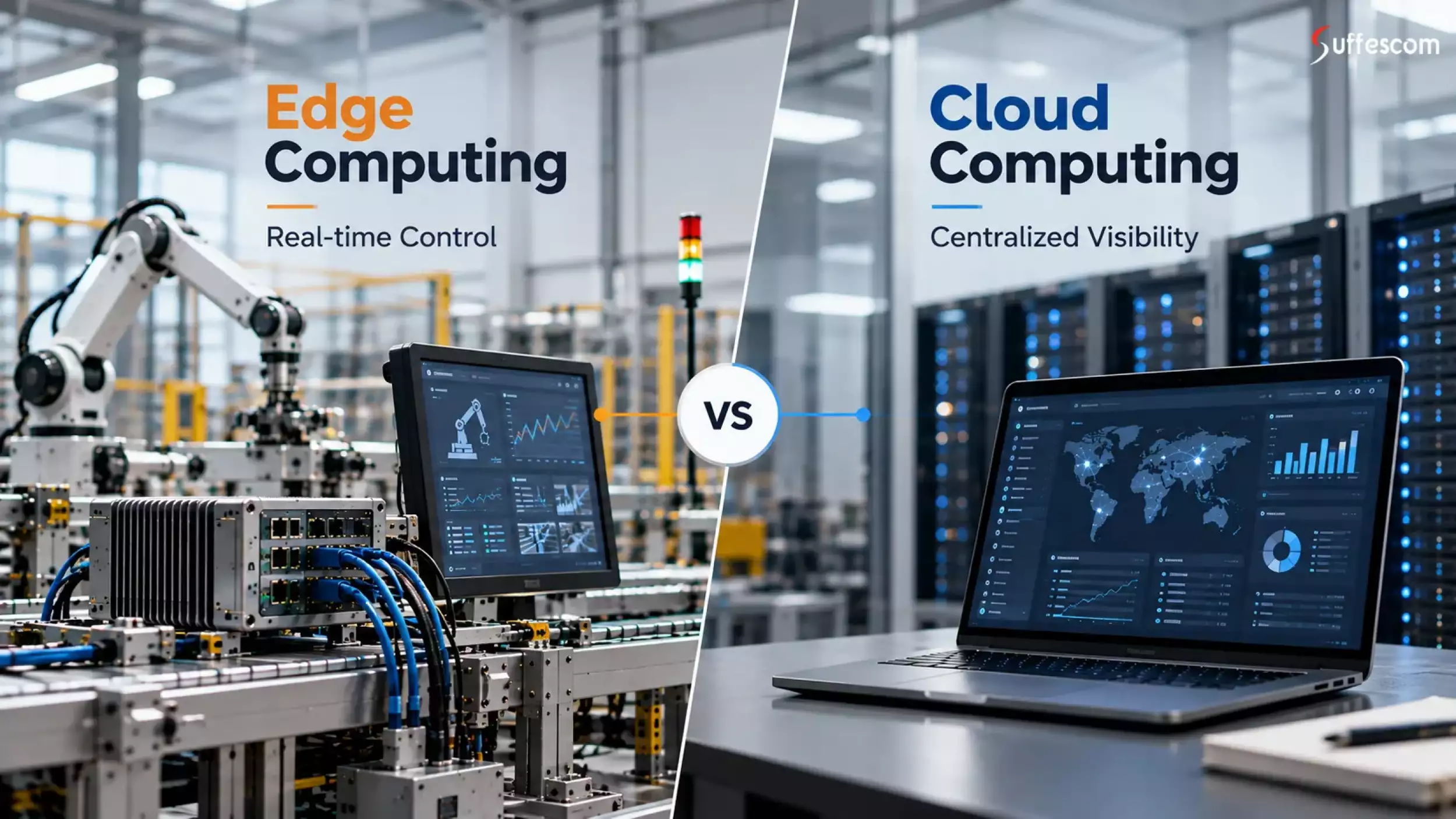
The key distinction between edge computing and cloud computing is the processing of data. The former does its computation near the devices creating it, while the latter performs processing and storage of information using servers that do not physically connect to the network.
This issue is of particular importance in manufacturing, as it impacts the speed of response of automated devices, the amount of transferred data, and the exchange of production knowledge between enterprises.
Edge Computing vs. Cloud Computing: Key Differences
| Comparison factor | Edge computing | Cloud computing |
| Processing location | Near factory machines, sensors, or local gateways | Remote cloud infrastructure |
| Response time | Supports low-latency, time-sensitive decisions | Depends on network connectivity and round-trip latency |
| Connectivity | Can support local processing during cloud connectivity interruptions | Remote services generally require network connectivity |
| Data handling | Processes data locally and can filter or aggregate it before transmission | Stores and analyzes large datasets from connected systems |
| Manufacturing applications | Local anomaly detection, machine monitoring, and rapid control responses | Historical reporting, predictive maintenance models, and multi-plant analytics |
| Scalability | Resources must be deployed and managed across edge locations | Computing and storage resources can scale centrally as needed |
How Edge Computing Works in Manufacturing
With edge computing, the data analysis process moves closer to where the data is being generated. The industrial gateway or edge computer can then process the sensor readings locally without having to first send the sensor readings to a distant cloud-based system.
For instance, the vibration sensors installed on a motor in a manufacturing plant may indicate an unusual vibration pattern. The edge computing system will immediately raise an alarm, which goes out to the maintenance staff. If the control system design permits it, a suitable protective action can be taken at the local end.
This method is effective in situations where delays may disrupt production or pose risks to machinery safety. In addition, the real-time insights generated through edge computing can support business intelligence consulting by helping organizations identify operational inefficiencies, improve maintenance planning, reduce downtime, and make data-driven business decisions.
How Cloud Computing Works in Manufacturing
With cloud computing, manufacturers have the ability to store and analyze production information via remote computing infrastructures.
For instance, a manufacturer running multiple plants can compare the performance of their motors, the history of the maintenance carried out on them, and other similar information.
It is important to note that cloud computing would be very helpful when large amounts of computing power or long-term storage are required, or when a complete overview of the business' operations is necessary.
The most important difference is that edge computing provides quick, local reaction to events, whereas cloud computing enables the analysis of production information into operational insights.
Both can co-exist within a connected manufacturing framework.
Planning Your Factory's Edge-Cloud Architecture?
Connect your industrial equipment with the right edge and cloud solutions to support factory automation and smarter production decisions.
Which One Is Better for Factory Automation?
Neither edge computing nor cloud computing is inherently superior to the other in the context of factory automation, depending on the speed with which the machine needs to respond and the nature of the task that demands either edge or cloud computation.
Tasks that demand quick reaction to an abnormality on the part of machines are best suited for edge computing. On the contrary, cloud computing would be appropriate for analyzing historical production data, coordinating operations between plants, and enhancing maintenance.
In most cases, an integrated application of edge and cloud computing in connected manufacturing will offer a more pragmatic approach.
Edge Computing vs. Cloud for Factory Automation
Consider an automated packaging line where the conveyor or motor starts vibrating abnormally. In such a scenario, the manufacturing unit must deal with the emerging problem while at the same time retaining a wide picture of its production performance.
In the case of edge computing, the local machine will be able to detect any abnormal vibration pattern through analysis without having to depend on any cloud response. With the right design of such a machine, it can raise a local alarm or provide information to the relevant control system.
In case of cloud computing, the manufacturer will be able to analyze vibration patterns along with maintenance records, production schedule, and equipment records.
Hence, the two types of technology cater to different operational requirements.
- Edge Computing should be chosen when there is a need for real-time reaction in machines.
- Cloud Computing should be used when there is a requirement for centralized storage of data and analytical needs.
- Both can be used in case of factories that require immediate local reactions as well as long-term information through production data.
Why Manufacturers Need Edge Computing and Cloud Computing Together
Factory automation creates two separate demands: machines need to react to their environment, and manufacturers need to know how that environment affects the production process in general.
A combination of edge and cloud provides an answer to this dilemma.
Edge deals with real-time control, local anomalies, and immediate protection of machinery. Cloud collects summarized data from the edge for reports, predictive analysis, and optimization.
Such an approach provides multiple benefits:
- Quicker local reactions: Processing that depends on time can occur locally at the device level without needing to make a round trip to the cloud.
- More efficient data transmission: Edge devices can analyze and compress the data before sending useful information across the network.
- Effective maintenance scheduling: Cloud computing can analyze historical data to identify recurring equipment issues, predict potential failures, and optimize maintenance schedules. With support from data analytics consulting, manufacturers can turn these insights into actionable strategies to reduce downtime, improve operational efficiency, and enhance production planning.
Need to Connect Your Factory Systems?
Build a connected manufacturing environment with custom software that integrates industrial equipment, edge devices, and cloud platforms.
The Future of Cloud Computing and Edge Computing in Manufacturing
Manufacturing's future is largely determined by how efficiently factory machinery translates data into decisions. With the development of IIoT technology, edge computing and cloud computing will collaborate to facilitate intelligent automation, connectivity in production processes, and predictive maintenance.
Some trends that will influence the implementation of these technologies include the following:
1. Edge AI for Real-Time Quality Inspection
AI models can be executed by manufacturers on the edge device to check their products for defects and any abnormalities in the machines themselves that are close to the manufacturing facility. It aids in cutting down latency since all images and sensor data have to travel to a distant server.
For instance, an edge vision system could indicate a defective part as it moves through the inspection station. The cloud will store certain inspection outcomes for analyzing the recurring pattern of defects.
2. Digital Twins Connected to Live Factory Data
The digital twin concept involves creating virtual copies of tangible things such as machines or whole production systems. Edge computing is highly used in digital twin development services. This is because edge computing can capture real-time sensor data from machines, whereas cloud computing helps in data aggregation, modeling, and analysis of data within bigger operations.
This can be utilized by manufacturers to test production changes, assess the behavior of their machines, and detect possible bottlenecks.
3. Predictive Maintenance Across Multiple Facilities
Predictive maintenance combines local anomaly detection with cloud-based analysis to identify potential equipment failures before they disrupt operations. Local anomaly detection identifies unusual vibrations, temperatures, or pressure levels that may indicate developing problems in machinery. Meanwhile, cloud-based AI models analyze historical data collected from multiple machines and facilities to identify recurring failure patterns and improve maintenance planning.
Beyond industrial applications, similar technologies are also transforming urban infrastructure. The combination of IoT and AI is driving the development of smart cities, where connected sensors collect real-time data from traffic systems, energy grids, and public infrastructure. Cloud computing processes this data to identify patterns, optimize resource utilization, and support better decision-making, helping cities improve traffic management, energy efficiency, and infrastructure maintenance.
4. More Connected and Autonomous Production Systems
Manufacturing processes are increasingly becoming more interconnected with communication between machines, industrial gateways, MES, and enterprise systems of record for operational data.
Edge computing technology is able to provide local decision making in production processes, whereas cloud computing is useful for coordination of information between departments and locations. This will improve understanding of production process state, machine performance, and supply chain requirements.
More connections require more security in the form of access control, network segmentation, safe device management, and system integration.
5. Hybrid Architectures Designed Around Factory Workloads
Manufacturers are expected to adopt architectures that allow them to allocate their workloads depending on their needs in terms of response time, connectivity, data, and security.
As an illustration, while a manufacturing facility is expected to carry out machine controls and anomaly detections locally, it might choose to report centrally and build models in the cloud. Certain workloads may even be processed in on-premises data centers or private clouds as dictated by operations and regulatory requirements.
However, the optimal architecture depends on the current architecture of the manufacturing facility and the implications of network disruptions.
Implications for manufacturers: Edge computing and cloud computing are becoming increasingly complementary components of industrial digital infrastructure. The objective here should be to link them in a manner that enhances production visibility and decision-making without losing control, reliability, or security.
Development of Cloud and Edge Computing Solutions
Integrating cloud and edge computing technologies in manufacturing goes beyond just integrating the machines inside a factory with the cloud. In creating such an integrated solution, several things have to be considered, such as the response time of the machines, industrial infrastructure, large amounts of data, network constraints, and the requirements of manufacturing.
The best solution will distribute the tasks where they belong. Critical tasks are done locally, and the cloud is used for storage and coordination.
1. Assess Factory Equipment and Workloads
Start with the analysis of the existing environment with respect to sensors, PLCs, SCADA, and MES.
Find out which processes require real-time action on the edge side and which processes can be processed with some delay. In this way, you will know how to use the edge and where to offload processes to the cloud.
2. Design the Edge-Cloud Architecture
Specify the communication between factory hardware, edge gateways, site-based systems, and cloud applications.
The architecture must define what gets computed at the site, what gets sent to the cloud, and how the systems interact with commands and responses. The architecture should address network disruptions and should make sure that machine control is not unnecessarily reliant on external services.
3. Integrate Industrial Devices and Software
It is typical for factories to have machines from various vendors, operating different communication protocols and data formats.
Integration is performed by means of connecting them via appropriate industrial interfaces or gateways, where protocols like OPC UA or MQTT, as well as MES, ERP, etc., are used depending on the environment.
The aim is to provide access to operational data in the systems that require it without interfering with existing production processes.
4. Develop Data Processing and Analytics Pipelines
Configuring the edge applications to process the machine data for detecting events and filtering/aggregating data for transmission is necessary. Cloud pipelines will be required to store the data and prepare it for dashboards and predictive maintenance analysis. Data quality, timestamps, equipment IDs, and correct formatting are essential for getting the right insights from the production lines.
5. Implement Security and Operational Resilience
Secure the links between devices used for industry, edge gateways, and cloud services through proper authentication, access control, encryption, and segmentation of the network.
The approach needs to have an action plan in case of gateway failure or disruption of cloud connectivity that will depend on the particular workload.
Separately from cloud analytics, critical control and safety functions need to be developed and validated.
6. Test, Deploy, and Optimize
Before scaling the solution to the whole factory, apply it to realistic production scenarios.
Test local reaction time, transmission dependability, system integration precision, and the behavior of the system during recovery. Observe the performance of the system and optimize processing procedures and cloud workloads as needed.
Testing of the solution on a single production line will allow validating the architecture prior to its application by the manufacturer to other lines or plants.
Building a Solution Around Your Manufacturing Environment
Each factory has its unique set of machinery, production processes, and infrastructure. The ideal cloud and edge computing system should be based on all of these parameters rather than fit all workloads into a common design.
Suffescom can provide assistance in designing and implementing manufacturing software solutions for connecting industrial machinery with cloud services, edge computing, and business applications. The main emphasis will be placed on the development of an architecture that is tailored to your current and future manufacturing needs.
Ready to connect your machinery with cloud services and edge computing? Talk about your manufacturing software needs to Suffescom.
Ready to Make Your Factory Data More Useful?
Develop connected data workflows that turn machine readings into actionable operational insights.
Conclusion
In manufacturing, edge and cloud computing have their own areas of application. Edge computing enables quick, local responses to changes in machinery status, while cloud computing supports better analysis of production data for improved decision-making.
When implementing factory automation, an integration of edge and cloud computing can give you all the advantages of both methods. In this case, workloads should be assigned according to response time, connectivity, data requirements, and risks involved.
To successfully perform the transition to the new technology, it is necessary to analyze your factory equipment and understand what would benefit from either local processing or centralization of analytics.
At Suffescom, we help companies implement customized solutions to connect their industrial systems to the cloud infrastructure. If you are going to automate your factory, a good architecture begins with knowing your equipment.
FAQs
1. Can edge computing work without an internet connection?
Yes. Edge computing has the ability to process information offline without needing an internet connection because all the necessary equipment and data is on hand. Yet, functions such as cloud syncing and remote monitoring cannot take place until a connection is established again.
2. Is edge computing more secure than cloud computing?
Neither approach offers an edge over the other in terms of security. Edge computing ensures that sensitive information is processed locally within the factory, but distributed devices and gateways will require security management too. Cloud computing allows for the implementation of security at one central point, but it needs to be configured appropriately.
3. What factors affect the cost of implementing edge and cloud computing in a factory?
Costs related to implementation are based on how many machines need to be installed, edge devices, integration needs, amount of data, cloud usage, and security. Existing equipment will need gateways or special connectors. Ongoing costs include cloud utilization, device maintenance, software updates, and connectivity.
4. Can manufacturers integrate edge and cloud computing with legacy machinery?
Absolutely. There are several ways to integrate legacy machinery through industrial gateways, protocol converters, or connectors. What is possible will depend on the specific interfaces of the machinery, communication protocols, and control system capabilities. Conducting an assessment of the existing equipment will help determine this.
5. What is the difference between edge computing and fog computing?
Edge Computing involves carrying out computations on the device where the data is produced or on devices that are near it. On the other hand, fog computing introduces an intermediary layer for processing that is between the edge devices and cloud computing infrastructure, such as a server within the region that controls multiple devices.
6. How should manufacturers choose an edge computing platform?
The manufacturer will consider support for industrial protocols, compatibility with current systems, processing capability, device management, security features, and offline capabilities. In addition, the platform must support the necessary integration with cloud services and manufacturing applications. It all boils down to the manufacturer's limitations and architecture in the end.
7. How long does it take to implement an edge-cloud solution in manufacturing?
Timeline depends on the scope of the project. A pilot using a relatively small number of devices and data workflows will be completed within weeks to a few months. A multi-location deployment that will involve legacy hardware, integration into corporate applications, advanced analysis, and extensive validation will require more time. A pilot will help confirm the requirements for a broader deployment.