Key Takeaways:
- AI in supply chain management helps businesses improve demand forecasting, inventory planning, warehouse operations, and logistics through predictive analytics and automation.
- AI-powered supply chain solutions provide real-time visibility into shipments, identify potential disruptions, and support faster, data-driven decisions.
- Machine learning, generative AI, computer vision, IoT, and predictive analytics enable intelligent supply chain workflows across multiple industries.
- AI supply chain management software can cost approximately $30,000 to $500,000+, depending on customization, AI complexity, system integrations, and scalability requirements.
- Successful AI implementation requires reliable data, integration with existing systems, appropriate security controls, and continuous performance monitoring.
Introduction
Supply chains have become increasingly complex as businesses manage changing customer demand, global sourcing, inventory fluctuations, transportation costs, and unexpected disruptions. Traditional supply chain systems can struggle to respond quickly when information is scattered across enterprise resource planning (ERP), warehouse management, transportation, and procurement platforms.
Artificial intelligence (AI) is changing this landscape by helping businesses analyze operational data, forecast demand, automate repetitive tasks, and identify risks before they affect deliveries. From intelligent inventory planning to AI-powered logistics optimization, these capabilities enable organizations to make faster and more informed decisions.
However, adopting AI requires more than deploying an isolated tool. According to Gartner's 2025 supply chain research, only 23% of surveyed supply chain leaders reported having a formal AI strategy. This highlights the importance of aligning AI investments with business objectives, existing workflows, and long-term technology plans.
For businesses exploring digital transformation, AI in supply chain management creates opportunities to improve operational efficiency, strengthen resilience, and build more responsive supply networks. This guide examines how AI is transforming supply chain operations, its applications and benefits, implementation steps, software costs, and emerging trends.
How AI Is Reshaping Supply Chain Operations Through Intelligent Automation
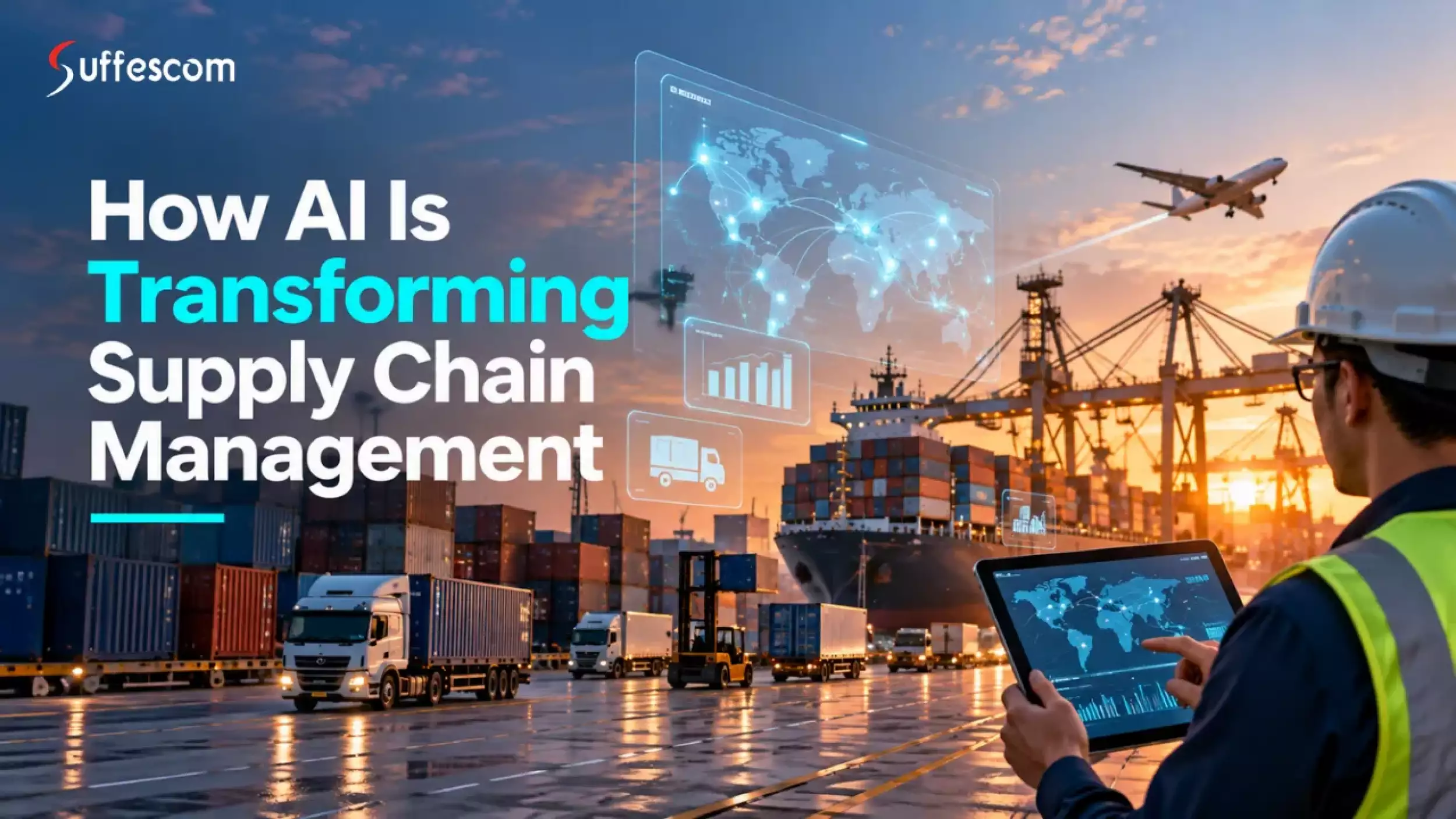
AI is transforming the supply chain industry by converting operational data into forecasts, recommendations, and automated actions. Instead of relying entirely on historical reports and manual decisions, businesses can use AI models to identify patterns, evaluate scenarios, and respond to changing conditions.
1. AI-Powered Demand Forecasting
Demand forecasting helps businesses estimate future product requirements using historical sales, seasonal patterns, market conditions, promotions, and other relevant signals. Machine learning models can analyze these variables to identify demand patterns that traditional forecasting methods may overlook.
More accurate forecasts help businesses plan procurement, production, and replenishment. For example, a retailer can anticipate increased demand during a seasonal promotion and adjust purchasing decisions before stock shortages occur.
2. Intelligent Inventory Management
AI helps businesses determine appropriate inventory levels by analyzing demand forecasts, supplier lead times, stock movements, and replenishment history. It can identify slow-moving products, flag potential stockouts, and recommend when to reorder items.
These insights can help reduce excess inventory and avoid missed sales caused by unavailable products. The recommendations should account for supplier reliability, storage capacity, and the consequences of running out of critical items.
3. AI-Driven Warehouse Automation
AI improves warehouse operations by supporting inventory location planning, picking optimization, workload allocation, and demand-based resource planning. Computer vision can also assist with barcode recognition, package inspection, and identifying selected handling errors.
When combined with robotics and warehouse management systems, AI can help coordinate repetitive tasks and improve order processing efficiency.
4. Smart Logistics and Route Optimization
AI-powered logistics systems analyze delivery locations, traffic conditions, vehicle capacity, delivery windows, and transportation costs to recommend efficient routes. Depending on data availability, the system can recalculate routes when disruptions or delays occur.
For logistics operators, this can improve fleet utilization, delivery planning, and shipment coordination. Combining route optimization with live tracking also helps teams respond to exceptions before they significantly affect delivery schedules.
5. Predictive Maintenance
Unexpected equipment failures can disrupt manufacturing, warehousing, and transportation operations. AI models can analyze sensor readings, operating conditions, maintenance histories, and equipment performance to identify patterns associated with possible failures.
These insights help maintenance teams prioritize inspections and schedule servicing before certain faults cause major downtime. Predictive maintenance is most effective when sensor data is reliable and model alerts are validated against actual equipment conditions.
6. Intelligent Procurement and Supplier Management
AI can help procurement teams evaluate supplier performance, compare lead times, identify pricing patterns, and monitor potential supply risks. Models can also flag unusual purchasing activity or highlight suppliers whose delivery performance has deteriorated.
These capabilities support more informed sourcing decisions and help businesses identify alternative suppliers when necessary. Final supplier selection should still account for quality, contractual obligations, compliance requirements, and human judgment.
7. Real-Time Supply Chain Visibility
AI can bring together information from ERP systems, warehouse platforms, shipment tracking, suppliers, and connected devices to create a more complete view of supply chain operations.
When the system detects a delayed shipment, unusual inventory movement, or a possible fulfillment bottleneck, it can alert the relevant team and recommend next steps. Businesses can also explore decentralized IoT in supply chains to understand how connected devices and distributed data architectures can support traceability and information sharing.
8. Supply Chain Risk Prediction
Supply chains face risks from supplier disruptions, transportation delays, changing demand, geopolitical events, and extreme weather. AI can analyze available operational and external data to identify risk signals and estimate how potential disruptions may affect supply, costs, and delivery schedules.
Businesses can use these insights to evaluate alternative routes, suppliers, or inventory strategies. AI cannot predict every unexpected event, but it can help organizations prepare scenarios and respond more systematically.
9. Automated Quality Control
Computer vision and machine learning can help identify visible product defects, packaging inconsistencies, labeling errors, and other quality issues in supported inspection workflows.
Automated checks can process large volumes of images or sensor readings and flag items for further review. Model performance must be validated against real production conditions, particularly when false positives or missed defects could create significant operational or safety risks.
10. Generative AI for Supply Chain Decision Support
Generative AI can help employees summarize supplier communications, interpret operational reports, search approved documentation, and query supply chain data using natural language.
For example, a procurement manager could ask an AI assistant to summarize delayed purchase orders or explain which shipments require attention. When connected to authorized business systems, these assistants can reduce the time spent searching for information. Access permissions, source validation, and human approval remain important for consequential decisions.
Benefits of AI-Powered Supply Chain Management Software: Emerging Trends and Advancements
AI for supply chain management can improve business performance by combining predictive insights with operational automation. The benefits depend on the quality of the implementation, the data available, and how well the solution fits existing processes.
Improved Forecasting and Planning
AI analyzes demand signals and historical patterns to help businesses anticipate changes in product requirements. Better forecasts can support purchasing, production scheduling, and replenishment decisions, reducing the need for frequent manual adjustments.
Reduced Inventory and Operating Costs
AI in inventory management helps organizations identify excess stock, avoid unnecessary replenishment, and manage warehouse resources more efficiently. Route optimization and workflow automation can also reduce avoidable transportation and administrative expenses.
Actual savings depend on existing operational performance, implementation costs, and how consistently teams use the recommendations.
Faster Order Fulfillment
AI can help coordinate picking, packing, dispatch, and delivery planning by identifying bottlenecks and prioritizing urgent orders. Better coordination between warehouse and transportation systems can reduce avoidable delays and improve fulfillment reliability.
Greater Supply Chain Visibility
Integrated data and AI-powered alerts help businesses identify issues across procurement, inventory, and logistics. Teams can investigate disruptions earlier rather than waiting for delayed reports or customer complaints.
Better Risk Management
AI can identify potential supply shortages, supplier performance issues, and unusual operational patterns. These insights allow teams to evaluate alternatives and develop contingency plans before disruptions escalate.
More Productive Teams
Automation can reduce repetitive tasks such as report preparation, order monitoring, data entry, and routine exception identification. Employees can then spend more time on supplier relationships, complex planning, and decisions that require experience.
Improved Sustainability
AI can support sustainability by optimizing delivery routes, reducing unnecessary transportation, improving inventory allocation, and identifying waste across operations. It can also help businesses monitor energy consumption and resource utilization when suitable data is available.
Sustainability gains should be measured using actual operational indicators, such as fuel consumption, empty miles, energy use, and product waste, rather than assuming that automation automatically reduces environmental impact.
Real-World Applications of AI in Supply Chain Management Software
AI applications vary by industry because each sector has different inventory requirements, delivery constraints, quality standards, and operational risks.
Retail and E-commerce
Retailers can use AI to forecast product demand, personalize replenishment decisions, optimize warehouse picking, and improve last-mile delivery planning. During peak shopping periods, predictive insights can help businesses allocate inventory across fulfillment centers and stores.
AI can also flag products likely to experience stock shortages or excess inventory, helping retailers adjust purchasing and distribution plans.
Healthcare and Pharmaceutical Supply Chains
Healthcare supply chains must manage product availability, expiration dates, specialized storage conditions, and strict traceability requirements. AI can help forecast medical supply demand, identify potential shortages, and prioritize replenishment of essential products.
For specialized healthcare workflows, healthcare supply chain management software development can support systems designed around medical inventory, procurement, distribution, and sector-specific operational requirements.
Manufacturing and Industrial Operations
Manufacturers can use AI to forecast raw material requirements, monitor production equipment, identify quality issues, and coordinate procurement with production schedules.
Predictive maintenance can help reduce unexpected equipment downtime, while demand planning can improve the coordination of materials, labor, and production capacity.
Food and Beverage
Food distributors and retailers can use AI to forecast demand for perishable goods, optimize cold-chain logistics, and reduce overstocking. Sensor data can help monitor temperature conditions during transportation and storage, while analytics can identify patterns associated with spoilage or delivery issues.
These capabilities can support waste reduction when combined with reliable monitoring and appropriate handling procedures.
Transportation and Logistics
Logistics companies can apply AI to fleet scheduling, route planning, shipment visibility, demand forecasting, and delivery exception management. Models can help estimate arrival times and identify shipments likely to miss their delivery windows.
A relevant example is Suffescom's logistics and supply chain automation case study, which provides context for discussing the role of software automation in logistics workflows.
How to Implement AI in Supply Chain Management Software
Successful AI implementation starts with a specific operational problem and progresses through data preparation, system integration, validation, and continuous improvement.
Step 1: Identify Supply Chain Challenges and Business Goals
Determine where AI can provide measurable value. Common starting points include demand forecasting, inventory optimization, warehouse efficiency, shipment delays, and supplier risk monitoring.
Set clear success measures, such as forecast error reduction, inventory turnover, order fulfillment time, or transportation cost per delivery. These metrics provide a baseline for evaluating the results after implementation.
Step 2: Assess Data Readiness and Existing Systems
Review the data available across ERP systems, warehouse management, transportation management, procurement, and inventory systems. Identify missing information, inconsistent records, duplicated data, and gaps in data ownership.
AI recommendations are only as useful as the information supporting them. Before selecting models, establish data quality standards and determine how the required information will be accessed, updated, and maintained.
Step 3: Select Suitable AI Use Cases
Prioritize use cases according to business impact, technical feasibility, data availability, and implementation risk. A business with frequent stockouts might begin with demand forecasting, while a logistics provider may benefit more from route optimization or shipment exception detection.
Starting with one focused use case helps teams validate value before extending AI to additional workflows. Avoid launching multiple disconnected pilots without a shared roadmap for future integration.
Step 4: Choose AI Models and Integration Technologies
Select technologies based on the task. Machine learning supports demand forecasting, optimization algorithms improve inventory planning, computer vision assists with inspections, and generative AI helps interpret information. Custom AI model development can address specific business requirements that existing models cannot fully meet.
The right choice depends on accuracy requirements, data volume, response time, explainability, and operating cost. Custom development may be appropriate when existing tools cannot meet specific business requirements.
Step 5: Integrate AI With Existing Systems
Connect AI capabilities with the relevant ERP, warehouse management system (WMS), transportation management system (TMS), supplier platforms, and data sources. Use secure APIs and controlled data pipelines to ensure information can move reliably between systems.
An effective integration should also define what happens when data is missing, a model fails, or an automated recommendation requires approval. This helps prevent isolated AI tools from creating additional manual work.
Step 6: Test, Validate, and Deploy AI Solutions
Test the solution using historical records, representative scenarios, and pilot workflows. Compare AI recommendations with existing processes and assess the impact on accuracy, cost, processing time, and operational reliability.
Deploy gradually where practical, with clear approval rules and fallback procedures. Teams should understand how to interpret model outputs and when to escalate unusual or high-impact decisions.
Step 7: Monitor Performance and Optimize AI Models
Track operational results after deployment, including forecast accuracy, stockout frequency, fulfillment time, delivery performance, and model reliability. Compare outcomes with the baseline established during planning.
Update data pipelines, model settings, and workflows as business conditions change. Continuous monitoring helps identify performance degradation and ensures the solution continues to support business objectives.
Must-Have AI Supply Chain Software Features for Smarter Operations
AI supply chain management software should combine intelligence with the operational tools teams need to act on its recommendations. The required features depend on the business model, existing infrastructure, and supply chain complexity.
1. AI-Based Demand Forecasting
Forecasting tools analyze historical sales, seasonality, promotions, and other available demand signals to estimate future requirements. Users should be able to compare forecasts, review changes, and understand the assumptions behind important recommendations.
2. Inventory and Replenishment Optimization
The software should track inventory levels, identify slow-moving items, highlight potential shortages, and recommend replenishment actions. Support for lead times, safety stock, and product expiration can be important for specialized industries.
3. Warehouse and Order Management
Warehouse features can include inventory location tracking, order prioritization, picking workflows, and fulfillment monitoring. AI capabilities can help identify bottlenecks and recommend adjustments based on order volumes and operational capacity.
4. Supplier and Procurement Management
Supplier management features can track supplier performance, delivery reliability, purchase orders, and procurement trends. AI-driven alerts can highlight deviations or risks that require further investigation.
5. Shipment Tracking and Route Optimization
The software can provide shipment visibility, estimated arrival times, delivery status, and route recommendations. Integration with fleet and transportation systems helps teams respond to changing conditions.
6. Predictive Alerts and Risk Monitoring
Risk dashboards can flag possible delays, stock shortages, unusual demand patterns, or supplier issues. Alerts should include relevant context and recommended next steps so employees can act without having to investigate every issue from scratch.
7. Analytics and Reporting Dashboard
A centralized dashboard should present relevant supply chain metrics, trends, exceptions, and forecasts. Role-specific views help procurement teams, warehouse managers, logistics operators, and executives focus on the information needed for their decisions.
8. ERP, WMS, TMS, and Third-Party Integrations
AI-powered inventory management software integrates with existing ERP, warehouse management (WMS), and transportation management (TMS) systems, as well as external platforms through third-party API integration. Secure APIs, consistent data formats, and reliable synchronization are essential for providing a dependable view of supply chain operations.
9. Workflow Automation and Access Controls
The platform can automate selected routine actions, such as generating alerts, assigning exceptions, or preparing replenishment recommendations. Permissions, approval workflows, and activity logs help ensure that sensitive information and consequential actions remain properly controlled.
How Much Does AI Supply Chain Management Software Cost?
The cost of AI supply chain management software can start at approximately $30,000 and reach $500,000 or more for a highly customized enterprise platform. The final investment depends on the number of workflows, complexity of AI models, data infrastructure, system integrations, and security requirements.
| Software complexity | Estimated development cost | Typical scope |
| Basic AI solution | $30,000–$80,000 | A focused use case, basic dashboards, and integration with selected data sources |
| Mid-level platform | $80,000–$200,000 | Multiple AI workflows, analytics, inventory or logistics features, and enterprise integrations |
| Advanced enterprise platform | $200,000–$500,000+ | Custom AI models, multiple operational modules, extensive integrations, and scalable data infrastructure |
Factors That Affect Development Costs
- AI model complexity: Integrating an existing forecasting model typically requires less effort than developing and validating custom models for multiple supply chain workflows.
- Data preparation: Cleaning, consolidating, and standardizing data from different systems can significantly affect implementation time and cost.
- System integrations: Connecting ERP, WMS, TMS, supplier portals, and third-party data services adds development and testing requirements.
- Feature scope: Demand forecasting, warehouse analytics, shipment tracking, and procurement automation each require different workflows and business rules.
- Infrastructure and security: Data storage, cloud computing, monitoring, access controls, and disaster recovery contribute to the total budget.
- Ongoing maintenance: Cloud usage, model monitoring, security updates, and continuous improvements create recurring expenses after launch.
A practical approach is to begin with a high-value use case, validate its results, and expand the platform as data readiness and business needs evolve.
Core Technologies Powering AI-Driven Supply Chain Management
The technology stack should be selected according to the intended use cases, available data, existing systems, and expected operational scale.
Machine Learning and Predictive Analytics
Machine learning models can identify patterns in historical demand, supplier performance, inventory movements, and delivery records. Predictive analytics uses these patterns to estimate future outcomes, such as stock requirements or the likelihood of delays.
Generative AI and Large Language Models
Generative AI can summarize operational reports, answer questions about approved business information, and assist with procurement documentation. When connected to enterprise data, it should use appropriate access controls and validation to reduce the risk of unsupported responses.
Computer Vision
Computer vision can support package inspection, product classification, label verification, and selected warehouse monitoring tasks. The model must be tested under real operating conditions to ensure that lighting, camera placement, and product variations do not undermine reliability.
Internet of Things (IoT)
IoT devices can provide real-time information about vehicle locations, equipment status, temperature, humidity, and other operational conditions. AI can analyze these readings to identify unusual patterns, monitor assets, and support time-sensitive decisions.
Cloud Computing and Data Engineering
Cloud platforms and data pipelines help businesses collect, process, store, and analyze information from distributed supply chain systems. The architecture should account for data volumes, access requirements, latency, availability, and ongoing infrastructure costs.
Optimization Algorithms and Digital Twins
Optimization algorithms help evaluate decisions involving routes, production schedules, inventory levels, and resource allocation. Digital twins can model selected supply chain operations to test scenarios and evaluate potential changes before applying them to real workflows.
These technologies can be combined, but the most suitable architecture is not necessarily the most complex. It should solve the defined business problem reliably and provide a clear path for future improvements.
Challenges of Implementing AI in Supply Chain Management
AI implementation can encounter data, integration, operational, and organizational challenges. Identifying these issues early helps businesses plan realistic deployment timelines and reduce implementation risks.
1. Poor Data Quality and Fragmented Systems
Supply chain data may be distributed across disconnected systems with inconsistent formats, missing records, or outdated information. These issues can reduce forecast accuracy and lead to unreliable recommendations.
How to address it: Establish data standards, identify authoritative sources, clean critical records, and build reliable data pipelines before scaling AI. Start with the datasets needed for the selected use case rather than attempting to consolidate everything at once.
2. Integration With Legacy Infrastructure
Older ERP, warehouse, and transportation systems may not support modern integration methods or real-time data exchange. Adding AI without addressing these limitations can create isolated tools and duplicate workflows.
How to address it: Assess system compatibility early, use secure APIs or suitable integration layers, and test data synchronization thoroughly. Apply legacy system modernization strategies where needed, and use a phased rollout to modernize critical workflows without disrupting existing operations.
3. High Initial Implementation Costs
Custom AI models, data preparation, infrastructure, and enterprise integrations can require substantial investment. Businesses may also underestimate the ongoing costs of cloud processing, monitoring, and model updates.
How to address it: Prioritize use cases with measurable business value, establish a baseline, and calculate total ownership costs rather than considering development fees alone. Use pilot results to determine whether a larger rollout is justified.
4. AI Accuracy and Reliability
Demand patterns, supplier behavior, and transportation conditions can change. Models trained on historical data may perform poorly when market conditions shift or when important inputs are unavailable.
How to address it: Evaluate models on representative data, monitor prediction errors, and establish thresholds for human review. Maintain fallback procedures for critical workflows and retrain or adjust models when performance deteriorates.
5. Data Security and Privacy Risks
Supply chain systems may contain supplier contracts, customer records, shipment details, commercial pricing, and other sensitive business information. Poor access controls or insecure integrations can expose these records.
How to address it: Apply encryption, role-based permissions, secure authentication, audit logs, and appropriate data-retention policies. Review third-party services and ensure AI tools only access information authorized for their intended purpose.
6. Employee Adoption and Skills Gaps
Employees may distrust AI recommendations, lack the skills to interpret model outputs, or continue using established manual processes. This can limit the value of even technically successful implementations.
How to address it: Involve operational teams in the design process, provide practical training, and explain how AI recommendations are generated and evaluated. Begin with workflows where employees can clearly see the benefit, and retain human oversight for consequential decisions.
Emerging AI Trends Shaping the Future of Supply Chain Management
AI supply chain capabilities are evolving from isolated predictions toward more connected, automated, and adaptive operations.
1. AI Agents for Supply Chain Workflows
AI agents may help coordinate multistep tasks such as reviewing purchase orders, gathering supplier information, identifying exceptions, and preparing recommended actions. High-impact decisions should retain appropriate approval controls, especially when actions affect contracts, spending, or customer commitments.
2. Autonomous Supply Chain Planning
As data quality and system integration improve, businesses may automate more routine planning decisions, such as replenishment suggestions and order prioritization. Strategic decisions involving major financial commitments or complex trade-offs will continue to require human judgment.
3. Digital Twins for Scenario Planning
Digital twins can help businesses model inventory changes, supplier disruptions, transportation constraints, and network adjustments. AI can support scenario analysis by comparing potential outcomes and identifying options for further evaluation.
4. Greater Real-Time Supply Chain Visibility
More connected sensors, tracking systems, and integrated data platforms can provide faster visibility into shipments, equipment, and inventory. AI can help convert this information into prioritized alerts and operational recommendations.
5. AI-Driven Sustainability
Businesses are likely to use AI more extensively to improve route efficiency, monitor energy consumption, reduce product waste, and evaluate resource utilization. The impact will depend on the accuracy of the underlying data and whether operational changes produce measurable environmental improvements.
6. More Accessible Generative AI Interfaces
Natural-language interfaces can make supply chain information easier to access for employees who do not specialize in data analysis. Users may be able to ask questions about delayed orders, stock availability, or supplier performance and receive answers grounded in authorized business records.
Conclusion
AI is transforming supply chain management by helping businesses forecast demand, optimize inventory, automate warehouse workflows, improve logistics, and identify operational risks. When integrated with reliable data and existing enterprise systems, these capabilities can support more responsive, efficient, and resilient supply chains.
Successful implementation starts with a clear business objective, suitable data, and a realistic roadmap. Businesses should prioritize measurable use cases, validate AI performance, and account for integration, security, and ongoing maintenance before expanding across the supply network.
Suffescom develops custom AI and software solutions that can support supply chain digital transformation, from intelligent workflows to connected operational platforms. As a logistics software development company, Suffescom can help businesses assess their logistics software requirements and plan digital solutions around transportation, shipment visibility, and operational workflows. The right development approach depends on the organization's existing systems, priorities, and long-term goals.
Frequently Asked Questions
1. How is AI transforming supply chain management?
AI is transforming supply chain management through demand forecasting, inventory optimization, warehouse automation, route planning, predictive maintenance, and supply risk monitoring. These applications help businesses use operational data to improve planning and respond to disruptions more efficiently.
2. How can AI enhance sustainability in supply chains?
AI can enhance sustainability by optimizing delivery routes, reducing unnecessary transportation, improving warehouse energy efficiency, and forecasting demand to minimize overproduction and product waste. It can also help monitor resource consumption and identify opportunities to reduce emissions when reliable environmental and operational data is available.
3. What are the benefits of AI for supply chain management?
Key benefits include improved forecasting, more efficient inventory management, faster order fulfillment, greater operational visibility, proactive risk identification, and reduced repetitive work. Results depend on data quality, implementation choices, and how effectively AI recommendations are integrated into daily operations.
4. What is AI supply chain management software?
AI supply chain management software uses technologies such as machine learning, predictive analytics, and generative AI to support supply chain planning and operations. Depending on its scope, it can include demand forecasting, inventory optimization, supplier management, shipment tracking, analytics, and workflow automation.
5. How is machine learning used in supply chain management?
Machine learning analyzes historical and real-time data to identify patterns and make predictions. Common applications include demand forecasting, replenishment planning, delivery time estimation, equipment failure prediction, and supplier risk assessment.
6. How much does it cost to implement AI in supply chain management?
A focused AI supply chain solution may cost approximately 30,000–80,000, while a mid-level platform may cost 80,000–200,000. Advanced enterprise solutions can reach 200,000–500,000 or more, depending on custom AI development, integrations, infrastructure, and operational requirements. These figures are illustrative estimates.
7. Can AI integrate with existing ERP and warehouse management systems?
Yes. AI can integrate with ERP, warehouse management, transportation management, and procurement systems through APIs, data pipelines, and other integration methods. Compatibility, data quality, security, and synchronization requirements should be assessed before implementation.
8. What are the biggest challenges of using AI in supply chains?
Common challenges include poor data quality, fragmented legacy systems, implementation costs, model reliability, data security, and employee adoption. A phased rollout with clear performance metrics, employee training, and continuous monitoring can help address these issues.