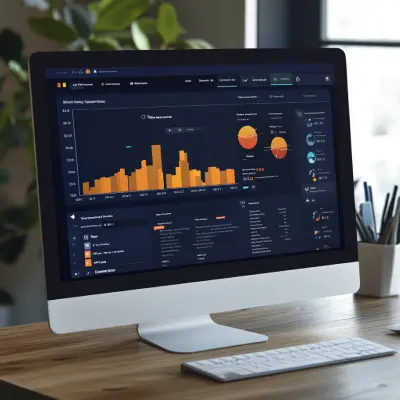
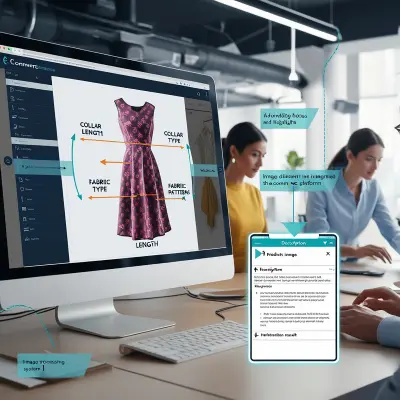
At Suffescom Solutions, we build tailored CRM solutions that centralize patient communication, appointment coordination, referral management, and care-related administrative tasks within a unified platform. With API-based integrations for supported EHR/EMR systems and scheduling applications, healthcare organizations can reduce manual data handling, improve workflow visibility, and deliver more coordinated patient experiences.
Why Do Healthcare Organizations Need Connected CRM Systems?
Healthcare organizations must have systems in place to manage patient data, appointments, and referrals. Using a healthcare CRM will help you keep everything in one place, helping you be more efficient and avoid any problems.
US hospitals enabled FHIR-based patient app access
What Would a Healthcare CRM Built Around Your Workflows Look Like?
From patient engagement and referral management to EHR/EMR integrations, we develop healthcare CRM solutions around your operational requirements, existing systems, and growth plans.
Patient portal and telehealth application integration
Data mapping, synchronization, and error handling
Healthcare CRM Migration, Modernization, and Support
We help healthcare organizations migrate CRM data to the cloud, legacy systems, and maintain platform performance.
Migration testing and data validation
Data mapping, cleansing, and deduplication
Legacy CRM modernization
Performance and security improvements
Ongoing maintenance and feature enhancements
Healthcare CRM Solutions for Patient Engagement and Workflow Automation
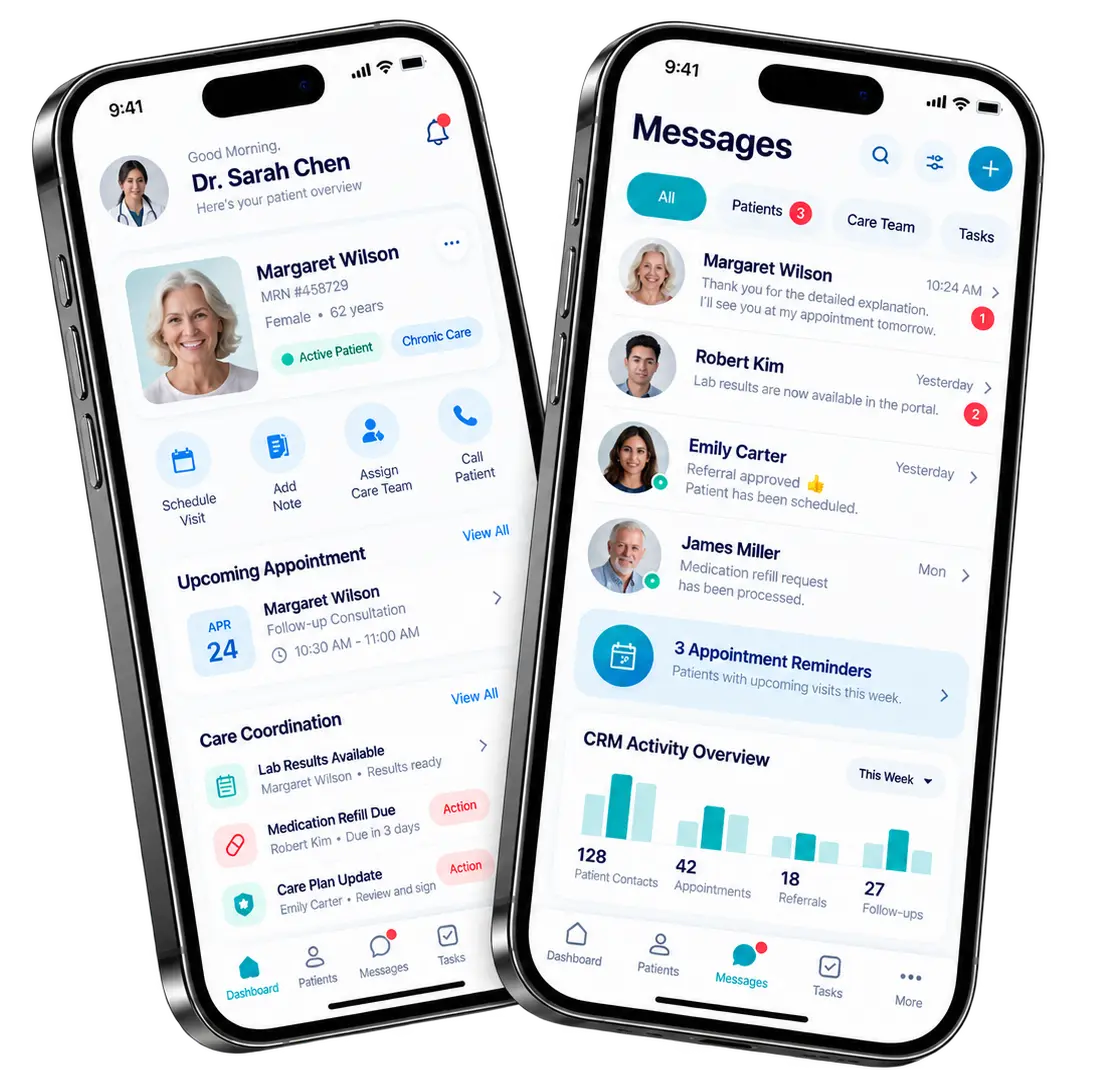
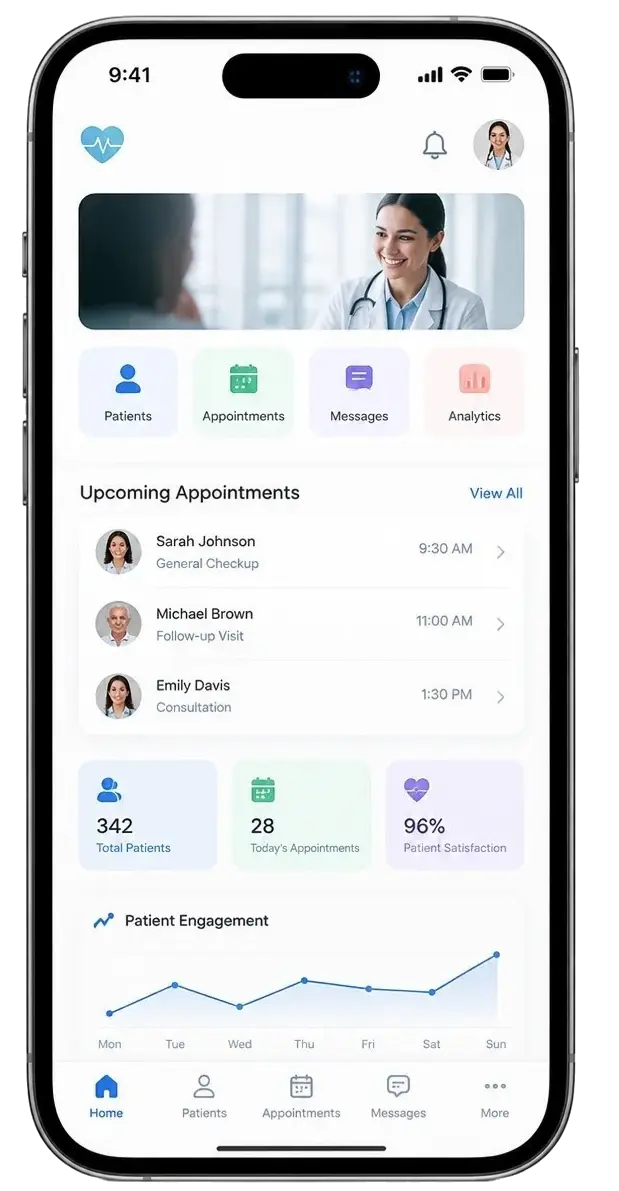
Healthcare CRM software connects patient relationship data, communication workflows, administrative operations, and engagement analytics. Customizable modules and integration capabilities allow the platform to align with existing healthcare systems and organizational requirements.
01 / 10
Unified Patient Profiles and 360-Degree Patient View
Combine patients' contact information, communication needs, appointment history, and questions and queries into an individualized profile of relationships. Data mapping, identity matching, deduplication, and source of truth rules are used to maintain consistency between different systems where all patient information is not stored within a single system like an electronic health record.
Unified patient and interaction records
Cross-system data synchronization
Duplicate detection and record matching
Permission-controlled access to patient information
02 / 10
Multichannel Patient Communication
Integrate a communication system for patients' needs via an app-based platform to manage events effectively. Trigger settings for deliveries and tracking of delivery statuses to avoid missing emails or duplicates are also useful because they reduce missing and duplication rates.
Message templates, delivery logs, and consent preferences
03 / 10
Appointment Scheduling and No-Show Management
Integrate CRM processes with scheduling tools for tracking appointment statuses and triggering timely notifications. Reconciliation of statuses and duplication detection for event and exception management help maintain consistency between appointment processes.
Appointment status visibility
Automated confirmations and reminders
Cancellation and rescheduling notifications
No-show tracking and follow-up task creation
04 / 10
Healthcare Referral Management
Organize the referral management process by means of an organized system for statuses, provider information assignments, and follow-up on them. Integration of this system with appropriate clinical software may offer more insight into referrals' status depending upon information accessibility and permission levels.
Referring-provider profiles
Referral intake and status tracking
Automated task assignment and follow-up reminders
Referral volume and status reporting
05 / 10
Patient Engagement and Behavior Analytics
Analyze engagement metrics for identifying trends in appointments attended by clients; communications received from them; and whether they completed their tasks after receiving those messages. Customizable dashboard settings allow for comparison of engagement levels among different departments or sites while still considering that behavior is not a medical condition, but rather an outcome thereof.
Patient engagement dashboards
Appointment attendance trends
Communication response and follow-up metrics
Location-based reporting and trend analysis
06 / 10
Healthcare Marketing Automation and Personalization
Configure patient outreach workflows using approved audience segments, communication preferences, and campaign rules. The consent checklists, suppression list, and event-based triggers are used to ensure compliance with relevant data protection laws for communications purposes.
Patient segmentation and targeted campaigns
Automated service and screening reminders
Configurable communication templates
Campaign tracking and performance reporting
07 / 10
Patient Feedback and Satisfaction Management
Gather and organize feedback after meetings, consultations, or services provided by us. The survey trigger, response classification, and process routing are useful for identifying problems so an admin team can take action on them later.
Automated survey distribution
Feedback collection and categorization
Satisfaction dashboards and trend analysis
Complaint routing and follow-up task assignment
08 / 10
Chronic-Care Engagement and Care-Plan Reminders
Maintain continuous patient involvement by scheduling regular notifications and approving follow-up processes linked with an authorized healthcare management system or medical records database. Access control mechanisms and physician-approved policies are used to prevent inappropriate data usage by reminders while still allowing them for proper medical decision-making purposes.
Scheduled follow-up and check-in reminders
Approved care-plan notifications
Patient education communications
Missed follow-up tracking and escalation
09 / 10
Reporting, Dashboards, and CRM Performance Analytics
Transform CRM workflows to generate reports on load management, customer support activities, and efficiency of processes. Customizable metric tracking tools, secure reporting interfaces, and periodic updates of information are useful for measuring results through uniform standards.
Appointment and referral reports
Communication and campaign performance
Task completion and workflow backlog
Cross-location operational comparisons
10 / 10
Task Automation and Healthcare CRM Workflow Management
Automation of routine tasks by means of customizable policies, events, and conditions for workflow automation. Process queuing, retry management, and duplication avoidance mechanisms for events and approvals are useful to enhance reliability without losing necessary manual control over them.
Automated task creation and assignment
Status-based alerts and referral routing
Escalation and approval workflows
Exception queues and workflow audit history
Are Your Patient Engagement Workflows More Complex Than Your Current CRM Can Handle?
Discuss a solution for patient communication, appointment coordination, referral tracking, and workflow automation that aligns with how your healthcare organization operates.
Healthcare CRM Use Cases for Real-World Healthcare Workflows
CRM for healthcare is designed to manage various processes, like customer relationship management systems, that are tailored according to organizational needs, such as patients' journeys or services provided by them. Configurations for customization are used by healthcare professionals to manage their work processes and track efficiency levels.
Patient Acquisition and Inquiry Management
Collect queries through website visits, telephone calls, or via an approved referrer system so that they can be forwarded by employees as needed. Tracking inquiries and converting them to reports helps us track response time and find out which channel is most successful at acquiring customers for our business.
Appointment Coordination and Patient Retention
Integrate CRMs with calendar software for managing appointments, sending notifications about them, and following up after visits. Tracking attendance through rules based on engagement helps administrators catch up on missed visits while maintaining regular contact between doctors and patients.
Referral Network Management
Handle referrals to other organizations from our healthcare provider network via an organized process of referral management. Tracking referrals by providers' interactions and assignments helps to track them for monitoring purposes within an organization of healthcare organizations.
Multi-Location Healthcare Operations
Centralized reporting system for supporting hospital-based organizations to operate at various locations with customizable workflow processes. Access control by role; facilities management functions; unified reporting tools for managing operations within a particular area of responsibility.
Patient Feedback and Service Improvement
Gather patients' opinions about services and send them to relevant departments where they can be addressed by those who are responsible for handling such problems. The categorization process is followed up by monitoring progress on these issues while also providing a means to report trends of customer satisfaction over time for administrative purposes.
AI Capabilities for Healthcare CRM: Patient Engagement and Workflow Intelligence
AI capabilities can support healthcare CRM workflows through inquiry classification, communication drafting, engagement analytics, task recommendations, and report summarisation. Implementation depends on data quality, system integration, privacy safeguards, model evaluation, and appropriate human oversight.
AI-Assisted Patient Communication
Message drafting
Inquiry classification
Interaction summarization
Response recommendations
Safety controls
Predictive Patient Engagement Analytics
Attendance prediction
Engagement analysis
Risk indicators
Model evaluation
Performance monitoring
Intelligent Referral and Task Routing
Referral classification
Information validation
Queue prioritization
Task recommendations
Human oversight
AI-Powered CRM Reporting and Knowledge Retrieval
Natural-language queries
Report summarization
Contextual retrieval
Role-aware responses
Governance and monitoring
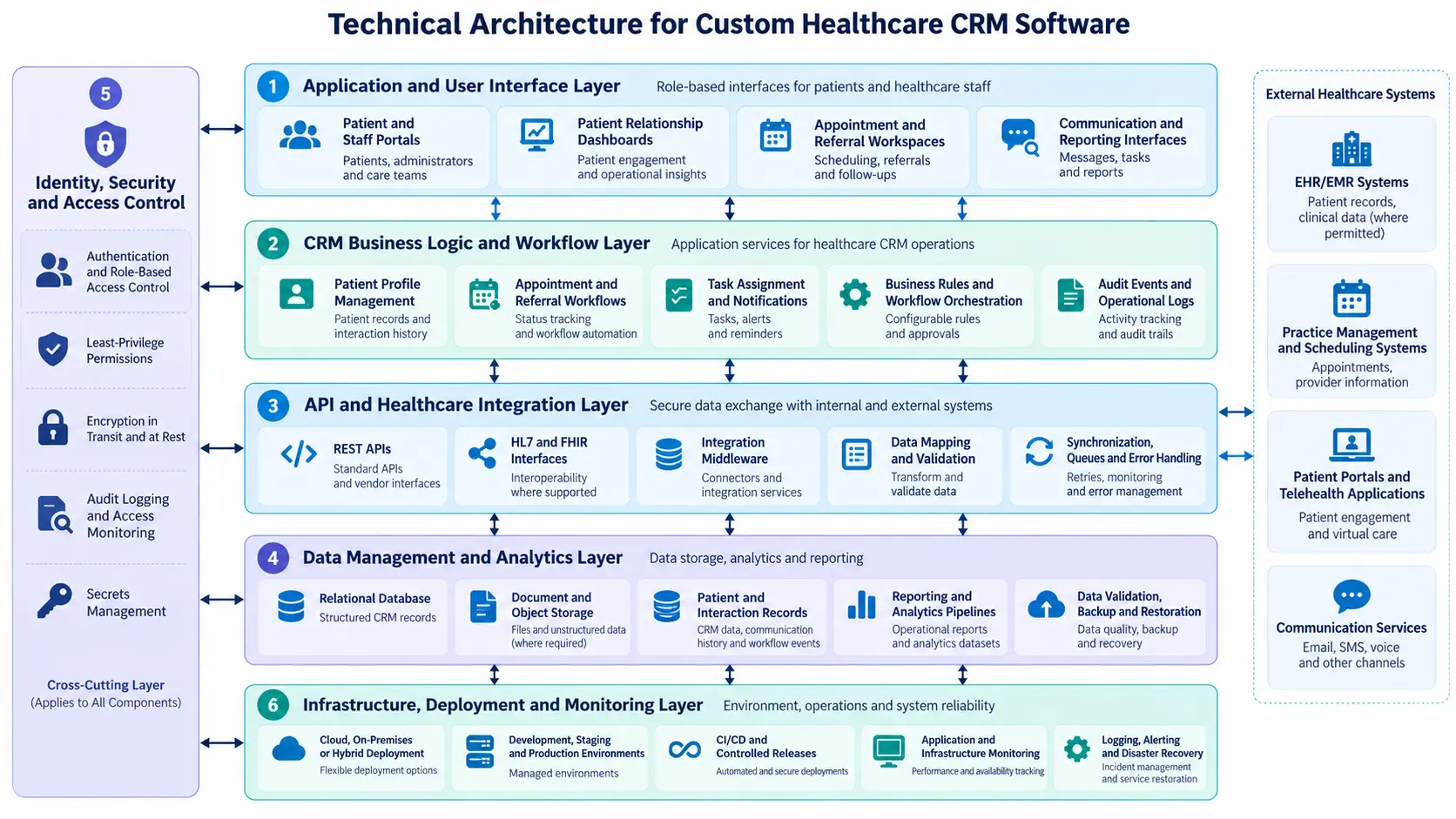
Custom Healthcare CRM Software Architecture
The custom healthcare CRM has an integrated system of modules for connecting patients' front-end applications, admin processes within hospitals or clinics, electronic medical records management software, and report generation tools. The architecture is designed for you based on integration needs, load expectations, deployment environments, and governance of information systems.
×
Application and User Interface Layer
Provides accessible, responsive interfaces tailored to healthcare staff and patient-facing workflows.
Patient relationship and operational dashboards
Appointment and referral management workspaces
Communication and task management interfaces
Reporting dashboards and role-specific views
Permission-based access to relevant functions
CRM Business Logic and Workflow Layer
Processes CRM operations and coordinates business rules, automated workflows, and administrative activities.
Patient profile and interaction management
Appointment and referral status transitions
Workflow orchestration and notification triggers
Approval processes and exception handling
Audit events and operational logs
API and Healthcare Integration Layer
Enables controlled data exchange between the CRM and connected healthcare applications.
REST APIs and vendor-supported interfaces
HL7 and FHIR integration where supported
Integration middleware for complex environments
Data mapping, validation, and transformation
Synchronization, retry queues, error handling, and monitoring
Data Management and Analytics Layer
Organizes CRM records, interaction histories, workflow events, and reporting data.
Relational databases for structured records
Document or object storage where required
Data relationships, identity matching, and deduplication
Audit records, retention policies, and data lifecycle controls
Reporting datasets and analytics pipelines
Backup, restoration, and data validation mechanisms
Infrastructure, Deployment, and Monitoring Layer
Supports reliable deployment, system performance, maintenance, and recovery.
Cloud, on-premises, or hybrid deployment
Separate development, staging, and production environments
CI/CD pipelines and controlled release processesli>
Application and infrastructure monitoring
Centralized logging, alerting, and error tracking
Capacity planning and performance testing
Disaster recovery and service restoration planning
Identity, Security, and Access-Control Layer
Protects patient-related information and restricts access according to user roles and operational needs.
Authentication and role-based access control (RBAC)
Least-privilege permissions and multifactor authentication where appropriate
Encryption in transit and at rest
Audit logging and access monitoring
Secrets and credential management
Recovery planning and incident-response procedures
Healthcare CRM Integration Solutions for Connected Healthcare Systems
Healthcare CRMs provide more business benefits by integrating with current healthcare systems to facilitate seamless data sharing between patients' interactions, appointment management, referrals, and reporting processes. The healthcare CRM integration service is designed according to an organization’s needs for connectivity features, data management rights and control policies, as well as syncing protocols between systems.
EHR and EMR Integration
Patient data exchange
Patient identity matching
Data mapping and transformation
Synchronization management
Access and error handling
01
Patient Portal, Mobile App, and Website Integration
API connectivity
Appointment request workflows
Questionnaire and survey synchronization
Identity and consent management
Data validation
02
Practice Management and Scheduling Integration
Schedule synchronization
Event-driven workflows
Status reconciliation
Duplicate-notification prevention
Exception management
03
Email, SMS, and Communication Platform Integration
Provider API integration
Template management
Consent and preferences
Delivery tracking
Retry and failure handling
04
Business Intelligence and Analytics Integration
Data pipeline development
Data transformation
Dashboard development
Refresh and processing controls
Data quality and governance
05
HL7, FHIR, and API-Based Data Exchange
FHIR-based exchange
HL7 integration
Vendor-specific APIs
Middleware and transformation
Interface monitoring
Security and interoperability testing
06
Compliance and Security Standards for Healthcare CRM Development: What We Consider
Patient information is protected by healthcare CRM security measures such as encryption, access control policies, auditing logs for tracking purposes, and secure storage of records. HIPAA, GDPR, and other national privacy regulations might be applicable for this application based upon its data type, location of deployment, and legal jurisdiction.
HIPAA and the HITECH Act
Protect ePHIs from unauthorized disclosure through measures like encryption policies and conduct regular security audits to identify vulnerabilities before they become threats that could compromise patient privacy or confidentiality of medical records.
GDPR and regional privacy laws
Support data minimization, a proper lawful basis for processing, consent management if necessary, subject access rights to their personal information, retention policy, and cross-border transfer protection measures. Some other relevant statutes are India's DPDP Act and California's CCPA.
Identity and Access Management
Implement RBAC, least privilege rights management, MFA, and SSO if needed for users' identities.
Data Encryption and Audit Trails
Secure credential management, access logging, integrity checks of information, and controlled retention policies for records.
Align development practices to ISO/IEC 27001, NIST Cybersecurity Framework, NIST SSDF, OWASP guidelines, and SOC 2/HITRUST standards as appropriate.
Planning AI-Powered Patient Engagement Without Losing Control of Your Data?
Explore how AI-assisted communication, engagement analytics, and workflow recommendations can fit into your healthcare CRM, with appropriate access controls, privacy safeguards, evaluation, and human oversight.
How Much Does Healthcare CRM Software Development Cost?
Explore healthcare CRM software development cost according to your company’s requirements for product features, system compatibility issues, and technical difficulties involved during the implementation process. Select an initial location to obtain a personalized quote on this matter.
Structured Healthcare CRM Development Approach: We Build Around Your Needs
Our work process is designed to deliver organizational goals, customer requirements, technology constraints, and timelines for execution. Every phase has specific objectives to be achieved, as well as standards of quality for completion at each step.
Healthcare Workflow and Requirements Assessment
Interview stakeholders to understand their needs and goals for the project.
Review existing process documentation, identify bottlenecks, and enhancement possibilities.
Define user groups, set business priorities, and define functional acceptance criteria.
Assess technological limitations and restrictions of current systems.
Define project scope, implementation priorities, and delivery requirements.
Technical Specification and Solution Planning
Convert approved requirements to functional and technical specification documents.
Module boundary definition, dependency management, and project priority setting.
Ownership of documents, integration requirements, and external dependencies.
Define functionalities such as speed, uptime reliability, and ease of maintenance.
Project milestone definition, delivery item specification, and verification points are defined here.
UI/UX Prototyping and Workflow Validation
Design wireframe models of important CRMs to build an interface prototype.
Map navigation and user interactions for different operational roles.
Check out forms' functionality, process flow changes, and data availability issues.
Perform a review of stakeholders' needs to identify issues related to usability.
Complete finalized design documents and interfaces prior to the start-up of project work.
Iterative Development and Integration
Create a customizable CRM module according to approval standards.
Develop back-end services, business logic, and necessary application features.
Version control systems, the code review process, and development environment management tools are used for this purpose.
Check out each part separately, then integrate it into an entire program.
Quality Assurance and Acceptance Testing
Run functionality testing and regression tests on specified specification documents.
End-to-end validation of processes between different healthcare systems.
Edge case testing for failures of transaction processing systems, duplicate submission problems, and recovery from failure situations.
Assess results for meeting defined standards of acceptability.
Fix bugs by getting feedback from users for validation purposes of a product or service.
Data Migration and Production Rollout
Create a script of an old database to migrate it into another system or format.
Migrate records and reconcile them to source information for investigation of inconsistencies.
Check validation of production configuration and completion for deployment readiness.
Implement and execute a cut-over plan along with rollback options if necessary.
User onboarding process, documentation procedure, and operations transfer.
Post-Launch Support and Continuous Improvement
Create a script of an old database to migrate it into another system or format.
Migrate records and reconcile them to source information for investigation of inconsistencies.
Check validation of production configuration and completion for deployment readiness.
Implement and execute a cut-over plan along with rollback options if necessary.
User onboarding process, documentation procedure, and operations transfer.
Why Choose Suffescom for Healthcare CRM Development?
Suffescom Solutions is the best healthcare CRM software development company. We deliver customized CRM solutions tailored to your current processes, infrastructure requirements, and goals. From workflow customization to system integration, the focus is on building maintainable solutions aligned with your requirements.
Custom CRM Engineering Around Healthcare Workflows
Create a healthcare customer relationship management system for patient relationships, referral processes, communications, and administrative tasks. Customizable business logic, access control policies, and analytics reports are useful for tailoring this system to meet organizational requirements.
Healthcare System Integration and Interoperability
Integrate healthcare CRM software to support an EHR/EMR system for appointment bookings, patient portal access, and messaging service provision. Integration of APIs, mapping to databases, and syncing between them help ensure smooth communication among linked devices or applications.
Security-Aware Software Development
Incorporate authentication, role-based access controls, encryption, and audit logging into the development process. Data security tests and risk management measures are used to meet relevant privacy law compliance issues.
Modular Architecture and Future Enhancements
Develop an easy-to-maintain CRM system for changing processes and integrations. The architecture may also be designed according to project requirements so that it is flexible enough for later modifications while avoiding any additional cost of adding more features.
Structured Delivery and Post-Launch Support
Project milestone definition, iteration process, stakeholder approval stage of the product life cycle, and quality assurance phase. Planning for deployment, documentation of technology needs, maintenance tasks, and continuous improvement may vary based on what you need from us as a customer.
Healthcare Technology Experience
The Suffescom published healthcare product line is a patient portal software for electronic record management system (EHR) integration, telemedicine services provider platform, and medical app development company. This project provided knowledge about integrated medical systems and patient care processes.
Technology Stack for Healthcare CRM Development: Built Around Your Needs
The technology stack supports patient relationship workflows, healthcare data exchange, application security, and scalable deployment. Technology selection depends on system compatibility, integration requirements, data workloads, identity management, and infrastructure constraints.
Frontend Development
React
Angular
Next.js
TypeScript
Backend Development
Node.js
.NET
Python
Java
Databases Data Management
PostgreSQL
Microsoft SQL Server
MongoDB
Redis
APIs Healthcare Interoperability
REST APIs
HL7 / FHIR
Webhooks
API Gateways
Cloud Infrastructure & Deployment
Amazon Web Services (AWS)
Microsoft Azure
Google Cloud Platform (GCP)
Docker / Kubernetes
Identity, Security & Monitoring
OAuth 2.0 / OpenID Connect
Role-Based Access Control (RBAC)
Application Logging and Monitoring
CI/CD Security Checks
Our Experience in Delivering CRM Solutions
Explore real-world CRM projects that demonstrate expertise in patient relationship management, workflow automation, customer data centralization, and integrated communication systems.
01 / 02
Omnichannel CRM Platform for Multi-Channel Customer Operations
Business Context
The client needed a unified CRM platform to manage customer interactions across multiple communication channels. Disconnected customer records and workflows made it difficult for sales, service, and marketing teams to coordinate activities, maintain consistent information, and manage follow-ups efficiently.
Our Approach
Developed an omnichannel CRM platform that centralized customer profiles, communication history, support requests, sales activities, and marketing workflows. The solution included inquiry routing, activity notifications, and coordinated follow-up workflows to improve visibility across teams.
A B2B organization relied on spreadsheets and disconnected communication channels to manage leads, customer information, sales activities, and pipeline reporting. These fragmented processes limited follow-up consistency and sales visibility.
Our Approach
Developed a centralized CRM with lead management, unified customer profiles, configurable sales pipelines, automated follow-ups, task management, real-time dashboards, and sales analytics.
Custom CRM Software for a Mexico-Based Footwear Brand
Business Context
A Mexico-based footwear brand needed to unify customer data, sales processes, and communication. Disconnected tools made lead management, follow-ups, pipeline tracking, and sales reporting difficult.
Our Approach
Built a custom CRM with centralized customer profiles, automated lead assignment, visual sales pipelines, workflow automation, unified communication, AI-assisted follow-ups, and third-party integrations.
Hear from Our Clients Who Transformed Their Healthcare CRM Workflows
CLIENT STORY
“Working with Suffescom helped us bring patient information, appointment management, and follow-up workflows into a more connected system. The tailored CRM solution addressed our operational challenges and helped our team manage patient relationships more efficiently.”
Steve AlemanChief Financial Officer at Prime Healthcare
“We needed a more organized way to manage patient interactions and communication. The CRM solution helped centralize information and streamline follow-ups, making it easier for our team to coordinate appointments and maintain consistent patient engagement.”
Erica Rossitto Senior Vice President and Chief Nurse Executive at HCA Healthcare
“We wanted to make it easier for patients and healthcare teams to access relevant information and communicate through a connected digital experience. The solution brought together patient-facing functionality and EHR integration to support smoother information exchange and administrative workflows.”
Samantha Ing Chief Operating Officer at Palm Beach Health Network
“Our goal was to reduce fragmented workflows and simplify administrative tasks across our healthcare operations. Integrating EHR and payment systems while centralizing patient intake and registration helped create a more connected application experience.”
Bret Johnson Chief Financial Officer at Cape Fear Valley Health System
“We needed better coordination between scheduling, billing, reporting, and patient engagement systems. Custom integrations helped connect these functions with our existing practice management platform, supporting more consistent information flow across operations.”
What Will It Take to Turn Your Healthcare CRM Requirements Into a Working Solution?
Share your project scope, required features, integration needs, and deployment preferences. We'll discuss the technical considerations, development priorities, and cost factors that should shape your healthcare CRM implementation.
Recognitions that reflect excellence in software engineering, technology innovation, and service delivery across diverse industries.
Rated 4.6 out of 5 by clients on Google
Rated 4.8 out of 5 by clients on Clutch
Rated 4.5 out of 5 by clients on GoodFirms
Rated 4.7 out of 5 by clients on Trustpilot
Read our client reviews on G2
Read our client reviews on DesignRush
Read our client reviews on Dribbble
Read our client reviews on Capterra
FAQs
Healthcare CRM software manages patient relationships, communications, referrals, appointments, and engagement workflows. Unlike general-purpose CRM platforms, it accommodates healthcare-specific processes, privacy requirements, and integrations with systems such as electronic health records (EHRs), laboratory management platforms, and other healthcare operational systems.
Healthcare CRM focuses on patient engagement, communication, referrals, and relationship management. EHR/EMR systems primarily manage clinical records and related care workflows. Integrating these systems enables authorized information exchange between patient-facing operations and clinical systems.
Common features include patient profiles, appointment management, automated reminders, referral tracking, communication management, engagement analytics, reporting dashboards, and role-based access controls. The final feature set depends on organizational workflows, integration requirements, user roles, and data protection needs.
Healthcare CRM software development costs vary with functionality, integrations, security requirements, and deployment complexity. Third-party estimates from Appinventiv indicate that focused MVPs may start at approximately $40,000, while complex implementations can reach $200,000–$400,000 or more. These are indicative market figures, not confirmed Suffescom pricing.
Development timelines depend on project scope, workflow complexity, integrations, data migration, testing, and deployment requirements. A focused CRM implementation generally requires less effort than an enterprise platform with multiple integrations. A realistic timeline is established after requirements, dependencies, and delivery milestones are assessed.
Yes, integration may be possible through supported APIs, HL7 or FHIR interfaces, middleware, and vendor-specific connectors. Feasibility depends on the existing system's capabilities, interface availability, access permissions, data formats, and interoperability requirements.
Healthcare CRM software can incorporate safeguards such as encryption, access controls, audit logs, and privacy-related workflows. However, compliance depends on applicable regulations, system configuration, organizational policies, contractual obligations, and operational practices. Software alone does not guarantee HIPAA or GDPR compliance.
Yes. Custom healthcare CRM development supports tailored workflows, specialized integrations, and greater control over functionality. Existing platforms may offer faster implementation and established features. The decision depends on licensing costs, customization needs, integration complexity, maintenance responsibilities, and long-term ownership objectives.
Yes. Event-driven workflows can trigger appointment reminders, follow-up tasks, surveys, and approved communication sequences. Automation can use scheduling events and predefined rules to initiate actions. Consent preferences, communication-channel restrictions, message accuracy, and appropriate escalation procedures must also be considered.
Yes. Healthcare CRM can track referring providers, incoming referrals, referral status, follow-up tasks, and referral-related performance metrics. Integration with scheduling or clinical systems can improve visibility into referral progress, subject to interface availability, data permissions, and workflow requirements.
Yes. AI capabilities can support inquiry classification, communication drafting, engagement analytics, workflow recommendations, and report summarisation. Implementation requires appropriate data access controls, privacy safeguards, output evaluation, and human oversight to reduce errors and maintain accountability.
Cloud-based CRM offers managed infrastructure and flexible scalability, while on-premises deployment provides greater direct control over infrastructure and hosting. Hybrid deployment is another option. The appropriate model depends on security requirements, integration dependencies, internal IT capabilities, regulatory obligations, and operational priorities.
Yes. CRM migration can involve data mapping, deduplication, transformation, validation, reconciliation, and controlled cutover. The migration strategy depends on source-system capabilities, data quality, record volumes, and available export or integration interfaces. Validation helps identify inconsistencies before the new system becomes operational.
Source code ownership and intellectual property rights depend on the development agreement. Contracts should define ownership of custom-developed code, licensing of pre-existing components, third-party software obligations, documentation, and handover requirements. Clear terms help establish usage rights and responsibilities after project completion.
🍪We use cookies
Our website requires some cookies to function properly.
•SUFFESCOM SOLUTIONS
Build Smarter. Scale Faster. Grow More.
Have a Vision? Let’s Turn It Into a Digital Reality.
Get a quick response from our best experts in under 10 minutes.
“
Suffescom easily understood our main goal and delivered the best digital solution. Their team was very cooperative, and it was a very good experience working with them. I would highly recommend them.
James AndersonFounder & CEO, FinTech Company
“
Working with Suffescom was a really great experience. Their developers demonstrated technical knowledge and delivered our mobile app solution with all required functionalities on time.
Sarah MitchellProduct Manager, Healthcare Startup
“
Suffescom helped us build a logistics software solution that completely improved our fleet operations. Their professionalism and transparency are what make them a reliable technology partner.
Michael RobertsCEO, Logistics Company
Our Customer Say:EXCELLENT★★★★½✓ Goodfirms
Have a project idea or need expert guidance? Share your requirements at sales@suffescom.com and our team will get back to you shortly.
Share Your Requirements. Our Experts Will Shape the Solution.
Expert consultation within 10 minutes.Your project details are completely secure under NDA protection.
Get Outstanding Business Outcomes With Future Ready Solutions
Get Free Consultation From Top Industry Experts
Begin A Generous Partnership Now
•SUFFESCOM SOLUTIONS
Build Smarter. Scale Faster. Grow More.
Have a Vision? Let’s Turn It Into a Digital Reality.
Get a quick response from our best experts in under 10 minutes.
“
Suffescom easily understood our main goal and delivered the best digital solution. Their team was very cooperative, and it was a very good experience working with them. I would highly recommend them.
James AndersonFounder & CEO, FinTech Company
“
Working with Suffescom was a really great experience. Their developers demonstrated technical knowledge and delivered our mobile app solution with all required functionalities on time.
Sarah MitchellProduct Manager, Healthcare Startup
“
Suffescom helped us build a logistics software solution that completely improved our fleet operations. Their professionalism and transparency are what make them a reliable technology partner.
Michael RobertsCEO, Logistics Company
Our Customer Say:EXCELLENT★★★★½✓ Goodfirms
Have a project idea or need expert guidance? Share your requirements at sales@suffescom.com and our team will get back to you shortly.
Share Your Requirements. Our Experts Will Shape the Solution.
Expert consultation within 10 minutes.Your project details are completely secure under NDA protection.







 React
 Angular
 Next.js
 TypeScript
 Node.js
 .NET
 Python
 Java
 PostgreSQL
 Microsoft SQL Server
 MongoDB
 Redis
 REST APIs
 HL7 / FHIR
 Webhooks
 API Gateways
 Amazon Web Services (AWS)
 Microsoft Azure
 Google Cloud Platform (GCP)
 Docker / Kubernetes
 OAuth 2.0 / OpenID Connect
 Role-Based Access Control (RBAC)
 Application Logging and Monitoring
 CI/CD Security Checks