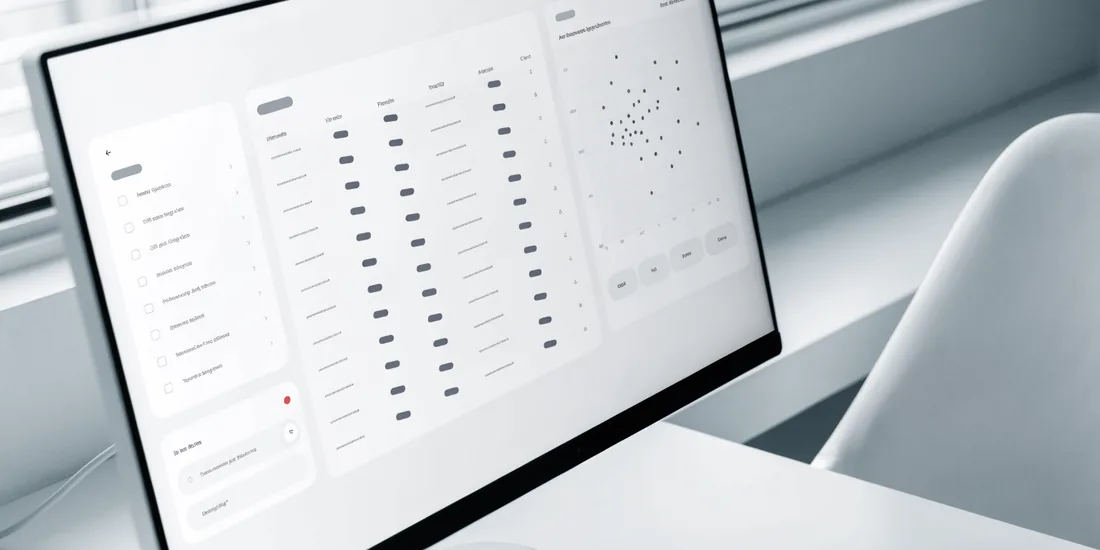
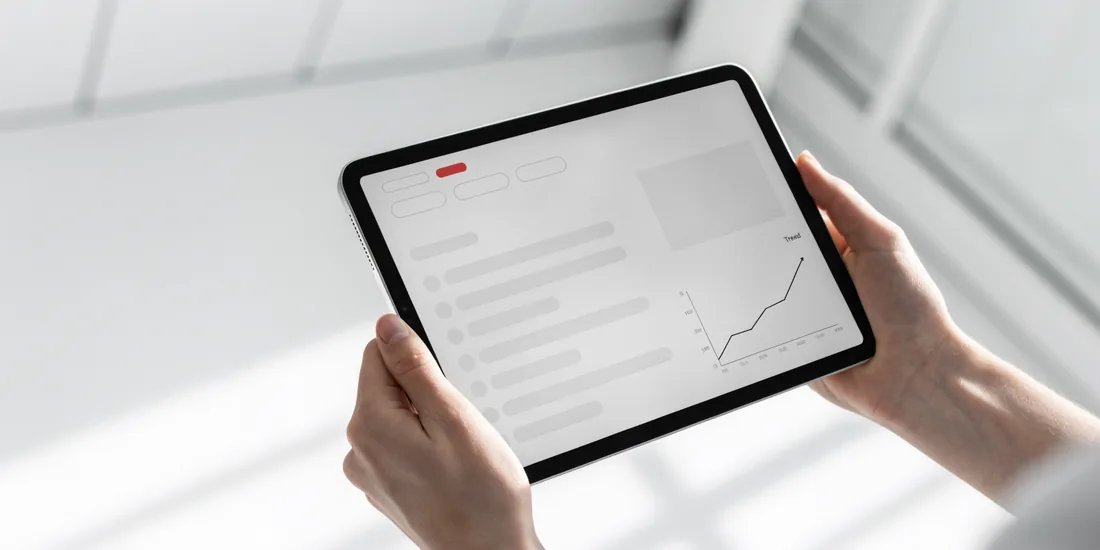
Laboratory Information System (LIS) Development
- Test order management
- Specimen identification
- Result management
- Clinical system connectivity

Manage samples, automate testing workflows, track laboratory inventory, and connect essential equipment through custom lab management software designed around your operations. Suffescom develops tailored laboratory software solutions that connect data, processes, and reporting.
From a standalone inventory manager to a full-scale LIMS or laboratory software system, our experts build cloud-based or on-premises systems according to your needs.
Laboratory overview
All departments · Sample data
Up 8.4% vs previous period
Samples by department
Labs need to manage samples, testing procedures, inventory, equipment, and results with end-to-end traceability and data accuracy. Laboratory management software connects these processes into unified chains of data and control.
Connect sample tracking, testing, inventory, instruments, and reporting with custom laboratory software tailored to your workflows.
A laboratory’s software must meet specific testing, analytical, hardware, and data needs. We can offer you bespoke software solutions from specific applications through to full laboratory management systems to suit your processes, infrastructure, and business requirements.
Connect sample tracking, testing, inventory, instruments, and reporting with custom laboratory software tailored to your workflows.
Custom laboratory software can enhance the functions that your team carries out on a daily basis, ranging from sample receiving to final reporting. Suffescom produces adaptable solutions that integrate laboratory processes, minimize the need for manual coordination, and provide teams with more operational data control.
Monitor the flow of samples in and out of registration, reception, testing, storage, review, and disposition. It may encompass one-of-a-kind sample identification, barcode labeling, chain of custody documents, storage location tracking, test assignment, and linking with results.
Schedule and assign different tests with configurable schedules, steps, procedures, and review workflows. Routes routine status and notifications automatically, collects supported instrument data, and forwards exceptions or instrument results for authorized review.
Keep track of reagent and consumable availability during the entire lifecycle. Monitor batches, expiration dates, and storage areas, and test or experiment using dates. Set up low stock alerts, reorder thresholds, and purchase request workflows in order to ensure timely reordering.
Use structured quality data with deviation tracking, corrective and preventive action workflows, controlled documents, approval history, and equipment calibration data. These capabilities aid teams in recovering pertinent proof and planning for an audit in accordance with the quality methodologies they are working with.
Integrate lab activities with common workflows, centralized reporting, and access permissions. Ensure proper levels of visibility into samples taken on site, stock and equipment held on site, and operational information, as well as controlling access to these by organizational role.
Manage research activities with linking of experiment records, procedures, materials, observations, results, and associated instrument records. Version control, programmability of templates, and group permissions can ensure uniformity of documents for different research projects.
Track instrument availability, scheduled maintenance, calibration dates, and downtime. Set up equipment status controls and maintenance reminders to assist teams in scheduling equipment use, coordinating servicing, and determining scheduling conflicts.
Convert operational data into reports and dashboards of all test turnarounds, pending workloads, sample volumes, repeat testing, reagent consumption, and equipment utilization. Provide resource planning metric data to managers and authorized groups to help pinpoint resources, trends, and measures for slowdowns.
Add the capabilities as individual modules or integrate them into an overall laboratory management solution. The scope of the solution can be customized to reflect your current processes, systems, integration needs, and future plans.
Connect sample tracking, testing, inventory, instruments, and reporting with custom laboratory software tailored to your needs.
Improve lab processes using AI-driven lab software. We will embed machine learning, generative AI, computer vision, predictive analytics, and blockchain to create bespoke lab management software.
AI capabilities

Integrate suitable AI technologies based on your laboratory's workflows, data, and operational objectives.
Predictive maintenance, workload forecasting, and anomaly detection.
Complex pattern recognition across scientific and experimental datasets.
Natural-language interaction, document generation, and contextual assistance.
Ground artificial intelligence responses in approved laboratory documents, SOPs, and knowledge repositories.
Coordinate authorized tasks across laboratory applications and workflows.
Analyze microscopy images, cell samples, and visual inspection data.
Extract information from laboratory reports, research documents, and unstructured records.
Enable voice notes, spoken commands, and hands-free workflow interaction.
Forecast equipment failures, workload changes, and operational bottlenecks.
Support model versioning, performance monitoring, drift detection, and controlled updates.
We build modular laboratory software using API-driven services, instrument integration, and event-driven data pipelines. Data validation, workflow orchestration, and asynchronous processing enable reliable integration across LIMS, LIS, ELN, instruments, and enterprise systems, supported by security controls and audit logging.
Configure laboratory software around the standards, regulations, and security controls relevant to your operating environment.
It is an international standard that supports laboratory quality management systems such as test documentation, equipment maintenance records, and traceability requirements of tests and calibrations conducted by a lab.
Supports medical laboratories' quality management system, documentation control, result tracking, and storage requirements.

Implements electronic records and signatures, such as access control, audit trail management, and signing procedures.

Where applicable to the US healthcare environment, HIPAA provides protection of electronic patient records via authentication mechanisms.

Where applicable, this provides privacy by limiting access rights to users' information, minimizing the amount collected from them while retaining it for a longer time period.

It restricts access to systems based on roles of users and their privileges.

Keep track of history records and timestamp changes to them by means of a log management system.

Configure backup schedules, restore data from backups when needed, and define disaster recovery goals based on business needs.

Support documented testing, controlled releases, configuration histories, and validation evidence where required.
Development costs vary depending on your laboratory's workflows, required features, integrations, and deployment needs.
Our approach is based on an organized methodology for developing lab applications that are tailored to your workflow needs and integration requirements, as well as business objectives, from the design phase through the implementation stage and continuous enhancements thereafter.






Build laboratory management software around your operational requirements with a custom data engineering system, interoperability, and maintainable application architecture. Suffescom can scope the development approach around your existing laboratory systems, data workflows, integration requirements, and deployment environment.
Develop complete laboratory applications across frontend interfaces, backend services, databases, and APIs. Implement sample registration, test assignment, result management, inventory records, and reporting through connected application components with defined business rules and data validation.
Translate laboratory procedures into configurable software workflows covering sample accessioning, testing stages, review queues, approvals, and result release. Define status transitions, exception handling, user permissions, and conditional rules to reflect how laboratory teams process work.
Connect compatible laboratory instruments and external systems using vendor-supported interfaces, APIs, middleware, or custom adapters. Map instrument outputs to application data models, validate incoming records, and implement error handling, retries, and integration monitoring where required.
Separate LIMS, inventory management, equipment tracking, and reporting into defined modules with clear interfaces and data dependencies. This structure supports controlled feature enhancements, isolated component updates, regression testing, and integration of additional laboratory capabilities without unnecessarily rebuilding the entire application.
Implement authentication, role-based access control, encrypted data transmission, input validation, and audit logging according to project requirements. Where applicable, design traceable record changes, controlled approvals, backup procedures, and retention mechanisms to support laboratory data governance and applicable compliance needs.
Prioritize core laboratory workflows before expanding into additional modules and integrations. Use agreed milestones, test criteria, release controls, and deployment checks to manage delivery. Post-launch maintenance, defect resolution, dependency updates, performance monitoring, and future enhancements can be defined within the support agreement.
We select technologies based on your laboratory workflows, data volumes, integration dependencies, security requirements, and deployment environment. Our architecture can combine modern application frameworks, structured databases, APIs, and cloud infrastructure to support connected laboratory operations.
 React.js
 Angular
 Vue.js
 Next.js
 TypeScript
 HTML5 and CSS3
 Node.js
 Python
 Java
 C# / .NET
 PHP
 Go
 PostgreSQL
 MySQL
 Microsoft SQL Server
 MongoDB
 Oracle Database
 Redis
 Amazon S3
 Azure Blob Storage
 REST APIs
 GraphQL
 Amazon Web Services (AWS)Microsoft Azure
 Google Cloud Platform (GCP)
 Docker
 Kubernetes
 TerraformPython
 Pandas
 Apache Kafka
 Apache Airflow
 Celery
 RabbitMQ
 Apache Spark
 Microsoft Power BI
 Tableau
 Grafana
 Metabase
 Apache SupersetMicrosoft Entra ID
 Keycloak
 Auth0
 OAuth 2.0
 OpenID Connect (OIDC)
 PrometheusGrafana
 OpenTelemetry
 ELK Stack (Elasticsearch, Logstash, Kibana)
 AWS CloudWatchAzure Monitor
 Datadog
 Sentry
 Git
 GitHub Actions
 GitLab CI/CD
 Jenkins
 Azure DevOpsTerraform
 AnsibleContainer-based deployment pipelinesPython
 PyTorch
 TensorFlow
 scikit-learn
 Hugging Face Transformers
 CLIENT STORY
Our awards and recognitions reflect our commitment to technology excellence, service quality, and delivering solutions that support evolving business needs.

Clutch Software 2025

Trustpilot

DesignRush

GoodFirms

Crypto Award 2025

Clutch Global 2025

G2 Spring Leader

UpCity Award

Top Blockchain Trust Firm

Capterra
Explore how custom healthcare software, patient portal development, EHR integration, and hospital management systems help connect clinical and administrative workflows, improve patient engagement, and streamline hospital operations.
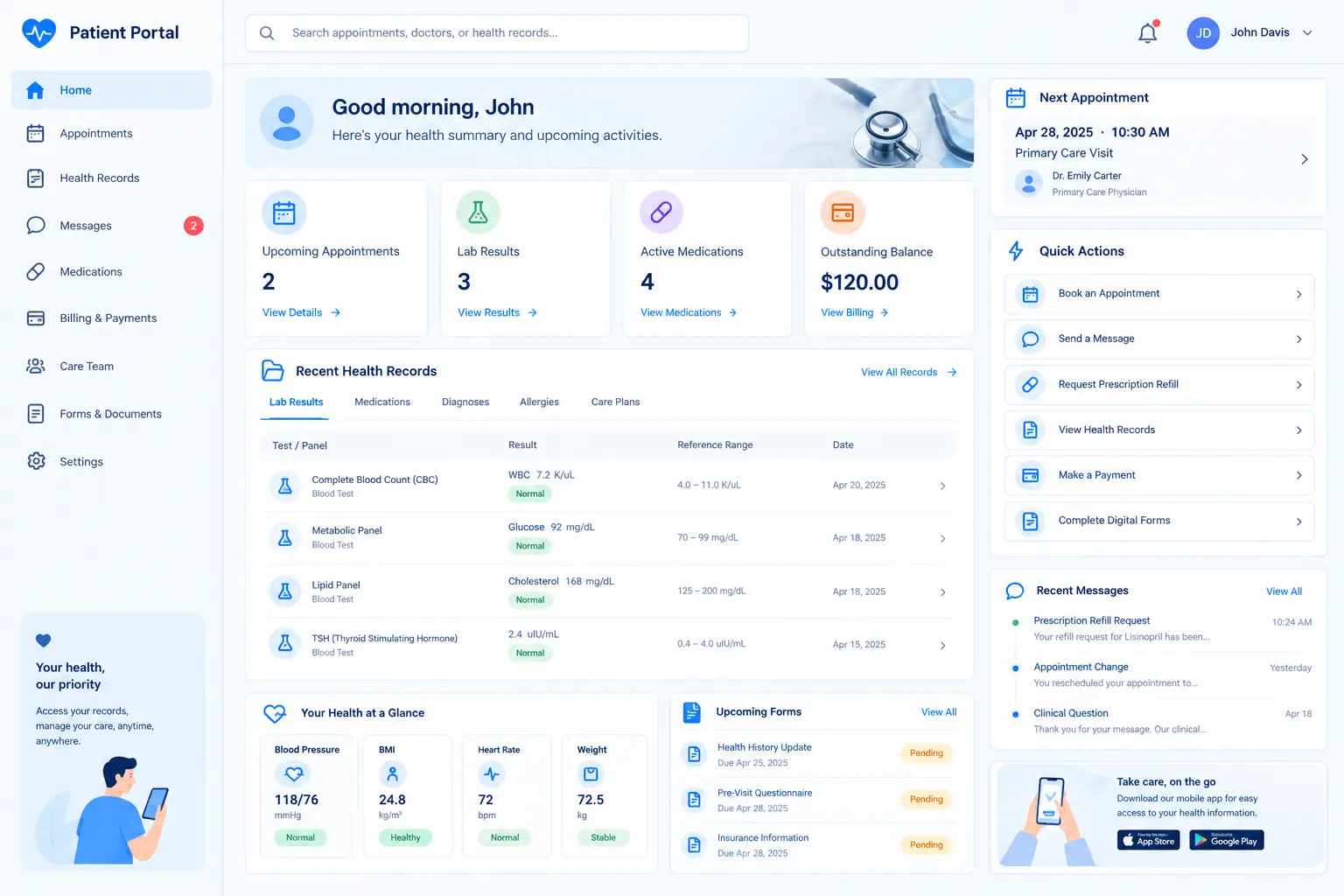
A multi-specialty healthcare provider needed to improve patient portal adoption, reduce administrative calls, and connect patient activities with its existing EHR system. .
Developed a mobile-first patient portal integrating appointment scheduling, secure messaging, digital intake, medical records, online payments, and real-time EHR synchronization using FHIR R4 APIs and HL7 v2.x..

A healthcare organization needed a digital platform to improve access to doctors, simplify appointments and consultations, manage medical records securely, and support communication between patients and healthcare professionals..
Developed the Sanar healthcare app with online appointment booking, HD video consultations, secure messaging, electronic medical records, and integrated payment gateways..
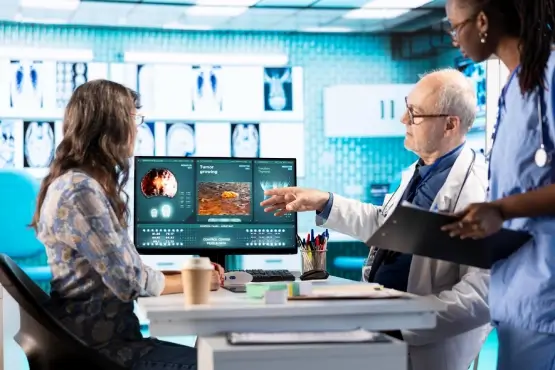
A hospital in Saudi Arabia needed to unify clinical, administrative, and financial operations while maintaining consistent patient information across departments. .
Developed an integrated Hospital Information System connecting patient records, OPD and IPD workflows, appointments, admissions, EHR, pharmacy, laboratory, radiology, billing, and inventory management, with role-based dashboards and scalable cloud infrastructure.

Bring sample management, testing workflows, inventory, and reporting together with custom laboratory software designed around your requirements. Let's discuss the right solution for your lab.
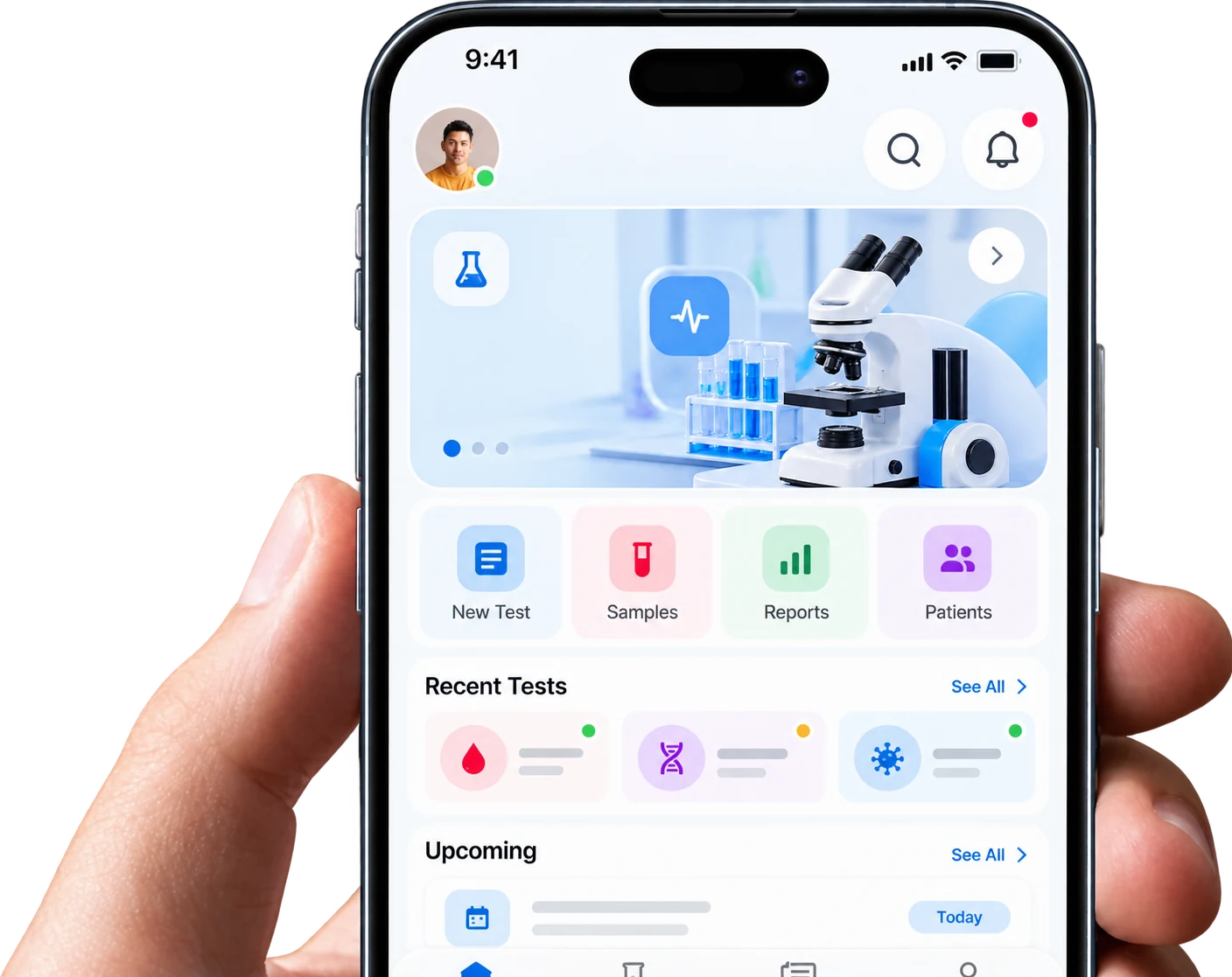
Custom lab or medical practice management software is an application tailored to laboratory workflows, including sample tracking, inventory, testing, equipment management, and reporting. It can operate as a standalone solution or integrate with existing laboratory systems, depending on operational requirements.
LIMS manages samples, testing workflows, and results. LIS primarily supports clinical laboratory operations and diagnostic testing. ELN records experiments, protocols, and research data. Laboratory inventory software tracks reagents, chemicals, consumables, stock levels, and expiry dates.
Yes. A standalone inventory management application can be developed alongside your existing LIMS. Depending on system compatibility, APIs or other integration methods can synchronize material records, stock movements, sample references, and relevant operational data without replacing the existing platform.
Depending on requirements, software can automate sample registration, barcode identification, test assignment, workflow notifications, inventory replenishment alerts, equipment maintenance reminders, result routing, approval workflows, and report generation. Automation rules should reflect laboratory procedures, user permissions, and required review checkpoints.
Yes, where supported interfaces are available. Integration may use vendor APIs, file exchange, middleware, or compatible communication protocols. The approach depends on instrument models, vendor documentation, output formats, connectivity options, and whether bidirectional communication is supported.
Yes, subject to the capabilities of the connected systems. Integrations can use REST APIs, supported vendor interfaces, middleware, or healthcare interoperability standards such as HL7 and FHIR where appropriate. Data mapping, authentication, error handling, and synchronization requirements must be assessed.
Custom laboratory software can be designed for public cloud, private cloud, on-premises, or hybrid deployment. The appropriate model depends on data governance, infrastructure, connectivity, security policies, integration dependencies, operational requirements, and the organization's maintenance capabilities.
AI can support document extraction, inventory forecasting, anomaly detection, predictive equipment maintenance, and natural-language search. Feasibility depends on data quality, available training or evaluation data, integration requirements, and risk controls. Outputs should be evaluated and reviewed appropriately before operational use.
Requirements depend on the laboratory's location, activities, and intended software use. Relevant considerations may include ISO/IEC 17025, ISO 15189, FDA 21 CFR Part 11, audit trails, access controls, electronic signatures, record retention, and validation. Software alone does not establish compliance.
Costs depend on modules, workflow complexity, instrument integrations, data migration, deployment, security, and validation requirements. A focused MVP generally costs less than an enterprise platform. A project-specific estimate requires requirements discovery, integration assessment, phased scoping, and documented deliverables.
Timelines depend on scope, integrations, data migration, testing, and validation requirements. A focused MVP may take several months, while complex multi-module or multi-site platforms can require substantially longer. A delivery timeline can be estimated after requirements and dependencies are assessed.
Yes. A phased approach can prioritize essential workflows, such as sample tracking or inventory management, before adding modules and integrations. The initial architecture should account for future requirements, shared data models, access controls, and integration dependencies to reduce avoidable rework.
Ownership depends on the signed development agreement. The contract should specify rights to custom-developed source code, deliverables, documentation, pre-existing components, third-party libraries, and licenses. Confirm intellectual property ownership, usage rights, and handover terms before project commencement.
Support can be scoped to include defect resolution, security updates, dependency maintenance, performance troubleshooting, monitoring, backups, and feature enhancements. Availability, response times, service hours, and fees depend on the agreed support arrangement and should be documented in the project contract.
• SUFFESCOM SOLUTIONS
Build Smarter. Scale Faster. Grow More.
Have a Vision? Let’s Turn It Into a Digital Reality.
Get a quick response from our best experts in under 10 minutes.
Suffescom easily understood our main goal and delivered the best digital solution. Their team was very cooperative, and it was a very good experience working with them. I would highly recommend them.

Working with Suffescom was a really great experience. Their developers demonstrated technical knowledge and delivered our mobile app solution with all required functionalities on time.

Suffescom helped us build a logistics software solution that completely improved our fleet operations. Their professionalism and transparency are what make them a reliable technology partner.

Share Your Requirements. Our Experts Will Shape the Solution.
• SUFFESCOM SOLUTIONS
Build Smarter. Scale Faster. Grow More.
Have a Vision? Let’s Turn It Into a Digital Reality.
Get a quick response from our best experts in under 10 minutes.
Suffescom easily understood our main goal and delivered the best digital solution. Their team was very cooperative, and it was a very good experience working with them. I would highly recommend them.
Working with Suffescom was a really great experience. Their developers demonstrated technical knowledge and delivered our mobile app solution with all required functionalities on time.
Suffescom helped us build a logistics software solution that completely improved our fleet operations. Their professionalism and transparency are what make them a reliable technology partner.
Share Your Requirements. Our Experts Will Shape the Solution.
Fret Not! We have Something to Offer.