+971-8000321216



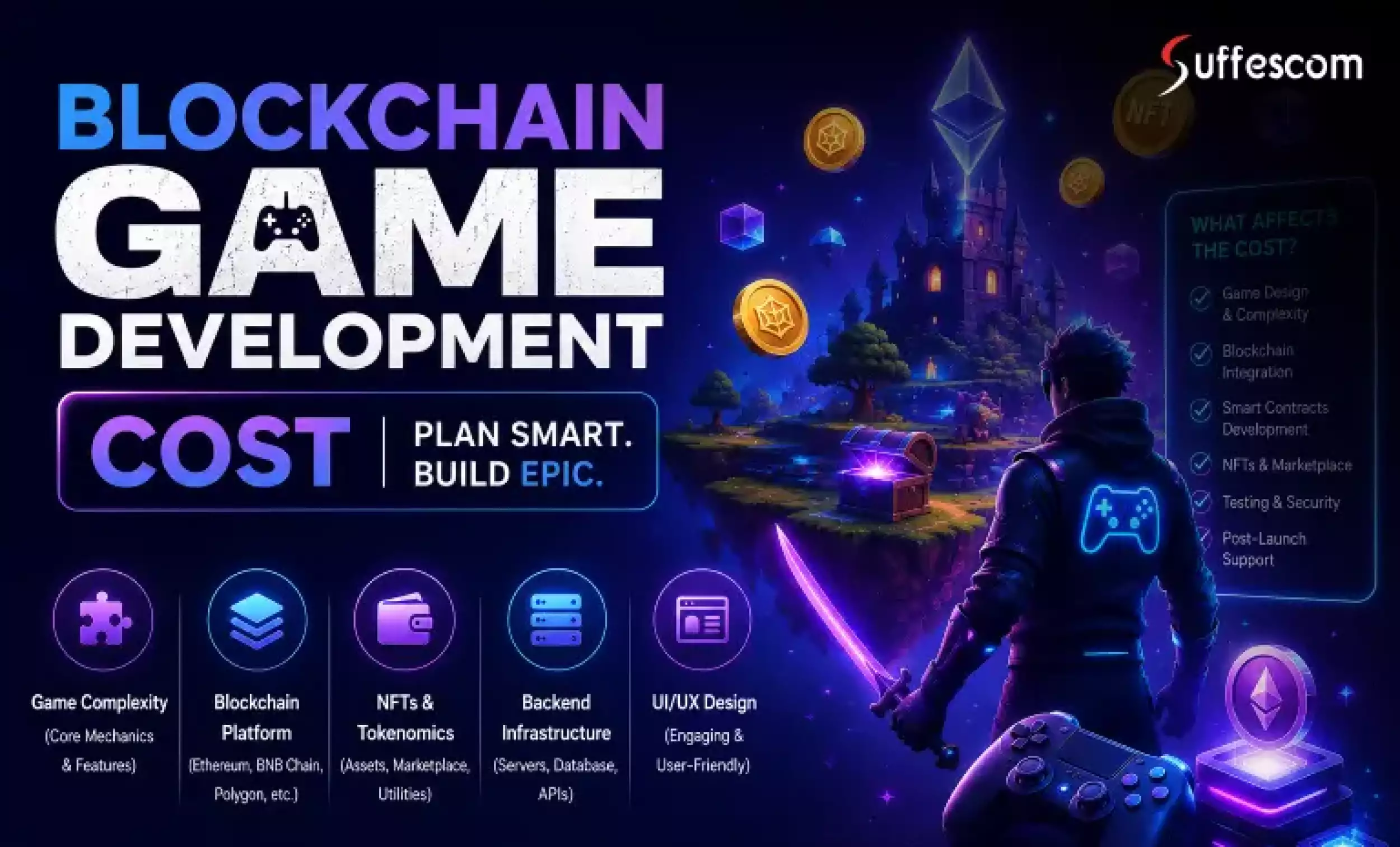
Blockchain game development costs will depend on your business needs, and they vary from $30,000 to $150,000. We recommend that you get in touch with our analysts to get an estimate for your project.
Between 2023 and 2030, the global blockchain gaming market is expected to witness growth at a CAGR of 68.3%. Not only for entertainment, but blockchain games also provide the ability for players to actually own in-game items, contributing to their growing popularity. As such, this industry turns out to be the new trend to follow for entrepreneurs who wish to build a blockchain game for a better business image. But what about costs? How much does it cost to develop a blockchain game?
Blockchain Gaming Market: Why Now Is the Right Time to Build
Before investing in the development of the project, it is crucial to understand the market you will be going into.
The blockchain games industry proves successful in all parameters. It is shown recently that top games like Pixel earned more than $35.6 million. It can be said that blockchain games offer great opportunities for making money through monetization models that cannot be offered by regular video games.
Entrepreneurs and investors need to keep several figures in mind when working with blockchain games, a multibillion-dollar market. There is an increasing number of daily users, wallets, and players being intrinsically motivated due to the ability of their work to bring profits. In fact, it is known that blockchain games have more active users compared to regular ones due to their financial interest in success.
Get a Custom Blockchain Game Development Cost Estimate
Tell us your game concept and our blockchain gaming architects will return a detailed, milestone-based estimate within 48 hours.
Blockchain Game Development Cost Overview: Quick Reference (2026)
Before examining individual cost factors, here is a high-level summary of what different game complexity tiers cost in 2026:
| Game Complexity | Estimated Cost | Development Timeline |
| Simple / Basic Game (NFT card, casual puzzle) | $10,000 – $50,000 | 2 – 4 months |
| Mid-Level Game (P2E with token economy) | $50,000 – $100,000 | 4 – 8 months |
| Advanced Game (strategy, action, multiplayer) | $190,000 – $150,000 | 8 – 18 months |
| AAA / Metaverse Blockchain Game | $150,000 – $200,000+ | 18+ months |
Cost by Blockchain Game Type (2026)
Different game genres carry fundamentally different technical requirements, blockchain integration depths, and smart contract complexity levels. This is the most important cost table for planning your budget.
| Game Type | Estimated Cost | Key Technical Drivers |
| NFT-Based Casual Game | $10,000 – $40,000 | Basic minting contract, simple marketplace integration |
| Play-to-Earn (P2E) Game | $30,000 – $120,000 | Token reward logic, staking, wallet integration |
| Strategy Blockchain Game | $50,000 – $180,000 | Complex game state, governance, multi-asset economy |
| Action Blockchain Game | $80,000 – $250,000 | Real-time mechanics, high-performance on-chain logic |
| Multiplayer Blockchain Game | $120,000 – $150,000 | Server infrastructure, anti-cheat, real-time settlement |
| Metaverse / AAA Blockchain Game | $150,000 – $200,000+ | Virtual world infrastructure, custom blockchain, full tokenomics |
Within these categories, cost escalates with the depth of blockchain integration. A P2E game with a single utility token and basic reward distribution sits at the lower end of its range; a P2E game with a dual-token economy, scholarship management, anti-bot protections, and governance voting sits at the upper end.
Development Stage-by-Stage Cost Breakdown
Understanding budget allocation by development phase helps identify where scope decisions have the greatest financial impact and where reducing scope carries the highest risk.
| Development Stage | Estimated Cost Range | What It Covers |
| Game Design and Tokenomics | $8,000 – $30,000 | Game mechanics, economic model design, whitepaper, technical specification |
| Smart Contract Development | $15,000 – $120,000 | Token contracts, NFT minting, staking, rewards, governance |
| Smart Contract Security Audit | $5,000 – $500,000 | Third-party audit by specialist firm; re-audits for major upgrades |
| Graphics and Animation | $10,000 – $120,000 | 2D/3D character art, environment design, UI assets |
| Backend Development | $15,000 – $80,000 | Game server infrastructure, API layer, database, wallet integration |
| Frontend / Game Client | $10,000 – $60,000 | Web or mobile game interface, wallet connection, marketplace UI |
| Testing, QA, and Security | $10,000 – $50,000 | Functional testing, load testing, penetration testing |
| Deployment and Launch | $5,000 – $30,000 | Mainnet deployment, infrastructure setup, monitoring configuration |
| Marketing and Community | $15,000 – $100,000 | Launch campaign, Discord/Telegram community, influencer partnerships |
The smart contract development and audit stages consistently account for 25–35% of total project budget in production-grade blockchain games. This is appropriate — smart contracts govern all asset ownership and financial transactions, and any vulnerability is permanent once deployed.
Mobile Blockchain Game Development Cost
Mobile is the fastest-growing distribution channel for blockchain games. Android and iOS deployment adds platform-specific development requirements alongside the blockchain layer.
| Mobile Game Type | Estimated Cost | Key Considerations |
| Simple Mobile Blockchain Game | $15,000 – $60,000 | Single platform (iOS or Android), basic NFT support |
| Mid-Level Mobile Blockchain Game | $60,000 – $100,000 | Cross-platform (iOS + Android), token economy, wallet integration |
| Advanced Mobile Blockchain Game | $100,000 – $150,000+ | AAA mobile experience, real-time multiplayer, deep on-chain economy |
Mobile blockchain games require additional work around gas abstraction (users should not need to manage gas fees directly), wallet integration for mobile wallets (MetaMask Mobile, Trust Wallet, Phantom), and App Store compliance — Apple's App Store policies around NFTs and cryptocurrency require careful navigation that adds legal review costs.
Multiplayer Blockchain Game Development Cost
Real-time multiplayer significantly increases infrastructure complexity. Blockchain state must be synchronized across players with minimal latency while maintaining on-chain transaction integrity.
| Multiplayer Type | Estimated Cost |
| Basic Multiplayer Blockchain Game | $80,000 – $100,000 |
| Mid-Level Multiplayer Blockchain Game | $100,000 – $150,000 |
| Advanced Multiplayer Blockchain Game | $150,000 – $200,000+ |
The cost premium for multiplayer comes from dedicated game server infrastructure, real-time WebSocket communication layers, anti-cheat systems (critical when real economic value is attached to outcomes), and the complexity of settling on-chain state from off-chain game events without introducing exploitable lag windows.
Blockchain Platform Selection: Cost and Performance Comparison
Your blockchain platform choice affects development cost, gas economics, developer availability, audit difficulty, and long-term operational cost. This decision should be made at the architecture stage, not after development begins.
| Platform | Transaction Cost | Development Cost | Gaming Suitability | Best For |
| Ethereum Mainnet | High (gas fees) | Moderate | Medium | High-value NFT auctions, premium assets |
| Polygon (PoS) | Very Low | Low-Moderate | High | P2E games, high-frequency transactions |
| Solana | Very Low | Moderate-High | Very High | Fast-paced action games, high-throughput |
| WAX | Very Low | Low-Moderate | Very High | NFT-heavy games, digital collectibles |
| BNB Chain | Low | Low-Moderate | High | Budget-conscious P2E, casual blockchain games |
| Immutable X | Zero gas for users | Moderate-High | Very High | NFT marketplaces, trading card games |
| Ronin | Very Low | Moderate | High | High-frequency gaming transactions |
Smart Contract Development and Security Audit Costs
Smart contracts are the most technically sensitive component of any blockchain game. They govern asset ownership, token distributions, staking mechanics, marketplace transactions, and governance and unlike conventional software, they cannot be patched after deployment without complex migration procedures.
Security auditing is the most frequently underbudgeted component of blockchain game development cost and the most costly to skip. The Ronin Network hack ($625 million, 2022), the Wormhole bridge exploit ($320 million, 2022), and dozens of smaller gaming contract exploits throughout 2023–2025 all involved vulnerabilities that professional audits would have detected.
Smart Contract Audit Cost by Complexity (2026)
| Contract Type | Estimated Audit Cost | Timeline |
| Simple NFT Minting / Basic Token | $5,000 – $15,000 | 2 – 5 days |
| P2E Token + Staking Contracts | $15,000 – $50,000 | 1 – 3 weeks |
| Complex Game Economy (dual-token, governance) | $50,000 – $150,000 | 3 – 6 weeks |
| Full Protocol / AAA Game Audit | $150,000 – $500,000+ | 2 – 4 months |
Every production blockchain game must be audited before launch. This is not optional for any game handling real user assets.
Blockchain Developer Hourly Rates and Team Cost (2026)
Developer location is the single most controllable variable in your project budget. In 2026, experienced blockchain game developers, particularly those with Solidity, Rust, or Unity-plus-blockchain expertise — remain in limited supply.
| Region | Junior Developer | Mid-Level Developer | Senior / Architect |
| United States / Canada | $80 – $120/hr | $120 – $180/hr | $180 – $250/hr |
| Western Europe | $60 – $90/hr | $80 – $120/hr | $100 – $160/hr |
| Eastern Europe | $30 – $55/hr | $45 – $80/hr | $65 – $100/hr |
| India | $15 – $30/hr | $25 – $50/hr | $40 – $70/hr |
| Southeast Asia | $15 – $35/hr | $25 – $50/hr | $35 – $65/hr |
| Latin America | $35 – $55/hr | $50 – $75/hr | $60 – $90/hr |
Based On The Development process
The development process is extremely crucial and requires precision at every possible step. Our software developers have the potential to build reliable and secure applications that captivate user attention. We will do everything from planning, analysis, requirement gathering, design/development, quality check, deployment and launch.
Game Design Documentation
The GDD is the foundation of any blockchain game. It outlines the storyline, scope, game proposals, character profiles, and storyboards. It also specifies platform requirements (e.g., Android or iOS), game mode (single or multiplayer), target markets, and languages.
Technical Specifications
This documentation details the technical aspects of development, serving as a blueprint. It clarifies implementation steps, reducing confusion during execution and saving time for programmers. Learn more about how to create a blockchain game to understand these specifications.
Prototyping
Prototyping is the most common step that is adopted by game development companies. It is the way of releasing the app as a sample l. This provides a preview of the game and the app's fundamental design beforehand. This procedure is followed to understand better the areas that need upgrading. For instance, if any gaming stage needs to be improved at any point, then it can be done instantly.
Architecture Design
The architecture of the gaming app is its structure that needs to be appropriate as per the demand. A robust architecture smoothens the whole development process. There are a lot of upgrades that are required at this stage to kick off enhancements.
If suitable steps are not taken into consideration, it might impact the application's working, especially speed. It decides the inclusive scalability, interoperability, and flexibility of the product.
Programming
Programming languages like Java, Kotlin, C++, and HTML5 are pivotal. For instance, HTML5 enables cross-platform blockchain games, accelerating development compared to native apps. Collaborate with a Crypto Game Development Company for expert programming.
Testing
After the app is developed, one needs to check the app for bugs and errors. There are a bunch of testing procedures that need to be performed, like unit testing, regression testing, load testing, usability testing, etc.
Launching and Maintenance
The final step in the game development process involves launching the app. Post maintenance, if there are any technical glitches, then those are resolved immediately by our tech experts.
| Development Process | Cost Estimation |
| Game Design Documentation | $3000-$4000 |
| Prototyping | $4500-$5500 |
| Architecture Design | $5000-$6000 |
| Programming | $7000-$8000 |
| Testing | $5500-$6500 |
| Launch And Maintenance | $5000-$6500 |
| Marketing | >$5500 |
Based On Genre
The game applications are developed according to the liking of online users. To fulfill their gaming necessities, there are various game genres around which gaming content is developed.
Adventure-Based Games
Adventure games range from simple to complex, with engaging storylines driving their popularity. The market is expected to grow at a CAGR of 9.42% by 2027 due to interactive exploration.
Casino-based Games
Casino games attract a predominantly male audience (81%), with an average age of 37. Popular blockchain gambling projects include Edgeless, Gnosis, BitDice, and Augur.
Role-Playing Games
RPGs feature fictional characters and immersive narratives. Games like Binemon, Six Dragons, Chain Guardians, and Nine Chronicles appeal to millennials. Explore how to build P2E blockchain games for RPG development insights.
Puzzle Games
These games are very easy to play. Individuals of all ages can participate in it. They are the actual stress busters. They could be considered the best choice for passing the time. It can also be best served to improve one’s memory while having fun at the same time.
Digital Card Games
Digital card games, such as Gods Unchained, Skyweaver, Sorare, and Splinterlands, offer solo play with dynamic interfaces and time-sensitive mechanics.
| Different Genres of Games | Development Cost |
| Adventure-Based Games | $35k-$90k |
| Casino-based Games | $32k-$70k |
| Role-Playing Games | $40k-$80k |
| Puzzle Games | $30k-$60k |
| Digital Card Games | $30k-$50k |
These different genres of games have unique budgets, on which your blockchain game development cost will majorly depend.
Ready to Build Your Blockchain Game?
Get a detailed, milestone-based development estimate from Suffescom's blockchain gaming team within 48 hours.
10 Key Factors That Determine Your Blockchain Game Development Cost
1. Game Architecture
The complexity of the architecture largely influences the cost. It includes features such as multiplayer support, PvP and PvE battles, open-world design, progressions, and many others. A feature-focused MVP helps to manage the cost efficiently.
2. Selected Blockchain Network
A blockchain network directly influences the cost due to such aspects as gas fees, scalability, interoperability, and others. Networks like Polygon and BNB Chain should be chosen for gaming due to higher efficiency.
3. The Complexity of the Used NFTs
If a game uses some types of NFTs, their complexity defines development cost. Static NFT assets are less expensive while dynamic ones are associated with the implementation of metadata and additional features.
4. Design of the Token Economy
Creating an efficient token economy requires the use of such elements as staking, token sinks, reward mechanisms, and other elements. Such aspects directly impact token value and the ecosystem's sustainability.
5. Game Logic on Smart Contracts
The on-chain game logic includes many operations, such as transferring assets, implementing transactions, and distributing royalties, among others. Hybrid architecture allows for efficient management of the blockchain game development cost.
6. Security Requirements
Security protocols such as smart contract audits, penetration testing, role-based access control (RBAC), anti-cheat systems, and exploit prevention are essential to secure player-owned assets.
7. Expertise in Development Teams
Blockchain game development needs skills in programming languages like Solidity/Rust, Unity/Unreal Engine, and wallet integration. Such teams minimize errors, bugs, delays, and audit costs.
8. Artwork, Audio, and Visual Effects
Higher resolution 3D graphics, animations, visual effects, audio, and user interface/user experience designs cost more to produce. Generally, 2D games will have minimal costs.
9. Backend Infrastructure
The backend is responsible for handling matchmaking processes, APIs, cloud hosting, server optimization, and other services that affect operational costs.
10. Technical Support after Launch
Technical support involves updating features and smart contracts, fixing errors, balancing updates, and many other tasks.
Blockchain Game Development Cost Breakdown
| Factor | Key Cost Impact | Estimated Cost |
| Game Complexity & Mechanics | Multiplayer systems, progression logic, game engine complexity | $10,000 – $35,000 |
| Blockchain Network Selection | Gas optimization, chain integration, interoperability | $5,000 – $12,000 |
| NFT Integration Scope | ERC-721/1155 assets, metadata, NFT utility | $5,000 – $15,000 |
| Tokenomics & P2E Model | Staking, rewards, token distribution | $5,000 – $18,000 |
| Smart Contract Architecture | On-chain logic, automation, royalties | $10,000 – $20,000 |
| Security & Audits | Pen-testing, RBAC, smart contract audit | $5,000 – $15,000 |
| Development Team Expertise | Blockchain, Unity/Unreal, Web3 engineers | $10,000 – $25,000 |
| Graphics & Sound Design | 2D/3D assets, VFX, UI/UX | $8,000 – $30,000 |
| Backend Infrastructure | APIs, cloud hosting, scalability | $5,000 – $12,000 |
| Post-Launch Maintenance | Updates, monitoring, optimization | 10–20% annually |
Tokenomics Design: How Your P2E Economy Affects Development Cost
The tokenomics model you choose is one of the most consequential decisions in blockchain game development and one with direct cost implications that most cost guides ignore entirely.
Single-token economies use one token for all in-game functions: earning rewards, purchasing items, and governance voting. These are simpler to develop but historically more vulnerable to inflation collapse as the player base grows.
Dual-token economies separate governance/investment tokens from utility/spending tokens. The Axie Infinity model (AXS governance + SLP utility) is the reference case. Dual-token systems require more complex smart contract architecture, such as two token contracts, a token swap mechanism, balanced emission controls for each token, and more sophisticated audit coverage.
Cost Implications of Tokenomics Choice
| Economy Model | Smart Contract Development Cost | Audit Cost | Economic Design Cost |
| Single Utility Token (Basic) | Baseline | Baseline | $3,000 – $8,000 |
| Single Token with Staking | +$10,000 – $25,000 | +$8,000 – $20,000 | $5,000 – $12,000 |
| Dual-Token Economy | +$25,000 – $60,000 | +$20,000 – $50,000 | $10,000 – $25,000 |
| Dual-Token with Governance DAO | +$40,000 – $80,000 | +$30,000 – $60,000 | $15,000 – $30,000 |
8 Proven Strategies to Reduce Blockchain Game Development Cost
1. Start with an MVP
Build the minimum viable game that validates your core concept before committing the full budget. An NFT card game MVP can be built for $15,000–$30,000 and validated with real players before scaling to a full P2E economy. The cost of discovering a fundamental game design flaw post-MVP is orders of magnitude lower than discovering it after a $200,000 full build.
2. Choose the Right Blockchain for Your Use Case
Avoid Ethereum mainnet unless your use case specifically requires its security reputation and liquidity depth. Polygon, WAX, or BNB Chain reduce gas costs from dollars per transaction to fractions of a cent, directly improving player experience while reducing operational overhead.
3. Build on Audited Open-Source Libraries
OpenZeppelin's smart contract libraries provide audited, battle-tested implementations of ERC-721, ERC-1155, ERC-20, access control, and governance patterns. Building on these foundations instead of writing custom contracts from scratch reduces development time, narrows audit scope, and reduces the probability of novel vulnerabilities — simultaneously saving on both development and audit costs.
4. Deploy on Layer 2 from the Start
If your game requires Ethereum-level security but needs low gas costs for high-frequency transactions, Layer 2 networks (Polygon, Arbitrum, Optimism) offer Ethereum-equivalent security at 95%+ lower transaction costs. Over 65% of new gaming smart contracts in 2025 were deployed on Layer 2 — this is now the recommended default for most projects.
5. Offshore to Qualified Teams Strategically
Outsourcing smart contract and game development to India or Eastern Europe can reduce talent costs by 40–70% compared to North American rates. The critical qualifier is "qualified" — vetting must include on-chain portfolio review, technical assessment of blockchain-specific knowledge, and reference checks from prior projects. Generalist offshore developers without blockchain game experience will cost more in the long run through rework and security findings.
6. Plan Smart Contract Audits Early
Scheduling your audit during development, not after code completion, prevents two cost traps: the 30–50% rush premium for expedited audits when launch dates approach, and the cost of discovering architectural issues during the audit that require significant rework. Engage your audit firm at the mid-development stage, not when the code is finalized.
7. Use a Hybrid Architecture for Game State
Putting all game state on-chain is the most decentralized approach but also the most expensive. Hybrid architectures where game state runs off-chain and only asset ownership and economic transactions are settled on-chain deliver most of the decentralization value at a fraction of the cost. This is the model used by virtually all successful large-scale blockchain games.
8. Defer Non-Core Features to Post-Launch
Marketplace royalty splits, cross-game asset interoperability, DAO governance, and advanced analytics dashboards are all valuable, but none of them need to be in version one. A focused launch with core game mechanics and fundamental blockchain integration, followed by rapid post-launch feature additions funded by early revenue, consistently produces better outcomes than attempting to build everything simultaneously.
Key Components of a Production-Ready Blockchain Game
The price to develop a blockchain game in 2026 will mainly depend on the features used in the gaming environment. A production-ready blockchain game is built around immersive gaming, verifiable ownership, and scalable blockchain technology.
Features for Players
Non-fungible Tokens (NFT) Ownership of Assets
Enable players to claim ownership over their characters, skins, weapons, and pieces of virtual land by means of non-fungible tokens. These assets are tradeable and transferable between different markets.
Play-to-Earn Gaming System (P2E)
Grant players crypto tokens or non-fungible tokens for completing tasks, winning missions, and reaching certain achievements. Such systems increase engagement since they unite both the gaming and earning capabilities of the game.
In-Game Non-Fungible Token Marketplace
Allow players to trade their non-fungible token items through a peer-to-peer marketplace using smart contracts, royalty distribution, and transaction management mechanisms.
Multi-Wallet Functionality
Include support for various wallets, including MetaMask, WalletConnect, Phantom, Trust Wallet, Ledger, and Trezor, for easy login and token management purposes.
Cross-Platform Play
Enable gaming experience on websites, desktop applications, and mobile platforms (iOS, Android).
Decentralized Economy
Implement functionality that allows for staking, rewards, trades, and gamified DeFi capabilities.
Developer & Admin Tools
Smart Contracts Management Console
Check the progress of tokens allocation, market activity, transaction volumes, and the performance of smart contracts using an admin panel.
Analytics & Game Players Information
Get the data on players' activities, wallet transactions, performance of the game, and economic performance.
DAO Governance Mechanism
Use token votes for making improvements within the game and managing the funds of your DAO.
How to Build a Blockchain Gaming Platform: Step-by-Step Development Process
If you're exploring how to start a blockchain gaming platform, understanding the step-by-step development process helps you plan the right blockchain architecture, features, and launch strategy.
Phase 1 – Concept & Tokenomics Design
Specify the game genre, mechanics, target blockchain platform, NFT structure, token-based economy, and monetization approach. Create the technical paper and whitepaper that will serve as an instruction for your future smart contracts. Allocate roughly 5-8% of the overall budget to this phase – more precise planning will pay off in terms of money saved.
Phase 2 – Architecture & Smart Contracts Development
Develop all required smart contracts, including token contracts, NFTs, reward and staking mechanisms, marketplaces, and governance tools. Build on top of OpenZeppelin libraries. Develop thorough unit tests, then move on to audit.
Phase 3 – Game Client Development (Frontend/UI+Game Engine)
Design the game client, implementing UI/UX in 3D games using Unity or Unreal Engine; in 2D browser games with Phaser and PixiJS engines; and in developing the mobile game with React Native. Web3 wallet connections, blockchain state queries, and transaction signing have to be implemented in the frontend part.
Phase 4 — Backend Infrastructure
Set up game servers, an API layer, an event processing pipeline, and off-chain game state management. Configure blockchain node access (Alchemy, Infura, or QuickNode for Ethereum-compatible chains) and set up event listeners for smart contract state changes.
Phase 5 — Testing and Security Audit
Conduct functional testing across all game mechanics, load testing at projected peak concurrent user counts, penetration testing on web and API surfaces, and most critically. It is a full smart contract security audit by an independent firm. Address all audit findings before mainnet deployment.
Phase 6 — Mainnet Deployment and Launch
Deploy contracts to mainnet with a staged rollout: whitelist launch to a controlled initial community, then public launch. Implement real-time monitoring dashboards from the first block. Maintain emergency pause capability in all contracts during the highest-risk post-launch window.
Phase 7 — Post-Launch Maintenance and Growth
Monitor economic health indicators, respond to player feedback, deploy game updates and new content, address security patches for any smart contract vulnerabilities discovered post-launch, and execute community marketing programs to grow the player base and trading volume.
Technology Stack for Blockchain Game Development
| Layer | Technology | Purpose |
| Game Engine | Unity / Unreal Engine | 3D game client; physics, rendering, animation |
| 2D / Web Games | Phaser, PixiJS | Browser-based 2D game clients |
| Smart Contracts (EVM) | Solidity + OpenZeppelin | Token contracts, NFT, staking, marketplace |
| Smart Contracts (Solana) | Rust + Anchor | High-throughput gaming programs |
| Contract Testing | Hardhat + Foundry | Unit testing, fork simulation, fuzz testing |
| Frontend Web | React.js / Next.js | Web game interface and wallet integration |
| Mobile | React Native / Flutter | iOS and Android game clients |
| Web3 Integration | Ethers.js / Viem / Wagmi | Blockchain interaction, wallet connection |
| Backend Runtime | Node.js / Go | Game server logic, API services |
| Blockchain Infrastructure | Alchemy, Infura, QuickNode | Managed RPC node access |
| Data Indexing | The Graph | On-chain event indexing for dashboards |
| Decentralized Storage | IPFS, Arweave | NFT metadata and asset storage |
| Wallet Integration | MetaMask SDK, WalletConnect | Non-custodial player authentication |
| Security | Slither, Certora | Static analysis, formal verification |
| Infrastructure | AWS / GCP + Kubernetes | Scalable game server deployment |
Why Partner with Suffescom for Blockchain Game Development?
Suffescom Solutions is a reliable blockchain game development company that has a team of 250+ blockchain game developers who create scalable Web3 game environments. Whether you need P2E games, an NFT marketplace, or an immersive metaverse gaming platform, our professional team creates production-ready blockchain gaming solutions that are highly scalable and performance-oriented.
As a top-tier blockchain game development company, we offer end-to-end services that include the validation of game concepts, tokenomics architecture, the use of an audited OpenZeppelin framework for smart contract development, development in Unity & Unreal engines, wallet integrations, the use of NFTs, security audits, and mainnet deployment.
If you want to learn how to develop blockchain games, Suffescom Solutions can help you achieve that aim through the development of a feature-loaded blockchain game platform. We will conduct transparent cost estimation that is determined by game type, blockchain network, technical architecture, and required features.
FAQs
1. What is the average cost of developing a blockchain game in 2026?
The average blockchain game development cost typically ranges between $30,000 and $150,000, depending on factors such as game complexity, blockchain network, NFT integration, tokenomics, and feature requirements.
2. How long does it take to develop a blockchain game?
Development timelines vary based on project scope. A basic blockchain game may take 2–4 months, mid-level games around 4–8 months, while feature-rich or metaverse-based games can take 9–12+ months.
3. What factors influence blockchain game development costs?
Major cost factors include game mechanics, blockchain platform selection, smart contract complexity, NFT functionality, tokenomics design, security audits, graphics quality, backend infrastructure, and development team expertise.
4. Which blockchain platform is best for game development?
Popular blockchain networks for gaming include Ethereum, Polygon, BNB Chain, Solana, and WAX. The best platform depends on your priorities, such as transaction speed, gas fees, scalability, and NFT compatibility.
5. How can I reduce blockchain game development costs without compromising quality?
You can reduce costs by starting with an MVP approach, prioritizing core gameplay features, using audited smart contract libraries like OpenZeppelin, and choosing cost-efficient networks such as Polygon or WAX.
6. What is a Play-to-Earn (P2E) game, and how does it affect development cost?
A Play-to-Earn (P2E) game rewards players with crypto tokens or NFTs for completing in-game activities. Since P2E games require wallet integration, reward mechanisms, staking logic, and NFT marketplaces, they typically increase development costs. Businesses exploring P2E ecosystems can also consider tap-to-earn app development for reward-based gaming experiences.
7. Can I reduce blockchain game development costs without sacrificing performance?
Yes. Choosing a hybrid on-chain/off-chain architecture, reusing proven frameworks, and working with an experienced blockchain game development team can significantly reduce costs while maintaining performance and security.