+971-8000321216



The global demand for crypto derivatives exchange development is increasing drastically in 2025. The average daily trading volume across the crypto derivatives market reached about USD 24.6 billion, rising nearly 16% compared to the previous year report by SQ Magazine. Derivatives continue to account for roughly 75–80% of total crypto exchange trading volume in 2025. Building a crypto exchange platform represents a major opportunity for firms aiming to serve the largest share of the market.
Building such an exchange requires more than adding leverage or margin trading. It needs a strong technical foundation, reliable risk and margin systems, and top-tier security. Even regulated giants like CME Group saw an average daily volume of 198,000 contracts (≈ $11.3B) in Q1 2025.
Whether you’re developing from scratch or choosing a white-label solution, staying aligned with these market shifts is key to building a competitive and scalable crypto derivatives exchange.
What is the Crypto Derivatives Exchange?
A crypto derivatives exchange is a platform where users trade financial contracts that derive their value from an underlying digital asset, such as Bitcoin, Ethereum, or stablecoins. Traders don't need to buy the cryptocurrency itself but instead speculate on the price movements through instruments like futures, options, and perpetual swaps. These products allow investors to hedge risks, leverage positions, and execute advanced trading strategies that aren’t possible on traditional spot exchanges.
Unlike a regular crypto exchange, which relies on immediate asset settlement for trading, a derivatives exchange relies on margin, risk engines, liquidation modules, and funding rate mechanisms. It makes the trading environment far more sophisticated and liquidity-driven.
Today, crypto derivatives account for nearly 75-80% of the total trading volume in the digital asset market, making derivatives exchanges the backbone of modern crypto trading ecosystems. For businesses considering entering this industry, understanding how these platforms work is the first step toward building a secure, compliant, and high-performance exchange.
Launch a Secure & High-Speed Exchange
Our trading engines support sub-millisecond execution and enterprise-grade security.
Who Should Build a Crypto Derivatives Exchange
This is not the right first move for everyone entering the crypto exchange space. It fits five situations well:
- Fintech startups entering crypto markets who want to launch with a differentiated product instead of a plain spot exchange clone
- Established crypto exchange operators adding derivatives to an existing spot platform to capture more of the trading volume already on-site
- Institutional trading platforms that need multi-asset margining and API access for algorithmic and high-frequency clients
- Web3 entrepreneurs targeting a niche market, such as a single-region user base or a specific contract type like perpetuals only
- Regional exchanges seeking differentiation in markets where global exchanges already dominate spot trading
If none of these describe your position, a spot exchange or a white-label spot solution is very likely the better starting point. Derivatives add real operational weight (see the failure modes section below) that only pays off once you have trading volume and a user base that wants leveraged products.
Types of Crypto Derivatives Contracts
A derivatives exchange rarely supports just one contract type. Here is what each one does and who actually uses it:
Futures contracts. A fixed price, locked in today, for a trade that settles on a specific future date. Used mostly by institutions for structured, predictable hedging.
Perpetual contracts. The same idea as futures, but with no expiry date. A funding rate mechanism keeps the contract price aligned with the spot market. This is the most heavily traded derivatives product on most exchanges, and it is usually the first product founders launch with.
Options contracts. The right, not the obligation, to buy or sell at a set price within a set window. Traders use options for volatility strategies and downside protection rather than raw directional bets.
Forwards contracts. A private, customized agreement between two parties on price, quantity, and settlement terms. Used mainly in OTC (over-the-counter, meaning traded directly between two parties instead of on the open exchange) deals for institutions and large traders.
Swaps. Two parties exchange cash flows or asset exposure at an agreed date, typically to manage risk or shift exposure without touching the underlying asset directly.
Most exchanges launch with perpetuals first, since that is where the trading volume concentrates, and add futures and options as the platform and its liquidity mature.
Must-Have Features for a Crypto Derivatives Exchange Platform
High-performance Matching Engine
Processes thousands of orders per second with ultra-low latency and fair price discovery. This is the core of the platform. Everything else depends on it running without delay, especially during high-volatility periods when order volume spikes.
Real-time Risk and Margin Engine
Calculates margin in real time, triggers liquidations at the right threshold, and supports both cross-margin (shared collateral across positions) and isolated-margin (collateral locked to one position) modes. Poor risk engine design is the single most common reason derivatives exchanges fail after launch, not the trading engine or the UI.
Multi-asset Wallet System
Hot wallets for active liquidity, cold wallets for secured long-term holding, automated reconciliation between the two, and multi-chain asset support.
Advanced Order Types
Market, limit, stop-loss, take-profit, and conditional or trigger orders. Professional traders will not use a platform without these.
Liquidity Aggregation
Connections to external liquidity providers plus an internal order book to reduce slippage. Automated market-making support keeps spreads tight during low-volume hours.
Admin and Compliance Dashboard
Full visibility into user activity, market risk, liquidity levels, system health, KYC status, and dispute handling in one place.
Mobile and API Access
REST and WebSocket APIs for algorithmic traders and institutional clients, plus a mobile-responsive or native app for retail traders.
Crypto Derivatives Exchange vs. Spot Exchange: What Actually Changes
| Aspect | Derivatives Exchange | Spot Exchange |
| Trading instruments | Futures, perpetuals, options, forwards | Direct buy/sell of the asset |
| Price mechanism | Mark price, index price, funding rate | Live market price |
| User funds model | Margin and collateral, cross or isolated | Full asset price paid upfront |
| Risk management | Automated liquidation, insurance fund, real-time monitoring | Basic order limits, AML checks |
| Technical complexity | High: matching engine plus risk engine plus liquidation module | Moderate: matching engine plus wallet system |
| Regulatory exposure | Higher, leveraged trading draws more regulatory attention | Lower, closer to standard exchange rules |
| Typical users | Professional traders, institutions, high-volume users | Retail and general crypto users |
Our position: if your user base is mostly new to crypto, start with a spot exchange and add derivatives once you have trading volume and a support team that can handle margin calls and disputes. If you already have an active trading community asking for leverage, or you are building for institutional clients from day one, build the derivatives layer from the start rather than bolting it on later. Retrofitting a risk engine onto a live spot exchange is a materially harder engineering problem than building both together.
Security and Compliance Requirements
Security failures and compliance failures both end a derivatives exchange, just on different timelines. Security failures end it in a day. Compliance failures end it in a lawsuit or a shutdown order six months later.
Core security measures:
- Cold wallet storage for the majority of user funds
- Multi-signature approval on fund movements
- Two-factor authentication on login and withdrawals
- Anti-DDoS protection and continuous infrastructure monitoring
- Regular third-party security audits, not just internal review
Regulatory requirements by region:
- United States: CFTC and SEC oversight applies to derivatives products
- Europe: MiCA (Markets in Crypto-Assets) regulation sets licensing and disclosure requirements
- Asia: Licensing requirements vary by country and must be checked individually
- Middle East: Several jurisdictions operate as regulated crypto hubs with dedicated frameworks
Regulations in this space change often. Treat this list as a starting point for legal review, not a compliance guarantee.
Where Crypto Derivatives Exchanges Fail
Most derivatives exchange content skips this, but it is the section that actually earns trust with a technical buyer, so it stays in.
Underbuilt risk engines. A risk engine that cannot calculate margin and trigger liquidation fast enough during a volatile move can wipe out user funds and platform solvency in minutes. This is not a rare edge case, it is the most common cause of derivatives exchange failure.
Liquidity cold start. Launching a derivatives exchange with no liquidity providers lined up means wide spreads, poor execution, and traders leaving before the platform has a chance to build volume. Liquidity partnerships need to be in place before launch, not after.
Regulatory exposure underestimated. Leveraged products draw more regulatory attention than spot trading in almost every jurisdiction. Treating compliance as a post-launch task instead of a design requirement is a common and expensive mistake.
Operational cost of running risk 24/7. Crypto markets do not close. A risk engine that is not monitored around the clock, with a real team on call, is a liability, not a feature.
Skipping the audit. A smart contract or margin engine that has not been through a third-party security audit is a real risk, not a formality to skip for a faster launch.
Hire Our Crypto Derivatives Exchange Development Services
Suffescom stands as a trusted crypto exchange development company, delivering high-performance, secure, and scalable derivatives exchange solutions.
Premium Crypto Derivatives Exchange Development Services for Modern Trading Platforms
As a leading crypto derivatives exchange development company, we provide end-to-end services that help you launch, scale, and maintain a high-performance derivatives trading ecosystem.
1. Exchange Consulting & Strategy Planning
Every project begins with clarity. Our consulting team helps you refine your business model, choose the right trading modules, and understand market demand. From perpetual futures to multi-chain margin trading, we guide you on how to develop a crypto derivatives exchange that aligns with your long-term goals.
2. Custom Crypto Derivatives Exchange Development
No two platforms operate the same way, so we tailor each solution to your business. Whether you want to add advanced order types, multi-asset settlement, social trading, or institutional-grade features, we build a fully customized crypto derivatives exchange platform from the ground up.
3. Crypto Exchange Software Development
If you prefer a faster launch, our ready-made crypto exchange software gives you a pre-built foundation with matching engine, wallet system, admin panel, liquidity integration, and derivatives modules. You can deploy it as-is or enhance it with unique features.
4. Complete Exchange Security Solutions
Security is non-negotiable in derivatives trading. We implement multi-layer protection, including cold wallet storage, anti-DDoS firewalls, encryption, two-factor authentication, smart contract audits, and automated risk monitoring systems to keep both your users and your platform safe.
5. API, Payment & Liquidity Integration Services
We enable seamless trading by integrating liquidity providers, fiat and crypto payment gateways, real-time market data feeds, and algorithmic trading APIs. These integrations ensure your exchange delivers the responsiveness and reliability modern traders expect.
6. Ongoing Maintenance & Platform Upgrades
A derivatives exchange needs continuous refinement. Our team provides 24/7 technical support, bug fixes, performance monitoring, feature upgrades, and compliance updates to ensure your platform runs smoothly even under heavy load.
7. Smart Contract Development & Auditing
For on-chain derivatives, margin vaults, or settlement engines, we create and audit smart contracts that are secure, efficient, and optimized for multi-chain deployment.
8. White Label Crypto Exchange
If you’re aiming for a faster launch, our white label crypto exchange software for crypto derivatives and perpetual trading helps you go live in weeks instead of months. You get a ready-built exchange framework that includes a trading engine, wallet system, risk modules, and liquidity integrations
9. Regulatory Compliance Assistance
We help you navigate KYC/AML implementation, licensing requirements, exchange compliance modules, and risk frameworks for global markets.
Business Benefits You Gain With Custom Crypto Derivative Exchange Development
Suffescom focuses on delivering real, measurable business benefits through secure, scalable, and high-performance crypto exchange solutions. Below are the benefits of crypto derivatives exchange development solutions:
1. Multiple Revenue Streams
A well-built crypto exchange isn’t limited to trading fees. You can generate income from deposit/withdrawal fees, maker/taker fees, listing charges, staking, futures funding rates, and even premium membership plans.
2. High Market Demand
More than 420+ million people now use crypto worldwide, and trading activity continues to rise each year. This steady demand makes crypto exchanges one of the most consistently profitable digital businesses.
3. Long-Term Profitability
Exchanges earn revenue even during market dips because traders actively hedge, short, or move funds, keeping liquidity and fee flow intact.
4. Global Scalability
Once the platform is live, you can scale instantly by adding new regions, tokens, trading pairs, and advanced modules like futures, options, and P2P trading.
5. Complete Brand Ownership
You control your branding, UX, UI, features, and revenue models, unlike aggregator or affiliate setups that limit customization.
6. Strong Competitive Advantage
Offering unique features like derivatives trading, copy trading, or multi-chain wallets helps you stand out in a crowded market.
7. Recurring User Engagement
Crypto exchanges naturally have high daily active usage because traders check markets constantly, boosting engagement and retention.
8. Opportunity to Attract Institutions
With advanced modules like multi-level security, risk engines, and high-speed matching, you can onboard institutional traders who bring significantly higher volume.
9. Future-Proof Business Model
As tokenized assets, RWAs (Real-World Assets), and stablecoins grow, exchanges will remain a core part of global digital finance.
Turn Volatility Into Opportunity
Derivatives trading volumes have grown 16% year over year, making it the fastest-growing sector in crypto.
How We Build a Crypto Derivatives Exchange: Step-by-Step Development Process
To build a crypto exchange platform process moves from ideation to real-world deployment. Here’s a clean, step-by-step breakdown of how a derivatives exchange development cycle typically unfolds.
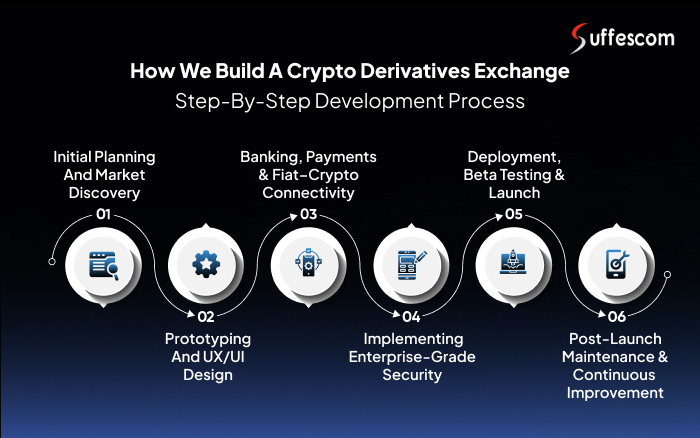
1. Initial Planning and Market Discovery
Everything starts with clarity. Before writing a single line of code, you need a grounded understanding of market demand, liquidity expectations, competitor offerings, and regulatory limitations.
This stage usually includes market studies, feasibility analysis, and defining what your derivatives platform should actually achieve. Whether it’s higher leverage options, low-latency trading, or a specific product line like perpetual futures. Once your goals are locked in, it becomes easier to shape the technical and business roadmap.
2. Prototyping and UX/UI Design
Once the vision looks solid on paper, the next move is to visualize it.
Prototypes, wireframes, and user-flow diagrams help you see how traders will interact with the platform It helps from opening positions to managing collateral.
During this phase, the focus shifts to:
- Creating intuitive dashboards,
- Designing clean order screens,
- Mapping complex tools like funding rates, leverage sliders, and liquidation warnings.
- A clear prototype minimizes future rework and ensures the final UI feels smooth even under heavy market activity.
3. Banking, Payments & Fiat–Crypto Connectivity
Now, to make your exchange usable, traders need a frictionless way to deposit or withdraw funds. This is where payment gateways, on/off-ramps, and banking APIs come into the picture.
Integration usually involves:
- KYC/AML-friendly payment partners,
- Multi-currency support for global users,
- Secure settlement flows for both fiat and crypto assets.
- These integrations must be stable, compliant, and latency-free because any delay in deposits during market volatility can cost users real money.
4. Implementing Enterprise-Grade Security
Security is non-negotiable in the development of crypto derivatives exchanges. Because leveraged trading involves high-volume transactions, even a small breach can result in significant losses.
To avoid that, platforms typically incorporate:
- Multi-layer encryption,
- Two-factor authentication,
- Cold wallet storage for funds,
- Automated risk monitoring,
- Regular third-party audits.
Some teams also partner with custodians such as Fireblocks, BitGo, or Gemini Custody for enhanced asset protection. The goal is simple: reduce vulnerabilities before the exchange goes live.
5. Deployment, Beta Testing & Launch
After integrating the trading engine, risk modules, liquidity frameworks, and APIs, your exchange enters the beta phase.
This stage helps you:
- Test order execution under different loads,
- Validate liquidations and leverage behaviour,
- Check integrations like Oracle feeds, KYC flows, and payment systems.
Once feedback is incorporated and everything runs smoothly, the platform is ready for a staged launch. It is typically a soft launch first, followed by a full public rollout. Real-time monitoring in the early days is crucial because even small optimizations can significantly improve user trust.
6. Post-Launch Maintenance & Continuous Improvement
Launching the platform isn’t the finish line it’s the starting point.
Derivatives exchanges require continuous updates, liquidity monitoring, bug fixing, risk system enhancements, and community-driven improvements.
This includes:
- 24/7 technical support,
- Continuous security patching,
- Feature upgrades based on trader behavior,
- UI/UX refinements,
- Performance scaling as user load grows.
Crypto Derivatives Platform Development Cost Breakdown
Building a crypto exchange isn’t a one size fits all project. The final crypto exchange development cost depends on the type of platform you want to launch, the features you prioritize, and the level of security and compliance required for long-term scalability. Below is a breakdown that helps potential investors understand exactly what they’re paying for.
Typical Cost Ranges Based on Complexity
Crypto exchange development generally falls into three broad cost brackets:
1. Basic / MVP Exchange (Entry-Level)
Ideal for startups testing the market or launching a pilot version.
Includes user onboarding, KYC, trading engine (spot), wallet integration, basic admin.
- Estimated Cost: $30,000 – $60,000
- Timeline: 6–10 weeks
2. Mid-Range Exchange (More Features & Better Scalability)
Includes liquidity management, advanced trading modules, security enhancements, and a cleaner front-end experience.
- Estimated Cost: $60,000 – $150,000
- Timeline: 10–16 weeks
3. Advanced Exchange (Derivatives, Perpetuals, High-Frequency Trading)
Suitable for companies planning to compete at the level of Binance, Bybit, or OKX.
It includes derivatives trading engine, multi-layered security, multi-asset support and high-load architecture
- Estimated Cost: $150,000 – $500,000+
- Timeline: 16–30+ weeks
For businesses looking to launch faster, white label solutions provide a cost-effective alternative. Understanding the white label crypto exchange cost helps teams compare budgets and choose the right development model.
Factors That Influence the Cost of Cryptocurrency Derivatives Exchange Development
(Features, Security, Compliance, Blockchain Integration, UI/UX)
Multiple factors can push the budget up or down. Here’s where the real cost difference comes from:
1. Features & Modules
Every additional feature adds development time and complexity.
Examples: Copy trading, futures, staking, multi-wallet support, P2P, analytics dashboards.
2. Security Architecture
Security is one of the most expensive components because exchanges are prime hacking targets.
Costs vary based on:
- Multi-sig wallets
- DDOS protection
- Cold storage integration
- Anti-market manipulation modules
- Smart contract audits
The more fortified your exchange, the higher the development cost but also the higher the trust.
3. Regulatory Compliance
Compliance can make up 15–25% of the project budget, depending on jurisdiction.
This includes:
- KYC/AML integration
- Transaction monitoring
- Licensing & legal alignment
- Reporting tools for regulators
4. Blockchain Integrations
Every chain added (BTC, ETH, BNB, TRON, Solana, etc.) requires separate wallet integration and testing.
More blockchains = more development cost.
5. UI/UX Design
A simple interface costs less. A high-end, polished, multi-panel trading UI (like Binance Pro) increases cost significantly.
Technologies Used for Crypto Derivatives Exchange Development
| Category | Technologies / Tools Used | Purpose |
| Frontend Development | React.js, Next.js, Vue.js, Angular | High-performance UI, trading dashboard, charts, user workflows |
| Backend Development | Node.js, GoLang, Python, Java, Rust | Core APIs, trading engine, wallet management, order routing |
| Database Management | PostgreSQL, MongoDB, Redis, Cassandra | User data, trades, caching, high-speed data retrieval |
| Blockchain & Wallet Integration | Web3.js, Ether.js, Bitcoin Core, Solana Web3, TronWeb | On-chain connectivity, deposits, withdrawals, token integrations |
| Smart Contracts (If Needed) | Solidity, Rust, Vyper | Perpetual contracts, settlement logic, multi-chain modules |
| Trading Engine Technologies | C++, Rust, Go, In-memory matching engine frameworks | Ultra-low latency order matching, high TPS performance |
| Security Tools | Multi-sig wallets, HSM modules, JWT, OAuth2, AES-256 | User security, transaction protection, authentication |
| Cloud & Infrastructure | AWS, Google Cloud, Azure, Kubernetes, Docker | Auto-scaling, load balancing, microservices deployment |
| Market Data & Price Feeds | Chainlink, Pyth Network, Binance/OKX APIs | Accurate price indexing, mark/funding rates for derivatives |
| Liquidity Integration | FIX Protocol, Liquidity APIs, Aggregators | Deep liquidity, faster order execution, reduced slippage |
| Monitoring & Analytics | Grafana, Prometheus, ElasticSearch, Kibana | Real-time metrics, system monitoring, fraud detection |
| Compliance & KYC/AML | Sumsub, Onfido, Chainalysis, TRM Labs | User verification, AML checks, regulatory compliance |
| Testing Tools | Jest, Mocha, Selenium, Postman | QA, performance tests, API validation |
Multi-Chain Support for Our Crypto Derivatives Exchange Platform
A powerful crypto derivatives exchange platform must be flexible enough to support a diverse range of assets, deliver seamless trading experiences, and enable cross-chain operations. That’s why our crypto derivatives exchange development framework is designed to integrate with multiple blockchain networks. It ensures high performance, interoperability, and faster settlement cycles.
Whether you're planning to launch perpetual swap markets, multi-chain margin wallets, or asset-backed derivative products, our architecture supports a wide range of L1 and L2 ecosystems.
Supported Blockchain Networks:
Bitcoin (BTC)
Ideal for BTC-backed derivative products, long-term settlement, and high-liquidity trading pairs.
Ethereum (ETH)
The most popular chain for smart contracts, enabling seamless integration of futures, options, and custom derivatives.
BNB Chain (BSC)
Known for low fees and fast transaction finality. It is perfect for scalable derivatives trading.
Polygon (MATIC)
A Layer-2 chain offering ultra-low gas fees and high throughput for high-frequency derivatives markets.
Solana (SOL)
Extremely high TPS, making it suitable for real-time trading engines and advanced derivatives.
Avalanche (AVAX)
Built for sub-second finality and supports complex financial instruments at scale.
Tron (TRX)
Popular in emerging markets with fast, cost-efficient transactions for margin trading.
Custom L1/L2 Blockchains
For businesses wanting full control, custom consensus, and tailor-made derivatives exchange development solutions.
What Makes Suffescom the Smart Choice for Crypto Derivative Exchange Development?
Suffescom continues to lead as a top cryptocurrency exchange development company by delivering secure, scalable, and innovation-driven trading platforms.
1. Fast & Efficient Exchange Deployment
We accelerate your go-to-market journey with agile development, pre-built modules, and automated testing pipelines. You launch faster without sacrificing performance, security, or scalability.
2. Global Compliance & Regulatory Support
We guide you through licensing, AML/KYC regulations, data laws, and region-specific compliance requirements. Your exchange stays legally aligned whether you operate in the US, EU, UAE, or Asia.
3. Complete End-to-End Development Expertise
From initial strategy and UI/UX design to smart contract development, liquidity integration, QA, and post-launch support. We manage the entire lifecycle. You get a fully engineered exchange ready for global markets.
4. Ultra-Low Latency Trading Engine
Our matching engines handle millions of transactions per second with near-zero latency. Users enjoy instant order execution, stable performance, and uninterrupted trading during peak volatility.
5. Seamless Third-Party Integrations
We integrate KYC tools, payment gateways, custody solutions, analytics dashboards, and liquidity partners smoothly into your ecosystem. It reduces operational friction and boosts reliability.
6. Global Compliance & Regulatory Support
We guide you through licensing, AML/KYC regulations, data laws, and region-specific compliance requirements. Your exchange stays legally aligned whether you operate in the US, EU, UAE, or Asia.
FAQs
1. How much does crypto derivatives exchange development cost?
A single-contract MVP starts around $40,000. A multi-contract platform with cross-margin support runs $80,000 to $200,000. A full institutional-grade platform with multi-asset margining and dedicated liquidity partnerships runs $200,000 to $500,000 or more, depending on the number of blockchains and depth of security auditing required.
2. How long does it take to build a crypto derivatives exchange?
A white-label launch takes 6 to 10 weeks. A custom single-contract MVP takes 8 to 12 weeks. A full institutional-grade custom build takes 5 to 8 months, including a dedicated security audit and testing phase.
3. What is the difference between a derivatives exchange and a spot exchange?
A spot exchange settles trades with immediate asset ownership. A derivatives exchange trades contracts based on an asset's price without transferring ownership and requires a margin system, a risk engine, and a liquidation module that spot exchanges do not need.
4. Which contract type should I launch with first?
Most exchanges launch with perpetual contracts first, since they carry the highest trading volume of any derivatives product and do not require managing contract expiry dates. Futures and options are typically added once the platform has established liquidity.
5. Is a white-label or custom-built derivatives exchange the better starting point?
White-label fits businesses validating demand before committing to a full build. Custom development fits businesses with an existing trading community, a specific differentiation strategy, or institutional clients that need dedicated API access. Retrofitting custom features onto a white-label base later typically costs more than building custom from the start.
6. What is the most common reason crypto derivatives exchanges fail?
An underbuilt risk and margin engine, not the trading engine or the user interface. A risk engine that cannot calculate margin and trigger liquidation quickly enough during a volatile market move can cause losses that outpace the platform's solvency.
7. What regulatory requirements apply to a crypto derivatives exchange?
In the United States, the CFTC and SEC both have oversight of derivatives products. In Europe, MiCA sets licensing and disclosure requirements. Requirements vary by country in Asia and by jurisdiction in the Middle East, so regional legal review is required before launch, not just a general compliance framework.