Key Takeaways:
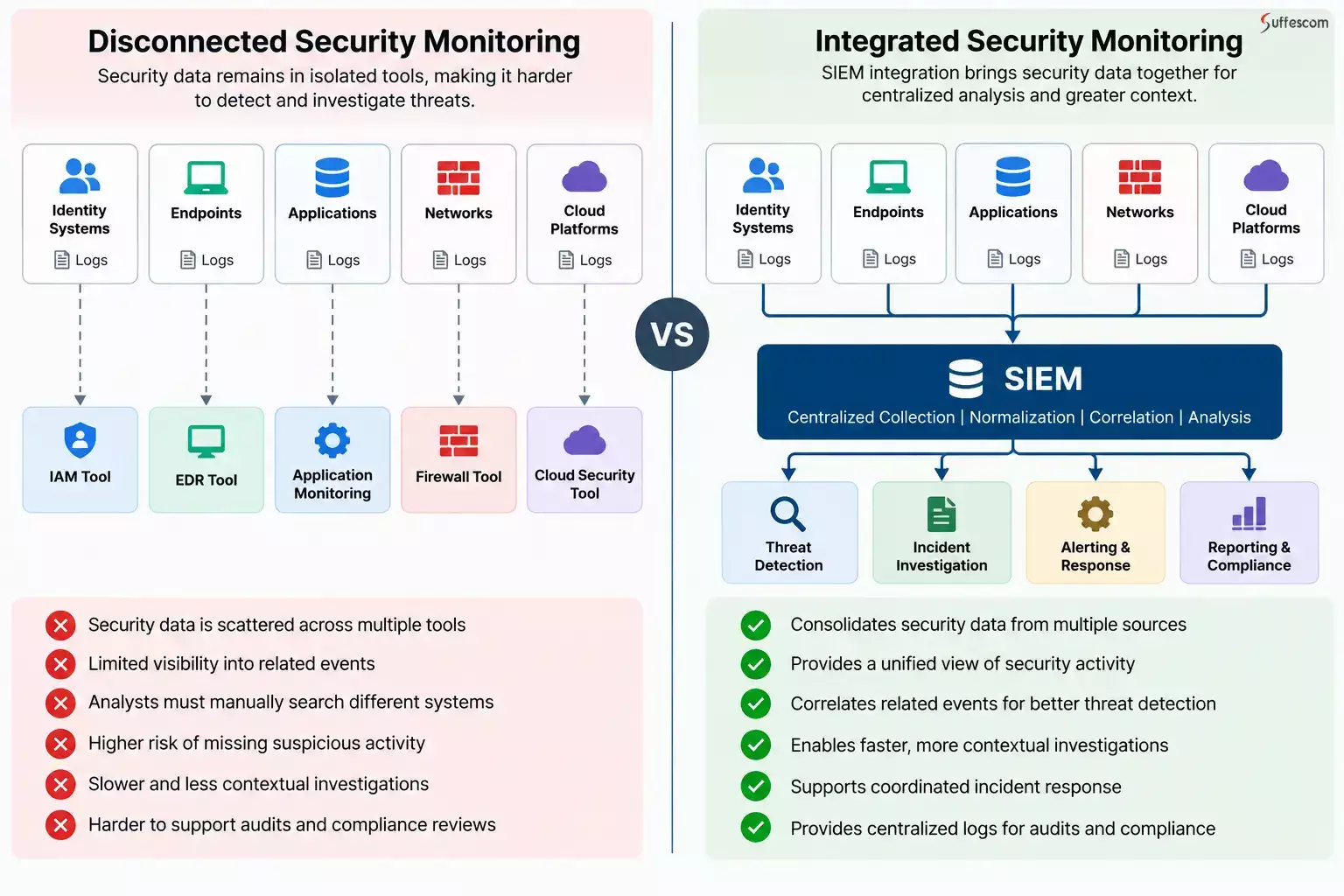
- SIEM integration brings together log information from different areas such as network devices, endpoints, cloud, application servers and identity management.
- This can help to detect threats by aggregating, parsing, enriching and correlating security data.
- Tools such as IAM, EDR, firewalls and cloud audit can assist security staff by providing them with useful data to quickly detect any odd activities.
- You will need to constantly monitor your integration to resolve any issues such as missing logs, parsing issues, failed connections, time stamp issues and too many alerts.
- You need to track how many log sources you have covered, detection accuracy, MTTD and MTTR whilst still keeping your data private and complying with regulations.
Today's companies depend upon networked systems like cloud services, software applications, devices at their locations (endpoints), and identity management solutions. Nevertheless, security incidents may be confined within individual systems rather than being shared among them, which makes it challenging for a security team to detect an attack that is coordinated between multiple systems. Integration of Security Information and Event Management (SIEM) helps to address this problem through consolidation of security information, correlation of related events, and assisting analysts in investigating suspicious suspicions within an organization’s IT environment.
Effective monitoring is more important due to its financial consequences from security breaches. According to IBM's 2026 Cost of a Data Breach Report, the global average cost for an IT security incident is $4.99 million. However, logging alone cannot detect threats effectively. Normalize data and enrich it with information about detection rules so that we can link them together to identify potential risks from unrelated sources of threat intelligence. CISA's joint cybersecurity advice with those of other nations' agencies involves connecting data from various sources for prioritizing important logs.
This article will cover the integration of SIEM systems by companies, the benefits they offer to organizations, requirements needed for implementation, issues faced while deploying these, and advice on implementing it properly.
What Is SIEM Integration in Cybersecurity?
Integration of SIEM is about connecting an organization's IT security tools and infrastructure to a SIEM console for collecting, correlating, and analyzing security incidents. Allows security teams to transcend siloed logs and alerts for uncovering suspicious activities within an interdependent system.
What Is SIEM (Security Information and Event Management)?
Security Information and Event Management (SIEM) is an IT infrastructure solution that collects data on security events from multiple sources to report them. This is an example of some basic functions it has.
- Logging of events at a centralized location: Collect for all endpoints, firewalls, identity management systems, application servers, and cloud infrastructure.
- Normalization and analysis: Conversion of various types of logs to a uniform format for analysis purposes.
- Event Correlation: Rules and analytics used to identify suspicious activity and alert to potential threats.
- Investigation Report: This is a report, timeline and log of events.
- Central Security Monitoring: A single source to monitor all different types of security events. This includes logs from devices, server reports, database activity, authentication details, web application traffic and cloud service stats.
What Does SIEM Integration Mean?
SIEM integration can be achieved using native connectors, agents, syslogs, API’s or other methods. A good cybersecurity strategy and implementation plan should take into account parsing, time stamping, normalising, enriching with context and detection rules. Not all sources will be useful once connected so you’ll need to analyse the data you’ve received to detect and trace threats.
SIEM Integration vs. Log Management
The logging system is a method for gathering, storing, searching, and keeping track of logs. SIEM is used for analyzing security incidents through log analysis, correlation detection of threats, and alerting systems. Although log management helps to manage SIEM systems, not every log management platform has been an SIEM solution.
| Comparison | Log Management | SIEM |
| Primary purpose | Log collection, storage, search, and troubleshooting | Security monitoring, threat detection, and investigation |
| Data processing | Parses, indexes, and organizes log records | Normalizes, enriches, and correlates security events |
| Threat detection | May provide basic alerts and rules | Applies security-focused detection rules and analytics |
| Investigation | Helps retrieve and examine individual logs | Connects related events to investigate potential incidents |
| Typical users | IT operations and system administrators | Security analysts and incident responders |
SIEM Integration vs. SIEM Implementation
The SIEM implementation is responsible for defining and setting up the SIEM capabilities, while the integration allows connecting individual data sources and security tools with it. Integration is an integral component of implementation but also an ongoing process due to the fact that the IT environment changes over time.
| Comparison | SIEM Implementation | SIEM Integration |
| Scope | Establishes and configures the overall SIEM capability | Connects specific systems, applications, and security tools |
| Key activities | Platform selection, architecture, configuration, access controls, and detection planning | Connector setup, API configuration, log ingestion, normalization, and validation |
| Primary objective | Establish a functioning SIEM environment aligned with security requirements | Ensure connected systems provide usable data for monitoring and investigation |
| Deliverable | A configured SIEM platform and operational framework | Validated data flows and functional integrations |
| Relationship | Encompasses the broader deployment process | Forms a key part of implementation and ongoing SIEM operations |
How SIEM Integration Supports Security Operations
- Centralized Security Monitoring System: A single point of access to monitor all types of security events, such as device logs, server activity reports, database transactions, authentication details, web application traffic, and cloud service usage statistics.
- Contextual Threat Detection: It correlates related events from multiple sources and looks for patterns across multiple channels to find suspicious activities.
- Improved Incident Investigation: This is a tool to help investigators create a timeline of incidents and track suspicious activity between connected systems.
- Improved Incident Management System: Connects with security tools and response procedures for faster reporting of incidents, investigations, and remediation.
- More Effective Security Monitoring: Allows for adjustment of detection rule sets by an organization to identify weaknesses within its own monitoring process as well as evaluate if it’s generating useful information on how secure a given system is.
- Audit and Compliance Support: Stores all relevant event history and reports for easy access by an organization so that they can investigate activities and provide evidence of appropriate security measures. SIEM does not guarantee compliance.
These functions are in line with the Australian Cyber Security Centre's (ACSC) SIEM and SOAR Practitioner Guidance, which says, "The key aspects for collecting information, correlating it, detecting threats, and responding accordingly must be well-managed."
Why Is SIEM Integration Important for IT and Security Infrastructure?
Currently, there are many security breaches happening at endpoints at the network level, application level, identity provider level, and cloud service level. They are not integrated properly by the SIEM system, which makes it harder for us to detect threats and investigate incidents. Seamless integration of relevant information enables centralized monitoring, cross-system analysis, and improved security decisions.
Eliminates Security Visibility Gaps
If there is no way to access data about such incidents at one place, it creates blind spots for analysts during those times when disconnections happen due to unconnected security tools. SIEM integrates relevant security data to help organizations monitor activities on multiple platforms for detecting anomalies not visible by standalone solutions.
Connects Events Across Different IT Environments
Logs of ID, endpoints, applications, networks, and clouds provide more information to investigators during an investigation. For example, if endpoints are accessing cloud resources for a period of time that is unusual to an account. It can help analysts determine if they represent a possible breach.
Enhance Threat Detection and Event Correlation
If available, SIEM systems analyze and correlate events according to pre-set detection criteria, threat intelligence information, and behavior patterns. If there is an accurate dataset and well-designed detection logs, then correlations may link different events that on their own may appear minor but could turn out to be a major security breach.
Faster, More Contextual Investigation Support
Suspicious activities are visible through a unified event search; alerts can be improved while correlating timelines without switching between tools and browsers. Quality data, alert accuracy, platform performance, and workflow affect investigation efficiency.
Security Governance and Auditability Improvement
Centralized logging helps with security reviews, investigation of security incidents, and collection of evidence to meet relevant regulatory requirements. Also, organizations should have proper access control, retention policy, and auditing procedures in place. SIEM integration does not ensure compliance with regulations.
Are disconnected security tools limiting your visibility into potential threats?
Explore ways to improve security visibility with SIEM integration tailored to your infrastructure and monitoring requirements.
How Does SIEM Integration Work?
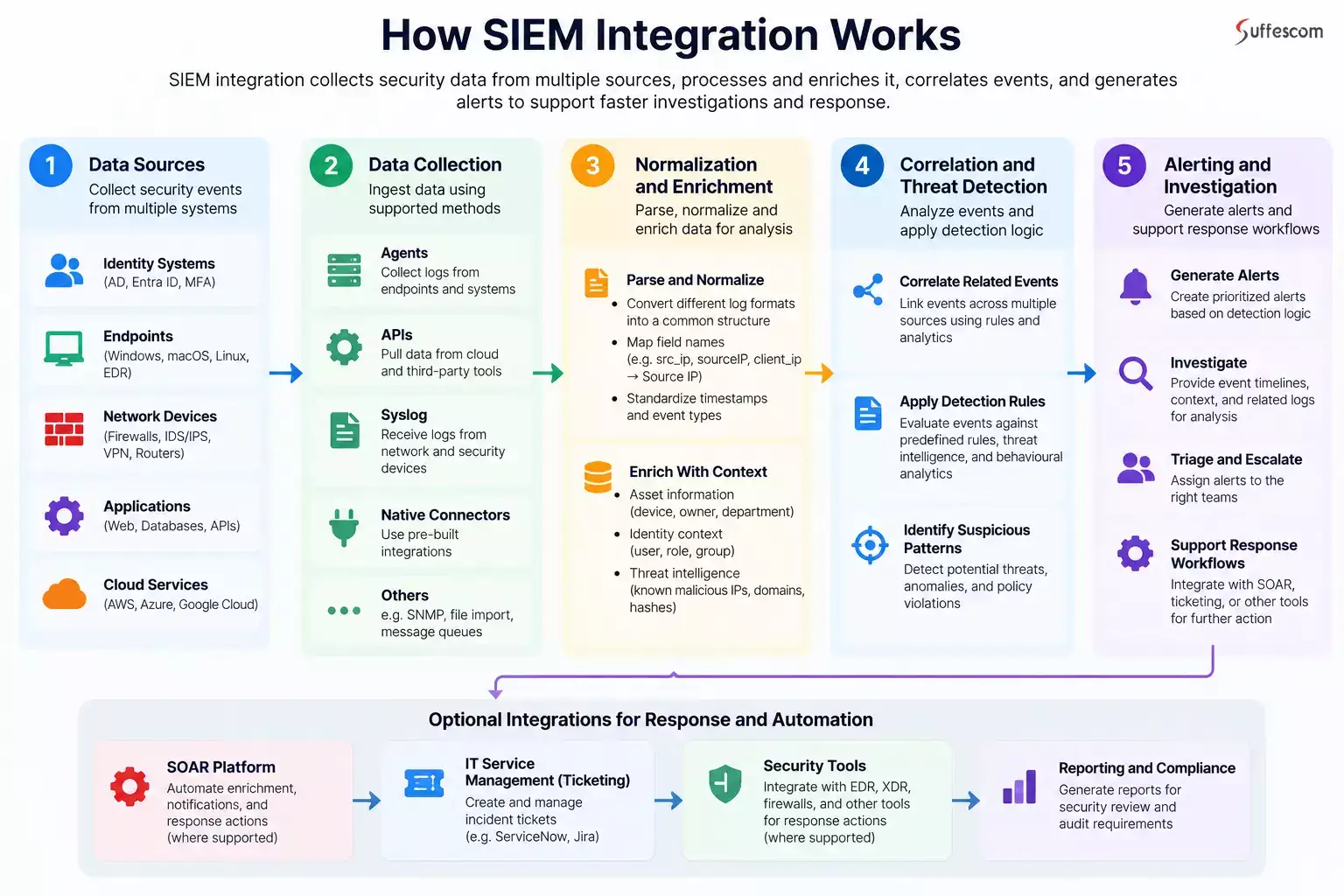
Instead of just logging and forwarding to a central system, SIEM integration is an enterprise-wide data management and analysis tool for security purposes. Integration must preserve event context, event ingestion integrity, normalization of data received from various vendors, and availability of security events for detection rules. It is identical for all types of SIEM products; however, there are some important technical steps involved in this process.
Step 1: Collect Security Events From Connected Systems
Identity provider, endpoint detection and response (EDR), firewall, DNS service, business application database, and cloud control plane information are sources of security data. Integration techniques depend upon their source and can be implemented in various ways, like native connectors, REST APIs, syslog, endpoint agents, event forwarders, and cloud event streams.
Step 2: Parse and Normalize Log Data
There may be different names for fields, times, severity and events between different sources. Parsing will extract data from the source and normalizing will map these extracted items into a consistent format to allow queries and correlations to take place.
For example, src_ip, sourceAddress, and client_ip may be mapped to a similar SourceIP column. Normalization should be done considering timestamps, time zones, user IDs, hostnames, and the specificity of event IDs from vendors.
Good SIEM integration requires gathering and managing relevant security logs from various sources within an organization. NIST guidance on cybersecurity log management is helpful to plan organizational logging policies and improve access to information required by security investigation teams.
Step 3: Enrich Events With Security Context
Enrichment provides more information about collected and normalized events for analysis purposes. According to location, it might contain asset inventory data, identity directory details, vulnerability reports, geolocation info, and threat intel.
For instance, a successful login from an unknown location might require further scrutiny because it is being done by someone who has privileged access to a vital server. Enrichment is most effective if it has up-to-date, accurate data that is relevant for users' needs.
Step 4: Correlate Events and Apply Detection Logic
SIEM systems analyze events based on defined rules, thresholds, time window parameters, sequence pattern detection capabilities, and behavior analysis features if available. Correlations are used by security teams to find connections among activities within different platforms instead of analyzing them individually.
For instance, repeated unsuccessful logins followed by a successful login, unauthorized privilege modifications, and access to confidential information might be signs of an attacker's compromise. Properly configured correlation rules will link them together to produce an alert that needs more attention.
Source coverage, event accuracy, rule design, and ongoing tuning affect detection quality. Poorly configured rules and incomplete records may lead to false positive results as well as allow suspicious activities to go unnoticed.
Step 5: Generate Alerts and Connect Response Workflows
If there is an event or series of events that match a detection rule on this system, it will be able to generate an alert with information like timestamp, severity level, affected asset, and supporting evidence. An analyst of security can check an alert, verify it is valid, and escalate any confirmed incident as per defined protocols.
Integration of the ITSM system for creating incident tickets and assigning them to the right team members. SOAR solutions are used for alert enrichment, notification coordination, and executing approved response actions. High-impact activities need to be well defined with permission levels, approval processes, audit logs, and disaster recovery plans.
Which Systems Should You Integrate With Your SIEM Platform?
SIEM integration is dependent upon a company's risk profile, important resources, and current protection measures. Focus on sources providing credible information about the verification process, network activities, endpoints' behaviors, admin modifications, and access to confidential file systems. Good logging of security information management logs needs enough detail about events to be collected for analysis.
Network Security Tools
Firewall integration, IDS/IPS, DNS service providers, and VPN gateway provider information sources for networks. The log files may show blocked links, malicious websites, odd web usage behavior, and unauthorized access attempts affiliated with a computer system remotely. Linking them to an identifier or endpoint would allow for investigation of possible command-and-control communications as well as unapproved entry points.
Endpoint Detection and Response (EDR) Platforms
Integration of SIEM and EDR provides more comprehensive threat detection through endpoint alerts as well as system logs for analysis purposes. This could be related to process execution, parent-child process relationships, file changes, malware detection, and device activities of an EDR product or configuration. Such incidents allow for analysis of whether there was any unusual activity on an endpoint due to unauthorized access from outside sources like this type of event.
Identity and Access Management Systems
Link identities to SSO services like Single Sign-On (SSO), MFA, and PAM solutions for privilege access control. Authentication results, MFA issues, account modifications, privilege grants, and admin operations are useful for detecting password theft, unauthorized logins, and possible misuse of privileges by an administrator. Identification of users' devices is important to link their identities with activities on other platforms.
Cloud Platforms and Infrastructure
SIEM cloud integration should cover relevant cloud audit logs, identity activity, administrative changes, workload events, and cloud security findings. The sources of information could be AWS CloudTrail, Microsoft Entra and Azure activity logs, and Google Cloud Audit Logs based on an organization’s needs. Prioritize control-plane activity and critical workloads, and verify permissions, event coverage, delivery delays, and retention requirements.
Applications, APIs, and Databases
Integrate app auditing log files from the APIs Gateway, Gravity Gateway, and WAF Database Audit Records if available. They may reveal unauthorized calls from APIs, authentication errors, unanticipated management activities on confidential information, and irregularities in accessing private data files. Security-relevant event collection without collecting too much information, and maintaining the confidentiality of payloads.
SIEM Integration Categories and Their Security Value
| Integration category | Priority telemetry | Primary security value |
| Network security | Firewall, DNS, IDS/IPS, VPN events | Investigates suspicious connections and network-based threats |
| EDR and endpoints | Endpoint alerts, process and device activity | Connects suspicious behavior to affected hosts and processes |
| Identity and access | Authentication, MFA, account and privilege changes | Detects account compromise and privilege misuse |
| Cloud infrastructure | Audit events, control-plane activity, cloud security findings | Identifies risky configuration and unauthorized cloud activity |
| Applications and data | API, WAF, application and database audit events | Investigates application abuse and potentially unauthorized data access |
Key Benefits of SIEM Integration for Businesses
Integration of SIEM provides avenues to help companies convert disjointed security data for use by risk management teams and security operations center staff. Actual business value is determined by source coverage, detection accuracy of platform configurations, and effectiveness of team actions based upon those findings.
Centralized Security Visibility
Integrating information from different parts of an organization's infrastructure provides better visibility into activities so that they can detect missing data points for their own needs as well as evaluate threats to all related services.
Improved Threat Investigation and Context
Events are correlated to analyze activities, detect possibly impacted accounts or devices for incidents, and determine their extent. This context can support better-informed investigations than examining isolated alerts.
More Efficient Security Operations
Search queries and a context-based alert system support consistent investigations and minimize time required by users while switching from one tool to another during an investigation process. Data quality efficiency improvement depends upon it being tuned for alerts and integrated into current response procedures.
Better Support for Compliance and Auditing
Logs are centralized and properly stored to help create an audit trail; they also aid in conducting a review of security issues or incidents as well as collecting evidence needed by regulations. Although organizations need to have proper control measures in place, such as an access restriction policy for data security purposes, a single system like an SIEM cannot guarantee that they are compliant with regulations.
More Informed Security Decisions
Coverage logs of incidents and recurrence rates for alerts are useful information that helps managers decide which areas need more attention while setting up effective monitoring procedures based on risks involved. Accurate reports are based on reliable information sources as well as clear metrics for measuring success.
Common SIEM Integration Challenges and How to Solve Them
There are several factors that can affect SIEM integration performance, including incompleteness of log sources, inconsistent event data, too many detection rules generating noise, and the cost to ingest the data being higher than expected. In order to solve these problems, continuous validation of the data quality, detection performance, and integration health is needed.
Incomplete Log Collection and Coverage Gaps
Problem: The lack of audit configuration, unplugged collectors, expired API credentials, or unsupported event sources may result in an inability to see critical security activity in a SIEM. This could prevent an attack across multiple systems from being detected by a rule.
Solution: Keep a list of mapping critical assets, required log sources, and detection use cases. Track events, event delays, collection failures, and source availabilities. Run tests to see if anticipated events end up on the SIEM once configured.
Inconsistent Log Formats and Parsing Errors
Problem: Timestamps, usernames, and IP addresses can each have different distributions across vendors, as can the severity of events. Inability to parse failures or incorrect field mapping could lead to a failure to execute the correlation rules, timeline alteration, and inaccurate alerts.
Solution: Check parsing and normalization rules against samples of each type of event coming from each source. Verify schema mappings, events, time-zone parameters, and time and timestamps. Record raw event information where possible to enable problem resolution of discrepancies.
Alert Fatigue and Poor Detection Rules
Problem: Rules that capture too much data noise from telemetry and lack context can create undue and unnecessary alerts, distracting analysts from real threats. But too strict policies can result in failure to detect illegal behavior.
Solution: Set up solution tuning with realistic attack scenarios and observed baseline activities. Where applicable, use asset criticality, identity context, and threat intelligence. Check that alerts are not spurious, and research errors that do recur and retest if there are rule changes.
Integration Complexity Across Cloud and Legacy Systems
Problem: Cloud APIs, on-premises systems, legacy applications, and security products may vary in their authentication requirements, connectivity, event formats, rates, and connectors supported. These disparities can introduce ingestion failures and maintenance overhead.
Solution: Check for connector compatibility and permissions, network access, API limits, and event coverage requirements prior to deployment. Include some critical sources in stages, have supported collection methods, and record dependencies, ownership, and steps to recovery.
Data Ingestion Costs and Performance Bottlenecks
Problem: Low cost for ingestion, processing, and storage of a high volume of telemetry, duplicated events, inefficient collection, or long retention period. If the volume is too great, it can also have an impact on search performance and analysts.
Solution: Prioritize events relevant to the level of security and the requirements and ability to be detected. Eliminate unnecessary or peripheral data where possible, avoid data duplication, and implement data tiers according to operational and regulatory requirements. Accept that data cannot be lost because of filtering for investigations or compliance purposes.
SIEM Integration Troubleshooting
| Challenge | Potential impact | Recommended solution |
| Incomplete log collection | Detection blind spots and missing incident evidence | Monitor source coverage, ingestion health, and expected event delivery |
| Parsing and normalization errors | Broken correlation and unreliable event timelines | Validate field mappings, timestamps, schemas, and raw events |
| Poor detection rules | False positives, missed threats, and analyst fatigue | Tune rules, add relevant context, and test realistic scenarios |
| Cloud and legacy incompatibility | Failed connectors, delayed ingestion, and maintenance overhead | Verify compatibility and permissions; deploy in phases |
| Excessive data volume | Higher costs, slower searches, and unnecessary noise | Prioritize sources, reduce safe-to-remove duplication, and optimize retention |
Planning to connect your cloud platforms, endpoints, and identity systems to a SIEM platform?
Discuss your integration requirements, data sources, and technical dependencies with our team.
SIEM Integration Best Practices for Modern IT Environments
The real value in integration depends not just on making a connection with data sources. As the IT environments grow and change, so will the need to collect events, maintain data quality, define event detection logic, and develop and test response workflows.
Prioritize Integrations According to Business Risk
Begin with systems that are vital for critical business operations, sensitive data, privileged accounts, and essential infrastructure. Identify potential threats for each system depending on how we can identify them in our logs, and then categorize our integrations by risk, detection value, and effort. That way, your teams won't consume ingestion and monitor important things that are left out.
Establish Consistent Logging and Data Standards
Determine what should be considered events to be sent by each system and the meaning of the events sent by the SIEM. Ensure precise time sync (reliable time sources), consistency of time and periods, and time and time zone normalization, and normalize crucial data elements like user ID, host names, IP, and event types. Having schema and logging standards ensures greater accuracy and reliability of incident timelines.
Monitor Integration Health and Data Quality
Having a configured connector doesn't ensure ingestion is ongoing and complete. Track source availability, event volume, event ingestion delay, parsing failures, API limits, and authentication errors. Set expected event baselines and review unexpected declines and delays to avoid going "undetected" without collecting.
Validate Detection Rules and Incident Workflows
Verify that representative security events raise the appropriate alerts and that there is enough context for analysts investigating events. Conduct controlled tests, review and verify the conditions and the severity assignments of the rules, and verify that the notification, incident ticket, and approved response actions are sent to the correct team. Retest the changes in connectors, schemas, or detection rules.
Review and Optimize Integrations Continuously
Existing integrations may not be comprehensive enough for new applications, cloud deployments, infrastructure modifications, and new threats. Periodically check log-source coverage as well as the performance of detection and retention methods and costs of getting logs into the system. Monitor and update the configurations and rules for event detection, as needed, and record ownership and dependency for integrations.
SIEM Integration Best Practices for Modern IT Environments
Integrating SIEM is more than just connecting data sources. Reliable event collection, consistent data quality, valid detection logic, and validated response workflows are required as the IT environments evolve.
Prioritize Integrations According to Business Risk
Begin with systems that safeguard critical business processes, sensitive data, and privileged accounts, along with critical infrastructure. Take all these elements into consideration to map the likelihood of a threat to the log sources expected to respond to the threat, and prioritize integrations based on their risk, extent of detection, and implementation complexity. That way, your teams won't consume ingestion and monitor important things that are left out.
Establish Consistent Logging and Data Standards
Identify events each system should raise and how the SIEM should react to them. Use trusted time sources to sync the system clock and normalize standardized and important system attributes like user ID, hostname, IP address, or event type. Having schema and logging standards ensures greater accuracy and reliability of incident timelines.
Monitor Integration Health and Data Quality
Having a configured connector doesn't ensure ingestion is ongoing and complete. Track the number of sources available, number of events sent, ingestion latency, parsing failures, API limits, and authentication errors. Set expected event baselines and review unexpected declines and delays to avoid going "undetected" without collecting.
Validate Detection Rules and Incident Workflows
Determine if representative security events trigger the right alerts and if the analysts have enough information to investigate the events. Run controlled tests, test and confirm the rule conditions and severity assignments, and confirm the notifications, incident tickets, and approved response actions are delivered to the correct teams. Re-test in case of changes to connectors, schemas, and detection rules.
Review and Optimize Integrations Continuously
New applications, cloud migration issues, infrastructural problems, and new security risks may lead to outdated integration solutions that are no longer up to date. Regularly review logs; the source availability rate of detection accuracy needs storage space cost for ingesting data. Updating connectors configuration and detecting issues if needed; documentation of integration owner and dependency management.
SIEM Integration With SOAR, EDR, XDR, and Threat Intelligence
The SIEM platform is better if it integrates with other types of security solutions. Nevertheless, they have various functions, such as ingesting information to feed it for monitoring purposes, correlating activities together, orchestrating tasks by coordinating them, and executing automation of authorized operations through an oracle.
SIEM and SOAR Integration
Alerts from SIEM systems may initiate processes within an SOAR system for enhancing alert information, incident assignment by analysts, notification of those involved, and coordination among them. Based upon what is available for integration and permission level, a workflow might also isolate an endpoint or disable an account. Effective measures for high impact would be proper authorizations, security controls, and auditing processes.
SIEM and EDR Integration
Endpoint detection and response systems are responsible for detecting threats at endpoints through alert notifications such as suspicious processes running on them or detected viruses from antivirus software; they also monitor devices' behaviors when available. SIEMs are able to link these data points with identities and network activities to detect whether an endpoint was involved in a larger event. The EDR is accountable to itself regarding endpoint-level detection and response functions.
SIEM and XDR Integration
The Extended Detection and Response (XDR) platform correlates security signals from various sources like endpoint devices, identity management systems, emails, network traffic, etc., based upon the type of solution being used by an organization. SIEM complements XDR through wider logging capabilities, multi-platform searching functions, and unified management of security information gathering across environments, as well as report generation services. Division of duties is based upon product type because there might be some overlap between them.
SIEM and Threat Intelligence Integration
Indicators from threat intelligence feeds include malicious IP addresses, domain names, URLs, and hash values for files; they may also contain some information about them. SIEMs are able to correlate those metrics against actual incidents for detecting possible threats. Relevance, accuracy, and timeliness should be assessed by indicators so that they do not produce false alarms due to old information or poor data.
SIEM and IT Service Management Integration
Linking SIAM notifications with ITSM or service desk systems would allow for incident reporting on the severity level of issues along with proof-of-memos, responsibility owners, and escalation information. Security teams can use MITRE ATT&CK Enterprise techniques as a reference when mapping detection rules to documented adversary behaviors and evaluating whether priority attack scenarios are covered by their monitoring strategy.
How These Integrations Work Together
Not all products should be identical in terms of features. To define roles clearly, link related datasets and processes together, and ensure proper integration of necessary information between systems so they can effectively detect incidents and handle them properly.
| Technology | Primary role | Relationship with SIEM |
| SOAR | Orchestrates security workflows and approved response actions | Uses alerts to initiate coordinated workflows |
| EDR | Detects and responds to endpoint threats | Supplies endpoint telemetry and detection findings |
| XDR | Correlates threats across supported security domains | Complements SIEM monitoring and investigation capabilities |
| Threat intelligence | Provides context about known or suspected threats | Enriches events and supports indicator matching |
| ITSM/ticketing | Manages incidents, ownership, and resolution | Tracks security investigations and escalation |
Real-World SIEM Integration Example: Correlating Security Events Across Systems
This is an example story, not an actual client experience report.
An organization where its IDP, an EDR solution for endpoints and clouds, sends out alerts through a SIEM system of theirs. An intrusion on an account may cause activities to occur within these applications.
The Initial Security Signals
An identity provider logs an unsuccessful attempt to log in after several failed attempts to log in. After that, the EDR detects any unusual behavior from processes running on its host machine or within the clouds' audit log of accessing confidential data.
Each of them individually might be due to some reason. Together, they warrant investigation.
How SIEM Integration Connects the Events
SIEM correlates event data by timestamp, user IDs, device info, source IP address of the web server, and anything else related to it, if any. The configuration of a detector is used for evaluating its sequences and conditions so as to decide if there should be any alerts generated by it.
Accuracy of timestamps is important for correlation; consistency between fields matters too as there are enough sources available to detect it properly.
How the Security Team Investigates the Incident
Reviewers analyze logs for authentication records and alerts at endpoints as well as audit trails from clouds. Their job is to verify accounts and devices for authenticity; they also check on any compromised assets while determining if an event was legitimate versus malicious.
How the Incident Response Workflow Proceeds
If the evidence supports escalation, the team creates an incident ticket, preserves relevant logs and endpoint evidence, and follows its incident response procedures. Based on the results of the investigation and approval by the organization, the responder could terminate the current session, disable the compromised account, and isolate the affected endpoint.
Core insights: SIEM integration allows for connecting data from various sources; however, just correlating events doesn't prove a breach occurred. Research is necessary for verification purposes.
Struggling with missing security logs, connector failures, or excessive alerts?
Identify potential integration issues and discuss approaches to improve data quality and monitoring reliability.
How to Measure the Success of SIEM Integration
The effectiveness of SIEM integration can be evaluated through its level of protection provided, detection rate achieved, investigative speediness, and cost-effectiveness instead of just counting on how many systems are linked together. Set up an initial point of reference data collection prior to implementation or significant modifications; after that, compare outcomes during regular monitoring time frames.
Log-Source Coverage and Ingestion Health
Monitor proportions of required logs, log source delivery rates and expectations, ingestion delay rate, connection failure count, and parse error frequency. However, the device must have an active connection to it before being considered a functional unit of operation.
Detection Coverage and Alert Quality
How many priority URTs were detected by these models? Check out or review false positive results detected by tests; check if an alert contains enough information to investigate it further. High levels of noise are not always indicative of an accurate identification rate.
Mean Time to Detect and Respond
The mean time to detect (MTTD) is an indicator for measuring how long it takes to recognize a cyber attack within its own framework. Mean Time to Respond (MTTR) may mean response initiation or resolution according to an organization’s definition. Record the starting point and ending point for comparison purposes.
Investigation Efficiency
Measure median investigation time, analyst effort per incident, escalation delays, and the proportion of alerts requiring substantial manual data gathering. This helps to find out which areas of better correlation or process integration could reduce operational friction.
Cost and Resource Utilization
Assess the cost of intake and storage along with license fees, retention charges, connector upkeep expenses, and analysts' time spent on them. Optimization of costs must not compromise on telemetry needed to detect priorities, investigate them, and meet any relevant storage requirements.
SIEM Integration KPI
| Metric | What to measure | Why it matters |
| Log-source coverage | Required sources delivering expected events | Reveals monitoring gaps |
| Ingestion health | Delays, failures, parsing errors, and event completeness | Shows whether data is available and usable |
| Detection coverage | Prioritized scenarios with validated detections | Measures readiness for defined threats |
| Alert quality | False positives and missed detections found through testing | Indicates whether detections are useful |
| MTTD and MTTR | Time to detection and a consistently defined response milestone | Tracks incident handling performance |
| Investigation efficiency | Investigation duration, analyst effort, and escalation delays | Identifies workflow bottlenecks |
| Cost efficiency | Ingestion, storage, licensing, maintenance, and staffing costs | Supports sustainable resource allocation |
Important: Integration of SIEM is not an automatic way to increase those numbers. Also, changes could be due to analyst training, detection tuning, incident complexity, and other security investments. Assess trends within an organization to determine if integration is providing tangible benefits.
SIEM Integration Costs and Resource Requirements
The cost of SIEM integration depends on the selected platform, daily log volume, number of connected systems, retention requirements, integration complexity, and ongoing maintenance needs. Organizations should evaluate both initial implementation expenses and recurring operational costs before finalizing a budget.
SIEM Licensing and Data Ingestion Costs
SIEM vendors use different pricing models, so organizations should compare the total cost of ownership rather than relying on a single pricing metric.
| Pricing model | Indicative cost | Key cost consideration |
| Data ingestion | $2–$4 per GB, according to published estimates | Costs increase with daily log volume. |
| Per device | $5–$25 per device per month, subject to source verification | Costs depend on the number of monitored devices. |
| Events per second (EPS) | Varies by provider and capacity | Peak event rates may require additional capacity. |
| Subscription or tier-based | Depends on the selected plan | Features, usage limits, and retention may affect the total. |
Note: These dollar ranges are indicative estimates, not universal rates. Actual pricing varies by platform, contract, features, and usage.
Factors That Affect SIEM Licensing Costs
- Daily ingestion volume affects the amount of data the platform must process and analyze. Estimate the expected log volume from endpoints, networks, identity providers, applications, and cloud services.
- Log retention requirements influence storage expenses and the cost of keeping data searchable for investigations, audits, and applicable regulatory obligations.
- Platform features may affect licensing costs, particularly when advanced analytics, automation, threat intelligence, or extended retention are charged separately.
- Infrastructure growth can increase ingestion volume and storage requirements as an organization adds applications, devices, cloud workloads, and business locations.
Integration Development and Connector Costs
Integration development costs depend on source-system compatibility, connector availability, and the amount of customization required.
Key cost factors include:
- Connector availability: Native connectors are easy to use, but unsupported ones need custom integration.
- API and authentication configuration: Secure access control, permission management, rate limits, and error handling need to be set up and tested properly.
- Data normalization: Normalization of data through parsing, timestamp matching, and field mapping helps to correlate them correctly.
- Compatibility testing: Ensure they work well together without any problems between them or their interfaces.
How Log Volume and Retention Affect SIEM Costs
Collecting and analyzing security telemetry creates ongoing infrastructure and operational costs.
- Storage and indexing: High-volume issues that require more space for data retrieval speed improvement.
- Processing workloads: Event correlation analysis and data mining tasks like searching frequently need sufficient processing power to work efficiently.
- Retention policies: A long-term retention policy is more expensive for storing data than a short-term one; it must be based on research requirements and legal responsibilities.
- Cost optimization: Tiered storage and careful filtering can reduce expenditure without discarding security-critical events.
Ongoing Maintenance Costs Factors
Continued technical and operational assistance is needed after installation of the SIEM system.
- Maintenance of integration system: Monitoring for connector issues, ingestion delay problems, parser mistakes, and auth failure rates.
- Detection engineering: Alert detection engineering is about developing, testing, and tuning rules for better alerts while reducing false positive rates.
- Investigation of an incident: Allocate personnel for analyzing reports, escalating issues, and documenting results.
- Training and optimization: Maintenance of employees' skills; updating processes for efficiency purposes; reviewing website performance metrics and expenses.
Managed SIEM and External Implementation Support
When an organization lacks resources for managing complex integration tasks and maintaining security operations internally, external expertise can be useful.
Organizations should evaluate:
- Support for implementation: It includes architecture design, connector development, configuration, and testing.
- Monitoring Management: Coverage times, alarm handling process, escalation procedure, and incident management responsibility.
- Service scope: This is to clarify ownership of integration, rule detection, documentation, and upkeep.
- Total contract cost: It includes any additional fees such as licenses, facility costs, maintenance expenses, and service charges.
Security, Privacy, and Compliance Considerations for SIEM Integration
SIEM integration is centralized for collecting security information throughout a company's network infrastructure. However, there may be vulnerabilities due to unsecured log files, access keys used by integrators, and automation processes that could lead to breaches. Secure access to information is important; control over its storage duration, as well as responsibility for managing it through proper management systems, are necessary for effective governance.
Protect SIEM Access and Integration Credentials
Connectors for SIAM usually need an interface with a cloud provider, identity management system application, or security tool. Too many privileges may lead to an unsecured system where someone else could have access without permission.
- Least privilege enforcement: Give access rights for connecting devices and services only as needed for processing data.
- Authentication security: Secure login procedures should be implemented for APIs; keep your API key secret from unauthorized access by rotating it periodically as per policies.
- Restrict administrative access: Limit admin rights to roles based on responsibilities; implement multi-factor authentication if available.
- Audit privileged activity: Monitor the privileges management audit for detecting unauthorized activities such as config changes, permission modifications, and admin logins.
Protect Sensitive Information in Logs
Logs can contain personal information, session tokens, authentication details, IP addresses, and application data. Excessive data gathering raises issues of privacy and security.
Check out log configuration settings prior to integration of any source. Exclude or redact any sensitive information from being stored on disk; secure transmitted data by encrypting it during transmission to prevent unauthorized access, and store it securely at rest. Keep necessary information about events required for analysis but restrict access to confidential data.
Define Log Retention and Access Policies
Investigation needs, cost of storing information, confidentiality issues, and relevant laws must be considered by retention policy makers.
Define what types of data need to be kept alive for a certain period of time, who has permission to view them, and when an item is removed, as well as downloads from that database. Access control for confidential records should be implemented through secure log management systems and tamper-proof logging mechanisms when necessary so as not to compromise their authenticity.
Align Monitoring With Applicable Compliance Requirements
SIEM integration is useful for security monitoring, collecting audit evidence, and investigating incidents within organizations like HIPAA, GDPR, and ISO/IEC 27001. But these are subject to an organization's operations, information management practices, legal framework of operation, and compliance regulations.
Relevant requirement mapping for log source management, access control policies, data retention policy implementation, and monitoring process definition. Check if necessary data is available for collection purposes and retrieval of information as per requirements.
Govern Automated Response and System Changes
SIEM integration to the SOAR IT system for automated alert enrichment, ticket generation, account lockout, and endpoint quarantine. On the other hand, wrong policies may interfere with legal activities of a company.
- Define approval thresholds: Automate low-risk activities when possible; however, manual authorization is needed for high-importance operations.
- Test workflows: Validate the test workflow for detecting conditions of access rights management system failures before going live to customers.
- Maintain audit trails: Audit trail maintenance is to record initiated tasks, completed outcomes, and approvals.
- Establish rollback procedures: Rollback procedure establishment document recovery process of automation tasks affecting account endpoint system production environment.
Check out those controls when there is an update to the integration system, detection rule set, or response workflow for maintaining reliability and accountability of security automation.
How to Choose the Right SIEM Integration Partner
Select an integrated system for monitoring (SIEM) provider that has good knowledge of technology, solid cybersecurity policies, and the ability to help you upgrade your network architecture. Assess these features to help you decide.
Evaluate Technical Integration Expertise
Assess the partner's hands-on experience in:
- SIEM configuration: Setting up data sources, dashboards, alerts, correlation rules, and detection workflows.
- Log management: Using Syslog, APIs, agents, parsing, normalization, and timestamp synchronization.
- Security tool integration: Connecting EDR/XDR, firewalls, IDS/IPS, IAM, VPNs, and vulnerability management tools.
- Cloud and hybrid environments: Integrating cloud audit logs, SaaS applications, and on-premises infrastructure.
- Detection engineering: Developing correlation rules, validating threats, and reducing false positives.
- Custom integrations: Handling API authentication, error recovery, and data schema changes.
- Incident response: Connecting SIEM with SOAR, ITSM, and ticketing systems for alert escalation and controlled response.
Assess Architecture and Scalability
Ensure the cybersecurity consulting partner can design integrations that accommodate growing data volumes and changing infrastructure. They should understand ingestion rates, events per second (EPS), storage, retention, query performance, and licensing requirements.
Review Security and Compliance Practices
Confirm that the partner follows least-privilege access, secure credential management, encryption, role-based access control, and appropriate log retention. They should also understand data privacy requirements and maintain auditable integration configurations.
Verify Testing and Detection Capabilities
The partner should test connectivity, event collection, parsing, correlation rules, alert delivery, and failure recovery before deployment. Ask how they monitor integration health, troubleshoot missing logs, and tune detection rules over time.
Evaluate Costs and Ongoing Support
Review implementation costs, licensing, data ingestion, storage, maintenance, and future scaling requirements. Confirm the availability of connector updates, troubleshooting, detection-rule maintenance, documentation, and technical support.
Confirm Scope and Deliverables
Ensure the agreement defines integration requirements, project milestones, testing criteria, documentation, ownership of custom connectors and configurations, and post-deployment responsibilities.
Why Consider Suffescom for SIEM Integration and Security Software Development?
Suffescom provides software development and cybersecurity-related services for businesses building secure, connected digital systems. Its published capabilities include SIEM and detection engineering, application security testing, cloud security assessments, and security compliance readiness. These capabilities are relevant to organizations evaluating security monitoring integrations and security-focused software development.
SIEM Integration and Enterprise System Connectivity
Suffescom's cybersecurity services describe SIEM log-source onboarding, event parsing, retention planning, detection-rule configuration, and incident escalation workflows. Businesses should confirm the supported SIEM platforms, integration scope, and operational responsibilities during the initial technical consultation.
Security-Focused Architecture and Implementation
Suffescom's software development capabilities include API integration, application security testing, secure code reviews, and cloud security assessments. These practices are relevant when designing connected applications, managing access controls, protecting sensitive data, and integrating security requirements into software architecture.
Security Credentials and Industry Recognition
Suffescom lists credentials and recognitions, including SOC 2 Type II, ISO 9001, AWS Cloud Operations Competency, and Microsoft Solutions Partner recognition. Verify the current validity and scope of each credential before publication.
The company also publishes announcements about industry recognition, including its Summer 2026 Clutch Global Award. These credentials and awards provide company background but should not be treated as proof of SIEM-specific expertise or performance.
Relevant Projects and Case Studies
Suffescom's published portfolio includes projects demonstrating technical capabilities relevant to secure software development and enterprise integration:
- GDPR-Compliant Patient Portal Development: Covers consent management, automated data subject access requests, deletion workflows, and data-access audit trails.
- Patient Portal Development With EHR Integration: Demonstrates FHIR and HL7 integration, bidirectional data synchronization, and secure information exchange between connected systems.
- Medical Device Integration Using Real-Time Data Pipelines: Demonstrates data ingestion from connected devices, data normalization, automated alerts, and integration with electronic health records.
These projects illustrate experience with data integration, access management, auditability, and secure application workflows. They are relevant examples of adjacent technical experience, not direct evidence of completed SIEM deployments.
Looking for a technical partner to assess your SIEM integration requirements?
Discuss your existing architecture, integration scope, security controls, and ongoing maintenance needs with our team.
Strengthen Your Security Visibility With the Right SIEM Integration Strategy
SIEM integration helps organizations consolidate security-relevant data from applications, endpoints, networks, cloud platforms, and identity systems to improve threat visibility and investigation. However, effective monitoring depends on reliable log collection, accurate data normalization, relevant detection rules, scalable architecture, and continuous testing and maintenance.
Organizations should prioritize integrations according to their threat exposure, critical assets, compliance obligations, and operational requirements rather than collecting every available event. Regularly reviewing detection coverage and integration health also helps maintain effective security monitoring as infrastructure evolves.
If you're planning a SIEM implementation or connecting existing systems, explore Suffescom's cybersecurity services and contact our team to discuss your data sources, integration requirements, and technical implementation scope.
FAQs
What Is SIEM Integration?
SIEM integration connects security-relevant systems, applications, and infrastructure to a Security Information and Event Management (SIEM) platform. It enables centralized log collection, event normalization, and correlation to help security teams identify suspicious activity across their IT environment.
Why Is SIEM Integration Important for Cybersecurity?
SIEM integration improves security visibility by bringing events from different systems into a centralized monitoring environment. By correlating related activities, security teams can identify potential threats, investigate incidents more efficiently, and respond based on a broader view of their infrastructure.
Which Systems Should Be Integrated With a SIEM?
Common SIEM data sources include identity providers, endpoint detection and response (EDR) tools, firewalls, network devices, cloud platforms, business applications, and databases. Organizations should prioritize sources based on their critical assets, threat exposure, compliance requirements, and incident investigation needs.
What Is the Difference Between SIEM and SOAR?
SIEM focuses on collecting, analyzing, and correlating security events to identify potential threats. Security Orchestration, Automation, and Response (SOAR) coordinates security workflows, such as enriching alerts, creating incident tickets, and executing approved response actions. Some modern platforms combine both capabilities.
What Are the Most Common SIEM Integration Challenges?
Common challenges include missing log sources, parsing errors, connector failures, inconsistent timestamps, excessive alerts, and high data ingestion costs. These issues can reduce detection accuracy or create monitoring gaps, making integration testing, data validation, and continuous maintenance essential.
How Can Organizations Improve SIEM Integration?
Organizations should prioritize high-value data sources, standardize event formats, validate log quality, and test detection rules against relevant threat scenarios. Monitoring connector health, tuning alerts, reviewing data retention, and updating integrations as systems change can help maintain reliable security monitoring.
How Much Does SIEM Integration Cost?
SIEM integration costs depend on the platform, number of data sources, connector complexity, daily log volume, retention requirements, and licensing model. Additional expenses may include custom connector development, infrastructure, detection engineering, testing, and ongoing maintenance. A technical assessment can help establish a realistic budget.
Does SIEM Integration Guarantee Compliance?
No. SIEM integration can support compliance by centralizing audit logs, monitoring security events, and helping organizations produce evidence for investigations and assessments. However, compliance with requirements such as GDPR, HIPAA, or ISO 27001 also depends on appropriate policies, access controls, risk management, and other organizational safeguards.
How Long Does SIEM Integration Take?
The implementation timeline depends on the number and complexity of data sources, the existing IT architecture, connector availability, and customization requirements. Testing, detection-rule tuning, security reviews, and stakeholder approvals can also affect delivery time, so timelines should be established after assessing the project scope.