Key Takeaways:
- Healthcare IT managed services help healthcare organizations maintain reliable systems, protect patient data, and reduce IT disruptions.
- Core services include infrastructure management, EHR/EMR support, cybersecurity, cloud management, help desk support, and disaster recovery.
- AI and automation improve monitoring, detect anomalies, route support tickets, and automate routine tasks with appropriate safeguards.
- Common use cases include maintaining EHR availability, monitoring clinical integrations, securing connected devices, and supporting multiple healthcare locations.
- Healthcare organizations should evaluate a provider's technical expertise, support SLAs, security controls, HIPAA responsibilities, and recovery capabilities before outsourcing.
- Basic managed IT support typically costs $75–$100+ per user per month, while fully managed services may cost $150–$200+ depending on requirements.
Healthcare IT has little room for downtime. When an electronic health record (EHR) system becomes unavailable, network connectivity fails, or staff cannot securely access patient information, clinical and administrative workflows can be disrupted. Healthcare IT managed services help organizations maintain reliable systems, strengthen security, and manage growing technical demands without relying entirely on internal IT teams.
Proactive IT management needs to be addressed now. According to an audit conducted by the US Department of Health and Human Services Office of Inspector General in 2026, a small Southeastern hospital was able to detect suspicious activity during simulated cyberattacks, which highlights its effectiveness at detecting threats through proper monitoring systems.
In the healthcare sector, system protection is more than just reacting after a system's failure. It requires constant monitoring, consistent maintenance, restricted access, and tested recovery measures.
Managed IT services for healthcare encompass continuous assistance relating to the signed-up technology environment, from system monitoring to application maintenance, cyber protection, helpdesk support, and disaster recovery. Technical risks can be addressed and important systems maintained if the right approach is taken.
Let’s explore everything you need to know about the managed IT services for your healthcare business.
What Are Healthcare Managed IT Services?
Healthcare managed IT services are a continuous partnership with an external IT provider managing defined technology services that are agreed and managed within a service level arrangement. While other service providers solve issues when they happen, a managed services provider (MSP) monitors contracted systems continuously or regularly, takes preventive measures, manages incidents, protects security, and reports on performance throughout. The goal is to set clear operational responsibility, service expectations, and uniformity of IT governance.
Understanding the Managed IT Services Model
A managed services engagement begins with an assessment of the organization's infrastructure, applications, endpoints, network dependencies, access requirements, and support processes. The provider then defines the service scope, monitoring configuration, escalation paths, maintenance schedule, and reporting requirements.
Technical implementation may include collecting infrastructure metrics and application logs, configuring alerts, integrating incidents with an IT service management (ITSM) platform, applying approved patches, and tracking configuration changes. The provider may also coordinate with EHR vendors, cloud providers, and application developers when an issue crosses organizational boundaries.
Managed IT Services vs. In-House IT vs. Break-Fix Support
The three models involve different allocations of IT responsibilities, different ways of providing IT support, and different IT cost management.
| Evaluation factor | Managed IT services | In-house IT team | Break-fix support |
| Responsibility | Defined operational duties under a service agreement | Managed directly by employees | Usually limited to individual incidents |
| Monitoring and maintenance | Recurring monitoring and maintenance within the contracted scope | Depends on internal tools and processes | Typically initiated when a problem occurs |
| Support coverage | Based on agreed hours and service levels | Depends on staffing and shift arrangements | Depends on provider availability |
| Escalation | Documented severity levels and escalation paths | Internal reporting and escalation procedures | Varies by provider and incident agreement |
| Cost predictability | Usually recurring fees for a defined scope | Salaries, tools, training, and other overheads | Variable charges based on incidents or hours |
| Internal control | Shared according to agreed permissions | Direct operational control | Internal control remains, with external help when needed |
| Specialist expertise | Access to contracted specialist skills | Depends on recruitment and team capabilities | Depends on the technician engaged |
Healthcare organizations with a need for continuous support and service plans can benefit from managed IT services. For some situations with occasional technical needs, break-fix support would be enough; for other outcomes, in-house teams are both necessary and valuable for direct control and institutional knowledge. With a hybrid model, internal IT teams get the freedom to have some tasks outsourced for strategic oversight and operational ones.
Which Healthcare Organizations Need Managed IT Services?
The correct service model is determined by the complexity of infrastructure, criticality of the system, internal skills, and the requirements of support.
- Hospitals and health systems: May need shared management of networks, servers, clinical applications, identification systems, and infrastructure in different departments and across settings.
- Clinics and medical practices: When it is difficult or impossible to maintain a big in-house team, lean on external support for endpoint management, user access, network maintenance, and application troubleshooting.
- Diagnostic laboratories and imaging centers: Frequently rely on accurate connections among imaging systems, reporting software, and other systems in the healthcare sector, including lab information systems.
- Multi-location healthcare groups: Require monitoring of endpoints in one location with standardized endpoints across sites, consistent access policies, and shared incident escalation across sites.
- Healthtech businesses: May need managed cloud environments, application monitoring, deployment support, security measures, and capacity management as workloads increase.
The level of services required by every organization is not the same. A small practice might focus on endpoint security and provide user support, while a hospital network might need something more sophisticated with integrated infrastructure monitoring, complex recovery plans, etc.
What Should a Managed IT Services Agreement Include?
Managed IT services should clearly detail the operational expectations, responsibilities, and measurable commitments.
- Service scope and asset coverage: Determine which servers, endpoints, applications, locations, cloud resources, and anything else are excluded from coverage. Describe the way to add new assets to the service.
- Service-Level Agreements (SLAs): Outline availability if applicable, incident severity, response times, resolution times, support hours, and escalation procedures. The distinction between response time and resolution time must be emphasized.
- Access and change management: Record privileged access, requirements for approval of changes, maintenance periods, changes in configuration, and emergency change procedures.
- Security and incident: The monitoring and remediation responsibility for vulnerabilities, the incident notification process, the need to log, contractual responsibilities, and the requirement for regulated data.
- Reporting and governance: Establish who reports, when, for service reviews, to analyze recurring incidents, set performance indicators, and track corrective action.
- Business continuity and exit terms: Set up backup and recovery roles and ownership of documents, access cancellation, handover of data, and transition support at the end of the contract.
For healthcare organizations, the agreement needs to be clear about the reliance on third-party vendors as well as the responsibility for each step of the incident resolution. Such requirements can transform healthcare managed IT services from a vague guarantee of technical assistance to an enforceable contract.
What Do Managed IT Services for Healthcare Include?
Healthcare IT managed services are performed for the rest of the operating elements necessary to maintain an environment that keeps your organization's technology stable, secure, and supported. These services can vary by contract and generally encompass infrastructure management, application support, cybersecurity, cloud operations, disaster recovery planning, and technical support.
Managing Healthcare IT Infrastructure and Networks
Providers check the status of the server, how much memory and CPU the server is using, how much storage space the server has, how slow or fast the server is, whether packets are lost, and whether connectivity between healthcare sites is present. Some common tasks may involve endpoint inventory, network troubleshooting and capacity planning, OS patching, and configuration management. Through monitoring thresholds and alarms, teams can more effectively investigate changes in performance before they become a more extensive problem in service.
Healthcare Application, EHR, and EMR Support
Application support includes availability checks, authentication failures, performance issues, interface errors, approved updates, and dependencies of clinical applications and underlying infrastructure. Providers may coordinate with EHR vendors when troubleshooting requires application-level access or specialist intervention. Infrastructure support does not automatically include responsibility for clinical software functionality, data accuracy, or vendor-managed application code.
Managed Cybersecurity and Endpoint Protection
Managed cybersecurity services may include endpoint detection and response (EDR), vulnerability scanning, security patch management, access reviews, suspicious-activity monitoring, and incident escalation. Providers can help investigate alerts and document remediation, but the agreement must clearly assign responsibility for security policies, risk acceptance, and incident reporting. Access to systems containing electronic protected health information (ePHI) should follow least-privilege principles and approved access procedures.
Cloud Infrastructure, Backup, and Disaster Recovery
Cloud and hybrid infrastructure management is concerned with resource usage, system status of services, modifications to configurations for storage space availability, and connection issues between these two environments. Backup services should include job monitoring, retention checks, and periodic restoration tests. The recovery planning must include RTOs for restoring systems within a certain period and RPOs to limit how much information can be lost during an outage. The goals should be verified by means of testing rather than being taken for granted based on a good backup report.
IT Help Desk, Incident Management, and Vendor Coordination
Healthcare IT support services typically include ticket logging, categorization, severity assignment, troubleshooting, escalation, and resolution tracking. L1 support is for routine requests, while L2 deals with more complicated technical issues, and L3 handles specialized engineering or vendor-level problems as per an agreement. Maintenance of the knowledge base and incident recurrence helps to minimize repeat requests for support. If there is a problem related to an EHR, cloud service provider, or network company, then their responsibility would be to handle escalation issues and track incidents until they are resolved.
Service agreements must specify what deliverables will be provided, such as a monitoring dashboard, incident report, patch compliance record, inventory of assets, and backup test results for periodic review.
Do your current IT services cover your critical healthcare systems?
Explore support options for infrastructure, application integration, security, and recovery.
How AI and Automation Are Transforming Managed IT Services in Healthcare
AI assists healthcare information systems to identify issues, analyze events, automate processes, and predict requirements for hardware or software upgrades. In terms of healthcare IT management services, it is useful for providing better insight into operational efficiency as well as faster reaction rates to issues without compromising security or compliance requirements.
AIOps for Predictive Monitoring and Incident Detection
IT Operations powered by AI (AIOps) collects data from systems like log files, performance statistics, trace information, and event records to monitor them. The machine learning system is able to recognize anomalies among alerts, correlations between them, and reduce false alarms by identifying possible underlying issues.
For instance, increasing application latency along with database errors could be due to an underlying problem. But incomplete telemetry data collection rates and changes in workload levels of applications may affect their ability to detect threats effectively. Anomaly detection can detect new issues. However, it does not forecast all failures.
AI-Powered IT Service Desks and Intelligent Ticket Routing
Support ticket classification by AI, incident summary, duplicate detection, and retrieval of approved knowledge base article information for routing request handling. Also, the natural language interface helps employees explain technical problems better.
In order to protect privacy for patients' health records, there are restrictions on who can view them, as well as methods like encryption or anonymization that hide personal details from unauthorized users. Troubleshoot AI-generated problems by following proper procedures for approval and escalation of issues. AI agent development will help to manage tickets more efficiently by coordinating tasks according to their level of access rights.
Automated Remediation and IT Workflow Orchestration
The automation is for performing tasks by software, whereas artificial intelligence interprets warnings and suggests appropriate actions to take. Restarting an approved non-critical system, gathering diagnostics reports, and starting from a recorded restoration process are some examples of this type of activity.
With an AI workflow automation system API integration tool for connecting monitoring ticket service provider services to infrastructures. The workflow must have a rules-based verification process, an approval gate on major modifications, a retry mechanism, an exceptions management system, a rollback procedure, and a log file of all activities performed by users. Deterministic rules tend to be more effective for predicting predictable, important events compared with those made by artificial intelligence systems.
AI-Assisted Security Operations and Threat Triage
AI correlates endpoints, identities, networks, and cloud security incidents and summarizes findings of investigations to identify them for prioritization by exploitable nature, exposed status, or importance level of assets.
Nevertheless, suggesting an answer differs from giving one. Disable account access and isolate the clinical system according to an established incident response plan with proper permissions. AI Integration Services must maintain access control, a log management system, and human supervision for integrations to the existing platform.
Predictive Capacity Planning and AI Governance for Healthcare IT
AI-based forecasting models can predict trends such as storage needs of data centers, cloud services usage patterns, and bandwidth utilization rates by applications. Forecasts are useful to identify bottlenecks in resources while planning upgrades; however, they need to consider load variations as well as abnormal demands.
Model validation is required for responsible deployment; there should be restrictions on accessing sensitive information; and it needs regular checks for correctness by humans before making any decisions based upon them. If an organization is using artificial intelligence to process its own electronic protected health information for that company’s purposes, then there are certain HIPAA regulations as well as business associates’ responsibilities that need to be evaluated by them too.
To be more proactive for managed health care information technology service providers while not allowing them too much power over important infrastructure.
Technical Architecture for Managed Healthcare IT Services
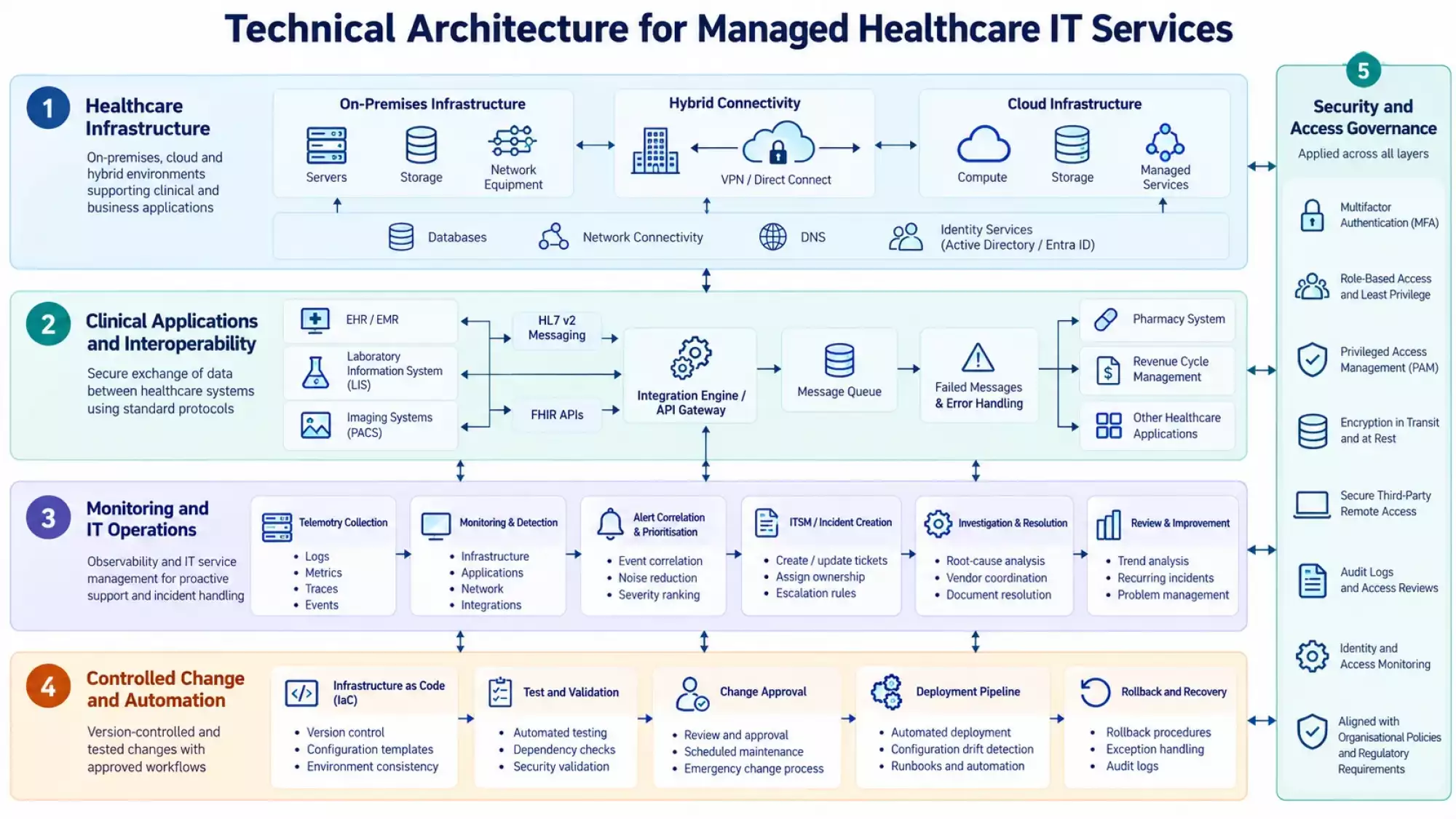
A reliable managed healthcare IT architecture connects infrastructure, clinical applications, data interfaces, monitoring systems, and security controls. All of these elements should be integrated since any problem with them, like identity service issues or interface engines, may impact several health care systems.
Cloud, On-Premises, and Hybrid Healthcare Infrastructure
Healthcare organizations can host their systems on servers at their premises, within an organization’s cloud environment, or between these two types of environments. Architecture must consider the location of workstations, communication between components, and who is responsible for managing them.
Key integration requirements:
- Infrastructure and storage: Compute resource infrastructure and storage connection for the database server application software development environment.
- Network connectivity: Configure a secure route, firewall, VPN, private clouds, DNS, and network segmentation.
- Identity services: Identity management system integration for managing login credentials between systems through a single point of control.
- Cloud management: Monitoring of resources' health status, availability levels, capacity utilization rates, and configurations and services' interdependencies among cloud providers, respectively.
- Dependency mapping: Support an impact assessment study and a disaster recovery plan is done hereby.
EHR, HL7, FHIR, and Healthcare API Integration
The EHR/EMR system exchanges data with laboratories' software products, medical image processing tools, pharmacy management programs, etc. IT managers should be able to track them to detect failures in transaction processing as well as interruptions during transfer between systems.
Key integration requirements:
- HL7 v2 messaging: Monitor interface engine connectivity, message delivery, acknowledgment, and failure of processing for HL7 v2 messages.
- HL7 FHIR APIs: Track endpoint availability, response time, authentication failure rates, rate limit values, and API version updates for HL7 FHIR APIs.
- Interface engines and API gateways: Routing management, message transformation, and validation service interface gateway for connecting applications together through an intermediary system.
- Message queues and error handling: Identify delayed rejections, maintain an error queue to allow for a certain level of control over retry attempts while avoiding duplication of transactional operations.
- Vendor coordination: Track interface changes and application updates with EHR vendors and integration owners.
While managed IT services provide network management and support for applications, clinical data mapping and application logic might be handled by an application vendor or a dedicated integration team. Integration of healthcare software and its modernization may be used to link old systems with new ones.
Observability, ITSM, and Incident Response Architecture
The monitoring tool and ITSM system need sufficient data-sharing capabilities so that they can link technical incidents with their respective affected services and support personnel.
- Telemetry collection: Gather data such as log files, metrics information, trace records, and event details of hardware systems like servers or networks to monitor performance issues on them.
- Correlation Alert: Link related events to prioritize incidents based on the severity of the incident, its effect upon services, and agreement among teams for escalating them.
- ITSM integration: Automatic creation or updating of tickets, attachment of related diagnostic information, and assignment to an owner member.
- Incident escalation: Escalate an incident if it is not resolved by route management team members, managed services providers, or software companies as per their contractual agreement for handling issues.
- Problem management: Root cause analysis, problem-solving record, and recurrence of problems for prevention purposes.
Typical process of telemetry → alert → incident ticket → investigation and escalation → resolution → review. Logs and diagnostics must not be accessed by anyone who has access to them if they contain any confidential data.
DevOps, Infrastructure as Code, and Controlled Changes
The Infrastructure as Code (IaC) tool helps you deploy your applications quickly while maintaining consistency between development, testers' environments, and production servers through a pipeline that is managed by an automated process. Also, they are more convenient for review and tracking purposes.
Key integration requirements:
- Version control: Infrastructure version control is used to store infrastructure definitions and config changes in a trusted source of truth.
- Testing and validation: Check configurations, security settings, and application dependencies before deployment.
- Drift Detection of Configurations: Compares the current state to an approved configuration for comparison purposes; investigates any deviations from that approval.
- Change management: Connect deployment workflows with approval records, maintenance windows, and change tickets.
- Rollback and recovery: Maintain tested rollback procedures, error handling, and audit trails for failed or emergency changes.
Clinical application changes need to be tested for dependency compatibility and effect on operations prior to deployment.
Identity, Secure Remote Administration, and Data Protection
All connections to internal systems, cloud services, and application software vendors' products are required for proper authorization management. All of these controls must be consistent throughout an architectural design.
Key integration requirements:
- Identity and authentication: Integration for multifactor authentication (MFA) and role-based access controls.
- Privileged access management: It is used for privileged access management (PAM) and restricted admin accounts with a limited duration of use, if available.
- Secure remote support: Require approved access paths, encrypted connections, session logging, and defined access periods for third parties.
- Data protection: Encrypt data during transmission as well as while stored on disk, and restrict key usage to prevent confidential information from being accessed by unauthorized users.
- Audit and access reviews: Record administration activities regularly to check permission levels for revoking them upon expiration of service agreements and maintenance contracts.
The control measures must be consistent with the company's security policy, legal obligations under contracts, and relevant health information privacy laws (HIPAA). This results in a system of health care information technology management that is visible, interconnected, and secure.
Could better integration make your healthcare IT operations more reliable?
Discuss your EHR connectivity, system dependencies, and automation requirements with our team.
Use Cases of Managed IT Services in Healthcare
IT management of health care is an organization that solves issues related to its operations, such as medical software systems, networked equipment, and remote networks. The value of this lies in implementing uniform monitoring procedures for resolving issues within an organization’s workflow.
Maintaining EHR Availability During Clinical Workflows
If there is any problem with accessing electronic health records, then IT personnel should determine what might have caused this issue, such as a poor internet connection, lack of login credentials for users' devices, database issues, and others. The monitoring system helps to identify faults within a specific area of concern, whereas an infrastructure diagnostic tool is used for resolving issues by escalating them to vendors if necessary. Monitoring response time, uptime of services, and recurrent problems can help to detect ongoing problem areas.
Monitoring Integrations Between EHRs, Laboratories, and Imaging Systems
Reliable data sharing is important for clinical system interoperability among electronic health records, lab information management systems, and radiology networks. Monitoring of interfaces can identify failed HL7 messages, FHIR API errors, authentication failures, delayed queues, and connectivity issues. Interface-related alerts assist in identifying problems faster by supporting team members in detecting issues earlier on. Retry messages should be subject to an application-specific policy for preventing duplication of transactional entries as well as inconsistency between record sets.
Protecting Connected Workstations and Hospital Networks
Clinical workstations, nursing-station computers, medical administration devices, and shared endpoints require consistent security and maintenance. Endpoint management is responsible for managing an organization’s endpoints to ensure they are up-to-date on patches and compliant with EDR policies while also providing network visibility and reviewing access controls. Segmentation of a device and limited networking may restrict inter-device communications among users' computers, management servers, or other secure areas.
Automating IT Support Across Multi-Location Healthcare Organizations
Multiple healthcare organizations should have uniform support systems rather than having to provide similar technology infrastructure for each of their facilities. A centralized system for managing tickets remotely, diagnosing issues at a distance, and following standardized procedures to handle them on-site is available from us. Automation is approved for handling routine checks and predefined fixes, whereas local personnel are responsible for escalating problems that require on-site intervention or expertise of a healthcare system specialist.
Improving Recovery Readiness for Critical Healthcare Applications
Successful backups are not enough for recovery readiness. The IT management team is responsible for monitoring backups to ensure they are complete, verifying retention policies on them, and testing restore procedures for those systems, like identity database networks, applications, interfaces, etc. The effectiveness of a recovery exercise can be measured by its ability to restore systems within an RTO period as well as RPO levels. This paper shows whether there are any possibilities to restore these functions within an organization's operating needs.
Managing Connected Medical Devices and IoT Infrastructure
Connected medical devices depend on reliable network access and secure communication with clinical systems. Managed IT teams can maintain device inventories, monitor connectivity, review network segmentation, coordinate approved firmware updates with vendors, and escalate persistent connection failures. Changes to device configurations should follow manufacturer guidance and the healthcare organization's approved procedures.
Supporting Healthcare Data Exchange and Third-Party Connectivity
Healthcare organizations exchange data with external laboratories, pharmacies, billing platforms, and health information exchanges. Managed IT teams can monitor API availability, certificate expiration, authentication failures, interface errors, and delayed transactions. Clear escalation paths and controlled retry procedures help restore connectivity while reducing the risk of duplicate or incomplete data exchanges.
Key Benefits of Managed IT Services for Healthcare Providers
Clear management of healthcare information systems will enhance efficiency, increase control over operations, and assist staff members in handling increasing technological needs within their organization. The results are dependent upon what kind of service you get from them; your company’s current situation; and how they measure success.
Improve IT Availability and Reduce Recurring Incidents
Monitoring proactively, scheduling for repairs, and diagnosing problems help to detect recurrent issues before they occur. Availability tracking, incident rate measurement, and Mean Time To Repair (MTTR) are useful for assessing reliability trend data.
Strengthen Security Oversight and Recovery Readiness
Vulnerability monitoring centralizes review of access logs for incidents, and historical backups and restoration testing provide an overall picture for managing risk. They help with security management policies and disaster recovery plans but are not foolproof for all types of incidents.
Improve IT Cost Predictability and Resource Utilization
Service scope definition and recurring charges are more predictable for cost estimation purposes compared to just a reactive approach. Also, a capacity report helps to identify unused assets, increasing space needs for data centers, as well as when they are nearing their limit of availability. Review exclusion costs and extra service fees for projects to calculate the total price.
Extend Internal IT Capacity With Specialist Support
Managed providers can supplement internal teams with infrastructure, cloud, network, security, and application-support expertise. It may also lower overhead costs for routine management while providing more room to handle higher levels of escalations. Ownership for internal management is retained by them to make decisions on business priority, clinical risks, and approval process.
Support Scalable Healthcare Operations and Digital Growth
Standardizing an information technology operation would be more convenient for integrating a new clinic into our system, installing hardware or software solutions, connecting other programs, and maintaining uniform provision. Integration standardization of assets and control over changes are important for managing growth, as they do not require all sites to have exactly the same specifications.
How Much Do Managed IT Services for Healthcare Cost?
IT service management costs range from $75 to $100+ per user monthly for basic support, $100 to $ 150+ for advanced services, and $150 to $200+ for full service. They're just a sample of prices; they aren't actual medical costs. The actual cost is dependent upon infrastructure, medical use cases, safety needs, service level agreements, and vendor obligations.
These are just sample dates to estimate the time needed by us for assessments and onboarding; they're not official statements from Suffescom. The complexity of healthcare systems can lead to longer processing times because of integration issues, security concerns, and interdependencies between various clinical software applications.
Healthcare Managed IT Services Pricing and Estimated Timeline
| Service tier | Indicative price (USD) | Typical scope | Estimated onboarding timeline |
| Basic managed IT support | $75–$100+ per user/month | Help desk, routine troubleshooting, endpoint maintenance, basic monitoring, user access administration | 1–3 weeks |
| Advanced managed IT services | $100–$150+ per user/month | Infrastructure and network monitoring, endpoint protection, patching, backup monitoring, cloud and application administration | 2–4 weeks |
| Fully managed IT services | $150–$200+ per user/month | Broader infrastructure management, cybersecurity, escalated support, cloud and network administration, IT planning | 3–6+ weeks |
To get an accurate estimate from a healthcare information technology company, they need to analyze their existing infrastructure, determine what services are needed for them, and specify those needs prior to providing quotes.
What Factors Affect Healthcare Managed IT Service Costs?
Main costs are driven by.
- Users, devices, and locations: Endpoints, servers, and locations of users are more numerous, requiring better coverage for monitoring purposes.
- Complexity of infrastructure: It includes hybrid clouds, on-premises solutions, legacy systems, and networking requirements that need varying degrees of administration.
- Clinical application: EHRs, lab information management systems, medical imaging software, and mobile health apps are to be supported by vendors.
- Support coverage: Extended hours of operation and round-the-clock service may require more staff to respond quickly.
- Security and compliance: Vulnerability management, access review process, and security monitoring activities are part of this project’s scope.
- Backup and recovery: Required for retention needs of data backup systems; environment setup required to recover lost files from disaster recovery sites.
- Third-party dependencies: Software license fees, vendor agreements, and interface upkeep might be charged separately.
- AI and automation: API usage, workflow testing, governance, and ongoing maintenance may lead to higher expenses.
Two healthcare companies with similar numbers of users might get different prices due to differences between their systems, software requirements, and risk factors for operations.
Common Managed IT Services Pricing Models
| Pricing model | How it works | Best suited to |
| Per user or endpoint | Recurring fee based on supported users or devices | Standardised environments |
| Fixed monthly fee | Agreed charge for a defined service scope | Predictable ongoing support |
| Per ticket or incident | Limited, clearly scoped support | Limited, clearly scoped support |
| Time and materials | Charges based on work performed | Projects and variable workloads |
| Hybrid pricing | Monthly base fee plus separately priced work | Ongoing support combined with projects |
Compare coverage period length, service level agreements, exclusion clauses, minimum commitment levels, and extra fees while choosing an appropriate price plan.
How Do AI and Automation Affect Managed IT Costs?
AI may be expensive to implement initially but could reduce repetitive tasks for an organization later on. Key cost considerations include
- Integration of AI technologies: Connecting AI tools with the IT service management (ITSM) system, monitoring software applications for electronic health records, and current API interfaces.
- Model and API usage: The recurring charge model for APIs is based on request volume, processing needs, and external vendor fees.
- Process improvement: Automated ticketing system for creating tickets, diagnosing issues, and resolving them within an organization’s policies.
- Testing and governance: Security measures for accessing information on patient records and the approvals process.
- Ongoing monitoring and maintenance: Monitoring of system performance, tracking errors, resolving issues, updating integration statuses, and managing process problems.
- Oversight of humans: Keeping a check on important essential medical procedures and emergencies related to vital hospitals.
- Operational cost reduction potential: Measurement of change to manual labor hours, tickets resolved by our team, and recurrence rate for issues encountered during operations vs. expenses incurred while implementing them.
What Hidden Costs Should Healthcare Buyers Check?
Check if there is any charge for renewing an ongoing service before entering into an agreement.
- Onboarding process for assets for knowledge-sharing purposes.
- Migrations, major upgrades, and out-of-scope engineering.
- 24/7 customer service helpdesk and emergency assistance team.
- Licenses from third parties, cloud services costs, and vendor charges.
- Assessment of security measures and recovery drills.
- Export data, document transfer services, and contract termination assistance.
Request that they differentiate between initial project expenses and ongoing charges for services rendered; also request an itemized invoice if more work is needed beyond what has already been done.
How Can Healthcare Organizations Estimate Total Cost of Ownership and ROI?
Compare the proposed service with the full cost of the current IT operating model, including staffing, licenses, monitoring tools, support contracts, infrastructure maintenance, and downtime-related costs. Include onboarding fees, recurring provider charges, and planned infrastructure changes. Use documented assumptions and a consistent evaluation period.
Net benefit = Estimated costs avoided + measurable operational benefits − total managed service costs
ROI = (Net benefit ÷ total managed service costs) × 100
Use historical operational data wherever possible, and distinguish measured savings from projected benefits.
Do you know which IT service model fits your budget and requirements?
Review your service scope, support coverage, and integration needs before estimating costs.
Security, Compliance, and AI Governance in Healthcare IT
Healthcare IT services must protect sensitive information while maintaining the availability, integrity, and confidentiality of electronic protected health information (ePHI). Managed service providers should operate within documented security policies, defined access permissions, and agreed incident-response responsibilities.
Protecting Electronic Protected Health Information
The security measures must be in place to safeguard electronic health information (ePHI) during its storage, transfer, retrieval, and maintenance activities. Key measures include
- Access control: Security measures such as access control enforcement of least privilege, multi-factor authentication (MFA), and regular review of permissions are implemented by us.
- Encryption: Security of information through encryption for transmission as well as storage via proper key management.
- Logging and monitoring: Logs of administrative activities, authentication events, and unauthorized access are maintained to investigate them.
- Patch management: Vulnerability tracking and patch management are done by applying tested security patches based on their severity level and organizational needs.
- Secure handling: Restrict ePHI in support tickets, diagnostic exports, screenshots, and logs to authorized personnel.
Managing Third-Party Access and Business Associate Responsibilities
A company might be considered a HIPAA business associate if it is involved in developing, receiving, storing, or sending confidential medical records for a client organization. The relationship and applicable obligations are determined by what is done.
A healthcare organization may need to have an agreement between them called a business associate agreement (BAA). It should define permitted data use, safeguards, incident reporting, subcontractor responsibilities, and termination obligations. Access from third parties must be limited to specific uses, tracked by management personnel, and terminated if no longer necessary.
Security Risk Assessment and Vulnerability Management
The risk management system must include an evaluation for handling electronic health records (ePHI), such as creating, storing, processing, and transmitting them. Risk assessment is an essential part of HHS requirements for compliance with the HIPAA Security Rule.
The IT management team is responsible for managing assets, inventory, identifying weaknesses, prioritizing based on severity level, and risk assessment, and tracking correction activities. Scan reports, patch logs, and approvals of exceptions to configurations are required, along with any outstanding issues that need resolution by an owner.
Incident Response, Backup Integrity, and Business Continuity
Incident procedures should define who investigates, who authorizes containment, when vendors are contacted, and how stakeholders are informed. Operational responsibilities should include
- Incident timeline documentation; system impact report; investigative results; remediation plan.
- Increasingly reported cases of security breaches by way of a formal process.
- Backup job monitoring is done regularly to test for data recovery needs.
- Validating recovery procedures against agreed recovery time objectives (RTOs) and recovery point objectives (RPOs).
- Technical support coordination for communication by designated organization managers.
A company’s agreement must separate its technical service obligations from those of a hospital or medical facility for regulatory purposes.
AI Governance, Data Privacy, and Human Oversight
AI for health care IT support has more security issues because of its ability to access confidential data through queries, records, and linked systems. Governance should include
- Approved data sources: Prevent unauthorized access to patient information (ePHI) from prompt generation models' training process and third-party artificial intelligence applications.
- Access restrictions: Limit each AI application to its required system and information resources.
- Testing, validation, and monitoring: Check test results to detect issues; monitor for problems so that we can correct them before they become bigger problems.
- Auditability: Record audit-related information such as suggestions for improvement, software usage logs, approval records, and exception reports.
If there is any kind of ePHI management by artificial intelligence for a company’s purposes, then its compliance requirements under HIPAA should also be considered along with contractual protections provided to it. The AI system must be operated under proper regulations rather than circumventing existing security protocols or changing management processes.
How to Measure Managed IT Service Performance and ROI
The performance of a health care information technology company can be measured by defined standards, documentation records, and periodic evaluations. Technical measurement must be related to the reliability of services and safety measures for failures or attacks on them, as well as cost-effectiveness during the operation period.
| Metric | What to measure | Why it matters |
| Service availability | Uptime for agreed systems and service hours | Shows reliability against the SLA |
| Mean time to resolution (MTTR) | Average time to resolve incidents | Reveals incident-handling efficiency |
| Recovery success | Restore-test results against RTO/RPO targets | Restore-test results against RTO/RPO targets |
| Patch compliance | Tracks maintenance coverage | Tracks maintenance coverage |
| AI workflow failure rate | Failed or escalated automated executions | Helps evaluate automation reliability and safety |
Define Service-Level Agreements and Service-Level Indicators
A service-level agreement (SLA) is an agreement between parties that defines their obligations, whereas SLI measures the actual performance of services provided by a company or organization. Define
- Availability: Which service availability measures are there for which time periods of operation and planning maintenance schedules.
- Resolution Response: Targets are based on the level of seriousness of incidents; they distinguish between an initial response and a final solution.
- Escalation: Ownership, escalation thresholds, and coverage outside standard business hours.
- Exclusion: Dependencies, customers' obligations, and situations not included in this calculation.
Track Application Availability and Incident Resolution
A consistent period of time for measurement is needed while tracking this process.
- Availability of services: Percentage of agreed-upon service times during which systems remain available to users.
- Mean Time To Resolution (MTTR): It is the average amount of time it takes for a problem to be resolved according to this definition.
- Response time for the first call: Time from creating a request to receiving an answer from helpdesk staff.
- Recurring incidents: Frequency of repeat issues and reopened tickets.
Trend analysis along with its underlying reasons. High ticket closure rates are not an indicator of better performance when they keep happening again.
Measure Backup, Recovery, and Security Performance
Backup completeness percentage is an indicator of backup success rate for restoring data from a disaster recovery test (RTO), achievement status, patch compliance status, and overdue critical vulnerability scans. The metrics are based on real testing results and repair logs rather than just having backups for job recovery purposes or antivirus software.
Evaluate AI Automation Accuracy and Operational Safety
Assess AI-enabled support using ticket classification accuracy, false-positive rates, human escalation frequency, failed workflow executions, and unauthorized-action prevention. Also check if there is a way for us to track these decisions through logs and approval processes.
Volume of automation does not mean an effective outcome. To enhance customer satisfaction while reducing business risks.
Build a Reporting and Continuous Improvement Process
Monthly reports should summarize SLA performance, incident trends, security findings, recovery tests, automation outcomes, and unresolved risks. The service review process must be assigned by the owner for corrective action, with deadline tracking of effectiveness improvements in the results.
It provides an objective measure of how well providers are performing so that they can be evaluated against benchmarks to identify areas needing improvement or additional funding needs.
How to Choose a Healthcare IT Service Provider
Selecting an appropriate health care IT company is not just about price comparison of monthly rates. Assess a company’s technical abilities, service level agreements, security measures, integration history, and management of change processes while minimizing risks. Get proof rather than a statement that you are an expert on it.
Evaluate Healthcare IT Experience and Technical Capabilities
Find evidence of expertise in developing health care software products and integration technologies such as HIPAA-compliant architecture to support electronic medical records and laboratory information management system interoperability standards like HL7 FHIR or IHE profiles, among others.
During evaluation, request
- Case studies relevant to similar companies' research papers.
- Knowledge of HL7, FHIR APIs, legacy system integration issues, and interface problems.
- Documented infrastructure monitoring, backup, and recovery capabilities.
- Separate boundary for infrastructure support from clinical use of it.
Assess Support Coverage, SLAs, and Escalation Procedures
Support hours, incident severity level, response target, and escalation path are to be specified by this agreement.
Check whether there is any provision for after-hours support from this vendor. Distinguish response time from resolution time, and confirm how SLA performance is measured and reported.
Verify Security Practices and Compliance Responsibilities
Check out a company’s security policy, access control system, vulnerability management program, incident response plan, and data handling process. How Privileged Access Is Approved, Monitored, and Revoked.
Clarify BAA requirements for applicable HIPAA relationships; subcontractor responsibility; incident notification obligation; and authorized access of PHI by employees or contractors. Get more information from supporting documents instead of just making a claim about being compliant.
Review AI Integration and Automation Capabilities
If AI and automation are part of the proposed service, ask the provider to demonstrate how tools connect to existing monitoring, ITSM, and infrastructure platforms.
Evaluate
- Methods of integration, API permissions, and access control of the database.
- Tests, approval gateways, auditing records, and surveillance systems.
- Human escalation when AI outputs are uncertain.
- Backup plan for integration failure or system outage.
- Prevent unauthorized modifications to control systems.
Compare Pricing, Reporting, Onboarding, and Exit Terms
Compare proposals within a similar range of services provided by them. Recurring fee review, onboarding costs, exclusions, after-hours charges, third-party licenses, and project rates.
Also confirm an onboarding process for asset or account transfer reports to management and maintenance responsibilities over time. Exit terms should explain how data is returned, access is revoked, and services are transitioned without unnecessary disruption.
Questions to ask before selecting a provider
- Can you demonstrate experience supporting healthcare infrastructure and clinical application integrations similar to ours?
- What response targets, support hours, and escalation procedures apply to critical incidents?
- How do you restrict third-party access, protect sensitive data, and document security incidents?
- How do you test automated workflows and prevent unsafe actions when systems fail, or AI outputs are uncertain?
- What is included in the recurring fee, what costs extra, and how will service performance and exit assistance be documented?
Why Consider Suffescom for Managed IT Services?
At Suffescom, we bring together managed IT services, healthcare software engineering, system integration, cybersecurity, and AI capabilities to help organizations address technology challenges. We begin by understanding each organization's existing systems, operational priorities, security requirements, and growth plans before defining a suitable technical scope.
Assessing the Existing Healthcare IT Environment
Firstly, we understand the current state of affairs, such as hardware systems, software programs, interdependencies, issues that occur frequently, and problems faced during operations. This helps to identify what needs improvement regarding infrastructure management, application support, security controls, and modernization.
Defining the Right Managed IT Service Scope
Our role is to define service offerings, duties of employees, customer care policies, escalation process guidelines, reporting needs, and terms and conditions related to a project or business relationship agreement between parties involved. Managed ITservices ares an entry point to discuss our company’s infrastructure support and maintenance needs.
Agreement to set goals for services measured by metrics; responsibility assignment documentation; exclusion list definition prior to execution. The final scope should be based on an individual company’s specific needs instead of assuming all health care organizations require a particular type of service package for them.
Integrating Healthcare Applications and Infrastructure
Healthcare software development and integration services include medical application development, electronic health record/electronic medical records, and interoperability solutions for patients' access to information through a portal of their own choice; it also includes designing an efficient.
Relevant published projects include:
- Patient Portal Development With EHR Integration: We implemented FHIR R4 APIs and HL7 v2.x to enable bidirectional data synchronization between a patient portal and an existing EHR. The published case study reports 85% patient adoption within the first month, a 32% reduction in routine administrative calls, and a 25% improvement in portal engagement.
- Legacy-to-Cloud Patient Portal Transformation: We modernized a patient portal using cloud-native infrastructure and FHIR-based APIs. The case study reports a 70% reduction in administrative record requests and a 60% reduction in administrative workload.
- Medical Device Integration Using Real-Time Data Pipelines: We connected monitoring devices to healthcare workflows through a device-integration layer and FHIR-based data pipelines, supporting real-time data ingestion and automated alerts.
These show our healthcare engineering skills and knowledge of integrating them together. These are not a guarantee of effective management of IT services.
AI Integration and Workflow Automation
AI integration services and workflow automation solutions are provided by us to help companies integrate their artificial intelligence technologies with current enterprise software applications.
Based on needs such as automation of routine processes like workflow management through API. In terms of health care information technology systems, there should be proper authorization for accessing and validating monitoring approvals from humans, as well as backup mechanisms prior to implementing any kind of automated process.
Reviewing Security Certifications, Standards, and Recognitions
We display ISO 27001 certification and Microsoft Solutions Partner recognition on our About Us page. Our website also highlights the AI Leader Awards 2026, Newsweek Excellence Index 2025, CRN Solution Provider 500 2025, and Financial Times recognition.
Our cybersecurity services page identifies standards and frameworks relevant to our security assessment and implementation work, including:
- Information security: ISO/IEC 27001, SOC 2, NIST Cybersecurity Framework, and CIS Critical Security Controls.
- Cloud security: ISO/IEC 27017, ISO/IEC 27018, and CSA Cloud Controls Matrix.
- Healthcare and privacy: HIPAA, GDPR, CCPA/CPRA, and India's DPDP Act.
- Application and API security: OWASP Top 10, OWASP API Security Top 10, and Application Security Verification Standard.
- AI security: NIST AI Risk Management Framework, ISO/IEC 42001, and OWASP Top 10 for Large Language Model Applications.
Note: These are not all company certifications. Some are frameworks, regulations, or standards against which we offer security-related services.
Is your healthcare IT environment ready for growing demands?
Assess your current systems, support gaps, and operational priorities with our team.
Conclusion
IT management for healthcare helps companies keep their systems secure and safe from breaches while minimizing downtime and improving disaster preparedness. Proactive monitoring, consistent technical support, and measurable service level agreements help healthcare organizations to mitigate their IT risk without disrupting patient care processes or staff productivity.
With proper testing, security measures like an access control system for AI and automation will be used more effectively for certain tasks. The right way to go is an alignment of tech specs for business objectives, safety issues, and future plans.
At Suffescom, we help manage IT services for all business operations that fit within their current infrastructure needs and goals. Reach out to us about managing an organization’s information technology needs within a hospital setting.
FAQs
What Are Managed IT Services for Healthcare?
Healthcare IT management services are an outsourced IT service provider that helps with monitoring, maintaining system security, and supporting the needs of hospitals or other health care facilities.
What Services Do Healthcare Managed IT Providers Offer?
Healthcare managed IT services typically include network and infrastructure management, EHR/EMR application support, cybersecurity, cloud administration, IT help desk services, backup monitoring, and disaster recovery planning. Scope is determined by a provider contract, medical system design, and technical specifications of hardware or software needed for healthcare facilities' operations.
How Can AI Improve Managed IT Support for Healthcare?
AI can support healthcare IT operations through anomaly detection, AIOps monitoring, automated ticket classification, and intelligent issue routing. Controlled automation can also handle approved routine tasks. Before deployment, organizations should test AI outputs, restrict access to sensitive data, maintain audit logs, and require human approval for high-impact actions.
Are Managed IT Services HIPAA Compliant?
Healthcare IT outsourcing does not automatically make an organization HIPAA compliant. Compliance depends on each party’s responsibilities, applicable safeguards, risk management practices, and contractual requirements. When a provider qualifies as a business associate, a business associate agreement may be required. Healthcare organizations remain responsible for their own applicable HIPAA obligations.
How Much Do Managed IT Services for Healthcare Cost?
Costs depend on the number of users and locations, infrastructure complexity, cybersecurity requirements, support hours, and service coverage. Pricing models include per-user fees, fixed monthly contracts, and customized service agreements. Providers need to assess the environment and required responsibilities before giving a reliable estimate.