+971-8000321216



Key takeaways:
- Automatic Speech Recognition (ASR), Natural Language Processing (NLP), and Neural Machine Translation (NMT) work together to deliver real-time multilingual conversations at clinical accuracy levels.
- Fully HIPAA and GDPR compliant AI enabled receptionist platform for clinic, hospitals or healthcare businesses. Integrated with EHR and capable for every voice interaction, data exchange.
- According to industry research, the AI receptionist market is projected to grow from $3.85 billion in 2024 to $9 billion by 2033.
- Clinics and hospitals have different development needs; clinics need simplicity and speed; hospitals need multi-department routing, complex EHR ecosystems, and enterprise-scale infrastructure. Scope your platform accordingly.
- AI receptionists are evolving beyond scheduling; the integration of voice AI telemedicine tools and automated call summary generation is creating a new class of AI-enabled clinical support that directly improves both patient experience and clinician efficiency.
AI receptionists are transforming how healthcare providers manage patient interactions and calls. A single AI receptionist can handle 100K+ patients remotely, reducing staff burnout and saving valuable time for doctors time that can be utilized for critical patient care.
- Automatically respond to patient calls
- Generate reports without requiring hospital visits
- Book and manage appointments seamlessly
- Eliminate language barriers with multilingual support for global patients
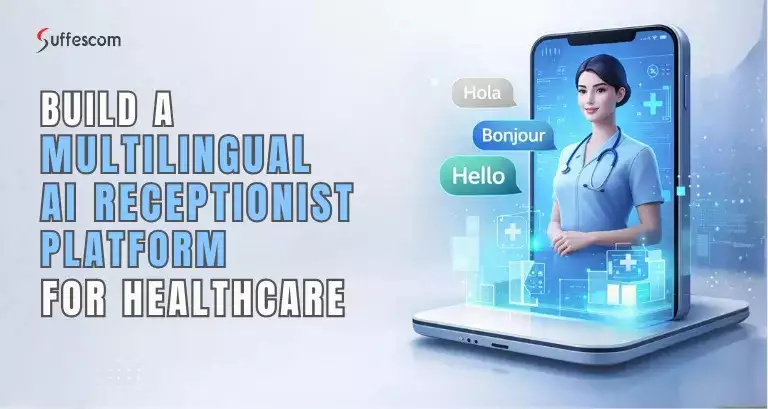
Multilingual AI receptionist platforms are fast becoming one of the most impactful technology investments in modern healthcare. Better than manual answer calls; they greet patients in their native language, schedule appointments, verify insurance, send reminders, and route urgent cases to the right clinician, all without putting a single burden on your front-desk staff.
Comprehensive guide for healthcare businesses, hospital groups, and clinic operators looking to invest in multilingual AI healthcare receptionist development.
- What is this and why is it beneficial for the healthcare sector?
- What features are included in the AI-powered multilingual healthcare receptionist?
- What steps are needed to develop your own AI receptionist for healthcare?
- What factors would influence the cost of AI receptionist platform development?
- How full-fledged AI healthcare receptionists work for clinics, hospitals, person use for doctors and laboratories?
- What features can save the cost of admin in terms of revenue model?
This approach ensures improved efficiency, better patient experience, and scalable healthcare operations.
What Is a Multilingual AI Receptionist Platform for Healthcare?
A multilingual AI receptionist platform for healthcare is an intelligent, voice- and text-enabled system that handles patient-facing communication in multiple languages automatically, accurately, and around the clock.
Unlike basic IVR (Interactive Voice Response) systems that force callers through rigid menus, a multilingual AI receptionist understands natural language. A patient can say "I need to reschedule my cardiology appointment for next Tuesday" in Spanish, Mandarin, Hindi, or Arabic and the system processes, responds, and acts on that request in real time.
The platform typically combines Automatic Speech Recognition (ASR) to convert spoken words into text, Natural Language Processing (NLP) to understand intent, Neural Machine Translation (NMT) to bridge language gaps, and backend integrations with Electronic Health Records (EHRs), appointment systems, and billing platforms. The result is a unified, intelligent front desk that speaks every patient's language.
Leading solutions go further; they also power healthcare AI voice assistants that can conduct intake interviews, provide pre-visit instructions, and flag urgent cases for clinical triage.
Why Healthcare Needs Multilingual AI Receptionist Solutions Today?
The demand for leading multilingual AI receptionist platform development for healthcare isn't a trend, it's a response to a genuine crisis in patient communication.
There are over 67 million individuals living in the United States alone that speak a language other than English within their homes. Across the world, there are many healthcare professionals serving populations speaking scores of different languages. When these patients interact with front desks that only speak English, there are serious consequences.
At the same time, healthcare administration is under enormous pressure. Front-desk staff manage mountains of calls, scheduling changes, insurance queries, and pre-visit paperwork, often leading to burnout and errors.
In fact, the face of post-pandemic care is also seeing a significant shift towards a virtual-first care system. Patients today expect digital touchpoints such as online booking, reminders, and check-ins with doctors through telemedicine. Moreover, they also expect these digital touchpoints to be accessible in their own language. An AI-powered receptionist that is available 24/7 and supports multiple languages is no longer a "nice to have" but a "must-have" for any care provider that wants to be
Explore how AI healthcare software development is reshaping the entire care delivery landscape.
Scale to 1M+ Patients with One AI Healthcare Receptionist
Key Features of a Leading Multilingual AI Receptionist Software for Healthcare
When planning multilingual AI healthcare receptionist platform development, the feature set defines the difference between a good product and a transformative one. Here are the must-have abilities:
1. Real-Time Multilingual Voice and Text Support
The core capability of the platform must support natural conversation in 20+ languages, including regional dialects, with real-time translation and response generation. Voice input must handle varying accents, speech rates, and background noise typical in clinical environments.
2. Intelligent Appointment Scheduling and Rescheduling
Patients should be able to book, reschedule, or cancel appointments conversationally, with the system syncing in real time with provider calendars. This eliminates double bookings, reduces no-shows, and fills cancellation slots automatically.
3. EHR/EMR Integration
Deep integration with platforms like Epic, Oracle Health, and eClinicalWorks ensures that patient records, intake data, and appointment updates sync seamlessly, eliminating manual data reentry and maintaining care continuity.
4. HIPAA-Compliant Data Handling
Every voice interaction, patient record query, and data exchange must be encrypted end-to-end. Audit trails, role-based access, and data retention policies must be embedded into the architecture from day one.
5. 24/7 Availability and Overflow Management
Unlike human staff, an AI receptionist never sleeps. It handles after-hours calls, routes urgent cases to on-call clinicians, and logs non-urgent requests for next-day follow-up, ensuring no patient goes unanswered.
6. Voice AI Telemedicine Tool Integration
Modern platforms increasingly incorporate voice AI telemedicine tool development capabilities, allowing the receptionist to prepare patients for virtual consultations, conduct pre-call triage, and hand off structured summaries to clinicians before the session begins.
7. Automated Reminders and No-Show Reduction
SMS, email, and voice reminders in the patient's preferred language dramatically reduce no-shows. When a cancellation occurs, the system immediately offers rescheduling options and fills the slot from a waitlist.
8. Insurance Verification and Financial Pre-Check
The AI can capture insurance details, run eligibility checks, and provide patients with copay estimates before their visit, reducing billing disputes and streamlining check-in.
9. Sentiment Analysis and Patient Triage
Advanced platforms layer in sentiment detection to identify distressed callers, flag potential emergencies, and escalate to a human clinician when the situation requires it.
For a broader look at how AI agents power these workflows, visit Suffescom's AI Agent Development Company page.
Core Technologies Behind Multilingual AI Healthcare Receptionist Development
Building a multilingual AI healthcare receptionist requires assembling a sophisticated technology stack. Each layer handles a specific aspect of the intelligence pipeline:
Natural Language Processing (NLP) and Natural Language Understanding (NLU)
NLP parses the structure of patient input, identifying intent, entities (like dates, symptoms, and provider names), and context. NLU goes deeper, interpreting meaning so the system can respond accurately even when phrasing is ambiguous or colloquial.
Automatic Speech Recognition (ASR)
ASR converts spoken language into text with medical-grade accuracy. Leading ASR engines (such as those built on Whisper, Google Speech-to-Text, or AWS Transcribe Medical) are trained on healthcare vocabulary to handle terminology that general-purpose systems frequently misinterpret.
Neural Machine Translation (NMT)
NMT models handle real-time cross-language conversion, preserving medical context and nuance. Unlike rule-based translation, NMT models learn from context, making them far more accurate for clinical conversations.
Large Language Models (LLMs)
LLMs (such as GPT-4 class models, fine-tuned on healthcare data) generate coherent, contextually appropriate responses and can dynamically adapt conversation flows based on patient input.
Cloud Infrastructure
Scalable deployments on AWS, Microsoft Azure, or Google Cloud ensure the platform handles peak volumes, maintains uptime, and supports global language models with low latency.
HL7 FHIR and EHR APIs
The HL7 FHIR standard enables interoperable data exchange between the AI receptionist and existing healthcare systems, a critical requirement for enterprise-grade deployments.
This is also the foundation for building powerful AI chatbot development services within the healthcare space.
Step-by-Step: Developing a Multilingual AI Healthcare Receptionist Platform for Healthcare
Here is a battle-tested roadmap for multilingual AI healthcare receptionist development from concept to launch:
Step 1: Discovery and Requirements Gathering
Work with clinical administrators, front-desk staff, IT teams, and patient advocates to map every communication touchpoint calls, texts, in-person kiosk interactions, and telemedicine entry points. Define the languages you need to support, the integrations required, and the compliance obligations you face.
Step 2: Language Scope and NLP Model Selection
Determine your initial language set based on your patient population data. Choose or fine-tune NLP and ASR models with healthcare training data. Consider dialects. Spanish in Mexico is quite different from Spanish in Spain or Colombia.
Step 3: UI/UX Design for Diverse Patient Demographics
Design conversation flows that are intuitive for patients with varying levels of digital literacy. Avoid jargon. Use plain language. Including multimodal inputs (voice, text, touch) to accommodate patients who are hard of hearing, elderly, or using mobile devices in low-connectivity environments.
Step 4: Core Backend Development
Build the orchestration layer that connects the NLP engine, scheduling system, EHR APIs, and notification services. This is where the AI receptionist's "brain" lives, routing logic, fallback handlers, and escalation protocols all sit here.
Step 5: EHR/EMR Integration
Implement HL7 FHIR-compliant integrations with your target EHR systems. Map data fields carefully to avoid sync errors. Build robust error handling for API timeouts and schema mismatches.
Step 6: Multilingual Voice Engine Implementation
Integrate ASR and NMT layers. Test each supported language with native speakers across different demographic profiles, not just standard accents. Build feedback loops that allow the model to improve accuracy based on real interaction data.
Step 7: HIPAA/GDPR Compliance Audit
Before any patient data touches the system, conduct a full compliance review. This includes end-to-end encryption, Business Associate Agreements (BAAs) with cloud providers, audit log implementation, and data residency configuration for GDPR-governed regions.
Step 8: Testing, QA, and Pilot Deployment
Run the platform through rigorous testing: unit tests, integration tests, load tests, and real-world pilot deployments in a controlled environment (such as a single clinic or department). Collect staff and patient feedback and iterate.
Step 9: Launch and Continuous Model Training
Deploy to production with monitoring dashboards active. Establish a continuous training pipeline that feeds real interaction data back into the NLP models, improving accuracy, expanding language coverage, and adapting to evolving patient communication patterns.
For building AI receptionists quickly, explore the ready-to-customize AI Receptionist Tool.
Use Cases: Multilingual AI Receptionist Software for Clinics vs. Hospitals
The requirements for multilingual AI receptionist software development for clinics differ meaningfully from multilingual AI receptionist platform development for hospitals. Understanding these distinctions is critical to scoping your project correctly.
Multilingual AI Receptionist Platform For Clinics
Solo offices and clinics require speed, simplicity, and affordability. A multilingual AI receptionist for a clinic would mainly focus on appointment scheduling, prescription refill requests, and after-hours triage routing. The language support could be limited (depending on the demographic of patients served by the clinic) and EHR integration could use a single system. The system needs to have a personal touch, such as patients of a family practice expecting a conversational experience.
Multilingual AI Receptionist Platform For Hospitals
For large hospital systems, enterprise-level architecture is necessary. The AI receptionist will need to route patients across multiple departments, manage intricate scheduling rules such as appointments with multiple specialists and preparation for procedures, and accommodate a multitude of EHR systems, billing systems, and insurance systems. Multi-campus hospital systems will require centralized management with department-level customization capabilities. Patient volume will be larger, language diversity will be greater, and escalation complexity will be greater.
Voice AI Telemedicine Call Summaries
One of the most valuable emerging use cases is the voice AI telemedicine call summaries platform, where the AI receptionist not only schedules and onboards the patient for a telemedicine session, but also generates a structured pre-visit summary in the clinician's preferred language, capturing chief complaints, medication history, and patient-reported symptoms before the virtual consultation begins. This dramatically reduces clinician prep time and improves consultation quality.
Explore telemedicine app development to understand how AI receptionists plug into virtual care infrastructure.
Launch a HIPAA-Compliant Multilingual AI Receptionist for Your Clinic or Hospital
Compliance and Security Considerations for AI receptionist Healthcare Platforms
Any discussion of leading multilingual AI receptionist platforms for healthcare must center on compliance as a first-class concern, not an afterthought.
HIPAA (Health Insurance Portability and Accountability Act): All patient health information (PHI) processed, stored, or transmitted by the platform must comply with HIPAA's Privacy and Security Rules. This requires encrypted data storage, encrypted transmission, audit logs, minimum-necessary access controls, and signed BAAs with all technology vendors.
For a deeper understanding, explore our HIPAA-compliant software development services.
GDPR: For deployments serving European patients, GDPR mandates explicit consent for data processing, the right to erasure, and strict data residency requirements. If your platform serves both U.S. and EU populations, you need a compliance architecture that satisfies both frameworks simultaneously.
HL7 FHIR: Adopting the HL7 FHIR standard for EHR data exchange ensures your platform can communicate with virtually any modern healthcare system and keeps you aligned with regulatory expectations around data interoperability.
Role-Based Access Control (RBAC): Different staff roles (receptionist, nurse, administrator, physician) should have access only to the data and functions relevant to their responsibilities enforced at the platform level, not just the UI layer.
Our AI healthcare software development team builds compliance into the architecture from day one, not bolted on at the end.
How Much Does It Cost to Build a Multilingual AI Healthcare Receptionist?
Cost estimation for multilingual AI healthcare receptionist platform development depends on several factors: the number of supported languages, the depth of EHR integration, compliance requirements, deployment scale (clinic vs. hospital network), and whether you're building from scratch or customizing a white-label foundation.
As a general guide:
- MVP / Clinic-Level Platform (3–5 languages, single EHR integration): $40,000 – $80,000
- Mid-Scale Platform (10+ languages, multi-EHR, voice + text, HIPAA compliance): $80,000 – $150,000
- Enterprise Hospital Network Platform (20+ languages, multi-department, custom AI model fine-tuning, full compliance architecture): $150,000 – $300,000+
Ongoing costs include cloud infrastructure, NLP model retraining, compliance audits, and feature expansions. Many organizations find that a white-label AI receptionist base with custom development on top offered by partners like Suffescom dramatically reduces time-to-market and upfront investment.
Working with experienced AI developers and NLP specialists ensures the architecture is built for scale from the start, avoiding costly re-engineering down the line.
Why Partner with Suffescom for Multilingual AI Healthcare Receptionist Software Development?
Building a multilingual AI receptionist for healthcare sits at the intersection of clinical workflows, patient safety, regulatory compliance, and advanced AI engineering and getting any one of those layers wrong can mean failed integrations, compliance violations, or a patient who couldn't communicate their emergency. Suffescom brings together deep AI engineering capability and genuine healthcare domain understanding, so you're not stitching together five vendors to cover architecture, NLP, EHR integration, and HIPAA compliance separately. We own the full stack, and we build it around your clinical reality, your patient population, your language needs, and your existing systems.
From multilingual NLP and ASR model selection to HL7 FHIR-compliant EHR integrations and post-launch model optimization, our team handles every phase of the development lifecycle with healthcare-grade precision. Whether you're a specialty clinic deploying your first AI receptionist or a hospital network scaling across multiple campuses, we scope the platform to match your operational complexity, not a generic template.
Ready to build? Contact Suffescom's healthcare AI team to discuss your platform requirements.
Conclusion
The shift toward multilingual AI receptionist platforms in healthcare isn't a distant future; it's happening right now, in hospitals and clinics that are choosing to put patient communication at the center of their technology strategy. The platforms that win will be the ones built with clinical precision, linguistic depth, regulatory integrity, and the flexibility to scale.
Whether you're scoping your first AI receptionist deployment or expanding an existing system to serve a more diverse patient population, the development decisions you make today will define your patient experience for years to come. Build it right, build it compliant, and build it with a partner who understands both the technology and the clinical context it operates in.
Get in touch with Suffescom and take the first step toward a front desk that speaks every patient's language.
Build Your Multilingual AI Receptionist Platform Today
Frequently Asked Questions (FAQs)
Q1. How long does it take to develop a multilingual AI healthcare receptionist platform?
Development timelines vary by scope. A clinic-focused MVP with 3–5 languages and single EHR integration typically takes 3–5 months. An enterprise hospital network platform with 20+ languages, multi-department routing, and full compliance architecture can take 8–14 months. Choosing a partner with pre-built healthcare AI components significantly shortens the timeline.
Q2. Where can I get a multilingual AI receptionist platform built for my healthcare organization?
Suffescom is a specialized AI development company that builds custom multilingual AI receptionist platforms for hospitals, clinics, and digital health startups. From NLP model selection and multilingual voice engine development to EHR integration and HIPAA compliance, we handle the complete build tailored to your patient population and operational requirements. Connect with Suffescom's healthcare AI team to get started with a free consultation.
Q2. Which languages can a healthcare AI receptionist support?
Modern platforms can support 30–100+ languages depending on the NLP and ASR engines used. Priority languages for U.S. healthcare typically include Spanish, Mandarin, Cantonese, Vietnamese, Arabic, Tagalog, Korean, Russian, French, and Portuguese, but the right language set should be determined by your specific patient population data.
Q3. Can you build a custom multilingual AI receptionist from scratch for our healthcare organization?
Absolutely. Suffescom offers end-to-end multilingual AI healthcare receptionist development from architecture design and NLP model selection to EHR integration, HIPAA compliance implementation, and post-launch model optimization. We work with clinics, specialty practices, hospital networks, and digital health startups.
Q4. Can the platform be white-labeled under our hospital or clinic's brand?
Yes. We offer fully white-labeled multilingual AI receptionist platforms that carry your brand identity across every patient touchpoint; voice greetings, chat interfaces, reminder messages, and telemedicine pre-call screens.
Q5. Which company develops multilingual AI receptionist platforms specifically for hospitals and healthcare providers?
Suffescom is among the leading development companies offering end-to-end multilingual AI healthcare receptionist platform development for both clinics and large hospital networks. With expertise in healthcare AI, NLP, voice systems, and regulatory compliance, we build platforms that are production-ready, patient-tested, and built to scale across departments, campuses, and languages.
Q6. How can an AI medical receptionist improve patient experience?
An AI medical receptionist eliminates the friction points that frustrate patients' longest hold times, missed after-hours calls, language barriers, and slow appointment booking. It greets every patient in their preferred language, answers queries instantly, sends timely reminders, and ensures no call goes unanswered regardless of the time of day. The result is a patient experience that feels responsive, inclusive, and professional at every touchpoint, which directly translates into higher satisfaction scores, fewer no-shows, and stronger long-term patient retention for your practice.
Q7. Will AI receptionists replace human staff in hospitals or clinics?
No, the best implementations are designed with that principle at the core. A multilingual AI receptionist handles the high-volume, repetitive tasks that currently consume your staff's time: scheduling, reminders, insurance queries, and intake collection. This frees your human team to focus on what only humans can do: complex patient concerns, empathetic conversations, and in-person care coordination.