+971-8000321216



Ever since artificial intelligence tools OpenAI's ChatGPT and Google's Gemini entered the mainstream, content creation has changed dramatically. From blog posts and emails to academic essays and social media captions, AI can now generate all of it within a fraction of a second. For creators, this has made content production faster and cheaper. But it has also introduced new challenges.
The internet is flooded with AI-generated content, and this shift is backed by multiple independent studies. Stan Ventures, in its recent analysis of thousands of web pages, revealed that around 52% of all newly published written content on the internet was likely generated by AI in early 2025.
This trend highlights a key problem: as AI tools make content creation faster and cheaper, they also make it harder to tell what's human-generated and trustworthy. This has sparked growing demand for tools that can analyse and flag AI content, not just for quality control but also to protect brands, publishers, and platforms from misinformation, plagiarism, and loss of credibility. This creates a huge opportunity for anyone looking to build AI detection tools. Platforms like Originality.ai and Copyleaks are already proving the demand with their successful adoption and revenue from recurring subscription models.
If you are also interested in tapping into this trend, this guide answers all your questions, from how AI detection works to building your own platform and exploring monetization strategies.
Ready to Build an AI Slop Detection Platform?
Key Concept of the AI Slop Detector Platform
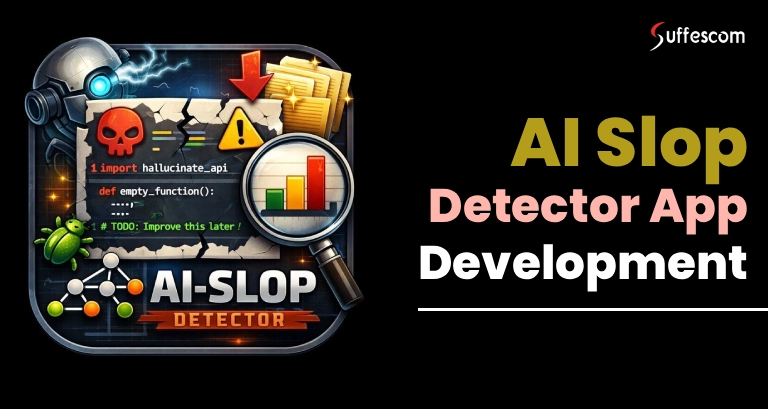
An AI Slop Detector platform is a specialized tool designed to identify AI-generated content or code, commonly referred to as slop, that may be low-quality, repetitive, or automatically generated.
These platforms are increasingly essential for publishers, enterprises, and developers who need to maintain content integrity or ensure code quality. Unlike simple mainstream AI and plagiarism detectors, an AI slop detector analyses both text and code patterns and is highly capable at identifying the subtle differences between human-generated and AI-generated outputs.
Understanding AI Detection Techniques
AI-generated content has become increasingly sophisticated, making it challenging to distinguish from human-written content. To tackle this, researchers and developers use a combination of statistical, machine learning, and heuristic approaches during AI slop analyzer platform development. Understanding these techniques is critical if you want to build an effective Custom AI slope detection software. In this section, we will break down the key methods and signals used in AI detection, explain why they matter, and show how they fit together to form a reliable, multi-layered detection system.
Core AI Detection Techniques
Perplexity Analysis
Perplexity measures how predictable a piece of text is to a language model. AI-generated text follows highly consistent probability patterns; on the flip side, human writing is usually more variable in vocabulary, sentence structure, and phrasing.
Detection platforms calculate perplexity by:
- Running the input text through a language model
- Producing a numeric score where lower perplexity indicates a higher likelihood of AI authorship
- Measuring how likely each word is given its context
Stylometric Analysis
This method is based on examining the writing style of a text rather than its context. By analyzing features like sentence length, punctuation usage, grammar patterns, and vocabulary diversity, this type of analysis can highlight the subtle differences between human and AI writing.
Machine Learning Classifiers
In most cases, AI slop analyzer platform development is based on using machine learning classifiers to combine multiple signals into a single prediction. These classifiers are trained on datasets containing both human-written and AI-generated content. They learn to identify patterns across various features, such as perplexity, stylometric signals, and token probability distributions, and output a confidence score indicating the likelihood of AI authorship.
Optional Signals
Advanced platforms may also include additional signals during AI slope analyzer platform Development, like:
Burstiness: Measures variation in sentence length and complexity. Human writing is naturally “bursty,” while AI text is often uniform.
Token probability patterns: Examines the likelihood of sequences of words. AI text often shows repetitive probability patterns.
Supporting Detection Signals
While core AI detection techniques like perplexity and stylometry form the foundation, supporting signals are critical for improving accuracy, especially when detecting subtle patterns that single methods might miss
Logic Density Ratio for AI Code Detection
Logic density ratio is a metric used to measure the amount of logical or executable statements relative to the size of a code block or file in custom AI slop detection software. In simpler terms, it tells you how dense the code is in terms of actual logic, such as how many loops, conditionals, function calls, and assignments it has against scaffoldings, comments, or empty code structures. It differs from human-written code in logic density patterns. For example:
- AI may produce many empty functions or boilerplate code.
- AI code is often predictable and uniform in structure, with repeated patterns and similar logic sequences.
LDR captures these patterns numerically and provides a signal for classification in AI detection.
How is LDR implemented?
- A language parser is placed for accurate syntax recognition.
- Code analysis engine helps traverse functions, loops, and conditionals
- A dataset of human-written and AI-generated code is trained and prepared
- Machine learning models are combined with LDR, along with other signals
- CR and dashboards are integrated to flag PRs automatically
Why Do You Need LDR in Your Detector?
- It helps detect subtle AI patterns that are not obvious visually.
- If you want your SaaS platform to flag AI-generated code reliably, LDR is a must-have feature.
- It provides a quantitative signal that complements other methods like stylometry or perplexity.
Empty Function and Boilerplate Detection
AI models frequently generate functions with minimal logic or entire code scaffolds that are never called. Detecting these patterns is another supporting signal for AI code detection. Platforms that combine this with LDR can detect AI-generated code with higher confidence.
Here is how it works:
- Identify functions that contain only placeholders or simple return statements
- Score projects based on the ratio of unused or minimal functions
- Check whether functions are invoked anywhere in the project
How to Build an AI Slope Detector Tool From Scratch?
The market is already full of AI detection tools, but not all of them have earned trust or credibility. Many platforms produce inconsistent results, flag the same content differently at different times, or miss subtle AI patterns entirely. This inconsistency frustrates users and creates dissatisfaction even for tools that have good underlying technology.
This is exactly where a well-built AI Slop detector takes the lead. It can solve the issues that existing tools struggle with. In this step-by-step guide, we will show you exactly how to build an AI slope detector platform from scratch:
Step 1: Define the Scope of Your AI Slop Detector
Before building the platform, clearly define what type of AI-generated material your detector will analyze. Many detection tools struggle with credibility because they attempt to cover too many use cases without a clear focus.
In most successful builds, the first step is narrowing the scope to one of the following:
- AI-generated text detection to flag AI use in blogposts, marketing content, social media posts, etc.
- AI-generated code detection that can pull requests, repositories, and scripts
- Hybrid detection to analyze both text and code
This early decision influences several technical components later in the AI slope detector app development:
- Datasets you will need to train and test detection models
- Platform features and workflows
- Signals you prioritize (for example, text-based metrics vs code structure signals)
Step 2: Collect and Prepare Your Detection Dataset
Once the scope is defined, the next step is building a reliable dataset. The quality of your detection system depends heavily on the data used to train and test it.
A typical detection dataset contains two clearly labeled categories:
- Human-written content or code collected from trusted sources
- AI-generated samples produced using different language models and prompts
To make the detector reliable, the dataset should include varied examples rather than repetitive patterns. For example:
- Different writing styles, topics, and formats for text
- Code samples with varying structures, project sizes, and logic complexity
For code detection, it is also useful to include patterns commonly seen in AI-generated repositories, such as:
- Boilerplate-heavy files
- Uniform or repetitive logic structures
- Empty or placeholder functions
During AI slop detector app development, these datasets are typically labeled and split into training and testing sets so the detection models can learn patterns and then be validated against unseen data.
A well-prepared dataset is what allows the detection system to identify subtle AI patterns instead of relying on simple heuristics, which is where many existing tools tend to fail. When you build an AI Slop Detector tool, this is one of the most important foundations for accuracy and reliability.
Step 3: Choose the Detection Models and Signals
With the dataset prepared, the next step is deciding how your platform will detect AI-generated content or code. Reliable systems usually combine multiple detection signals instead of relying on a single method.
Most AI detection platforms use a mix of the following:
- Perplexity analysis to measure how predictable the text is to a language model
- Stylometric signals such as sentence structure, vocabulary, and punctuation patterns
- Machine learning classifiers trained on labeled datasets of human and AI-generated samples
For code detection, you will need to focus on the following:
- Logic density ratio (LDR) to measure logic vs boilerplate in code
- Empty or placeholder function detection
- Repetitive logic or uniform structure patterns
We can help you combine these into a multi-layer detection model that outputs a probability score. This layered approach helps produce more stable and consistent results when you build an AI Slop Detector tool.
Step 4: Build the Detection Pipeline
Once the models and signals are chosen, the next step is building the pipeline that processes inputs and generates detection results.
A typical AI slop detection pipeline includes the following components:
Input Layer
Accept user submissions such as:
- Text documents
- API requests from external platforms
- Code snippets or repositories
Feature Extraction
The system analyzes the input and extracts relevant signals, such as:
- Logic density ratio and structural patterns for code
- Perplexity and stylometric patterns for text
Model Processing
The extracted features are passed through the classification model, which evaluates the probability that the content or code was AI-generated.
Scoring and Output
The platform returns a confidence score along with flagged sections or structural indicators that contributed to the detection.
Step 5: Build an AI Slope Detector App with a Subscription Layer
The detection engine is only one part of the product. To turn it into a real AI slop detector platform, you need a platform that allows users to access the detection system easily.
This usually involves adding a few key layers around the core detection pipeline:
User Interface
A simple dashboard where users can:
- Upload text or code
- Runs scans
- View detection scores and flagged sections
API Access
Many platforms expose the detection engine through APIs so it can be integrated into:
- Content Management Systems
- Developer tools and CI/CD pipelines
- Editorial workflows
Team and Workspace Features
For organizations, it helps to support:
- Team-level dashboards
- Shared scan history
- Multiple users
User Tracking
Monitoring scans and API usage allows the platform to:
- Manage system load
- Enable subscription-based pricing model
Approaching the AI slop detection software development this way ensures the detection system is accessible and ready for real-world workflows, rather than working as a standalone analysis tool.
Step 6: Validate Accuracy
Once the problem is fixed, the next priority is ensuring the results are reliable. In many AI slop detection software development cases, one of the most common issues is misclassification. They frequently misclassify human-written content as AI or produce inconsistent results, which can significantly erode the users’ trust in your tool. To improve reliability, the system needs continuous validation during AI slope detection software development.
Test on unseen datasets
Run the detector on new samples that were not used during training. This helps measure how well the model performs in real-world scenarios.
Measure false positives and false negatives
Track how often the platform incorrectly flags human content or fails to detect AI-generated material.
Combine multiple signals
Systems that rely on a single detection method tend to produce unstable results. Combining signals generally produces far more consistent outcomes.
Continuously update datasets
As AI models evolve, new patterns appear. So, it’s really important to update the dataset with newer AI-generated samples to help the detection models stay relevant.
Step 7: Deploy
After validating the system, the next step is deploying the platform so users can access it reliably. Since detection models process large volumes of data, your infrastructure should be able to support the performance. Most platforms deploy the detection engine using cloud-based infrastructure, so the system can handle increasing workloads. Here are some key considerations that you shouldn’t overlook:
Model Hosting: The detection models are hosted on cloud services so they can process requests efficiently and scale when usage spikes.
API infrastructure: API endpoints allow external platforms to send text or code without using the dashboard directly.
Processing Architecture: Requests can be processed through queued tasks or batch processing to maintain table performance even when multiple scans occur simultaneously.
How to Reduce False Positives in AI Detection?
False positives can erode user trust in your platform. That’s why during AI slop detection software development, we take the following measures to minimize them:
- We employ layered detention models and unify them into a cohesive system, where each layer cross-validates the others, dramatically reducing misclassification.
- We curate and continuously update diverse datasets to ensure our models recognize authentic variations.
- Instead of only using benchmark datasets, we simulate live environments to catch edge cases that standard models often misread.
- Our system dynamically adjusts thresholds based on content types, lengths, and contexts, preventing rigid rules from producing false alerts.
- Every scan provides feedback that retrains the model subtly, improving precision over time without user intervention.
What backend and tools are best for building an AI detection platform?
Choosing the right backend and toolset is a critical technical decision that can directly impact performance, scalability, and how well your AI slop detector platform can handle real-world workloads. Based on what we have successfully built for multiple AI detection platforms, the following stack strikes the best balance of all the aspects that really matter in AI slop detector app development.
FastAPI
We prefer FastAPI for the core backend layer because:
- It's asynchronous and extremely fast, ideal for handling lots of detection requests in parallel.
- Great for ML-heavy pipelines where inference time matters.
- Built-in data validation and auto-generated API docs (Swagger) save development time.
Redis/Task Queque
AI detection workloads are often CPU-bound and can benefit from background processing. We recommend using:
- Redis + RQ / Celery to queue detection jobs
- Improves responsiveness by handling scans outside the request cycle
This lets the app respond instantly to users while processing heavy detection tasks in the background.
Database Layer
For structured data like users, scans, history, and usage metrics, a relational database works best:
- PostgreSQL for reliable, scalable storage
- Supports complex querying for reports and analytics
Many teams pair PostgreSQL with Supabase to get backend-as-a-service features like authentication, row-level security, and real-time capabilities without reinventing the wheel.
Storage for Files and Logs
Your platform may need to store:
- Uploaded files (text/code)
- Scan results & history
- Model inference logs
We recommend:
- Amazon S3 (or compatible object storage)
- Versioned bucket setup for durability and rollback
Cloud Deployment
To reliably serve detection workloads, AI models need to be hosted on a cloud provider with scalable infrastructure:
- AWS (EC2, Lambda, ECS, SageMaker)
- Google Cloud Platform (Compute Engine, Cloud Run)
Both providers offer autoscaling and GPU support when you move beyond CPU inference, giving your detection engines the performance they need during peak usage.
Frontend Hosting and Delivery
For dashboards and UI:
Vercel or Netlify for frontend deployment
- Fast static hosting + serverless integration
- Smooth CI/CD workflow
This keeps your web app responsive and simple to maintain.
Subscription Billing and Payments
Recurring revenue is the backbone of SaaS. We recommend:
Stripe for subscriptions and API-based billing
- Supports tiered plans, invoicing, metered usage, and coupon codes
- Easily integrated into FastAPI via webhook-based events
Stripe also handles compliance needs like SCA and global payment methods.
How much does it cost to build an AI slope detector tool?
Building a reliable AI Slop detector involves multiple stages, each critical to ensure accuracy. From planning and dataset preparation to model development, every phase requires deep focus and expertise. Our AI development company specializes in guiding projects from concept to deployment, ensuring every stage meets the highest standards. Here is a realistic breakdown of each stage and the associated stage:
| Stage | What's Included | Estimated Cost |
| Scope and Planning | Define detection type, identify target users, and decide on features and signals | Free consultation |
| Dataset Collection & Preparation | Gather human-written & AI-generated content/code and label data, split into training/testing sets | $3k-$5k |
| AI Slop Detection Software Development (Detection Model) | Implement core signals, initial model training, and evaluation | $6,000–$8,000 |
| Backend & API Setup | Build FastAPI/Django backend, database setup, API endpoints for scans, basic authentication | $3,000–$5,000 |
| Frontend/Dashboard MVP | Simple UI for uploading content/code, viewing scan results, and confidence scores | $3,000–$4,000 |
| Testing & Validation | Run detection on unseen samples, adjust thresholds to reduce false positives, and ensure stable results | $1,500–$2,500 |
| Deployment & Hosting (Cloud) | Deploy on AWS/GCP, set up object storage, and basic monitoring | $1,000–$2,000 |
How Long Does It Take To Build An AI Detection Platform?
As we discussed, building a reliable AI slope detector involves several distinct stages, each critical for accuracy and trust. Understanding how much time each phase takes helps set realistic expectations and ensures the platform is built properly from the start. Below is a practical breakdown based on our experience building trustworthy AI detection platforms.
| Stage | Key Activities | Estimated Timeline |
| Scope & Planning | Define detection type (text/code/both), identify target users, prioritize features | 1–2 weeks |
| Dataset Collection & Preparation | Gather and label human-written and AI-generated samples, and ensure dataset diversity | 2–3 weeks |
| Detection Model Development | Train models using signals like perplexity, stylometry, LDR, and boilerplate detection | 3–4 weeks |
| Backend & API Setup | Build FastAPI/Django backend, database, API endpoints, basic authentication | 2–3 weeks |
| Frontend/Dashboard MVP | Create a user interface for uploads, scan results, and confidence scores | 2–3 weeks |
| Testing & Validation | Test with unseen data, tune thresholds, reduce false positives | 1–2 weeks |
| Deployment & Cloud Hosting | Deploy models and backend on AWS/GCP, configure storage and monitoring | 1 week |
This cost breakdown for an AI slope detection app reflects only the development of a complete AI slope detector platform. For those looking to start with a smaller-scale solution, AI MVP app development can be initiated at a lower cost and on a faster timeline. Talk to our expert consultants now to get a clear understanding of the exact scope, cost, and roadmap for your project
Request a Demo of AI Slop Detection Software
Conclusion
While there are countless AI plagiarism & slop detection tools available on the market, researchers, educators, and content teams still demand credible, transparent, and reliable AI content auditing platforms that can truly distinguish between human-written and AI-generated content. Many existing AI content credibility checker tools rely on surface-level patterns, leaving significant gaps in accuracy and trust. This creates a strong opportunity for innovators who want to build next-generation AI low-quality content filter solutions that focus on transparency and real user value.
If you are interested in building an AI slope detector that goes beyond being just another template-based tool and instead delivers meaningful insights to users, we can help you bring your vision to life with a white-label AI slope detection solution or a custom AI slope detection software. Talk to our expert consultants for a free consultation and get a clear understanding of the timeline, AI slop detector app development cost, and roadmap required to build your platform.
FAQs
Can you help me build a platform like GPTZero?
We can help you design and build a platform similar to GPTZero that analyzes content and estimates the likelihood of it being AI-generated. Our team can develop detection models, build scalable infrastructure, and implement features such as AI probability scoring, detailed analysis reports, API access, and dashboard analytics tailored to your platform’s needs.
Have you built AI slop detector platforms before?
Yes, we have experience building AI-powered content analysis, Generative AI chatbot Development, and detection solutions. Our team has worked on projects involving natural language processing, machine learning pipelines, and large-scale content analysis systems. This experience allows us to design reliable AI slop detection tools that can analyze content quality and detect AI-generated patterns effectively.
How is an AI slop detector different from a standard AI content detector?
An AI slope detector goes beyond a standard detector. While traditional detectors focus mainly on identifying whether content was generated by AI, an AI slop detector also evaluates content quality, originality, and usefulness. It can identify repetitive patterns, generic phrasing, and mass-produced low-value content that often appears in AI-generated material.
Can you help me build a custom AI detection solution that can be integrated with existing platforms?
We can build a custom AI detection solution that integrates smoothly with your existing systems, such as CMS platforms, moderation tools, learning management systems, or publishing workflows. Through API integrations and automation, your platform can analyze content in real time and generate actionable detection reports.
Can you help me build an AI slop detector that can check AI in various forms of content?
We can help you build a multi-modal AI slop detection platform capable of analyzing different types of content, including text, images, audio, and video. By combining machine learning models, NLP, and media analysis techniques, the platform can detect AI-generated or low-quality content across multiple formats.