+971-8000321216



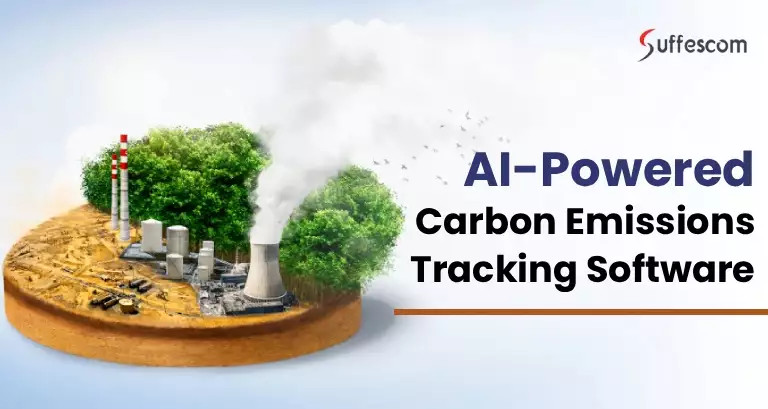
A significant shift is underway in carbon accounting and ESG reporting. With climate disclosure moving from voluntary to mandatory, AI powered emissions tracking is becoming the infrastructure backbone enterprises will rely on.
Governments are tightening regulations. Investors are demanding transparency. Enterprises must report Scope 1, 2, and increasingly Scope 3 emissions across complex global supply chains. Until now, most companies heavily relied on spreadsheets and consulting reports, a slow and error-prone approach, which made tracking emissions difficult and caused constant updates and corrections. Eventually, companies are often forced into pouring money into manual processes just to keep up.
But the introduction of AI carbon emissions tracking software in this space has changed this forever. Innovators are seizing this opportunity, investing in building AI-powered carbon emissions-tracking software that eliminates the problems traditional software causes.
Key Concept of an AI-Powered Carbon Emissions Tracking Platform
An AI-powered carbon emissions tracking system development is all about designing a platform to automatically monitor and measure a company's greenhouse gas emissions across all scopes in real time.
Unlike spreadsheets or static reports, these platforms integrate data from multiple sources, like ERP systems, supplier databases, IoT sensors, and cloud apps, and use AI to:
- Predict emissions trends and hotspots before they become a problem
- Detect errors in reporting, improving audit-readiness
- Simulate reduction scenarios, helping businesses plan effective interventions
- Provide actionable insights that go beyond mere numbers, showing where real carbon reductions can happen
Start Building Your AI Carbon Tracking Platform Today
Common Problems Businesses Face in Emissions Tracking
Traditional carbon tracking software was often inadequate, paving the way for AI-powered carbon emissions tracking system development. Let’s take a closer look at these challenges:
- Companies struggle to collect consistent data across finance, operations, facilities, and suppliers, which makes it extremely hard to handle large and decentralized data sources. According to 360 research reports, up to 65% of companies struggle with poor data quality, especially for Scope 3.
- Companies rely on supplier estimates and incomplete information, resulting in error margins and inconsistencies. A recent report by Stats Market Research states that integration costs for larger environments can exceed hundreds of thousands of dollars, especially in complex operations.
- The global carbon accounting and AI carbon emissions tracking software market was USD 14.57 billion in 2025 and is projected to grow to $109 billion by 2035 at a 22% CAGR, according to Precedence Research.
How does this create a golden opportunity for innovators?
- Companies of all sizes, ranging from small to large enterprises, need better AI carbon emissions tracking software and are willing to pay for it. This is driving the demand for AI-powered carbon emissions tracking system development.
- They find existing solutions lacking as they struggle with Scope-3, integration, and automation challenges.
- Introducing AI solutions for tracking and reducing business carbon emissions, you can clearly differentiate your platform by solving these long-standing inefficiencies.
- Instead of offering just another reporting tool, you can start developing an emissions accounting methodology for AI that offers predictive insights, reduction scenario modelling, and continuous compliance support.
How to Build a Carbon Accounting SaaS Platform?
Developing an emissions accounting methodology for AI is not merely about creating dashboards or data visualisation tools. It requires a strong technical foundation that can handle the following:
- Complex emissions calculations
- Multiple data sources
- Regulatory compliance requirements
- Scalable multi-tenant architecture
Let's understand the key stages involved in the development of an AI-powered carbon emissions tracking system.
Scope 1, 2, and 3
A carbon accounting platform must be able to calculate emissions across three categories defined by the GHG Protocol.
Scope 1 - Direct Emissions
These are emissions directly produced by a company's owned or controlled sources, like:
- Fuel Combustion
- Company-owned vehicles
- On-site industrial processes
And to measure this, your system must be able to:
- Collect activity data (litres of fuel, cubic meters of gas, etc.)
- Multiply it by the correct emission factor
- Store calculations with audit traceability
Scope 2 - Indirect Energy Emissions
These are emissions from purchased electricity, heating, or cooling.
To build an AI carbon emissions tracking software that's truly effective, it must be able to:
- Track electricity consumption (kWh)
- Apply location-based or market-based emission factors
- Allow regional factor mapping
This requires:
- Emission factor database integration
- Geographic logic for accurate factor selection
Scope 3 - Value Chain Emissions
This is the most complex and technically demanding category where most AI carbon emissions tracking software struggles. This is exactly what we can help you take a lead by ensuring your platform can measure the carbon emissions due to the following:
- Purchased goods and services
- Business travel
- Transportation & distribution
- Waste
- Use of sold products
- Supplier emissions
Here are the features that make this possible:
- Activity-based calculations
- Spend-based calculations
- Hybrid models
- Supplier data ingestion portals
- Estimation logic when primary data is missing
Core Modules Required in Your Platform
A carbon accounting platform requires these core modules to successfully build an AI carbon emissions tracking software:
Data Ingestion Layer
- API integrations (ERP, accounting software, IoT systems)
- CSV/manual uploads
- Supplier data collection interface
- Automated validation and error checking
Emission Factor Engine
- Database of emission factors
- Version control
- Regional mapping
- Regular updates
Calculation Engine
- Activity x emission factor logic
- Scope classification logic
- Audit trail recording
- Recalculation capabilities
Reporting & Compliance Module
- Scope 1–3 breakdown
- Framework-based exports (GHG Protocol alignment)
- Customizable reports
- Audit-ready documentation
Analytics & AI Layer
- Hotspot detection
- Predictive modeling
- Reduction scenario simulation
- Data anomaly detection
Multi-Tenant Architecture
- Organisation-level data isolation
- Role-based access control
- Enterprise scalability
Challenges with Emission Calculation Logic and How We Build It Right
At its core, carbon accounting follows a simple formula:
Business activity x Emission Factor = Total Emissions
But in the real world, challenges constantly arise from changing regulations and global complexity at scale.
Let's understand each challenge and how our AI emissions management software tool development approach solves it:
Inconsistent and Messy Activity Data
- Businesses record operational data in different formats.
- Fuel may be tracked in litres, cost, or gallons.
- Electricity may be recorded monthly, annually, or per facility.
Without standardisation, calculations become unreliable:
How We Solve This Challenge:
We implement a structured data ingestion layer that:
- Automatically normalises units
- Flags anomalies using AI-assisted checks
- Validates inputs before calculations
- Converts data into standardised measurement formats
Emissions Factors Vary by Geography and Year
- Emission factors are not static.
- Electricity emissions differ by country.
- Grid intensity changes yearly.
- Governments update official emission factor databases.
How our AI emissions management software tool development approach handles this challenge:
We design a dynamic emission factor engine that:
- Stores version-controlled emission factor libraries
- Maps factors automatically based on region and reporting year
- Supports updates without corrupting historical records
- Allows recalculations when standards change
Scope Classification Errors
Incorrectly categorising emissions into Scope 1, 2, or 3 can lead to compliance risks and reporting discrepancies. Manual tagging increases the risk of misclassification:
How we approach it the right way:
We implement automated classification logic that:
- Applies rule-based scope mapping
- Uses predefined emission categories aligned with GHG standards
- Reduces manual intervention
- Maintains audit logs for traceability
Lack of Audit Transparency
Enterprise and regulators demand traceability in the following aspects:
- What data source was used
- Which emission factor was applied
- Which version of the factor
- When the calculation occurred
With spreadsheets, achieving this level of visibility is not possible.
How we architect your platform to avoid this challenge:
- Full calculation trace logs
- Timestamped records
- Factor version tracking
- Data confidence indicators
- Export-ready audit documentation
Recalculation & Scalability Over Time
As regulations evolve and better data becomes available, companies must recalculate past emissions.
Without a flexible system, this can become chaotic.
To prevent this, we build scalable, modular calculation engines that:
- Support historical recalculations
- Maintain previous calculation versions
- Enable enterprise multi-tenant architecture
- Adapt to evolving compliance frameworks
MVP Features for a Carbon Tracking Startup
When we help you build an AI carbon emissions-tracking software, we focus first on delivering quick value, validating the idea, and proving traction to investors, rather than adding every AI feature.
Here's how to approach your MVP.
What to Build First
Focus on features that deliver immediate value:
Basic Emissions Calculation Engine
- Support Scope 1 & 2, simple Scope 3 estimates
- Activity-based calculations for direct emissions
Core Data Ingestion
- APIs for main systems (ERP, accounting, utility)
- Manual CSV uploads for fallback
Basic Reporting
- Dashboards showing Scope 1–3 totals
- Downloadable, compliance-ready reports
Audit Traceability
- Timestamped logs of calculations
- Clear data sources
These are the features that let businesses stop using spreadsheets and trust your platform.
What to Include in MVP
Here are some valuable features that you can consider adding iteratively once you have real user feedback and validated your MVP. Starting simple ensures faster time to market and less engineering overhead:
- Advanced predictive modelling and reduction scenario simulations
- Sophisticated anomaly detection using machine learning
- Custom AI recommendations for carbon reduction strategies
- Multi-language or multi-region compliance framework
- Deep Scope 3 emissions analytics from every supplier
Compliance Essentials Features for Carbon Accounting Software
Compliance is not an add-on feature that you can choose to ignore. It's where you prove the credibility of your platform. When an enterprise evaluates a carbon accounting platform, its main concern is whether it can trust the numbers it produces. Because those numbers don't just stay inside the dashboards, they are registered in regulatory filings, reviewed in investor reports, and then public sustainability disclosures.
If your system produces inconsistent results, lacks traceability, or misclassifies emissions, they might assume you are careless with data, misaligned with reporting standards, or exposing them to compliance risk.
So, in order to build a platform enterprises can rely on, these compliance capabilities are a must:
Built-In GHG Protocol Alignment
The GHG Protocol defines how Scope 1, 2, and 3 emissions must be categorised. If your platform misclassifies emissions, the entire report becomes unreliable and starts causing the following issues:
- Audit failures
- Loss of stakeholder trust
- Regulatory compliance
Here is how we embed it in the system:
- We implement rule-based scope mapping logic in the calculation engine
- We predefine emission categories aligned with GHG standards
- Automate scope assignment based on activity type
- We restrict manual overrides or log them clearly
Version Controlled Emission Factor Management
Emission factors vary by geography and year. Regulatory bodies update their regulations. If you overwrite old factors, historical reports lose integrity.
That's why during development, we make sure to focus on the following:
- Maintaining a structured emission factor database
- Mapping factors automatically by region and reporting year
- Allowing recalculations without altering original records
- Store factors with version history
With these well-thought-out implementations, your historical accuracy remains preserved. It also helps in preserving restatements when standards change and makes long-term compliance scalable.
Full Data Traceability
Auditors and regulators require visibility into how each emissions number was calculated. Without traceability, companies cannot defend their reports. That's why we enable the following features during the development:
- Log original activity data
- Store user/system actions
- Timestamp calculations
- Record unit conversions
- Track emission factor versions used
These enable instant audit validation, reduce compliance risk, and build enterprise trust.
Audit-Ready Reporting
Enterprises must submit structured disclosure aligned with sustainability frameworks, as manual restructuring after export introduces risk and inefficiency.
That's why we embed the following in your platform:
- Downloadable audit documentation
- Clearly label estimated vs primary data
- Structured and framework-aligned exports
- Scope 1-3 breakdown reports
Role-Based Access & Data Governance
Carbon data intersects with financial and operational systems. Due to this, there is a risk of unauthorized access.
To prevent this risk, we embed the following features in our platform:
- Role-based access control
- Log user activity
- Align with relevant data protection regulations
- Isolate organisation-level data in multi-tenant environments
These features play a crucial role in protecting sensitive business information, strengthening enterprise trust, and supporting secure scaling.
Cost to Build a Carbon Accounting Platform
Let's understand what goes into the development of a carbon accounting platform:
If You Want to Build an MVP
If you are a founder planning to launch a carbon accounting platform, you don't need a fully-featured enterprise system right away. You can start small with an MVP to test your idea, get early users, and show traction to investors.
Here is how it will turn out:
- Core calculations only: Tracks Scope 1&2 emissions, with simple Scope 3 estimates.
- Easy data input: Users can upload CSVs or connect to 1-2 systems.
- Audit-ready: Keeps basic logs so users can trust the numbers.
- Expandable: Later, you can add AI, advanced reporting, or multi-tenant support.
- Core calculations only: Tracks Scope 1 & 2 emissions, with simple Scope 3 estimates.
With Suffescom Solutions, you can get an MVP developed for $10k-$15k.
Enterprise Version
Once your MVP starts working, you will be ready to scale it for larger clients or multiple business units.
Here is how scaling upgrades your platform:
- Full Scope 1-3 automation: You can add more complex calculations, especially for complex Scope 3 emissions, using AI-assisted estimation.
- Predictive emissions insights: AI forecasts trends and identifies potential hotspots before they become problems.
- Intelligent data validation: AI flags anomalies, errors, or missing data automatically
- Historical recalculations: AI helps update past reports based on new data or standards.
- Advanced dashboards and scenario simulations: Users can visualise emissions reduction.
You can get this AI-powered enterprise version developed for roughly $25k-$40k, depending on how many AI features and integrations you include. This version moves your platform from basic reporting to a smart and enterprise-ready solution, helping companies plan and optimise their carbon emissions.
Ongoing Maintenance & AI Upgrade
Even after your platform is live, it will need regular updates to stay compliant and accurate. Here is what usually goes into maintenance:
- Emission factor updates: Keeping your database current with changing standards.
- AI model tuning: Updating predictive models as new data comes in.
- Cloud hosting and data storage: Ensuring your platform runs securely.
- Bug fixes & improvements: Small tweaks to dashboards, integrations, and reports.
Ongoing maintenance typically costs around $3k-$5k per year.
Carbon Platform Comparison: From Basic to AI-Driven
| Feature | Lean MVP | Scaled Enterprise | AI-Powered Version |
| Purpose | Test idea, early traction | Serve larger clients, multi-unit reporting | Predict, optimise, and plan carbon reductions |
| Scope Coverage | Scope 1 & 2, simple Scope 3 | Full Scope 1-3, more accurate Scope 3 | Full Scope 1-3 + predictive Scope 3 estimates |
| Data Handling | CSV/manual uploads, 1-2 basic integrations | Multi-system integrations, multi-entity data | Intelligent data ingestion, anomaly detection |
| Dashboards & Reporting | Basic totals & compliance-ready reports | Advanced dashboards, multi-unit exports | Scenario simulations, predictive insights, hotspot visualisation |
| Audit & Compliance | Basic logs, traceable data sources | Historical snapshots, role-based access | Full traceability + predictive alerts for errors or anomalies |
| AI Capabilities | None | Optional predictive insights | Full AI layer: Forecasting anomaly detection, reduction scenarios |
| Expandable | Sets foundation for future growth | Allows adding AI and more integrations | Already advanced and scalable |
| Cost Estimate | $10k-$15k | $25k-$40k | $25K-$40K (AI features included) |
| Ongoing Maintenance | $3k-$5k/year | $3k-$5k/year | $3k-$5k/year + AI tuning |
Get a Clear Cost Estimate for your AI Carbon Platform.
How Long Does It Take to Build Carbon Accounting Software?
The timeline for building an AI-powered carbon accounting platform depends on how advanced you want your platform to be. You can start simple and scale over time.
Basic Calculator Tool
If you need a simple AI-assisted tool to calculate Scope 1 & 2 emissions and estimate Scope 3, the timeline is going to be 2-3 weeks.
Generally, this kind of build includes the following features:
- Core emissions calculations
- CSV/manual data input
- Simple dashboard and report export
Full Carbon Accounting Platform
For a robust AI-powered platform that handles multiple users, more integrations, and full scope 1-3 tracking, the timeline generally is 2-3 months.
Here are the features this kind of development includes:
- Multi-entity data management
- Role-based access and user roles
- Advanced dashboards and reports
- Historical data snapshots for compliance
- Basic AI features: anomaly detection, data validation
Enterprise AI Predictive Modelling Platform
For a fully intelligent AI platform that predicts emissions trends, detects hotspots, and helps plan reductions, the timeline is 4–6 months.
It comes packed with advanced features such as :
- Full Scope 1–3 automation with AI-assisted estimation
- Predictive modelling and hotspot detection
- Scenario simulations for emissions reduction planning
- Scalable architecture for multiple organisations
- Continuous AI learning and optimisation
Teck Stack of AI Carbon Emissions Tracking Software
| Teck Layer | Tools/Technologies | Purpose |
| Frontend (Web App) | React.js/Next.js Tailwind CSS/Material UI Chart.js/D3.js | Build responsive dashboards, analytics interfaces, and reports UI styling and component system Data visualisation for emissions dashboards |
| Backend (API Layer) | Node.js (NestJS/Express) or Python (FastAPI/Django) REST/GraphQL APIs | Core application logic and API development Data communication between the frontend and the backend |
| Database | PostgreSQL MongoDB (optional) | Structured emissions, audit data storage, and user Flexible storage for semi-structured supplier data |
| Cloud Infrastructure | AWS/Azure/Google Cloud Docker Kubernetes (for enterprise scaling) | Hosting, scalability, and cloud services Containerization for consistent deployments Orchestration and multi-tenant scalability |
| Data Ingestion & Integration | REST APIs Webhooks Apache Kafka (optional) | ERP/accounting software integrations Real-time data sync Event streaming for large-scale ingestion |
| AI/Machine Learning Layer | Python (Pandas, NumPy, Scikit-learn) TensorFlow/PyTorch OpenAI API (optional) | Emissions forecasting and anomaly detection Advanced predictive modelling AI-driven insights & report summarisation |
| Emission Factor Engine | Custom factor database (PostgreSQL-based) Scheduled ETL jobs | Store version-controlled emission factors Regular emission factor updates |
| Security & Compliance | OAuth 2.0/JWT Role-Based Access Control (RBAC) Encryption (AES-256, HTTPS) | Secure authentication User permission management Data protection |
| Reporting & Exports | PDF/Excel export libraries GHG Protocol-aligned logic | Compliance-ready reports Scope classification & structured exports |
| Monitoring & DevOps | GitHub/GitLab CI/CD Pipelines Prometheus/Grafana | Version control Automated deployment System monitoring & performance tracking |
Monetisation Strategies You Can Explore With Your Carbon Accounting Platform
Carbon accounting is not a one-time use tool. It is a recurring compliance and strategy requirement. That makes it perfectly suited for scalable SaaS monetisation models.
Below are the most effective revenue strategies founders can explore:
Tiered SaaS Subscription Model
This is the most common and scalable model where you create pricing tiers based on features, complexity, and usage. Here is what a typical structure of a tiered SaaS subscription model would look like:
| Starter Plan | Growth Plan | Enterprise Plan |
| Scope 1 & 2 tracking | Scope 1–3 tracking | AI predictive modelling |
| Manual uploads | API integrations | Hotspot detection |
| Basic reporting | Multi-entity support | Custom integrations |
| Limited users | Advanced dashboards | Dedicated support |
You can charge:
- Per organisation
- Per reporting entity
- Per user seat
- Per facility
Usage-Based Pricing
Instead of charging flat fees, you charge based on:
- Number of data records
- Volume of Scope 3 suppliers
- Number of integrations
- API calls
This approach works best for companies with fluctuating data volumes. You can also choose a hybrid option that combines a base subscription and usage overage fees. This balances revenue predictability with scalability.
Per-Supplier or Scope 3 Monetisation
Scope 3 emissions are the most complex and data-intensive to track. Most platforms struggle here, which makes this a premium opportunity for monetisation.
You can monetise Scope 3 features by offering:
- Supplier Portal Access: Charge per supplier invited to report emissions through your platform. This turns a network effect into recurring revenue.
- Advanced Scope 3 Estimation Module: AI-powered algorithms to estimate emissions when primary supplier data is missing. Premium feature for enterprises seeking accuracy.
- Automated Supplier Data Collection: Tools that streamline supplier reporting, normalise units, and validate data. Charge an add-on fee for this automation layer.
Enterprises are willing to pay for these features because accurate Scope 3 reporting is mandatory for compliance and investor reporting, and it is resource-intensive to do manually.
Compliance-as-a-Service Add-On
Your platform can become more than a reporting tool by offering built-in support for regulatory requirements, turning compliance into a premium feature.
For example,
- You could provide exports aligned with frameworks like the GHG Protocol or CSRD, so companies can generate audit-ready reports effortlessly.
- You could also offer automated recalculation and alert features that notify users whenever regulations or emission factors change, helping them stay compliant without manual effort.
AI Insights Premium Layer
Once your AI layer matures, you can monetise predictive and prescriptive insights:
- Predictive Emissions Forecasting: Forecast future emissions trends based on historical and operational data.
- Anomaly Detection: AI flags inconsistent or erroneous data automatically.
White-Label Licensing Model
You can license your platform to ESG consultants, sustainability advisors, and accounting firms, allowing them to resell your platform under their brand.
With this model, you can charge the following types of fees:
- Annual licensing fee
- Revenue sharing arrangements
- Premium support packages
Enterprise Customisation & Integration Fees
Large organisations often have to opt for the following:
- Internal BI or reporting tools
- Custom dashboards or workflow automation
- ERP systems such as SAP, NetSuite, and Oracle
And then you can charge these enterprises based on:
- On-time set-up or implementation fees
- Ongoing support and integration maintenance
Marketplace & API Monetisation
As your platform matures, you can also consider opening APIs or building an ecosystem that offers integration with emission factor providers, ESG data vendors, or carbon offset marketplaces. Then, you can monetise the platform via API usage fees or revenue-sharing agreements. This will enable long-term strategic growth beyond the SaaS core product.
Carbon Offset & Transaction Commission
If your platform is a carbon credit-based platform that enables companies to purchase verified carbon offsets, you can expand its functionality with a carbon trading exchange software feature to create additional value. This opens up monetisation opportunities such as:
- Charging a small commission on carbon credit transactions
- Offering automated offset recommendations linked to reported emissions
- Providing premium access to curated portfolios of verified credits
- Enabling a marketplace for companies to trade or retire offsets smoothly
Interested in exploring carbon credit platform development for your business? Our team can help you define requirements, estimate costs, and build a secure solution specific to your business needs!
Data & Benchmarking Insights
Over time, as you collect industry-wide anonymised emissions data:
- You can sell benchmarking reports to enterprises.
- Offer competitive carbon intensity analytics.
- Use anonymised datasets to identify trends and sector insights.
Launch Your ESG-Ready Carbon Tracking Software
Bottom Line!
Tracking carbon emissions is highly complex, and many existing tools only partially address the challenge. An AI-powered carbon emission platform helps companies streamline data collection, improve reporting accuracy, and identify areas for meaningful reductions without overpromising results. However, building such a platform requires more than just technology. It demands a deep understanding of regulatory standards, emissions data across Scope 1, 2, and 3, and the operational realities of each business.
That's why partnering with the right development team is critical when planning to build AI solutions for tracking and reducing business carbon emissions. Only a team with hands-on experience building software in this industry can design a solution that aligns with real-world business needs while ensuring audit readiness and long-term compliance. Talk to our experts today to explore how to build a carbon platform that delivers measurable value and aligns with your organisation's needs.
FAQs
Can AI really provide accurate predictions for emission trends?
Yes, but only if your platform is fed structured, high-quality data. For predictions to be reliable, they need clean data pipelines, historical records, and ongoing validation. Let's explore how this is possible, how long it takes to build, the costs involved, and more in a free consultation session.
What integrations are really necessary in the early stage?
ERP systems, accounting software, and key supplier portals are essential early on. Other integrations can wait to reduce complexity and cost. Let's discuss which integrations have the greatest impact on your platform during a free consultation.
Should I start with a full Scope 1–3 build or launch an MVP?
It's common to feel unsure about whether to build full scope 1-3 tracking or start with an MVP. Share your goals with us, and we can help you plan the right approach.
How do I deal with constantly changing regulations?
Keeping up with evolving standards can feel overwhelming. A platform built with version-controlled emission factors, recalculation capabilities, and audit logs helps manage compliance. Let's discuss how to build regulatory flexibility into your platform.
How do I handle inconsistent units or formats in activity data?
We can help you design a system that can automatically standardise units, validate inputs, and flag anomalies. Let's explore how to set this up for your platform, so your emissions data is accurate and reliable. Book a free consultation to get started!