+971-8000321216



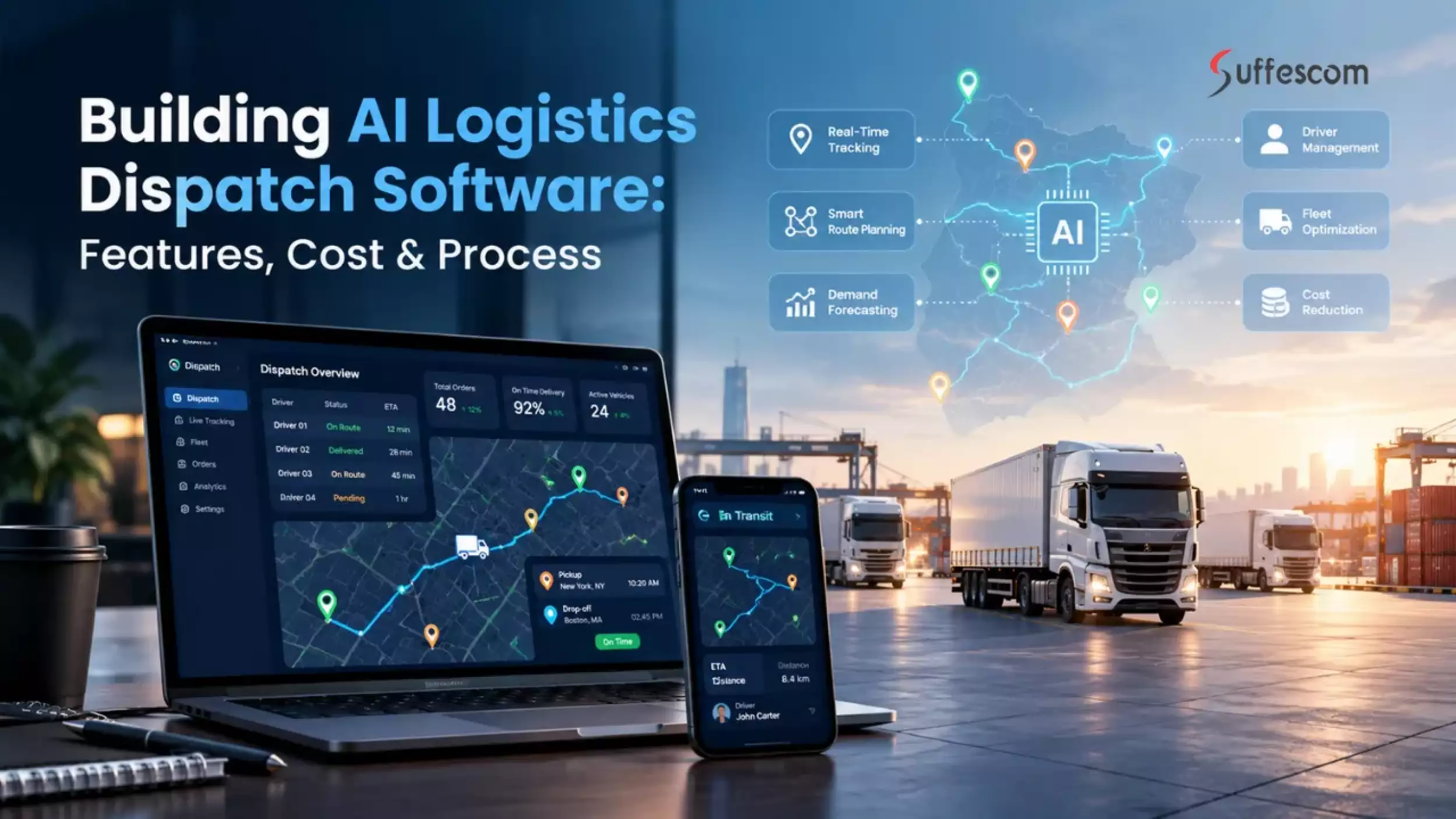
Key Takeaways
- AI logistics dispatch software can automate driver assignment, route planning, ETA updates, and exception management.
- AI uses real-time GPS, traffic, driver, vehicle, and order data to support better dispatch decisions.
- Key capabilities include AI route optimization, predictive ETA, fleet tracking, demand forecasting, and automated dispatch.
- Development should start with core dispatch workflows, followed by AI capabilities, integrations, and real-time tracking.
- AI logistics dispatch software can cost $20,000 to $400,000+, with development timelines ranging from 3 to 12+ months based on project complexity.
A late pickup can throw an entire delivery schedule off track. Dispatchers may need to find another driver, change the route, and update the customer within minutes. When these decisions are handled manually, keeping up with a growing number of shipments becomes difficult.
AI logistics dispatch software development can automate much of this work. The global logistics automation market is anticipated to surpass $260.75 billion by 2034, according to a report. This indicates growing demand for logistics automation.
AI dispatch software can evaluate available drivers and assign loads, considering current operational conditions. Moreover, this type of software could alter routes depending on traffic changes as well as calculate new ETAs during a journey. Dispatchers get a live view of operations and can step in when an exception needs human attention.
Here, we will discuss the key features, software development process, cost, timeline, and KPIs involved in building AI logistics dispatch software.
What Is AI Logistics Dispatch Software?
AI logistics dispatch software uses artificial intelligence to help manage dispatching activities. It can determine who can handle a job, what kind of vehicle should be used to complete the task, and which route will ensure delivery within the specified time.
While basic dispatch systems may not dynamically adjust to changing conditions, AI-based software will be able to do so. This is possible because the program can consider current traffic conditions, driver locations, vehicle status, and past delivery history.
How AI Dispatch Software Works
The process usually follows these steps:
- Collects orders and loads: Captures pickup details, delivery windows, priorities, and load requirements.
- Checks driver and vehicle availability: Matches jobs with available drivers and suitable vehicles.
- Plans routes: Evaluates traffic, distance, delivery windows, and vehicle capacity.
- Assigns jobs: Selects suitable drivers based on current operational conditions.
- Tracks trips: Uses GPS data to monitor vehicle locations and progress.
- Updates ETAs: Recalculates arrival times when traffic or delays affect a route.
- Sends dispatch alerts: Notifies dispatchers when a delivery needs attention.
- Monitors performance: Uses completed trip data to identify patterns and improve future decisions.
This workflow supports intelligent dispatching while reducing manual work across logistics operations.
AI Dispatch Software vs Traditional Dispatch Software
| Traditional Dispatch | AI-Powered Dispatch |
| Manual assignment | Automated assignment |
| Fixed schedules | Dynamic schedules |
| Basic route planning | AI route optimization |
| Manual ETA updates | Predictive ETA |
| Reactive decisions | Data-based recommendations |
| Limited automation | Automated workflows |
Traditional dispatch software is mostly useful for coordination and record-keeping for teams. AI dispatching software can process operational data and provide decision-making suggestions or make automated decisions, making it useful for AI-enabled transportation and logistics operations.
Build AI-Powered Dispatch Software
Plan a custom dispatch platform around your fleet, workflows, and operational requirements.
Why Do Logistics Companies Need AI Dispatch Software?
Managing dispatch gets more difficult with an increase in shipments and changing delivery conditions during the day. Dispatchers may have to change drivers’ schedules, deal with traffic jams, and communicate with customers all at the same time.
Adoption of AI in logistics is increasing rapidly. According to a report from DHL, the adoption of AI in 2023 increased by 50%, while the compound growth rate up to 2030 is also expected to be high.
Too Much Manual Dispatch Work
Dispatchers may be involved in load assignment and driver availability checks for a significant portion of their day. As the number of deliveries grows, the process of coordinating may become an issue. AI can handle assignment-related processes and flag cases that require human intervention.
Delayed Deliveries and Poor ETAs
A calculated delivery time may be shifted in case a vehicle gets stuck in traffic or spends additional time at a prior stop. AI can analyze the current state of the trip and recalculate ETAs.
Rising Fuel and Transportation Costs
Each additional mile spent adds to transportation expenses. The routing engine can check route costs using factors like traffic conditions and distance.
Poor Fleet Visibility
Dispatchers cannot make informed decisions without knowing where vehicles are and what they are doing. Real-time GPS tracking provides a current view of fleet movement and trip progress.
Difficulty Managing More Orders
As order volumes increase, dispatcher workloads can grow faster than staffing capacity. AI is capable of processing many orders as well as the criteria for assigning the orders simultaneously.
Logistics Problems and AI Solutions
| Logistics problem | AI-powered solution |
| Manual scheduling | Automated dispatch |
| Unused vehicle capacity | Load optimization |
| Traffic delays | Dynamic routing |
| Missed delivery windows | Predictive ETA |
| Dispatcher overload | AI recommendations |
| Poor visibility | Real-time tracking |
AI does not need to replace the dispatcher. A practical system handles repetitive decisions while keeping people involved when an exception requires judgment.
Key AI Technologies Powering Logistics Dispatch Software
AI logistics dispatch platforms are developed with different technologies. The technology choice depends on the dispatch problem and the level of automation required.
1. Machine Learning
Machine learning models can learn from historical trip and fleet data to support recurring dispatch decisions.
- Estimates arrival times using historical travel times and traffic conditions.
- Predicts order volumes by location and time period to support capacity planning.
- Scores feasible driver-job combinations before an assignment is made.
- Identifies unusual patterns such as unexpected delays or route deviations.
For production systems, model performance should be checked against outcomes. ETA models, for example, can be evaluated using metrics like MAE (Mean Absolute Error).
2. Optimization Algorithms
Optimization algorithms are useful when dispatch systems consist of different vehicles and delivery requirements. They can assess combinations and not just choose the closest driver.
- Vehicle Routing Problem (VRP): Optimizes routes in multiple vehicles and stops.
- Capacitated VRP: Considers capacity constraints of vehicles.
- Time window constraints: Schedules deliveries taking into account time windows.
- Assignment optimization: Assigns vehicles and drivers to suitable tasks.
- Dynamic rerouting: Redefines schedules based on changes in operations.
A suitable architecture should apply hard constraints before optimization. For example, a vehicle that cannot carry a particular load should be excluded before the model scores possible assignments.
3. Generative AI
Generative AI can provide a natural-language layer in dispatch operations. It is more useful for decision support and information retrieval than for replacing deterministic dispatch rules.
- Summarizes active delivery exceptions
- Explains why a route or assignment was recommended
- Generates operational reports
- Answers questions about fleet activity
- Converts dispatch data into customer or management updates
Critical dispatch decisions should remain governed by business rules and validated system data rather than relying solely on generated output.
4. Computer Vision
Computer vision can extend dispatch software beyond just GPS and telematics data by processing images or video from vehicles and different logistics facilities.
- Detects visible vehicle damage
- Supports proof-of-delivery verification
- Identifies loading or unloading issues
- Monitors selected driver-safety events
- Extracts information from logistics documents
The resulting events can be passed into the dispatch workflow. For example, a detected vehicle issue could trigger an inspection workflow before the vehicle is assigned another load.
5. Predictive Analytics
Predictive analytics combines historical and current operational data to identify conditions that may affect future dispatch performance.
- Forecasts delivery delays
- Identifies potential capacity shortages
- Predicts maintenance requirements
- Estimates future order volumes
- Highlights recurring route inefficiencies
The value comes from connecting predictions to operational actions. If the system predicts that a delivery window is at risk, for example, the dispatch workflow can flag the trip and recommend reassignment or rerouting.
What Features Should AI Logistics Dispatch Software Have?
AI logistics dispatch software should cover the daily tasks involved in moving orders from pickup to delivery. It should help dispatchers assign jobs, monitor trips, handle exceptions, and review results. AI can support these workflows by analyzing operational data and making recommendations.
AI-Based Automated Dispatch
The system evaluates each job before assigning it. It can check:
- Driver availability
- Current location
- Vehicle type
- Load capacity
- Driver skills
- Working hours
- Delivery priority
- Delivery window
The system can recommend a suitable driver or assign the job automatically based on set rules.
AI Route Optimization
The routing engine can find suitable routes based on:
- Traffic conditions
- Distance
- Multiple stops
- Delivery windows
- Fuel usage
- Road restrictions
- Vehicle limitations
Routes can be updated when conditions change during a trip.
Real-Time GPS Fleet Tracking
Dispatchers can see vehicle locations on a live map. They can check trip progress and identify delays without calling drivers for updates.
Load and Order Management
Manage orders from one place. Dispatchers can view pickup details, load requirements, delivery priorities, and current order status before assigning a job.
Driver Management
Maintain driver profiles in the dispatch system. Store availability, assigned jobs, working hours, qualifications, and performance records.
Vehicle Management
Track vehicle type, capacity, mileage, availability, and service status. The system can prevent unsuitable vehicles from being assigned to specific loads.
Predictive ETA
ETA can be predicted using live trips and historical trends. It can also adjust the ETA if traffic or other issues cause delays.
Dispatch Dashboard
Add a dashboard that gives dispatchers a view of active orders and fleet activity. It can also show available drivers, any delays and everything.
Alerts and Notifications
Send alerts when trips are delayed or delivery windows are at risk. The system can also send notifications on assignments, changes in routing, and other important issues.
Proof of Delivery
Drivers will be able to collect proof of delivery through a mobile app, including the signature of the recipient, pictures, timestamps, and other relevant information.
Analytics and Reports
Monitor key performance indicators like on-time delivery rate, empty miles, vehicle utilization, route efficiency, and delivery exceptions. You can use this information to discover areas of improvement.
Customer Tracking Portal
Customers can check shipment status without contacting the dispatch team. The portal can show the current trip status and estimated arrival time.
AI Forecasting and Recommendations
AI can study historical operations to identify demand patterns and possible capacity issues. It can also flag potential delays and suggest operational changes.
Driver Mobile App
Drivers can view assigned jobs and delivery instructions from their phones. They can also update trip status and submit proof of delivery.
Geofencing
Create virtual boundaries for warehouses and delivery destinations. The system application will send a notification if there is an entry or exit from the specified region.
Exception Management
The software can flag missed pick-ups, route variations, missed deliveries, and unavailability of vehicles. Dispatchers can then review these exceptions.
Maintenance Alerts
Based on vehicle mileage and maintenance history, predict future maintenance requirements to minimize unexpected downtime.
Role-Based Access Control
Give users access based on their role. Dispatchers, drivers, managers, and customers can see only the information they need.
Multi-Depot Management
Manage vehicles and orders across multiple depots from one platform. Jobs can be assigned based on depot location and fleet availability.
How AI Improves Logistics Dispatch
AI in logistics improves dispatch by turning operational data into dispatch recommendations. A production system can aggregate data from GPS, telematics, order database, schedule of drivers, traffic data, and historic trip information. The AI component can score potential decisions according to operational parameters and business rules.
AI for Route Planning
The AI route planner can analyze multiple potential routes instead of limiting itself to a single shortest path. The traffic situation, delivery windows, stop locations, vehicle restrictions and historic travel times can all be considered.
For multi-stop operations, you can use vehicle routing problem (VRP) models like capacitated VRP. A route optimizer will provide a sequence of stops rather than the shortest distance.
AI for Driver and Vehicle Assignment
The assignment models can score potential assignments of drivers to jobs using inputs like current GPS location, vehicle capacity, driver availability, skill level, and delivery priorities.
A rules engine handles hard constraints, while an optimization algorithm scores feasible assignments. This solution can be useful when the optimal assignment is not the closest driver to the delivery site.
AI for Delivery Time Prediction
Predictive ETA models can integrate the location of the vehicle, the progress of the route, and previous trip information. Feature examples include time of day, road segment, traffic conditions, number of stops, and historical travel times.
A machine learning model can generate an ETA that is continuously updated by new telematics data. The system will also be able to add a confidence interval, instead of just predicting with certainty.
AI for Demand Forecasting
Historical order information can be used to forecast the volume of orders in a given area and time frame. Forecasting models are able to detect repeating demand trends and unusual demand surges.
These forecasts can inform operations teams so that they can prepare for drivers in advance of the surge in demand.
AI for Fleet Performance Analysis
Artificial Intelligence can be used to look at trip and telematics data and recognize patterns like excessive idle time, route deviations, frequent delays or poor vehicle utilization.
An anomaly detection model can alert to unusual activity to review rather than look at each trip individually.
AI for Exception Management
AI can monitor live dispatch events and identify situations that require attention. For example, a vehicle may be moving behind schedule or a delivery window may become difficult to meet.
The system can recommend actions like rerouting the vehicle or reassigning the stop. Human-in-the-loop controls should allow dispatchers to approve or override AI recommendations when operational judgment is required.
How to Build AI Logistics Dispatch Software
Developing AI logistics dispatch software takes more than adding an AI model to a dashboard. The system needs reliable data and an architecture that can handle all fleet activity. A suitable logistics software development process begins with the right workflow and adds AI where it improves decision making.
Step 1: Define the Logistics Business Problem
Start by documenting the current dispatch process before selecting technologies. Identify:
- Fleet size and vehicle types
- Shipment and load types
- Pickup and delivery model
- Number of dispatchers
- Geographic coverage
- Existing TMS, ERP, or fleet systems
- Current dispatch rules
- Main operational bottlenecks
Map the existing workflow from order creation to proof of delivery. This helps define goals like ETA accuracy or dispatcher workload.
Step 2: Research Users and Workflows
User workflows and permissions vary by role. Record all their functions and permissions prior to designing the system.
- Dispatcher: Load dispatching, monitoring of trips and handling exceptions.
- Driver: Job acceptance, following the route, and delivery reporting.
- Fleet manager: Monitoring of vehicles and fleet performance.
- Operations manager: KPI analysis and operational trend monitoring.
- Customer: Monitoring of deliveries.
- Administrator: User management and permissions management.
Use workflow mapping and role-based access control to define what each user can view or change.
Step 3: Choose the Software Architecture
The architecture should support real-time fleet activity and future AI workloads. A cloud-based architecture can separate core dispatch functions from AI services.
A typical architecture may include:
- Frontend: React or Next.js
- Mobile: Flutter, React Native, or native apps
- Backend: Node.js, Python, Java, or .NET
- Database: PostgreSQL or another workload-appropriate database
- Cache: Redis for frequently accessed data
- APIs: REST or GraphQL for application integrations
- Real-time layer: WebSockets or event-driven messaging
- AI services: Python-based ML services
- Cloud: AWS, Azure, or Google Cloud
Microservices can be useful for platforms where dispatch and AI workloads need to scale. A modular monolith can be more suitable for an MVP.
Step 4: Design the UX/UI
Design the interfaces around real dispatch tasks rather than adding screens for every possible feature.
Core interfaces may include:
- Dispatcher dashboard
- Driver mobile app
- Fleet manager dashboard
- Customer tracking page
- Admin panel
A dispatcher dashboard should surface active trips and exceptions without requiring multiple screens. The driver app should keep important actions accessible.
Step 5: Build the MVP
Build the operational foundation before introducing complex AI. The logistics dispatch software MVP can include:
- Login and role management
- Order management
- Driver management
- Vehicle management
- Load assignment
- GPS tracking
- Route planning
- Notifications
- Basic reporting
Use a normalized data model for core entities such as orders, loads, drivers, vehicles, routes, stops, and delivery events. API validation and audit logging should be implemented from the start.
Step 6: Add AI Capabilities
Incorporate AI based on operational challenges that are quantifiable. Route optimization could leverage the Vehicle Routing Problem (VRP). ETA estimation can rely on supervised learning using past trip data. Demand forecasting can take into account shipments over time and place.
Keep hard operational rules outside the model where possible. For example, a vehicle that cannot legally or physically carry a load should be filtered out before an optimization model scores potential assignments.
AI recommendations should also support human review. A dispatcher can accept or reject a decision made by the system in case of an exception.
Step 7: Integrate Third-Party APIs
Connect the platform to external services required for real-world dispatch operations.
Common integrations include:
- Mapping and routing APIs
- GPS and telematics platforms
- TMS and ERP systems
- CRM platforms
- Payment and billing systems
- SMS and email providers
- Push notification services
Use API authentication and structured error handling. Keep external integrations behind service interfaces so one provider can be replaced without rewriting the core dispatch system.
Step 8: Test the Logistics Dispatch Software
Testing should cover both software behavior and AI output.
Run:
- Unit testing
- Integration testing
- Functional Testing
- API testing
- End-to-end testing
- Load testing
- Security testing
- Mobile testing
- GPS and real-time event testing
- AI model validation
Test edge cases to help find any issues and resolve them before deploying the AI logistics dispatch software.
Step 9: Launch and Monitor
Roll out the platform gradually rather than changing everything at once. Apply CI/CD processes and environment segregation for development and production.
Once deployed, analyze API latency, system failures, GPS event latencies, queue status, database performance, and cloud utilization. Application logs and distributed tracing can assist in detecting issues in various services.
Step 10: Improve the AI Model With Real Data
AI performance should be monitored after deployment to see how it performs in production. Compare prediction results with reality to detect any model drift.
For instance, an ETA prediction can be analyzed using the MAE (Mean Absolute Error). The same can be done for route recommendation analysis.
To develop such a solution, collaborate with a logistics software development company that has experience and can align the platform with your operational requirements.
Automate Your Dispatch Operations With Artificial Intelligence
Build software that can automate assignments, optimize routes, track vehicles, and manage exceptions.
What Data Does AI Dispatch Software Need to Make Effective Decisions?
AI logistics dispatch software will not be able to make sound decisions based on partial or obsolete information. This will need a constant stream of information about operations to know the current status of orders, drivers, trucks, and routes.
For example, assigning a nearby driver may seem efficient until the system finds out that the truck has insufficient capacity or the driver already has an order. The combination of various data inputs enables the AI system to make an informed suggestion.
| Data Category | Examples | How AI Uses It |
| Order Data | Pickup location, delivery address, load size, priority | Determines suitable assignments and delivery sequences |
| Driver Data | Location, availability, working hours, skills | Identifies drivers who can handle a job |
| Vehicle Data | Capacity, type, fuel level, service status | Filters vehicles that meet load requirements |
| GPS & Telematics | Live location, speed, trip status | Tracks vehicles and updates dispatch decisions |
| Route Data | Distance, traffic, road restrictions | Calculates suitable routes and ETAs |
| Historical Trip Data | Past ETAs, delays, route performance | Improves ETA prediction and route recommendations |
| Customer Data | Delivery windows, location preferences, service requirements | Helps prioritize and schedule deliveries |
| Weather Data | Rain, snow, storms, severe weather alerts | Helps identify potential route and delivery delays |
| Operational Data | On-time rate, empty miles, vehicle utilization | Helps identify inefficiencies and improve future decisions |
Technology Stack Used to Build AI Logistics Dispatch Software
There is no single technology stack that fits every AI dispatch platform. The right choice depends on fleet size, real-time tracking needs, AI workload, integrations, expected traffic, and the type of interfaces required.
| Layer | Possible technologies | Role in the system |
| Web frontend | React, Next.js | Dispatcher and management dashboards |
| Mobile app | Flutter, React Native, native iOS/Android | Driver-facing applications |
| Backend | Node.js, Python, Java, .NET | Business logic and APIs |
| Database | PostgreSQL, MySQL, MongoDB | Orders, vehicles, drivers, routes, and events |
| AI/ML | Python, TensorFlow, PyTorch, ML APIs | Prediction and optimization |
| Maps | Mapping and routing APIs | Geocoding, navigation, traffic, and route data |
| Cloud | AWS, Azure, Google Cloud | Application hosting and infrastructure |
| Real-time data | WebSockets, event-driven architecture | Live GPS and dispatch updates |
| Analytics | BI and reporting platforms | Operational reporting and KPI tracking |
| Security | OAuth, RBAC, encryption, audit logs | Identity and data protection |
APIs and Integrations Needed in AI Dispatch Software Development
AI dispatch software often connects with external systems. These integrations bring live location data into the platform. They can also sync shipment records and customer updates. The exact integrations depend on the company's existing systems.
Mapping and Navigation APIs
Mapping APIs handle geocoding and route calculations. They can also provide traffic and navigation data. Examples include Google Maps Platform and Mapbox.
The dispatch engine uses this data to compare routes. It can also recalculate ETAs when traffic conditions change.
GPS and Telematics APIs
Telematics APIs connect vehicle data with the dispatch platform. Providers like Samsara and Verizon Connect can provide vehicle location and fleet data.
The system can process these GPS events to update vehicle positions. It can also detect route deviations.
TMS and ERP Integrations
A TMS or ERP may already store orders and records for shipments. Platforms like Oracle Transportation Management and Microsoft Dynamics 365 can connect with the dispatch system through APIs.
This allows order and load information to move between systems without manual entry.
CRM Integrations
CRM platforms like Salesforce and HubSpot can provide customer and account information. The dispatch system can use this data to connect shipments with customer records.
Payment and Billing Systems
Payment APIs such as Stripe can connect delivery charges with the dispatch workflow. A completed delivery can then trigger the next billing step based on configured business rules.
SMS, Email, and Push Notifications
Services such as Twilio and Firebase Cloud Messaging can handle customer and driver notifications.
For example, a driver can receive a push notification when a load is assigned. A customer can receive an SMS when the vehicle is approaching.
Accounting and Invoicing Systems
Platforms such as QuickBooks Online, Xero, and NetSuite can receive completed delivery and billing records. This reduces duplicate data entry between logistics and finance teams.
Before software development, review each provider's official API documentation. Check authentication requirements and rate limits. Also verify webhook support and API versioning. Error handling should include timeouts and fallback workflows.
Types of AI Logistics Dispatch Software Solutions
AI Dispatch Software for Freight
Designed for freight and long-haul operations. It can handle load assignment and shipment tracking.
AI Dispatch Software for Last-Mile Delivery
Built for high-volume delivery operations. It can optimize multi-stop routes and provide dynamic ETAs for customers.
AI Fleet Dispatch Software
Focused on companies operating their own vehicles. Features can include driver assignment and maintenance data.
AI Dispatch Software for 3PLs
Supports multiple customers and carrier networks from one platform. It can manage separate workflows and also keep shipment and performance data organized.
AI Dispatch Software for Field Service Fleets
Useful when vehicles are assigned to service appointments rather than freight deliveries. The system can match jobs with technicians based on location and appointment windows.
AI Dispatch Software for Multi-Depot Operations
Designed for businesses managing vehicles from multiple facilities. AI can consider depot location and fleet availability when assigning jobs.
Custom AI Dispatch Software
Built around a company's existing dispatch rules and systems. Custom development can connect the platform with its TMS, ERP, telematics provider, and other operational tools.
How Much Does AI Logistics Dispatch Software Development Cost?
The cost of AI logistics dispatch software development can range from $20,000 to $400,000+. A basic dispatch MVP with order management and GPS tracking is much easier to develop than an enterprise solution that uses artificial intelligence, telematics, and route optimization algorithms.
| Complexity Level | Estimated Cost Range | Average Timeline | Core Features Included |
| Basic MVP | $20,000 – $60,000 | 3–4 months | Order management, load assignment, driver management, basic GPS tracking, dispatcher dashboard, basic map integration |
| Mid-Level Platform | $60,000 – $200,000 | 5–8 months | AI route optimization, real-time tracking, driver app, analytics, automated notifications, telematics and TMS integrations |
| Advanced Enterprise Platform | $200,000 – $400,000+ | 9–12+ months | Predictive analytics, dynamic AI rerouting, demand forecasting, custom AI models, complex ERP/TMS/WMS integrations, multi-tenant architecture |
These are development estimates rather than fixed quotes. A detailed estimate should be prepared after defining the required workflows, integrations, AI models, and platforms.
What Changes the Development Cost?
Several factors can increase or reduce the overall AI logistics dispatch software development budget:
- Number of platforms: Driver app, web dashboard, customer portal, and admin panel will all require separate development efforts.
- Number of users: A large number of users will require more robust infrastructure, access control, and optimization.
- Complexity of AI: Recommendations will be cheaper than predictive models or optimization engines.
- Number of integrations: There will be additional development effort required for such integrations as TMS, ERP, telematics, mapping, payment, and communications.
- Real-time tracking: Frequent updates from GPS will need event processing, location storage, and scaling of infrastructure.
- Security requirements: Security needs to include encryption, RBAC, logging, SSO, and security testing.
- Complexity of UI/UX: More advanced dispatching maps and operational dashboards will require more frontend development.
- Maintenance: Future maintenance will include API changes, updates, bug fixing, and security patches.
A Real-World AI Dispatch Workflow
Let's say that a logistics firm receives 100 delivery orders for that day. AI dispatch software can process these delivery orders instead of assigning them manually and keep tweaking the delivery plan as things change.
- Collects orders: The AI checks the availability of the drivers and their current location.
- Checks driver availability: The AI reviews which drivers are available and where each driver is currently located.
- Checks vehicle capacity: The system filters vehicles based on capacity, vehicle type, and load requirements.
- Analyzes routes: The routing engine works out the routes and sequence of stops for the available vehicles.
- Analyzes constraints: AI takes into account traffic conditions, delivery windows, driver schedules and route restrictions.
- Assigns jobs: Assigns the appropriate driver-vehicle combination to each order.
- Assigns tasks: Drivers get their designated tasks, stop sequence, route, and delivery information via the mobile app.
- Tracks vehicles: GPS and telematics data continuously update the location and status of vehicles.
- Alerts: Alerts dispatchers if a vehicle goes off route or the delivery window is at risk.
- Updates customers: Customers are updated on the delivery status and ETA via a tracking portal or push notification.
- Records trip data: Once complete, the system will record the performance of the route, delivery times, delays, and other operational data for future analysis.
This workflow shows how automated dispatch connects order management and AI in one logistics platform. Moreover, companies like Amazon use generative AI to transform logistics and optimize routes. This shows how AI can support improved route planning and help logistics teams respond to changing operational conditions.
Security and Compliance for Logistics Software
AI logistics dispatch software manages driver and customer data. As a result, security controls should be built. The compliance requirements vary according to the data processed and areas of operation.
User Access and Role-Based Permissions
Incorporate RBAC (Role-Based Access Control) to limit access to the system. Different permissions need to be granted to dispatchers, drivers, fleet managers, customers, and administrators. MFA and SSO can provide additional identity protection.
Encryption
Use TLS 1.2 or higher for data transmitted between applications and APIs. Sensitive data stored in databases and backups should use encryption at rest such as AES-256.
Audit Logs
Record important activities such as login attempts, order changes, driver assignments, permission changes, and administrative actions. Immutable or tamper-resistant logs can support security investigations and compliance reviews.
Secure API Connections
Protect integrations with OAuth 2.0 and access tokens where appropriate. Apply rate limiting and timeout controls to external API connections.
Data Retention
Define retention periods for GPS records and system logs. Data should not be retained indefinitely without a business or legal requirement. Secure deletion procedures should also be defined in the logistics software.
Driver and Customer Privacy
Driver location data and customer information should be gathered only for operational purposes. Based on the region and data involved, privacy requirements may include the GDPR, CCPA/CPRA, or other applicable privacy laws.
Industry and Contract Requirements
Logistics platforms may also need to address requirements such as the U.S. DOT/FMCSA regulations, Electronic Logging Device (ELD) requirements under 49 CFR Part 395, and customer-specific data protection standards.
Common Mistakes When Building AI Dispatch Software
AI logistics dispatch platforms can become costly or difficult to use when software development is not aligned with actual operations. Let’s explore the issues that can occur during development.
Adding AI Without a Real Business Problem
Integrating AI without a use case can increase complexity without improving operations.
Solution: Find the problem in your workflow first, then select the AI capability that fits. For example, use predictive ETA when late deliveries are an issue.
Ignoring Dispatcher Experience
A technically advanced system can still fail if dispatchers find it difficult to use.
Solution: Design the dashboard around daily dispatcher workflows. View delayed trips, available drivers and route changes in a single view.
Using Poor-Quality Data
Incomplete GPS records or incorrect delivery timestamps can impact the AI predictions.
Solution: Add data validation and missing-value handling before data reaches the AI model.
Building Too Many Features in the First Version
Adding every feature can increase logistics software development time and cost.
Solution: Start with main functions and then add advanced AI features after the MVP is validated.
Forgetting Real-Time Performance
Delayed location updates can lead to a lot of inaccurate dispatch decisions.
Solution: Use event-based processing and technologies like WebSockets to deliver important GPS and trip updates quickly.
Depending on One External API
An outage from a mapping or telematics provider can disrupt dispatch operations.
Solution: Build integration layers that allow providers to be replaced and maintain fallback workflows for critical services.
Why Choose Suffescom for AI Logistics Dispatch Software Development?
Suffescom builds custom logistics dispatch software based on the workflows and integration needs of each business. Our software development approach combines dispatch automation with AI and instant data processing.
Logistics Software Development Expertise
We develop custom platforms for dispatch management, fleet tracking, route optimization, delivery management, and transportation workflows.
AI and Machine Learning Integration
Our team can integrate AI capabilities like predictive ETA and anomaly detection into logistics platforms.
Real-Time Fleet Tracking
We build dispatch systems that process GPS and telematics data to provide live vehicle visibility. Dispatchers can monitor trips and respond to exceptions as they occur.
Third-Party Integrations
We integrate logistics platforms with TMS, ERP, WMS, CRM, mapping, telematics, payment, and communication APIs to connect existing business systems.
Scalable Architecture
We use cloud infrastructure, APIs, event-driven services, and modular architecture to support growing shipment volumes and fleet activity.
Security-Focused Development
We incorporate security controls like RBAC and secure API authentication based on the project's security and compliance requirements.
Post-Launch Support
Our team provides ongoing technical support, maintenance, performance improvements, API updates, and AI model optimization after deployment.
Final Thoughts
AI logistics dispatch software can help businesses automate routine dispatch decisions and also give teams a lot more visibility into daily operations. Features like AI route optimization and exception management can improve how dispatch teams handle changing conditions.
The software development process should begin with the core dispatch workflow and the problems the organization needs to solve. From there, AI capabilities, real-time tracking, third-party integrations, and predictive analytics can be implemented as per the operational needs.
If you are planning to develop an AI logistics dispatch platform, collaborate with our logistics software development company to build a solution around your operational needs.
Ready to Automate Your Dispatch Process?
Build a scalable logistics platform with automated assignments, dynamic routing, fleet tracking, and AI recommendations.
FAQs
1. What is AI logistics dispatch software?
AI logistics dispatch software automates or supports dispatch decisions using AI and operational data. It can help with driver assignment, route planning, ETA prediction, fleet tracking, and exception management.
2. How does AI dispatch software work?
The system collects order, driver, vehicle, GPS, traffic, and historical data. This data is fed into AI, which evaluates it with operational rules and suggests or makes dispatch decisions automatically. The system can then monitor the trip and adjust plans as needed during the trip.
3. What features should logistics dispatch software have?
Core features of logistics dispatch software include:
- Order and load management
- Automated dispatch
- GPS tracking
- AI route optimization
- Predictive ETA
- Driver and vehicle management
- Proof of delivery
- Analytics
- Exception management.
4. How much does it cost to develop AI logistics dispatch software?
AI logistics dispatch software development can cost around $20,000 to $400,000+, depending on the project scope. AI complexity, number of platforms, third-party integrations, real-time tracking, security requirements, and custom model development can affect the final cost.
5. How long does it take to build AI dispatch software?
AI dispatch software development can take 3 to 12+ months, depending on complexity.
- Basic MVP: 3–4 months
- Mid-range platform: 5–8 months
- Enterprise platform: 9–12+ months
6. Can AI automatically assign drivers to deliveries?
Yes. AI can evaluate available drivers against factors such as location, vehicle capacity, driver skills, delivery windows, and work schedules. The system can automatically assign suitable jobs or send recommendations to dispatchers for approval.
7. Can AI dispatch software optimize delivery routes?
Yes. AI dispatch software can evaluate multiple route options using current traffic, delivery windows, vehicle restrictions, stop sequences, and distance. Complex operations can use Vehicle Routing Problem (VRP) models for multi-stop optimization.
8. Can AI dispatch software track vehicles in real time?
Yes. GPS and telematics integrations can continuously send vehicle location data to the platform. Dispatchers can monitor active trips, view route progress, identify deviations, and receive updated ETAs.
9. What APIs are needed for logistics dispatch software?
Common integrations include:
- Mapping and routing APIs
- GPS and telematics APIs
- TMS and ERP APIs
- SMS, email, and push notification APIs
- Payment APIs
- Accounting APIs
The exact APIs depend on the company's existing systems and workflow.
10. Can AI dispatch software integrate with a TMS?
Yes. APIs and webhooks can connect the dispatch platform with an existing TMS. The integration can synchronize orders, loads, shipment status, assignments, and delivery events between both systems.
11. Can AI dispatch software be customized for a logistics company?
Yes. Custom logistics software can be designed around a company's fleet, workflows, dispatch rules, and existing technology. It can also include custom AI models, TMS or ERP integrations, driver workflows, customer portals, and business-specific reports.
12. What technology stack is used to build AI dispatch software?
A typical technology stack for AI logistics dispatch software development may include
- React or Next.js for web interfaces
- Flutter or React Native for mobile apps
- Node.js or Python for backend services
- PostgreSQL for structured data
- Python with TensorFlow or PyTorch for AI workloads.
13. How does AI improve fleet management?
AI can analyze fleet and trip data to identify operational patterns. It can support route optimization, vehicle utilization analysis, predictive maintenance, driver performance analysis, demand forecasting, and anomaly detection.
14. What data does an AI dispatch system need?
An AI dispatch system needs reliable operational data such as order details, driver availability, vehicle information, GPS and telematics data, traffic conditions, historical delivery times, customer delivery windows, and weather information.
15. How secure is AI logistics software?
Security depends on the architecture and controls implemented during development. Important measures can include:
- Encryption in transit and at rest
- Role-based access control
- Multi-factor authentication
- Secure API authentication
- Audit logging
- Data retention controls
Applicable privacy and industry requirements should also be assessed for the specific business model.
16. How can I measure the ROI of AI dispatch software?
Businesses can compare implementation and operating costs against measurable improvements. Useful KPIs include:
- Fuel or mileage costs
- On-time delivery rate
- Vehicle utilization
- Dispatcher workload
- Empty miles
- Delivery costs
- ETA accuracy