+971-8000321216



Software testing is becoming more complex, dynamic, and release-driven with the emergence of digital technologies. The way enterprises are implementing this innovation has shifted in the last couple of decades.
Traditional testing systems fail to address this challenge because of their stiff mechanism and inability to adapt to evolving business needs. This issue bottlenecks leads to delayed workflow, steeper cost structures, and inefficiency in the existing frameworks.
However, with the rising awareness toward smarter, intelligent systems, AI software testing tool development has gained traction in recent times. These tools are faster, smarter, efficient, and cost-effective, catalyzing better productivity and user retention rates.
It is essential for every enterprise to know about the applicability of AI-powered testing tool development to help them leverage its full-scale potential in their processes.
Build Your AI Testing Tool with Experts
Why Traditional Software Testing Fails at Enterprise Scale?
The primary reason traditional testing fails at scale is its inability to cope with unpredictable, fast-paced digital environments, a gap that AI-based test automation tool development is designed to bridge.
Inability to Handle Complexity and Interdependencies
When workflows connect between different systems, they are subjected to minor data inconsistencies, timing issues, and API changes. The traditional systems fail to detect these changes, triggering the need for an instantaneous issue-detecting testing mechanism.
High Maintenance of Brittle Automation
Traditional automated scripts often rely upon static features such as rigid UI elements and brittle object locators that crash with minimal technological changes.
Slow Feedback Loops and Scaling Challenges
Traditional software testing was a linear process. As a result, manual or slow, automated testing cannot keep hands-on with frequent or daily releases inside the system.
Lack of Context-Aware Testing
Conventional software testing can detect patterns, but it lacks the capability to identify the logic behind implementing those frameworks, for instance, user intent and regulatory compliance.
What are AI Test Automation Tools and How They are Transforming Enterprise QA Workflows?
AI in test automation refers to the use of platforms that leverage NLP, predictive analysis, and machine learning in software testing to automate software testing across the entire SDLC
These include planning and continual maintenance phases with minimal human intervention.
To understand it better, here is an example:
If the company updates its login page, the AI test automation tools mechanism ensures users can log in without errors through automated, intelligent methodologies. The tool has completely transformed how enterprises are implementing AI into their QA workflows.
Self-Healing Test Scripts: These tools can easily detect changes in UI elements, significantly reducing human efforts and downtimes.
Intelligent Test Generation: It can automatically adapt to modern ecosystems by analyzing the user requirements, their stories, and application behaviors.
Autonomous Agentic Testing: The Agentic AI in software testing surpasses the conventional AI benchmarks by holistically completing an operational loop. For instance, creating steps and reporting accurate results when we offer them commands to verify the checkout process.
Predictive Detection Analysis & Risk-Based Testing: They analyze the vast patterns of past data to assist enterprises in predicting the most likely pitfalls.
Visual Testing at Scale: These tools do not just rely on code to perform operations. They leverage "computer vision," a vision-based technique to compare user interfaces across devices.
Core Components of AI Test Automation Tools for Enterprises
The architecture of AI in test automation is built upon rigorous AI model development, where core components are synthesized into a unified platform. These components rise through needs for devising precise solutions in response to the diverse business exigencies.
Intelligent Test Authoring & Design
Modern enterprises prioritize democratization test creation to ensure the availability of critical business information for non-technical users through AI test automation tool development mechanism.
Natural Language Processing (NLP): NLP helps to convert simple language prompts to executable testing codes.
Generative AI (GenAI): GenAI generates complete test cases, scripts, and synthetic data by analyzing simple language (similar to NLP) requirements, user stories, and application codes.
Model-Based Testing: The prototype of the actual product is created to test the functionality in real-world conditions. When combined with an AI business idea validator, enterprises can ensure that the underlying product logic is commercially viable before the original architectural schematics are even finalized.
Autonomous Execution & Maintenance
Maintenance and stability are the core parameters in enterprise testing. To ensure their robustness, the AI-based test automation tool development can be performed in multiple ways:
Self-Healing Scripts: The scripts that can heal and easily adapt to any UI changes.
Computer Vision (Visual AI): Systems that not only read code to adapt to changes but also perceive the UI visually to devise a tailored intelligent test automation solution.
Intelligent Test Prioritization: Analyzing a vast stream of data, such as code commits and historical defect data, to identify high-risk areas.
Advanced Intelligence & Observability
Enterprises need to understand the 'why' behind test failures to make accurate business decisions, a process significantly enhanced by an AI code reviewer that identifies underlying logic flaws and code smells before testing even begins.
AI-Powered Root Cause Analysis (RCA): Mainly identifies whether a failure pertains to a product bug, an environment issue, or script errors by correlating logs, screenshots, and network traffic.
Predictive Analytics: Forecasting the bug location to help enterprises make timely error mitigations.
Anomaly Detection: Monitor system behavior during performance to detect any subtle patterns that could trigger instability or vulnerabilities.
Enterprise-Grade Governance & Ecosystems
Integrity and compliance are imperatives behind the smoother functioning of the enterprises.
Unified Multi-Platform Coverage: This helps tools to test software performance across web, mobile, desktop, and complex packaged applications like Salesforce, SAP, and Workday.
Seamless DevOps Integration: A software practice where developers merge code changes into a central repository. These include Native connectors for CI/CD pipelines (GitHub Actions, Jenkins), issue trackers (Jira), and test management platforms (TestRail).
Security & Compliance: Stand as the key features for secure data handling (GDPR/HIPAA compliance), role-based access control (RBAC), and on-premises or private cloud deployment options.
Key Features of AI-Powered Testing Tools for Enterprises
AI-automated compliance testing tools are built through several features that aim to deliver the right enterprise solutions based on their clients’ objectives and critical bottlenecks in software testing.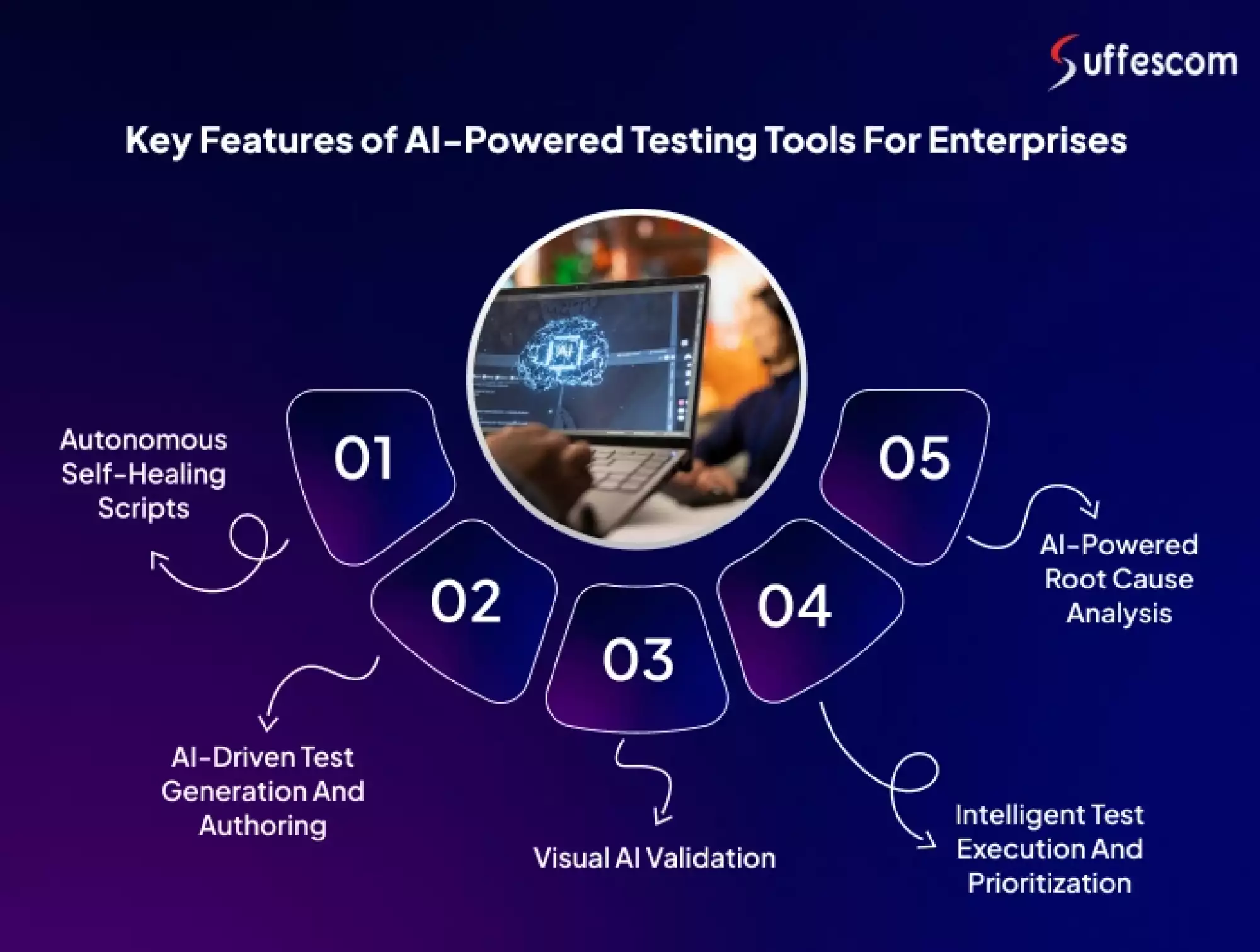
Autonomous Self-Healing Scripts
As the name suggests, these scripts solve their internal anomalies automatically without requiring explicit human intervention. For instance, if the login button is shifted to the right, instead of crashing, the system automatically alters its codes to align with the dynamics.
AI-Driven Test Generation and Authoring
Rather than a professional writing the entire testing code, the autonomous test generation and authoring feature performs this by writing its own code to check the appropriate app/website functioning.
Visual AI Validation
Visual AI Validation enables testing tools to visualize the challenge and perform the required operation, instead of analyzing the backend code to authenticate the function.
Intelligent Test Execution and Prioritization
Every minor change in the platform demands tedious testing (often 1000+ in quantity). However, through Intelligent test execution and prioritization, these AI tools can bypass the redundant testing phases and perform testing relevant to the specific functional gap, saving both time and efforts.
AI-Powered Root Cause Analysis (RCA)
When the test fails, typically, a professional would intervene and assess thousands of telemetry logs to identify the root cause. However, AI-Powered Root Cause Analysis (RCA) performs those operations autonomously through the large-scale inferences of AI.
Top Benefits of AI Test Automation for Enterprise Software Teams
AI based test automation tool development helps enterprises by transitioning from manual, script-heavy processes to intelligent, self-adapting systems to optimize ROI and release velocity in Agile and DevOps environments.
Accelerated Testing Cycles & Faster Release Velocity
Software testing automation tools can amplify testing speeds by performing tests parallelly without interfering with the cross-functionalities across multiple devices/browsers. Additionally, these frameworks support continuous integration/deployment (CI/CD) workflows.
Enhanced Test Coverage and Quality
These AI-powered testing tools for enterprises can analyze a vast array of datasets stemming from application behavior, comprehensive test cases, and system logs to generate comprehensive test cases. These include edge cases that professionals might fail to address, improving anomaly detection software’s capabilities and reliability.
Intelligent Defect Prediction and Risk Mitigation
Apart from the standard user activity data sources, AI automation testing tools, engineered by the top AI development company, like Suffescom Solutions, can analyze the data pertaining to past errors, code modification history, and code complexity to identify high-risk modules. This allows professionals to address the likely-pitfalling areas better, improving business productivity and minimizing user churn rates.
Lower Testing Costs and Higher ROI
Irrespective of their initial costs, these tools are sustainably cost-effective by minimizing the needs for manual QA teams to handle repetitive tasks, such as high-volume data-driven AI-automated compliance testing and parameterization. Many reports have indicated the cost-saving figures of up to 50% compared to traditional frameworks.
Robust Regression Testing
Instead of running the entire testing suite, the AI automation tools identify the most relevant tests (based on recent code changes). This approach makes regression tests swifter and more efficient and helps stakeholders to focus on the largely critical operational abilities.
Real-World Use Cases of AI Test Automation in Enterprises
AI test automation can be termed as the “digital evolution lever” that is deployed in almost all the major industries today, including fintech and life sciences. However, the way these sectors result in developing AI-powered testing tools has changed in recent years.
Low-Code & Natural Language Processing (NLP)
Teams write prompts in plain language, and the testers automate those complex testing workflows without explicit coding requirements, amplifying their productivity and efficiency rates.
AI-Generated Test Cases
Most of the test cases written today are AI-generated. This facilitates enterprises producing test results that align better with their user requirements and application behaviors. Moreover, such approaches are useful in dynamic scenarios with rapidly changing feature updates and agile iterations. They help enterprises to detect edge cases, which a professional might fail to intercept.
LLM-Based Test Generation
Most of the modern enterprises leverage AI to automatically generate unit tests, analyze codebases, and create missing test scenarios, significantly bypassing manual interference.
Predictive Defect Prioritization
Today, AI test automation tools identify high-risk areas using predictive intelligence, which allows enterprises to address those concerns proactively. This approach helps them to focus on the most critical functionalities, such as regression-prone modules.
Autonomous Mobile Testing
Transiting from massive digital screens to smartphones has catalyzed the mobile testing needs. In such scenarios, AI-automated compliance testing tools analyze the interface and identify issues in rendering, image quality, and functional behavior across multiple devices.
API Testing Automation
API testing automation is the process of leveraging digital platforms to perform testing on the Application Programming Interface (APIs). Such applications have gained notable traction in recent years with the advent of advanced APIs. The framework ensures that the backend logic, security, and performance of a service function as expected with minimal human intervention.
Flaky Test Detection
Flaky Tests are distinctive and unreliable test results that appear without change in codes. These different results can overwhelm development pipelines by creating false failures. AI test automation platforms address this concern by analyzing execution patterns and identifying underlying causes such as timing issues and environment instability.
Challenges of Implementing AI Test Automation in Enterprises
Implementing AI test automation in enterprises, despite its large-scale benefits, has certain challenges that enterprises need to address, which Suffescom Solutions has successfully mitigated with their team of seasoned AI professionals.
Integration and Compatibility
A few AI tools fail to integrate into existing complex CI/CD pipelines and lack capabilities with older and specialized mainframe systems, a significant challenge for enterprises to devise universal, compatible AIs that can work across multidimensional frameworks.
Skill Gaps and Expertise
Despite the vast AI advancements, the industry is still facing a skilled testers’ shortage who can integrate AI potential into their work. AI is a dynamic technology, and adapting to its stochasticity is still a challenge for enterprises.
High Costs and ROI Uncertainty
Adopting AI in test automation tools possesses higher initial costs and could be a financial barrier choice for enterprises seeking a quicker entry or that have already established their authority into the corporate landscape.
Data Privacy and Security
Enterprises must ensure the AI model training on company data accurately complies with market regulations (for example, GDPR and HIPAA), optimizing the ethical and sensitive data usage.
"Black Box" Problem
While many AI models fail to provide proper explanations for their decisions, referred to as the “Black Box” problem, it becomes a challenge for enterprises to proactively address their internal concerns.
Cost Breakdown of Implementing AI Automation Testing Tools for Enterprises
The overall cost of implementing AI automation testing tools for enterprises can range between $1000 and $50,000, depending upon the product’s complexity and security features. For a comprehensive understanding, we have devised a tabulated cost breakdown below:
| Cost Component | Estimated Cost (USD) |
| Requirement Analysis & Architecture Design | $1,000 – $5,000 |
| AI Proof of Concept (PoC) | $3,000 – $10,000 |
| UI/UX Development | $2,000 – $8,000 |
| Core Automation Framework Development | $8,000 – $25,000 |
| AI & Intelligent Automation Layer | $10,000 – $40,000 |
| Integrations (CI/CD, APIs, Enterprise Systems) | $5,000 – $20,000 |
| AI MVP Development | $15,000 – $50,000 |
| Testing & QA of AI Models | $3,000 – $12,000 |
| Deployment & DevOps Setup | $5,000 – $15,000 |
| Advanced Enterprise Integrations | $10,000 – $40,000 |
| AI-Enabled RPA Capabilities | $8,000 – $30,000 |
| Security & Compliance Implementation | $5,000 – $20,000 |
| Scalability & Performance Optimization | $5,000 – $15,000 |
How to Successfully Adopt AI Test Automation in Enterprises?
Adopting AI test automation in your enterprise requires a blend of tailored strategies and technical rigor. The focus has shifted from mere adoption to the precision of creating AI powered testing tools that align with specific organizational goals.
Start with Pilot Projects
Don’t opt for a full-scale deployment initially. Start with a pilot project with limited, high-valued features to analyze the ROI and whether that integration aligns with your business objectives.
Prioritize Self-Healing Tools
Prioritize AI tools that could self-heal if the link is broken due to change in UI elements. By leveraging this approach, you can reduce both maintenance time and redundant expenses.
Focus on Data Quality & Infrastructure
Focus on the high-quality, standardized testing data to prevent inaccurate and unreliable predictions. Prioritize centralizing their execution for a robust AI training.
Upskill and Train Teams
AI upskilling is the cornerstone that is applicable to every business stakeholder. This upskilling methodology will help these enterprises to maximize their employees' performances and position themselves at the corporate forefront.
Define Clear Metrics (KPIs)
Quantified metrics (KPIs) such as defect detection rates, test coverage, and time saved help enterprises to validate the effectiveness of the AI initiatives. This enables them to take calculated decisions related to their critical operations.
Key Trends Shaping the Future of AI Test Automation Tools for Enterprises
In the fast-paced world, delivering high-quality software products is imperative. Enterprises can achieve this technological agility by incorporating AI in test automation models. Over time, numerous concepts are evolving that define the future of AI test automation tools.
Autonomous Agentic Testing
Modern enterprises are shifting from traditional script-based testing to advanced capabilities of Agentic AI that can identify problems, implement features, and generate test cases independently.
Generative AI for Test Authoring (Natural Language Processing)
Large Language Models (LLMs) are widely used by enterprises to educate non-technical users about their products, broadening their global reach. These LLMs can easily translate standard languages or user stories into executable test scripts, making it seamless for stakeholders to make reliable decisions.
Predictive Test Selection (Quality Intelligence)
AI can easily identify the changes in codes and suggest the most appropriate testing solutions for enterprises rather than running 1000+ testings simultaneously for distinctive operations. Such approaches can accelerate CI/CD pipelines significantly.
API and End-to-End Functional Integration
Modern AI test automation tools are rapidly evolving to integrate API testing with UI testing for delivering comprehensive, end-to-end coverage and improving cross-layer traceability.
Shift-Left Testing With AI
“Shift-Left Testing“ refers to performing tests in initial stages rather than waiting for the task to complete. This trend is expected to witness a significant shift due to its swifter problem remediation and reduced downtime.
Request a Custom Demo for AI Testing Tools
Conclusion: AI Software Testing Tool Development with Suffescom Solutions
AI software testing tool development frameworks have streamlined business functionality by offering AI-backed, customized solutions in their processes. The key reasons these enterprises are adopting this architectural migration are that these tools offer stability, compliance, faster deployment, and minimal maintenance expenses. Moreover, they are highly efficient and deliver superior ROI compared to traditional software testing mechanisms.
Today, as the technological paradigm evolves, you may witness a substantial surge in AI implementation across broader testing elements, including heuristic self-healing and probabilistic path analysis.
Suffescom Solutions, as the established pioneer of developing the most reliable AI test automation platforms, supports 150+ enterprise-level infrastructures worldwide and delivers 500+ production-grade deployments. We have continued our success story through continuous testing within DevOps pipelines, accelerating release cycles while ensuring higher software quality and reduced operational costs.
Quality, precision, and client satisfaction act as our core success pillars, which are reflected in the positive client testimonials we have received over the years!
FAQs
Is AI-Powered Testing Only for Large-Scale Enterprises?
No, AI software testing tool development, although it manages complexity, has applications across Micro, Small, and Medium Enterprises (MSMEs). Over time, more enterprises are capitalizing on its higher-quality coverage, which requires fewer resources, making it the first-hand choice for diverse business segments.
Is AI Test Automation Secure for Enterprise Applications?
Yes, AI test automation tools are highly secure for enterprise applications, attributed to their “security-by-design” approach that includes human oversight, data privacy controls, and specialized AI security frameworks.
What Types of Testing can be Automated Using AI?
Since AI automation leverages the potential of ML, NLP, and computer vision, it can be implemented across multiple modalities of testing, including:
- Functional testing: NLP-based testing, autonomous test generation, self-healing tests,
- Visual Testing: UI/UX validation, dynamic content handling
- Regression testing: test impact analysis, flaky test detection
- Performance and load testing: anomaly detection, predictive analysis
- API Testing: API test generation, schema change detection
- Security Testing: Vulnerability detection, adversarial testing
Does Modern AI Test Automation Mechanism Support Agile and DevOps Environments?
Yes, modern AI software testing tool development mechanisms do support Agile and DevOps environments because they offer speed, efficiency, flexibility, and feedback loops necessary to adapt to rapid software delivery. The technology implements these frameworks through self-healing, intelligent test creation, and predictive analytics, converting QA from a bottleneck into an accelerator-driven asset.
Can AI Testing Tools Integrate With Existing CI/CD Pipelines?
Yes, AI testing tools can easily integrate with existing CI/CD pipelines by streamlining traditional automation with advanced capabilities, such as automated test generation and predictive test selection.
What is the Primary Business Advantage of Integrating AI Into Testing Strategy?
The key business advantages of integrating AI into testing strategies include a massive boost in efficiency and speed, which drastically reduces testing cycle times and accelerates time-to-market deployment.
Can AI Completely Replace Manual Testing?
No, it's highly unlikely that AI will completely replace manual testing. Rather, they could augment various repetitive tasks like regression and UI testing. Human testers will still be integral for exploratory testing, usability analysis, complex cognitive tasks, and emotional intelligence, which demands logical reasoning and critical thinking.