+971-8000321216



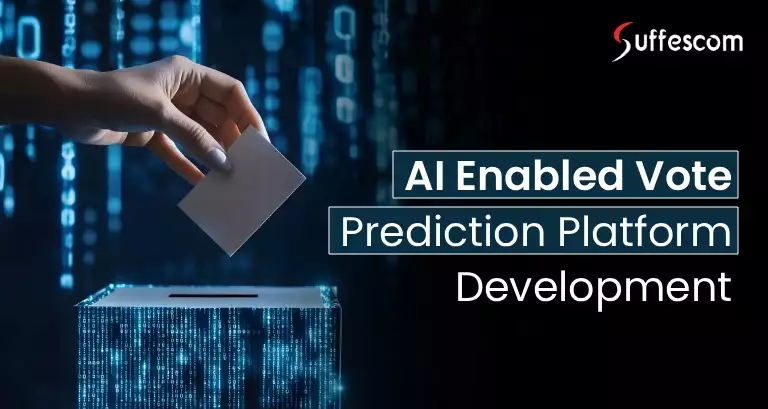
The traditional election process relies on opinion polls, exit polls, and manual voter surveys. It results in small sample bias, delayed insights, and inaccurate voter sentiment. With the AI in the picture, the transformation of election analysis has become more efficient.
Modern AI Enabled vote prediction platform development combines machine learning, NLP, and big data analytics. It predicts voter behavior and election outcomes. AI vote prediction platforms are emerging as the backbone of political analytics. It enables campaigns, researchers, and governments to analyze elections with utmost accuracy.
The Core Concept of the AI Vote Prediction Platform
AI vote prediction platform development Service involves a data-driven system that analyzes voter behavior, sentiment, and demographic patterns. These patterns enable forecasting election outcomes and campaign performance.
The platform's core capabilities include voter behavior modeling, constituency-level prediction, real-time sentiment tracking, biometric authentication, and campaign performance. The machine learning models, NLP sentiment analysis, data dashboards, and predictive analytics forecast outcomes. It analyzes historical voting trends, economic indicators, and social sentiment signals.
Benefits of AI Vote Prediction Platform Development
The benefits of AI vote prediction platforms enhance the electoral process. It promotes democratic engagement and provides stakeholders with valuable insights to resolve the complexities of modern elections.
1) Better Forecasting
AI capabilities analyze complex voter patterns in a precise manner. Compared with traditional polling, AI Enabled vote prediction platform development yields much more accurate results.
2) Real-Time Intelligence
Campaign real-time insights provide instant results based on shifts in voter sentiment. It analyzes the shift over time.
3) Data-Driven Campaign
Teams utilize AI to identify swing constituencies, target persuadable voters, and optimize messaging. These insights inform campaign strategies and drive data-driven AI decision-making.
4) Resource Optimization
An AI-enabled platform helps with campaign budget allocation. It can be allotted strategically, avoiding overuse or underspend.
5) Voter Engagement Insights
AI platforms provide engagement insights. It provides understanding of public opinion trends, policy priorities, and voter concerns. Also, multi-factor authentication improves voter identity verification.
Improve Electoral Accuracy with AI Vote Prediction Platform
Learn how Suffescom help businesses achieve unparalleled electoral accuracy.
Key Features of an AI Vote Prediction Platform
User Panel
AI Slider
It allows users to select options by adjusting the slider for various questions. AI generates personalized opinions based on user inputs for better insights.
AI-Powered Text-to-Speech
The text-to-speech feature converts written text into spoken words in all languages. It improves the user experience with a seamless, lifelike audio experience.
AI Language Translations
It improves cross-language communication by translating content using AI and language translation technologies, such as Akamai CDN and LLM development.
Make Own Forecast
Users use the index of opposition unity to gauge the rivals' popularity. This allows them to create personalized forecasts based on stats and insights.
Win Prediction
Users are able to participate in engaging gamification elements to predict the outcomes of upcoming elections and win rewards.
24/7 Live Streaming
Real-time streaming of diverse content from different channels is seamlessly integrated into a single platform. Also, geo-tracking of polling stations ensures smooth operations.
Interactive Election Dashboard
Live election results are displayed on charts and in a video. It includes voter demographics, voting patterns, and historical data; all in one place.
Articles & Opinions
This feature lets users consume data in various forms such as text, audio, and video. It can convert any content into different formats to suit their preferences.
Voter Behavior Analytics
Voter behavior is studied using demographic segmentation, ideology, identification, and turnout probability models to enable accurate prediction.
Sentiment Analysis
With AI capabilities for sentiment analysis through social media or news platforms, it can detect voter narrative shifts, emerging issues, and emotions.
Campaign Strategy
AI suggests recommendations based on priority regions, target voter segments, and messaging strategies.
Admin Panel
AI Winning Odds
It lets the platform owner/admin make accurate predictions based on previous agencies. Final predictions are made based on past accuracy.
Data Management Dashboard
Admins get an overview of the data management dashboard. They can manage and upload election datasets, integrate polling APIs, and manage demographic databases.
Real-Time Data Monitoring
Admins monitor social media data, polling feeds, and voter survey updates in real-time. Tamper-proof blockchain-based vote recording improves the transparency for the users.
Role-based Access Controls
Admins get access to manage role-based controls within the platform.
Prediction Analytics
Admins get prediction confidence scores, model performance metrics, and error analysis to assess accuracy.
Security & Compliance Controls
End-to-end encryption and RBAC standards are met for the platform to ensure auditability.
Full-Fledged Working Process of AI Vote Prediction Platform
The working process of an AI vote prediction platform is a sophisticated pipeline that transforms raw data into actionable insights. Based on industry standards, the full operational workflow is as follows.
Step 1 — Data Collection
The process begins with large-scale election datasets from multiple structured and unstructured sources. The collection of data involves voter records, historical election results, and demographic data. Data connectors and web-scraping tools continuously pull fresh signals, ensuring the platform works well with high-volume, real-time political datasets.
Step 2 — Data Processing
After the data enters the system, it goes through a processing pipeline designed to make it model-ready. Workflows clean noisy records, remove duplicates, normalize formats, and structured datasets using ETL processes.
Step 3 — Behavioral Modeling
Refined datasets are fed into machine learning models that identify patterns in voter behavior. Algorithms analyze historical data, demographic correlations and policy alignment signals to build predictive behavioral profiles.
Step 4 — Sentiment Analysis
Natural language processing models scan political conversations across digital channels to understand public opinion. The platform analyzes posts, comments, news and campaigns to identify sentiment and narrative trends.
Step 5 — Prediction & Simulation
The AI engine runs predictive algorithms to forecast election outcomes. Models generate probabilistic outputs, such as vote-share predictions, seat-distribution forecasts, turnout estimates, and victory likelihoods.
Step 6 — Insight Delivery
The final stage translates model outputs into visual and strategic insights through interactive dashboards. Data visualization tools display predictive maps, constituency heatmaps, and campaign performance analytics in real time.
Tech Stack for AI Vote Prediction Platform
Advanced technologies and tools handle high-volume data ingestion. Robust architecture and real-time visualization are built on an essential technology stack for an AI-enabled voting prediction platform.
Below is the list of technologies required to build a scalable, revenue-driven platform.
| Layer | Technology | Role in the Platform |
| Frontend | React.js, Next.js, D3.js, Mapbox / Leaflet | This component-based architecture makes it easier for development teams to scale the UI as new product features are added. |
| Backend | Node.js, Python, FastAPI / Django, | Manages real-time data communication between the frontend dashboards and backend services. |
| AI / ML | TensorFlow, PyTorch, Scikit-learn, HuggingFace Transformers | It allows data scientists to train models on large datasets and deploy them within the prediction engine. |
| Data Infrastructure | Apache Spark, Apache Kafka, Snowflake, BigQuery | Processes large-scale election datasets through distributed data pipelines. It allows teams to analyze millions of voter records and historical results efficiently. |
| Cloud | AWS, Google Cloud, Azure | Cloud services support reliability, security, and flexible scaling. |
| DevOps | Docker, Kubernetes, CI/CD Pipelines | These technologies simplify deployment and ensure that development and production setups remain aligned. |
Cost Breakdown of AI Vote Prediction Platform Development
The cost of enterprise-grade platforms ranges from $5,000 to $25,000. However, the cost depends on various factors like architectural complexity, AI integrations, and security compliance requirements.
| Cost Component | Description | Cost Impact |
| Requirements & Architecture Design | Includes product discovery, technical consultation, system architecture planning, database schema design, and infrastructure roadmap. | Free of Cost at Suffescom |
| UI/UX Development | Focuses on user flow, real-time streaming interface, and dashboard visualization aligned with artificial intelligence. | $1,500 – $3,000 (10%) |
| Core Development | Backend logic, session management, authentication systems, API development, database configuration, and secure browser integration. | $4,500 – $9,000 (30%) |
| AI & Automation | Development and integration of facial recognition, object detection, liveness detection, behavioral analytics, and risk scoring models. | $3,000 – $6,000 (20%) |
| Integrations | LMS, payment gateways, SSO systems, third-party verification APIs, and cloud AI services integration. | $4,500 – $9,000 (10%) |
| Testing & QA | Functional testing, AI accuracy validation, load testing, security testing, and compliance verification. | $1,500 – $3,000 (10%) |
| Deployment & Maintenance | Cloud deployment (AWS/Azure/GCP), containerization setup, CI/CD pipeline configuration, performance monitoring, and ongoing updates. | $3,000 – $6,000 (20%) |
Foundation for AI Vote Prediction Platform Development Process
AI Enabled vote prediction platform development Service requires a detailed and structured approach. The development process of this platform with the right company makes a huge difference. A right platform provides accurate predictions and better insights based on behavioral patterns. Below is the development process of taking platform ideation to execution.
Step 1: Research & Product Strategy
The initial step involves studying target users, understanding the political ecosystem, and data availability. It sets the base of the product development process.
Step 2: Data Infrastructure Development
Build scalable data pipelines to ingest historical election data, census datasets, voter rolls, and polling data. Large-scale pipelines transform raw data into structured datasets for machine learning models.
Step 3: AI Model Development
This step includes developing AI models using algorithms such as neural networks, NLP transformers, emotion-detection models, and others.
Step 4: Frontend & Backend Development
This step involves developing the architecture, including data processing pipelines, ML model deployment, prediction APIs, and an analytics engine.
Step 5: Testing Stage
Experts conduct rigorous testing of the platform, including prediction accuracy, data integrity, model bias detection, and security testing, to ensure it works seamlessly.
Step 6: Deployment Stage
The platform is deployed via cloud platforms, microservices architecture, and containerized infrastructure. It ensures the system can process millions of voter data records in real time.
Step 7: Post-launch Maintenance
Once the platform is deployed, the experts provide post-launch support. It includes bug fixes, feature enhancements, and constant updates.
Embrace the Future of Elections Process with an AI-driven Approach to Delivering Results
1) Sentiment Analysis: This approach works on analyzing public opinions, sentiments, and emotions towards candidates. It turns complex data from text into actionable insights.
2) Identifying Trends: Natural language processing analyzes vast amounts of data to pinpoint the gaps. It helps us understand public concerns and predict voting behavior.
3) Dynamic Prediction Models: The AI vote prediction platform development approach involves continuous learning. It adapts predictions based on real-time data from social media and other sources.
4) Analysis of Electorate Structure: It identifies patterns and relationships of how information flows among voters. This insight into the structure helps refine predictions.
Monetization Models for AI Vote Prediction Platforms
Monetizing an AI Enabled vote prediction platform development requires balancing recurring costs. Businesses implement the high-stakes value of electoral intelligence.
Below are the effective strategies combined to achieve high profit margins and custom insights.
1) Subscription & SaaS Models
A basic monthly or yearly fee is charged for SaaS, along with usage-based credit for high-intensity periods, such as the 30 days before an election.
2) Consumption-Based Pricing
Users pay for a specific volume of data processed, such as social media posts analyzed. Prediction credits allow campaigns to run specific simulations on voter turnout.
3) Insight-as-a-Service
IaaS is a one-time strategy, blueprints, or white label apps for sale to political consultants for expert advice or guidance for resource allocation.
4) Partnerships
Partnering with other platforms brings in recurring revenue. It provides election-related risk signals that impact stock market volatility.
Increase Turnout by Aligning Outreach with Suffescom Solutions
Traditional campaigning is no longer effective for boosting voter turnout. It demands data-driven engagement strategies to connect with voters at the right time. Suffescom Solutions enables organizations to leverage AI-powered outreach insights for effective voter engagement.
We also help optimize campaign timing and communication channels, ensuring outreach efforts are deployed. Experts at Suffescom quickly adjust strategies based on shifting public opinion, enabling more responsive and impactful engagement. Our white glove service improves user experience, making the platform not just a tool. It transforms to a comprehensive solution that supports clients at every stage of election campaigns.
We focus on outreach initiatives with intelligent analytics to help organizations strengthen voter awareness, encourage civic participation, and build informed and engaged electorates.
Build an AI Vote Prediction Platform & Stay Ahead in Election Analysis
Join the revolution in political analytics. Contact Suffescom for a 1-1 consultation and improve campaign insights and voter engagement.
Conclusion
AI vote prediction platforms are changing how elections are studied and conducted. With AI and data analytics tools, it is possible to obtain better insights into elections. With the adoption of AI tools by the organization, it is possible to make better strategic decisions and engage the audience more effectively while dealing with the complexities of the electoral system.
FAQs
1. What is an AI Vote Prediction Platform?
An AI Vote Prediction Platform is a data-driven platform that uses machine learning and sentiment analysis to predict voting behavior and possible election outcomes.
2. Can organizations integrate an AI vote prediction platform with existing data systems?
The enterprise AI vote prediction platform can be integrated with existing systems through secure APIs, data connectors, and cloud-based data pipelines. These integrations allow data to be imported from polling systems, CRM tools, and social media analytics tools.
3. How can an AI vote prediction platform support campaign strategy planning for enterprises?
AI-powered systems provide data-driven insights into voter behavior, regional voting patterns and demographic trends. These insights are used to optimize messaging, target voter segments, and allocate campaign resources.
4. Who can benefit from AI Vote Prediction Platforms?
Political campaigns, research institutions, media organizations, government institutions, and political consultants are some organizations that can benefit from AI vote prediction platforms.
5. Are AI Vote Prediction Platform Development Services secure?
Yes, modern platforms implement strong security measures such as encryption, role-based access controls, and compliance protocols to protect sensitive electoral and voter-related data.
6. How long does it take to develop an AI vote prediction platform?
Development timelines typically range from 3 to 4 months, depending on the platform’s complexity, data integrations, AI models, and required analytics features.
7. Which company is best at providing AI enabled voting prediction tool development service?
Suffescom Solutions is one of the companies businesses rely on for app development services. Such platforms are developed in compliance with compliance regulations, election laws, and regional privacy standards.